Counteracting the nuclear spin, and more – week to 29 July

Some bits of good news. The Gambia’s decision to uphold ban on Female Genital Mutilation (FGM) a critical win for girls’ and women’s rights. Oceana Canada Celebrates Major Conservation Victory: Underwater Mountains off the Coast of B.C. Now Permanently Protected, under indigenous guidance. Great Green Wall has revived Africa’s degraded landscapes
**************************************
TOP STORIES.
What the top UN court’s ruling means for Israel. Netanyahu Commands, US Obeys.
Rolling stewardship of nuclear waste.
Young Changemakers Advocate for Nuclear-Free Future through Educational Journey in Kazakhstan.
Climate. Severe heatwave in Iran forces shops and public institutions to close
Noel’s notes. Militarism: How NATO is co-opting women and young people – with a veneer of peace and fun. The digital system threatens the nuclear industry – it’ll get worse with AI. Absolutely fed up with Facebook and Google’s censorship of nuclear issues.
************************************************
AUSTRALIA. Dutton’s nuclear delusion an exercise in stupidity. Czech nuclear deal shows CSIRO GenCost is too optimistic, and new nukes are hopelessly uneconomic. Aussies react to Dutton’s Nuclear Policy – https://www.youtube.com/watch?v=9o4S335dXM4
Canada rejects AUKUS nuclear submarine deal. AUKUS and the pride of politicians.
From the archives. Gina Rinehart’s threat to the proud independence of Australia’s Fairfax newspapers.
Respect and responsibility: Jabiluka safe as uranium mining lease for Kakadu site not renewed8.
Lots more Australian news at https://antinuclear.net/2024/07/23/australian-nuclear-news-headlines-22-29-july/
NUCLEAR ITEMS
CLIMATE. Hungary to allow nuclear plant to exceed Danube water temperature limit. Huge wildfire rips into California.
ECONOMICS.
- Critical AUKUS contract doubles in price and now a year late.
- ‘ Regulated Asset Base’ system mulled in Japan to add nuke plant construction costs to rates.
- Point Lepreau nuclear station down till at least September, costing utility extra $71M ALSO AT https://nuclear-news.net/2024/07/24/3-b1-point-lepreau-nuclear-station-down-till-at-least-september-costing-utility-extra-71m/ A New Brunswick reaction to the exorbitant costs of Point Lepreau nuclear power station.
- Spain: Nuclear Industry Reels After Tax Increase.
- UK / New Energy Minister Underlines ‘Absolute Support’ For SMRs, But Less Certain On Wylfa Plans.
- French nuclear giant ORANO slips into the red following Niger-French breakup. EDF looks towards future projects after flagging tough second half.
| EDUCATION. Bangor University to collaborate with Rolls Royce and the University of Oxford to develop nuclear power for space. | ENERGY. Solar doesn’t need a toxic “friendship” with nuclear power. | ETHICS and RELIGION. A letter to the children of tomorrow. “Nuclear disarmament is a right to life issue” – Catholic Archbishop John C Wester. |
EVENTS. 30 July Webinar: Halt Holtec – the Nuclear Mafia Atomic People will be broadcast on Wednesday 31 July on BBC Two and BBC iPlaye 6 August WEBINAR. Never Again! Remembering the Atomic Bombing of Hiroshima and Nagasaki
| LEGAL. A $36.8 billion lesson from Georgia– “The most expensive electricity in the world”Potential claims against NANO Nuclear Energy Inc. The World Court Has Cleared the Fog Hiding Western Support for Israel’s Crimes.Hundreds protesting Netanyahu visit arrested at US Capitol. Two legal actions against the hasty commissioning of Flamanville nuclear reactor. | MEDIA. BBC correspondent exposes ‘collapse of journalistic norms’ after 7 Oct. Meta’s Policy On Zionism Exposed: Cyberwell Scrambles After Israel Ties Revealed. U.S. media downplays and ignores ICJ ruling declaring Israeli occupation illegal. We published an analysis from a leading economist on soaring nuclear costs. Facebook removed it |
OPPOSITION to NUCLEAR . Nuclear energy not the way to go: coalition Taiwan. UK Nuclear Free Local Authorities back joint statement condemning AUKUS nuclear proliferation. Nuclear Free Local Authorities congratulate marchers on Lakenheath protest.
| PEACE. 2024 Golden Rule Voyage Begins! | PERSONAL STORIES. ‘Atomic bomb hell must never be repeated’ say Japan’s last survivors. | PLUTONIUM. Is nuclear waste able to be recycled? Would that solve the nuclear waste problem? |
| SAFETY Safety warnings as cracks rise at Torness nuclear plant. Japan Nuclear Restart Suffers Major Setback. | TECHNOLOGY. Humans should teach AI how to avoid nuclear war—while they still can. | WASTES. Radioactive Wastes from Nuclear Reactors. |
| WAR and CONFLICT. Israel nearing ‘all-out war’ – foreign minister. Washington gives Netanyahu ‘full backing’ to expand war on Lebanon: Israel Report. While Netanyahu is feted in U.S. Congress, Israeli airstrike hits a school sheltering people in Gaza, killing at least 30. Scottish parliamentarian highlights ‘nuclear annihilation risk’ in major UN speech | WEAPONS and WEAPONS SALES. Will US defend Japan with nukes or turn it into the line of fire? US Forces Japan to be upgraded to warfighting command. Tit for tat? Putin warns Russia may resume production of intermediate-range nuclear weapons. EU sets date of transfer of Russian money to Ukraine for arms purchases. |
‘Atomic bomb hell must never be repeated’ say Japan’s last survivors

Atomic People will be broadcast on Wednesday 31 July on BBC Two and BBC iPlaye
Lucy Wallis, BBC News https://www.bbc.com/news/articles/crg5lyd25jno 26 July 24
It was early in the day, but already hot. As she wiped sweat from her brow, Chieko Kiriake searched for some shade. As she did so, there was a blinding light – it was like nothing the 15-year-old had ever experienced. It was 08:15 on 6 August 1945.
“It felt like the sun had fallen – and I grew dizzy,” she recalls.
The United States had just dropped an atomic bomb on Chieko’s home city of Hiroshima – the first time a nuclear weapon had ever been used in warfare. While Germany had surrendered in Europe, allied forces fighting in World War Two were still at war with Japan.
Chieko was a student, but like many older pupils, had been sent out to work in the factories during the war. She staggered to her school, carrying an injured friend on her back. Many of the students had been badly burnt. She rubbed old oil, found in the home economics classroom, onto their wounds.
“That was the only treatment we could give them. They died one after the next,” says Chieko.
“Us older students who survived were instructed by our teachers to dig a hole in the playground and I cremated [my classmates] with my own hands. I felt so awful for them.”
Chieko is now 94 years old. It is almost 80 years since the atomic bombs were dropped on Hiroshima and Nagasaki and time is running out for the surviving victims – known as hibakusha in Japan – to tell their stories.
Many have lived with health problems, lost loved ones and been discriminated against because of the atomic attack. Now, they are sharing their experiences for a BBC Two film, documenting the past so it can act as a warning for the future
After the sorrow, new life started to return to her city, says Chieko.
“People said the grass wouldn’t grow for 75 years,” she says, “but by the spring of the next year, the sparrows returned.”
In her lifetime, Chieko says she has been close to death many times but has come to believe she has been kept alive by the power of something great.
The majority of hibakusha alive today were children at the time of the bombings. As the hibakusha – which translates literally as “bomb-affected-people” – have grown older, global conflicts have intensified. To them, the risk of a nuclear escalation feels more real than ever.
“My body trembles and tears overflow,” says 86-year-old Michiko Kodama when she thinks about conflicts around the world today – such as the Russian invasion of Ukraine and the Israel-Gaza war.
“We must not allow the hell of the atomic bombing to be recreated. I feel a sense of crisis.”
Michiko is a vocal campaigner for nuclear disarmament and says she speaks out so the voices of those who have died can be heard – and the testimonies passed on to the next generations.
“I think it is important to hear first-hand accounts of hibakusha who experienced the direct bombing,” she says.
Michiko had been at school – aged seven – when the bomb was dropped on Hiroshima.
“Through the windows of my classroom, there was an intense light speeding towards us. It was yellow, orange, silver.”
She describes how the windows shattered and splintered across the classroom – the debris spraying everywhere “impaling the walls, desk, chairs”.
“The ceiling came crashing down. So I hid my body under the desk.”
After the blast, Michiko looked around the devastated room. In every direction she could see hands and legs trapped.
“I crawled from the classroom to the corridor and my friends were saying, ‘Help me’.”
When her father came to collect her, he carried her home on his back.
Black rain, “like mud”, fell from the sky, says Michiko. It was a mixture of radioactive material and residue from the explosion.
She has never been able to forget the journey home.
“It was a scene from hell,” says Michiko. “The people who were escaping towards us, most of their clothes had completely burned away and their flesh was melting.”
She recalls seeing one girl – all alone – about the same age as her. She was badly burnt.
“But her eyes were wide open,” says Michiko. “That girl’s eyes, they pierce me still. I can’t forget her. Even though 78 years have passed, she is seared into my mind and soul.”
Michiko wouldn’t be alive today if her family had remained in their old home. It was only 350m (0.21 miles) from the spot where the bomb exploded. About 20 days before, her family had moved house, just a few kilometres away – but that saved her life.
Estimates put the number of lost lives in Hiroshima, by the end of 1945, at about 140,000.
In Nagasaki, which was bombed by the US three days later, at least 74,000 were killed.
Sueichi Kido lived just 2km (1.24 miles) from the epicentre of the Nagasaki blast. Aged five at the time, he suffered burns to part of his face. His mother, who received more serious injuries, had protected him from the full impact of the blast.
“We hibakusha have never given up on our mission of preventing the creation of any more hibakusha,” says Sueichi, who is now 83 and recently travelled to New York to give a speech at the United Nations to warn of the dangers of nuclear weapons.
When he woke up after fainting from the impact of the blast, the first thing he remembers seeing was a red oil can. For years he thought it was that oil can that had caused the explosion and surrounding devastation.
His parents didn’t correct him, choosing to shield him from the fact it had been a nuclear attack – but whenever he mentioned it, they would cry.
Not all injuries were instantly visible. In the weeks and months after the blast, many people in both cities began to show symptoms of radiation poisoning – and there were increased levels of leukaemia and cancer.
For years, survivors have faced discrimination in society, particularly when it came to finding a partner.
“‘We do not want hibakusha blood to enter our family line,’ I was told,” says Michiko.
But later, she did marry and had two children.
She lost her mother, father and brothers to cancer. Her daughter died from the disease in 2011.
“I feel lonely, angry and scared, and I wonder if it may be my turn next,” she says.
Another bomb survivor, Kiyomi Iguro, was 19 when the bomb struck Nagasaki. She describes marrying into a distant relative’s family and having a miscarriage – which her mother-in-law attributed to the atomic bomb.
“‘Your future is scary.’ That’s what she told me.”
Kiyomi says she was instructed not to tell her neighbours that she had experienced the atomic bomb.
Since being interviewed for the documentary, Kiyomi has sadly died.
But, until she was 98, she would visit the Peace Park in Nagasaki and ring the bell at 11:02 – the time the bomb hit the city – to wish for peace.
Sueichi went on to teach Japanese history at university. Knowing he was a hibakusha cast a shadow on his identity, he says. But then he realised he was not a normal human being and felt a duty to speak out to save humankind.
“A sense that I was a special person was born in me,” says Sueichi.
It is something the hibakusha all feel that they share – an enduring determination to ensure the past never becomes the present.
Atomic People will be broadcast on Wednesday 31 July on BBC Two and BBC iPlaye
Rolling stewardship of nuclear waste

Rolling Stewardship is not a solution to the radioactive waste problem, but an acknowledgement that we do not have a solution. Instead of assuming a solution exists, we should recognize that there is no proven solution.
Instead of abandoning the waste, we should monitor it and make sure it is retrievable.
We know how to package these wastes well enough to keep the radioactive contents out of the environment. The containers should be thick-walled, very robust, and built to last. They should not be right beside major bodies of water. They should be subject to Hardened On-Site Storage away from the shore.
Radioactive Wastes from Nuclear Reactors, Questions and Answers, Gordon Edwards 28 July 24.
Rolling Stewardship is a concept put forward by the National Academy of Sciences in connection with other long-lived toxic wastes like heavy metals and asbestos. When we do not have a genuine waste solution, we must not abandon it. We must continue to look after it on an intergenerational basis, passing the responsibility, the knowledge and the resources to the next generation, with the object of continually improving safe storage.
For the first thirty years of the nuclear age, until mid 1970s, no one knew about radioactive waste. The nuclear industry did not tell anyone about it. People were told that nuclear power is clean. And they believed it. But it was not true.
In the mid-1970s, radioactive waste suddenly became public knowledge. Major reports in several countries called for a halt to nuclear power unless the problem is solved. The waste problem became an existential problem for the industry. In self-defence, the industry claimed – without real evidence – that they had a solution: “Bury the waste in an undisturbed geologic formation”. But of course, the moment you dig, it is no longer undisturbed. We have seen three deep underground repositories for lower level radioactive waste fail – two in Germany, and one near Carlsbad New Mexico. As for high-level radioactive waste, the USA has tried eight times to locate a deep underground disposal site, and they have failed all eight times.
Here in California, in 1976, hundreds of thousands of people signed a citizen’s initiative bill to stop any new reactors from being built in the state because there is no waste solution. That bill was passed into law, and it is still the law. The California Legislature asked the Energy Resources and Conservation Commission to determine if there is a safe disposal method. After 2 years of intensive public hearings the verdict was “no”.
The Commission Chairman said : “We think it probable that [safe permanent disposal] will never be demonstrated. Excessive optimism about the potential for safe disposal [of nuclear wastes] has caused backers of nuclear power to ignore scientific evidence pointing to its pitfalls. That’s the real crux of what we found — that you have to weigh scientific evidence against essentially engineering euphoria.”
Emilio Varanini III, Chairman, California Energy Resources and Conservation Commission, 1978
Rolling Stewardship is not a solution to the radioactive waste problem, but an acknowledgement that we do not have a solution. Instead of assuming a solution exists, we should recognize that there is no proven solution.
Instead of abandoning the waste, we should monitor it and make sure it is retrievable.
Instead of waiting for the containers to fall apart underground, we should repair and repackage and improve safety measures from one generation to the next. Instead if walking away from the waste, we should keep it under close surveillance.
Leakage in a burial chamber will not be detected until it is too late. Rolling Stewardship will allow us to take timely action to intervene – to stop the leak and prevent recurrence.
Instead of waiting for the containers to fall apart underground, we should repair and repackage and improve safety measures from one generation to the next. Instead if walking away from the waste, we should keep it under close surveillance.
Leakage in a burial chamber will not be detected until it is too late. Rolling Stewardship will allow us to take timely action to intervene – to stop the leak and prevent recurrence.
Instead of closing the door on research to find a genuine solution to the waste problem, Rolling Stewardship will ensure that we keep that quest at the forefront of human consciousness.
This may sound idealistic, but in fact it is simply realistic. The worst thing about self-deception (thinking you have a solution when you don’t) is that you end up with a radioactive mess – a vastly inferior and dangerous form of rolling stewardship – and very much costlier, because it was not planned at the outset.
We know how to package these wastes well enough to keep the radioactive contents out of the environment. The containers should be thick-walled, very robust, and built to last. They should not be right beside major bodies of water. They should be subject to Hardened On-Site Storage away from the shore.
The main reason waste storage is currently so unsatisfactory is that the industry has told us it is only temporary. We have to stop thinking that way.
Because we do not have a solution, Rolling Stewardship is what we do in the meantime to keep ourselves and our environment safe from the radioactive legacy of the nuclear age.
One of the worst things about abandoning radioactive waste is that, over the very long term, amnesia sets in. Everyone forgets where the waste is or what it is or how to contain it. So when it leaks out into the environment – and it will leak out sooner or later – no one knows how to even detect it or to deal with it.
Rolling Stewardship, on the other hand is predicated on the persistence of memory. The knowledge of these highly toxic wastes and how to deal with them must be kept alive from generation to generation because it remains an ongoing risk.
In 2019 I attended a 3-day conference in Stockholm about how to warn future generations abut the legacy of radioactive waste that we are leaving behind. We do not know what languages people will be speaking in 2,000 years, or 10,000 years.
So how do we warn them? Do we put up a sign saying “Do not dig here”? Will they understand the sign? And if they do understand it, will they obey it? If I were a future archeologist who came across such a sign, I would say to my team “Hey guys, Let’s dig here!”
The Strockholm Conference was a fascinating affair. One-third of the participants were nuclear scientists from several countries. One-third were independent commentators and critics of nuclear power, such as myself. And one-third were librarians, archivists and curators who knew little about radioactive waste, but lots about preserving Records, Knowledge and Memory (RKM). The conference was an outgrowth of the European Nuclear Energy Agency’s “RKM Project”, already working eight years on this exact question.
We were all keenly aware that the problem under consideration is similar to the problem of communicating with extra-terrestrial intelligence. How do we communicate with others, with no assurance that they understand any human languages that are used in the 21st century?
One of the advantages of Rolling Stewardship is that we can more easily pass on knowledge, information and advice from one generation to the next – rather than trying to communicate with a completely unknown society of the future, thousands of years away from us. We can still leave records for future societies, but each generation can review the adequacy of those records and try to improve them.
It became evident during the conference that if we want to communicate with future generations we have to begin by communicating with the present generation. If we cannot tell people today the truth about radioactive wastes, what hope do we have of telling future civilizations?
One of the conclusions of this conference was that decision-making about radioactive wastes can no longer be left solely in the hands of the nuclear industry and its captured regulator, the NRC. We have to plan now to address the future. This is a societal problem, not just an industry problem.
We need radioactive waste and nuclear decommissioning agencies that are independent of the promoters of nuclear energy, whether commercial or governmental.
We need agencies whose sole focus is the protection of people and the environment.
We need agencies that can communicate openly and transparently with citizens about the nature of the radioactive waste problem and the range of possible options.
The Age of Nuclear Energy will come to an end, but the Age of Nuclear Waste will continue forever – unless we learn how to completely eliminate that radioactive legacy permanently. At present we have no idea how to do that.
As long as we continue to operate old nuclear reactors and build new ones, we are simply compounding an already intractable problem. No matter how fast we bury the old waste, the surface of the Earth will always be prone to catastrophic releases from the freshly produced nuclear wastes which accumulate every day in the cores of operating reactors and in the immediate vicinities of those plants. Burial is no solution as long as the industry is growing, or even continuing with the status quo.
California was wise to pass a law in 1976 that phases out the production of new nuclear waste, by banning the building of any new nuclear plants. It is time for other states and other nations to follow suit. ——–
Young Changemakers Advocate for Nuclear-Free Future through Educational Journey in Kazakhstan

The Astana Times – bringing Kazakhstan to the world, By Assel Satubaldina , 29 July 2024
ASTANA—A group of 20 young changemakers from Kazakhstan and Germany recently embarked on a week-long educational journey through Kazakhstan to explore the country’s nuclear past, meet policymakers, and talk to affected communities.
The tour took the group to the ministerial halls in Astana, activists in Almaty, researchers, and the nuclear-affected communities in Semei, which was once the site for the Soviet-run nuclear test site. This educational tour, organized by the Friedrich Ebert Foundation in Kazakhstan, ICAN Germany, and Kazakhstan’s STOP (Steppe Organization for Peace) youth initiative, aimed to foster a deeper understanding of nuclear non-proliferation and amplify the voices of affected communities.
Kazakhstan’s Semipalatinsk nuclear test site was a venue for the Soviet Union to test nuclear weapons. Official data indicates that 456 nuclear tests between 1949 and 1989, including 340 underground and 116 atmospheric tests, were conducted at the test site, with an area of 18,300 square kilometers.
Around 1.5 million people have been affected by radiation exposure over the years, including health consequences such as an increase in cancer rates, birth defects, and other radiation-related illnesses among the local population. The long-term effects are still present for generations.
Meeting with government officials in Astana
Astana was the first stop on the trip. The group visited the Kazakh Ministry of Foreign Affairs. There, Arman Baissuanov, the head of the ministry’s international security department, briefed them on the country’s nuclear history and its leading role in global non-proliferation efforts. He also discussed Kazakhstan’s role in the Central Asian Nuclear Weapon Free Zone and the Treaty on the Prohibition of Nuclear Weapons (TPNW).
Among other officials, the group met with Roman Podoprigora, a judge of the Constitutional Court of Kazakhstan, who spoke about recommended changes to the 1992 law on those affected by the nuclear tests, and Nurlan Auesbaev, a member of the Parliament.
Yerdaulet Rakhmatulla, co-organizer of the study tour, described it as a positive sign that civil society representatives could visit the ministry and productively discuss the nuclear politics and more. According to him, it is quite a rare occasion.
“I think just this step from their side was a great sign of progress in our bilateral relationships as state, as government and civil society,” he said in a comment for this story.
Officially titled the law on social protection of citizens who suffered from nuclear tests at the Semipalatinsk nuclear test site, the document envisioned measures to address the severe health and social impacts. However, experts say the law has many shortcomings, including a limited scope of financial compensation, which is insufficient to cover the long-term health needs of the affected population. The law’s criteria to identify affected individuals have also been seen as too narrow.
Сonfronting the human impact of nuclear testing
Understanding Kazakhstan’s tragic nuclear past would not be complete without visiting the region where thousands of people witnessed the tests firsthand and have borne the consequences for many years since. In Semei, the young people met with people still grappling with the legacy of the Soviet-era tests, listening to their stories that, for some reason, often remain unheard.
Maira Abenova, a survivor of the Soviet nuclear tests in Semei and founder of the Polygon 21, an institution that advocates for the rights of Semipalatinsk nuclear test survivors, helped the group to meet those affected in Semei and Astana.
During the meeting in Semei, many of the survivors reported on their health problems, such as cancer and heart disease, according to a press report from ICAN Germany. They said they hope their voices will be heard internationally. Their voices “do not yet reach as far as those of Hiroshima and Nagasaki,” say the survivors.
For Rakhmatulla, these meetings were “extremely special………………………………………………………………………………………………..
Lessons learned
Janina Ruther, a participant of the tour and project manager at ICAN Germany, spoke to The Astana Times, sharing her impressions and key takeaways from the educational tour.
Because of her experience with ICAN, she got to know more about Kazakhstan and the country’s history with nuclear weapons.
Ruther said what made the trip so special was the variety of places they visited and the diverse range of people they spoke to in different contexts.
“That was so special, and it made it a once-in-a-lifetime experience,” she added. “I think I don’t have words for that because we talked to so many people who were actually surviving all these tests. It was so brave that they talked to us because I cannot imagine how hard it must be.”
She also shared meeting young people at the universities and experiencing the night train journey was unforgettable.
She described the tour using a quote from one of the meetings: “The more we educate young people, the greater the hope for a world without nuclear weapons.”
She stressed that the primary goal was to reach young people who could spread the message and educate others. Equally important was understanding the needs and desires of the people affected by nuclear testing in Kazakhstan and bringing their voices to an international level. https://astanatimes.com/2024/07/young-changemakers-advocate-for-nuclear-free-future-through-educational-journey-in-kazakhstan/
While Netanyahu is feted in U.S. Congress, Israeli airstrike hits a school sheltering people in Gaza, killing at least 30
The strike came a day before officials from the U.S., Egypt, Qatar and Israel were scheduled to meet in Italy to discuss the ongoing hostage and cease-fire negotiations.NBC News, By Freddie Clayton and The Associated Press, 27 July 24,
Israeli airstrikes hit a school being used by displaced people in central Gaza on Saturday, killing dozens of people, as the country’s negotiators prepared to meet international mediators to discuss a proposed cease-fire.
At least 30 people sheltering at a girls school in Deir al-Balah were taken to Al Aqsa Hospital and pronounced dead after a strike that Israel’s military said targeted a Hamas command and control center used to store weapons and plan attacks.
The devastation was caught on camera by an NBC News team. Ambulance sirens rang out as footage showed hundreds of men and women rushing toward the school, or carrying their bloodied and injured away on makeshift stretchers.
Standing in the rubble, a young boy wept amid the chaos. “We were sitting, happily playing,” he said. “Missiles hit us. Four missiles went down on us. Glass and stones fell on us. Everything became dusty.”
A volunteer at a clinic at the school was inside at the moment of the strike. She carried her young son over her shoulder as she went in search of another one of her children.
“I hid for a short while, then I went looking for my children,” she said. “I found my son hurt, and the third boy is not around. A school like this — why did they target it? What’s in it to target?”
Gaza’s Health Ministry said at least 11 people had been killed in other strikes on Saturday.
Near the hospital, Associated Press journalists saw an ambulance rushing through a dusty road as a few people ran in the opposite direction. An injured man lay on a stretcher on the ground. A body covered with a blanket and a dead toddler lay inside the ambulance.
Inside the school, classrooms were in ruins. People were seen searching for victims under the rubble and some were gathering remains of those who were killed.
Earlier, Israel’s military ordered the evacuation of part of a designated humanitarian zone in Gaza ahead of a planned strike on Khan Younis on Saturday……………………………………………….. more https://www.nbcnews.com/news/world/israeli-airstrike-hits-school-sheltering-people-gaza-rcna163917
2024 Golden Rule Voyage Begins!

The Golden Rule peace boat departed from Humboldt Bay in northern California on Sunday July 28 at 5:10 am, crossing into the ocean around 6 am!
We’re headed for the Pacific Northwest, and will stop in 16 Washington, Oregon and British Columbia ports over the next two months
To follow the Golden Rule’s voyage, click HERE or go to https://share.garmin.com/goldenrule to see the interactive map that’s updated every 10 minutes.
……..The VFP Golden Rule Project is delighted to announce that Michelle Marsonette has joined our team as Project Co-Manager!
This much-needed organizational boost is made possible by the generous donations of the Golden Rule’s loyal supporters. Thank you! The job of coordinating boat repairs, captains and crews, organizing events, producing a newsletter, fundraising and much more is way too big for one person. We now have two half-time Project Co-Managers, but we all know this is no half-time job. Helen Jaccard, who has been Project Manager for almost ten years, is VERY happy to have Michelle aboard……………………..
Jeju Island woman Kim A-Hyun Joins Golden Rule Crew
………………………..now there is another. South Korean activists resisting the expansion of a U.S. military base on Jeju island were inspired by the prospect of the Golden Rule’s planned 2020 visit to Asia. Covid stopped us from making that voyage, but it didn’t stop them. They decided to restore another boat, Jonah’s Whale, and they sailed from Jeju to Okinawa, Taiwan, and several other island nations. Last year they completed a 107-day voyage, with the mission to unite the various struggles against the militarization of their islands.
The VFP Golden Rule Project is delighted to announce that a Jonah’s Whale crew member, Ms. Kim A-Hyun (her nickname is Shik-Cho) will be on the Golden Rule crew for our Pacific Northwest voyage……………………
Is nuclear waste able to be recycled? Would that solve the nuclear waste problem?

Radioactive Wastes from Nuclear Reactors, Questions and Answers, Gordon Edwards 28 July 24.
Well, you know, the very first reactors did not produce electricity. They were built for the express purpose of creating plutonium for atomic bombs. Plutonium is a uranium derivative. It is one of the hundreds of radioactive byproducts created inside every uranium-fuelled reactor. Plutonium is the stuff from which nuclear weapons are made. Every large nuclear warhead in the world’s arsenals uses plutonium as a trigger.
But plutonium can also be used as a nuclear fuel. That first power reactor that started up in 1951 in Idaho, the first electricity-producing reactor, was called the EBR-1 — it actually suffered a partial meltdown. EBR stands for “Experimental Breeder Reactor” and it was cooled, not with water, but with hot liquid sodium metal.
By the way, another sodium-cooled electricity producing reactor was built right here in California, and it also had a partial meltdown. The dream of the nuclear industry was, and still is, to use plutonium as the fuel of the future, replacing uranium. A breeder reactor is one that can “burn” plutonium fuel and simultaneously produce even more plutonium than it uses. Breeder reactors are usually sodium-cooled.
In fact sodium-cooled reactors have failed commercially all over the world, in the US, France, Britain, Germany, and Japan, but it is still the holy grail of the nuclear industry, the breeder reactor, so watch out.
To use plutonium, you have to extract it from the fiercely radioactive used nuclear fuel. This technology of plutonium extraction is called reprocessing. It must be carried out robotically because of the deadly penetrating radiation from the used fuel.
Most reprocessing involves dissolving used nuclear fuel in boiling nitric acid and chemically separating the plutonium from the rest of the radioactive garbage. This creates huge volumes of dangerous liquid wastes that can spontaneously explode (as in Russia in 1957) or corrode and leak into the ground (as has happened in the USA). A single gallon of this liquid high-level waste is enough to ruin an entire city’s water supply.
In 1977, US President Jimmy Carter banned reprocessing in the USA because of fears of proliferation of nuclear weapons at home and abroad. Three years earlier, in 1974, India tested its first atomic bomb using plutonium from a Canadian research reactor given to India as a gift.
The problem with using plutonium as a fuel is that it is then equally available for making bombs. Any well-equipped group of criminals or terrorists can make its own atomic bombs with a sufficient quantity of plutonium – and it only takes about 8 kilograms to do so. Even the crudest design of a nuclear explosive device is enough to devastate the core of any city.
Plutonium is extremely toxic when inhaled. A few milligrams is enough to kill any human within weeks through massive fibrosis of the lungs.
A few micrograms – a thousand times less– can cause fatal lung cancer with almost 100% certainty. So even small quantities of plutonium can be used by terrorists in a so-called “dirty bomb”. That’s a radioactive dispersal device using conventional explosives. Just a few grams of fine plutonium dust could threaten the lives of thousands if released into the ventilation system of a large office building.
So beware of those who talk about “recycling” used nuclear fuel. What they are really talking about is reprocessing – plutonium extraction – which opens a Pandora’s box of possibilities. The liquid waste and other leftovers are even more environmentally threatening, more costly, and more intractable, than the solid waste. Perpetual isolation is still required. ————
Hungary to allow nuclear plant to exceed Danube water temperature limit

By Reuters, July 27, 202 https://www.reuters.com/business/energy/hungary-allow-nuclear-plant-exceed-danube-water-temperature-limit-2024-07-27/
BUDAPEST, July 27 (Reuters) – Hungary is planning to allow the temperature limit for a section of the Danube which receives cooling water from the Paks nuclear power plant to be exceeded for security of supply reasons, the energy ministry said in a statement on Friday.
The plant’s four reactors operate by using the water of the Danube to cool its operations. Currently, according to the regulation, the river cannot receive water if its temperature exceeds 30 degree Celsius, in which case the operator must cut output and wait for the river to cool below the limit.
“In addition to environmental considerations, it may therefore be justified to exceed the limit value on a case-by-case basis if this is unavoidable for security of supply.”
The Paks plant has four Russian-built VVER 440 reactors with a combined capacity of about 2,000 megawatts. The reactors became operational between 1982 and 1987 and are scheduled to be retired in 2032-2037.
Hungary plans to expand the plant, with Russia’s Rosatom building two VVER reactors with a capacity of 1.2 gigawatts each, in addition to the currently working four reactors.
Hungary is planning to allow the temperature limit for a section of the
Danube which receives cooling water from the Paks nuclear power plant to be
exceeded for security of supply reasons, the energy ministry said in a
statement on Friday. The plant’s four reactors operate by using the water
of the Danube to cool its operations. Currently, according to the
regulation, the river cannot receive water if its temperature exceeds 30
degree Celsius, in which case the operator must cut output and wait for the
river to cool below the limit.
Reuters 27th July 2024
Scottish Greens warn that “Great Britain Energy” could funnel public money into subsidising non-viable nuclear power projects

Patrick Harvie warns of major devolution tests for GB Energy
By Nan Spowart , 28th July
LABOUR’S new flagship energy company will be an important test of the relationship between the new regime in Westminster and the devolved governments, according to Scottish Greens co-leader Patrick Harvie.
……………………….. He is now calling for more detail of the remit of GB Energy after it was revealed that the organisation could get involved in planning disputes…………………
“The real worry I have is that it ends up simply as a way of channelling
public money into subsidising otherwise non-viable nuclear developments
like small modular reactors which is a technology that the industry was
pushing very aggressively a few years ago but is failing at a commercial
level in a number of other countries. “We should not be going down that
route and the principal means Scotland has been saying no to new nuclear
has been through the planning system, so we need clarity early doors that
that is not their agenda.”
The National 28th July 2024
https://www.thenational.scot/news/24480590.patrick-harvie-warns-major-devolution-tests-gb-energy/
A $36.8 billion lesson from Georgia- “The most expensive electricity in the world”

In May, the plaintiffs along with four other prominent Georgia consumer groups released a report, Plant Vogtle: The True Cost of Nuclear Power in the United States. The analysis detailed how the U.S. Department of Energy, Georgia Power, and the Georgia Public Service Commission (PSC), conspired to force Georgians into purchasing the most expensive electricity in the world, costing ratepayers $10,784 per kilowatt, compared to $900 to $1,500 per kilowatt (KW) for wind or solar. Recent Georgia Power electricity bills have shown the bill increase to be in the 30-40% range.
Again and again, the Georgia Public Service Commission (PSC) was warned about the astronomical cost of the Vogtle reactors and the financial toll it will bear on Georgians for decades to come.
Ratepayers beware. New nuclear power plants will gouge customers
From Georgia Conservation Voters Education Fund and Georgia WAND
Georgia consumer groups have filed a major lawsuit against the State of Georgia [AF1] in federal court, alleging Georgia lawmakers violated the state’s constitution by unilaterally postponing Georgia Public Service Commission (PSC) elections. According to the lawsuit, the PSC election’s unlawful postponement allowed the sitting commission members to rubberstamp the largest utility rate increases in Georgia history and grant utility companies the authority to charge Georgians for cost-overruns and mishaps. The groups argue that the charges may not have been passed onto consumers if elections were held as regularly scheduled.
House Bill 1312, which Georgia legislators passed in April, delays the election of new PSC members until at least 2025, giving multiple sitting PSC members an extra two years in office. Georgia’s constitution requires that PSC terms shall be six years, and therefore cannot be lengthened without a constitutional amendment. All PSC members have had their office terms extended to eight years, and one nine years as a result.
…………………………………….Brionté McCorkle, plaintiff and executive director of Georgia Conservation Voters Education Fund, said: “Georgians are fighting every month to stay ahead of rising costs for food, housing, and now energy. These aren’t optional costs. They’re things we need to survive. Public Service Commissioners like Tricia Pridemore, Fitz Johnson, and Tim Echols have allowed Georgia Power to take money out of the pockets of hard-working Georgians – and it has to end.”
In May, the plaintiffs along with four other prominent Georgia consumer groups released a report, Plant Vogtle: The True Cost of Nuclear Power in the United States. The analysis detailed how the U.S. Department of Energy, Georgia Power, and the Georgia Public Service Commission (PSC), conspired to force Georgians into purchasing the most expensive electricity in the world, costing ratepayers $10,784 per kilowatt, compared to $900 to $1,500 per kilowatt (KW) for wind or solar. Recent Georgia Power electricity bills have shown the bill increase to be in the 30-40% range.
Additional Key findings in the May Vogtle report included:
- Plant Vogtle allowed Georgia Power to expand its rate base, the assets on which they earn a guaranteed rate of return, by over $11 billion. Yet their share of Vogtle is 1,020 megawatts, making it the most expensive electricity in the world at $10,784/KW. Normal (wind, solar, natural gas) generation prices range from $900 to $1500/KW.
- Vogtle Units 3 & 4 took 15 years to build and cost $36.8 billion, well over twice the projected timeline and cost.
- Vogtle independent construction monitors documented that Georgia Power provided materially false cost estimates for at least ten years, falsehoods used to justify expanding Plant Vogtle. Similar false cost estimates sent South Carolina utility executives to jail for that state’s failed nuclear plant, which started construction at the same time as Plant Vogtle.
Patty Durand, consumer advocate, founder of Cool Planet Solutions and a recent candidate for the Georgia PSC, said:
“Again and again, the Georgia Public Service Commission (PSC) was warned about the astronomical cost of the Vogtle reactors and the financial toll it will bear on Georgians for decades to come. Commissioners repeatedly declined to protect ratepayers from cost overruns and ignored PSC staff recommendations to cancel the project. People went to prison for actions like this in South Carolina, yet we have had no accountability for the same, and worse, behavior here. Instead, the state legislature decided to shield current commissioners from facing voters by delaying PSC elections indefinitely. This is clearly unconstitutional. This is un-American.” https://beyondnuclearinternational.org/2024/07/28/a-36-8-billion-lesson-from-georgia/
Dialogue Over Deterrence

The theory of nuclear deterrence is one of these root causes of tension and conflict that must be addressed……………….. the violent potential of nuclear deterrence policies means that everyone in the world is at risk all of the time.
the profits of the new nuclear arms race have superceded all sense of logic or reason in international relations and domestic budgets.
The theory of nuclear deterrence is one of these root causes of tension and conflict that must be addressed……………….. the violent potential of nuclear deterrence policies means that everyone in the world is at risk all of the time.
the profits of the new nuclear arms race have superceded all sense of logic or reason in international relations and domestic budgets.
Ray Acheson, 24 July 2024Download the full edition in PDF
People at this NPT Preparatory Committee are worried. Really worried. Delegations delivering general debate statements, activists holding meetings with each other and with diplomats, anyone paying attention, is worried about nuclear war. Words like abyss, doomsday, annihilation, and other cheery phrases were on everyone’s lips, in official statements and by the coffee bar. The fear is justified—the nuclear-armed states are building up their arsenals, modernising their weapon systems, and coming up with new deployment strategies—and they are not talking to each other. The interactions between Russia and the United States are so tense that a Dr. Strangelove moment of “You can’t fight in here. This is the war room!” seems possible at any moment.
Mozambique very astutely called out the worrying trend of “deterrence diplomacy,” which is a pretty good term for what seems to be happening. Perhaps it’s a strategy of confrontation in the conference room to deter a nuclear confrontation outside; or maybe it’s just the use of diplomatic spaces like NPT meetings to bolster one’s claims. But just like deterrence doesn’t work, as evidenced by the many conflicts fought by nuclear-armed states throughout the nuclear age, deterrence diplomacy doesn’t work either. It only leads to the collapse of international law, which most of the rest of us are relying upon to constrain massive nuclear violence.
This may sound awfully gloomy. It is. But as always, hope is found in the determination and creativity of those who do not see their strength or security coming from bombs and bombastic quarrels. Calls for dialogue, (real) diplomacy, and disarmament resounded during the general debate. Delegations highlighted the work that has been done to prohibit nuclear weapons, to study the harms of nuclear production and testing, to address nuclear injustice, and to reduce the dangerous risks of nuclear war. The vast majority of this work is being carried out by non-nuclear-armed states, activists, and international organisations. It’s time the nuclear-armed states put down their swords, picked up their pens, and got to work, too. They can start by acknowledging the reality of the situation they have created, in which they have weaponised international law and created a culture of defiance of rules and norms that are meant to protect us all.
The invisibilised genocide
Part of the dangerous situation the nuclear-armed states have created is their refusal to implement the laws to which they have previously bound themselves. It was striking that mid-way through the first week of the PrepCom, you’d barely know there was genocide going on in the world. During the general debate, many states reiterated their condemnation of Russia’s aggression against Ukraine, especially in relation to its threats to use nuclear weapons, deployment of nuclear bombs to Belarus, and its attacks against the Zaporizhzhia Nuclear Power Plant. But there were very few comments about Israel’s slaughter of Palestinians over the past ten months, even in the wake of the International Court of Justice (ICJ)’s finding of plausible genocide in January 2024 and its ruling in July 2024 that Israel is guilty of apartheid and that its occupation of Palestine is illegal, and the International Criminal Court (ICC)’s application for an arrest warrant for the Israeli Prime Minster for war crimes in May 2024. Algeria, Egypt, Finland, Lebanon, Indonesia, Kuwait, Mozambique, Oman, Peru, Slovakia, Syria, Tunisia, Türkiye, and Venezuela criticised Israel’s “war on Gaza” to various extents, or condemned Israel’s nuclear threats in that context. But most delegations said absolutely nothing.
Why this comparative silence? Some might claim Israel’s genocide of Palestinians is not an NPT issue. But for whom should hundreds of thousands of deaths, mass displacement and injury, starvation, disease, and the destruction of an entire strip of land where more than two million people live under conditions of apartheid and “open-air” incarceration not be an issue? Especially when nuclear weapons, and the aura of impunity and lawless violence these weapons perpetuate, are the heart of it all.
Beyond the moral imperative of caring about humans living and dying through such suffering, Israel’s genocide is an NPT issue. Israel is a nuclear-armed state. It is not an NPT state party, but that is only because it is allowed to remain outside the treaty by its protectorates. Israel is also only able to wage genocide because NPT states parties are providing it with weapons and other military equipment, including the United States, Germany, Canada, Italy, Australia, the United Kingdom, and others. Again, in contrast to the situation in Ukraine, it was very striking that during the PrepCom’s general debate, some delegations condemned arms transfers to Russia from China, the Democratic People’s Republic of Korea, and/or Iran in support Russia’s war effort, while saying nothing about the billions of dollars of weapons being transferred to Israel to commit atrocities and facilitate the destruction of Palestine.
Weaponisation of international law
The selective defiance of international law, lack of accountability, and granting of impunity are all NPT issues. They are features of the way the Treaty has been implemented since 1970. This is not simply a matter of double standards. This is about the inequality that the nuclear-armed states have intentionally built up and baked into international law over decades. The UK’s claim to be “a government that believes in the rule of law at home and internationally” would be laughable if it was not so offensive as it expands its nuclear arsenal and ships bombs to the Middle East to be dropped on civilians.
The nuclear-armed states weaponise international law by shirking from their own obligations and accountability while enforcing it, sometimes violently, upon others. The nuclear-armed states see themselves as being above the law and act accordingly. Their modernisation of nuclear weapons and nuclear arms racing, their refusal to comply with their legal obligation to disarm, their attempts to reinterpret NPT provisions and commitments, their trashing of arms control agreements and NPT outcome documents, are all part of their collective contempt for international law.
This contempt is shared among all nuclear-armed states. They could work together to eliminate their nuclear arsenals in compliance with international law; instead, they work together to perpetuate patriarchal myths about nuclear deterrence and strategic stability and undiminished security for all—buzzwords that mean the indefinite possession and manufacture and possible use of weapons of mass destruction. Nuclear deterrence theory is a protection racket of apocalyptic proportions, leading to vast profits for a few and terror for most. Deterrence diplomacy leads away from, not toward, nuclear disarmament.
It might be hard to identify anything the nuclear-armed states do as a collective project, of course. During the general debate (and side events), the Russian and US delegations predictably accused each of being obstructionist to reviving nuclear arms control talks or reducing the risk of use of nuclear weapons. Neither will accept their mutual responsibility for creating the profoundly dangerous environment within which everyone on this planet is forced to live. But this situation of grave peril is a joint project, manufactured by governments and war profiteers seeking power through violence in supremacy in a world that is already burning from climate change, colonialism, and conflict.
Dismantling deterrence to build back better
“Never has it been more important to commence the process of rebuilding trust, of prioritizing dialogue over deterrence and of getting the world back on to the path of the verifiable, irreversible elimination of nuclear weapons,” said the UN High-Representative for Disarmament Affairs during the general debate. Most delegates attending the PrepCom clearly share this sentiment. From working papers about reducing nuclear risk to interventions about the importance of rebuilding trust and relationships, non-nuclear-armed states emphasised again and again the unacceptability of the fraught and fragile nature of the current moment.
Brazil noted that real security “does not derive from the number or quality of weapons of mass destruction” but in “our ability to build trust, foster cooperation, and address the root causes of tension and conflict.” The theory of nuclear deterrence is one of these root causes of tension and conflict that must be addressed. As long as a handful of nuclear-armed states and heavily militarised allies claim protection from nuclear weapons, invest billions of dollars into maintaining and modernising their arsenals, and engage in nuclear war planning in preparation for using these weapons, diling back the tensions and finding avenues for dialogue will remain elusive.
As the states parties to the Treaty on the Prohibition of Nuclear Weapons (TPNW) said in a joint statement to the PrepCom, “The perpetuation and implementation of nuclear deterrence in military and security concepts, doctrines and policies not only erode and contradict non-proliferation but also obstruct progress towards nuclear disarmament.” Rather than preventing conflict or preserving “strategic stability,” the violent potential of nuclear deterrence policies means that everyone in the world is at risk all of the time. When there are people actively planning for nuclear war—building the bombs, testing the missiles, targeting the systems, and making threats of use—the possibility of dialogue becomes increasingly marginalised. We have seen this happen over the last decades, where the profits of the new nuclear arms race have superceded all sense of logic or reason in international relations and domestic budgets.
Nuclear deterrence is the opposite of dialogue. And dialogue is essential to overturning deterrence. Many nuclear-armed allies, like the NATO members, of course call for dialogue, but it’s usually only among the nuclear-armed states. The nuclear-armed states are failing miserably at that task, though, so we need much more than that. We need concrete action, not endless discussions. We need disarmament, without any more delay.
Determining disarmament
Disarmament is a strategic imperative. Our survival depends upon it. The only way out of this mess is through demilitarisation; is through the abolition of nuclear weapons and the structures of war profiteering and military supremacy that are used to justify them. But disarmament is also a moral imperative. The end of nuclear weapon programmes is owed to those who have suffered from nuclear violence for generations, without their consent and often without their knowledge. As decribed in the powerful Joint Statement on Legacy of Nuclear Weapons and reiterated throughout several civil society presentations, Indigenous Peoples and other marginalised groups have long suffered the catastrophic humanitarian and environmental impacts of nuclear weapons from uranium mining to nuclear testing and use to radioactive waste. The dismantlement of the entire nuclear fuel chain, the end of the nuclear industry, and the elimination of nuclear weapons is essential to nuclear justice, as are reparations and remediation for harms caused already.
As Austria said, the existential risk inherent in nuclear deterrence and the nuclear status quo is intergenerational injustice. The only way to change the current and future reality being imposed upon the world is to end nuclear weapons and the violent structural thinking in which genocide, perpetual war, and nuclear annihltion can ever again be considered “reasonable” responses to disagreements that manifest in the global system.
As a group of civil society organisations said in a statement from WILPF to the PrepCom, as the so-called leaders of the most heavily militarised states in the world are “thumping their chests at each other as if they’re a group of drunk men in a bar, ready to burn the place down just to prove that they are the manliest,” it should be clear now is the time for a different approach to disarmament diplomacy.
6 August WEBINAR. Never Again! Remembering the Atomic Bombing of Hiroshima and Nagasaki.
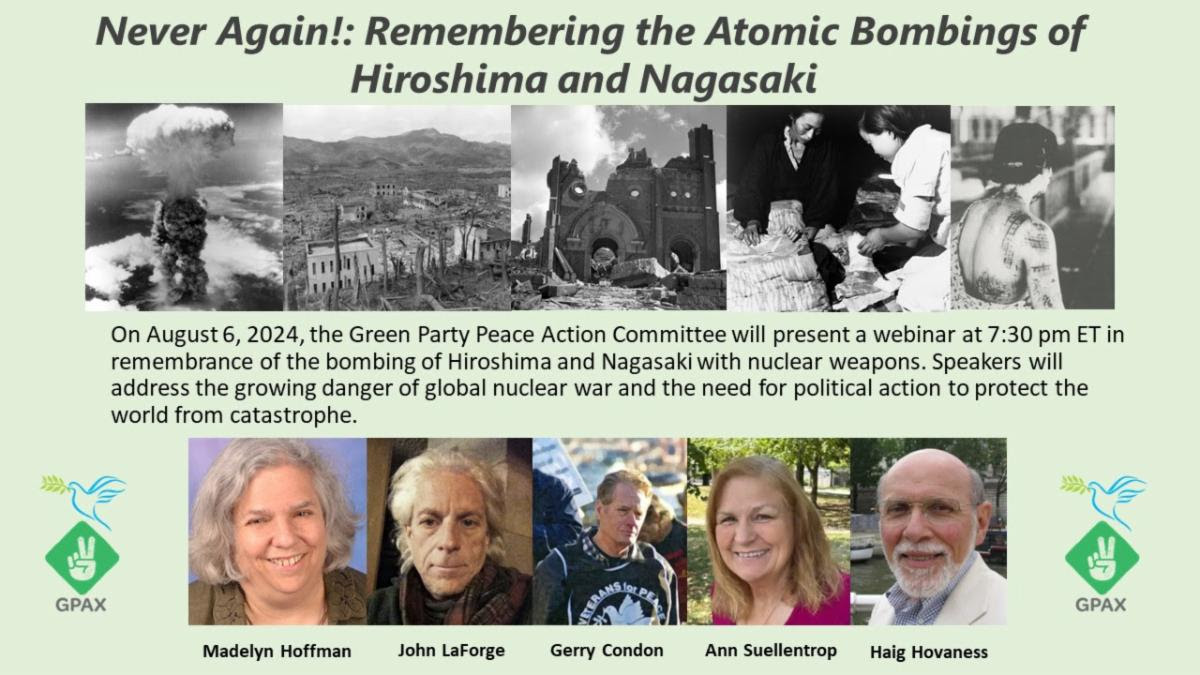
On the anniversary of the atomic bombing of Hiroshima, GPAX will present a webinar on the growing danger of global nuclear war resulting from expanding regional conflicts involving the U.S. Speakers will address the history of the nuclear weapons threat, starting with the Hiroshima and Nagasaki attacks and growing through the Cold War until the current period of extreme danger, when the Doomsday Clock is now set to 90 seconds before midnight.
August 6, 2024 7:30 PM ET, 6:30 CT, 5:30 MT, 4:30 PM PT You Must Pre-Register for the Webinar HERE
French nuclear giant ORANO slips into the red following Niger-French breakup
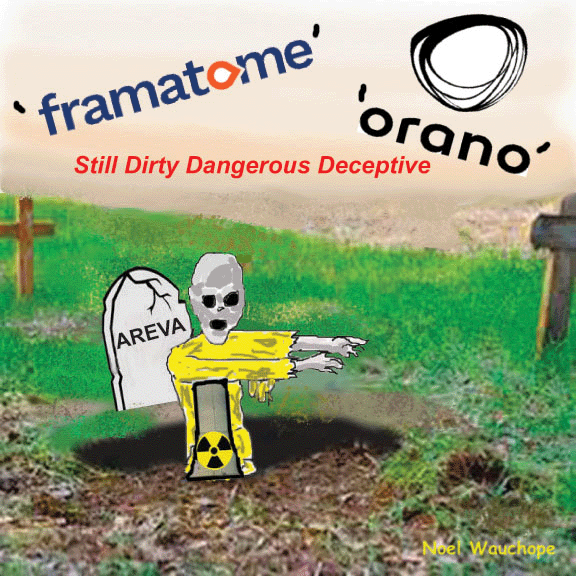
French nuclear giant Orano ended the first half of the year with a loss of €133 million, weighed down by difficulties in its mining activities in Niger due to a “highly degraded” political context since a military regime came to power a year ago.
Radio Free Europe: 29/07/2024 –
At the end of June 2024, the group noted “the deteriorated situation affecting mining operations in Niger,” Orano’s chief financial officer, David Claverie, said in a statement.
The coup d’état in Niger on 26 July last year led to a halt in imports of critical materials necessary for uranium exploitation in Orano’s Somaïr mine, such as soda ash, carbonate, nitrates and sulphur.
And although uranium extraction continued in the first quarter of 2024 “after several months of early maintenance,” Somaïr’s sales were unable to resume “due to a lack of logistics solutions approved by the Niger authorities”.
The blockage led the mine into “financial difficulty … weighing on its ability to continue its operations”, the statement read.
In late June, Niger decided to withdraw the licence of Imouraren SA, a company jointly operated by Orano, Niger Mining and Korea Electric Power, and which ran the Somaïr mine.
The situation could eventually lead to “insolvency in the short to medium term, in the coming months”, Claverie said……………………………… https://www.rfi.fr/en/international/20240729-french-nuclear-giant-slips-into-the-red-following-niger-french-breakup
Severe heatwave in Iran forces shops and public institutions to close

A heatwave blanketing Iran has forced authorities to cut operating hours at
various facilities on Saturday and order all government and commercial
institutions to close on Sunday, as hospitals received more than 200 people
for heatstroke treatment. Temperatures ranged from 37C (98.6F) to 42C
(107F) in the capital, Tehran, according to weather reports. The state-run
Islamic Republic News Agency (IRNA) said banks, offices and public
institutions across the country would close on Sunday to protect people’s
health and conserve energy and that only emergency services and medical
agencies would be excluded.
Guardian 27th July 2024
War Criminal Benjamin Netanyahu Addresses the US Congress

Lies proliferate and Congress cheers genocide in Gaza
The Unz Review, Philip Giraldi • July 26, 2024
To my surprise, last Thursday morning there was relatively little coverage of the address to the US Congress delivered by Israeli Prime Minister Benjamin Netanyahu last Wednesday afternoon apart from a critical opinion piece that appeared in the New York Times regarding Israel’s war on the Palestinians. The article, by Megan K. Stack, asserted:
“History will cast Mr. Netanyahu’s visit in deservedly ugly tones. He’s not a guest we should aspire to host, but he is a visitor we deserve. Gaza is our war, too, thanks to the indispensable military aid and political cover the US government has lavished on Israel as the death toll climbs… What exploded as a war of retribution against Hamas has looked increasingly like a broader campaign of annihilation — the slaughter of trapped civilians; the excruciating deaths of thousands of children; the destruction of hospitals, schools and much of the civilian infrastructure.”
Polls have shown for months that more Americans disapprove than approve of the Israeli onslaught in Gaza, but Congress and the White House are not interested in the views of the public when they are on the receiving end of hundreds of millions of dollars in “donations” from Jewish billionaires.
Much of the coverage of the Netanyahu appearance in the mainstream media was toothless and even adulatory. It generally reflected what was hailed as Bibi’s “fiery speech” that “did not give an inch” which vowed to continue fighting until “total victory” is achieved. There was some coverage of how Netanyahu went so far as to portray the many thousands of demonstrators, some of whom were pepper-sprayed and arrested, who surrounded the Capitol as “useful idiots paid for by Iran.” The jibe, together with other calls to go to war with Iran, produced cheers and other paroxysms of joy among the leaping and waving Congressmen. Bibi might have been particularly personally aggrieved by Pro-Palestinian protesters successfully having released insects into the Watergate Hotel where he was staying. Online video showed maggots running amok on the dinner table.
The Netanyahu speech was light on serious analysis, but heavy on emotional appeals, repeatedly invoking the assertion that he and the United States, in its “ironclad” support of Israel, are fighting to save “civilization” and that “our enemies are your enemies” and “our victory will be your victory.” Predictably, the Congressmen and guests who filled the chamber bobbed up and down applauding wildly after nearly every sentence, producing 53 standing ovations, far exceeding Netanyahu’s record 29 obtained the last time he addressed Congress in 2015.
Notably some Congressmen with active consciences skipped the event, including Nancy Pelosi, who, after the fact, denounced the address in a post on X:
“Benjamin Netanyahu’s presentation in the House Chamber today was by far the worst presentation of any foreign dignitary invited and honored with the privilege of addressing the Congress of the United States. Many of us who love Israel spent time today listening to Israeli citizens whose families have suffered in the wake of the October 7th Hamas terror attack and kidnappings. These families are asking for a ceasefire deal that will bring the hostages home – and we hope the Prime Minister would spend his time achieving that goal.”
nore https://www.sott.net/article/493515-War-criminal-Benjamin-Netanyahu-addresses-the-US-Congress
A substantial number of progressive and moderate Democrats, possibly as many as 136, also did not attend, suggesting that Netanyahu is not well regarded by many in the Democratic Party. Netanyahu spoke for an hour and the over-the-top reception he received from congress suggested that:
the government’s true loyalty is not to the voters who elected them but rather to a foreign leader who is a war-criminal, implying to some that Bibi is actually de facto the American president and Israel and the US are in practical terms one country, with Israel as the dominant partner in the arrangement.……………………………………………………………………
My particular gripe was over the fact that Netanyahu’s speech was full of uncontested lies and grossly exaggerated assumptions designed to get his audience roaring. The falsehoods were certainly recognizable as such by much of the audience, but Netanyahu was not challenged by anyone save only Representative Rashida Tlaib, a Democrat of Michigan and the sole Palestinian-American member of Congress, who attended the speech while holding up a sign while many of her colleagues applauded Netanyahu’s comments………………………………………………………………….more https://www.sott.net/article/493515-War-criminal-Benjamin-Netanyahu-addresses-the-US-Congress
1 This Month
10 March A LIVE WEBINAR THE REAL EFFECTS OF NUCLEAR POWER
What the Industry Isn’t Telling Us
1:00 PM Mountain, 2 pm Central, 3 pm Eastern. Live on the Keepers of the Water Facebook page



18 March Webinar @ 1 PM EST: An Assessment of SMR Projects: The Case of Canada
register for the zoom:
https://us02web.zoom.us/webinar/register/WN_o8BIIOUvQ2ONJR1nta65DQ#/registration


of the week – STOP SMALL MODULAR REACTORS IN CANADA
To see nuclear-related stories in greater depth and intensity – go to https://nuclearinformation.wordpress.com
-
Archives
- March 2026 (129)
- February 2026 (268)
- January 2026 (308)
- December 2025 (358)
- November 2025 (359)
- October 2025 (376)
- September 2025 (258)
- August 2025 (319)
- July 2025 (230)
- June 2025 (348)
- May 2025 (261)
- April 2025 (305)
-
Categories
- 1
- 1 NUCLEAR ISSUES
- business and costs
- climate change
- culture and arts
- ENERGY
- environment
- health
- history
- indigenous issues
- Legal
- marketing of nuclear
- media
- opposition to nuclear
- PERSONAL STORIES
- politics
- politics international
- Religion and ethics
- safety
- secrets,lies and civil liberties
- spinbuster
- technology
- Uranium
- wastes
- weapons and war
- Women
- 2 WORLD
- ACTION
- AFRICA
- Atrocities
- AUSTRALIA
- Christina's notes
- Christina's themes
- culture and arts
- Events
- Fuk 2022
- Fuk 2023
- Fukushima 2017
- Fukushima 2018
- fukushima 2019
- Fukushima 2020
- Fukushima 2021
- general
- global warming
- Humour (God we need it)
- Nuclear
- RARE EARTHS
- Reference
- resources – print
- Resources -audiovicual
- Weekly Newsletter
- World
- World Nuclear
- YouTube
-
RSS
Entries RSS
Comments RSS
 nuclear-news