History of Ionizing Radiation and Human Health.

From Hiroshima to Fukushima to You, Dale Dewar, 4 July 2024
Radiation was primordial, present since the Big Bang. Humans evolved with it. It could not be seen, felt, smelled or tasted. We didn’t even know it existed.
In November 1895, a German mechanical engineer and physicist, Wilhelm Roentgen produced and measured electromagnetic waves which, not knowing what they were, he called “x-rays”. Three months later, March 1896, a French engineer and physicist, Henri Becquerel found natural radiation that emanates from uranium salts.
The natural radiation, first thought to be x-rays, was soon parsed into alpha and beta particle radiation by Sir Ernest Rutherford and gamma rays by Paul Villard, French chemist and physicist.
The remarkable ability for x-rays to create images of bones led to widespread experimentation and medical diagnosis. The speed at which x-rays were adopted by physicians is exemplified by the opening of the first x-ray department in the Royal Infirmary in Scotland only one year later in 1896.
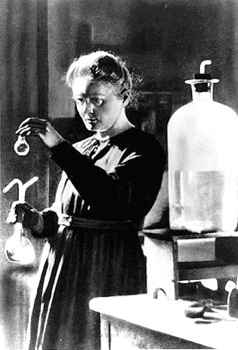
Radium was discovered by Madame Marie Curie when she was pursuing Becquerel’s “emanations” for her PhD thesis. It glowed in the dark by ionizing the air around it. It too enjoyed remarkable popularity and was incorporated into gels, creams, and drinking potions before its darker side was revealed.
In 1903, when Madame Curie received her degree, Sir Rutherford was visiting at a celebratory tea party. After darkness descended, Pierre brought out a sample of radium to oohs and ahs. Later that evening Sir Rutherford would refer to Pierre’s gnarled and deformed hands in his journal as “typical” of those who worked with radiation.

Most of the “typical hands” would have been those of x-ray machine operators. They used their hands to focus the x-rays of their primitive x-ray machines. To prevent this, Thomas Edison, US scientist and inventor, worked on a focussing mechanism but abandoned his work when his skin became reddened, and his eyes hurt. His assistant, Clarence Daily continued the work. Clarence’s hands became reddened, deformed, and painful and were finally amputated. By 1905 he died with bone cancer.
The turn of the century was an era of experimentation, and scientific exploration. It was also the time of rampant capitalism. New discoveries were quickly commodified for mass consumption.
Physicians x-rayed everything – the ethical were mesmerized by the sight of the insides of people’s bodies and explored the diagnostic limits of x-rays. The less ethical saw dollar signs. X-rays were focused on skin lesions and acne to remove them. The new gadget aided diagnosis and correct setting of broken bones. A physician with an x-ray machine attracted patients and, with them, their money.
Radium was Marie Curie’s pride and joy. She carried it in her pocket with a bottle containing her other discovery, polonium. At night at social gatherings, she would bring the radium out to show off its eerie pulsating blue glow made by the interaction between the ionizing radiation and the air.
People claimed that hot springs containing natural radium had healing properties. Many people boasted of miraculous cures after taking a few days off and going several times to the pool. Spas sprang up wherever there was hot water spilling out of rocks.
If radium was good on the outside, would it not be even better eaten or drank? Radium-infused drinking water was in demand. Doctors were recruited or bribed to participate in marketing schemes.
The early fascination with radium led to its widespread advertising and use by all kinds of charlatans as a cure-all for everything from menstrual cramps and headaches to impotence and anal warts. Physicians were drawn into the fray through a method of kickbacks for their prescriptions.
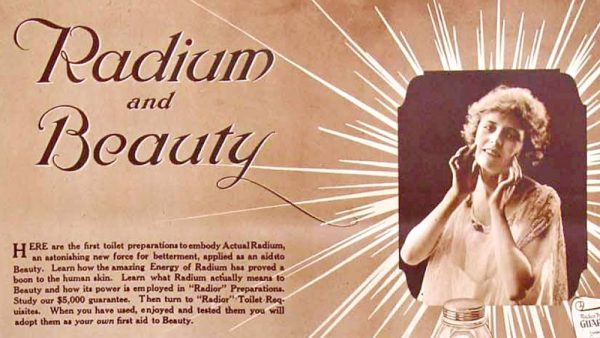
The radium industry was a shill game which included miners, millworkers and even steamboat operators at Great Bear Lake in Northern Canada. The market crashed when Eben McBurney Byers, a wealthy industrialist and competitive amateur golfer developed osteosarcoma (bone cancer) after drinking a prescribed radium-laced water, “Radithor”.
Shortly before he died, having survived the surgical removal of his jaw, a lawsuit was making its way through the courts. The property of glowing in the dark had found a use in dials for airplane instruments in WWI and for civilian clocks and wristwatches. The radium was painstakingly painted onto the dials by young women who were instructed to follow a mantra of “Lip, Dip, and Paint”, using their lips to bring their brushes to a point, each time ingesting a tiny bit of radium.
Radium is an element belonging to the same family as strontium and calcium. When ingested, our bones will suck radium atoms out of the blood stream and insert them where there should be calcium atoms. Women, some of them as young as twelve years old, were assured that it was safe. That was a lie. Every atom of radium in bone fires off radioactive shrapnel to the cells around it.
Company executives knew that it was not safe – they didn’t know how unsafe it was but they and their lab technicians both shielded and limited their contact with it. They denied compensation to the women for years. When the workers started developing anemia, bone pain and tumors, they were diagnosed by company doctors as having poor diet, neuroses or even syphilis. Even after one court case was concluded, women at another site sought compensation for their medical bills through legal means
The widespread use of x-rays during WWI using poorly constructed and calibrated units also led to international concern about the exposure of operators and patients to their harm. In the late 1920’s, both national and international commissions occurred to pool information and to set standards for exposure. The early belief was that as long as skin reddening did not occur or resolved quickly, no actual harm was done.
………………………………………………………………………………………………………………………………………………………………. During the Manhattan Project the first victims of very high radioactive exposures occurred. They were immediately hospitalized and followed through to their deaths. Those exposed to greater than 10,000 mSv had the same outcome no matter how quickly or how well they were treated. Death came over a period of four weeks. If the exposure was doubled to 20,000 mSv, death came within 24 hours.
In neither case was death painless.
Besides secrecy around the project, lying about the side effects of ionizing radiation was necessary for the further development of the bomb project. For example, General Lesley Groves, the administrative “boss” of the Project knowingly lied when he tried to convince a Senate Committee in 1945 after the bombs had been dropped on Hiroshima and Nagasaki that radiation exposure was a “pleasant way to die”[ii].
By observing soldiers, pilots and sailors, the medical teams for the Project were able to establish benchmarks for other exposures.
50 – 100 mSv changes in blood chemistry, anemia
400 – 500 mSv nausea, vomiting, poor coordination
700 mSv everyone vomits
750 mSv hair loss within two weeks
1000 mSv hemorrhage
4000 mSv death within months[iii]
For comparison, one chest x-ray, two views give 0.15 mSV, an abdominal CT scan 10.0 mSv.
But what of doses below these? What does 5 mSv do over time? 10 mSv? The nuclear industry maintains that low-dose exposure has such a low health effect that it can basically be ignored. This “harmless” rhetoric is maintained through the years by many medical personnel ordering CT scans and dentists requesting panoramic dental x-rays.
The United States National Academy of Sciences has examined the question of low dose for decades and intermittently produced a document called the Biological Effects of Ionizing Radiation (BEIR). In BEIR 2007 their report concluded that every exposure has the potential to cause damage to humans.
How does ionizing radiation harm human cells?

It is called “ionizing radiation” because it causes molecules to “ionize”. Molecules are formed when atoms join together to build virtually anything, especially, biological structures – cellular walls, protein structures, enzymes, RNA and DNA. Struck by radiation, these molecules can be broken into parts called “ions”. The ions can join together in different configurations so that the enzyme may no longer work properly, or the DNA molecule may no longer transmit its genetic information correctly.
Any one of the products of radiation – alpha, beta or neutron particles, x-ray, gamma or cosmic rays – can cause this. As far as a cell is concerned, it is as though “there’s a bull loose in the China shop”. The greater the energy carried by the radiation, the greater the damage.
It is impossible to say whether any given disease or cancerous growth can be blamed upon any given exposure to radiation. We can discern the damage only through populations studies, comparing a group of people who had been exposed to a group of people who had not.
Humans have lived with natural radiation for thousands of years – has it caused damage?
There are two distinct examples of natural radiation causing cancer: radon, largely in basements, and skin cancers from cosmic rays…………………………………………………………………………………………………………………………………………………………………………………………….
[i] Alan Chodos, Editor, This Month in Physics History, December 1938: Discovery of Nuclear Fission, December 2007 (Volume 16, Number 11) APS News
[ii] William King, A weapon too far: The British radiological warfare experience, 1940–1955, Sage Journals, Volume 29, Issue , January 11, 2021, https://doi.org/10.1177/0968344520922565 Accessed 28.12.23
[iii] United States Environmental Protection Agency, http://www.epa.gov/rpdweboo/understand/health-effectshtml#est_health_effects …………………….. https://ionizingradiationandyou.blogspot.com/
No comments yet.
1 This Month

of the week – Shut Down Drone Warfare!


Tell the Ukrainian Government to Drop Prosecution of Peace Activist Yurii Sheliazhenko

Petition to revoke the licensing of the Near Surface Nuclear Disposal Facility (NSDF) at Chalk River. https://www.ourcommons.ca/petitions/en/Petition/Details?Petition=e-7247
To see nuclear-related stories in greater depth and intensity – go to https://nuclearinformation.wordpress.com
-
Archives
- March 2026 (244)
- February 2026 (268)
- January 2026 (308)
- December 2025 (358)
- November 2025 (359)
- October 2025 (376)
- September 2025 (257)
- August 2025 (319)
- July 2025 (230)
- June 2025 (348)
- May 2025 (261)
- April 2025 (305)
-
Categories
- 1
- 1 NUCLEAR ISSUES
- business and costs
- climate change
- culture and arts
- ENERGY
- environment
- health
- history
- indigenous issues
- Legal
- marketing of nuclear
- media
- opposition to nuclear
- PERSONAL STORIES
- politics
- politics international
- Religion and ethics
- safety
- secrets,lies and civil liberties
- spinbuster
- technology
- Uranium
- wastes
- weapons and war
- Women
- 2 WORLD
- ACTION
- AFRICA
- Atrocities
- AUSTRALIA
- Christina's notes
- Christina's themes
- culture and arts
- Events
- Fuk 2022
- Fuk 2023
- Fukushima 2017
- Fukushima 2018
- fukushima 2019
- Fukushima 2020
- Fukushima 2021
- general
- global warming
- Humour (God we need it)
- Nuclear
- RARE EARTHS
- Reference
- resources – print
- Resources -audiovicual
- Weekly Newsletter
- World
- World Nuclear
- YouTube
-
RSS
Entries RSS
Comments RSS
 nuclear-news
Leave a comment