Hinkley Point C, the £46 billion mega-project digging tunnels under the sea
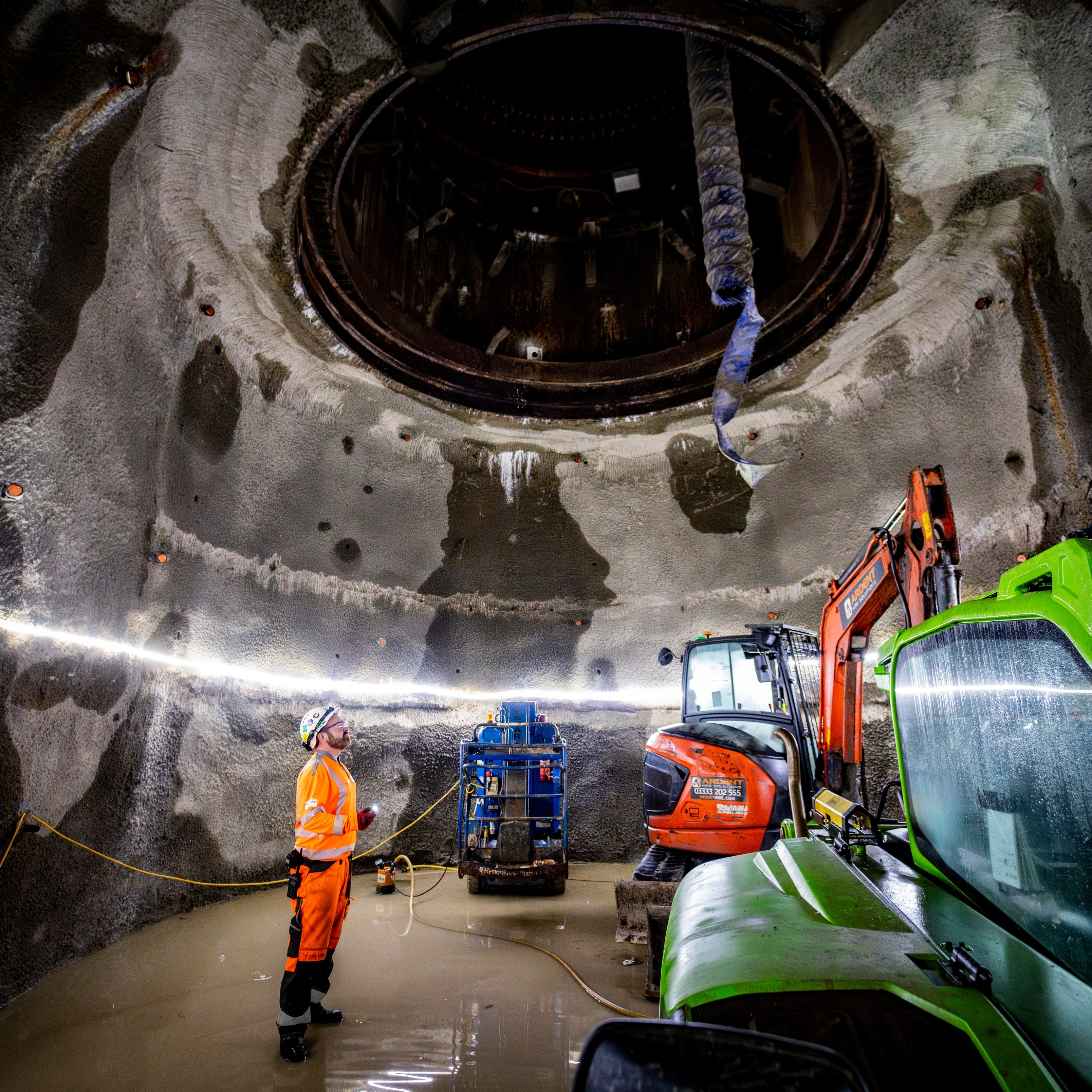
As engineers finish 30m-deep tunnels that will provide water for the £46
billion power station, Labour must decide whether to back new nuclear
plants.
Deep beneath the Bristol Channel, the latest phase of the Hinkley
Point C nuclear power station is nearing completion. Three tunnels
extending miles under the seabed are being fine-tuned by engineers in
bright orange overalls. When the plant is operational, two of these
tunnels, 6m wide and 3.5km long, will be flooded with seawater that will be
used to cool the plant. A third tunnel will return it to the sea.
Constructing all this has required some fiddly design. Each tunnel is
connected to 44m-long metal “water heads” that have been designed to
suck in water but not fish. There is also a “fish return pipe” to help
any unlucky sprat get back to the ocean. The complexity of these tunnels
speaks to the engineering challenge of building Britain’s first new
nuclear power station in 30 years. Overruns and delays mean that Hinkley
Point C is now likely to cost £46 billion by the time the first of its two
reactors is switched on in 2029.
Hinkley is just over halfway built, and
its delivery will fall to the new Labour government. The party is
pro-nuclear but it will soon have to decide whether to give the green light
to an identical plant, Sizewell C in Suffolk, and a new breed of smaller
reactors.
Does it have the political will — and the financial firepower
— to back this new nuclear age? EDF hit out at British regulators for
ordering 7,000 changes to the design of its reactors, which were not
required in other countries where they have been built. These changes
include the fish return pipe and a requirement that Hinkley’s critical
systems have an “offline” back-up to protect them against cyberattack.
Some industry sources counter that EDF should bear most of the blame.
“They hadn’t done the proper engineering design and construction
planning before they started work,” said one senior figure. Hinkley’s
Crooks blames stringent measures imposed by the Environment Agency for some
of the delays. “The processes in the agency are very, very, very
challenging, and very long. And everything is subject to legal challenge,
which goes on for ever,” he said.
EDF’s current spat with the agency
concerns the company’s plan to ditch underwater speakers that were
supposed to deter fish from swimming near the site. Both parties have
agreed these speakers won’t work, but are now wrangling over what EDF
should do instead. Until the row is resolved, Hinkley won’t have a
licence to operate.
Ironing out these problems is especially important
because EDF plans to replicate Hinkley’s design at Sizewell. It insists
that project will benefit from the lessons learnt at Hinkley. Crooks said:
“I’m highly confident Sizewell will be quicker and a lot cheaper than
this one.”
The UK government is still looking for private investors to
back Sizewell; a final investment decision was due before the election, but
never came. The project is now sitting at the top of energy secretary Ed
Miliband’s in-tray. He is expected to give it close scrutiny, as
electricity bill-payers will be on the hook for the bulk of the cost.
Miliband must also decide how much the UK wants to spend on a newer breed
of smaller modular reactors. Steve Thomas, emeritus professor of energy
policy at Greenwich University, notes that the reactor model being used at
Hinkley has run into problems and delays wherever it has been built — in
China, Finland and France. “Going forward with Sizewell C would be a
costly and risky venture and would draw resources away from the options
that would allow us to meet our climate-change goals quicker, more cheaply
and more reliably,” he said.
There are even more immediate concerns. CGN
has refused to put any more money into Hinkley to cover the overruns. EDF
won’t give a number, but industry sources suggest the project is facing a
funding gap of up to £5 billion. “We are actively looking for investors
to mitigate this cash requirement,” said Crooks. Under the terms of its
contract, EDF — or, more precisely, the French government — will have
to pick up the tab.
Times 13th July 2024
No comments yet.
1 This Month
10 March A LIVE WEBINAR THE REAL EFFECTS OF NUCLEAR POWER
What the Industry Isn’t Telling Us
1:00 PM Mountain, 2 pm Central, 3 pm Eastern. Live on the Keepers of the Water Facebook page



18 March Webinar @ 1 PM EST: An Assessment of SMR Projects: The Case of Canada
register for the zoom:
https://us02web.zoom.us/webinar/register/WN_o8BIIOUvQ2ONJR1nta65DQ#/registration


of the week – STOP SMALL MODULAR REACTORS IN CANADA
To see nuclear-related stories in greater depth and intensity – go to https://nuclearinformation.wordpress.com
-
Archives
- March 2026 (109)
- February 2026 (268)
- January 2026 (308)
- December 2025 (358)
- November 2025 (359)
- October 2025 (376)
- September 2025 (258)
- August 2025 (319)
- July 2025 (230)
- June 2025 (348)
- May 2025 (261)
- April 2025 (305)
-
Categories
- 1
- 1 NUCLEAR ISSUES
- business and costs
- climate change
- culture and arts
- ENERGY
- environment
- health
- history
- indigenous issues
- Legal
- marketing of nuclear
- media
- opposition to nuclear
- PERSONAL STORIES
- politics
- politics international
- Religion and ethics
- safety
- secrets,lies and civil liberties
- spinbuster
- technology
- Uranium
- wastes
- weapons and war
- Women
- 2 WORLD
- ACTION
- AFRICA
- Atrocities
- AUSTRALIA
- Christina's notes
- Christina's themes
- culture and arts
- Events
- Fuk 2022
- Fuk 2023
- Fukushima 2017
- Fukushima 2018
- fukushima 2019
- Fukushima 2020
- Fukushima 2021
- general
- global warming
- Humour (God we need it)
- Nuclear
- RARE EARTHS
- Reference
- resources – print
- Resources -audiovicual
- Weekly Newsletter
- World
- World Nuclear
- YouTube
-
RSS
Entries RSS
Comments RSS
 nuclear-news
Leave a comment