Radioactive Real Estate: Finding a Forever Home for Nuclear Waste
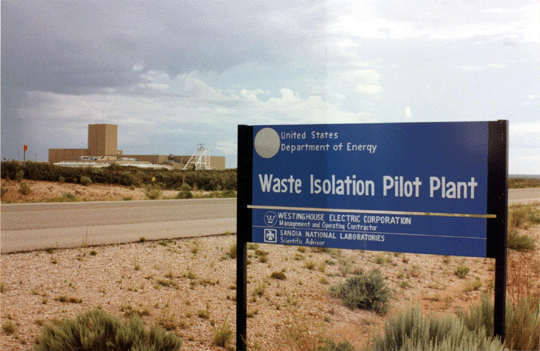
To this day, WIPP only houses transuranic waste with medium radioactivity from nuclear defense projects — not, for example, waste from nuclear energy, or items with very high or low levels of radioactivity. There is no pilot plant for high-level materials in the U.S. at the moment or in the plans
Undark, 10 July 2024, BY SARAH SCOLES
Castoffs from U.S. nuclear weapons get buried at one site in New Mexico. But what happens when that facility fills up?
THE LAND around Carlsbad, New Mexico is spiked with oil and gas wells. Mines hoist up minerals. Hotel parking lots teem with twinning white work trucks, driven by employees who specialize in pulling material out of the Earth.
Amid these extractors, though, are others putting material into the planet: They work for a facility called the Waste Isolation Pilot Plant, located about 40 minutes from downtown Carlsbad. At first glance, WIPP resembles a normal industrial site: A road sign near the entrance sports its inscrutable name, pointing toward tan warehouse-like buildings, evaporation ponds, and headframes for hoisting material.
Superficially, it looks like any other mine in the area. But that sameness belies the strangeness of what lies below ground: A huge subterranean salt deposit that stores nuclear waste from the country’s defense projects.
Once the repository is full, the salt will naturally undo the miners’ work: Tunnels and rooms will collapse, entombing the radioactive material and protecting life aboveground. WIPP has buried more than 14,000 shipments of nuclear waste since its start in 1999.
Twenty-five years after that opening, on a chilly March morning, a charter bus carries a crowd of people — some wearing cowboy attire, others in insulated vests zipped over dress shirts — into the parking lot. They congregate next to a semitruck laden with cylindrical cargo containers that sport radioactive warning labels. The labels, it turns out, are just for show. These containers are empty — staged for a photograph as part of WIPP’s 25th anniversary, and these guests have come to mark the occasion.
When the event starts, in a building plunked just before the security gate, Mark Bollinger, head of the Department of Energy’s Environmental Management Carlsbad field office, heads to a lectern.
“This,” he proclaims, “is a celebration.”
Others beg to differ. According to WIPP’s founding documents, the site should be winding down soon: It is a pilot plant — an experiment, a proof-of-concept — these critics argue, not a permanent one. The goal is to show that it is possible to safely store nuclear waste underground, shut the plant down, and seal it off. Initially, the timeline estimated disposal would stop in the middle of this decade, letting earth close around the waste. Over the course of WIPP’s operating life, and drawing on lessons learned here, the United States would identify and open new repositories for America’s nuclear waste.
That’s not exactly what has happened though.
Today, there are no concrete plans for new deep geologic repositories in the U.S. There are no established future sites for the medium-level nuclear waste that WIPP handles, nor for more dangerous radioactive waste, nor for the tens of millions of pounds of spent nuclear fuel from power plants. Indeed, much of the radioactive trash the country has created since the 1940s still lives in temporary storage, spread across the U.S. And officials now expect WIPP could remain open until the 2080s — decades beyond its originally conceived chronology.
The lack of permanent nuclear waste storage in the U.S. isn’t an engineering problem. “It’s not technically difficult,” said Allison Macfarlane, director of the School of Public Policy and Global Affairs at the University of British Columbia, and former chair of the U.S. Nuclear Regulatory Commission.
The solution, she says, is to bury it. The more radioactive, the deeper it goes.
Politically and culturally, however, convincing communities to permanently host nuclear detritus remains difficult, and WIPP is the world’s only operational example of a deep geological repository for nuclear waste — and the only one on the horizon. If officials are to find a post-WIPP solution for the mid-level nuclear waste being stored here — and the other kinds of radioactive discards — they’ll need to study how WIPP came to be, and why Carlsbad residents haven’t put up much of a fuss.
“In any future repository program,” said Matt Bowen, a senior research scholar at the Center on Global Energy Policy at Columbia University and a former official with the National Nuclear Security Administration, “state and local officials are going to want to understand WIPP.”
THE IDEA that you could store nuclear waste in salt dates to the 1950s, when the National Academy of Sciences published a report about radioactive waste disposal, identifying places where nuclear waste could remain undisturbed. Subterranean salt deposits, the panel of experts concluded, were the best spots, geologically speaking.
“The great advantage here is that no water can pass through salt,” read the report. Cracks in the mineral would heal themselves, theoretically helping halt radioactivity’s flow up or down. Salt deposits are also typically in seismically inactive areas, so nothing should shake the dangerous drums. “Abandoned salt mines or cavities especially mined to hold waste are, in essence, long-enduring tanks,” it continued.
Other geologic options that have been floated include crystalline rock, shale or clay, shale over hard rock, and volcanic rock called tuff, all of which can isolate the waste from the outside environment.
More than a decade passed before officials implemented the academy’s suggestion, with the defense apparatus continuing to produce nuclear waste the whole time. But when they did move forward with preliminary work in the 1970s, they settled on a part of New Mexico underlain by a huge slab of salt from the long-gone Permian Sea. This salt is 2,000 feet thick, starting 850 feet underground. It seemed perfect.
But first they needed to convince the public.
Proponents and politicians navigated this in part by allowing independent oversight and research and giving the state of New Mexico some power over the process. In the 1970s, the state created a radioactive and hazardous waste committee in the legislature, to recommend legislation for WIPP and for the transportation of radioactive material. And in the 1980s Congress allocated money to mine two shafts through the salt and research the site and its safety, access that allowed the state of New Mexico to do its own, independent research.
That was part of a plan that politicians and policymakers in favor of WIPP had in this era, says former Rep. John Heaton, whose district housed the future site. Namely, that they wanted the public to “hang loose.”
“Let’s not go overboard,” Heaton said of the advice to the public at the time. It is no use thinking of only bad-case scenarios or scary what-ifs. Let’s instead, the advice went, wait for the facts to come in.
As those facts arrived, independent researchers learned about how waste containers corroded over time, and how the underground salt behaved at different temperatures. The research pointed to the long-term safety of the site, and waiting on the scientific results had worked: Carlsbad was on board, with opposition coming mostly from larger, more liberal cities like Santa Fe, where Heaton lives now. And while the project did face controversy and opposition from the state, by the time the project was getting started, more people were in favor of WIPP than against it.
By 1992, politicians had drawn up the Waste Isolation Pilot Plant Land Withdrawal Act, giving more than 10,000 acres to WIPP and laying out its parameters — including the total amount of waste the Department of Energy could “emplace” — a fancy word used to mean “put underground.” WIPP would house material dubbed “transuranic,” largely objects contaminated with radioactive elements heavier than uranium — in this case, mostly plutonium — soiled during nuclear defense work.
(To this day, WIPP only houses transuranic waste with medium radioactivity from nuclear defense projects — not, for example, waste from nuclear energy, or items with very high or low levels of radioactivity. There is no pilot plant for high-level materials in the U.S. at the moment or in the plans.)
TODAY, WIPP is not just a hole in the ground but a series of tunnels and rooms largely housing barrels filled with pieces of rebar, rags, clothing, empty containers of spray adhesive — remnants of the objects engineers and technicians used while working on nuclear weapons or defense research.
…………………………………………………………………………………………………………… “legacy waste” — radioactive trash created long ago when records were less detailed and methods less stringent than they are now. Some of it was simply put in containers and buried in shallow trenches, or even above-ground, on the nuclear labs’ property during the Cold War. Legacy material makes up much of WIPP’s contents, and much of what will be in its future deliveries.
…………………………….. CHECKS and balances have been fine-tuned since 2014, when WIPP experienced its greatest setback.
February that year was a bad month for the plant. First, a truck hauling salt caught fire underground, spreading soot on important equipment and smoke throughout the site — and endangering the 86 workers underground. Everyone made it the 2,000 feet to the surface, but several had to be treated for smoke inhalation.
Just over a week later, in a different part of WIPP, a drum of waste exploded, turning itself essentially into a dirty bomb, blasting out transuranic radioactive material in a fiery burst.
Twenty-two workers received doses of radiation, and a small amount of contamination escaped into the outside world — about 3 percent of the amount of radiation from a chest X-ray.
The dangerous drum had originally come from Los Alamos, where workers had mixed in the wrong kind of cat litter — a simple substance that typically helps stabilize nuclear waste. But in this case, instead of combining the hazardous substances with inorganic kitty litter, they had mixed it with “an organic kitty litter,” the instructions having gotten garbled. And organic material can react with nitrates, causing chemical reactions that release heat. The increasing heat bumped up the pressure inside the drum, until it burst.
………………………………………………… The 2014 accidents may have been the most significant in WIPP’s history, but yearly, smaller incidents also occur. “It’s difficult to operate this kind of facility,” said Hancock. “Nobody in the world has ever safely operated a deep geologic repository.”
And that is the difference between the real world and a report from a national academy about what kind of rock or mineral is safe: A place can be perfect in geological theory, but when operated by flawed humans, it will be subject to their mishaps and misjudgments.
………………………………………………………………………Critics, like proponents, want the legacy waste cleaned up, and safely. But they don’t trust WIPP with that last part. While the bigger cities in the region are unlikely to suffer ill effects from a disaster at the plant itself, trucks of nuclear waste pass through on their highways. And some residents are concerned about the safety of those trucks. Any vehicle traveling anywhere, carrying anything, can have an accident.
They are also worried about WIPP’s proximity to oil and gas activity…………………………………………………………………..
WIPP RECENTLY received its latest 10-year operating permit from the state of New Mexico. As part of the final agreement, the DOE agreed to look for a future waste-disposal site, in another state. “I think it will be a consent-based siting program,” said Bowen, of repositories to come. “I don’t think anybody wants to fight states.”
But it will be hard to find a new, permanent place — or other places for the other kinds of nuclear waste out there. “At some point in time, we’re going to have to start this effort of establishing another deep geologic repository,” said Bowen. WIPP, after all, took decades to open, so starting now could mean getting a new space in the 2040s or 2050s, with more waste piling up in the meantime. “We need to get going on that,” he continued. He’s hopeful things may get started in 2025.
And as with WIPP, the hardest part won’t be finding more salt spots, or deciding between volcanic rock and shale: It will be getting the people sitting in Washington and the people living atop those deposits to agree to something. “The affected public has to trust those who are implementing this process and those who are regulating this process,” said Macfarlane.
But the requirement goes the other way, she added: The implementers and regulators have to trust the public. That latter part often falls apart, she said………………………………………………………………
In the 1990s, Sandia National Laboratories convened linguists, scientists, and anthropologists, among others, to figure out how to separate WIPP from the people of the future. They came up with a plan involving signs and symbols: The site will be surrounded by huge earthen berms, metal objects and magnets buried within, meant to reflect radar beams and make this place register as magnetically anomalous. The perimeter will also host 25-foot-tall granite columns, engraved with warnings, and no-go markers will be buried up to six feet deep throughout the site. WIPP’s center, if someone gets that far, will host an information center that includes pictorial messages today’s humans hope will convey “leave this alone” to future ones.
“Other nuclear waste disposal sites must be marked in a similar manner within the U.S. and preferably world-wide,” read the multidisciplinary report. Its authors likely imagined there would be plans for such sites by now, and that WIPP would soon be getting its warnings. But it got, instead, a birthday party. https://undark.org/2024/07/10/radioactive-real-estate-nuclear-waste-forever-home/?utm_source=Undark%3A+News+%26+Updates&utm_campaign=1b7bb2c675-RSS_EMAIL_CAMPAIGN&utm_medium=email&utm_term=0_5cee408d66-185e4e09de-%5BLIST_EMAIL_ID%5D
No comments yet.
1 This Month

of the week – Shut Down Drone Warfare!


Tell the Ukrainian Government to Drop Prosecution of Peace Activist Yurii Sheliazhenko

Petition to revoke the licensing of the Near Surface Nuclear Disposal Facility (NSDF) at Chalk River. https://www.ourcommons.ca/petitions/en/Petition/Details?Petition=e-7247
To see nuclear-related stories in greater depth and intensity – go to https://nuclearinformation.wordpress.com
-
Archives
- April 2026 (34)
- March 2026 (251)
- February 2026 (268)
- January 2026 (308)
- December 2025 (358)
- November 2025 (359)
- October 2025 (376)
- September 2025 (257)
- August 2025 (319)
- July 2025 (230)
- June 2025 (348)
- May 2025 (261)
-
Categories
- 1
- 1 NUCLEAR ISSUES
- business and costs
- climate change
- culture and arts
- ENERGY
- environment
- health
- history
- indigenous issues
- Legal
- marketing of nuclear
- media
- opposition to nuclear
- PERSONAL STORIES
- politics
- politics international
- Religion and ethics
- safety
- secrets,lies and civil liberties
- spinbuster
- technology
- Uranium
- wastes
- weapons and war
- Women
- 2 WORLD
- ACTION
- AFRICA
- Atrocities
- AUSTRALIA
- Christina's notes
- Christina's themes
- culture and arts
- Events
- Fuk 2022
- Fuk 2023
- Fukushima 2017
- Fukushima 2018
- fukushima 2019
- Fukushima 2020
- Fukushima 2021
- general
- global warming
- Humour (God we need it)
- Nuclear
- RARE EARTHS
- Reference
- resources – print
- Resources -audiovicual
- Weekly Newsletter
- World
- World Nuclear
- YouTube
-
RSS
Entries RSS
Comments RSS
 nuclear-news
Leave a comment