The Atlas Network’s transnational revolution.
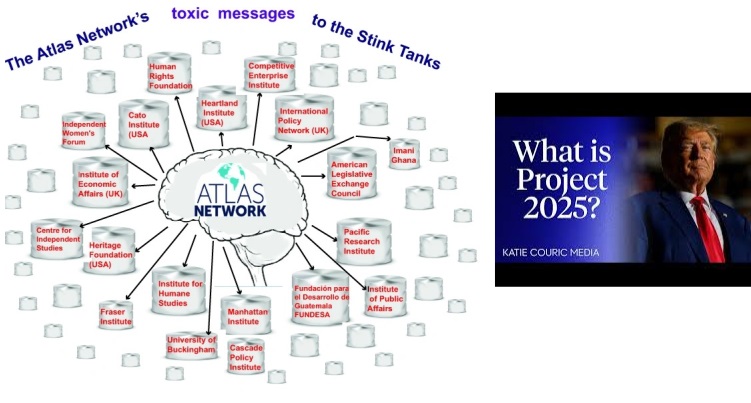
By Lucy HamiltonJul 8, 2024 https://johnmenadue.com/the-atlas-networks-transnational-revolution/
Twice in a fortnight, the president of the Heritage Foundation has declared that America is experiencing its second revolution. The revolution would remain bloodless (because their side is “winning”) “if the left allows it to be.” The two bodies whose acts provoked the announcements are leading Atlas Network partners. They are also spending millions of dollars in Europe to roll back rights for women and LGBTQIA people.
Both president Kevin Roberts’ announcements were made on Steve Bannon’s War Room broadcast, central to the Trumpist movement and its efforts to remake America from every school board and electoral precinct upwards.
The first announcement of revolution was made on the 22nd June. It functioned as an advertisement for the MAGA(Make America Great Again) audience to take part. Becoming a revolutionary involves undertaking Project 2025’s recruitment and training of loyalists to staff the incoming Trump administration, but also at state and local government levels. Roberts declared they were building not just for 2025, but for the next century in the United States.
Project 2025 is the most recent iteration of Heritage’s Mandate for Leadership. The first was written for Ronald Reagan, spelling out his massive reforms. He implemented two thirds in his first term. The last iteration for Donald Trump’s first term was similarly “business Republican” in tone, and Trump too implemented two thirds in his first year. The newest iteration is, as Roberts describes, revolutionary. It dictates the process for the dismantling most of the federal government as well as setting America on track to eliminate reproductive and Queer rights.
It also sets out the intention to dismantle the vital energy transition work underway as a result of the Inflation Reduction Act, with plans to boost fossil fuel production instead. This is fitting as much of Heritage’s funding comes from fossil fuel sources.
Project 2025 is a joint Atlas Network and Council for National Policy project.
The second announcement of revolution was made after the Supreme Court’s dramatic week of judgements. In particular, the one that granted the President of the United States immunity for the vaguely worded field of “official acts.” Naturally the partisan court will make the determination which acts are “official.”
The week also compounded the Trumpist Supreme Court’s norm-violating series of decisions that have rolled back reproductive healthcare access for women across Republican states, further damaged voters’ representation, and frozen programs that aim to address entrenched disadvantage.
In one week, the Court placed itself above the experts in government agencies who define, for example, how much mercury is unsafe to consume. While the relevant judge confused nitrous oxide and nitrogen oxide, he dared to claim that judges were better placed than government experts to determine the minutiae of America’s functioning. This attack on the administrative state’s ability to protect the public from corporate recklessness and malfeasance was a triumph for capital. The court also damaged the SEC’s ability to deal with White Collar crime.
Such gifts to the wealthy were balanced with another judgement that decided a gratuity given after a favour was received would not be determined an illegal bribe. For a court riddled with scandal over oligarch largesse, this was a particularly cynical decision.
As a footnote, the same week revealed a decision that said regions could make it illegal to be homeless. This can provide numbers for private prison operator profits. There prisoners are hired out to businesses for near slave-labour wages.
All these decisions have resulted from the years of work by the Federalist Society which handed Trump his literal list from which to choose judges. Republicans had stalled appointments to federal benches over the Obama era, granting Trump the gift of hundreds of appointments; some appointees were considered scandalous.
The years of surreptitious work by the Federalist Society and its leader Leonard Leo have been documented by Pro Publica. The body made headlines when it was gifted $1.6 billion by a single donor.
Both Heritage and the Federalist Society are Atlas Network partners. They are also Council for National Policy (CNP) members: that’s the interlinked body that has been driving the Christian Nationalist takeover of America.
Dr Jeremy Walker explained the process by which the Atlas Network architecture of influence operates in the lead-up to the Voice referendum in 2023.
Investigative journalist Jane Mayer revealed its American operations in Dark Money, using the label “Kochtopus” after Charles and David Koch, preeminent funders of the network. Historian Nancy MacLean documented its longer history in Democracy in Chains.
With around 500 partner organisations in roughly 100 countries its global operations remain less obvious because the system is intentionally covert.
The central “think” tanks foster the replication of more such bodies, providing seed funding if necessary and training in fundraising and public relations strategies to help the local offshoots become independent. They network. The primary function is to sell the donors’ messages by advertising them constantly: in 1985, Heritage founder Ed Feulner told Australian operatives to treat campaigns as if they were for a toothpaste brand that needed constant reinforcing. The messages: low tax, minimal regulation, small government, dismantling of social safety nets. Together the junktanks, as journalist George Monbiot has labelled them, create a chorus of voices from university centres and civil society bodies reinforcing the wishlist.
While the focus has primarily been on these “business Republican goals,” junktanks have their own remit. Conservative social messaging about the family has been partly used to conceal the lack of ethics in the libertarian mission. It has partly functioned to encourage family and church networks to mitigate the damage done to communities and individuals by the slashing of safety nets. There has also remained a more socially conservative and religious array of junktanks within the network.
The more toxic “family values” groups tend to be interconnected with Atlas rather than Atlas partners themselves. Trump appointee Betsy DeVos, for example, links the two. She has been chair and on the board of two Atlas partners: the American Federation for Children that aims to replace the public school system with privatised charter schools and the Acton Institute for the study of Religion and Liberty which educates business leaders and academics in “the connection that can exist between virtue and economic thinking.” Both Prince and DeVos families are substantial donors to the anti-LGBTQIA group Focus on Family. Focus is part of the CNP, a Christian Nationalist network that includes the Charles Koch and the Prince and DeVos families as donors, not to mention Mike Pence and Steve Bannon as key figures.
Both the extremist Christians and the libertarians are close to achieving their goals in America. Apart from the impact the implosion of the United States government and civil rights framework will have on the rest of the world, this is relevant because the very global nature of Atlas means that its outposts are trying to replicate its work outside the American homeland.
The European Parliament conducted a study affirming reporting that $280 million dollars have been funnelled into the EU over the last decade by Atlas and CNP partners as well as by Evangelical mission programs. Heritage and Federalist stand alongside the Cato Institute, the Leadership Institute and Acton as having donated roughly $20 million towards European groups fighting to repeal reproductive healthcare rights and LGBTQIA rights. Another American body, the American Society for the Defense of Tradition, Family and Property (TFP) has also been training European groups in strategy in cooperation with Bruce Eberle a “visiting professor” at the Leadership Institute. The Koch, DeVos and Prince families are named as major sources of the money.
(These donations are overshadowed in scale by those from European and Russian sources.)
Australia’s Centre for Independent Studies (CIS) mostly leaves the culture war battles on gender and religious virtues to the Institute of Public Affairs (IPA) and their media ally, News Corp. This year’s CIS Consilium event where the Atlas pipeliners intermingle with local and international talking heads is running adjacent to the inaugural conference of the Australian Chapter of the Alliance for Responsible Citizenship. The London original was a religio-ethnonationalist event. The consecutive timing is convenient for international guests to attend both.
The rest of us must remain focused on the fact that these networks operate transnationally. They share talking points, strategies, individuals and sometimes money. The revolution that Kevin Roberts has declared they are winning in the US is to be reenacted, piecemeal, for all of us.
US says not ready to resume nuclear talks with Iran under Pezeshkian
Iran International 8 July 24
The Biden administration is not ready to resume nuclear talks with Iran under the new president, the White House national security council spokesman said Monday.
In his presidential campaign, Iran’s president-elect Masoud Pezeshkian advocated engagement in constructive talks with Western powers to revive the 2015 nuclear deal (JCPOA) and to lift the sanctions that he says have crippled the Iranian economy since the withdrawal of the US from the agreement in 2018.
Asked whether Pezeshkian’s election will change the US negotiating position, the White House’s John Kirby offered a blunt “no”…………………………………………….more https://www.iranintl.com/en/202407084339
US Mayors for Peace Call for Dialogue in a Time of Nuclear Danger
“If you don’t think nuclear weapons are a local issue, just ask the mayors of Hiroshima and Nagasaki.”
QUENTIN HART. 5 July 24 https://www.thenation.com/article/world/hiroshima-nagasaki-nuclear-threats-rising-urgent-diplomacy-needed/
he 79th anniversaries of the US atomic bombings of Hiroshima and Nagasaki are coming up in August. Rather than commemorating those somber anniversaries as a grim reminder of the past, this year they serve as a foreboding warning of what may be to come.
The Russian war on Ukraine, with its attendant nuclear threats, and an intensifying array of antagonisms among nuclear-armed governments in Northeast Asia, the South China Sea, South Asia, and the Middle East have brought into sharp focus the increasing risks of nuclear war by accident, miscalculation, or crisis escalation, making new efforts to restart disarmament diplomacy an imperative.
Instead, we are seeing progress toward nuclear disarmament slide into reverse. The last remaining US-Russia arms control treaty is set to expire in 2026. The United States is planning to spend $2 trillion over the next 30 years to maintain and modernize its nuclear warheads and delivery systems, and a new multipolar arms race is underway, as all nuclear-armed states are qualitatively and, in some cases, quantitatively upgrading their nuclear arsenals.
Reflecting the urgency of this moment, at the close of its 92nd annual meeting in Kansas City, Missouri, on June 23, the United States Conference of Mayors (USCM) adopted a new resolution, titled,“The Imperative of Dialogue in a Time of Acute Nuclear Dangers.” This is the 19th consecutive year that the USCM has adopted a resolution submitted on behalf of US members of Mayors for Peace.
By adopting this resolution, the USCM, the official nonpartisan association of more than 1,400 American cities with populations over 30,000, has once again charted a responsible path. It “condemns Russia’s illegal war of aggression on Ukraine and its repeated nuclear threats and calls on the Russian government to withdraw all forces from Ukraine.” Importantly, it also calls on the President and Congress “to maximize diplomatic efforts to end the war in Ukraine as soon as possible.”
The resolution welcomes national security advisor Jake Sullivan’s June 2023 invitation to Russia to manage nuclear risks and develop a post-2026 arms control framework, and his signal of US readiness to engage China to ensure that competition does not veer into conflict. It further “encourages our government to pursue any offer made in good faith to negotiate a treaty among nuclear powers barring any country from being the first to use nuclear weapons against one another.”
In an important provision, the resolution “calls on the government of the United States to make good faith efforts to reduce tensions with the government of the People’s Republic of China, seeking opportunities for cooperation on such global issues as the environment, public health, and equitable development, and new approaches for the control of nuclear arms.”
And the resolution welcomes the September 10, 2023, Declaration of the G20 Leaders meeting in Delhi—including leaders or foreign ministers of China, France, India, Russia, the United Kingdom, and the United States—that the “threat of use or use of nuclear weapons is inadmissible.”
Looking to the future, the USCM “calls on the Administration and Congress to reconsider further investments in nuclear weapons and find ways that our finite federal resources can better meet human needs, support safe and resilient cities, and increase investment in international diplomacy, humanitarian assistance and development, and international cooperation to address the climate crisis.”
As an elected official and original sponsor of this resolution, I understand just how precious human life is. It is our responsibility as leaders to ensure we leave this earth in a better place than we inherited it. It’s imperative that we look at the ways we utilize nuclear weapons and the threat thereof, and that we promote meaningful global dialogue to avoid nuclear war and create a culture of peace. I am proud to stand shoulder to shoulder with mayors across the globe as a member of the Mayors for Peace initiative that has led the way.
Mayors for Peace was founded in 1982 and is headed by the mayors of Hiroshima and Nagasaki. Its 8,397 members cities in 166 countries and territories are working for a world without nuclear weapons, safe and resilient cities, and a culture of peace.
Our resolution calls on USCM member cities to take action at the municipal level, to raise public awareness of the growing dangers of wars among nuclear-armed states, the humanitarian and financial impacts of nuclear weapons, and the urgent need for good faith US leadership in negotiating the global elimination of nuclear weapons. Mayors for Peace has a wide range of resources available for mayors: for example, planting seedlings of A-bombed trees, hosting A-bomb poster exhibitions, and the annual Mayors for Peace Children’s Art Competition, “Peaceful Towns.”
Mayors are the elected representatives who are closest to the people. As my good friend, Frank Cownie, the former mayor of Des Moines, has remarked, “If you don’t think nuclear weapons are a local issue, just ask the Mayors of Hiroshima and Nagasaki.” It’s past time for the federal government to heed the advice of the nation’s mayors.
“The Imperative of Dialogue in a Time of Acute Nuclear Dangers” was sponsored by Mayor Quentin Hart of Waterloo, Iowa, and cosponsored by Mayor Jesse Arreguin of Berkeley, California; Mayor Lacey Beaty of Beaverton, Oregon; Mayor Brad Cavanagh of Dubuque, Iowa; Mayor Martha Guerrero of West Sacramento, California; Mayor Chris Hoy of Salem, Oregon; Mayor Elizabeth Kautz of Burnsville, Minnesota; Mayor Daniel Laudick of Cedar Falls, Iowa; Mayor Satya Rhodes-Conway of Madison, Wisconsin; Mayor Andy Schor of Lansing, Michigan; Mayor Matt Tuerk of Allentown, Pennsylvania; and Mayor Victoria Woodards of Tacoma, Washington.
Pentagon keeps commitment to Sentinel nuclear missile as costs balloon

Defense news, By Stephen Losey 8 July 24
The military will continue developing its new LGM-35A Sentinel intercontinental ballistic missile but has told the U.S. Air Force to restructure the program to get its ballooning costs under control.
Even a “reasonably modified” version of the Northrop Grumman-made Sentinel will likely cost $140.9 billion, 81% more than the program’s original cost estimate of $77.7 billion, the Pentagon said in a statement. If Sentinel continues on its current path without being modified, the likely cost will be about $160 billion, it said.
And the military expects restructuring the program will delay it by several years.
“There are reasons for this cost growth, but there are also no excuses,” William LaPlante, undersecretary of defense for acquisition and sustainment, said in a conference call with reporters on Monday. “We fully appreciate the magnitude of the costs, but we also understand the risks of not modernizing our nuclear forces and not addressing the very real threats we confront.”
The Sentinel is intended to replace the Air Force’s half-decade old Minuteman III nuclear missile, which is nearing the end of its life. In January, the Air Force announced Sentinel’s future costs were projected to run over budget severely enough to trigger a review process known as a critical Nunn-McCurdy breach.
Such a review can sometimes lead to a program being canceled. LaPlante said Monday he decided to proceed with Sentinel after concluding it met several criteria, including that it is essential to national security and there were no cheaper alternatives that would meet the military’s operational requirements.
Big changes are coming for Sentinel, however. LaPlante rescinded the program’s Milestone B approval, which in September 2020 authorized the program to move into its engineering and manufacturing development phase. He also ordered the Air Force to restructure the program to address the root causes of the cost overruns and make sure it has the right management structure to keep its future price down.
The per-unit total cost for Sentinel was originally $118 million in 2020, when its cost, schedule and performance goals were set. When the Nunn-McCurdy breach was announced in January, those per-unit costs had grown at least 37% to about $162 million.
Hunter said the per-unit cost for the revised Sentinel program — which include components in addition to its missiles — is estimated to be about $214 million……………………………. more https://www.defensenews.com/air/2024/07/08/pentagon-keeps-commitment-to-sentinel-nuclear-missile-as-costs-balloon/—
Julian Assange And The Criminalization of Journalism: A Story Of Moral Injury And Moral Courage
New Matilda, By Kari James on July 8, 2024
‘The truth will out’, or so the saying goes. The question is, at least in a modern context, is how much injury – moral and otherwise – is suffered by the courageous men and women trying to expose it? Psychologist and researcher Kari James explores that answer.
12th July 2007: Two US Apache helicopters unleash 30mm cannon fire on a group of Iraqi civilians. Two of them are Reuters journalists – Namir Noor-Eldeen and Saeed Chmagh.
Twelve are killed, including both journalists and a passing van driver who stops to help the wounded. The van driver’s two young children, passengers at the time, are severely wounded.
The journalists’ cameras were later retrieved from the soldiers who had seized them. They indicated no evidence of the firefight the US military claimed had prompted the strike.
5th April 2010: WikiLeaks releases a video titled Collateral Murder, confirmed as authentic by the US military. The grainy footage taken from one of the Apaches documents the casual slaughter of noncombatants. You can hear the crew laughing at some of the casualties.
Is this just part and parcel of war? Is it sanctioned by the brass, or just the actions of a few bad apples, like the 2005 Abu Ghraib prisoner abuse scandal that had previously embarrassed the US military?
The troops involved in the Collateral Murder atrocity were well aware of the rules of engagement, and that they were in violation. Yet a US military investigation cleared them of any wrongdoing, though they were unable to locate their own copy of the footage.
Stories that make or break
In service of public interest reporting, journalists worldwide may routinely witness traumatic events like the Collateral Murder atrocity.
While that’s no picnic, it’s the outcome of a story that makes or breaks the journalist.
In some cases, the story never sees the light of day, spiked by an editor who doesn’t see the value in it.
In other cases, the story is published, people read it and think ‘oh, how awful’, and then nothing changes. The same atrocities continue.
And in other cases, the story is published, the public react to it, and the world comes perilously close to making much-needed changes. Vested interests may then come into play, seeking to make scapegoats and examples of those who dare to incite change.
That’s how people like Jamal Khashoggi, Shireen Abu Akleh, and the Balibo Five wind up on the cutting room floor. And that’s how WikiLeaks founder Julian Assange wound up behind maximum security bars in Belmarsh.
A timeline of persecution
25th June 2024: Julian Assange is released from prison, a guilty plea of espionage extorted from him in exchange for his freedom.
It’s an interesting conclusion to a saga that began with Swedish sexual assault charges in 2010, just a few months after the release of Collateral Murder……………………………………………………………………………………………………………………………………….
Moral betrayal and moral injury
…………………………….Upon visiting Assange in prison, Nils Melzer, UN special rapporteur on Torture and Other Cruel, Inhuman or Degrading Treatment or Punishment, concluded that he presented with symptoms typical of prolonged exposure to psychological torture.
…………………The treatment of Assange has a label: moral betrayal.
Moral betrayal involves witnessing or experiencing persecution, gross injustice, or systemic failure; or being let down by legitimate authorities, colleagues, or the public when it really counts.
……………….Occupational hazard?
Like first responders, journalists are frequently, and often repeatedly, exposed to trauma and moral challenge, whether reporting on natural disasters, violent crime, war, or human rights abuses………………………………………………………………..
………………..A chilling effect?
It’s now widely speculated that Assange’s plea bargain will have a chilling effect on future reporting on the moral and ethical transgressions of the world’s governing authorities and their enforcers.
It seems prior chilling events may have tumbled down the memory hole.
Yes, while the plea bargain sets a precedent for the criminalization of public interest journalism, extrajudicial guarantees against public interest journalism have long been in place…………………………………………………………………………
Temperatures 1.5C above pre-industrial era average for 12 months, data show

The world has baked for 12 consecutive months in temperatures 1.5C (2.7F)
greater than their average before the fossil fuel era, new data shows.
Temperatures between July 2023 and June 2024 were the highest on record,
scientists found, creating a year-long stretch in which the Earth was 1.64C
hotter than in preindustrial times.
The findings do not mean world leaders
have already failed to honour their promises to stop the planet heating
1.5C by the end of the century – a target that is measured in decadal
averages rather than single years – but that scorching heat will have
exposed more people to violent weather.
A sustained rise in temperatures
above this level also increases the risk of uncertain but catastrophic
tipping points. Carlo Buontempo, director of the Copernicus Climate Change
Service, which analysed the data, said the results were not a statistical
oddity but a “large and continuing shift” in the climate.
Guardian 8th July 2024
“Nuked” on Aukus ‘fiasco’ says decision to embrace pact will ‘haunt’ Australia’sLabor for years

“undermines any argument that the new submarines – whether nuclear or not – would be used primarily to defend Australia or to protect the nation’s shipping lanes”.
“at least one new cabinet minister wondered if it was possible to stop Aukus, but the suggestion went no further”.
Fowler said he did not believe there had been adequate public debate in Australia about the merits of Aukus,
Andrew Fowler’s book reveals one of Australia’s most important requirements for its submarines was the ability to work alongside the US in South China Sea
Daniel Hurst , 7 July 24, https://www.theguardian.com/world/article/2024/jul/07/book-on-aukus-fiasco-says-decision-to-embrace-pact-will-haunt-labor-for-years
One of Australia’s most important requirements for its new submarines is the ability to work alongside the United States in the South China Sea, a new book discloses.
The book by Andrew Fowler, a former investigative journalist for the ABC’s Four Corners and Foreign Correspondent programs, also predicts that Labor’s rush to embrace the Aukus pact “will haunt them for years to come”.
Fowler examines the Morrison government’s cancellation of the French submarine contract and its pursuit of a nuclear-powered alternative in the book Nuked: The Submarine Fiasco that Sank Australia’s Sovereignty.
The book makes the case that Aukus is a “deeply flawed” scheme that, when combined with a parallel effort to deepen military integration with the US, effectively ties Australia’s future “to whoever is in the White House”.
It includes an interview with David Gould, a former UK undersecretary for defence, who was headhunted by the then Gillard Labor government in 2012 as a consultant on a replacement for Australia’s ageing Collins-class submarines.
“As we sat talking, Gould revealed for the first time what has long been suspected: one of the submarine’s most important requirements would be to work with the Americans in the South China Sea,” Fowler writes.
“He explained that the submarine would need ‘to get through the archipelago to the north of Australia and into the South China Sea and operate in the South China Sea for a reasonable period of time and then come back again, without docking, or refuelling or anything. That’s what it needs to do.’”
The book quotes Gould as saying that the submarine would work alongside the US and Japan in an “integrated system”, which had become “even more pertinent with China”.
Fowler writes that the statement “undermines any argument that the new submarines – whether nuclear or not – would be used primarily to defend Australia or to protect the nation’s shipping lanes”.
Fowler contends that the focus is “to contain China and threaten its trade routes and food and energy supplies in a crisis”.
The Australian government has repeatedly said that its strategic motivation for acquiring nuclear-powered submarines is to “contribute to the collective security of our region” and maintain the global rules-based order.
The Labor defence minister, Richard Marles, has argued that the defence of Australia “doesn’t mean that much unless we have the collective security of our region” and that the nuclear-powered submarines would put a “question mark in any adversary’s mind”.
Fowler contends that the focus is “to contain China and threaten its trade routes and food and energy supplies in a crisis”.
The Australian government has repeatedly said that its strategic motivation for acquiring nuclear-powered submarines is to “contribute to the collective security of our region” and maintain the global rules-based order.
The Labor defence minister, Richard Marles, has argued that the defence of Australia “doesn’t mean that much unless we have the collective security of our region” and that the nuclear-powered submarines would put a “question mark in any adversary’s mind”.
The book reveals that after Labor won the 2022 election, “at least one new cabinet minister wondered if it was possible to stop Aukus, but the suggestion went no further”.
In an interview with Guardian Australia, Fowler said he began researching the book after becoming fascinated with “the overuse of executive power of government in the Morrison government, particularly the exposure of his five secret ministries”.
“I thought that the arrival of a $368bn secret deal that was done and then sprung on the public and the opposition party at the last moment would require an investigation,” he said.
Fowler said he did not believe there had been adequate public debate in Australia about the merits of Aukus, the security partnership with the US and the UK that involves the nuclear-powered submarine project but also collaboration on other advanced defence technologies.
“I think we debate the dollar-and-dime arguments, as the Americans might say, but we don’t debate the really big issues,” Fowler said.
“I don’t give advice to government but I think the Australian people have a right to know what the submarines are being bought for. They’re being bought to run with the Americans and Japan to contain the rise of China.”
Fowler said the then Labor opposition was put “in a diabolical position” when forced by Scott Morrison to make a quick decision on whether to support Aukus in 2021.
“This was a calculated attempt to wedge Labor on this issue and Labor only had 24 hours to make a decision,” he said. “It was obscene and absurd, and yet they made the decision fearing that if they opposed it they would be accused of being anti-American and weak on national security.
“I do understand why they went with it, but I think they also had some time to do some backtracking.”
Fowler called for an inquiry focused on “a failure of due process” in the cancellation of the French contract and the decision to pursue the Aukus arrangement, which officials admitted during Senate estimates hearings had not gone through the normal two-gate process for defence acquisitions.
Instead, the Morrison government announced Australia, the US and the UK would carry out an 18-month joint study to work out how to deliver the project. That led to the Albanese government’s March 2023 announcement of more detailed plans.
The book argues the French submarines would have given Australia “greater independence”, noting the president, Emmanuel Macron, had described Australia, India and France as being at the heart of a “new Indo-Pacific alliance and axis”.
The book says this “more independent thinking” caused “consternation in Washington”.
New nuclear is ‘too expensive’ for UK zero-carbon energy target.
Chairman of the Energy Transitions Commission says hydrogen or gas power
with carbon capture and storage could help to keep the lights on. New
nuclear power stations may not be needed for Britain to hit targets for net
zero because there are cheaper, low-carbon alternatives that could back up
intermittent renewable power, the head of a leading think tank has claimed.
Lord Turner of Ecchinswell, chairman of the Energy Transitions Commission,
said that while it was important to keep existing nuclear power stations
running for as long as possible, hydrogen fuel or gas power stations that
had been fitted with carbon capture and storage technology could fill the
gap when wind or solar generation was not enough to keep the lights on.
“I don’t think it is the case that you need new nuclear to balance the
system. The systems of the future don’t absolutely need a base load,”
he said. Turner, the former head of the Financial Services Authority and a
former director-general of the CBI, said future power sources “can work
on a combination of intermittent variable renewables, wind and solar plus
some hydro.
“I think the challenge for new nuclear is that it is just
expensive. Bluntly, new nuclear can play very little role in a 2030
target,” Turner said, referring to the new government’s target to
decarbonise the energy system by the end of the decade.
Times 8th July 2024
1 This Month


Tell the Ukrainian Government to Drop Prosecution of Peace Activist Yurii Sheliazhenko

Petition to revoke the licensing of the Near Surface Nuclear Disposal Facility (NSDF) at Chalk River. https://www.ourcommons.ca/petitions/en/Petition/Details?Petition=e-7247


of the week – STOP SMALL MODULAR REACTORS IN CANADA
To see nuclear-related stories in greater depth and intensity – go to https://nuclearinformation.wordpress.com
-
Archives
- March 2026 (212)
- February 2026 (268)
- January 2026 (308)
- December 2025 (358)
- November 2025 (359)
- October 2025 (376)
- September 2025 (258)
- August 2025 (319)
- July 2025 (230)
- June 2025 (348)
- May 2025 (261)
- April 2025 (305)
-
Categories
- 1
- 1 NUCLEAR ISSUES
- business and costs
- climate change
- culture and arts
- ENERGY
- environment
- health
- history
- indigenous issues
- Legal
- marketing of nuclear
- media
- opposition to nuclear
- PERSONAL STORIES
- politics
- politics international
- Religion and ethics
- safety
- secrets,lies and civil liberties
- spinbuster
- technology
- Uranium
- wastes
- weapons and war
- Women
- 2 WORLD
- ACTION
- AFRICA
- Atrocities
- AUSTRALIA
- Christina's notes
- Christina's themes
- culture and arts
- Events
- Fuk 2022
- Fuk 2023
- Fukushima 2017
- Fukushima 2018
- fukushima 2019
- Fukushima 2020
- Fukushima 2021
- general
- global warming
- Humour (God we need it)
- Nuclear
- RARE EARTHS
- Reference
- resources – print
- Resources -audiovicual
- Weekly Newsletter
- World
- World Nuclear
- YouTube
-
RSS
Entries RSS
Comments RSS
 nuclear-news