French nuclear giant scraps SMR plans due to soaring costs, will start over.
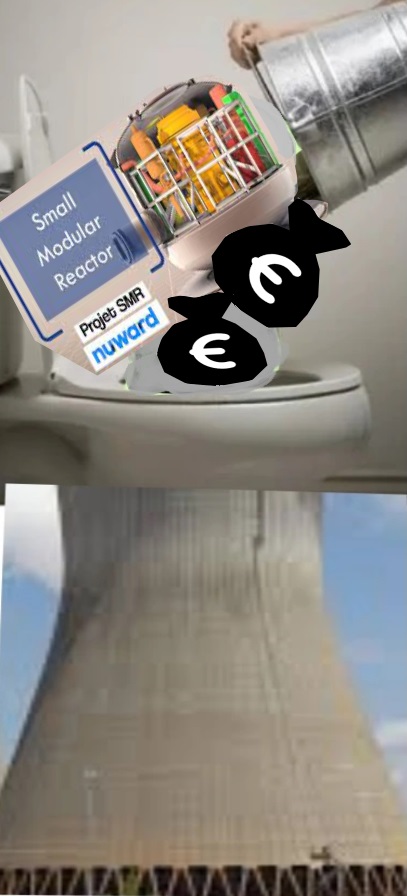
Another Small Modular Nuclear Reactor project goes down the toilet
This time it’s that great nuclear poster boy France that is facing the humiliation and embarrassment of wasting billions on “New Nuclear”
Last time it was the USA with the NuScale fiasco
Giles Parkinson Jul 2, 2024, https://reneweconomy.com.au/french-nuclear-giant-scraps-smr-plans-due-to-soaring-costs-will-start-over/
The French nuclear giant EdF, the government owned company that manages the country’s vast fleet of nuclear power stations, has reportedly scrapped its plans to develop a new design for small nuclear reactors because of fears of soaring costs.
EdF, which is now fully government owned after facing potential bankruptcy due to delays and massive cost over-runs at its latest generation large scale nuclear plants, had reportedly been working on a new design for SMRs for the last four years.
The French investigative outlet L’Informé reported on Monday that EdF had scrapped its new internal SMR design – dubbed Nuward – because of engineering problems and cost overruns. It cited company sources as saying EdF would now partner with other companies to use “simpler” technologies in an attempt to avoid delays and budget overruns.
Reuters confirmed the development, citing an email from a company spokesman that confirmed the program had been abandoned after the basic design had been completed.
“The reorientation consists of developing a design built exclusively from proven technological bricks. It will offer better conditions for success by facilitating technical feasibility,” an EDF spokesperson told Reuters via email.
Continue readingWhy Julian Assange couldn’t outrun the Espionage Act

the grave threat the Espionage Act poses to journalism and the First Amendment
SOTT, Jordan Howell The FIRE, Wed, 26 Jun 2024
Julian Assange spent seven years in self-exile in London’s Ecuadorian Embassy avoiding arrest, and five more in prison, for publishing classified documents on WikiLeaks.
Julian Assange is a free man, and one of the most contentious press freedom controversies in living memory may finally be coming to a close.
The WikiLeaks founder reached a plea deal with the Department of Justice on Monday after spending five years in an English prison fighting extradition to the United States. Federal officials sought to charge Assange with conspiracy to obtain and disclose national security information under the Espionage Act of 1917.
Assange and WikiLeaks shocked the world in 2010 by publishing hundreds of thousands of secret military documents and diplomatic cables related to the wars in Iraq and Afghanistan that were leaked by Army intelligence analyst Chelsea Manning. Months later, Assange was on the run and Manning was in jail.
Assange claimed that by receiving and publishing confidential information, what he did was no different than the type of routine news reporting that journalists around the world engage in every day. As the Supreme Court ruled in New York Times Co. v. United States (1971), better known as “The Pentagon Papers” case, publishing leaked documents is protected under the First Amendment.
FIRE has long opposed use of the Espionage Act to curtail the rights of journalists to source information. And in December 2022, FIRE signed an open letter organized by the Committee to Protect Journalists along with 20 other civil liberties groups calling on the federal government to drop its charges against Assange.
“We are united . . . in our view that the criminal case against him poses a grave threat to press freedom both in the United States and abroad,” we argued. “[J]ournalists routinely engage in much of the conduct described in the indictment: speaking with sources, asking for clarification or more documentation, and receiving and publishing official secrets. News organizations frequently and necessarily publish classified information in order to inform the public of matters of profound public significance.”
Assange’s 12 year ordeal, including seven years in self-exile in the Ecuadorian Embassy in London before his arrest and imprisonment, underscores the continued threat that the century-old Espionage Act still poses to civil liberties today — and not just in the United States. Assange is not a U.S. citizen, nor was he ever a resident. But because of modern extradition treaties, there were few places in the world where he could travel to escape the Act’s reach,
Under the terms of Monday’s deal, Assange pleaded guilty to the charges and was sentenced to 62 months incarceration, but with credit for time served, according to documents filed with the U.S. District Court for the Northern Mariana Islands.
Ultimately, freedom of the press is what was at stake with the government’s case against Assange. It was never only about him. The precedent that would have been set by his extradition and trial would have sent a chilling message to journalists across the country and the world: You can run, but you can’t hide from the Espionage Act.
What is the Espionage Act?……………………………………………………………………………………….Based on the Defense Secrets Act of 1911, the Espionage Act of 1917 included much stiffer penalties — including the death penalty — for sharing secret or confidential information or otherwise interfering with the operations of the U.S. military.
The Espionage Act made it a crime to obtain information regarding national defense “with intent or reason to believe” that doing so would hurt the U.S. or to advantage another country. While subsequent amendments and court decisions have refined its language and scope, its core purpose remains the same.
Espionage Act and the Supreme Court
The law was immediately controversial because its use was not limited to actual acts of espionage. Rather, the Espionage Act allowed the government to clamp down on anyone who opposed the war effort.
In Schenck v. United States, in 1919, the Supreme Court upheld the conspiracy conviction against socialist Charles Schenck under the Espionage Act for distributing anti-war leaflets that urged people to boycott the draft.
The problem with the Court’s ruling in Schenck, as subsequent decisions would affirm, is that Schenk’s speech was not calling for violence or even civil disobedience. Rather, his speech was precisely the kind of political expression that decades of subsequent Supreme Court decisions would ultimately uphold. Numerous convictions under the Espionage Act would make their way to the Court, including that of socialist presidential candidate Eugene Debs, who was arrested for giving a speech opposing the war.
Since then, one of the most nefarious uses of the Espionage Act has been to silence journalists. At least insofar as publishing the leaked documents on the Wikileaks website, what Assange did was little different than what The New York Times and The Washington Post did in 1971 when they published and reported on thousands of pages from a classified report about the war in Vietnam.
……………………………………….As the Supreme Court has ruled, freedom of the press is a foundational principle, enshrined in the Bill of Rights. And though Julian Assange is finally free, FIRE continues to have serious concerns about the grave threat the Espionage Act poses to journalism and the First Amendment. https://www.sott.net/article/492768-Why-Julian-Assange-couldnt-outrun-the-Espionage-Act
You Don’t Want to Live in America’s ‘Nuclear Sponge’

military planners often describe ICBMs as a “nuclear sponge” that would soak up hundreds of Russian warheads as they tried to destroy the missiles before they could launch.
People living in Montana, North Dakota, Wyoming and Colorado may not think of their homes as “nuclear sponges” but that is one of the primary justifications for ICBMs today………. . ICBMs are sitting ducks
By Joseph Cirincione, National Security Analyst, 3 July 24, https://www.newsweek.com/you-dont-want-live-americas-nuclear-sponge-opinion-1919646
ou have to be a real optimist to think that we can keep thousands of nuclear weapons in fallible human hands indefinitely and nothing terrible will happen. Something terrible will happen—and it could mean the end of human civilization.
The risks are growing. Today, nine nations hold over 12,000 nuclear weapons, each many times more powerful than those used on Japan. The United States and Russia have most of them—about 90 percent of the global total—but China may be trying to catch up.
The fear that China might increase its nuclear arsenal from some 500 to 1,000 weapons has fueled calls for America to abandon all arms control limits and vastly increase its stockpile of some 5,000 weapons. In fact, massive new programs to build a new generation of nuclear-armed bombers, submarines and missiles were well under way before China began its build up—and may well have triggered China’s move.
The cost of this new nuclear arms race is high. A new report shows that global spending on nuclear weapons jumped last year—and that the United States accounted for 80 percent of that increase.
The global costs and the U.S. share will grow. This year, U.S. spending climbed again to more than $70 billion. The Congressional Budget Office estimates that the government will spend over $750 billion on nuclear weapons over the next 10 years. The total modernization cost will likely be over $2 trillion. Add in the $30 billion a year spent on programs to try to intercept ballistic missiles and the cost goes from unimaginable to unaffordable.
It gets worse. The Air Force just disclosed that the price of its new intercontinental ballistic missile (ICBM) has jumped 37 percent. Originally, the Air Force claimed that replacing the existing force of 400 Minuteman III missiles would cost only $62 billion. That rose to $95 billion, then to more than $125 billion (plus tens of billions more for the nuclear warheads). In a new report, the watchdog group, Taxpayers for Common Sense, warns that the price tag could hit $315 billion.
For a family, a cost increase of 37 percent on a house or car they want to buy would certainly change their minds. Even for the Pentagon, this hike was “a critical breach” of cost projections, triggering a rare report to Congress.
This is likely why defense contractors are working furiously with their Congressional supporters to defend the program, supplying members with talking points and briefings, in addition to the generous contributions that flow into their campaign coffers. Members in the few states that have nuclear bases also do not want to lose the considerable economic benefits they provide.
Thus, Sen. Deb Fischer, a Republican from Nebraska, home to the Strategic Command, pleads in her recent piece for Newsweek, to continue the programs no matter what the cost. She argues that “Our ground-based intercontinental ballistic missiles (ICBMs) are indispensable. …by virtue of their location in our heartland, [they] are also unlikely to be targeted by enemy attacks.”
That would be a surprise to military planners who often describe ICBMs as a “nuclear sponge” that would soak up hundreds of Russian warheads as they tried to destroy the missiles before they could launch. This would complicate an adversary’s planning so severely that it would discourage any attack, the theory goes.
People living in Montana, North Dakota, Wyoming and Colorado may not think of their homes as “nuclear sponges” but that is one of the primary justifications for ICBMs today. Formerly valued as being more accurate and faster to launch than missiles from submarines, that is no longer the case. As the Taxpayers report notes. “Both ballistic missile submarines and nuclear-armed aircraft carry more accurate and powerful nuclear weapons than they used to,” allowing them to destroy even the most hardened target. Meanwhile, “the survivability of U.S. ICBMs has steadily declined as U.S. adversaries have developed more powerful and accurate nuclear weapons.”
Submarines are undetectable and bombers can be scrambled. ICBMs are sitting ducks that must be launched on warning of an enemy attack, stressing their human controllers to decide within minutes whether to launch Armageddon. Former Secretary of Defense William Perry says we must eliminate these relics of the Cold War, calling them, “some of the most dangerous weapons in the world. They could even trigger an accidental nuclear war.”
There have been dozens of close calls in the nuclear age, most caused by the need to launch these hulking missiles so quickly. Rep. John Garamendi (D-CA), Don Beyer (D-VA) and Sen. Ed Markey (D-MA) will hold a public hearing July 24 to examine the troubled missile program and “raise the alarm about our unsustainable, reckless nuclear posture.”
“We must confront the challenges before us, not by building ever more dangerous weapons,” says Garamendi, “but by placing the same priority on effective arms control and risk reduction measures that we currently place on modernization.”
This hearing may be our last, best chance to evaluate the risks of putting more nuclear weapons on hair-trigger alert before it is too late.
Joe Cirincione is the author or editor of seven books and over a thousand articles on nuclear policy and national security.
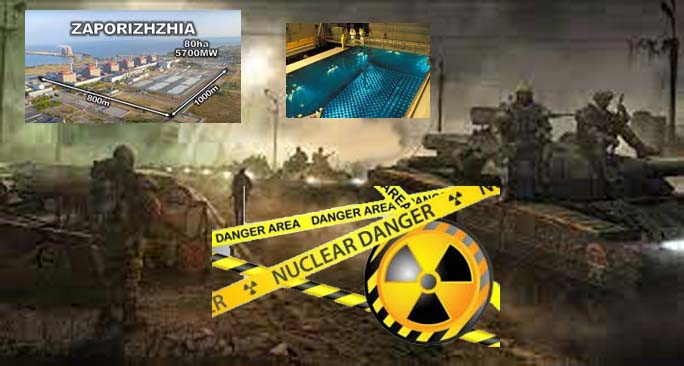
Russia might restart the Zaporizhzhia Ukrainian nuclear plant it seized, our new report shows
Charles Digges, Bellona, 2 July 24
“……………………………………………….. Russia has taken over the plant with its own technicians while coercing the Ukrainian workers who remain to sign contracts with Rosenergoatom, the branch of Rosatom, responsible for day-to-day operations at the 11 nuclear plants within Russia. The Kremlin has also spun off another commercial tendril from Rosatom to oversee the management of the captive plant.
But should a potential restart continue to unfold, the principal nuclear threat of Putin’s war on Ukraine could soon be an atomic energy station operating on the front lines of a protracted war.
Since early in the invasion, all of the Zaporizhzhia nuclear plant’s reactors have been placed in various states of shutdown. This was a critical safety measure, urged by the IAEA and agreed to by both Moscow and Kyiv, which would dampen the impact of a radiological disaster should any of the reactors suffer a catastrophic strike.
In this setting, the content of short-lived and highly dangerous radionuclides like iodine-131 in uranium fuel is much lower than if the plant was active because they have partially, or even completely decayed since September 2022. But once the reactors are restarted, these radionuclides will once again begin to form — making their spread into the environment a possibility should reactor containments be ruptured.
Despite the obvious risks, recent statements from Russian officials and, more concretely, the activities of Russia’s technical oversight agency within Ukraine, indicate that the plant’s Russian occupiers could move to restart at least one of the reactor units sometime this year — thus removing this important assurance against disaster.
To restart a reactor, Russian technicians would first have to guarantee an ample and stable supply of cooling water. This task was made more difficult by the destruction of the nearby Khakovka Dam in June 2023, which compromised several reservoirs used for precisely that purpose.
But over the past year, the Russian side has announced plans to replenish the plant’s damaged cooling ponds, which would then be capable of supplying up to three reactors.
Further, Russian technicians have begun to rewire the power grid to divert the electricity produced by the Zaporizhzhia nuclear plant toward Russia and the occupied territories of Ukraine. Satellite images of the Rosatom-controlled Zaporizhzhia Terminal Power Plant, which connects the nuclear plant to the Ukrainian grid, show evidence of efforts to shift powerlines away from Ukraine and into the occupied regions.
The plant has also recently played host to high-profile guests from Moscow. In April, Alexander Trembitsky, the head of Russia’s Federal Service for Environmental, Technological and Nuclear Supervision, Rostekhnadzor) visited the plant to review personnel certifications and work toward extending the lifespan of the reactors. Rostekhnadzor officials have also been codifying licensing requirements for the plant to operate under Russian purview and reviewing various plant systems since the start of the year.
That same month Sergei Kiriyenko, a former CEO of Rosatom and one of Putin’s first deputies, visited Enerhodar, where many plant workers live.
This flurry of activity followed a March meeting in Sochi between Putin, current Rosatom CEO Alexei Likhachev, and IAEA director general Rafael Grossi, during which, according to media reports, Putin stated his intentions to restart Zaporizhzhia’s reactors. This remains diplomatically unconfirmed by other sources, but recent events seem to bear those intentions out.
Kyiv vociferously protested Russia’s efforts to disconnect a nuclear plant that once supplied 5700 megawatts, or about 10%, of Ukraine’s entire electricity needs. There is little doubt that the military could fight back against any efforts to redirect this energy.
Still, efforts to relaunch the reactors may prove to be more effort than they are worth.
Fresh nuclear fuel and spare parts would have to be transported across war zones. The pump station enhancing cooling water supplies is being constructed under conditions of military conflict. Powerlines will have to be rerouted under fire. All of this will cost billions of rubles, which, in our analysis, will hardly be recouped by tariffs on the power one or two Zaporizhzhia reactors would produce. ………. https://bellona.org/news/nuclear-issues/2024-07-russia-might-restart-the-ukrainian-nuclear-plant-it-seized
Talent Shortage Threatens Europe’s Nuclear Renaissance
As many countries in Europe look to boost their nuclear power capacities
and build more reactors, companies face a workforce challenge as many of
the skilled force are retiring while younger generations choose energy jobs
in solar and wind. European countries and companies planning major
expansion in nuclear fleets are struggling to fill in thousands of skilled
engineering jobs that would support the construction of nuclear reactors,
which take years to complete. Companies in France are hiring back retirees
and are collaborating with colleges and universities to promote jobs in the
nuclear power sector.
Oil Price 3rd July 2024
Congressional group on nuclear arms sets July hearing for embattled missile program

The program, which is being led by defense contractor Northrop Grumman, is now expected to cost around $130 billion, up from initial projected costs of around $60 billion in 2015. It is also expected to be delayed by at least two years.
BY BRAD DRESS – 06/04/24, https://thehill.com/policy/defense/4703104-congressional-group-on-nuclear-arms-sets-july-hearing-for-embattled-missile-program/
The chairs of a congressional working group on nuclear arms announced Tuesday a late July hearing on the controversial Sentinel missile program, which has blown past its budget and triggered concerns among more progressive lawmakers on Capitol Hill.
Members of the Nuclear Weapons and Arms Control Working Group, co-chaired by Democrats Sen. Ed Markey (Mass.) and Reps. John Garamendi (Calif.) and Don Beyer (Va.), said the July 24 hearing would focus on testimony from experts in the nuclear arms world.
Garamendi said at a press conference that the goal of the hearing is to try to “engage Congress in its constitutional responsibility.”
Beyer added that he wants to “raise the alarm about our unsustainable, reckless nuclear posture.”
“We all understand the need for adequate nuclear deterrence,” said Beyer. “But our spending process and nuclear posture are becoming increasingly divorced from reality — a reality of scarce resources and a variety of competing national security priorities.”
The Tuesday press conference was also attended by former Rep. John Tierney (D-Mass.) and Daryl Kimball, executive director of the Arms Control Association.
“In the United States, there seems to be a sense of inevitability around the need to build up our own stockpile,” Tierney said, adding he was “demanding answers to questions about the programs that cost taxpayers hundreds of billions of dollars without making us one iota safer.”
Tierney said it was the duty of Congress to conduct oversight, but that many of his former colleagues were “eager to simply rubber stamp multibillion dollar programs without asking even the most basic questions.”
In January, Sentinel overshot its projected budget by 37 percent, forcing the Pentagon to step in and review the program.
The program, which is being led by defense contractor Northrop Grumman, is now expected to cost around $130 billion, up from initial projected costs of around $60 billion in 2015. It is also expected to be delayed by at least two years.
Most of Congress supports modernizing the nuclear arsenal and views land-based intercontinental ballistic missiles (ICBMs) as a vital part of nuclear deterrence, along with the other legs of the so-called triad: bomber planes and submarines.
Proponents argue the Sentinel program is a national security priority, especially with China and Russia modernizing or increasing their nuclear arms. Still, progressive Democrats have raised alarm about the ballooning costs and feasibility of the program.
The congressional working group on Tuesday called for the Pentagon to conduct a candid review of Sentinel, which Garamendi and Sen. Elizabeth Warren (D-Mass.) have previously pushed for.
And Markey called for the Pentagon to declassify the 2014 Analysis of Alternatives report that found it would be cheaper to create new Sentinel missiles than to life-extend the more than 50-year-old Minuteman III ICBMs. The Air Force has kept the report, which would detail how they arrived at that conclusion, classified.
Markey also pushed for a review of the costs for modernizing the entire nuclear triad and stressed his concerns about the “insanity” of spending hundreds of billions of dollars on updating nuclear weapons under the “guise” of protecting against national security risks.
“That is simply not an excuse to open up the federal government’s bank account to write a blank check made out to nuclear bombmakers with no transparency,” he said. “We have a responsibility to ensure we put the Sentinel program on the chopping block.”
Sentinel will replace the 400 Minuteman III ICBMs scattered across the rural Western U.S. in missile silos and deploy them through 2075. The program is a huge overhaul and involves a major real estate effort across several states that is driving up costs.
Garamendi tried to pass several amendments to rein in the Sentinel program in the annual defense bill that the House Armed Services Committee passed last month, but they were ultimately blocked aside from one requiring the Government Accountability Office to audit the Pentagon’s review of the program.
Garamendi has raised concerns about the difficulty to get Congress to conduct more oversight of the program.
“We want Congress to do its job,” Garamendi said.
SCOTTISH GREENS WILL OPPOSE ALL PLANS FOR NEW NUCLEAR ENERGY

Nuclear energy will leave a toxic and costly legacy.
Every vote for the Scottish Greens is a vote to oppose new nuclear energy, says the party’s Co-leader, Lorna Slater MSP, who said any expansion would leave “a costly and dangerous legacy.”
The party’s manifesto commits to opposing all new nuclear power, including the expansion or renewal of Scotland’s remaining nuclear power station at Torness.
The UK Tory government has pledged to triple nuclear power by 2050, and has announced plans for the biggest nuclear expansion for 70 years. Similarly Keir Starmer’s Labour Party has promised to expand it, with Mr Starmer calling it a “critical part” of his energy plan.
This follows news that the new Hinkley Point C reactor will now cost up to £46 billion and is expected to come online in 2031 rather than 2017.
In May 2024 the outgoing Secretary of State for Scotland, Alister Jack, said that he hoped the next UK government would work with anti-independence parties in Holyrood to impose a new nuclear reactor on Scotland.
Ms Slater said: “More nuclear power would leave a legacy of debt and radioactive waste for generations to come. Backing it is not just a distraction, it undermines our journey to 100% renewable energy. The Scottish Greens will oppose any attempts to expand or impose it.
“The disastrous mismanagement of Hinkley Point C tells us everything we need to know about how unreliable and expensive nuclear has become. It is now running 14 years behind schedule and costs have inflated to £46 billion – seven times Scotland’s entire annual capital budget.
“Even though Hinkley is on the South coast of England, Scottish households will be paying for this travesty for decades. It’s outrageous that instead of learning from this catastrophic mismanagement the Tories and Labour are committing to pouring even more of our money into new nuclear power.
“The Tory and Labour nuclear fantasies will do nothing for our climate and will leave future generations with a costly and dangerous legacy to clean up.
Scotland and the UK has a vast potential for renewable energy, but we need to invest in it. The huge sums of money being wasted on nuclear energy could be far better spent on rapidly expanding our green industries, delivering 100% renewable energy and investing in the jobs of the future.”
From the Scottish Greens manifesto
“New nuclear is outrageously expensive, unnecessary, dependent on the expertise and assets of foreign governments, and detracts from renewables. It will also leave generations to come with a costly and dangerous responsibility to keep the waste safe.
The disastrous Hinkley Point C project has been hit by a string of delays, and is now estimated to be costing an eye watering £46 billion, yet there is still no confidence as to when it will be online, and now Westminster are threatening to impose a new plant on Scotland against the policy of the Scottish Government.
We cannot afford to make the mistake of commissioning another new nuclear power plant. The Scottish Greens will oppose new nuclear power, and the expansion or renewal of Scotland’s remaining nuclear power station at Torness.
Unable to effectively operate its lone existing nuclear reactor, New Brunswick is betting on advanced options.
The International Panel found that sodium-cooled reactors proved expensive to build, complex to operate, prone to malfunctions, and difficult and expensive to repair. Sodium reacts violently with water and burns if exposed to air. Major sodium fires have occurred in previous reactors, often leading to lengthy shutdowns.
If NB Power needs outside assistance with a conventional reactor it has owned and operated for more than 40 years, one might question the wisdom of building two more featuring untested designs. Mr. Holland’s replacement as energy minister, Hugh Flemming, must now decide how comfortable he is with the province’s SMR ambitions.
Perhaps the most fundamental risk to New Brunswick’s SMR push is that the province can’t afford it.
MATTHEW MCCLEARN, JULY 2, 2024 https://www.theglobeandmail.com/business/article-new-brunswick-nuclear-reactor-technology-arc-clean-moltex-energy/
Mike Holland was among Canada’s leading evangelists for small modular nuclear reactors. During his tenure as New Brunswick’s energy minister, from 2018 to when he stepped down on June 20, he vigorously supported plans by the province’s Crown utility, NB Power, to construct two different small reactor designs from startup companies: U.S.-based ARC Clean Technology and Britain’s Moltex Energy. This represents Canada’s most ambitious – and perhaps riskiest – foray into bleeding-edge nuclear technology.
In an interview shortly before he resigned to pursue an opportunity in the private sector, Mr. Holland recalled how SMRs arrived on his agenda soon after he assumed office. He began exploring what advanced reactors could mean for decarbonizing the province’s electricity sector and growing its economy, and concluded New Brunswick could become a hub for nuclear design and manufacturing, and export reactors around the world.
“I saw the opportunity for New Brunswick to not just participate, but be a leader in this,” he said. “I am someone that loves to be on the cutting edge.”
His enthusiasm and risk tolerance proved a boon for ARC and Moltex, two tiny startups that have neither licensed nor constructed a commercial reactor. Under Mr. Holland’s leadership, New Brunswick became an incubator and helped the companies attract government funds to continue their work.
But NB Power is already struggling with persistent problems at its lone existing reactor at Point Lepreau Nuclear Generating Station. It has been negotiating a partnership with Ontario Power Generation that could see the latter assume partial ownership and help fix the ailing plant.
If NB Power needs outside assistance with a conventional reactor it has owned and operated for more than 40 years, one might question the wisdom of building two more featuring untested designs. Mr. Holland’s replacement as energy minister, Hugh Flemming, must now decide how comfortable he is with the province’s SMR ambitions.
Unconventional thinking
Nearly all of the more than 400 nuclear reactors operating today use water to cool their highly radioactive cores. Water also acts as a “moderator,” slowing down the high-energy neutrons produced by nuclear fission. Though water-cooled reactors have dominated for decades, they cost huge sums to build and produce waste that remains hazardous for countless human lifetimes. They’re vulnerable to severe (albeit rare) accidents that can render surrounding areas uninhabitable.
Virtually every SMR is marketed as addressing these and other shortcomings – and most have ditched water as coolant and moderator.
According to documents released by New Brunswick’s energy ministry through the province’s freedom of information legislation to researcher Susan O’Donnell, and provided to The Globe and Mail, in 2017 NB Power reviewed dozens of SMRs it read about in nuclear industry publications. It came up with a short list of five, which it later narrowed to ARC and Moltex, and enticed both companies to set up headquarters in Saint John.
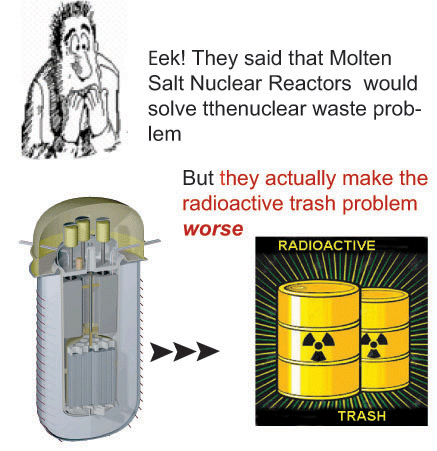
ARC and Moltex are pursuing what the industry calls “fast” neutron reactors, so named because they lack a moderator. The ARC-100 reactor would be cooled using liquid sodium metal and consume enriched uranium metal fuel. Moltex’s Stable Salt Reactor-Wasteburner (SSR-W), meanwhile, would use molten salt fuel placed in fuel assemblies similar to those in conventional reactors.
The SSR-W would require its own fuel reprocessing plant called WATSS (short for Waste to Stable Salt), which would convert Point Lepreau’s spent fuel into new fuel. For NB Power, that’s a major attraction: As of last summer, Point Lepreau had more than 170,000 Candu spent fuel bundles. Moltex says that’s enough to power its reactor for 60 years.
In May, 2019, NB Power sent a letter to Mr. Holland and Premier Blaine Higgs urging them to support fast reactors. The utility told its government masters that there was enough room at Point Lepreau for both reactors and that they could be up and running by 2030.
“These two technologies have different market applications and there is no downside to letting both of them work through the process,” the letter stated.
New Brunswick’s latest energy plan suggests electricity consumption will nearly double in the next few decades. NB Power’s challenge is to satisfy that demand while simultaneously reducing greenhouse gas emissions; Lori Clark, its chief executive, has cast SMRs as playing an important role in the utility’s efforts to reach net zero by 2035.
What New Brunswick covets most, however, is a shot of economic adrenalin.
Even optimists expect that SMR demonstration units will be too expensive to be economically attractive. Multiple units must be built to exploit economies of scale and reduce costs.
NB Power is counting on that. According to documents released under the federal Access to Information Act, the utility expects the first ARC-100 would be followed by 11 more units by mid-century. By then, up to 24 would be built in Canada, and the same number in other countries. And the first SSR-W would lead to 11 more built across Canada and two dozen more in the United States, Britain and Eastern Europe. If that happened, they’d be among the most successful models in history.
NB Power thought more than half of the components would be manufactured in New Brunswick. It also enthused about royalty payments on reactor sales, “potentially worth billions of dollars.”
Technical risks
But to realize any of that, New Brunswick’s SMR program must overcome technical challenges that have plagued the nuclear industry from its earliest days.
Edwin Lyman, a physicist at the Union of Concerned Scientists, has warned policy makers about the pitfalls of betting on “advanced” reactor designs, which he has studied over many years. “Developing new designs that are clearly superior to light water reactors overall is a formidable challenge, as improvements in one respect can create or exacerbate problems in another,” he wrote in a 2021 report.
Fast reactors, which originated in the earliest years of the nuclear age, bear this out. The U.S., Britain, the Soviet Union, France, Germany, Japan and India all pursued so-called “fast breeder” reactors that could produce more plutonium fuel than they consumed. A report that examined the history of those reactors, produced in 2010 by the International Panel on Fissile Materials, a group of arms control and non-proliferation experts, found member countries of the Organization for Economic Co-operation and Development collectively invested about US$50-billion researching breeder reactors. Outside the OECD, Russia and India also spent heavily.
They didn’t have much to show for it. According to the International Atomic Energy Agency, there are only two fast reactors currently generating electricity – both in Russia. The International Panel found that sodium-cooled reactors proved expensive to build, complex to operate, prone to malfunctions, and difficult and expensive to repair. Sodium reacts violently with water and burns if exposed to air. Major sodium fires have occurred in previous reactors, often leading to lengthy shutdowns.
As for molten salt reactors, there have only been two experimental exemplars, the most recent of which operated in the 1960s. Mr. Lyman’s 2021 report said molten salts were highly corrosive to many materials typically used in reactor construction. Moreover, “liquid nuclear fuels introduce numerous additional safety, environmental and proliferation risks.” Molten salt reactors likely couldn’t be built before the 2040s at the earliest, he concluded.
In addition to confronting such technical challenges, New Brunswick’s strategy also presupposes that reprocessing of spent fuel will be permitted and affordable. But a report published last year by the Nuclear Waste Management Organization, the industry-controlled organization tasked with disposing of Canada’s reactor waste, was skeptical on both counts.
NB Power is also counting on circumstances that are beyond its control. According to a letter signed by former CEO Keith Cronkhite in 2020 and released under the Access to Information Act, New Brunswick’s plan hinges on Ontario and other provinces building multiple BWRX-300s. (The letter was sent to Prime Minister Justin Trudeau.) If they do not, “SMR companies based in New Brunswick will not be able to attract private investment necessary to ever deploy a new reactor,” Mr. Cronkhite’s letter predicted.
The SMR plan is already falling behind schedule. At a rate hearing in June before the New Brunswick Energy and Utilities Board, Brad Coady, vice-president of strategic partnerships and business development, said NB Power believes it is no longer possible to have SMRs operating by 2030; the earliest date for the first unit has been pushed back to 2032 or 2033.
Delays will have consequences, because NB Power needs options to replace its coal-fired generation while at the same time satisfying growing demand for electricity. The utility, he said, has been studying alternative scenarios “if we don’t have them in time.”
Paying for it
Perhaps the most fundamental risk to New Brunswick’s SMR push is that the province can’t afford it.
Last year, ARC and Moltex each estimated that developing their reactors would cost around $500-million per company. NB Power is Canada’s most heavily indebted utility, and its budgets must be approved by the province’s Energy and Utilities Board. It has limited ability to pay for crucial early steps such as studies necessary to establish what the environmental consequences of the SMRs might be. In published reports, NB Power has acknowledged that its research and development efforts might have to be sacrificed to meet debt-reduction targets.
David Coon, leader of New Brunswick’s Green Party, said NB Power faces huge capital spending to retire its Belledune coal-fired generating plant and refurbish its Mactaquac hydroelectric dam and transmission lines.
“That is why they’re really not putting much into this,” he said. “Their approach has been, well, if we get a new nuclear plant out of this that that doesn’t really cost us much of anything, then bonus!”
ARC and Moltex also don’t have the money. In late June, ARC parted ways with CEO William Labbe and laid off an undisclosed number of staff – a move some observers said was likely due to a shortage of funds. Mr. Chronkite’s 2020 letter warned that the two SMR developers were small startups that couldn’t afford to do work using their own resources, and were at immediate risk of insolvency.
“Without federal support this year to the SMR developers in New Brunswick, one or both companies are expected to close their offices in the next year,” Mr. Cronkhite’s letter stated.
Indeed, New Brunswick officials have counted on continuing and generous support from Canadian taxpayers. In his letter, Mr. Cronkhite called on the federal government to provide $70.5-million that year to ARC and Moltex – and more than $100-million the following year – to “keep the SMR development option in New Brunswick viable.” In 2022, the two companies would need another $91-million.
Ottawa obliged, but only partly. It gave Moltex $50.5-million in 2021. The federal government also provided ARC $7-million last year. The lobbying efforts continue: When NB Power board vice-chair Andrew MacGillivray received his mandate letter in May, 2023, it instructed him to “support efforts to acquire federal funding” for the SMRs.
New Brunswick’s own history suggests the risks inherent in counting on boundless federal support.
Andrew Secord, an economics professor at St. Thomas University in Fredericton, has studied decision-making in the 1970s that led to the construction of the original Point Lepreau reactor. In a 2020 paper, he detailed how Point Lepreau arose in part from an export-led strategy under which multiple large reactors would be built and their electricity exported to New England. NB Power (then known as the New Brunswick Electric Power Commission, or NBEPC) first focused on building interconnections with New England and then pivoted to building reactors.
This strategy failed by 1972, but by that point NBEPC was unwilling to change course. Over the next three years, it assumed ever greater risks as potential partners failed to materialize.
“NBEPC managers continued along the nuclear path, exhibiting higher risk behaviour in the process,” Mr. Secord wrote. “As NBEPC executives spent more time and resources on the nuclear option, their personal attachment and the associated institutional commitment increased.”
Mr. Coon said New Brunswick’s SMR plan so far has cost the provincial and federal governments only around $100-million. But it could start costing taxpayers and ratepayers “much more money” if things progress further.
“It seems like we haven’t learned our lesson in New Brunswick,” he said.
When it comes to power, solar is about to leave nuclear and everything else in the shade

In Australia, solar is pushing down prices
Australia’s energy market operator says record generation from grid-scale renewables and rooftop solar is pushing down wholesale electricity prices.
Peter Martin, Visiting Fellow, Crawford School of Public Policy, Australian National University July 2, 2024 https://theconversation.com/when-it-comes-to-power-solar-is-about-to-leave-nuclear-and-everything-else-in-the-shade-233644
Opposition leader Peter Dutton might have been hoping for an endorsement from economists for his plan to take Australian nuclear.
He shouldn’t expect one from The Economist.
The Economist is a British weekly news magazine that has reported on economic thinking and served as a place for economists to exchange views since 1843.
By chance, just three days after Dutton announced plans for seven nuclear reactors he said would usher in a new era of economic prosperity for Australia, The Economist produced a special issue, titled Dawn of the Solar Age.
Whereas nuclear power is barely growing, and is shrinking as a proportion of global power output, The Economist reported solar power is growing so quickly it is set to become the biggest source of electricity on the planet by the mid-2030s.
By the 2040s – within this next generation – it could be the world’s largest source of energy of any kind, overtaking fossil fuels like coal and oil.
Solar’s off-the-charts global growth
Installed solar capacity is doubling every three years, meaning it has grown tenfold in the past ten years. The Economist says the next tenfold increase will be the equivalent of multiplying the world’s entire fleet of nuclear reactors by eight, in less time than it usually takes to build one of them.
To give an idea of the standing start the industry has grown from, The Economist reports that in 2004 it took the world an entire year to install one gigawatt of solar capacity (about enough to power a small city). This year, that’s expected to happen every day.
Energy experts didn’t see it coming. The Economist includes a chart showing that every single forecast the International Energy Agency has made for the growth of the growth of solar since 2009 has been wrong. What the agency said would take 20 years happened in only six.
The forecasts closest to the mark were made by Greenpeace – “environmentalists poo-pooed for zealotry and economic illiteracy” – but even those forecasts turned out to be woefully short of what actually happened.
And the cost of solar cells has been plunging in the way that costs usually do when emerging technologies become mainstream.
The Economist describes the process this way:
As the cumulative production of a manufactured good increases, costs go down. As costs go down, demand goes up. As demand goes up, production increases – and costs go down further.
Normally, this can’t continue. In earlier energy transitions – from wood to coal, coal to oil, and oil to gas – it became increasingly expensive to find fuel.
But the main ingredient in solar cells (apart from energy) is sand, for the silicon and the glass. This is not only the case in China, which makes the bulk of the world’s solar cells, but also in India, which is short of power, blessed by sun and sand, and which is manufacturing and installing solar cells at a prodigious rate.
Solar easy, batteries more difficult
Batteries are more difficult. They are needed to make solar useful after dark and they require so-called critical minerals such as lithium, nickel and cobalt (which Australia has in abundance).
But the efficiency of batteries is soaring and the price is plummeting, meaning that on one estimate the cost of a kilowatt-hour of battery storage has fallen by 99% over the past 30 years.
In the United States, plans are being drawn up to use batteries to transport solar energy as well as store it. Why build high-voltage transmission cables when you can use train carriages full of batteries to move power from the remote sunny places that collect it to the cities that need it?
Solar’s step change
The International Energy Agency is suddenly optimistic. Its latest assessment released in January says last year saw a “step change” in renewable power, driven by China’s adoption of solar. In 2023, China installed as much solar capacity as the entire world did in 2022.
The world is on track to install more renewable capacity over the next five years than has ever been installed over the past 100 years, something the agency says still won’t be enough to get to net-zero emissions by 2050.
That would need renewables capacity to triple over the next five years, instead of more than doubling.
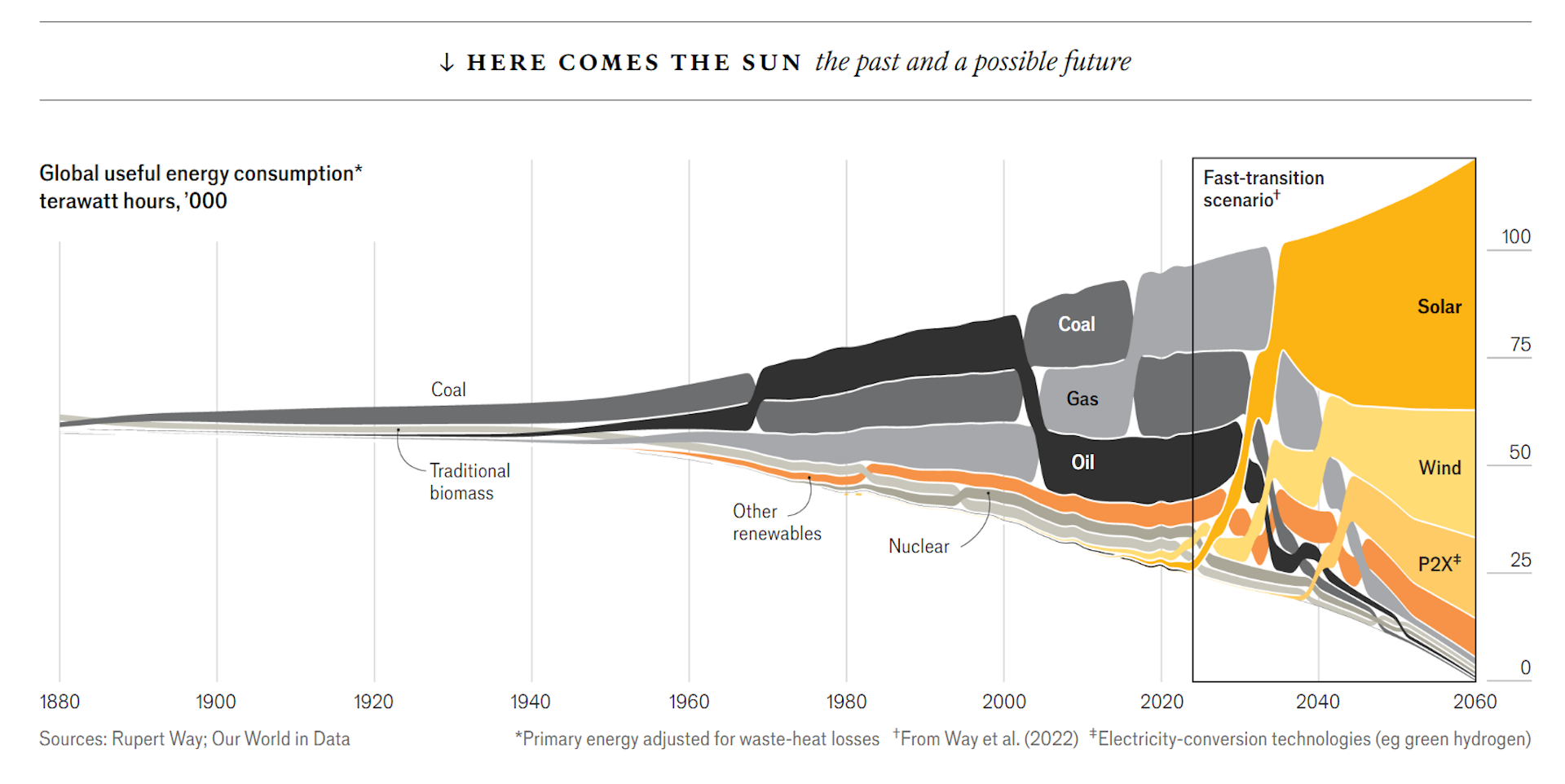
Oxford University energy specialist Rupert Way has modelled a “fast transition” scenario, in which the costs of solar and other new technologies keep falling as they have been rather than as the International Energy Agency expects.
He finds that by 2060, solar will be by far the world’s biggest source of energy, exceeding wind and green hydrogen and leaving nuclear with an infinitesimally tiny role.
In Australia, solar is pushing down prices
Australia’s energy market operator says record generation from grid-scale renewables and rooftop solar is pushing down wholesale electricity prices.
South Australia and Tasmania are the states that rely on renewables the most. They are the two states with the lowest wholesale electricity prices outside Victoria, whose prices are very low because of its reliance on brown coal.
It is price – rather than the environment – that most interests The Economist. It says when the price of something gets low people use much, much more of it.
As energy gets really copious and all but free, it will be used for things we can’t even imagine today. The Economist said to bet against that is to bet against capitalism.
1 This Month

of the week – Shut Down Drone Warfare!


Tell the Ukrainian Government to Drop Prosecution of Peace Activist Yurii Sheliazhenko

Petition to revoke the licensing of the Near Surface Nuclear Disposal Facility (NSDF) at Chalk River. https://www.ourcommons.ca/petitions/en/Petition/Details?Petition=e-7247
To see nuclear-related stories in greater depth and intensity – go to https://nuclearinformation.wordpress.com
-
Archives
- April 2026 (79)
- March 2026 (251)
- February 2026 (268)
- January 2026 (308)
- December 2025 (358)
- November 2025 (359)
- October 2025 (376)
- September 2025 (257)
- August 2025 (319)
- July 2025 (230)
- June 2025 (348)
- May 2025 (261)
-
Categories
- 1
- 1 NUCLEAR ISSUES
- business and costs
- climate change
- culture and arts
- ENERGY
- environment
- health
- history
- indigenous issues
- Legal
- marketing of nuclear
- media
- opposition to nuclear
- PERSONAL STORIES
- politics
- politics international
- Religion and ethics
- safety
- secrets,lies and civil liberties
- spinbuster
- technology
- Uranium
- wastes
- weapons and war
- Women
- 2 WORLD
- ACTION
- AFRICA
- Atrocities
- AUSTRALIA
- Christina's notes
- Christina's themes
- culture and arts
- Events
- Fuk 2022
- Fuk 2023
- Fukushima 2017
- Fukushima 2018
- fukushima 2019
- Fukushima 2020
- Fukushima 2021
- general
- global warming
- Humour (God we need it)
- Nuclear
- RARE EARTHS
- Reference
- resources – print
- Resources -audiovicual
- Weekly Newsletter
- World
- World Nuclear
- YouTube
-
RSS
Entries RSS
Comments RSS
 nuclear-news