Why the Australian Opposition Party is not genuinely interested in nuclear power, (just in prolonging fossil fuels)

This is the truth at the heart of the Coalition’s latest climate fantasy: it gives people concerned about the speed and impact of the energy transition an alternative reality where this change doesn’t have to happen.
The Coalition’s nuclear fantasy serves short-term political objectives – and its fossil fuel backers
This is the truth at the heart of the Coalition’s latest climate fantasy: it gives people concerned about the speed and impact of the energy transition an alternative reality where this change doesn’t have to happen.
Dutton’s policy latches on to genuine concerns about power prices and disruption evident in the latest Guardian Essential report, but what are its real motivations?
Peter Lewis, 2 July 24 https://www.theguardian.com/australia-news/commentisfree/article/2024/jul/02/coalition-nuclear-policy-peter-dutton-power-plants
In 1959 the US government hatched a covert scheme to replace every single bird with a replicant surveillance drone to spy on its own citizens. This is only the second silliest theory flying around the internet right now.
Peter Dutton’s make-believe nuclear plan bears some of the hallmarks of Peter McIndoe’s actual piss-take, “Birds Aren’t Real”, which became so real he wound up doing interviews with Fox News and running large-scale community rallies where only some of the participants were chanting his nonsense slogan ironically.
There’s not too great a distance from ‘bird truthers’ to the Coalition’s latest permutation of fossil-fuelled climate skepticism.
In a world where information is driven by platform algorithms designed to maximise attention and reinforce existing prejudices, any theory can find a home; the crazier and louder the claims, the more likely they are to take off.
This is the truth at the heart of the Coalition’s latest climate fantasy: it gives people concerned about the speed and impact of the energy transition an alternative reality where this change doesn’t have to happen.
As this week’s Guardian Essential Report shows, support for renewable energy is contested. Lining up renewables, nuclear and fossil fuels, we found a lack of consensus on price, environmental impact and economic consequence.
While renewables are seen as the best energy source for the environment and most desirable overall, fossil fuels are seen as cheaper and better for jobs. It is here that the Coalition’s nuclear fantasy plays a critical bridging role.
The rollout of the renewable energy grid is a genuinely disruptive development; coal communities genuinely fear for their long-term economic future; consumers genuinely feel power prices rising as the rollout of renewables gathers momentum.
Coalition energy spokesperson Ted O’Brien is tasked with convincing those who have genuine concerns that if they just embrace nuclear, they can stop all these things they don’t like and still hit net zero by 2050.
Just like the bird conspiracy, this nuclear policy isn’t real: it has no scope, no production estimate, no costings, no timeline. But it’s a device that serves a flock of short-term political objectives.
It creates a reason to delay decommissioning coal and gas because, like magic, nuclear will provide a short cut. That’s good for the LNP’s fossil fuel backers and communities that rely on the production of these energy sources.
It offers hope to coal communities that they can become home to a new heavy industry. While critics of nuclear can make fun of the three-headed fish near the Springfield, the truth is Homer Simpson enjoyed the sort of secure job these communities fear will soon disappear.
And it sends a message to every regional community that they might not need to host the new renewable energy grid that is being rolled out. Because if you have a choice between looking out across a valley or looking out across power lines, who wouldn’t take the valley?
The problem for the Albanese government is that while each of these justifications is patently false, attacking them head-on risks a rerun of the voice referendum dynamic where “two sides” reporting creates a false equivalence that ends up defining the contest as a coin toss.
Exacerbating this challenge is the fact that fewer people trust the main proponents of the energy transition – the government and energy companies. Instead, trust is anchored at the level of the local.
The only people we really trust are those who we know personally – our friends and family and members of our community. Which raises the question, who do the people we trust get their information from? Perversely, the answer can only be “us”.
As McIndoe riffs in a hilarious piece of performance media: “Just because it’s a theory doesn’t mean its fake. It’s on the media, you can find it … Truth is subjective … There’s different proof out there for different things and if you do your research, you just might find it.”
Given this environment, the choice for Labor is whether to get dragged into a nuclear showdown where alternate facts will be wished into existence or simply dismiss the whole charade as the piece of political theatre it is.
A final question in this week’s report suggests the more effective way of confronting the nuclear “debate” is what disinformation experts call “pre-bunking” by calling out the opposition’s real motivations.
These findings show that half the electorate – and nearly two-thirds of young people – will reject the idea that this is a legitimate debate at all. Taking these people out of the equation before embarking on any merit analysis drastically reduces the number of votes in play.
Rather than trading economic models or platforming nuclear safety fears, the best approach might actually be the most honest one: to drag nuclear back into the political swamp from which it has risen.
First, expose the interests that will benefit from Dutton’s nuclear fantasy. Put the spotlight on the fossil fuel and nuclear players, who runs them, where they converge, who they pay to keep their dream alive and how much they stand to make by delaying the energy transition for a couple more decades.
Second, take away the oxygen for nuclear by doing the hard work required to build social licence for renewables, responding to legitimate concerns by giving communities a greater say in the way development occurs and how both costs and benefits are distributed.
Finally, turn the opposition to renewables back on to the LNP. While the political opportunism of the Dutton nuclear play is obvious, there are also risks that this decision comes to define not just him as a leader, but his entire political apparatus.
In a world where younger generations just want to get on with the job of addressing climate change, a major political party is walking away from this challenge in the interests of its corporate masters.
That’s the real conspiracy. And it’s not just a theory.
- Peter Lewis is the executive director of Essential and host of Per Capita’s Burning Platforms podcast
Confronting NATO’s War Summit in Washington

But NATO’s leaders are not coming to Washington to work out how they can comply with their international obligations and negotiate peace in Ukraine. On the contrary. At a June meeting in preparation for the Summit, NATO defense ministers approved a plan to put NATO’s military support to Ukraine “on a firmer footing for years to come.”
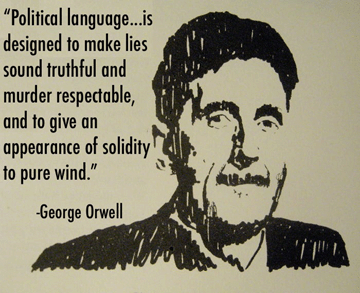
Echoing George Orwell’s doublethink that “war is peace”, NATO Secretary General Stoltenberg said, “The paradox is that the longer we plan, and the longer we commit [to war], the sooner Ukraine can have peace.”
By Medea Benjamin and Nicolas J. S. Davies, World BEYOND War, July 1, 2024
“…………..The details of NATO’s agenda for the Washington summit were revealed at a NATO foreign ministers’ meeting in Prague at the end of May. NATO will drag its members into the U.S. Cold War with China by accusing it of supplying dual-use weapons technology to Russia, and it will unveil new NATO initiatives to spend our tax dollars on a mysterious “drone wall” in the Baltics and an expensive-sounding “integrated air defense system” across Europe.
But the main feature of the summit will be a superficial show of unity to try to convince the public that NATO and Ukraine can defeat Russia and that negotiating with Russia would be tantamount to surrender.
On the face of it, that should be a hard sell. The one thing that most Americans agree on about the war in Ukraine is that they support a negotiated peace. When asked in a November 2023 Economist/YouGov poll “Would you support or oppose Ukraine and Russia agreeing to a ceasefire now?,” 68% said “support,” and only 8% said “oppose,” while 24% said they were not sure.
However, while President Biden and NATO leaders hold endless debates over different ways to escalate the war, they have repeatedly rejected peace negotiations, notably in April 2022, November 2022 and January 2024, even as their failed war plans leave Ukraine in an ever worsening negotiating position.
The endgame of this non-strategy is that Ukraine will only be allowed to negotiate with Russia once it is facing total defeat and has nothing left to negotiate with – exactly the surrender NATO says it wants to avoid.
As other countries have pointed out at the UN General Assembly, the U.S. and NATO’s rejection of negotiation and diplomacy in favor of a long war they hope will eventually “weaken” Russia is a flagrant violation of the “Pacific Settlement of Disputes” that all UN members are legally committed to under Chapter VI of the UN Charter. As it says in Article 33(1),
“The parties to any dispute, the continuance of which is likely to endanger the maintenance of international peace and security, shall, first of all, seek a solution by negotiation, enquiry, mediation, conciliation, arbitration, judicial settlement, resort to regional agencies or arrangements, or other peaceful means of their own choice.”
But NATO’s leaders are not coming to Washington to work out how they can comply with their international obligations and negotiate peace in Ukraine. On the contrary. At a June meeting in preparation for the Summit, NATO defense ministers approved a plan to put NATO’s military support to Ukraine “on a firmer footing for years to come.”
The effort will be headquartered at a U.S. military base in Wiesbaden, Germany, and involve almost 700 staff. It has been described as a way to “Trump proof” NATO backing for Ukraine, in case Trump wins the election and tries to draw down U.S. support.
At the Summit, NATO Secretary General Stoltenberg wants NATO leaders to commit to providing Ukraine with $43 billion worth of equipment each year, indefinitely. Echoing George Orwell’s doublethink that “war is peace”, Stoltenberg said, “The paradox is that the longer we plan, and the longer we commit [to war], the sooner Ukraine can have peace.”
The Summit will also discuss how to bring Ukraine closer to NATO membership, a move that guarantees the war will continue, since Ukrainian neutrality is Russia’s principal war aim.
As Ian Davis of NATO Watch reported, NATO’s rhetoric echoes the same lines he heard throughout twenty years of war in Afghanistan: “The Taliban (now Russia) can’t wait us out.” But this vague hope that the other side will eventually give up is not a strategy.
There is no evidence that Ukraine will be different from Afghanistan. The U.S. and NATO are making the same assumptions, which will lead to the same result. The underlying assumption is that NATO’s greater GDP, extravagant and corrupt military budgets and fetish for expensive weapons technology must somehow, magically, lead Ukraine to victory over Russia.
When the U.S. and NATO finally admitted defeat in Afghanistan, it was the Afghans who had paid in blood for the West’s folly, while the US-NATO war machine simply moved on to its next “challenge,” learning nothing and making political hay out of abject denial.
Less than three years after the rout in Afghanistan, US Defense Secretary Austin recently called NATO “the most powerful and successful alliance in history.” It is a promising sign for the future of Ukraine that most Ukrainians are reluctant to throw away their lives in NATO’s dumpster-fire.
In an article titled “The New Theory of Ukrainian Victory Is the Same as the Old,” the Quincy Institute’s Mark Episkopos wrote, “Western planning continues to be strategically backwards. Aiding Kyiv has become an end in itself, divorced from a coherent strategy for bringing the war to a close”.
Episkopos concluded that “the key to wielding [the West’s] influence effectively is to finally abandon a zero-sum framing of victory…”
We would add that this was a trap set by the United States and the United Kingdom, not just for Ukraine, but for their NATO allies too. By refusing to support Ukraine at the negotiating table in April 2022, and instead demanding this “zero-sum framing of victory” as the condition for NATO’s support, the U.S. and U.K. escalated what could have been a very short war into a protracted, potentially nuclear, war between NATO and Russia.
Turkish leaders and diplomats complained at how their American and British allies undermined their peacemaking, while France, Italy and Germany squirmed for a month or two but soon surrendered to the war camp.
When NATO leaders meet in Washington, what they should be doing, apart from figuring out how to comply with Article 33(1) of the UN Charter, is conducting a clear-eyed review of how this organization that claims to be a force for peace keeps escalating unwinnable wars and leaving countries in ruins.
The fundamental question is whether NATO can ever be a force for peace or whether it can never be anything but a dangerous, subservient extension of the U.S. war machine……………………………..
the world’s population that is suffering under the yoke of militarism cannot afford to wait for NATO to give up and go away of its own accord. Our fellow citizens and political leaders need to hear from us all about the dangers posed by this unaccountable, nuclear-armed war machine, and we hope you will join us—in person or online—in using the occasion of this NATO summit to sound the alarm loudly.
Medea Benjamin and Nicolas J. S. Davies are the authors of War in Ukraine: Making Sense of a Senseless Conflict, published by OR Books in November 2022.
Medea Benjamin is the cofounder of CODEPINK for Peace, and the author of several books, including Inside Iran: The Real History and Politics of the Islamic Republic of Iran.
Nicolas J. S. Davies is an independent journalist, a researcher for CODEPINK and the author of Blood on Our Hands: The American Invasion and Destruction of Iraq. https://worldbeyondwar.org/confronting-natos-war-summit-in-washington/
“They just fit in with what we do:” Australian farmers reap rewards as they play host to wind and solar
ReNewEconomy Liv Casben, Jun 29, 2024
Renewables in agriculture are gaining momentum across the nation as Australia pushes to reach its net-zero emissions target by 2050.
Australia’s energy market operator has declared renewables as the most cost-effective way of reaching net-zero targets in the grid, but just how much of the load will be carried by the farming sector remains unclear.
Across pockets of the nation, farmers are already doing their bit to reduce their carbon footprint.
“Anecdotally, we have seen a huge increase in farmers seeking renewables projects as farmers seek to increase the productivity of their farms,” Farmers for Climate Action’s Natalie Collard told AAP.
“Renewables offer drought-proof income, and drought-proof income keeps farms going through the toughest of times.”
The Lee family has farmed at Glenrowan West for 150 years, but for the past three years they’ve also added solar to the mix.
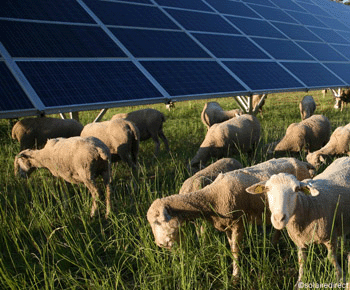
A German-based company leases the land from the Lees and maintains the solar panels, which run alongside the sheep farming operation.
“The lessee basically runs it just as another paddock, the sheep go in just as they would under any other farming operation,” Gayle Lee said. “We haven’t found there to be any noticeable loss of production.”
……………………………………………………. Karin Stark, who will host the annual Renewables in Agriculture conference in Toowoomba next week, says consultation is key to farmers playing a “critical role” in the renewables transition and keeping everyone happy…………… more https://reneweconomy.com.au/they-just-fit-in-with-what-we-do-farmers-reap-rewards-as-they-play-host-to-wind-and-solar/?fbclid=IwZXh0bgNhZW0CMTEAAR0qML5s3XgsQ3EZd5pJl15CdGXQ60-BC3TLkIVpcaWkgLsBSarHkHoPUYI_aem_OC5kzgz0cTiwWtnLVva56A
The Release of Julian Assange: Plea Deals and Dark Legacies

It ultimately goes to the brutal exercise of US extraterritorial power against any publisher, irrespective of outlet and irrespective of nationality…………….. the measure extracts a pound of flesh from the fourth estate. It signals that the United States can and will seek out those who obtain and publish national security information that they would rather keep under wraps under spurious notions of “harm”.
June 27, 2024, by: Dr Binoy Kampmark https://theaimn.com/the-release-of-julian-assange-plea-deals-and-dark-legacies-2/
One of the longest sagas of political persecution is coming to its terminus. That is, if you believe in final chapters. Nothing about the fate of Julian Assange seems determinative. His accusers and inquisitors will draw some delight at the plea deal reached between the WikiLeaks founder’s legal team and the US Department of Justice. Others, such as former US Vice President, Mike Pence, thought it unjustifiably lenient.
Alleged to have committed 18 offences, 17 novelly linked to the odious Espionage Act, the June 2020 superseding indictment against Assange was a frontal assault on the freedoms of publishing and discussing classified government information. At this writing, Assange has arrived in Saipan, located in the US commonwealth territory of Northern Mariana Islands in the Western Pacific, to face a fresh indictment. It was one of Assange’s conditions that he would not present himself in any court in the United States proper, where, with understandable suspicion, he might legally vanish.
As correspondence between the US Department of Justice and US District Court Chief Judge Ramona V. Manglona reveals, the “proximity of this federal US District Court to the defendant’s country of citizenship, Australia, to which we expect he will return at the conclusion of proceedings” was also a factor.
Before the US District Court for the Northern Mariana Islands, he will plead guilty to one count of conspiracy to obtain and disclose national defence information under the Espionage Act of 1917, or section 793(g) (Title 18, USC). The felony carries a fine up to $10,000 and/or up to 10 years in prison, though Assange’s time in Belmarsh Prison, spent on remand for some 62 months, will meet the bar.
The felony charge sheet alleges that Assange knowingly and unlawfully conspired with US Army intelligence analyst Chelsea Manning, then based at Operating Base Hammer in Iraq, to receive and obtain documents, writings and notes, including those of a secret nature, relating to national defence, wilfully communicated those documents from persons with lawful possession of or access to them to those not entitled to receive them, and do the same from persons unauthorised to possess such documents.
Before turning to the grave implications of this single count and the plea deal, supporters of Assange, including his immediate family, associates and those who had worked with him and drunk from the same well of publishing, had every reason to feel a surreal sense of intoxication. WikiLeaks announced Assange’s departure from London’s Belmarsh Prison on the morning of June 24 after a 1,901 day stint, his grant of bail by the High Court in London, and his release at Stansted Airport. Wife Stella regularly updated followers about the course of flight VJ199. In coverage posted of his arrival at the federal court house in Saipan, she pondered “how overloaded his senses must be, walking through the press scrum after years of sensory depravation and the four walls” of his Belmarsh cell.
As for the plea deal itself, it is hard to fault it from the emotional and personal perspective of Assange and his family. He was ailing and being subjected to a slow execution by judicial process. It was also the one hook upon which the DOJ, and the Biden administration, might move on. This being an election year in the US, the last thing President Biden wanted was a haunting reminder of this nasty saga of political persecution hovering over freedom land’s virtues.
There was another, rather more sordid angle, and one that the DOJ had to have kept in mind in thinning the charge sheet: a proper Assange trial would have seen the murderous fantasies of the CIA regarding the publisher subject to scrutiny. These included various possible measures: abduction, rendition, even assassination, points thoroughly explored in a Yahoo News contribution in September 2021.
One of the authors of the piece, Zach Dorfman, posted a salient reminder as news of the plea deal filtered through that many officials during the Trump administration, even harsh critics of Assange, “thought [CIA Director Mike] Pompeo’s extraordinary rendition plots foolhardy in the extreme, and probably illegal. They also – critically – thought it might harm Assange’s prosecution.” Were Pompeo’s stratagems to come to light, “it would make the discovery process nightmarish for the prosecution, should Assange ever see trial.”
From the perspective of publishers, journalists and scribblers keen to keep the powerful accountable, the plea must be seen as enormously troubling. It ultimately goes to the brutal exercise of US extraterritorial power against any publisher, irrespective of outlet and irrespective of nationality. While the legal freight and prosecutorial heaviness of the charges was reduced dramatically (62 months seems sweetly less imposing than 175 years), the measure extracts a pound of flesh from the fourth estate. It signals that the United States can and will seek out those who obtain and publish national security information that they would rather keep under wraps under spurious notions of “harm”.
Assange’s conviction also shores up the crude narrative adopted from the moment WikiLeaks began publishing US national security and diplomatic files: such activities could not be seen as journalistic, despite their role in informing press commentary or exposing the venal side of power through leaks.
From the lead prosecuting attorney Gordon Kromberg to such British judges as Vanessa Baraitser; from the national security commentariat lodged in the media stable to any number of politicians, including the late California Democrat Dianne Feinstein to the current President Joe Biden, Assange was not of the fourth estate and deserved his mobbing. He gave the game away. He pilfered and stole the secrets of empire.
To that end, the plea deal makes a mockery of arguments and effusive declarations that the arrangement is somehow a victory for press freedom. It suggests the opposite: that anyone publishing US national security information by a leaker or whistleblower is imperilled. While the point was never tested in court, non-US publishers may be unable to avail themselves of the free speech protections of the First Amendment. The Espionage Act, for the first time in history, has been given a global, tentacular reach, made a weapon against publishers outside the United States, paving the way for future prosecutions.
Big Tech is turning to nuclear power because it needs more energy for AI

Amazon Web Services is reportedly making a deal for electricity from a nuclear power plant
By Britney Nguyen, https://qz.com/big-tech-nuclear-power-plants-ai-energy-electricity-1851569796 2 July 24
The generative artificial intelligence boom has led to a massive demand for electricity — and tech companies are turning to nuclear power to feed it.
A third of nuclear power plants in the U.S. are discussing deals with tech companies to supply electricity for data centers powering leading AI models, The Wall Street Journal reports. The Journal, citing unnamed sources familiar with the matter, reports that Amazon Web Services is closing in on a deal for electricity from Constellation Energy, the largest owner of nuclear power plants in the country. The Amazon subsidiary bought a nuclear-powered data center from Talen Energy in March for $650 million. Amazon did not immediately respond to a request for comment.
As tech companies race to develop larger, more powerful AI models, the overwhelming demand for electricity to power the technology could eventually slow down the race. In April, Ami Badani, chief marketing officer of the chip design firm Arm, said data centers currently make up 2% of global energy consumption. With the rapid growth of AI, Badani predicted that energy consumption from the industry could make up a fourth of all power use in the U.S. by the end of the decade.
“We won’t be able to continue the advancements of AI without addressing power,” Badani said. “ChatGPT requires 15 times more energy than a traditional web search.”
By 2030, data centers could consume up to 9% of electricity in the U.S. — more than double what is being used now, according to the Electric Power Research Institute.
In April, OpenAI chief executive Sam Altman was among investors in Exowatt, a startup developing modules that store energy as heat and produce electricity for AI data centers. The startup raised $20 million in a round that also included venture capital firm Andreessen Horowitz.
U.S. Congress Votes To Bar State Department From Citing Gazan Health Ministry

If passed into law, US diplomats would be unable to discuss casualty figures from Palestinian sources that are generally considered credible.
by Kyle Anzalone June 27, 2024 https://news.antiwar.com/2024/06/27/house-votes-to-bar-state-department-from-citing-gazan-health-ministry/
During the debate of the State Department funding bill, the House added a provision that would bar American diplomats from citing statistics from the Gaza Health Ministry. The amendment would prevent American diplomats from discussing the casualty figures produced by the Palestinian agency.
On Thursday, the House voted 269-144 for an amendment to the Department of State appropriations bill proposed by a bipartisan group led by Rep. Jared Moskowitz (D-FL). The provision “prohibits funds appropriated by this act to be made available for the State Department to cite statistics obtained from the Gaza Health Ministry.”
The amendment received bipartisan support. All but 14 Republicans voted yes, with Reps. Paul Gosar (AZ) and Matt Rosendale (MT) are the only no votes. The Democrats split support 69-114. The Democratic leadership in the House elected not to endorse or oppose the amendment.
During Israel’s nearly nine-month-long onslaught in Gaza, the Health Ministry has recorded nearly 38,000 deaths and 85,000 injuries. Many of those injured have life-altering wounds. The head of the UN Palestinian Aid Agency (UNRWA) estimates that over 2,000 children, or nearly ten per day, have lost legs since October 7.
Prior to Israel’s most recent military campaign in Gaza, the casualty figures were generally considered accurate and regularly cited by Western media. During Israel’s “Swords of Iron” operations, the corporate press has started to slant cover of those numbers by asserting Hamas runs the health ministry whenever the numbers are reported.
However, many human rights groups and officials believe the official figures are an undercount. Save the Children estimates that in addition to the 15,000 dead Palestinian children counted by the health ministry, an additional 4,000 are uncounted because their bodies have not been recovered.
During the debate over Moskowitz’s amendment, Rep Rashida Tlaib blasted the provisions as being a part of the decades-long coordinated effort by the House to “erase Palestinians from existence.”
“Today, we are witnessing the apartheid Israeli government carry out a genocide in real-time. This amendment is an attempt to hide it.” She added, “My colleagues don’t even want to acknowledge that Palestinians exist at all.”
Why cost should not be an obstacle to compensating nuclear survivors
By Alicia Sanders-Zakre, Susi Snyder | July 1, 2024, https://thebulletin.org/2024/07/why-cost-should-not-be-an-obstacle-to-compensating-nuclear-survivors/?utm_source=Newsletter+&utm_medium=Email&utm_campaign=MondayNewsletter07012024&utm_content=NuclearRisk_CompensatingNuclearSurvivors_07012024
Passing an extended and expanded Radiation Exposure Compensation Act (RECA) would be an enormous victory for those affected by US nuclear weapons testing and development who will receive compensation from the legislation. A proposed revised bill would include many communities formerly left out from the compensation program, including additional residents of Arizona, Nevada and Utah, for the first time, residents of Colorado, Idaho, Guam, Montana and New Mexico, uranium miners after 1971, veterans of nuclear waste clean-up in the Marshall Islands, and St. Louis area residents exposed to nuclear waste. The bill, originally estimated by the Congressional Budget Office to cost $147 billion over 10 years, was cut down to cost $50 billion over 10 years, due to concerns by members of Congress about the expense. A RECA bill has gained overwhelming support in the Senate, but it has yet to be passed by the House, in part due to ongoing concerns about the price tag.
Our research shows that more resources exist and should be directed to this important effort, in the United States and internationally, where many nuclear survivors still wait for justice. In our report, we found that nuclear-armed countries spent $91.4 billion on nuclear weapons in 2023 alone. That’s nearly $3,000 every second. The United States spent more than half of that total – $51.5 billion or $1,633 per second. In the five years that we have done this research, from 2019 to 2023, governments have spent a total of $387 billion on nuclear arsenals. The United States alone spent more than $212 billion of that total.
The amount that the United States and other nuclear-armed governments have put towards addressing the harmful legacy of nuclear weapons for their citizens pales by comparison. Since RECA was passed in 1990, the United States has put $2.67 billion into one-time settlements to compensate those whom the United States considered eligible. To address the nuclear legacy of its testing in the Marshall Islands, the United States gave $150 million to establish a Nuclear Claims Tribunal in 1987, but has not provided further funds explicitly for this purpose since.
Internationally, compensation for survivors also comes up short. Russian nuclear test veterans receive one-time compensation for harm to health of 22,102 roubles ($245 as of February 1, 2024) as well as small monthly stipends for food. In 2023, Russia spent 710.5 billion roubles ($8.3 billion) on its nuclear arsenal. In France, CIVEN, le Comité d’Indemnisation des Victimes des Essais Nucléaires, provided 14.9 million euros ($15.9 million) to victims of its nuclear testing in Algeria and French Polynesia in 2022. Last year, France spent 5.6 billion euros ($6.1 billion) on its nuclear weapons. The United Kingdom provided a “full and final” settlement payment of £20 million to Australia in 1993 to remediate former nuclear tests sites there, in comparison to the £6.5 billion ($8.1 billion) it spent on its nuclear arsenal in 2023.
It is no coincidence that, around the world, formerly colonized and Indigenous populations were the first to be bombed and the last to receive recognition and compensation. Existing programs rarely address the multifold harms of nuclear testing beyond physical harm from radiation, such as the psychological and economic toll of displacement, deprivation of traditional ways of life or the fear of children also suffering the scars of nuclear weapons.
But international efforts to address nuclear harms, grounded in human rights principles, have increased in recent years. In July 2017, 122 governments adopted the Treaty on the Prohibition of Nuclear Weapons. The treaty includes Articles 6 and 7, creating for the first time an international collective effort to address the impacts of nuclear weapons use and testing on people and the environment. States affected by nuclear weapons use and testing that have joined the treaty—such as Kazakhstan, Kiribati, Fiji, and New Zealand—take the lead in identifying needs for affected people and for environmental remediation in their countries and designing national plans of action and structures to address those needs. All governments that have joined this treaty pledge to help if they are able. States are currently discussing establishing an international trust fund to support this work.
Providing adequate assistance to those suffering from nuclear harm and beginning to remediate contaminated environments will cost money. It will also take time. But the cost is not an excuse to forgo necessary nuclear justice programs. Our research clearly shows that ever-growing budgets to build and rebuild nuclear arsenals are readily approved by every nuclear-armed government, while funds to help those suffering are a pittance in comparison.
The exorbitant funding poured into producing and maintaining weapons of mass destruction—as those who have borne the brunt of their impacts are dismissed—constitutes a gross dereliction of duty by the nuclear-armed countries. Governments must work together at the national and international level to address the multifaceted harms that nuclear weapons production and testing have inflicted on survivors and the environment. Extending and expanding RECA would be a good place to start. House leaders should stop stalling and start acting.
1 This Month

18 March Webinar @ 1 PM EST: An Assessment of SMR Projects: The Case of Canada
register for the zoom:
https://us02web.zoom.us/webinar/register/WN_o8BIIOUvQ2ONJR1nta65DQ#/registration

of the week – STOP SMALL MODULAR REACTORS IN CANADA
To see nuclear-related stories in greater depth and intensity – go to https://nuclearinformation.wordpress.com
-
Archives
- February 2026 (256)
- January 2026 (308)
- December 2025 (358)
- November 2025 (359)
- October 2025 (376)
- September 2025 (258)
- August 2025 (319)
- July 2025 (230)
- June 2025 (348)
- May 2025 (261)
- April 2025 (305)
- March 2025 (319)
-
Categories
- 1
- 1 NUCLEAR ISSUES
- business and costs
- climate change
- culture and arts
- ENERGY
- environment
- health
- history
- indigenous issues
- Legal
- marketing of nuclear
- media
- opposition to nuclear
- PERSONAL STORIES
- politics
- politics international
- Religion and ethics
- safety
- secrets,lies and civil liberties
- spinbuster
- technology
- Uranium
- wastes
- weapons and war
- Women
- 2 WORLD
- ACTION
- AFRICA
- Atrocities
- AUSTRALIA
- Christina's notes
- Christina's themes
- culture and arts
- Events
- Fuk 2022
- Fuk 2023
- Fukushima 2017
- Fukushima 2018
- fukushima 2019
- Fukushima 2020
- Fukushima 2021
- general
- global warming
- Humour (God we need it)
- Nuclear
- RARE EARTHS
- Reference
- resources – print
- Resources -audiovicual
- Weekly Newsletter
- World
- World Nuclear
- YouTube
-
RSS
Entries RSS
Comments RSS
 nuclear-news