Julian Assange Is Finally Free, But Let’s Not Forget the War Crimes He Exposed

Contrary to US government claims, WikiLeaks’s revelations actually saved lives — and drove demand for US accountability.
| By Editor on June 29, 2024 https://truthout.org/articles/julian-assange-is-finally-free-but-lets-not-forget-the-war-crimes-he-exposed/ |
After a 14-year struggle, including five years spent in Belmarsh, a maximum-security prison in London, WikiLeaks publisher Julian Assange is finally free. Under the terms of a plea deal with the U.S. Department of Justice, Assange pled guilty to one count of conspiracy to obtain documents, writings and notes connected with the national defense under the Espionage Act. Assange was facing 175 years in prison for 18 charges in the indictment filed by the Trump administration and pursued by the Biden administration.
The plea agreement requires that before entering his plea, Assange must have done everything he could to either return or destroy “any such unpublished information in his possession, custody, or control, or that of WikiLeaks or any affiliate of WikiLeaks.”
As stipulated in the plea deal, Ramona Manglona, U.S. Chief Judge of the District Court for the Northern Mariana Islands, sentenced Assange to 62 months with credit for the time he served in Belmarsh Prison. The U.S. sentencing guidelines say the range for this “offense” is 41-51 months, so Assange served 11 to 21 months longer than this type of case would typically garner.
Assange was prosecuted because WikiLeaks exposed U.S. war crimes in Iraq, Afghanistan and Guantánamo Bay. In 2010, U.S. Army intelligence analyst Chelsea Manning, who had a “TOP SECRET” U.S. security clearance, furnished WikiLeaks with 700,000 documents and reports, many of which were classified “SECRET.”
These documents included the “Iraq War Logs,” 400,000 field reports documenting 15,000 unreported deaths of Iraqi civilians, as well as systematic rape, torture and murder after U.S. forces transferred detainees to a notorious Iraqi torture squad.
They also contained the “Afghan War Diary,” comprising 90,000 reports that documented more civilian casualties by coalition forces than the U.S. military had reported. And they included the “Guantánamo Files” — 779 secret reports containing evidence that 150 innocent people had been held at Guantánamo Bay for years. The reports explain how the nearly 800 men and boys there had been tortured and abused, which violated the Geneva Conventions and the Convention Against Torture and Other Cruel, Inhuman or Degrading Treatment or Punishment.
Manning also provided WikiLeaks with the infamous 2007 “Collateral Murder” video, which depicts a U.S. Army Apache attack helicopter crew targeting and killing 12 unarmed civilians in Baghdad, including two Reuters journalists, as well as a man who came to rescue the wounded. Two children were injured in the attack. A U.S. Army tank drove over one of the bodies, severing it in two. In a conversation after the attack, one pilot said, “Look at those dead bastards,” and the other responded, “Nice.” The video reveals evidence of three violations of the Geneva Conventions and the U.S. Army Field Manual.
WikiLeaks provided material for news outlets around the world to report on U.S.-led atrocities. Informing the public about the illegality of George W. Bush’s “war on terror” resulted in calls for accountability.
“10 years on, the War Logs remain the only source of information regarding many thousands of violent civilian deaths in Iraq between 2004 and 2009,” John Sloboda, co-founder of Iraq Body Count (IBC), wrote in his submitted testimony for Assange’s extradition hearing in October 2020. IBC is an independent NGO that has done the only comprehensive monitoring of credibly reported casualties in Iraq since Bush’s 2003 invasion.
“WikiLeaks cables have contributed to court findings that US drone strikes are criminal offences and that criminal proceedings should be initiated against senior US officials involved in such strikes,” Clive Stafford Smith, co-founder of Reprieve and attorney for seven Guantánamo detainees, wrote in his submitted testimony.
“They took a hero [Assange] and turned him into a criminal,” Vahid Razavi, founder of Ethics in Tech, told Common Dreams. “Meanwhile, all of the war criminals in the files exposed by WikiLeaks via Chelsea Manning are free and never faced any punishment or even their day in court.”
The Iraq War Logs
The Iraq War Logs contained extensive evidence of U.S. war crimes. Several reports of detainee abuse were supported by medical evidence. Prisoners were blindfolded, shackled and hung by their ankles or wrists. They were subjected to punching, whipping, kicking, electrocution, electric drills, and cutting off fingers or burning with acid. Six reports document the apparent deaths of detainees.
Secret U.S. Army field reports revealed that U.S. authorities refused to investigate hundreds of reports of murder, torture, rape and abuse by Iraqi soldiers and police. The coalition had a formal policy of ignoring these allegations, marking them “no investigation is necessary.”
Although U.S. and U.K. officials maintained that no official records of civilian casualties existed, the logs document 66,081 noncombatant deaths out of 109,000 fatalities from 2004-2009.
The log describes video footage of Iraqi army officers executing a prisoner in Tal Afar. It says, “The footage shows approximately 12 Iraqi army [IA] soldiers. Ten IA soldiers were talking to one another while two soldiers held the detainee. The detainee had his hands bound … The footage shows the IA soldiers moving the detainee into the street, pushing him to the ground, punching him and shooting him.”
The Afghan War Diary
The Afghan War Diary also revealed evidence of U.S. war crimes from 2004-2009. The reports describe how a secret “black” unit composed of special operations forces hunted down accused Taliban leaders for “kill or capture” without trial. Secret commando units — classified groups of Navy and Army special operatives — used a “capture/kill list,” which resulted in the killing of civilians, angering the Afghan people.
Moreover, the CIA expanded paramilitary operations in Afghanistan, carrying out ambushes, ordering airstrikes and conducting night raids. The CIA financed the Afghan spy agency, operating it like a subsidiary.
A 2007 meeting between Afghan district officials and U.S. civil affairs officers was documented in the reports. Afghan officials are quoted as saying, “The people of Afghanistan keep loosing [sic] their trust in the government because of the high amount of corrupted government officials. The general view of the Afghans is that the current government is worst [sic] than the Taliban.”
The logs recorded numerous civilian casualties from airstrikes, shootings on the road, in villages and at checkpoints; many were caught in the cross fire. The victims weren’t suicide bombers or insurgents. Several deaths were not reported to the public.
The Guantánamo Files
The Guantánamo Files say that only 220 of the 780 people held at the prison camp since 2002 were classified as “dangerous international terrorists.” Of the rest of the detainees, 380 were classified as low-level foot soldiers and 150 were considered innocent Afghan or Pakistani civilians or farmers.
Many detainees were held at Guantánamo for years based on paltry evidence or confessions extracted by torture and abuse. Among the detainees, for example, were an 89-year-old Afghan villager with senile dementia and a 14-year-old boy who was the innocent victim of a kidnapping.
The files document a system aimed more at extracting intelligence than detaining dangerous terrorists. One man was transferred to Guantánamo because he was a mullah with special knowledge of the Taliban. A taxi driver was sent to the prison camp because he had general knowledge of certain areas in Afghanistan. An Al Jazeera journalist was held at Guantánamo for six years to be interrogated about the news network.
Nearly 100 detainees were classified with depressive or psychotic disorders. Several joined hunger strikes to protest their indefinite detention or attempted suicide, the files revealed.
No One Was Harmed by WikiLeaks’s Revelations
Although the U.S. government alleged that WikiLeaks’s publication of information had caused “great harm,” they “admitted there was not a single person anywhere that they could produce that was harmed by these publications,” Assange’s attorney Barry Pollack said at a June 26 press conference in Australia.
The plea agreement says, “Some of these raw classified documents were publicly disclosed without removing or redacting all of the personally identifiable information relating to certain individuals who shared sensitive information about their own governments and activities in their countries with the U.S. government in confidence.”
The U.S. government claims that Assange endangered U.S. informants who were named in the published documents. But John Goetz, an investigative reporter who worked for Germany’s Der Spiegel, testified at the 2020 extradition hearing that Assange went to great lengths to ensure that the names of informants in Iraq and Afghanistan were redacted. Goetz said that WikiLeaks underwent a “very rigorous redaction process” and Assange repeatedly reminded his media partners to use encryption. Indeed, Goetz said, Assange tried to stop Der Freitag from publishing material that could result in the release of unredacted information.
Moreover, WikiLeaks’s revelations actually saved lives. After WikiLeaks published evidence of Iraqi torture centers established by the U.S., the Iraqi government refused then-President Barack Obama’s request to grant immunity to U.S. soldiers who committed criminal and civil offenses there. As a result, Obama had to withdraw U.S. troops from Iraq.
Obama took credit for ending U.S. military involvement in Iraq. But he had tried for months to extend it beyond the December 31, 2011, deadline his predecessor negotiated with the Iraqi government. Negotiations broke down when Iraq refused to grant criminal and civil immunity to U.S. troops.
What Assange’s Plea Bargain Means for Free Speech
Before she accepted Assange’s guilty plea, Judge Manglona asked him what he did to violate the law. “Working as a journalist, I encouraged my source to provide information that was said to be classified,” Assange said. “I believed the First Amendment protected that activity, but I accept that it was a violation of the espionage statute.” Assange then added, “The First Amendment was in contradiction with the Espionage Act, but I accept that it would be difficult to win such a case given all these circumstances.”
Even though Assange will go free, his plea deal raises concerns for First Amendment advocates in the U.S.
“The United States has now, for the first time in the more than 100-year history of the Espionage Act, obtained an Espionage Act conviction for basic journalistic acts,” David Greene, head of civil liberties at the Electronic Frontier Foundation, told The New York Times. “These charges should never have been brought.”
Charlie Savage, who has covered the Assange case extensively for years, warned that Assange’s plea sets a “new precedent” that “will send a threatening message to national security journalists, who may be chilled in how aggressively they do their jobs because they will see a greater risk of prosecution.” But, Savage noted, since Assange pled guilty and didn’t mount a constitutional challenge to the Espionage Act, that eliminated the risk that the U.S. Supreme Court would ultimately sanction a narrow interpretation of First Amendment press freedoms.
“WikiLeaks published groundbreaking stories of government corruption and human rights abuses, holding the powerful accountable for their actions,” WikiLeaks said in a statement announcing the plea agreement. “As editor-in-chief, Julian paid severely for these principles, and for the people’s right to know. As he returns to Australia, we thank all who stood by us, fought for us, and remained utterly committed in the fight for his freedom.”
There is no doubt that but for the sustained activism of people around the world and the work of his superb legal team, Julian Assange would still be languishing behind bars for revealing evidence of U.S. war crimes.
The $91 billion wasted on nuclear weapons last year could transform ecosystem restoration (commentary)

by Melissa Parke on 28 June 2024, https://news.mongabay.com/2024/06/the-91-billion-wasted-on-nuclear-weapons-last-year-could-transform-ecosystem-restoration-commentary/
- Nuclear weapons have caused much damage to the environment and are the only devices ever created that have the capacity to destroy all complex life forms on Earth.
- Yet every year, the nine nuclear armed-nations divert vast sums of taxpayers’ money into producing, maintaining and modernizing weapons of mass destruction, approximately $91.4 billion in 2023 alone.
- “One year of nuclear weapons spending could pay for wind power for more than 12 million homes to help combat climate change, plant one million trees a minute, or clean up the Great Pacific Garbage Patch for 187 years in a row,” argues the director of the Nobel Peace Prize-winning organization, ICAN.
- This post is a commentary. The views expressed are those of the author, not necessarily of Mongabay.
The overwhelming sums of money being wasted on nuclear weapons every year should be spent on conserving our planet instead, argues a new report from my organization, the International Campaign to Abolish Nuclear Weapons (ICAN). We should take the money wasted on these bombs and missiles every single year and instead of setting ourselves up to cause more, possibly irrevocable and irreconcilable damage, clean up the legacy of harm already done and invest in restoring ecosystems and halting biodiversity loss.
Nuclear weapons have already caused so much damage to our environment and they are the only devices ever created that have the capacity to destroy all complex life forms on Earth. Nuclear war would mean climate disruption with devastating consequences. The world would fall under a nuclear winter, be subject to a deadly global famine and exacerbated effects of global warming.
But contrary to what some would like you to believe, their devastating impact is not just limited to a hypothetical post-apocalyptic hell, many of them are already being felt today.
Throughout their entire cycle, nuclear weapons have left a devastating environmental legacy around the world: from uranium mining through fuel production at nuclear processing plants to the impacts of the thousands of nuclear tests over the decades. Nuclear weapons facilities have contaminated land and water with radioactive waste that can last many thousands of years. Efforts to clean up the sites have been haphazard or half-hearted, cost billions of dollars over decades – and are still largely unfinished.
For a terrible and terrifying example of how poorly restoration efforts were carried out, we need to talk about the Runit Dome in the Marshall Islands. After exploding 43 nuclear bombs on the Enewetak Atoll between 1948 and 1958, and removing the people who lived there from their homes, the U.S. government did not initiate clean up until the 1970s. This consisted of – as the LA Times put it in a scathing exposé – “burying 33 Olympic-sized swimming pools’ worth of irradiated soil and two Olympic swimming pools’ worth of contaminated debris from islands across the atoll” and dumping it into the crater they created with the detonation, capping it off with a concrete dome.
That dome is showing signs of structural weakness and could crack under the pressure from rising sea levels. The U.S. Government now contends that the crater was built to store the debris, not protect the rest of the nearby environment from its contents.
Of course, it is not only the U.S. that has failed to deal with the environmental effects of its nuclear weapons production, testing, and use. The same can be said for the British in Australia and Kiribati, the French in Algeria and the Pacific, and the USSR/Russia in Kazakhstan.
It is also important to remember that radiation cannot be contained geographically; it respects no country’s border. Fallout patterns are complex and the full consequences of the fallout of years of particular atmospheric nuclear testing is not known- neither on humans, nor on other animals. Recent scientific studies found that the high radiation levels in wild boars in Ukraine are likely not directly due to the Chernobyl disaster but rather the result of nuclear weapons testing before the disaster occurred, resulting in residual radiation in the surrounding areas for decades.
Yet their destructive capacity does not end there. Nuclear weapons also carry a hefty opportunity cost that prevents us from addressing some of the urgent crises facing our planet.
Every year, the nine nuclear armed-states divert vast sums of taxpayers’ money into producing, maintaining and modernizing weapons of mass destruction. ICAN puts out the only report tracking this global nuclear weapons spending on an annual basis, our latest edition found that they wasted $91.4 billion on their arsenals in 2023.
Think of what this money could have gone to instead. One year of nuclear weapons spending could pay for wind power for more than 12 million homes to help combat climate change, plant one million trees a minute, or clean up the Great Pacific Garbage Patch for 187 years in a row.
It could also cover the entire annual funding gap ($79 billion) for global efforts to restore ecosystems and halt biodiversity loss. As biodiversity loss continues at unprecedented speeds under the onslaught of environmental degradation and climate change, new studies reveal that conservation efforts to improve or slow the decline of biodiversity are working in two-thirds of the cases. Imagine what could be achieved if these efforts were fully funded.
Anyone concerned about the climate crisis, about environmental degradation and biodiversity loss, should also support the cause of nuclear disarmament with equal passion, as these are interconnected issues.
Every species will be harmed in a nuclear war. Only one species can stop it.
Melissa Parke is Executive Director of the International Campaign to Abolish Nuclear Weapons (ICAN), winner of the 2017 Nobel Peace Prize. She formerly worked for the United Nations in Gaza, Kosovo, New York and Lebanon and served as Australia’s Minister for International Development.
WAR OR PEACE: Towards a Ukrainian Peace or a Direct NATO-Russian War
Russian and Eurasian Politicsby GORDONHAHN. June 28, 2024
Introduction
The following is an overview of the recent events and present state of the NATO-Russia Ukrainian War. We observe movement towards the end of the conflict in its present configuration and in two new directions simultaneously—a race to the final resolution of the NATO-Russia question. One direction consists of movement towards peace negotiations. The other is toward escalation into a open, direct NATO-Russia war likely to expand beyond the borders of Ukraine and far western regions of Russia. The race to resolution is on and it remains anyone’s guess whether peace or greater war will win the day.
Russia Proposes Diplomacy…Again
On June 14 Russian President Vladimir Putin proposed a roadmap for ending the NATO-Russia Ukrainian War during a speech at Russia’s Ministry of Foreign Affairs………………………………………………………………..
. In particular, he has now offered “simple” conditions for the “beginning of discussions.” They include: the full withdrawal of all Ukrainian troops from Donetsk, Luhansk, Kherson, and Zaporozhia oblasts as they existed as of 1991—that is, Russia would receive all the oblasts’ territories not just those now controlled by Russian troops. Immediately upon agreeing to this condition and a second requiring Kiev’s rejection of any NATO membership (Ukraine’s “neutral, non-bloc, non-nuclear status”), from the Russian side “immediately, literally the same minute there will follow an order to cease fire and begin negotiations” and Moscow “will guarantee the unhindered and safe withdrawal” of Ukrainian units. ……………………………….
To be sure, Putin’s offer was not made under the illusion that it would be taken up within the next few months and was certainly another effort to lay blame for the conflict at Washington’s, Brussels and, less so perhaps, Kiev’s doors. Nevertheless, Putin’s public offering before Russia’s Foreign Ministry personnel is a most authoritative and official statement of a specific proposal from Russia; one that included paths to both a ceasefire and permanent peace, if Washington and/or Kiev choose to take them as Ukraine continues to crumble at the front, in the political sphere, and economically throughout this year.
………………………………………………………Continued refusal to talk with Moscow and any further Russian gains give Putin flexibility in enticing or threatening Washington, Brussels, and/or Kiev to the negotiating table. Refuse talks and lose non-Novorossiyan lands; accept talks and Kiev gets them back.
Also, both subjectively (with Putin’s intent) and objectively (without Putyin’s intent) the proposal undermined Ukrainian President Volodomyr Zelenskiy’s ‘disnamed’ ‘peace summit’ in Switzerland which was nothing other than an exercise in rallying support among supporters for the beleaguered Maidan regime. ………………………..
……………………………………………………my sense that the Ukrainian war will end one way or the other this year unless NATO intervenes directly with troops on the ground.
Moscow’s Military Plans: Reject Talks and War You Shall Have
Moscow’s military plans for the remainder of the year can be summed up as continuity in Ukraine and preparations for war beyond Ukraine against the West. Thus, in Ukraine Russia will continue its more offensive strategy of ‘attrit and advance’ upgraded from, an intensification of what Alexander Mercouris calls ‘aggressive attrition’ (https://gordonhahn.com/2024/02/02/russian-strategic-transformation-in-ukraine-from-aggressive-attrition-to-attrit-and-advance/). . Under attrit and advance, Russian forces still emphasize destruction of Ukraine’s armed forces over the taking and holding of new territory. The attrition of massive, combined air, artillery, missile, and drone war supersedes the advances on the ground by armor and infantry in this strategy. Thus, territorial advance is slow, but personnel losses are fewer.
………………………………………………………………….Despite the calls of some Russian hawks, Putin will never acquiesce to bomb Ukraine, no less Kiev ‘into a parking lot’ or ‘the stone age.’ For Russians, Ukrainians are a fraternal eastern Slavic people, with long-standing ties to Russia. Most Russian families have relatives or friends from or in Ukraine. Kiev is ‘the mother of all Russian cities’, and despite Russia’s possession of precise smart weapons, the risk of destroying Orthodox holy sites and other historical monuments in Kiev is too high. Russia’s overwhelming strength in weapons and manpower, despite Western inputs into Ukraine’s armed forces, could allow Russian attrit and advance to persist for many years—more than will be necessary to force negotiations or seize much of Ukraine.
Boiling the Russian Frog – Escalation by Any Other Name
There has been much talk about the US repeartedly stepping over Russian red lines. The most recent is Washington’s and Brussels’ (NATO’s) grant of permission to Kiev to target the territory of Russia proper (1991 territory) with Western-made weapons. The West itself has drawn many red lines that it said could spark direct war with Russia and, therefore, should not be crossed: offensive weapons, artillery, tanks, aircraft, various types of missiles, cluster munitions, etc., etc. Most recently, Washington crossed two red lines in rapid succession by approving Kiev use of U.S missiles, such as ATACMs to target Russian territory across the border in Kharkov and, presumably Sumy……………………………………………………………………
It then expanded approval of the use of such missiles against any Russian territories from which attacks in Ukraine are being supported (www.politico.com/news/2024/06/20/us-says-ukraine-can-hit-inside-russia-anywhere-00164261). Days later Ukraine fired 5 ATACMs (4 were intercepted) at Sevastopol which hit beach-goers far from any military target, wounding 46 and killing 3, including 2 children. The potential escalation of the overall war resulting from this Ukrainian target was compounded ……………………………………………………………………….
Western NATO leaders seem intent on expanding the war beyond Ukraine’s borders and that will require Western public support and thus a vaccum of public discussion of NATO actions and national interests. Even if the constant escalation is ‘simply’ a game of chicken, upping the ante to see if Putin blinks or if the war can be dragged out past the November U.S. elections, there are many in U.S. intelligence and other departments, who are itching for a war against Russia who may escalate or enable Kiev to do so, intentionally or not, such that one is provoked. Unintentionality comes in, as Kiev has been anxious to force NATO or at least NATO member-states into direct involvement in the war. Ukraine has achieved some success in this, but so far such Western involvement has been limited, intially, to secret injections of Western troops and mercenaries, and then to open advisory roles. The summer and fall of 2024 will be a dangerous window in which a spark can detonate the larger war that such mad men and women are playing with.
To the extent that the West remains intent on continuing the escalation of the NATO-Russia Ukrainian War, Moscow will engage in asymmetrical escalation targeting Western forces outside of Europe and prepare for possible full-scale war with NATO or NATO members in and beyond Ukraine……………………………………………………………….
Towards a Eurasian Security Pact: Getting Ready for Direct War with NATO
With war with NATO now firmly in the cards, a distinct possibility, the Kremlin is intensely set on military and military-political preparations. The rejection of Putin’s next peace proposal was likely the last straw that will set in motion the next phase in Russia’s diplomatic offensive in tendem with China aimed at rallying the Rest against the West. …………….
For years, particularly after the Maidan coup, Putin has been conducting Russian diplomacy with the goal of creating a Great Eurasian and global alternative to the West’s ‘rules-based world order’, seeking to base a new, alternative international system of political, economic, financial, and monetary institutions on different rules written by all the great powers – the ‘Rest’ – rather than just the West…………………………………………………………………………
………………………………………………………. This Greater Eurasia security pact is thus also a mechanism for splitting NATO, particularly Europe from the U.S. This is to be achieved by networking and lobbying all the international organizations in Eurasia that Russia has been building for decades now: ………………………………….
……………………………………………… the train of the Rest’s rejection of the Western worldview has left the station, and, with the danger of escalation in Ukraine, Israel, and elsewhere afoot, it seems more likely that the new Eurasian-South bloc will be an alternative to, possibly a foe of the West’s ‘rules-based world order’ rather than a partner (http://kremlin.ru/events/president/transcripts/74285).
Conclusion
Again, the NATO-Russia Ukrainian War – the current war with militay combat confined largely to Ukrainian and far western Russian territory — will end this year or very early next year. However, a new broader war can take its place, if the peace fails or is never agreed upon. ………………………………………………………
…………….. The hope is that cooler heads will prevail, but the U.S. is in the midst of a deep and potentially explosive political crisis in which bureaucratic politics can become highly cryptic, conspiratorial, chaotic, and irrational, provoking new more dangerous conflict. Similarly, in Kiev a meltdown of the Maidan regime could be imminent and will likely come as a shot in the dark, unexpected by all……………………………………………………..
That Zelenskiy is now broaching peace talks with Putin is a reflection of the opportunity and dangers that are in the offing. https://gordonhahn.com/2024/06/28/war-or-peace-towards-a-ukrainian-peace-or-a-direct-nato-russian-war/
Nuclear weapons spending report reveals corporate intervention in UK nuclear policy – CND

“It is time for political parties to determine policy based on the interests of the people, not the arms companies.” Kate Hudson, CND General Secretary
“It is time for political parties to determine policy based on the interests of the people, not the arms companies.” Kate Hudson, CND General Secretary
By the Campaign for Nuclear Disarmament (CND) , https://labouroutlook.org/2024/06/29/nuclear-weapons-spending-report-reveals-corporate-intervention-in-uk-nuclear-policy-cnd/
CND welcomes the release of the “Surge: 2023 Global Nuclear Weapons Spending” report by the International Campaign to Abolish Nuclear Weapons (ICAN). The report provides a stark and troubling overview of global nuclear weapons expenditure: it has surged by 34% in the past five years, from $68.2 billion to $91.4 billion annually, with a cumulative total of $387 billion during this period.
The report also highlights a deeply worrying and absolutely inappropriate corporate involvement in UK government policy making. The report found that companies involved in Britain’s nuclear weapons programmes have held meetings with senior government officials in the past year. These manufacturers, along with nuclear-armed states, have also financed – to the tune of millions of pounds – think tanks that shape government policy and public opinion on nuclear weapons.
In terms of spending on nuclear weapons, UK figures are particularly shocking. Over the past five years, Britain’s spending has increased by over 43%. In 2023 alone, Britain spent a staggering £6.5 billion on nuclear weapons, up 17.1% on the previous year. This positions Britain as the fourth-highest spender on nuclear weapons globally, just behind Russia, and marks the second-largest increase in spending after the United States – which spent more than all the other nuclear-armed states combined.
This report comes at a critical time, during Britain’s general election campaign. Both Labour and the Conservatives have pledged to modernise the country’s nuclear arsenal, seemingly at any cost.
CND General Secretary Kate Hudson said:
“The billions of pounds being funnelled into these weapons of mass destruction are a gross misallocation of resources that could be used to address pressing issues such as climate change, biodiversity loss, and poverty alleviation. It is deeply concerning that our political leaders are prioritizing the expansion of our nuclear arsenal over the well-being of our citizens and the health of our planet.
This report also makes absolutely clear the influence of arms companies in the shaping of defence and foreign policy, their funding of think tanks, and their meetings with government officials. This runs against all democracy and accountability, and must be exposed, investigated and ended.
As we approach the general election on 4 July, we urge voters to elect MPs who prioritise peace, disarmament, and justice. It is time for political parties to determine policy based on the interests of the people, not the arms companies. We want a decent peaceful future that does not include reckless expenditure on nuclear weapons but creates a safer, fairer world for all.”
A vigil behind bars: pair who protested US nuclear bombs in Germany serving time

The judges and prosecutors, as well as the guards in prison, treat us respectfully and politely while at the same time sticking to laws and rules that are unjust and cause suffering. The biggest crime in their eyes is to upset the “order”, even though the order is set up to be criminal.
By Susan Crane and Susan van der Hijden , 29 June 24 https://beyondnuclearinternational.org/2024/06/30/a-vigil-behind-bars/
Here in Rohrbach prison we are awakened by the sounds of doves and other birds, giving the illusion that all is well in the world, until other sounds, keys rattling, doors being shut, and guards doing the morning body check, bring us back to reality.
We are sitting in a prison cell, 123 km from Büchel Air Force Base, where more than 20 U.S. nuclear bombs are deployed.
At the moment, the runway at Büchel is being rebuilt to accommodate the new F-35 fighter jets that will carry the new B61-12 nuclear bombs that were designed and built in the U.S.
The planning, preparation, possession, deployment, threat or use of these B61-bombs is illegal and criminal. The U.S., Germany and NATO know that each B61 nuclear bomb would inflict unnecessary suffering and casualties on combatants and civilians and induce cancers, keloid growth and leukemia in large numbers, inflict congenital deformities in unborn children and poison food supplies.
“We have no right to obey,” says Hannah Arendt.
Although our actions might seem futile, we understand that it is our right, duty and responsibility to stand against the planning and preparation for the use of these weapons. They are illegal under the Non-Proliferation Treaty, which both Germany and the U.S. have signed and ratified, and under the the Hague Convention, the Geneva Convention and the Nuremberg Charter.
During the international peace camps in Büchel (organized by the G.A.A.A. which consists of, among others, IPPNW, ICAN and DFG-VK; the German War Resisters League), we, together with other war resisters, and with the help of many supporters, went onto Büchel Air Force Base to communicate with the military personnel about the illegality and immorality of the nuclear bombs. We also wanted to withdraw our consent and complicity to their use.
The judges who sentenced us for these actions made a decision to follow some laws and ignore others. It is common sense, and we all know, that even the law against trespass can be broken when life is endangered.
The judges and prosecutors, as well as the guards in prison, treat us respectfully and politely while at the same time sticking to laws and rules that are unjust and cause suffering. The biggest crime in their eyes is to upset the “order”, even though the order is set up to be criminal.
We wake up every day with determined joy to continue our “vigil behind bars”. A joy constrained by knowing that the other women here have pain, from being separated from their family and children or from constant physical or psychological difficulties or from being locked in a cell all day with nothing to do.
We are only able to “vigil behind bars” through the immense support of people making sure our Catholic Worker houses can continue, people sending us cards and stamps, organizing visits and money for phone calls, remembering us in their prayers, doing press work and those that continue fighting the death dealing war-makers in the world.
Susan Crane is serving a 229 day sentence, and Susan van der Hijden a 115 day sentence, for their nonviolent nuclear disarmament actions at Büchel air base. You can write cards and letters to them, individually addressed to each at JVA Rohrbach, Peter-Caesar-Allee 1, 55597 Wöllstein, Germany. Updates can be found here.
Do the research and end the nuclear hype in New Brunswick
by Susan O’Donnell, June 29, 2024, https://nbmediacoop.org/2024/06/29/do-the-research-and-end-the-nuclear-hype-in-new-brunswick/
New Brunswick’s ARC nuclear project is in trouble. This situation highlights the lack of critical knowledge about nuclear reactor designs within NB Power and the New Brunswick government.
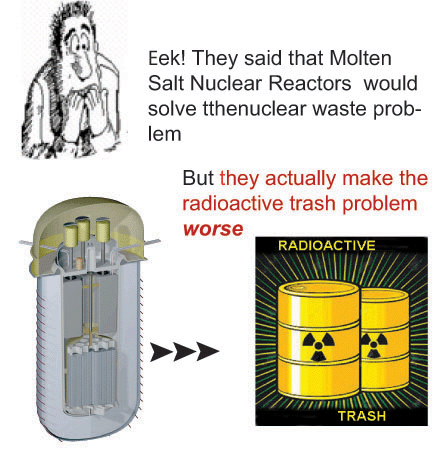
The ARC project goal is to design and build a nuclear reactor cooled with liquid sodium metal at the Point Lepreau site on the Bay of Fundy. NB Power also plans a second reactor at the site, the Moltex reactor design cooled with molten salt.
The proposed nuclear reactor designs lack commercial viability
If NB Power and the provincial government reviewed available research, they would learn that both sodium-cooled and molten salt reactors have never operated successfully on a commercial electricity grid.
An expert report from the U.S. National Academies of Sciences, Engineering, and Medicine stated that inherent problems with sodium-cooled and molten salt reactors means new builds will have difficulty reaching commercial viability by the year 2050, far later than the federal 2035 deadline for utilities to transition to a net-zero electricity grid.
For sodium-cooled reactors like the ARC design, tens of billions of dollars have been spent over decades trying to make them work in a commercial setting, by companies in other countries with considerable experience building nuclear reactors. The failures are well-documented.
Liquid sodium metal is reactive and burns when exposed to air or water. The first commercial sodium-cooled reactor in the U.S. had a partial meltdown and was quickly scrapped.
In other countries, sodium fires and unpredictable performances led to sodium-cooled reactors being abandoned in France (the Superphénix), Japan (the Monju breeder), Germany (the Kalkar plant), and Scotland (the Dounreay reactor).
All these shut-down sodium-cooled reactors cost far more to decommission than they did to build, partly due to the expense of removing the sodium from the reactors’ radioactive waste material so it could be safely disposed without causing underground explosions due to sodium-water reactions, as happened for Scotland’s Dounreay reactor.
The proposed reactor designs lack financing
The ARC sodium-cooled design is in its preliminary stage. Bill Labbe, the ARC CEO who suddenly left the company recently, said in 2023 that $500 million is needed to develop the ARC reactor design, and a further $600 million in power purchase agreements to move the project forward. The money raised to date for the ARC project is only a tiny fraction of that.
Since 2018 the provincial government has handed $25 million to ARC and $10 million to Moltex, as ‘seed’ funding to attract private investment. The federal government gave Moltex $50.5 million in 2021 and ARC $7 million in 2023.
However, six years of trying to entice private investors to the ARC and Moltex projects has not yielded results. Globally, private investment in the energy sector is going into renewable – not nuclear – energy.
Misplaced government hype
Despite the ARC company’s financial difficulties, according to news reports both NB Power and the New Brunswick government continue to support the ARC project.
Since the two start-up companies arrived in Canada and landed in Saint John in 2018, the government’s hype around the ARC and Moltex projects at times has been intense, surprisingly so, given that neither company has ever built a nuclear reactor.
In the past, Energy Minister Mike Holland has been the biggest booster of the ARC and Moltex “advanced” reactor designs.
However, in a curious coincidence, Holland quit the cabinet and gave up his MLA seat just days before the troubles at the ARC company hit the news, after previously announcing he would not stand in the upcoming election.
New Brunswick’s money-losing Point Lepreau nuclear plant
NB Power wants to build the ARC reactor near its existing Point Lepreau nuclear reactor, a consistent money loser for the utility.
According to the NB Auditor General, about three-quarters of NB Power’s $5 billion debt is from cost over-runs on the original CANDU reactor build 40 years ago and the re-build more than a dozen years ago.
At the recent Energy and Utility Board hearings, it was clear that the ongoing poor performance of the Lepreau plant is contributing to the utility’s financial difficulties and its request for an unprecedented rate hike.
Nuclear: the most expensive option for generating electricity
New Brunswick’s abysmal prior experience with nuclear reactors raises an obvious question: why is the province intent on trying to develop experimental nuclear reactors as part of its energy transition plans?
Nuclear power is a more expensive way to generate electricity than renewable energy with storage. Nuclear plants take much longer to build than solar or wind farms. These facts are well-known.
Even the right-wing magazine The Economist recognizes the global trend toward renewables and away from nuclear energy, stating in its most recent issue that: “the next ten-fold increase (in solar energy) will be equivalent to multiplying the world’s entire fleet of nuclear reactors by eight, in less than the time it typically takes to build one of them.”
New Brunswick: clinging to an outdated vision of electricity production
The challenge for New Brunswick is that our public utility NB Power is stuck, along with Ontario Power Generation, in the Jurassic era, feeding their nuclear dinosaurs while the rest of the utility world is getting on with their renewables and storage rollouts.
Across the globe, countries are focused on technological revolutions in energy efficiency and productivity, building smart grids with demand management and response and distributed renewable energy and storage resources. These offer lower-cost, lower-risk, faster and more flexible pathways for decarbonized electricity grids without large centralized nuclear systems.
Building more nuclear reactors and increasing power rates is not compatible with what many commentators in the province want in our shared economic, social and cultural future. It’s time for New Brunswick to end the nuclear hype.
Susan O’Donnell is the principal investigator with teammates of the CEDAR project, St. Thomas University in Fredericton.
Israeli Defense Minister Vows to Return Lebanon to ‘Stone Age’
President Joe Biden has significant leverage he could use to reign in Prime Minister Benjamin Netanyahu, but has largely refused to do so. While US officials claim their diplomatic efforts are not stalled, an increasing number of countries worry war will break out and are asking their citizens to leave Lebanon.
The White House reversed course and now says a ceasefire in Lebanon cannot be contingent on a deal in Gaza
by Kyle Anzalone June 27, 2024 , https://news.antiwar.com/2024/06/27/israeli-defense-minister-vows-to-return-lebanon-to-stone-age/
Defense Minister Yoav Gallant said Israel was prepared to send Lebanon back to the “Stone Age” with a massive bombing campaign. The White House desperately tries to avert a major war in the Middle East but is not making progress.
After three days of meetings with top officials in Washington, Gallant told reporters that Israel preferred diplomacy but was also willing to utterly destroy Lebanon. “We do not want war, but we are preparing for every scenario. Hezbollah understands very well that we can inflict massive damage in Lebanon if a war is launched,” he said. Israel could bomb “Lebanon back to the Stone Age, but we don’t want to do it.”
Gallant’s remarks come as daily tit-for-tat exchanges between Hezbollah and Israel risk escalating into a major war that could see the US, Iran, and other militias across the Middle East enter the fray. After announcing it had “operational plans” ready for an attack, Israel has started to move some military assets from near Gaza to its northern border.
The White House has invested considerable effort into bringing the conflicts in Lebanon and Gaza to a close. However, rather than applying pressure on Tel Aviv to deescalate, Washington has tried to force Hezbollah and Hamas to accept Israeli demands. Last week, American officials told Beirut that Washington was unable to constrain Tel Aviv, in hopes the warning would convince Hezbollah to back down.
President Joe Biden has significant leverage he could use to reign in Prime Minister Benjamin Netanyahu, but has largely refused to do so. While US officials claim their diplomatic efforts are not stalled, an increasing number of countries worry war will break out and are asking their citizens to leave Lebanon.
Last week, Biden’s envoy Amos Hochstein visited Tel Aviv and Beirut, hoping to work on a deal to end the fighting. At the time, Hochstein pushed for a deal to end the war in Gaza, with the belief that it would lead to deeslcation on Israel’s northern border as well.
Hezbollah maintains that it will end operations against Israel once the onslaught in Gaza comes to a close. Israel says it will not stop attacks on Lebanon until Hezbollah withdraws several miles from the border. Tel Aviv has decimated southern Lebanon, turning much of the area within three miles of the border into a “dead zone.”
Now, the Biden administration’s tactics have flipped, with officials telling reporters that the deal to end the fighting across the Israel-Lebanon border must be separate from any Gaza ceasefire. “The logic of [Hezbollah leader Hassan] Nasrallah…is that it is all tied to Gaza, and until there is a cease-fire in Gaza the firing at Israel won’t stop,” the Wall Street Journal reported, citing a senior Biden official. “We frankly, completely reject this logic.”
Kyle Anzalone is the opinion editor of Antiwar.com, news editor of the Libertarian Institute, and co-host of Conflicts of Interest.
Do thorium reactors prevent nuclear weapons proliferation risks?

Gordon Edwards, 30 June 24.
Many people have been assured, incorrectly, that the use of thorium as a “nuclear fuel” eliminates the danger of nuclear weapons proliferation. That is simply untrue.
The fact is, thorium is NOT a nuclear fuel.
However, a thorium-232 atom can be transmuted into a uranium-233 atom by capturing a stray neutron, and uranium-233 (not generally found in nature) is an excellent nuclear fuel and can also be used to make excellent nuclear weapons. So a “thorium reactor” is really a uranium-233 reactor.
Natural thorium — thorium-232 — is not fissile (i.e. it is not a chain-reacting material). So thorium requires a concentrated fissile material to be added to it, in order to get a chain reaction going and produce the neutrons that are needed to transmute thorium-232 atoms into chain-reacting uranium-233 atoms.
That concentrated fissile material additive does not have to be enriched uranium, it can equally well be plutonium. It has to be either one or the other, there is no other choice. So, in any event, to get a “thorium reactor” going, you need to use either uranium (enriched to a rather high degree) or plutonium (extracted from used nuclear fuel) as an additive. In either case, you will need to use proliferation-sensitive technologies (uranium enrichment or plutonium extraction) before even embarking upon a thorium reactor program.
Thorium use is therefore not a proliferation-resistant plan of action, not even to begin with.
It gets worse, because subsequently, if the “thorium-impregnated-with-fissile material” is irradiated in a reactor, the thorium atoms will FIRST be transmuted into protactinium atoms (protactinium-233) which will then spontaneously “decay” into uranium-233 atoms. In addition, further neutron captures inside the reactor will also produce a small amount of uranium-232, an undesired pollutant that is a strong gamma emitter.
Thorium enthusiasts often say that the powerful gamma rays from U-232 will make the U-233 unusable for nuclear weapons, which is somewhat of an exaggeration to begin with.
However, if the protactinium-233 is chemically separated out from the irradiated “thorium fuel” outside the reactor, those protactinium-233 atoms will spontaneously decay into pure uranium-233 atoms without any admixture of uranium-232 (because there are no neutrons outside the reactor to create uranium-232 as a result of additional neutron captures),
Since pure U-233 can be produced spontaneously outside the reactor, as outlined above by separating out protactinium-233 first, this procedure can completely avoid the problem of U-232 contaminating the U-233 — which, admittedly, would make nuclear weapons construction more difficult (although not impossible).
So the complicating factor of U-232 can be circumvented entirely by a would-be proliferator. There is no doubt that U-233 is an extremely powerful nuclear explosive material and, uncontaminated, can be used to make arsenals of nuclear weapons with relative ease.
Thus thorium reactors do not “eliminate” or even significantly reduce the problem of nuclear weapons proliferation.
UK’s Nuclear weapons pose a risk to proposed new homes
By Nick Clark, Local Democracy Reporting Service, 28 June 24, https://www.bbc.com/news/articles/clddy5kyv64o
Nuclear weapons could pose a risk to plans for almost 500 homes just outside a village, a council has been warned.
The Atomic Weapons Establishment (AWE) – the only maker of nuclear warheads in Britain – has opposed plans for the development near Spencers Wood in Berkshire.
It told Wokingham Borough Council the residents would live in an area exposed to a “radiation emergency” if something went wrong at its site in nearby Burghfield.
Proposals for the site also include a primary school and green space.
‘Safety concerns’
Development consultants Pegasus Group submitted the plans for up to 475 homes in May.
While not a formal planning application, the submission hopes to determine if a development would affect the environment, according to the Local Democracy Reporting Service (LDRS).
But in a letter to the council, AWE said the plans raised “significant” safety concerns.
It said the proposed site, between Basingstoke Lane and Sussex Lane, fell within its Detailed Emergency Planning Zone (DEPZ).
This is an area where neighbouring West Berkshire Council must have a detailed plan in place for its response to a nuclear emergency at Burghfield.
AWE said: “Whilst chances of a radiation emergency at AWE B are very low, the potential impact on the local population would be high and an appropriate and proportionate step is, to where possible, avoid new development being located within the DEPZ.”
It added the increased population in the area would also put strain on emergency services’ ability to help existing residents in the event of an emergency.
Wokingham Borough Council’s own emergency planning manager also said he would likely oppose the proposals if developers Richborough applied for planning permission.
He said the new development would have a “detrimental impact” on its emergency plan to help people living within the DEPZ.
What does Chevron mean for nuclear? The USA courts can now supercede the safety role of the Nuclear Regulatory Commission

should we trust the courts to be better arbiters of how nuclear power plants should be regulated than the actual agency set up to regulate them?
In the worst-case scenario, rogue judges are now empowered to issue out-of-pocket decisions on highly technical matters they don’t actually understand.
The NRC was the undisputed final word in what goes for nuclear energy in the United States. Did the overturning of the longstanding Chevron decision now put the courts above the regulatory agency?
Elemental, ANGELICA OUNG, JUN 30, 2024
The US Supreme Court just overturned the longstanding “Chevron deference” This is a move so dramatic that Dahlia Lithwick, senior legal editor at Slate, described it as a “requiem” for the Administrative state.
According to Lithwick in the Slate Podcast on the issue, the Chevron doctrine said that when a statute is unclear, federal courts should defer to a reasonable interpretation by administrative agencies. No more. Courts can now decide from the get-go what a statute means, regardless of what the agency thinks.
Once upon a time, ironically, it was the conservative Justice Scalia who was the Chevron doctrine’s biggest fan. But as it becomes increasingly clear that the conservative justices are going to enjoy a generational hold on the Supreme Court while the party holding the Executive Branch flips and flops, it became an advantageous political project for the court to take out Chevron and transfer power from the “ABC agencies,” which of course includes the National Regulatory Commission (NRC) over to the courts.
“This fundamentally changes the way government governs,” said Lithwick.
So what now? If the court is now the final arbiter for whether, say, a bump stock makes a gun a machine gun, is it also going to become the final arbiter on whether a giant trampoline works as well as a reinforced containment dome for that purpose of protecting a nuclear reactor from the impact of a large commercial aircraft?
In fact, since the Aircraft Impact Assessment (AIA) is a part of the NRC’s regulations, not explicitly mandated by law, the court can even opt to throw the regulation out entirely.
The undercutting of the NRC goes both ways: just as nuclear companies can now challenge what they see as unreasonably onerous NRC regulations in court, they are now also vulnerable to individuals or groups claiming harm, even if the companies followed all the regulatory guidelines, increasing their legal risk.
As Chief Justice John Roberts wrote in his opinion in the landmark 6-3 ruling, “Agencies have no special competence in resolving statutory ambiguities. Courts do.”
In a dissenting opinion, Justice Elena Kagan warned that Congress does not have the ability to write perfectly complete regulatory statutes and it would be preferable for the gaps formed by inevitable ambiguities to be filled by the responsible agency, not a court. The decision “is likely to produce large-scale disruption.”………………………………………………………………………………………………
…….should we trust the courts to be better arbiters of how nuclear power plants should be regulated than the actual agency set up to regulate them?
In the worst-case scenario, rogue judges are now empowered to issue out-of-pocket decisions on highly technical matters they don’t actually understand. https://elementalenergy.substack.com/p/what-does-chevron-mean-for-nuclear
1 This Month

Petition to revoke the licensing of the Near Surface Nuclear Disposal Facility (NSDF) at Chalk River. https://www.ourcommons.ca/petitions/en/Petition/Details?Petition=e-7247


of the week – STOP SMALL MODULAR REACTORS IN CANADA
To see nuclear-related stories in greater depth and intensity – go to https://nuclearinformation.wordpress.com
-
Archives
- March 2026 (153)
- February 2026 (268)
- January 2026 (308)
- December 2025 (358)
- November 2025 (359)
- October 2025 (376)
- September 2025 (258)
- August 2025 (319)
- July 2025 (230)
- June 2025 (348)
- May 2025 (261)
- April 2025 (305)
-
Categories
- 1
- 1 NUCLEAR ISSUES
- business and costs
- climate change
- culture and arts
- ENERGY
- environment
- health
- history
- indigenous issues
- Legal
- marketing of nuclear
- media
- opposition to nuclear
- PERSONAL STORIES
- politics
- politics international
- Religion and ethics
- safety
- secrets,lies and civil liberties
- spinbuster
- technology
- Uranium
- wastes
- weapons and war
- Women
- 2 WORLD
- ACTION
- AFRICA
- Atrocities
- AUSTRALIA
- Christina's notes
- Christina's themes
- culture and arts
- Events
- Fuk 2022
- Fuk 2023
- Fukushima 2017
- Fukushima 2018
- fukushima 2019
- Fukushima 2020
- Fukushima 2021
- general
- global warming
- Humour (God we need it)
- Nuclear
- RARE EARTHS
- Reference
- resources – print
- Resources -audiovicual
- Weekly Newsletter
- World
- World Nuclear
- YouTube
-
RSS
Entries RSS
Comments RSS
 nuclear-news