Deaths mount as Pakistan swelters in heatwave

As the temperatures rose in southern Pakistan, so did the body count. The
Edhi ambulance service says it usually takes around 30 to 40 people to the
Karachi city morgue daily. But over the last six days, it has collected
some 568 bodies – 141 of them on Tuesday alone. It is too early to say
exactly what the cause of death was in every case. However, the rising
numbers of dead came as temperatures in Karachi soared above 40C (104F),
with the high humidity making it feel as hot as 49C, reports said. People
have been heading to hospitals seeking help.
BBC 27th June 2024
Japan starts 7th discharge of Fukushima nuclear-contaminated wastewater despite opposition

https://news.cgtn.com/news/2024-06-28/news-1uNrsTbwBm8/p.html
Japan on Friday started the seventh round of release of nuclear-contaminated wastewater from the crippled Fukushima Daiichi Nuclear Power Plant into the Pacific Ocean.
Despite opposition from local fishermen, and residents as well as backlash from the international community, Tokyo Electric Power Company (TEPCO), the plant’s operator, started releasing the radioactive wastewater in the morning, the third round in fiscal 2024.
Just like the previous rounds, about 7,800 tonnes of wastewater will be discharged from about a kilometer off the coast of Fukushima Prefecture via an underwater tunnel until July 16.
According to TEPCO, the company will begin dismantling empty storage tanks after the wastewater has been discharged around January next year.
There are approximately 1,000 storage tanks at the Fukushima plant because of its continued production of wastewater. TEPCO plans to dismantle 21 of these tanks over about one year starting next January, which will free up 2,400 square meters of space.
There is still uncertainty when it comes to the decommissioning schedule of the Fukushima plant and the measures to deal with contaminated wastewater, Masahide Kimura, a member of a Japanese anti-nuclear campaign group, told Xinhua.
The collapse of houses, the destruction of roads and the ground uplift along the coast caused by the recent Noto Peninsula Earthquake have warned us that nuclear power plants should not be operated in Japan, an archipelago prone to earthquakes, Kimura said.
Hit by a 9.0-magnitude earthquake and an ensuing tsunami on March 11, 2011, the Fukushima nuclear plant suffered core meltdowns that released radiation, resulting in a level-7 nuclear accident, the highest on the International Nuclear and Radiological Event Scale.
The plant has been generating a massive amount of water tainted with radioactive substances from cooling down the nuclear fuel in the reactor buildings. The contaminated water is now being stored in tanks at the nuclear plant.
Despite furious opposition both at home and abroad, the ocean discharge of the Fukushima nuclear-contaminated water began in August 2023.
Complete BS from the IAEA about the non-existent “global consensus” on nuclear power.

The latest (today) International Atomic Energy Agency newsletter includes this BS info about a fantasy “global consensus” on nuclear power.
The World Bank and other MDBs currently do not contribute financing to nuclear power new build projects, although some MDBs have provided lending for upgrades to existing nuclear power reactors or their decommissioning. Mr Grossi said that financing nuclear power would better align MDBs with the “new global consensus” forged at last year at COP28 in Dubai, where the world called for accelerating the deployment of nuclear power along with other zero emission energy technologies to achieve deep and rapid decarbonization.
Dozens of countries have also signed on to a pledge made at COP28 to work towards tripling global nuclear power capacity to achieve net zero by 2050. The pledge also called on the World Bank, regional development banks and international financial institutions to include nuclear in their lending. That call was echoed by scores of countries at the first-ever Nuclear Energy Summit organized by the IAEA and Government of Belgium in March.
**
The statement supporting nuclear power was made at a private media event at COP 28 and was not part of the official COP proceedings. Canada’s nuclear industry booster NRCan has it on its website but it is not on the site of Environment Canada, which is responsible for COP declarations.
There is no “global consensus” on nuclear energy. Here’s the full IAEA statement:
How I read this: the nuclear industry is desperate. If you read the full item above, you will see a desperate plea for the World Bank and others that do not currently fund nuclear projects to begin doing it. What’s not here is why the private sector is not funding nuclear projects but rather putting their money into solar and wind development, which is that nuclear is a terrible investment and renewables are a good investment.
Israel’s leaked plan for annexing the West Bank, explained
Israeli Finance Minister Bezalel Smotrich’s plan to annex the West Bank would see over 60% of the territory becoming a part of Israel. But Palestinian experts say it is “already happening.”
BY QASSAM MUADDI Mondoweiss
The issue of Israel’s creeping annexation of the West Bank has resurfaced in recent days after a leaked recording of Israel’s finance minister Bezalel Smotrich revealed a “dramatic” plan to impose permanent Israeli control over the West Bank “without the government being accused of annexing it,” as Smotrich was recorded saying.
Smotrich’s statements, recorded by the Peace Now Israeli NGO and published by CNN and the New York Times, were made during a speech he gave to settler leaders earlier in June. Smotrich was recorded saying that he had elaborated a plan in the past year and a half and exposed it to Israel’s Prime Minister Netanyahu, who was “fully onboard.”
The plan centers around transferring administrative authorities in the West Bank from the Israeli army to the civil authorities of the Israeli government. Smotrich said that he oversaw the creation of an entire administrative body directly linked to the government and that members of this body were already embedded in the Israeli army’s Civil Administration.
In 1967, Israel began administering the West Bank and Gaza under a military administrative body, the Military Government, and in 1981, the Civil Administration was established in its place. Following Netanyahu’s formation of the most right-wing government in Israel’s history in 2022, Smotrich was put in charge of the Civil Administration. Since October 7, Smotrich’s hardline policies pushing for settlement expansion have reached new heights, with the recently leaked annexation plan raising fears about the intentions of the self-described fascist toward the Palestinians living in the West Bank.
According to Smotrich, the administrative changes he wishes to implement represent a “dramatic change” equivalent to “changing the DNA of the system.”
Smotrich said that large budgets were allocated to infrastructure projects for settlement expansion and for “security measures” for the settlements, adding that the aim of such a plan is “to avoid the West Bank from becoming part of a Palestinian state.”
Smotrich plan ‘already happening’………………………………..more https://mondoweiss.net/2024/06/israels-leaked-plan-for-annexing-the-west-bank-explained/
Israeli Officials Hiding Data About Forced Starvation of Gaza Prisoners: Report
Former detainees say the Israel Prison Service “has significantly reduced their food rations, to the point of starvation, causing them to shed dozens of kilograms.”
BRETT WILKINS, Jun 27, 2024, Common Dreams,
Israeli prison officials are concealing information about reductions in food rations for Palestinians held in the Gaza Strip, where detainees—who have also reported horrific abuse including alleged rape and deadly torture—have been deliberately driven “to the point of starvation,” according to a report published Thursday.
Security sources told the Israeli newspaper Haaretz that the Israel Prison Service (IPS) is intentionally cutting Palestinian prisoners’ caloric intake, a move confirmed by Israeli National Security Minister Itamar Ben-Gvir, who called the policy a “deterrent.”
“The Palestinian detainees will receive the minimum rights and the minimum food, and I will ensure that this policy is implemented,” Ben-Gvir, who leads the far-right Otzma Yehudit (Jewish Power) party, said Thursday in response to a query from Israel’s Supreme Court…………………………………………………………………………………………….. https://www.commondreams.org/news/israel-starving-prisoners
CEO, staff suddenly depart New Brunswick reactor developer ARC Clean Technology

“reactor developers would not normally terminate staff after hitting a regulatory milestone.
“If they were going to move forward, basically, they would be hiring people,”
MATTHEW MCCLEARN 26 June 24, https://www.theglobeandmail.com/business/article-ceo-staff-depart-new-brunswick-reactor-developer-arc-clean-technology/
ARC Clean Technology Canada, a developer of small modular reactors in New Brunswick, has revealed the sudden departure of its Canadian chief executive, raising questions about its future.
Alongside Tuesday’s announcement of CEO William Labbe’s exit, other ARC employees also received layoff notices, according to a report from the Telegraph Journal, a Saint John, N.B., newspaper. The company did not respond to questions from The Globe about those reported departures, or how many staffers remain with the company.
In a statement, ARC spokesperson Sandra Donnelly said the company had nearly completed a phase of a pre-licensing process with the Canadian Nuclear Safety Commission, and was “realigning personnel and resources to strengthen our strategic partnerships and rationalize operations to best prepare for the next phase of our deployment.”
Ms. Donnelly said ARC Canada will be led by Bob Braun, chief operating officer of its Washington-based parent ARC Clean Technology Inc., and two vice presidents, Lance Clarke and Jill Doucet.
The company’s staff changes follow the resignation of New Brunswick energy minister Mike Holland, announced June 20. Mr. Holland had been an advocate for the province’s SMR program, but had previously announced he would not stand for re-election.
ARC set up offices in Saint John several years ago, as part of an initiative to build SMRs at the province’s only nuclear power plant, Point Lepreau Nuclear Generating Station. The plant’s owner, NB Power, has promoted plans for demonstration units of two different reactors built there by 2030. The second reactor would be designed by another startup, Moltex Energy, which would include a nuclear fuel reprocessing plant.
ARC is one of several vendors jockeying to sell SMRs to Canadian utilities. All existing commercial power reactors in Canada – including the existing one at Point Lepreau – are of the homegrown Candu design. (The newest, at Ontario’s Darlington Nuclear Generating Station, was completed in the early 1990s.)
The company is in the early stages of designing a reactor known as the ARC-100, a next-generation reactor that would use sodium as coolant – a striking departure from Candus and nearly all other commercial power reactors used today, which are water-cooled. The ARC-100 is also marketed as having the ability to consume reprocessed spent fuel, something that has not been done historically in Canada.
As ARC rationalizes its work force, some of its better-established competitors are staffing up. U.S.-based GE-Hitachi and Ontario Power Generation are preparing a site at Darlington for potential construction of a BWRX-300 small modular reactor. Westinghouse, which is marketing several reactors including its AP-1000 large reactor and eVinci microreactor, announced a new 13,000-square-foot office in Kitchener, Ont., this month along with plans to hire 100 engineers to staff it by next year.
Last year, Mr. Labbe said developing the ARC-100 would cost around $500-million. But so far, the company has raised only a small fraction of that. In 2022, it announced it had raised $30-million from the provincial government and the private sector. In October, the federal government awarded it another $7-million. Its partner, NB Power, has not contributed any funding.
ARC submitted an application to the Canadian Nuclear Safety Commission in 2023 for a license to prepare a site at Point Lepreau for its demonstration unit. At an industry conference in April, Mr. Labbe said ARC was also preparing to apply for a license to construct the reactor, which it planned to issue within the next year.
“We’ve been at this for about seven years,” he told the audience. “And we really have another six, seven years until we get that commercial deployment.”
Mr. Labbe became ARC Canada’s CEO in May, 2021. His predecessor, Norm Sawyer, is now president of ION Nuclear Consulting Ltd., an adviser to investors, energy companies and First Nations. Mr. Sawyer said that, while he had no inside information on the company, reactor developers would not normally terminate staff after hitting a regulatory milestone.
“If they were going to move forward, basically, they would be hiring people,” he said.
“If you’re on hold and you’re thinking that you’re going to move forward in a short time period, you maintain your staffing levels.”
Susan O’Donnell, a researcher at St. Thomas University who studies energy technologies, said that, while ARC has managed to attract some private funding, it has remained almost wholly dependent on government money. She added that the federal government is unlikely to provide the billions of dollars required to build new reactors at Point Lepreau.
“I just don’t see how this is going to work, where the money’s going to come from,” she said. “And I think this is why we’re seeing this with ARC today.
“They can’t afford to have that number of staff.”
As recently as November, NB Power chief executive officer Lori Clark had said SMRs were “a key part” of the utility’s plans to phase out coal by 2030. On Tuesday, NB Power said it will continue to provide technical expertise to ARC and Moltex, and that it regards SMRs as a “potential option” to achieve net zero emissions electricity production by 2035.
“We continue to work toward the goal of having an SMR on the grid by the early 2030s,” spokesperson Dominique Couture wrote in an e-mail.
With a report from Emma Graney
Greenpeace activist climbs on top of Conservative election campaign bus
Earlier this afternoon, a Greenpeace UK activist climbed onto the top of the Conservative party election campaign ‘battle bus’ using a telescopic ladder as it was parked in an industrial estate near Ollerton, in Nottinghamshire, during the Conservative’s election campaign trail. The activist unfurled a handheld banner reading ‘Clean Power Not Paddy Power’, in reference to the Conservative election date betting scandal.
Greenpeace is protesting against the Conservative party’s persistent failure to tackle the climate and nature crises while in government [1], which was repeated in their election manifesto.
An analysis of political party election manifestos, published this week by Greenpeace UK and Friends of the Earth, put the Conservatives rock bottom, scoring just 5 points out of a possible 40 for its plans for climate and nature – four times worse than Labour’s plans.
The Conservatives’ divisive manifesto doubles down on trying to make climate and nature a wedge issue by committing to licence new fossil fuels on an annual basis, ban measures to clean up toxic air, and spark a bonfire of ‘red tape’ when it comes to protecting the environment.
The campaigners are urging the British public to use the upcoming general election to vote for a government that will bring in policies that would deliver clean energy, lower bills, more energy security, and economic prosperity.
Amy Rugg-Easey, the Greenpeace activist who climbed onto the roof of the bus, said:
“We’ve had enough of this government lurching from one scandal to the next, while gambling with our future. We need clean power, not Paddy Power.
“Fourteen years of Conservative governments has left this country broken. Sunak has gone backwards on climate action, ditching key pledges and promising to ‘max out’ the climate-wrecking oil and gas that are the cause of the cost of living crisis and our unaffordable bills. Our rivers are awash with sewage, and our economy, NHS and public services are on their knees.
“Enough is enough. We’ve climbed onto Sunak’s battle bus today to remind the British public that it is the Conservative government’s consistent failure to deliver greener, fairer policies that has created the mess we’re in. Don’t back the wrong horse – a vote for the climate is a vote for a better future.”………………………………………more https://www.greenpeace.org.uk/news/breaking-greenpeace-activist-climbs-on-top-of-conservative-election-campaign-bus/
Post Election: A Different Kind of Nuclear Bomb

The Nuclear Legacy
The Government has accidentally left behind an unexploded bomb for an incoming Labour Government. Should it go off, it will be early evidence for the argument that Starmer can’t be trusted. The bomb in question is whether or not to go ahead with building another large French nuclear power station at Sizewell in Suffolk.
Our current experience with building large French nuclear power stations is no
Tom Burke on how an incoming Labour Government will have to deal with the unexploded political bomb of nuclear left behind by the Conservatives
BYLINE SUPPLEMENT, JUN 26, 2024, https://www.bylinesupplement.com/p/post-election-a-different-kind-of
You know something is changing in British politics when our better-known political commentators start turning up at Green Party events. They have not found it easy to make much sense of what such a heterodox coalition offers voters. But there is no doubting that their presence signals an old order in transition.
The Financial Times publishes a general election poll tracker. The picture it shows has not changed significantly for eighteen months. A consistent 20 point gap between Labour and the Conservatives is now barely worth a comment. Much less noticed, however, has been another equally consistent pattern.
Adding together support for the insurgent parties – Reform at 11.5%, Lib-Dems at 9.2% and the Greens at 6.3% – may not tell you much about the balance of power in the next Parliament but it does tell you something significant about Britain’s electorate. Voter support for the three minor parties totals 27%, almost 4% higher than that for the ruling Conservatives.
Put another way, more than 70% of British voters want anyone other than the current Conservative Government to run the country. Apart from being a clear demonstration of the wisdom of crowds, this is another dagger at the heart of our archaic and increasingly dysfunctional first past the post voting system. The political complexities of the 21st Century cannot easily be tackled as a tidy battle between labour and capital. Voters have already recognised this. It is time that our political leaders did too.
No issue makes this more apparent than that of climate change. The Conservatives’ choice of this issue as a key battleground on which to fight an electoral culture war was entirely voluntary. There was no great grassroots pressure from within the Party itself. Nor was there any groundswell of public opinion although there was a noisy, if evidence-free, torrent of editorial ink from the Rothermere, Murdoch, Barclay press.
The Uxbridge by-election last July paused a string of Conservative losses. Victory was put down to a voter rebellion against too-expensive climate change policies. The Government then seized on climate as a wedge issue for the forthcoming election and began a systematic winding back of climate action.
In doing so it was copying an election strategy first adopted by the Australian National Party. Since our Prime Minister’s election strategist is the Australian Isaac Levido – a protégé of another, better known, Australian political strategist, Lynton Crosby, this should not have surprised anyone.
What is less explicable is why anyone should have thought that a strategy that failed in Australia would work here. Labour’s victory in the 2022 Australian election was aided by a break-away group of candidates standing as ‘Teals’ – blue-green Conservatives. Exactly the constituency David Cameron had wooed for the Tories here in 2010.
As things currently stand, Labour looks like being helped into Downing Street by an ill-chosen culture war that climate change won. This will have its own challenges for Labour. No-one doubts their good intentions on the climate. But their clumsy handling of, and subsequent back pedalling on, their £28 billion a year green prosperity pledge has left a legacy of doubt in voters’ minds. It risks being punished by increasingly volatile voters if it cannot quickly resolve those doubts.
The Nuclear Legacy
The Government has accidentally left behind an unexploded bomb for an incoming Labour Government. Should it go off, it will be early evidence for the argument that Starmer can’t be trusted. The bomb in question is whether or not to go ahead with building another large French nuclear power station at Sizewell in Suffolk.
Our current experience with building large French nuclear power stations is not encouraging. Although, unusually, we are not alone in this respect. No-one else, including the French themselves, has been able to do so either. Indeed, France has now decided not to even try to build any more of the type of reactors intended for Sizewell as they are too expensive and difficult to build. They will build a different design instead.
The French reactor we are currently building at Hinkley Point was promised to cost £5.6 billion in 2008 and be producing the electricity to cook turkeys on by 2017. In today’s money it will cost nearer to £46 billion and not be producing electricity before 2030. To get EDF to invest, the then Labour Government promised EDF an index linked price for its electricity.
This means that, were it available now, electricity from Hinkley Point would cost £130/MWh. Since National Grid will sell you electricity today for about £80/MWh why would anyone buy more expensive nuclear electricity? To get EDF to build Hinkley Point a Conservative Government bought 35 years’ worth of electricity in advance at a fixed price. To pay for the difference between what EDF can get from the wholesale market there will be tax on everyone’s electricity bill.
It is beyond my understanding why any sane person would want to repeat this experience. Yet that is just what the Conservative Government, with Labour support, was planning to do. It is often argued that building a second station using the same reactors will be cheaper. If that were so, someone needs to explain why the French have already decided not to build any more. Is there something they know that we don’t?
Labour now face a particular difficulty on Sizewell. Since their wind-back of the green prosperity plan, they have doubled down on their promise to deliver carbon-free electricity by 2030. So let us, for argument’s sake, put aside any reservation about whether this is practical. We, and our children, will all certainly be better off if they can deliver carbon-free, secure and affordable electricity to consumers by 2030.
But construction of Sizewell cannot start until after 2030. What then, is the case for forcing homeowners and businesses to pay a tax on their energy bills to finance an unnecessary nuclear power station? And what would this do to the scale and speed of investment in the energy efficiency and renewables which are cheaper and faster ways to get both bills and carbon emissions down?
Assange Is Free, But US Spite Will Chill Reporting for Years
ARI PAUL, 26 June 24 https://fair.org/home/assange-is-free-but-us-spite-will-chill-reporting-for-years/
In some ways, the nightmare for WikiLeaks founder Julian Assange is coming to an end. After taking refuge at the Ecuadorian embassy in London in 2012, he was arrested in 2019 by Britain, who have since been trying to extradite him to the United States on charges that by publishing official secrets he violated the Espionage Act (FAIR.org, 12/13/20; BBC, 6/25/24). Once he enters a guilty plea, he will be sentenced to time served and walk away a free man (CBS, 6/25/24).
Assange’s case has attracted the attention of critics of US foreign policy, and those who value free speech and a free press. His family has rightly contended that his treatment in prison was atrocious (France24, 11/1/19; Independent, 2/20/24). A group of doctors said he was a victim of “torture” tactics (Lancet, 6/25/20). In 2017, Yahoo! News (9/26/21) reported that the “CIA plotted to kidnap the WikiLeaks founder, spurring heated debate among Trump administration officials over the legality and practicality of such an operation” and that CIA and Trump administration insiders “even discussed killing Assange, going so far as to request ‘sketches’ or ‘options’ for how to assassinate him.”
His supporters noted that the charges against him came after he harmed the US imperial project, particularly by leaking a video showing US troops killing Reuters journalists in Iraq (New York Times, 4/5/10). Under his watch, WikiLeaks also leaked a trove of diplomatic cables that the New York Times (11/28/10) described as an “unprecedented look at back-room bargaining by embassies around the world, brutally candid views of foreign leaders, and frank assessments of nuclear and terrorist threats.”
Press freedom and human rights groups like the International Federation of Journalists and Amnesty International had long called for his release. Several major news outlets from the US and Europe—the New York Times, Guardian, Le Monde, Der Spiegel and El País—signed a letter calling for his release (New York Times, 11/28/22). They said his “indictment sets a dangerous precedent and threatens to undermine America’s First Amendment and the freedom of the press.
Hostility toward press freedom
Assange’s loved ones and supporters are certainly glad to see him come home (Guardian, 6/25/24). But let’s be perfectly clear-eyed: The entire ordeal and his plea deal are proof of a hostile climate toward a free press in the United States and the wider world, and its chilling effect on investigative journalism could substantially worsen.
Assange’s deal has echoes of the end of the West Memphis Three case, where three Arkansas men were wrongfully convicted as teenagers of a heinous triple homicide in 1993 (Innocence Project, 8/19/11). The three re-entered guilty pleas in exchange for time served. They won their freedom, but their names were still attached to a terrible crime, and the state of Arkansas was able to close the case, ensuring the real killer or killers would never be held accountable. It was an imperfect resolution, but no one could blame the victims of a gross injustice for taking the freedom grudgingly offered.
Something similar is happening with Assange. It compounds the persecution already inflicted on him to force him to declare that exposing US government misdeeds was itself a high crime.
“On a human level, we’re thrilled that he’s out of prison, including the time in the embassy,” said Chuck Zlatkin, a founding member of NYC Free Assange, a group that has held regular protests calling for his release. “We’re thrilled for him personally.”
But the deal shows how eager the US government is to both save face and remain a threatening force against investigative reporters.
‘Criminalization of routine journalistic conduct’
As Seth Stern, the director of advocacy at the Freedom of the Press Foundation (6/24/24), said in a statement:
It’s good news that the DoJ is putting an end to this embarrassing saga. But it’s alarming that the Biden administration felt the need to extract a guilty plea for the purported crime of obtaining and publishing government secrets. That’s what investigative journalists do every day.
The plea deal won’t have the precedential effect of a court ruling, but it will still hang over the heads of national security reporters for years to come. The deal doesn’t add any more prison time or punishment for Assange. It’s purely symbolic. The administration could’ve easily just dropped the case, but chose to instead legitimize the criminalization of routine journalistic conduct and encourage future administrations to follow suit. And they made that choice knowing that Donald Trump would love nothing more than to find a way to throw journalists in jail.
And that is all happening while threats against leakers and journalists remain. Edward Snowden, the source in the Guardian’s investigation (6/11/13) into National Security Agency surveillance, still resides in Russia in order to evade arrest. I recently wrote about the excessive sentencing of the man who leaked tax documents to ProPublica and the New York Times showing how lopsided the tax system is in favor of the rich (FAIR.org, 2/2/24). NSA contractor Reality Winner was sentenced to five years in prison for leaking documents to the Intercept on the issue of Russian interference in the 2016 US election (Vanity Fair, 10/12/23)
Laura Poitras, one of the journalists who brought Snowden’s revelations about NSA surveillance to light, said that Assange’s conviction could silence reporters doing investigative reporting on the US government (New York Times, 12/21/20). Chelsea Manning, Assange’s source for these investigations, spent only seven years in prison out of the 35 years of her sentence thanks to presidential clemency, but that is still a harrowing experience (NPR, 5/17/17).
‘Not transparency’ but ‘sabotage’
Worse, some in the so-called free press have rallied behind the government. The Wall Street Journal editorial board (4/11/19) cheered the legal crusade against Assange, arguing that the leaks harmed national security. “Assange has never been a hero of transparency or democratic accountability,” the Murdoch-owned broadsheet proclaimed.
The neoconservative journal Commentary (4/12/19) dismissed the free press defenders of Assange, saying of Wikileaks’ investigations into US power: “This was not transparency. It was sabotage.”
And the British Economist (4/17/19) said, in support of Assange’s extradition to the US:
WikiLeaks did some good in its early years, exposing political corruption, financial malfeasance and military wrongdoing. But the decision to publish over 250,000 diplomatic cables in 2010 was malicious. The vast majority of messages revealed no illegality or misdeeds. Mr. Assange’s reckless publication of the unredacted versions of those cables the following year harmed America’s interests by putting its diplomatic sources at risk of reprisals, persecution or worse.
Unsurprisingly, Murdoch outlets gave the plea deal a thumbs down. “Don’t fall for the idea that Mr. Assange, the founder of WikiLeaks, is a persecuted ‘publisher,’” the Wall Street Journal editorial board (6/25/24) warned.
The New York Post editorial board (6/25/24) disparaged Assange’s motives, saying he “wasn’t interested in justice or exposing true abuse; he simply relished obtaining and releasing any secret government or political material, particularly if US-based.” Alleging that the documents he published were sensitive, the paper argued in favor of government secrecy: “Uncle Sam needs to keep some critical secrets, especially when lives are on the line.”
In reality, US intelligence and military officials have never been able to trace any deaths to WikiLeaks‘ revelations (BBC, 12/1/10; Guardian, 7/31/13; NPR, 4/12/19)—and certainly have never identified any damage anywhere nearly as serious as the very real harms it exposed. (NPR did quote a former State Department lawyer who complained that WikiLeaks‘ exposes “can really chill the ability of those American personnel to build those sorts of relationships and have frank conversations with their contacts.”) Alas, some publications side with state power even if journalistic freedom is at stake (FAIR.org, 4/18/19).
‘Punished for telling the truth’
Assange’s case is over, but he walks away a battered man as a result of the legal struggle. And that serves as a warning to other journalists who rely on brave people in high levels of power to disclose injustices. Stern is right: Another Trump administration would be horrendous for journalists. But the current situation with the Democratic administration is already chilling.
“All he was being punished for was telling the truth about war crimes committed by this country,” Zlatkin told FAIR.
And without a real change in how the Espionage Act is used against journalists, the ability to tell the truth to the rest of the world is at risk.
“We’re still not in a situation where we as a general population are getting the truth of what’s being done in our name,” Zlatkin said. “So the struggle continues.”
Why WikiLeaks founder will plead guilty – and what happens next
Angus Thompson and Millie Muroi, June 25, 2024 , The Age
WikiLeaks founder Julian Assange, 52, has struck a plea deal with the United States that is set to end a years-long legal pursuit over the release of classified documents.
He is expected to plead guilty to conspiring to unlawfully obtain and disseminate classified national defence information in a court in the Northern Mariana Islands at 9am on Wednesday (AEST) but will avoid jail time in the US after spending several years fighting extradition from London’s maximum-security Belmarsh Prison.
Why was Julian Assange released?
Assange is en route to Saipan, the largest of the Northern Mariana Islands, which are a US commonwealth in the western Pacific. There he will face a US Federal Court judge on a single charge of breaching the Espionage Act with the mass release of secret documents leaked by former intelligence analyst Chelsea Manning.
He faced 18 espionage charges after being indicted in early 2019 by the US Justice Department, which began legal proceedings to seek his extradition from Britain in the same year.
The charges sparked a global outcry over press freedom and led a cross-party coalition of Australian politicians, including former Nationals leader Barnaby Joyce and teal independent Monique Ryan, to travel to the US in 2023 to pressure the Biden administration to drop its pursuit.
US President Joe Biden told a press conference earlier this year he was “considering” a deal over Assange, after Prime Minister Anthony Albanese raised it during his October 2023 US visit.
“I’ve made it clear that enough is enough – that it’s time it was brought to a conclusion,” Albanese said.
How long did Assange spend in prison?
Assange was first detained in 2010 and sent to London’s Wandsworth Prison after a Swedish court ordered his arrest on sex crime allegations. He was freed on bail with a £240,000 surety, but in February 2011, a London court ordered Assange’s extradition to Sweden.
The British Supreme Court rejected his final appeal against the extradition in June 2012. Five days later, he took refuge in Ecuador’s embassy in London, seeking political asylum……………………………………………………………….
What does the plea deal mean for Assange’s future?
Assange is expected to face a US judge at 9am local time in Saipan, who is expected to approve the plea deal, meaning he will avoid the maximum 175 years he faced in the US under the original charges.
His future is largely unknown beyond that, however, in a post on social media platform X on Tuesday morning celebrating Assange’s release, WikiLeaks said he was expected to return to Australia.
What has been the Australian government’s response?
Albanese has so far been tight-lipped about Assange’s release. But Coalition and Greens MPs welcomed the announcement. Opposition foreign affairs spokesman Simon Birmingham said he welcomed the fact Assange’s decision to plead guilty would bring an end to the “long-running saga”.
Nationals MP Joyce said the issue was about “extraterritoriality” and went beyond Assange as an individual. “It’s about an issue, about an Australian citizen, who did not commit a crime in Australia,” he said.
Greens senator David Shoebridge said whistleblowers such as Assange continued to pay an unfair price for revealing unethical and criminal actions of governments. https://www.theage.com.au/politics/federal/why-wikileaks-founder-has-been-set-free-and-what-happens-next-20240625-p5joia.html
The Australian Opposition Party says its nuclear plants will run for 100 years. What does the international experience tell us?

The average age of an active nuclear reactor worldwide is about 32 years – and a live plant reaching even 60 has ‘never happened’, an expert says
Peter Hannam, Mon 24 Jun 2024 https://www.theguardian.com/australia-news/article/2024/jun/24/coalition-nuclear-policy-peter-dutton-power-plants-100-years-run-time
The federal Coalition’s pledge to build nuclear reactors on seven sites in five states if elected has continued to raise questions this week.
Ted O’Brien, the shadow energy minister, says the plants can operate for between 80 and 100 years, providing “cheaper, cleaner and consistent 24/7 electricity” compared with renewables.
That claim comes despite the CSIRO’s Gencost report estimating each 1-gigawatt nuclear plant could take 15-20 years to build and cost $8.4bn. The first may be double that given the high start-up costs.
But what does the state of the nuclear energy internationally tell us about the Coalition’s proposal?
What is the state of the global nuclear industry?
The world opened five nuclear reactors last year and shut the same number, trimming 1GW of capacity in the process, says Mycle Schneider, an independent analyst who coordinates the annual world nuclear industry status report.
During the past two decades, it’s a similar story of 102 reactors opened and 104 shutting. As with most energy sources, China has been the biggest mover, adding 49 during that time and closing none. Despite that burst, nuclear provides only about 5% of China’s electricity.
Last year, China added 1GW of nuclear energy but more than 200GW of solar alone. Solar passed nuclear for total power production in 2022 while wind overtook it a decade ago.
“In industrial terms, nuclear power is irrelevant in the overall global market for electricity generating technology,” he says.
As for small modular reactors, or SMRs,nobody has built one commercially. Not even billionaire Bill Gates, whose company has been trying for 18 years.
The CSIRO report examined the “contentious issue” of SMRs, and noted that one of the main US projects, Utah Associated Municipal Power Systems, was cancelled last November. Even then, its estimated costs in 2o2o of $18,200/kiloWatt, or more than double that of large-scale plants at $8,655/kW (in 2023 dollars).
“In late 2022 UAMPS updated their capital cost to $28,580/kW citing the global inflationary pressures that have increased the cost of all electricity generation technologies,” CSIRO said. “The UAMPS estimate implies nuclear SMR has been hit by a 57% cost increase which is much larger than the average 20% observed in other technologies.”
So at least some nations are still building large reactors?
Of the 35 construction starts since 2019, 22 were in China and the rest were Russian-built in various nations. Russia sweetens its deals by agreeing to handle the waste from the plants it builds.
“The US has blacklisted CGN and CNNC, which are the two major [Chinese] state-owned nuclear companies [in China] that could respond to an international call for tender,” Schneider says. “So could you imagine that Australia would hire a Chinese company under those conditions to build nuclear reactors?”
Aren’t allies like France an option?
France’s EDF was a poster child for the industry, not least because nuclear provides almost two-thirds of the country’s electricity. However, the firm has €54.5bn ($88bn) debt and hasn’t finished a plant since 2007.
Construction of its Hinkley Point C plant in the UK – two giant, 1.63GW units – began in 2018, aiming for first power from 2025. Rounds of delays now mean it might not fire up until 2031 and the costs may approach $90bn when it is complete.
South Korea’s Kepco has been active too, building the 5.6GW Barakah plant in the United Arab Emirates. As Schneider’s report notes, the UAE “did not agree” to the disclosure of cost, delays or impairment losses.
That Kepco debt totals an astonishing $US154bn ($231bn) is perhaps “a slight indication that they cannot have made tonnes of money in the UAE”, Schneider says.
The 4.5GW Vogtle plant reached full capacity in April, making it the US’s largest nuclear power station. Its first two units exceeded $US35bn, with the state of Georgia’s Public Service Commission saying cost increases and delays have “completely eliminated any benefit on a lifecycle costs basis”.
Can these plants really run 80-100 years?
Of the active 416 nuclear reactors, the mean age is about 32 years. Among the 29 reactors that have shut over the past five years, the average age was less than 43 years, Schneider says.
There are 16 reactors that have been operating for 51 years or more. “There is zero experience of a 60-year-old operating reactor, zero. It never happened. Leave alone 80 years or beyond,” he says. (The world’s oldest, Switzerland’s Beznau, has clocked up 55 years with periods of outages.)
CSIRO’s report looked at a 30- or 40-year life for a large nuclear plant as there was “little evidence presented that private financing would be comfortable” with risk for any longer.
As plants age, maintenance costs should increase, as they have in France. That’s not the case in the US, though, with declining investment in the past decade even as the average reactor age has jumped from 32 to 42 years.
“You have two options as to the outcome: either you hit an investment wall, so you have to have massive investments all over the place at the same time, or you get a very serious safety or security problem somewhere,” Schneider says.
US plants have been running an “incredible” 90% of the time over the past decade. Compare that with France’s load factor in 2022 of just 52%, he says.
“The best offshore wind farms in Scotland have a five-year average load factor of 54%.”
Test site activity sparks fears of more nuclear blasts
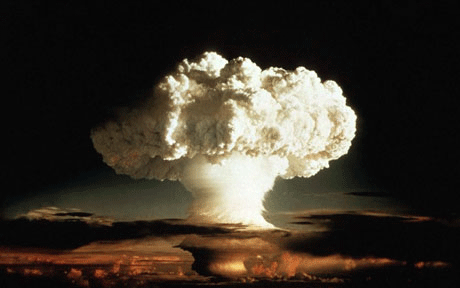
Satellite imagery shows that Russia, China and the US are building roads
and other infrastructure in historic nuclear test sites, raising fears that
they could soon not be historic any more, and back in use.
A powerful piece of multimedia storytelling in the NYT offers a reminder of what that could
mean: raised levels of radioactive strontium-90 in teeth and bones,
off-the-charts levels of cancer, diabetes, stillbirth and miscarriage in
“downwind” populations near nuclear test sites, and a resumption of the
mad race to build ever bigger bombs that was supposed to end with the cold
war.
The US poisoned the lives and destroyed the homelands of the Marshall
islanders. The UK did similar in the Australian outback, and France in
French Polynesia. Some of those affected have received compensation. None
has ever had an official apology.
Tortoise 24th June 2024
https://www.tortoisemedia.com/2024/06/24/test-site-activity-sparks-fears-of-more-nuclear-blasts/
Iran Says Cooperation With UN Nuclear Watchdog Limited to Nuclear Non-Proliferation Treaty (NPT)
Iran’s top nuclear official says the country’s interactions with the UN
nuclear watchdog, IAEA, are limited to the legal boundaries of the Nuclear
Non-Proliferation Treaty (NPT) and the Safeguards. Mohammad Eslami
emphasized that the International Atomic Energy Agency (IAEA) has no right
to demand anything beyond these limits. The statement arises amid increased
scrutiny over Iran’s nuclear activities, with international concern about
potential NPT violations.
Iran International 23rd June 2024
How Israel Became a Nuclear Power
The United States actively works to shield the Israeli nuclear weapons program from criticism as well as public knowledge.
In effect, unwillingness to commit to nuclear nonproliferation has led to nuclear proliferation.
https://antinuclear.net/2024/06/24/keep-up-to-date-on-australias-media-quagmire-on-nuclear-power/
Israel’s nuclear weapons program has been an open secret for over fifty years. Declassified documents and the wider availability of satellite imagery have largely been responsible for revealing the extent of the nation’s nuclear program. So too has the courage of whistleblowers such as Mordechai Vanunu, an Israeli nuclear technician who exposed his country’s covert program and was subsequently drugged and kidnapped by Mossad agents in Italy before being secretly tried and sentenced to eighteen years in prison in 1986.
Yet the United States and other nuclear-armed states, as well as a broad range of bodies responsible for monitoring arms proliferation, continue to maintain a policy of not publicly acknowledging the existence of Israel’s nuclear weapons.
These norms of institutional secrecy are surprisingly powerful and far-reaching. US government employees have been fired for referring to Israeli nuclear weapons. Even Wikipedia’s page on the subject uses circuitous language to refer to their existence. (The page is locked to edits from almost all contributors.) This approach is effective: a 2021 poll suggested that more Americans believed that Iran has nuclear weapons than that Israel does, when the reality is the opposite.
This wall of silence has proven remarkably porous. During the early days of Israel’s war on Gaza, government officials openly entertained the possibility of using nuclear weapons on the battlefield, and figures within the US military think tank circuit have wondered whether Israel’s secrecy is doing it more harm than good.
Conventional wisdom about the strategic importance of possessing nuclear weapons is that there’s no reason to have one if you don’t tell anyone. Intimidation is as much a part of deterrence as use. If no one suspects you can respond to an attack with the overwhelming force of a nuclear counterattack, what’s to make them think twice?
But Hezbollah’s continued assault on northern Israel, which has thus far led to the evacuation of over ninety thousand people, gives lie to the notion that possession of nuclear weapons offers complete protection. In a recent speech, Hassan Nasrallah, Hezbollah’s secretary general, made it clear that if Israel were to cross what it considers to be red lines, there would be no target within the country safe from a retaliatory response. It is therefore not clear that Israel’s nuclear weapons are on their own preventing it from being attacked in a way that threatens its existence. Israel’s relationship with the United States has, however, afforded it a range of impressive offensive and defensive nonnuclear capabilities, backed up by the even larger looming threat of US military involvement, which it is actively using.
Were the US to enforce its own policies consistently, Israel’s status as a state in possession of nuclear weapons would directly threaten its access to aid. The Glenn Amendment to the US Arms Export Control Act explicitly prohibits arms assistance to and mandates sanctions on countries that have, as Israel did in 1979, tested a nuclear weapon after 1977. But the fact that its nuclear weapons program continues to command this kind of bizarre deference illuminates the forces driving nuclear proliferation around the world.
The Forces Behind Proliferation
Scrupulous nonacknowledgment of Israeli nuclear weapons in the present day is part of the United States’ general position of aiding Israeli military endeavors, regardless of the financial or strategic cost. But the reason Israel has nuclear weapons in the first place has less to do with its relationship with the United States and more to do with the geopolitical forces that have driven proliferation since America first dropped the bomb on Japan.
The program that produced Israel’s nuclear weapons is as old as the state itself. As Avner Cohen details in Israel and the Bomb, a nuclear program was discussed by Israel’s leaders practically from the establishment of the Israeli state in 1948. David Ben-Gurion, the country’s first prime minister, took an intense personal interest in nuclear technologies in particular and science and technology as foundations of modern state power in general.Hezbollah’s continued assault on northern Israel gives lie to the notion that possession of nuclear weapons offers complete protection.
Already in 1949, Israel was conducting exploratory research for potential uranium deposits in the Negev, a desert region in the country’s south. When these proved inadequate, it developed techniques for producing usable nuclear material from the relatively poor resources at its disposal, before turning to the United States as the potential source of the raw materials necessary to jump-start a nuclear program.
But in the immediate postwar years, the United States was unwilling to provide the necessary material without guarantees from Israel that the country’s leaders saw as undesirably inhibiting. Israel instead turned to other small countries with nuclear programs at different stages of development: France and Norway, two of only three European countries in the early 1950s operating nuclear reactors.
Israel and France shared a set of geopolitical interests. Both opposed the government of Egyptian president Gamal Abdel Nasser. The French, motivated by neocolonial idealism, took issue with Nasser for nationalizing the Suez Canal, and Israel of course felt threatened by Nasser’s Arab nationalism.
Skepticism about the possibility that the US nuclear umbrella could actually offer security guarantees also motivated nations like France to advance a Gaullist policy of strategic autonomy. This meant encouraging nuclear proliferation where doing so would secure the broader geopolitical interests of declining powers.
Nonproliferation Amid Great-Power Rivalry
In the present, the United States actively works to shield the Israeli nuclear weapons program from criticism as well as public knowledge. As with France’s hostility to a Nasser-led anti-Western order, the Israeli-US alliance is strongly motivated by fear of Iran, or any other anti-American state, developing its own nuclear program. Yet Israel’s nuclear weapons, along with the substantial, long-term support among a certain segment of the US political class for war with Iran, are two very powerful factors driving Iran to develop its own nuclear weapon.
At present, Iran does not have nuclear weapons, though experts believe that it currently maintains the capability to quickly develop them. President Barack Obama’s 2015 Iran nuclear deal limited Iran’s ability to develop a nuclear weapon and imposed a regime of inspections and oversight which provided assurance to other countries that it was not developing nuclear weapons. But Israel opposed the deal on the grounds that it did not go far enough to preclude the possibility that Iran might one day develop a nuclear weapon — a similar kind of all-or-nothing approach to the one that informed the Donald Trump administration’s decision to exit the agreement in 2018.
As Israel’s war on Gaza continues and expands outward into the broader region, it seems it may only be a matter of time before Iran finally does develop a nuclear weapon. After its recent large-scale rocket attacks against Israel, Iran announced that it might reverse its current voluntary commitment to not developing nuclear weapons should Israel retaliate by hitting its nuclear facilities. It goes without saying that this would make the ongoing conflict between Israel and Iran much more dangerous, giving even low-level incidents the potential to escalate to dramatic and destructive new heights.
The United States actively works to shield the Israeli nuclear weapons program from criticism as well as public knowledge.
In effect, unwillingness to commit to nuclear nonproliferation has led to nuclear proliferation. This explains why Saudi Arabia has in recent years betrayed nuclear ambitions. Crown Prince Mohammed bin Salman has stated in US press outlets that Saudi Arabia would develop a nuclear weapon if Iran did so. Yet rather than treating this open disregard for stated US policy as a serious limit on US-Saudi relations, the United States has been pushing for a so-called “normalization” deal between Saudi Arabia and Israel — including a stipulation of a “credible path to a Palestinian state.” Saudi Arabia, in turn, wants the United States to provide it with nuclear technology — ostensibly, of course, for a power program.
The dilemma for America is that whatever interest it does have in nuclear nonproliferation must be balanced against its broader commitment to global hegemony. The latter would be undermined if China, which it now sees as its key competitor, stepped in to provide technical support to fledgling nuclear programs, as it has done with Saudi Arabia. Last year, China sent one of its engineering companies to conduct surveys of the Gulf monarchy’s uranium deposits, although it seems unlikely that these deposits could support a nuclear program of any size.
Nuclear weapons experts have called for safeguards that could prevent the development of a Saudi nuclear weapons program. Yet unlike in the case of Israel’s search for nuclear material, the threat of safeguards doesn’t seem to be a deterrent to the kingdom’s openly stated nuclear ambitions. It sometimes seems that U.S. nuclear weapons policy in 2024 is based on a tacit acceptance of its powerlessness over global nuclear weapons politics. Rather than trying to prevent proliferation, America has been forced to settle for the role of being the primary nuclear patron where it can.
Existential Threats
Israel’s possession of nuclear weapons has been largely irrelevant to the ongoing war in Gaza. The country’s overwhelming conventional capabilities have granted it superiority on the battlefield, at the cost of the lives of tens of thousands of civilians. But possession of nuclear weapons reinforces the worldview that underlies Israel’s political calculations (and to some extent, those of every nuclear-armed country): that its existence is constantly threatened, and it is only rational for it to possess the means of responding to such threats with unlimited force.
It is the states with the most nuclear weapons, Russia and the United States, that most assiduously cling to the logic that weapons of mass destruction are the only safeguard against existential threats. Both have consistently bypassed opportunities to deescalate the very real, immediate risks to human safety and civilization that the continued existence of nuclear weapons poses. In doing so, they’ve set a powerful precedent for every other country in the world to uphold nuclear weapons as the only real guarantor of security.
Without a real commitment to reducing the role of nuclear weapons in global politics by the states that can certainly afford it, this de facto policy encourages nuclear proliferation. Israel’s well-defended status as a nuclear power that need not even announce itself is not an exception, but an example to other states thinking of going nuclear.
Emma Claire Foley is a writer and filmmaker based in New York. Her writing and commentary has appeared in Newsweek, NBC, the Guardian, and elsewhere.
The U.S. power structure is blindly dedicated to Israel
When the board of the Columbia Law Review clumsily censored a pro-Palestinian article it revealed the degree to which pro-Israel ideology is enmeshed in the U.S. power structure. Luckily, a generational shift is changing this before our eyes.
BY PHILIP WEISS , Mondoweiss
Recently there was an important event at Columbia Law School. The school’s law review published a piece on a sweeping legal theory of the Nakba by Harvard law student Rabea Eghbariah — and the board of the law review stepped in in unprecedented fashion to shut down the publication online. After the Intercept reported that the website had been “nuked,” the authoritarian move became an embarrassment; and the piece was restored. Though students obviously feel chilled.
This story reminds us that the U.S. establishment is firmly and blindly pro-Israel. The board that squashed the students included operators of the highest order: professor Gillian Metzger, who also serves in the Justice Department’s Office of Legal Counsel; Justice Department senior counsel Lewis Yelin; and Ginger Anders, a former assistant to the U.S. Solicitor General.
We used to call people like this the ruling class. These high appointees understand what American values are, and today American values are standing by Israel even as it massacres thousands of children. These values surely have to do with the importance of Zionist donors to Joe Biden and universities, but they go beyond that to the makeup of the U.S. establishment. Pro-Israel voices — including Jewish Zionists — are a significant element of corporate culture. They are a generational force. Young progressives and young Jews are rejecting Israel. But they aren’t in the power structure…………………………………………………………………………………………………. more https://mondoweiss.net/2024/06/the-u-s-power-structure-is-blindly-dedicated-to-israel/
-
Archives
- February 2026 (211)
- January 2026 (308)
- December 2025 (358)
- November 2025 (359)
- October 2025 (376)
- September 2025 (258)
- August 2025 (319)
- July 2025 (230)
- June 2025 (348)
- May 2025 (261)
- April 2025 (305)
- March 2025 (319)
-
Categories
- 1
- 1 NUCLEAR ISSUES
- business and costs
- climate change
- culture and arts
- ENERGY
- environment
- health
- history
- indigenous issues
- Legal
- marketing of nuclear
- media
- opposition to nuclear
- PERSONAL STORIES
- politics
- politics international
- Religion and ethics
- safety
- secrets,lies and civil liberties
- spinbuster
- technology
- Uranium
- wastes
- weapons and war
- Women
- 2 WORLD
- ACTION
- AFRICA
- Atrocities
- AUSTRALIA
- Christina's notes
- Christina's themes
- culture and arts
- Events
- Fuk 2022
- Fuk 2023
- Fukushima 2017
- Fukushima 2018
- fukushima 2019
- Fukushima 2020
- Fukushima 2021
- general
- global warming
- Humour (God we need it)
- Nuclear
- RARE EARTHS
- Reference
- resources – print
- Resources -audiovicual
- Weekly Newsletter
- World
- World Nuclear
- YouTube
-
RSS
Entries RSS
Comments RSS
 nuclear-news