Nuclear Power Is Hard. Billionaire Bill Gates Wants to Make It Easier

COMMENT. Sodium cooled nuclear reactors are not necessarily safer. Nuclear power: molten salt reactors and sodium-cooled fast reactors make the radioactive waste problem WORSE
Work is starting in Wyoming coal country on a new type of reactor.
Its main backer, Bill Gates, says he’s in it for the emissions-free
electricity. Outside a small coal town in southwest Wyoming, a
multibillion-dollar effort to build the first in a new generation of
American nuclear power plants is underway. Workers began construction on
Tuesday on a novel type of nuclear reactor meant to be smaller and cheaper
than the hulking reactors of old and designed to produce electricity
without the carbon dioxide that is rapidly heating the planet.
The reactor being built by TerraPower, a start-up, won’t be finished until 2030 at the
earliest and faces daunting obstacles. The Nuclear Regulatory Commission
hasn’t yet approved the design, and the company will have to overcome the
inevitable delays and cost overruns that have doomed countless nuclear
projects before.
What TerraPower does have, however, is an influential and
deep-pocketed founder. Bill Gates, currently ranked as the seventh-richest
person in the world, has poured more than $1 billion of his fortune into
TerraPower, an amount that he expects to increase.
At a recent conference in New York, David Crane, the Energy Department under secretary for
infrastructure, said that two years ago he “didn’t really see” a case
for next-generation reactors. But as demand for electricity surges because
of new data centers, factories and electric vehicles, Mr. Crane said he had
become “very bullish” on nuclear to provide carbon-free power around
the clock without needing much land. One problem with nuclear power,
though, is that it has become prohibitively expensive.
Traditional reactors are huge, complex, strictly regulated projects that are difficult to build
and finance. The only two American reactors built in the last 30 years,
Vogtle Units 3 and 4 in Georgia, cost $35 billion, more than double initial
estimates, and arrived seven years behind schedule. TerraPower’s reactor,
by contrast, uses liquid sodium instead of water, allowing it to operate at
lower pressures. In theory, that reduces the need for thick shielding. In
an emergency, the plant can be cooled with air vents rather than
complicated pump systems. The reactor is just 345 megawatts, one-third the
size of Vogtle’s reactors, making for a smaller investment.
New York Times 11th June 2024 https://www.nytimes.com/2024/06/11/climate/bill-gates-nuclear-wyoming.html
94% of Americans want to end Ukraine war, but US rejects China peace deal, opposes talks with Russia
Polling shows 94% of people in the US and 88% in Western Europe want a negotiated settlement to end the war in Ukraine, but NATO opposes a peace proposal made by China and Brazil, and refuses to invite Russia to talks in Switzerland.
By Ben Norton, 9 June 24, https://geopoliticaleconomy.com/2024/06/08/end-ukraine-war-us-china-peace-deal-russia/
Polling shows that the vast majority of people in the United States and Western Europe want negotiations to end the war in Ukraine.
Despite this, NATO opposes a peace proposal made by China and Brazil, and refuses to invite Russia to a so-called “peace conference” that the Western powers are holding in Switzerland from June 15-16.
The Institute for Global Affairs of Eurasia Group, an avowedly pro-NATO and anti-Russia consulting firm that has worked extensively with Western governments, published a study this June titled “The New Atlanticism”.
The survey found that the 94% of people in the US and 88% in Western Europe want a negotiated settlement to end the war in Ukraine.
Just 17% of North Americans and Western Europeans say that the war must continue in order to weaken Russia.
(The poll allowed participants to choose two answers, which explains why the total is larger than 100%).
In May, China and Brazil introduced a joint proposal for peace negotiations between Russia and Ukraine.
In their six-point plan, Beijing and Brasilia called for “an international peace conference held at a proper time that is recognized by both Russia and Ukraine, with equal participation of all parties as well as fair discussion of all peace plans”.
This contrasted with a so-called “peace conference” that the Western powers are holding in Switzerland from June 15-16. Russia was not invited to this NATO-backed “peace summit”, meaning there will not be any actual negotiations between the warring parties to try to end the war.
The Chinese government said it will not participate in the one-sided Switzerland conference, stating that it would only join if Russia was invited as well.
Beijing has made numerous peace proposals to try to end the war in Ukraine. These have been consistently opposed by the US and its NATO allies.
This comes at a very dangerous moment, when the US government is considering deploying more strategic nuclear weapons, aimed at China and Russia, Reuters reported.
Politico revealed in May that the Joe Biden administration had authorized Ukraine to use US weapons to launch attacks inside Russian territory.
French President Emmanuel Macron announced this June that Paris and Western allies had made an agreement to send military trainers to Ukraine. The Washington Post noted that this “is the latest sign that France and other allies may now be willing to put NATO country troops on Ukrainian soil”.
The US and its European allies have already had special operations forces and spies on the ground in Ukraine since the beginning of the conflict. The New York Times admitted this in June 2022. But the number of Western forces was quite small. NATO member states now plan to send even more.
UN Security Council Adopts Gaza Ceasefire Resolution
The US claims Israel has accepted the proposal, but Netanyahu continues to reject the idea of a permanent ceasefire
by Dave DeCamp June 10, 2024, https://news.antiwar.com/2024/06/10/un-security-council-adopts-gaza-ceasefire-resolution/
On Monday, the UN Security Council adopted a US-drafted ceasefire resolution for Gaza based on a proposal recently outlined by President Biden. Fourteen members of the 15-member body voted in favor, and Russia abstained.
The US claims Israel has accepted the proposal, but Israeli Prime Minister Benjamin Netanyahu has publicly rejected it and continues to rule out the idea of a permanent ceasefire. Russia said it couldn’t support the resolution because it wasn’t clear what Israel had agreed on and that the language was too “vague.”
While Hamas hasn’t formally responded to President Biden’s proposal, it welcomed the ceasefire resolution and released a statement showing strong support. The Palestinian group said it was ready to “enter into indirect negotiations on the implementation of these principles.”
The resolution outlines a three-phase deal. The first phase includes an “immediate, full, and complete ceasefire with the release of hostages including women, the elderly, and the wounded, the return of the remains of some hostages who have been killed, and the exchange of Palestinian prisoners.”
The first phase would also involve an Israeli withdrawal from densely populated areas of Gaza, the return of displaced Palestinians, and a significant increase in humanitarian aid.
The two sides are supposed to negotiate a permanent ceasefire during the first phase, and the second phase would see a permanent end to hostilities “in exchange for the release of all other hostages still in Gaza, and a full withdrawal of Israeli forces from Gaza.” The third phase would start “a major multi-year reconstruction plan for Gaza, and the remains of any Israelis in Gaza would be returned to Israel.
The resolution calls on Israel and Hamas to implement the deal “without delay and without condition.” US officials are claiming Hamas is the only thing standing in the way of a deal despite Netanyahu reaffirming his opposition to a permanent ceasefire.
“My message to governments throughout the region, to people throughout the region, is – if you want a ceasefire, press Hamas to say ‘yes,’” Secretary of State Antony Blinken told reporters during a visit in Cairo.
US officials told NBC News that the Israeli operation in Nuseirat that killed over 200 Palestinians and freed four Israeli hostages makes a ceasefire deal less likely since it has emboldened Netanyahu. While claiming it has been pushing for a ceasefire, the US supported the massacre by providing intelligence.
Great British Nuclear Small Reactors competition timeline delayed for General Election, amid doubts on their viability
There have been some doubts cast, with the Environmental Audit Committee claiming that SMRs will not be able to help the UK decarbonise by 2035. Additionally, US think tank Institute for Energy Economics and Financial Analysis (IEEFA) has said that SMRs are “too expensive, too slow, and too risky”.
10 JUN, 2024 BY TOM PASHBY
The six small modular reactor (SMR) developers shortlisted in Great British Nuclear’s (GBN’s) competition now have an extra two weeks to submit documentation due to the General Election.
The competition winner will receive government backing to deploy a fleet of SMRs in the UK. At the time of the competition announcement, GBN chief executive Gwyn Parry-Jones
said parties would be “aiming for a final contract agreement in the
summer”. Even if not successful in GBN’s competition, many of the
shortlisted firms have signalled intent to deliver SMRs in the UK.
Rolls-Royce SMR recently announced a prototype module testing facility at
the University of Sheffield and Holtec has shortlisted four UK sites for
its SMR module factory. Westinghouse has plans to deploy the first
privately funded SMRs in North Teesside by the 2030s.
There have been some doubts cast, with the Environmental Audit Committee claiming that SMRs will not be able to help the UK decarbonise by 2035. Additionally, US think tank
Institute for Energy Economics and Financial Analysis (IEEFA) has said that
SMRs are “too expensive, too slow, and too risky”.
New Civil Engineer 10th June 2024
Gates-backed nuclear plant breaks ground without guarantee it’ll have fuel
TerraPower’s atomic facility needs lots of low-enriched uranium and who mainly makes it … ah, jeez
The Register Brandon Vigliarolo, Tue 11 Jun 2024
Unwilling to let a little thing like reality stand in its way, Bill Gates’ TerraPower has broken ground on its Wyoming nuclear power plant without any guarantee it’ll have the fuel needed to run the thing once it’s finished.
The Microsoft tycoon made no mention of that supply issue in a memo he published on Monday announcing the ground breaking in the former coal town of Kemmerer in western Wyoming.
Instead of dwelling on the fact that the world’s large-scale producers of high-assay low-enriched uranium (HALEU) – needed for the plant’s liquid-sodium-cooled reactor – are right now located in Russia and China and that difficulties in getting that fuel into the United States have already delayed his project, Gates chose instead to wax philosophical about the future of nuclear energy.
“As I looked at the plans for this new reactor [before the founding of TerraPower in 2006], I saw how rethinking nuclear power could overcome the barriers that had hindered it — and revolutionize how we generate power in the US and around the world,” Gates, who co-founded TerraPower, wrote.
“That technology was just an idea in a lab and on a computer screen until today.”
We note that the reactor which so captivated the Windows billionaire prior to TerraPower’s founding is still just an idea in a lab, however. The original plan was for TerraPower to develop a traveling-wave reactor (TWR) that slowly burns columns of depleted uranium as a safe power source.
TerraPower planned to have an experimental TWR online in 2022, which never happened. Instead, the biz turned its focus away from TWR to the HALEU-fueled “Natrium” sodium fast reactor now under early construction in Wyoming, trading a development impediment for a fuel one.
Two years ago, there was only a single concern in the US able to produce the needed HALEU fuel. Not much has improved on the nuclear fuel front since then, as President Biden signed a total ban on Russian uranium imports just last month, meaning US companies won’t be able to go to Russia, at least, for their HALEU ingredients.
We can’t imagine procuring HALEU from China will be particularly fun for American entities, either, assuming the Middle Kingdom can produce the goods at all at scale.
The one business we’re aware of in the US producing HALEU fuel – American Centrifuge Operating (ACO) – only shifted its first HALEU in November 2023 – and a mere 20 kilograms of it at that. ACO parent Centrus reported it produced an additional 135kg in the first quarter of 2024, but that’s still not enough.
The US Dept of Energy reckons America needs more than 40 metric tons of the stuff by the end of the decade to “deploy a new fleet of advanced reactors,” and that amount is just for starters: Additional fuel will be needed each year. If ACO continued to produce 135kg of fuel each quarter for the rest of the decade, we’d still only be at around three metric tons by 2030.
Luckily, Centrus tells us it’s ready to start scaling up production as soon as it gets necessary funding from the federal government.
“There’s a request for proposal out right now for the DoE’s HALEU availability program,” Centrus VP of corporate communications Dan Leistikow told The Register. Proposals were due back in March, Leistikow said, and he expects to hear something back within the next few months.
“We can be at a commercial scale within four years of receiving funding,” Leistikow said.
There’s also a British HALEU plant on the cards, scheduled to go online in the early 2030s, which might be able to supply the likes of TerraPower in America……………………………………………………………..
That’s still one tight timeline
When TerraPower announced in late 2022 that its now-HALEU-based Wyoming plant had been delayed due to being able to secure uranium fuel supplies, the biz also said it was going to at least break ground in the state in 2023 – and it couldn’t even get that started on time.
Gates’s sodium-cooled HALEU reactor doesn’t have the same challenging form-factor as a small modular reactor (SMR) – the other new hotness in nuclear power – but its delays remind us of difficulties encountered by operators of SMRs and larger-scale plants.
A study by the Institute for Energy Economics and Financial Analysis (IEEFA) found that nuclear plants – regardless of their form factor – pretty much never meet expected budgets or timelines.
Of the four SMRs online or under construction, the IEEFA noted none were supposed to take longer than four years to build, yet none took less than 12 years to complete. Looking to older generations of nuclear power, similar issues arose when building Vogtle Unit 3, the first nuclear power reactor to come online in the US this century. That reactor was more than half a decade late and nearly bankrupted US nuclear giant Westinghouse.
In other words, as much as we’re fans of harnessing the atom, nuclear power goalposts have a history of being rather mobile, and so far TerraPower is readily embracing that. https://www.theregister.com/2024/06/11/terrapower_nuclear_plant/#:~:text=Unwilling%20to%20let%20a%20little,the%20thing%20once%20it’s%20finished.
TODAY. UK and other mainstream media -oblivious of the suicidal danger of attacking Russia

Once again, I am grateful to the extraordinary Dominic Cummings, for expressing this so eloquently:
“If you want to see the rot of the old system consider this.
A week ago (5/6/24), Putin called in the international media. He told them: NATO has given Ukraine long range missiles to strike deep in Russia, why don’t we have the right to give weapons to other regimes to do the same to NATO, we are considering such options…
And what media coverage do you see?
The old UK media almost entirely censored the event. Although widely discussed globally, it is a non-event in the UK. I’d bet >95% of MPs don’t know it happened.
Not only is our Idiocracy escalating a disastrous war they’ve blundered into they’re censoring statements from the world’s biggest nuclear power directly threatening us with reprisals for our actions, shoving celebrity gossip onto the BBC website rather than translating Putin’s words (then they claim ‘trust the BBC not disinformation’!). And funding Ukraine which is drone-striking Russian early-warning radars for nuclear weapons, of no relevance to the UKR war.
The gap between the self-perception of our elite media and the reality has not been starker since I started watching them.”
Strange – in 1963 U.S. President John F Kennedy gave a similar warning his American University speech:

“Above all, while defending our own vital interests, nuclear powers must avert those confrontations which bring an adversary to a choice of either a humiliating retreat or a nuclear war. To adopt that kind of course in the nuclear age would be evidence only of the bankruptcy of our policy–or of a collective death-wish for the world.”
The day the West defined ‘success’ as a massacre of 270 Palestinians

Jake Sullivan, President Joe Biden’s national security adviser, was keen to take credit for the mass carnage – or what he termed a “daring operation”.
Israelis dance in the streets, the White House hails a ‘daring’ operation, Rishi Sunak expresses relief. How carnage in Gaza has become the new normal
JONATHAN COOK, JUN 12, 2024
Israel hasn’t just crossed the Biden administration’s pretend “red lines” in Gaza. With its massacre at Nuseirat refugee camp at the weekend, Israel drove a bulldozer through them.
On Saturday, an Israeli military operation to free four Israelis held captive by Hamas since its 7 October attack on Israel resulted in the killing of more than 270 Palestinians, many of them women and children.
The true death toll may never be known. Untold numbers of men, women and children are still under rubble from the bombardment, crushed to death, or trapped and suffocating, or expiring slowly from dehydration if they cannot be dug out in time.
Many hundreds more are suffering agonising injuries – should their wounds not kill them – in a situation where there are almost no medical facilities left after Israel’s destruction of hospitals and its mass kidnap of Palestinian medical personnel. Further, there are no drugs to treat the victims, given Israel’s months-long imposition of an aid blockade.
Israelis and American Jewish organisations – so ready to judge Palestinians for cheering attacks on Israel – celebrated the carnage caused in freeing the Israeli captives, who could have returned home months ago had Israel been ready to agree on a ceasefire.
Videos even show Israelis dancing in the street.
According to reports, the bloody Israeli operation in central Gaza may have killed three other captives, one of them possibly an American citizen.
In comments to the Haaretz newspaper published on Sunday, Louis Har, a hostage freed back in February, observed of his own captivity: “Our greatest fear was the IDF’s planes and the concern that they would bomb the building we were in.”
He added: “We weren’t worried that they’d [referring to Hamas] do something to us all of a sudden. We didn’t object to anything. So I wasn’t afraid they’d kill me.”
The Israeli media reported Israeli Defence Minister Yoav Gallant describing Saturday’s operation as “one of the most heroic and extraordinary operations I have witnessed over the course of 47 years serving in Israel’s defence establishment”.
The chief prosecutor of the International Criminal Court is currently seeking an arrest warrant for Gallant, as well as Prime Minister Benjamin Netanyahu, for war crimes and crimes against humanity. The charges include efforts to exterminate the people of Gaza through planned starvation.
State terrorism
Israel has been wrecking the established laws of war with abandon for more than eight months.
At least 37,000 Palestinians are known to have been killed so far in Gaza, though Palestinian officials lost the ability to properly count the dead many weeks ago following Israel’s relentless destruction of the enclave’s institutions and infrastructure.
Israel has additionally engineered a famine that, mostly out of view, is gradually starving Gaza’s population to death.
The International Court of Justice put Israel on trial for genocide back in January. Last month, it ordered an immediate halt to Israel’s attack on Gaza’s southern city of Rafah. Israel has responded to both judgments by intensifying its killing spree.
In a further indication of Israel’s sense of impunity, the rescue operation on Saturday involved yet another flagrant war crime.
Israel used a humanitarian aid truck – supposedly bringing relief to Gaza’s desperate population – as cover for its military operation. In international law, that is known as the crime of perfidy.
For months, Israel has been blocking aid to Gaza – part of its efforts to starve the population. It has also targeted aid workers, killing more than 250 of them since October.
But more specifically, Israel is waging a war on Unrwa, claiming without evidence that the UN’s main aid agency in Gaza is implicated in Hamas “terror” operations. It wants the UN, the international community’s last lifeline in Gaza against Israel’s wanton savagery, permanently gone.
By hiding its own soldiers in an aid truck, Israel made a mockery of its supposed “terrorism concerns” by doing exactly what it accuses Hamas of.
But Israel’s military action also dragged the aid effort – the only way to end Gaza’s famine – into the centre of the battlefield. Now Hamas has every reason to fear that aid workers are not what they seem; that they are really instruments of Israeli state terrorism.
Nefarious motive
In the circumstances, one might have assumed the Biden administration would be quick to condemn Israel’s actions and distance itself from the massacre.
Instead, Jake Sullivan, President Joe Biden’s national security adviser, was keen to take credit for the mass carnage – or what he termed a “daring operation”.
He admitted in an interview on Sunday that the US had offered assistance in the rescue operation, though he refused to clarify how. Other reports noted a supporting British role, too.
…………………………………………………………. ‘Successful’ massacre
As ever, for western media and politicians – who have stood firmly against a ceasefire that could have brought the suffering of the Israeli captives and their families to an end months ago – Palestinian lives are quite literally worthless.
The German Chancellor Olaf Scholz thought it appropriate to describe the killing of 270-plus Palestinians in the freeing of the four Israelis as an “important sign of hope”, while the British Prime Minister Rishi Sunak expressed his “huge relief”. The appalling death toll went unmentioned.
………………………………………..Media outlets uniformly hailed the operation as a “success” and “daring”, as though the killing and maiming of around 1,000 Palestinians – and the serial war crimes Israel committed in the process – need not be factored in.
BBC News’ main report on Saturday night breathlessly focused on the celebrations of the families of the freed captives, treating the massacre of Palestinians as an afterthought. The programme stressed that the death toll was “disputed” – though not mentioning that, as ever, it was Israel doing the disputing.
……………………………………….. The focus on Israeli politicking – rather than US complicity in the Nuseirat massacre – will doubtless provide a welcome distraction, too, as US Secretary of State Antony Blinken tours the region. He will once again wish to be seen rallying support for a ceasefire plan that is supposed to see the Israeli captives released – a plan Netanyahu will be determined, once again, to stymie.

Blinken’s efforts are likely to be even more hopeless in the immediate wake of the Biden administration’s all-too-visible involvement in the killing of hundreds of Palestinians
…………………………………………Israel needs to finish pulverising Gaza, making it permanently uninhabitable, so that the population will be faced with a stark dilemma: remain and die, or leave by any means possible.
The same US “humanitarian pier” that was pressed into service for Saturday’s massacre may soon be the “humanitarian pier” that serves as the exit through which Gaza’s Palestinians are ethnically cleansed, shipped out of a death zone engineered by Israel.
Top civil servant joins EDF after running department that struck nuclear deal
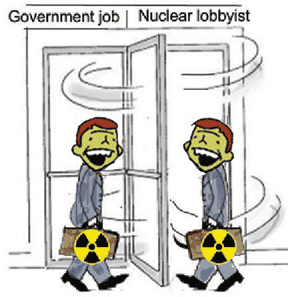
Alex Chisholm, who led business office during Hinkley Point C negotiations, appointed UK chair of energy firm
Rowena Mason Guardian, Whitehall editor, Wed 12 Jun 2024
One of the UK’s most senior civil servants, Alex Chisholm, has been revealed as the new UK chair of the energy company EDF, after having previously run the department that struck a deal for it to build a new nuclear power station.
Chisholm was permanent secretary at the Cabinet Office, and before that led the business department, which worked on the government deal for EDF to go ahead with the Hinkley Point C nuclear plant in Somerset. The agreement was struck in 2016 with UK bill payers bearing the cost of the construction over a 35-year period.
The long-delayed project’s costs have soared from an estimated £18bn to at least £31bn and it is due to be completed in 2031 – about 14 years after EDF thought it would be up and running.
The French state-owned company is a specialist in nuclear power, and one of the “big six” energy providers that have been criticised for huge profits during the energy crisis sparked by the war in Ukraine.
Chisholm’s departure is one of a number of high-profile exits from the civil service before a likely change of governing party. Alex Aiken, a former longstanding head of government communications, recently left Whitehall for a job as an adviser on communications to the government of the United Arab Emirates.
There is also speculation about the future of Simon Case, the cabinet secretary and former royal aide installed by Boris Johnson, given incoming prime ministers often want their own preferred candidate in the job.
Chisholm’s EDF role was approved by the watchdog on post-government jobs, known as the Advisory Committee on Business Appointments. But the watchdog said he must wait three months after departing government to take up the job and observe a ban on lobbying the government or involvement in negotiating government contracts for two years after leaving office.
The watchdog said: “In 2016, his department was responsible for the decision on finalising the first contract for difference [a pricing mechanism], with respect to EDF and the construction of Hinkley Point C. However, this was ultimately a decision for the secretary of state and followed the 2014 approval from the European Commission and was based on terms agreed then, 10 years ago.
“Significantly, due to the period of time that has elapsed, the committee did not consider Sir Alex could reasonably be seen to have influenced this decision in anticipation of an offer of work a decade later.”
Chisholm said his appointment came “at a time of great change and opportunity in the energy sector”……….https://www.theguardian.com/politics/article/2024/jun/11/top-civil-servant-edf-department-nuclear-deal-alex-chisholm
Alarm over 174 security breaches at Clyde nuclear bases

Rob Edwards, June 10, 2024, https://theferret.scot/security-breaches-clyde-nuclear-bases/—
Two nuclear bomb bases on the Clyde recorded 174 security breaches over five years, according to information released by the Ministry of Defence (MoD).
Between 2018 and 2022 there were 130 breaches reported at the Trident submarine base at Faslane, near Helensburgh, and a further 44 breaches at the nearby nuclear weapons store at Coulport.
The MoD has not given any details of the incidents, but suggested that some were “minor”. They could include lost identity cards, misplaced documents and data protection breaches, it said.
The MoD stressed that it investigated every incident “no matter how small” with the aim of continuously improving security.
Campaigners, however, warned there were “risks of major catastrophe” at Faslane and Coulport. They called on whoever wins the general election to “get to grips” with security problems.
The Conservatives, Labour and the Liberal Democrats all support the UK’s nuclear weapons programme. The Scottish National Party and the Greens oppose it.
A freedom of information response released by the MoD in May revealed that the Royal Naval Armaments Depot at Coulport recorded the highest number of security breaches – 13 – in 2019. Since then, there were 11 in 2020, nine in 2021 and nine in 2022.
Coulport is where around 200 of the UK’s arsenal of nuclear warheads are kept in underground bunkers. Spread across the slopes above Loch Long, the site is dotted with watchtowers and protected by a series of barbed wire fences.
The latest MoD release also confirmed a previous report that there were 60 security breaches at Faslane in 2022. Another report in 2022 said that there were 16 breaches at Faslane in 2021, and 18 in each of the previous three years.
Faslane, on the Gareloch, is the home port for the UK’s four Vanguard-class submarines that carry nuclear-armed Trident missiles. One submarine is meant to be continuously on patrol at sea, but in recent years the service has been stretched.
The numbers of security breaches in 2023 and so far in 2024 have not been published by the MoD. But it has previously released figures for nuclear safety incidents that have also plagued the Clyde bases.
The Ferret reported in April that Faslane and Coulport logged 843 “nuclear site events” from 2019 to April 2024. Twelve of them were classified by the MoD as having “actual or potential for radioactive release to the environment”.
We also revealed in August 2023 that the MoD’s Defence Nuclear Organisation, which oversees the UK nuclear weapons programme, had recorded 113 “security concerns” since 2017-18. Again, no details were given.
The Scottish Campaign for Nuclear Disarmament warned that security breaches should not be “shrugged off” as minor. “Faslane and Coulport combine nuclear bombs, nuclear reactors and missiles – radioactivity, explosives and highly flammable rocket fuel – always presenting potential targets and risks of major catastrophe,” said the campaign’s chair, Lynn Jamieson.
“At these most dangerous places, regular breaches signal either a grossly-inappropriate casual culture or the impossibility of 100 per cent security. Incidents rising to 60, averaging more than one a week, is a warning and calls for public investigation.”
Jamieson also attacked the MoD failure to provide details of the breaches. “Secrecy cloaks the reality of the everyday risks in our own backyard,” she told The Ferret.
“Secrecy is convenient for politicians who spout the myth that threatening to destroy half the planet with nuclear weapons keeps us safe.”
Some nuclear security breaches ‘serious’
The Nuclear Information Service, which researches and criticises nuclear weapons, argued that any security breaches were concerning. “If, as the MoD imply, some of these incidents were relatively minor, why have no further details been disclosed?” asked the service’s director, David Cullen.
“The obvious inference is that some of the incidents were much more serious. Whoever wins the election, I hope the incoming government will get to grips with this.”
The large increase in security breaches at Faslane between 2021 and 2022 was “especially worrying”, he said. A report by the London news broadcaster, LBC, in September 2023 suggested that this could be linked to Russian activity in the wake of the invasion of Ukraine in February 2022.
According to the MoD, incidents “can include minor breaches”. They can also include “the mis-accounting of documentation, loss of identity cards, inadvertent use of personal electronic devices and breaches in general data protection,” it said.
A spokesperson for the Royal Navy added: “Security is of paramount importance and we investigate every incident, no matter how small, to ensure we learn from experience and continuously improve our security.”
Will NATO member states individually or collectively go to war against Russia?

VOLTAIRE NETWORK | 31 MAY 2024, https://www.voltairenet.org/article220954.html
Spokesman for the German government Steffen Hebestreit said his country opposed the deployment of NATO’s anti-missile system on Ukrainian territory.
The German point of view matches that of Secretary General of the Alliance Jens Stoltenberg who said in an interview with The Economist: “The time has come for allies to reflect on whether they should lift some of the restrictions on the use of weapons given to Ukraine (…) Especially now, when a lot of fighting is taking place in Kharkov, near the border, denying Ukraine the ability to use these weapons against legitimate military targets on Russian territory makes it very difficult to defend it.”
He also said: “We have no intention of sending NATO ground troops to Ukraine because our objective… is twofold: to support Ukraine as we do, but also to ensure that it does not escalate into a full-scale conflict”
According to the New York Times, US Secretary of State Antony Blinken would be in favor of this second proposal. Steffen Hebestreit, for his part, evaded journalists’ questions on this subject.
☞ Extending the protection of the Atlantic anti-missile shield to Ukrainian territory would mean going to war collectively against Russia. But allowing Ukraine to attack Russia with weapons supplied by NATO member states would mean their individual entry into war against Russia.
For his part, Italy’s deputy prime minister Matteo Salvini commented: “This gentleman [Jens Stoltenberg] is dangerous because talking about World War III, Western weapons capable of striking and killing inside Russia, seems to me very, very dangerous and reckless (…) NATO cannot force us to kill in Russia, nor can anyone force us to send Italian soldiers to fight or die in Ukraine.”
Russian president Vladimir Putin told reporters: “This constant escalation can lead to serious consequences. If these serious consequences occur in Europe, how will the United States behave, given our parity in the field of strategic weapons? It’s hard to say. Do they want a world conflict?”. “Let them [European NATO member states] remember that their territory is small and their population is dense,” he continued.
Russian senator Dmitry Rogozin, former director of Roscosmos, directly warned Washington: “We are not only on the threshold, but already on the edge, beyond which, if the enemy is not stopped in such actions, an irreversible collapse of the strategic security of the nuclear powers will begin.”
In all likelihood, Poland is expected to be the first NATO member state to allow Ukraine to strike Russia with the weapons it has supplied. Moscow would then have to retaliate by striking at least the NATO logistics center on Polish territory in Rzeszów. It will be up to the other NATO member states to consider whether or not to activate Article 5 of the North Atlantic Treaty and start World War III.
From a strategic point of view, the deployment of US medium-range missiles on the borders of Russia and China now exposes them to this eventuality. That is why Russian Foreign Minister Sergei Lavrov announced that the two countries reached a joint defense agreement during President Vladimir Putin’s last visit to Beijing. In addition, Russia is currently conducting simulations with Belarus of the use of tactical (not strategic) nuclear weapons.
Two small communities are competing to receive Canada’s inventory of nuclear waste. They can’t be sure what they’ll get

“They’re basically surrendering any kind of fundamental right of public dissent on the part of the mayor and town council,”
“We’re talking about binding future generations.”
The Globe and Mail, MATTHEW MCCLEARN, JUNE 10, 2024
Two Ontario municipalities are vying to become hosts for an underground disposal facility for Canada’s nuclear waste. Both must formally announce in the coming months whether they’ll accept the facility – but they cannot know exactly what wastes they’d be agreeing to receive.
The Nuclear Waste Management Organization (NWMO) designed its $26-billion facility, known as a deep geological repository, to receive spent fuel from Candu reactors located in Ontario, Quebec and New Brunswick. This year, it plans to choose between the last two sites still in the running: the Municipality of South Bruce, Ont., located more than 120 kilometres north of London; or near Ignace, Ont., a town of 1,200 more than 200 kilometres northwest of Thunder Bay.
But since the project was conceived, two of NWMO’s three members (Ontario Power Generation and New Brunswick Power) proposed to build new reactors that would burn different fuels and produce novel wastes. The organization guarantees reactor developers that it will dispose of these wastes, even though their nature might not be understood for decades. And in the past few months, both candidate municipalities signed agreements that spell out how the project could be modified to receive such wastes, while limiting their ability to refuse.
These provisions help reduce uncertainty for the nuclear industry. A roadmap produced last year by the Nuclear Energy Institute, a U.S. lobby group, noted that because most small modular reactors (SMRs)being developed would burn different fuels from those of existing reactors, “technology neutral” criteria for accepting spent fuel into repositories was needed as soon as this year in both Canada and the United States.
But the provisions could make it harder to find willing hosts.
Ignace will decide through a council resolution whether it will accept the repository by July 30. South Bruce will hold a by-election in late October.
Consent from First Nations is also required. NWMO spokesperson Fred Kuntz said the organization is negotiating hosting agreements with both Wabigoon Lake Ojibway Nation for the Ignace project and Saugeen Ojibway Nation for the one in South Bruce. Both are in a position to effectively halt the project, and both have indicated they are not open to accepting SMR wastes at this time.
Mark Winfield, a professor of environmental and urban change at York University, said the NWMO’s decision to accept responsibility for non-Candu wastes means the host communities can’t know the nature of some of the waste they’ll receive, nor the quantity.
“They really are being asked for a blank cheque.”
Canada’s waste inventory includes 3.3 million Candu fuel bundles as of last year, and grows by about 90,000 annually. Each is about the size of a firelog and weighs slightly less than 20 kilograms. They’re highly radioactive upon removal from a reactor, and must be stored in pools of water for about a decade before they can be moved to storage containers. Utilities have considerable experience handling the bundles, and the industry has developed copper-clad containers to place them in, which in turn would be encased in bentonite clay in underground chambers.
The municipalities also agreed to accept fuel owned by Atomic Energy of Canada Ltd., a Crown corporation that operated several research reactors. There are dozens of types of wastes from these reactors, in far smaller amounts.
The hosting agreements detail what the NWMO is offering in return. South Bruce says it’s expecting $418-million over nearly a century and a half. Ignace anticipates $170-million. Jake Pastore, a spokesperson for Ignace, said its lower amount in part reflects the fact that the repository’s site is more than 30 kilometres west of the town, whereas the South Bruce site is on farmland within its boundaries and subject to local taxes.
And the agreements clarify what the repository won’t be receiving: Both agreements explicitly prohibit storing liquid nuclear waste. Waste originating from another country is similarly verboten.
Beyond these provisions, however, the agreements afford the industry considerable flexibility.
Ignace has agreed that the repository could accept spent fuel from SMRs and other non-Candu sources, provided a licence application has been filed with the Canadian Nuclear Safety Commission. The commission is considering three SMR-related applications.
The agreement also lays out a process by which the repository’s scope can be changed to accept other forms of spent fuel. Mr. Pastore said the NWMO would have to complete an “intense” regulatory review before introducing non-approved wastes. The organization has provided assurances, he added, that it would not bring such wastes unless there was “full agreement on moving forward.”
Both agreements contain dispute-resolution mechanisms, but the municipalities have agreed to support the NWMO in any regulatory process, including proposals to modify the project’s scope. Ignace has agreed not to support any resident or other municipality that opposes a regulatory approval sought by the organization.
“They’re basically surrendering any kind of fundamental right of public dissent on the part of the mayor and town council,” said Gordon Edwards, a consultant who runs a non-profit organization called the Canadian Coalition for Nuclear Responsibility.
“We’re talking about binding future generations.”
South Bruce’s agreement is less permissive than Ignace’s. It doesn’t make direct references to accepting SMR wastes. And it stipulates that before making a regulatory application to modify the repository’s scope, the NWMO must notify the municipality at least three years in advance. ……………………………………………………..
The types of waste produced in Canada could change significantly if the nuclear industry’s plans come to fruition.
Candus consume natural uranium with minuscule concentrations of the more fissile uranium-235. But most reactors in the U.S., Europe and elsewhere use “enriched” fuel containing higher quantities of U-235. Virtually all SMRs would use enriched fuels. And some would use exotic fuels for which there is limited international experience.
For example, New Brunswick Power proposes to build an ARC-100 reactor at its Point Lepreau plant, which would use a metallic uranium alloy fuel. The vendor, ARC Clean Technologies, said its reactor will need to be refuelled only every 20 years, and wastes from the proposed facility “will be fully characterized” and placed in appropriately sized and approved on-site storage containers while awaiting final disposal.
New Brunswick Power also seeks to build a molten salt reactor called the Stable Salt Reactor-Wasteburner. A 2021 study of reactor technologies by the Union of Concerned Scientists warned that all molten salt reactors it reviewed lacked “a well-formulated plan for management and disposal” of spent fuel.
“There’s so many different SMR designs, and I don’t think we can predict, in 2024, if many or any of them are ever going to go into production,” said Brennain Lloyd, a project co-ordinator with the environmental group Northwatch, which opposes the Ignace repository.
“But there’s potential that we could have a number of different designs, and all of them might behave differently. That’s a dog’s breakfast of additional risk.”………………………………………………………………………………
The Saugeen Ojibway Nation,from whom the industry seeks consent, has objected in writing to receiving SMR waste in its territory, adding that this “fundamental change in circumstances” means its discussions with the NWMO must be “reset.” It said its concerns about these wastes have not been addressed, and it’s not satisfied with the information it provided. “The ground is shifting beneath us, and the original project description no longer reflects the reality,” it declared in a regulatory submission in November.
In an interview, Chief Gregory Nadjiwon of the Chippewas of Nawash Unceded First Nation – one of the two member nations of Saugeen Ojibway Nation – said his organization is looking for resolution to wastes that have long been in its territory at the Bruce Nuclear Generating Station. It’s disinclined to receive wastes from other Candu stations outside its territory, let alone from SMRs.
“If you have a complex issue that hasn’t been resolved, why would you add another layer to it?”
………………………………………………………………. More controversial still is the possibility that the repository might accept wastes from reprocessing – which means applying physical and chemical processes to spent fuel to recover fissionable products, which could be used for new reactor fuel.
……………………………………… Mr. Edwards said that when a Candu fuel bundle is demolished for reprocessing, all of the radioactive materials contained within are released into a solid or liquid form. “You no longer have these nicely packaged fuel bun
Mr. Edwards said that reprocessing is the dirtiest segment of nuclear fuel chains. Sites where it has taken place, such as Hanford, Wash., in the U.S., Sellafield in Britain, and La Hague in France, are heavily contaminated and could cost hundreds of billions of dollars to clean up. The two candidate municipalities should have obtained legally binding vetoes against receiving reprocessing wastes, he said.
“Otherwise, they’re being led by the nose, assuming that one thing is going to happen when instead, something very different may end up happening – something that’s much more threatening to the community.”dles, you have something that’s much more complex and more difficult to manage.”
Documents released by New Brunswick Power under the province’s freedom of information legislation, and supplied to The Globe and Mail by nuclear issues researcher and activist Susan O’Donnell, show the corporation regarded long-term storage of reprocessing wastes as critical for attracting investors for its next-generation reactor projects. https://www.theglobeandmail.com/business/article-two-small-communities-are-competing-to-receive-canadas-inventory-of/—
Biden hits ‘new low’ in arming ‘pro-Nazi’ Azov: US Congressman

ByAl Mayadeen English, Source: Agencies, 12 Jun 2024 https://english.almayadeen.net/news/politics/biden-hits–new-low–in-arming–pro-nazi–azov–us-congressm
Paul Gosar says the Biden administration’s decision to lift a ban on arms supplies to Ukraine’s Azov battalion prolongs the war.
US President Joe Biden has reached a new low after his administration decided to remove restrictions on arms supplies to Ukraine’s Azov battalion, US Congressman Paul Gosar pointed out on Wednesday.
On Tuesday, The Washington Post, citing the US State Department, reported that the Biden administration has lifted the ban on arms supplies to and training of the Azov battalion.
Established in 2014 by Ukrainian ultra-nationalists in the wake of the Western-backed Maidan riots, the Azov Battalion was included in the National Guard of Ukraine in November of that year.
The battalion has come under severe criticism for its support of Nazi ideology and symbols, as well as its human rights violations against the Russian-speaking population of Eastern Ukraine.
Russia’s Supreme Court designated Ukraine’s Azov Battalion as a terrorist organization in August 2022.
Russian Ambassador to the United States Anatoly Antonov called the reported decision by the United States outrageous, adding that it raises serious concerns about US readiness to fight terrorism.
The Russian Prosecutor General’s Office last year accused Azov militants of employing prohibited means and methods of warfare, including the torture of civilians and the killing of children.
The battalion’s symbol is the neo-Nazi Wolfsangel, a black swastika against a yellow background. Founded by Andriy Biletsky, who vowed to “lead the white races of the world in a final crusade…against Semite-led Untermenschen,” the group is a pack of neo-Nazis working with the US-backed Ukrainian military.
Biden’s Saudi Arabia Deal
The Biden administration will also be agreeing to the installation of a nuclear reactor in Saudi Arabia without conditions. It will be agreeing to the sale of advanced military technology to Saudi Arabia,
The White House is committing itself to the survival and longevity of one of the most totalitarian regimes in the region, and the world.
By As`ad AbuKhalil, Consortium News , 11 June 24
Like every president before him, Joe Biden has decided to elevate relations between the U.S. and the Saudis. He is now finalizing a potentially historic security deal.
If concluded, the U.S. will be committing itself not to the security of the Saudi kingdom and its people, but to the survival and longevity of one of the most totalitarian regimes in the region, and the world.
The Abraham Accords, initiated by the Trump administration, were predicated on the recognition that the Arab people are not in any way eager or interested in making peace with Israel. ……………….
The Biden administration has wholeheartedly endorsed the Trump-Kushner foreign policy in the Middle East region. On all key points, it has stuck to the path of the previous administration in dealing with the Middle East and the Arab-Israeli conflict:
No. 1) It refused to revive the Iran nuclear agreement despite pledges to the contrary during the Biden campaign. It engaged in indirect negotiations with Iran but insisted on adding more concessions from Iran that were part of the objections that Republicans had raised back in 2015.
No. 2) it refused to re-open the PLO office in Washington, D.C., although the PLO has become (since the Clinton administration) a mere tool of the U.S. and acts in the service of the Israeli occupation army. The PLO had even amended its charter according to specific instructions of the Clinton administration and Israel. The PLO today stands in opposition to the real representatives of the Palestinians people.
No. 3) The U.S. administration didn’t return the U.S. embassy to Tel Aviv from Jerusalem, thereby sticking to the demand of the Christian Right and the Israeli embassy. The U.S. has now committed itself to the recognition of Israeli sovereignty over Jerusalem.
No. 4) The U.S. government did not declare Israeli settlements in the West Bank as being in contradiction with international law (which was the classic characterization by U.S. administrations since 1967 until the George W. Bush administration).
No. 5) The U.S. government did not reverse Trump’s policy of accepting Israeli sovereignty over the occupied Golan Heights.
No. 6) The Biden administration stuck to the model of Donald Trump’s son-in-law, Jared Kushner, of ignoring the Palestinian problem altogether and seeking instead separate bilateral peace treaties between Israeli and Gulf despots.
That Punishment Pledge
The story is now well-known, how Biden, while campaigning in 2020, pledged to punish the Saudi regime which he characterized as a pariah. He said that he could not find one redeeming quality in Muhammad Bin Salman, the actual ruler who is guilty not only of the murder and dismemberment of Washington Post columnist Jamal Khashoggi, but also of gross human rights violations throughout the region………………..
Even when Israel continues in its war of genocide, the Biden administration has consistently pursued talks with Saudi Arabia, not over a solution to the Palestinian problem, but over the best methods to achieve Saudi-Israeli peace.
The Israel Lobby’s Flawed Premise
The premise of the Israel lobby on that potential deal is flawed. It assumes that the Saudi regime genuinely speaks on behalf of the Arab and Muslim people, and that the Saudi government can “deliver,” so to say, the Palestinian people.
It has been proven in the events of the last several months, that the Saudi regime does not hold any sway over the Palestinian people and that Iran has more credibility among Palestinian leaders and factions in Gaza than the Saudi regime. ……………………………………………………………………………………………
The Biden administration will also be agreeing to the installation of a nuclear reactor in Saudi Arabia without conditions. It will be agreeing to the sale of advanced military technology to Saudi Arabia, which the U.A.E. regime had asked for itself when it agreed to the Abraham Accords.
Those accords will not affect the lives of the Palestinians and will only embolden Israel to commit more atrocities and war crimes.
The Biden administration has become one of the worst administrations in the history of U.S. foreign policy in the Middle East; it has not only fully participated in the Israeli war of genocide but it has also given more U.S. support to the perpetuation of Arab despotic order in the interest of Israel and its lobby in D.C. https://consortiumnews.com/2024/06/11/asad-abukhalil-bidens-saudi-deal/
MP’s claim of support for nuclear power in Highlands challenged
By John Davidson john.davidson@hnmedia.co.uk, Northern Times 11th June 2024
An anti-nuclear campaigner has hit out at a claim made by Highland MSP Edward Mountain that people in the region want nuclear power.
The Conservative MSP hosted an energy summit in Strathpeffer last Friday, bringing together industry experts and members of the public.
The aim was to discuss the future of energy production and provision in the Highlands, with panellists including representatives from SSEN, Storegga, Highland Fuels, Highland Renewables, and the Anaerobic Digestion and Bioresources Association.
‘I heard all of my friends’ last breath’: Testimonies from the Nuseirat massacre
The Israeli massacre in Gaza’s Nuseirat camp killed over 270 Palestinians and injured many more. Survivors say the horrors they witnessed will stay with them for the rest of their lives.
BY TAREQ S. HAJJAJ https://mondoweiss.net/2024/06/i-heard-all-of-my-friends-last-breath-testimonies-from-the-nuseirat-massacre/
The Israeli massacre in the Nuseirat camp to liberate four Israeli prisoners held by resistance factions in the Gaza Strip started at 11:00 in the morning on June 8. Although the scenes of Palestinians running for safety may have seemed sadly familiar, this invasion was different from others that have been carried out across the Gaza Strip.
This time, the Israeli military wore civilian clothes, rode in Palestinian cars, and moved among the people in disguise. There were no warnings to evacuate, or orders from the army to move elsewhere, and people were surprised by the Israeli special forces and tanks. A large number of special forces hidden among the people only revealed themselves once the deadly operation began as other special forces stormed the area traveling in cars loaded with luggage, the same luggage that the displaced people carry with them, such as mattresses, pillows, blankets, and bags. When the Palestinians detected them, the soldiers quickly called for support, and helicopters, fighter planes, artillery, and tanks descended. Reconnaissance aircraft and foot solders then began committing massacres against the civilian population.
The intensity of shelling and gunfire soon warned the residents that a massacre was unfolding. They left their homes and took to the streets running in search of safety, which could not be found.
The Israeli operation killed 274 Palestinians, including 64 children, and injured 689 Palestinians in total. “Some of the bodies that arrived at the hospital were body parts, as well as dismembered bodies,” the Gaza Ministry of Health reported when announcing the casualty numbers.
As the world celebrates the liberation of four Israeli hostages from the Gaza Strip, and the media focuses on their lives, freedom, and the happiness of their families there is barely a mention of the number of Palestinian casualties or consideration that each of those killed are also leaving behind a bereaved family.
Issam Hajjaj, 27, survived the massacre and spoke to Mondoweiss. “We were running away from bombing and killing. In all directions, there was either bombing, an Israeli tank, or Israeli gunmen shooting at anyone in their path,” he explained. “While we were running away from death, I saw dismembered bodies on the road as a result of the bombing, and I saw those who left their loved ones under the rubble and fled to save the rest of the family.”
“We did not know from which direction death would come for us.”
Anatomy of a massacre
Following the attack the Israeli army announced that the element of surprise had been crucial. This is why the military operation took place during daylight hours and in a densely populated area. This is also why there was such a high number of Palestinian casualties.
Hajjaj says that within minutes of the invasion starting, Israeli forces surrounded the targeted location from all sides and did not leave any route for people to escape except one road, Al-Zuhur Road connecting Nuseirat and Deir Al-Balah. However, just at the same time that the Nuseirat massacre took place, people near Al-Aqsa Martyrs Hospital in Deir Al-Balah were fleeing to Nuseirat, and people were using this street to arrive. The intense crowding in the street during the continuous bombing spread panic, and bodies soon began to fly as a result of the direct targeting of everything in that area.
“During our escape, we saw bodies being loaded into cars heading to Al-Aqsa Martyrs Hospital. Women were screaming in the streets, and children were crying and screaming,” Hajjaj recounted. “I saw a family that was fleeing together. A shell fell on the father and killed him in front of his wife and young daughter. After the mother got up and carried her daughter, she discovered that her husband was killed; she left him on the ground and fled to save her daughter and herself.”
Hajjaj explained that the targeted location was two buildings near Al Awda Hospital in the Nuseirat camp, but to reach these two buildings, the Israeli army destroyed an entire residential square. He says that while the Israeli army liberated more than four hostages, the intensity of fire from the Palestinian resistance stopped them from getting out more captives.
The Al-Qassam Brigades, the military arm of Hamas in the Gaza Strip, seemed to confirm this account in a video it published declaring that three Israeli prisoners were killed by the Israeli bombing of the Nuseirat camp.
“We inform you that in exchange for these, your army killed three prisoners in the same camp, one of whom held American citizenship,” Al-Qassam announced in the video. The resistance group stressed that the remaining Israeli prisoners would not be liberated until the Palestinian prisoners in Israeli prisons were freed as well.
Several Palestinians published photos and video from the scene in Nuseirat that confirmed the firsthand accounts collected by Mondoweiss showing an Israeli special force vehicle entering the camp at the beginning of the invasion which was followed by indiscriminate bombing as a form of support cover. Other videos show a car loaded with luggage entering the Block 5 area in the Nuseirat camp and killing a person at the door of one of the buildings. Israeli forces then used iron ladders to reach the upper floors, as shown in one of the pictures that spread on social media. Other details of the invasion are still being established. Many on social media have circulated photos that seem to indicate the floating pier constructed by the United States on the Gaza coast was used as a launching point for the operation, a claim the U.S. Central Command denied.
Clashes continued for more than three hours. During this time, the Israeli army used excessive force to demolish homes and kill hundreds of residents in the vicinity of the operation.
“I did not think for a moment that I might survive”
Tawfiq Abu Youssef, an 11-year-old child, sits in Nasser Hospital in Khan Younis where he was referred to for treatment. His face is bloodied and his eyes are swollen blue after he was pulled from under the rubble of their home in Nuseirat. He says he doesn’t know how he escaped death.
“Suddenly, the situation in the area changed, and people started running in fear, saying that special forces had stormed the area,” the boy recounted to Mondoweiss. “All of this was happening in front of our house, and we were stuck inside under fire and bombing. We tried to get out, but drones opened fire on us until the house was bombed and fell over our heads.”
“Before our house was bombed, we saw people in the street across from our house on the ground cut up. We saw missiles hitting the people fleeing in the streets, how they cut them off, and how the planes bombed everything moving in the streets – cars and people. The street was full of people, and suddenly, all of them… They were on the ground, and smoke and blood filled the place. Everywhere we looked, shelling and shrapnel were flying.”
As Tawfiq leaned his back against the hospital wall and sat on the floor to receive treatment, he said that he did not expect to survive this massacre. The scenes he saw were too difficult to believe.
“I stayed under the rubble for hours. I did not think for a moment that I might survive and see life again. I had lived through death enough while I was under the rubble. That was death. I do not think I will forget or get over these moments.”
The operation was carried out near a central market, where Amjad Abu Laban, 43, was selling some food items on the road. He survived death but suffered various injuries to his hand and foot.
He says that everything started at once: planes, tanks, shooting, and people were in the middle of bombing and death and did not know how to react or where to turn.
“Intense bombardment began in several areas in front of us, around us, and behind us, and people began falling to the ground by the dozens near Al-Awda Hospital in the Nuseirat camp. Before our eyes, we saw bodies being torn apart and scattered on the roads, and we saw soldiers hidden in civilian clothes and in people’s cars running and killing everyone they met on their way without distinguishing between a child, a woman, a young person, or an old person. We saw the bodies of our brothers cut up, without heads, lying on the ground,” Abu Laban told Mondoweiss.
“These massacres that occurred before my eyes cannot be described.”
In the same hospital, Mahmoud Al-Hawar, 27, lies on his back as a result of an injury to his leg. Al-Hawar witnessed the massacre as he bravely attempted to save his family and neighbors from the bombing.
“The planes bombed our neighbors’ house, and there was a girl under the rubble screaming to be saved. I went with my friends to try to save her, but the rubble was heavy, and we could not dig her out or even lift it to reach that girl, so we waited until the civil defense team arrived. A large number of young men gathered to try to rescue them. But the planes bombed us,” he told Mondoweiss.
Al-Hawar recounted that he felt the missile hit him and his group of friends and they were thrown to the ground. Minutes later, Mahmoud regained consciousness and found himself covered in blood and saw his friends next to him, on the verge of death.
“Before we were bombed, if I told you that I saw more than 10 drones above our heads, you would not believe it. We were looking at the sky and did not know what was happening.”
After the bombing, Al-Hawar tried to stand up to save himself and his friends. “I tried to stand up, but I couldn’t. I was covered in blood. I looked at my leg and it was cut off. I looked at my best friend next to me, and I found him taking his last breath.”
Their injuries were all severe, and when someone arrived who could take them to the hospital, the five friends were placed on top of each other in a small transport truck, with Al-Hawar underneath them all.
“I was in pain from my injury, but I was feeling more pain because I could hear my friends pronouncing their martyrdom and taking their last breaths. All my friends were dying above me, and I was hearing and feeling everything. They were all killed. Some of them were martyred on the road before my eyes, and some of them died later.”
Al-Hawar agreed that the scenes he saw of the dead in the streets will never be forgotten. “I have not slept since the incident. I cannot sleep. I cannot forget anything I witnessed and saw. I cannot forget the people who were running in panic and fear, searching for their relatives and families amidst the destruction and dismembered bodies.”
Rescue operations continue
Rescue teams are still working in Nuseirat with limited capabilities in an attempt to recover the bodies that remained under the rubble. Many residents remain missing due to the massive bombing in the area, and the many homes that were demolished, some on top of their residents. Many others were killed in the market as they tried to meet the needs of their families.
Anees Ghanima, an activist in the Nusreiat refugee camp, summarized the senseless killing on social media, ““This is what happens when we say that we are at risk of being killed at any moment. Imagine that most of those who just left were only in the market, trying to meet their families’ needs. Put yourself in the place of the child who spent all night deceiving his mother to buy him some necessities, and she was killed today during raids. How could we tell him about peace in this world?”
Hassan Sleieh contributed to this report.
1 This Month
23 April – WEBINAR – Why new nuclear reactors are the wrong tools for decarbonization Thursday, April 23 • 1 AM – 2 AM AEST
World Nuclear Power. Reactors 1951-2026, 75 Years of Nuclear Power.
Interactive Map– https://dv.worldnuclearreport.org/

Chernobyl: The Lost Tapes – A good documentary on Chernobyl on SBS available On Demand for the next 3 weeks– https://www.sbs.com.au/ondemand/tv-program/chernobyl-the-lost-tapes/2352741955560

of the week–London Campaign for Nuclear Disarmament


Tell the Ukrainian Government to Drop Prosecution of Peace Activist Yurii Sheliazhenko
To see nuclear-related stories in greater depth and intensity – go to https://nuclearinformation.wordpress.com
-
Archives
- April 2026 (231)
- March 2026 (251)
- February 2026 (268)
- January 2026 (308)
- December 2025 (358)
- November 2025 (359)
- October 2025 (376)
- September 2025 (257)
- August 2025 (319)
- July 2025 (230)
- June 2025 (348)
- May 2025 (261)
-
Categories
- 1
- 1 NUCLEAR ISSUES
- business and costs
- climate change
- culture and arts
- ENERGY
- environment
- health
- history
- indigenous issues
- Legal
- marketing of nuclear
- media
- opposition to nuclear
- PERSONAL STORIES
- politics
- politics international
- Religion and ethics
- safety
- secrets,lies and civil liberties
- spinbuster
- technology
- Uranium
- wastes
- weapons and war
- Women
- 2 WORLD
- ACTION
- AFRICA
- Atrocities
- AUSTRALIA
- Christina's notes
- Christina's themes
- culture and arts
- Events
- Fuk 2022
- Fuk 2023
- Fukushima 2017
- Fukushima 2018
- fukushima 2019
- Fukushima 2020
- Fukushima 2021
- general
- global warming
- Humour (God we need it)
- Nuclear
- RARE EARTHS
- Reference
- resources – print
- Resources -audiovicual
- Weekly Newsletter
- World
- World Nuclear
- YouTube
-
RSS
Entries RSS
Comments RSS
 nuclear-news