Keep up to date on Australia’s media quagmire on nuclear power.
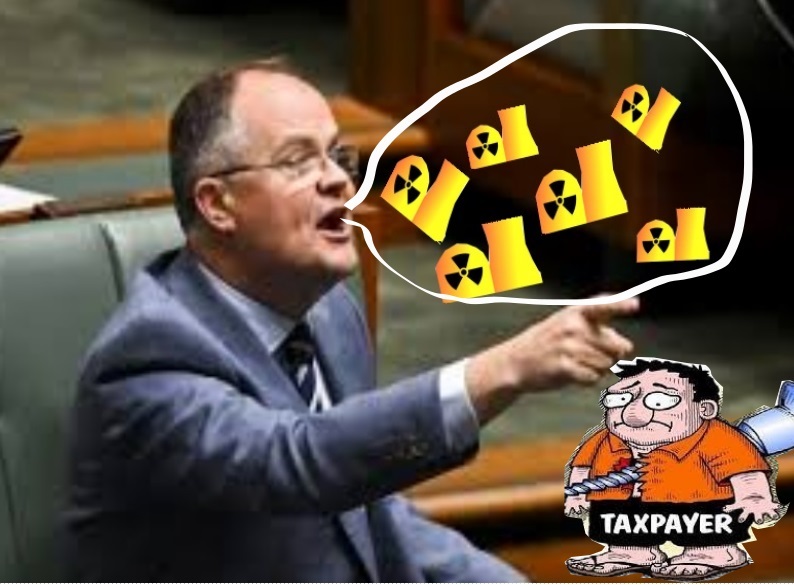
This is still the most interesting article of all
Patricia Karvelas: Peter Dutton’s nuclear energy plan breaks all the rules of policy making. Is it genius or career self-destruction?
Below is a list of news articles. Now I have not here included the pro nuclear propaganda ones, nor the ravings of the very right-wing shock jocks of commercial radio – such as Melbourne’s 3AW. But you can find all that stuff on mainstream, mainly Murdoch media. The ABC is doing its best to stay afloat and actually give the facts. I am sure that those brave female TV and radio voices are now under quite vicious attack – Patricia Karvelas, Sarah Ferguson and Laura Tingle
I will try to keep this list up-to date – it is a daunting task –
National politics Dutton’s plan to nuke Australia’s renewable energy transition explained in full . No costing, no clear timelines, no easy legal path: deep scepticism over Dutton’s nuclear plan is warranted Nuclear plan is fiscal irresponsibility on an epic scale and rank political opportunism. Dutton’s nuclear lights are out and no one’s home. Peter Dutton launches highly personal attack on Anthony Albanese, calling him ‘a child in a man’s body’ while spruiking his new nuclear direction. Peter Dutton vows to override state nuclear bans as he steps up attack on PM. Peter Dutton is seated aloft the nuclear tiger, hoping not to get eaten.
Local politics. Nuclear thuggery: Coalition will not take no for an answer from local communities or site owners.
Climate change policy. Here’s how bad the climate crisis will get before Dutton builds his first nuclear reactor. Labor’s new climate chief Matt Kean says nuclear not viable. Peter Dutton’s flimsy charade is first and foremost a gas plan not a nuclear power plan. Coalition’s climate and energy policy in disarray as opposition splits over nuclear and renewables.
Economics Peter Dutton’s nuclear plan could cost as much as $600bn and supply just 3.7% of Australia’s energy by 2050, experts say . The insane amount it could cost to turn Australia nuclear – as new detail in Peter Dutton’s bold plan is revealed. Nuclear engineer dismisses Peter Dutton’s claim that small modular reactors could be commercially viable soon. Wrong reaction: Coalition’s nuclear dream offers no clarity on technology, cost, timing, or wastes. ‘Peter Dutton’s nuclear plan is an economic disaster that would leave Australians paying more for electrici.ty’. Dutton’s nuclear thought bubble floats in a fantasy world of cheap infrastructure. UK’s nuclear plant will cost nearly three times what was estimated.
Energy, Coalition won’t say how much nuclear power its plan will generate until after an election. Is rooftop solar a fatal flaw in the Coalition’s grand nuclear plans? Nuclear lobby concedes rooftop solar will have to make way for reactors.
Health Nuclear industry workers face significant, inevitable and unavoidable radiation health risks
Indigenous issues, How a British nuclear testing program ‘forced poison’ onto Maralinga Traditional Owners.
Technology. Dutton’s plan to build nuclear plants on former coal sites not as easy as it seems Over budget and plagued with delays: UK nuclear lessons for Australia.
Sabotaging renewables. There’s one real Coalition energy policy now: sabotaging renewables.
Secrecy. Port Augusta mayor and local MP kept in the dark about Liberal Coalition’s plant to site nuclear reactors there.
Site locations for reactors. Peter Dutton reveals seven sites for proposed nuclear power plants. Coalition set to announce long-awaited nuclear details.
Safety. Nuclear debate is getting heated, but whose energy plan stacks up? Some of the Coalition’s proposed nuclear locations are near fault lines — is that a problem?
Spinbuster. It’s time to go nuclear on the Coalition’s stupidity. Ziggy Switkowski and another big nuclear back-flip . Does the Coalition’s case for nuclear power stack up? We factcheck seven key claims. A Coalition pie-in-the-sky nuclear nightmare.
The US, Russia, and Ukraine: 75 Years of Hate Propaganda
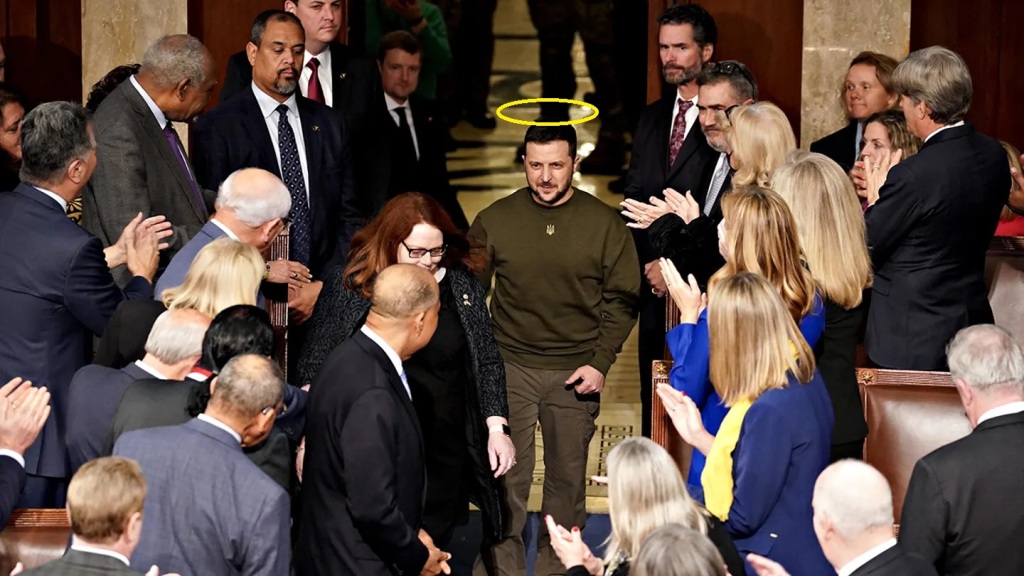
Zelensky: The “Winston Churchill of Our Time” (George W. Bush)
In the Western symphony of propaganda, the hated Putin, the “autocrat,” is contrasted with the heroic Zelensky the “democrat” (Time magazine’s 2022 “person of the year”). But how democratic is Zelensky?
His man-of-the-hour image had help from international friends. Zelensky’s global perception management team is run by a well-connected London-based British firm, The PR Network, that helps him prepare messages for global consumption.
BY GERALD SUSSMAN APRIL 18, 2023, https://www.counterpunch.org/2023/04/18/the-us-russia-and-ukraine-75-years-of-hate-propaganda/
“It is not a matter of what is true that counts, but a matter of what is perceived to be true.”
– Henry Kissinger
“But the most brilliant propagandist technique will yield no success unless one fundamental principle is borne in mind constantly and with unflagging attention. It must confine itself to a few points and repeat them over and over.”
– Adolf Hitler
“We lied, we cheated, we stole. We had entire training courses [on deceiving the public].”
– Mike Pompeo on his time as CIA director
What is state propaganda? It is a disciplined and coordinated discourse using mass persuasion on behalf of state interests. It’s one instrument of what’s called realpolitik – foreign policy designed to advance “national interests,” which in a neoliberal economy like the US means corporate interests. The oligarchs, the billionaire class in the age of neoliberalism, in their unfettered greed have employed both US political parties and their accessories in the media, the intelligence community, and Congress and turned them into a collective ministry of (dis)information and subalterns of empire. Propaganda as a tool in foreign policy commonly relies on hate-laden ideology to mobilize public consensus.
Enemies
A key to successful mass mobilization of the public mind is the enemy construct. One of the key studies on the subject found that the US has had a permanent need for enemies, and when not “readily available, we have created them” (Finlay, Holsti, and Fagen, cited in Murray & Myers, 1989, p. 555). Russia as enemy (Russophobia) works just as well if not better when it’s conceived in demeaning ethnic rather than political economic terms. That’s because hierarchical race and ethnicity ideas are closer to the surface of public prejudice than those focused on, for example, effigies of socialism or communism. In other words, it is easier to orchestrate hatred toward Russia and Putin when there preexists a deep distrust of Russians, their history, and (orthodox religious) culture and its people based on “difference” and a perceived civilizational threat to the West. Under such collective psychological conditioning, this has led to a rejection of Russia membership in the congregation controlled by white European Christian nations.
The US has manufactured innumerable enemies during the course of its existence, and it has had to in order to become a world superpower. Since 1776, there have been only 16 years when the country was not at war. In the pantheon of America’s villains during its 247-year history, one of the most prominent portraits is that of the demonic Vladimir Putin, whose “enemy” status among Americans was pumped up to 70% by March 2022, soon after the start of Russia’s “special operation” in Ukraine.
The “liberal” Democrats are found to be far more inclined to carry out a proxy war against Russia than Republicans and much more supportive of supplying Ukraine with advanced weapons and US troops: tanks (67% to 48%), long-range missiles (60% to 41%), fighter jets (56% to 39%), direct invasion (33% to 22%) (Frankovic and Orth, 2023). Former CIA director and defense secretary under Obama, Leon Panetta bluntly declared, ‘It’s a proxy war with Russia, whether we say so or not” (Bloomberg, 2022).
The massive US “proxy” assault on Russia, more like a full-scale invasion but without its own troops physically on the ground and in the air, is only the latest episode of a hundred-year-old effort to impose Western hegemony over that country. It started with the joint “expedition” that the sanctimonious Woodrow Wilson (“I am going to teach the South American republics to elect good men”) sent to Siberia and northern Russia in a failed attempt, along with mainly European allies, to back the White Russians in the civil war and overthrow the Bolshevik government. Anti-communism was toned down during the Second World War, as it was the Soviet Union, including Ukraine, tactically allied with the US and the British Empire, that bore by far the heaviest burden, suffering 27 million deaths, in defeating the Nazi regime. It’s a sobering reality of historical proportions that is rarely acknowledged in the US. Immediately following the war, the US quickly converted the USSR/Russia from ally to enemy (and their enemies to allies) and worked closely with anti-communist groups in Ukraine and the larger Soviet region in efforts to break apart the Soviet state.
The then newly formed CIA, established in 1947, covertly supervised underground far right organizations in Ukraine, in particular the pro-Nazi Organization of Ukrainian Nationalists (OUN) and the anti-Soviet Ukraine Insurgent Army (UPA), as part of its “psychological warfare activities
Continue readingAustralian Opposition Leader Peter Dutton’s nuclear plan could cost as much as $600bn and supply just 3.7% of Australia’s energy by 2050, experts say

Coalition proposal would cost a minimum of $116bn – the same as Labor’s plan for almost 100% renewables by 2050, the Smart Energy Council says
Jordyn Beazley, Sun 23 Jun 2024 https://www.theguardian.com/australia-news/article/2024/jun/23/peter-duttons-nuclear-plan-could-cost-as-much-as-600bn-and-supply-just-37-of-australias-energy-by-2050-experts-say
The Coalition’s pledge to build seven nuclear reactors as part of its controversial energy plan could cost taxpayers as much as $600bn while supplying just 3.7% of Australia’s energy mix by 2050, according to the Smart Energy Council.
The analysis found the plan would cost a minimum of $116bn – the same cost as delivering the Albanese government’s plan for 82% renewables by 2030, and an almost 100% renewable energy mix by 2050.
The Coalition has drawn widespread criticism for not releasing the costings of the nuclear power proposal it unveiled on Wednesday as part of its plan for Australia’s energy future if elected. On Friday, the opposition leader, Peter Dutton, said the costings would come “very soon”, but did not confirm whether it would be days, weeks or months.
The Smart Energy Council came to the $116bn figure using data from the CSIRO and the Australian Energy Market Operator’s latest GenCost report. It factored in the Coalition’s proposed timeframe and the capital costs of replacing the 11 gigawatts of coal capacity produced on the seven sites with nuclear reactors.
But factoring in the experience of cost and timeframe blowouts in the UK, the refurbishment of coal-fired power stations, and Dutton’s plan to compensate the states, the Smart Energy Council found the cost could reach as much as $600bn.
The council found the large nuclear reactors – of which there will be five alongside two smaller reactors – would probably cost $60bn each and were unlikely to be built by 2040. Dutton has said that they plan for the reactors to be built and operational by the second half of the 2030s.
“At best, Peter Dutton’s nuclear proposal would deliver 3.7% of the energy required at the same cost as the government’s comprehensive strategy,” John Grimes, the chief executive of the Smart Energy Council, said.
“In reality, current cost overruns happening right now in the UK could mean a $600bn bill to Australian taxpayers, whilst delivering a small proportion of the energy that is actually required.
“The most optimistic assessment of Peter Dutton’s nuclear proposal indicates it is a pale shadow of the reliable renewables plan outlined and costed by the Australian Energy Market Operator (Aemo).”
The Smart Energy Council called on the opposition to immediately release its costings and the generation capacity of the proposed seven nuclear reactors.
“They need to explain how their forecasts contradict the experts at the CSIRO and Aemo. It is extraordinary that the details are being hidden from the Australian public,” said Grimes.
The CSIRO and Aemo have assessed the cost of different electricity sources and found nuclear generation would be the most expensive technology available for consumers.
It found that solar and wind backed by storage energy, new transmission lines and other “firming” – in other words, what the country is building now – were the cheapest option.
The Coalition’s promise has met widespread scepticism from Australia’s energy sector and industry groups, which have warned about the risks of cost blowouts and destroying private sector investment.
During an address to party officials in Sydney on Saturday, Dutton said his nuclear energy plan would cost a fraction of Labor’s renewable energy rollout, and would assist in achieving the party’s goal for “cheaper, cleaner and consistent power.
Why ‘no’ to NATO?
David Swanson, beyondnuclearinternational
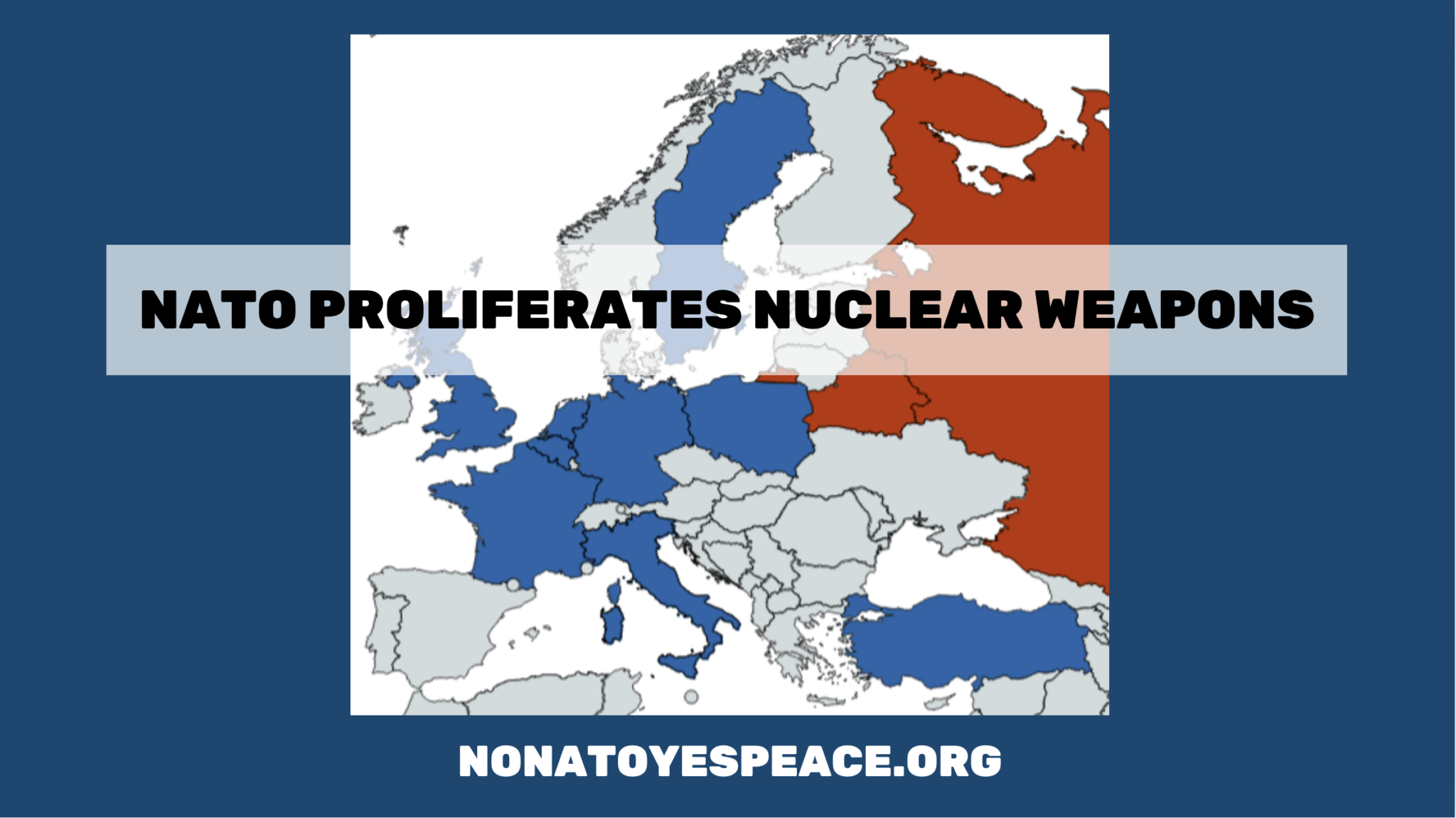
The Nuclear Nonproliferation Treaty forbids transferring nuclear weapons to other nations. It contains no NATO exception. Yet NATO proliferates nuclear weapons
Five NATO members have U.S. nuclear weapons stored and controlled by the U.S. military within their borders: Belgium, Germany, Italy, the Netherlands, and Turkey.
The people of each of these countries routinely protest the presence of nuclear weapons and have never been asked to vote on the matter.
Alliance spreads nuclear weapons, nuclear energy and risk, writes David Swanson
Article 5 of the North Atlantic Treaty declares that NATO members will assist another member if attacked by “taking action as it deems necessary, including the use of armed force.” But the UN Charter does not say anywhere that warmaking is authorized for whoever jumps in on the appropriate side.
The North Atlantic Treaty’s authors may have been aware that they were on dubious legal ground because they went on twice to claim otherwise, first adding the words “Any such armed attack and all measures taken as a result thereof shall immediately be reported to the Security Council. Such measures shall be terminated when the Security Council has taken the measures necessary to restore and maintain international peace and security.” But shouldn’t the United Nations be the one to decide when it has taken necessary measures and when it has not?
The North Atlantic Treaty adds a second bit of sham obsequiousness with the words “This Treaty does not affect, and shall not be interpreted as affecting in any way the rights and obligations under the Charter of the Parties which are members of the United Nations, or the primary responsibility of the Security Council for the maintenance of international peace and security.” So the treaty that created NATO seeks to obscure the fact that it is, indeed, authorizing warmaking outside of the United Nations — as has now played out in Yugoslavia, Afghanistan, and Libya.
While the UN Charter itself replaced the blanket ban on all warmaking that had existed in the Kellogg-Briand Pact with a porous ban plagued by loopholes imagined to apply far more than they actually do — in particular that of “defensive” war — it is NATO that creates, in violation of the UN Charter, the idea of numerous nations going to war together of their own initiative and by prior agreement to all join in any other member’s war. Because NATO has numerous members, as does also your typical street gang, there is a tendency to imagine NATO not as an illegal enterprise but rather as just the reverse, as a legitimizer and sanctioner of warmaking.
The Nuclear Nonproliferation Treaty forbids transferring nuclear weapons to other nations. It contains no NATO exception. Yet NATO proliferates nuclear weapons, and this is widely imagined as law enforcement or crime prevention. The prime minister of Sweden said in May that NATO ought to be able to put nuclear weapons in Sweden as long as somebody has determined it to be “war time.” The Nonproliferation Treaty says otherwise, and the people who plan the insanity of nuclear war say “What the heck for? We’ve got them on long-range missiles and stealth airplanes and submarines?”
The people of Sweden seem, at least in large part, to also want to say No Nukes — but when were people ever asked to play a role in “defending democracy”? The purpose of bringing nukes into Sweden, for those in the Swedish government who favor it, may in fact be purely a show of subservience to U.S. empire, driven by fear of its obliging partner in the arms race, the militarists in Russia.
Poland’s president says his country would be happy to have “NATO” nuclear weapons there, “war time” or not, and this proposal is reported in U.S. corporate media with no mention of any legal concerns and with the claim that it comes as a response to the Russian placement of nuclear weapons in Belarus. Last year I asked the Russian ambassador to the United States why putting nuclear weapons into Belarus wasn’t a blatant violation of the Nonproliferation Treaty, and he said, oh no, it was perfectly fine, because the United States does it all the time.
In fact, NATO itself owns and controls no nuclear weapons. Three NATO members own and control nuclear weapons. We cannot be certain how many weapons they have, since nuclear weapons are both justified with the dubious alchemy of “deterrence” and, contradictorily, cloaked in secrecy. The United States has an estimated 5,344 nuclear weapons, France an estimated 290, and Great Britain an estimated 240.
NATO calls itself a “nuclear alliance” and maintains a “Nuclear Planning Group” for all of its members — those with and those without nuclear weapons — to discuss the launching of the sort of war that puts all life on Earth at risk, and to coordinate rehearsals or “war games” practicing for the use of nuclear weapons in Europe. NATO partners Israel and Pakistan are estimated to possess 170 nuclear weapons each.
Five NATO members have U.S. nuclear weapons stored and controlled by the U.S. military within their borders: Belgium, Germany, Italy, the Netherlands, and Turkey. These are estimated at 35 nuclear weapons at Aviano and Ghedi Air Bases in Italy, 20 at Incirlik in Turkey, and 15 each at Kleine Brogel in Belgium, Volkel Air Base in the Netherlands, and Büchel Air Base in Germany. The United States is reportedly also moving its own nuclear weapons into RAF Lakenheath in the UK, where it has stored them in the past.
The people of each of these countries routinely protest the presence of nuclear weapons and have never been asked to vote on the matter. The notion that the nuclear weapons in a European country are still U.S. nuclear weapons and thus haven’t been proliferated is an odd fit with the general understanding of international treaties, which are conceived and written as if there were no such thing as empire……………………………………………………………………………………………………………………………………….. more https://beyondnuclearinternational.org/2024/06/23/why-no-to-nato/
David Swanson is an author, activist, journalist, and radio host. He is executive director of WorldBeyondWar.org and campaign coordinator for RootsAction.org.
What nuclear annihilation could look like

“The survivors would envy the dead.”
by Sean Illing, Jun 23, 2024
How often do you think about all the ways the world could end?
As the host of The Gray Area, I find myself engaged in this macabre exercise more than most. We’ve done episodes on runaway AI and climate change and extinction panics. One of the few topics we haven’t covered, however, is nuclear war. Which is surprising because this scenario is near the top of basically every list of existential threats — and now feels newly salient with recent news involving North Korea, Iran, and China.
Annie Jacobsen is a reporter and the author of a new book called Nuclear War: A Scenario. I read a lot of books for the show and this one stuck with me longer than any I can recall. It’s a book that clearly wants to startle the reader, and it succeeds.
Jacobsen walks you through all the ways a nuclear catastrophe might unfold, and she gives a play-by-play breakdown of the terrifying choreography that would ensue in the minutes immediately after a nuclear missile launch.
So I invited Jacobsen on The Gray Area to talk about what a nuclear exchange would really look like and how perilously close we are to that reality. As always, there’s much more in the full podcast, so listen and follow The Gray Area on Apple Podcasts, Spotify, Pandora, or wherever you find podcasts. New episodes drop every Monday.
This conversation has been edited for length and clarity.
Sean Illing
I suspect the image most of us still have of nuclear bombs is the image of Hiroshima and Nagasaki, but that was a long time ago. How much more powerful are the thermonuclear weapons we’re talking about today?
Annie Jacobsen
To give you an idea of a thermonuclear weapon, I went to one of the ultimate sources, a 93-year-old nuclear weapons engineer named Richard Garwin, probably the most famous nuclear weapons engineer, physicist, presidential adviser, still alive. Garwin drew the plans for the very first thermonuclear weapon. Its code name was Ivy Mike; it’s on the cover of my book. It was 10.4 megatons.
So consider that the Hiroshima bomb that you referenced was 15 kilotons and then think about 10.4 megatons. It’s about 1,000 Hiroshima-sized bombs detonating at the same time from the same center point. Garwin explained it to me in the simplest of terms when he asked me to visualize this fact: A thermonuclear weapon uses an atomic bomb as its fuse inside of the weapon. That’s how powerful it is.
Sean Illing
Paint the picture for me, as you do in the opening pages of the book, where you imagine a nuke is dropped on Washington, DC. What happens next?
Annie Jacobsen
So with a 1-megaton bomb on Washington, DC, what happens in the very first millisecond is that this thermonuclear flash expands into a ball of fire that is one mile of pure fire. It’s 19 football fields of fire.
Then the fireball’s edges compress into what is called a steeply fronted blast wave — as dense wall of air pushing out, mowing down everything in its path three miles out, in every direction, because it is accompanied by several-hundred-mile-an-hour winds.
It’s like Washington, DC, just got hit by an asteroid and the accompanying wave. When you think about this initial 9-mile diameter ring, imagine every single engineered structure — buildings, bridges, etc. — collapsing.
There’s also a thermonuclear flash that sets everything on fire and melts lead, steel, and titanium. Streets nine miles out transform into molten asphalt lava. The details are so horrific; it’s important to keep in mind these are not from my imagination. These are sourced from Defense Department documents because the Atomic Energy Commission and the Defense Department have been keeping track of what nuclear bombs do to people and to things ever since the Hiroshima and Nagasaki bombings of 1945.
Sean Illing
When all that happens, we’re in what you call “Day Zero,” and then the nuclear winter begins. What does that look like?……………………………………………………………………….. more https://www.vox.com/the-gray-area/356044/nuclear-annihilation-annie-jacobsen
Senate Nuclear Fetishists Take Lid Off of Pandora’s Box

“It’s extremely disappointing that, without any meaningful debate, Congress is about to erase 50 years of independent nuclear safety oversight by changing the NRC’s mission to not only protect public health and safety but also to protect the financial health of the industry and its investors
19 June 2024, David Kraft, Director, NEIS
CHICAGO—In a lopsided 88-2 vote (with 10 not voting, including Sen. Richard Durbin), the Senate passed S.870 – the so-called ADVANCED Act, a bill which quite literally takes the lid off of the nuclear safety box, both domestically and internationally.
So proud and confident were the Senators in nuclear power’s promises, rather than being introduced as stand-alone legislation, the 93-page bill had to be snuck into the 3-page Fire Grants and Safety Act – a bill reasonably assured to pass at a time when huge parts of the nation are again in the process of burning to the ground.
Using the logic similar to that of an adolescent purchasing a first car (“If it’s red, fast, and a convertible – that’s it! What could go wrong?”), bill advocates trotted out the usual litany of at best contestable at worst discredited arguments for its passage: nuclear is clean and green, is needed to fight the climate crisis, creates jobs, and is over-regulated.
Sen. Shelley Moore Capito (R-W.Va.), the bill’s lead sponsor, (quite erroneously) stated, “Today, nuclear power provides about 20% (18.2% in 2022; 18.6% in 2023) of our nation’s electricity. Importantly, it’s emissions-free electricity (allowed to release radionuclides into the air and water, below regulatory limits) that is 24/7, 365 days a year. (except for outages and maintenance)”
While critics of the legislation warned of significant weakening of regulatory oversight built into the bill, John Starkey, director of public policy at the pro-nuclear American Nuclear Society, stated the Nuclear Regulatory Commission (NRC), “is a 21st century regulator now.”
That statement alone should send shivers up the spine, since that list would include: the FAA allowing Boeing to self-regulate in designing the 737-MAX, resulting in two crashes and hundreds of deaths, and the revelation that sub-standard parts have been manufactured into new planes; Norfolk Southern preventing desperately needed rail safety measures from passing in Congress, resulting in the East Palestine train disaster; and the federal pipeline regulatory agency PIMSA being asleep at the wheel, resulting in the Sartortia, Mississippi CO2 pipeline explosion.
Residents of Illinois – the most nuclear state in the U.S., which recently repealed its nuclear construction moratorium, opening the door to new reactors – might begin to feel some elevated distress, but – relax. There’s nothing you can do about it, since homeowners are unable to obtain private insurance coverage against nuclear disasters.
Nuclear safety expert Dr. Ed Lyman of the Union of Concerned Scientists had this to say about the ADVANCED Act:
“It’s extremely disappointing that, without any meaningful debate, Congress is about to erase 50 years of independent nuclear safety oversight by changing the NRC’s mission to not only protect public health and safety but also to protect the financial health of the industry and its investors. Just as lax regulation by the FAA—an agency already burdened by conflicts of interests—can lead to a catastrophic failure of an aircraft, a compromised NRC could lead to a catastrophic reactor meltdown impacting an entire region for a (many) generations.
“Make no mistake: This is not about making the reactor licensing process more efficient, but about weakening safety and security oversight across the board, a longstanding industry goal. The change to the NRC’s mission effectively directs the agency to enforce only the bare minimum level of regulation at every facility it oversees across the United States.
“Passage of this legislation will only increase the danger to people already living downwind of nuclear facilities from a severe accident or terrorist attack, and it will make it even more difficult for communities to prevent risky, experimental reactors from being sited in their midst.”
The Biden Administration legislation of the past few years has lavished more than $7 billion on the development of experimental, still non-existent “small modular nuclear reactors” (SMNRs) as a way to fight climate change. Yet, only one design has passed NRC licensing muster to date, and these reactors will not be commercially available in sufficient numbers to have an appreciable effect on climate disruption until well into the 2030s – assuming the proposed designs actually work.
As alarming as the domestic implications of the ADVANCED Act are, the international implications can be devastating. The Act fast-tracks the development of SMNRs, which nuclear industry companies intend to sell oversees. Some of these reactor designs require fuel that is more highly “enriched” – just barely below weapons-grade concerns – than that used in contemporary reactors. Currently, the only available source for this fuel – called “HALEU”, for “high assay low-enriched uranium” – is RUSSIA. Another design, using a different fuel concept, requires specially refined carbon, the main source of which is CHINA.
It is not unreasonable to ask: just where would SMNRs have been placed in, say – Mariupol, Ukraine? Or in Gaza? Or any of the other world hot spots? Again, not an unreasonable line of questioning since a recent priority of the Biden Administration is to sell nuclear technology to Saudi Arabia – where apparently the sun no longer shines, and journalists are hacked to pieces for covering such controversial topics.
Viable alternatives to nuclear expansion do exist: renewable energy, energy efficiency, energy storage, and transmission improvements are ALL cheaper, quicker to implement, reduce carbon emissions, produce no radioactive wastes, create no nuclear proliferation issues, and, most importantly – ALREADY EXIST. Nothing more needs to be invented; just implemented.
The Federal Energy Regulatory Commission (FERC) stated in December, 2023 that roughly 2,600 giga-watts (GW) of electric power projects – over twice the entire electrical use of the US, and roughly 27 times the entire output of all current US reactors combined. The large majority of this backlog are renewable energy projects awaiting connection access to the aging transmission grid. New EXISTING transmission technologies like reconductoring could double the capacity of the grid, creating greater ease of access for renewables and storage.
To summarize, The ADVANCE ACT:
• kick-starts more radioactive releases and exposures using tax dollars;
• spreads contamination to more places in the US and abroad;
• ignores the potential increased harm from nuclear reactors large and small;
• creates more intensely radioactive fuel;
• less regulatory oversight;
• export to other countries, and
• foreign control of nuclear sites within our homeland.
Yet, the nuclear zealots continue to pour tax dollars into the nuclear power black hole by means of the ADVANCED Act. This legislation was indeed a Trojan Horse – filled with killer bees. And they don’t make honey.
Nuclear Energy Information Service (NEIS) was formed in 1981 to watchdog the nuclear power industry, and to promote a renewable, non-nuclear energy future.
Australia’s Nuclear debate is getting heated, but whose energy plan stacks up?

by Mike Foley, June 24, 2024, https://www.smh.com.au/politics/federal/nuclear-debate-is-getting-heated-but-whose-energy-plan-stacks-up-20240624-p5jo45.html
The Coalition’s nuclear power policy is less than a week old, but the political debate about Australia’s energy future has been raging since. The opposition’s claims about both its policy and the renewables-focused government plan have prompted plenty of questions about their veracity.
We take a look through the biggest of those talking points to see whether they stack up.
*** Labor’s ‘renewables-only’ plan will cost more than $1 trillion: False
The opposition says it will cost more than $1 trillion for the Albanese government to reach its target of boosting renewables to 82 per cent of the electricity grid by 2030. Currently, about 40 per cent of the grid is renewable electricity.
Nationals Leader David Littleproud on Sunday attributed the numbers to Net Zero Australia: a think tank of academics from University of Melbourne, University of Queensland and Princeton University.
The think tank calculated the estimated cost of reaching net zero across the entire economy, not just the electricity grid.
They found that it would cost more than $1 trillion by 2030 and up to $9 trillion by 2050, largely driven by private investment. The figure includes a range of actions, from integrating electric vehicles into the transport fleet to heavy industry, such as smelting switching from gas to electric power.
The Australian Energy Market Operator (AEMO) forecasts that the cost of reaching 82 per cent renewables, again largely driven by private investment in wind and solar farms and transmission lines, will cost $121 billion in today’s money.
The Albanese government has also committed $20 billion to underwrite transmission-line construction and has set up a fund called the Capacity Investment Scheme, estimated to be worth tens of billions of dollars. It will underwrite new renewable projects, and if private investors fail to achieve forecast returns, taxpayers could be on the hook to subsidise operations but will get a cut of the profits when they exceed a set threshold.
*** Nuclear energy will deliver cheaper power bills: False
Dutton said on Wednesday last week his plan would “see Australia achieve our three goals of cheaper, cleaner and consistent power”.
The opposition has committed to release the costings of their plan before the next election.
Many experts disagree, arguing nuclear power delivers the most expensive form of electricity.
The same report cited by the opposition for a $1 trillion cost of the renewables rollout said there is “no role” for nuclear power in Australia’s energy mix.
“We only see a potential role for nuclear electricity generation if its cost falls sharply and the growth of renewables is constrained,” Net Zero Australia’s report in July last year said.
Internationally recognised financial services firm Lazard also found renewable energy sources continued to be much cheaper than nuclear. It said onshore wind was the cheapest, with a cost between $US25 and $US73 per megawatt hour. The second cheapest was large-scale solar at between $US29 and $US92. Nuclear was the most expensive, at between $US145 and $US222.
The CSIRO found the cheapest electricity would come from a grid that draws 90 per cent of its power from renewables, which would supply electricity for a cost of between $89 and $128 per megawatt hour by 2030 – factoring in $40 billion in transmission lines and batteries to back up renewables.
CSIRO calculated that a large-scale nuclear reactor would supply power for $136 to $226 per megawatt hour by 2040.
** The renewables rollout needs 28,000 kilometres of transmission lines: False
“Labor has promised 28,000 kilometres of new poles and wires, there’s no transparency on where that will go, and we’ve been very clear about the fact that we don’t believe in that model,” Opposition Leader Peter Dutton said last week.
The AEMO releases a document each year called the Integrated System Plan, after consulting private industry, that details a road map of what the most efficient energy system will look like in coming years, including new infrastructure, up to 2050.
The Integrated System Plan includes directives set by policymakers, like the Albanese government’s commitment to reach 82 per cent of energy generation coming from renewables by 2030, and to hit net zero emissions by 2030.
The most recent plan, from January, says around 5000 kilometres of transmission lines are needed in the next 10 years to deliver the Albanese government’s goals, including 4000 kilometres of new lines and upgrading 1000 kilometres of existing lines. AEMO said 10,000 kilometres of transmission lines will be needed for Australia to reach net zero by 2050.
The 28,000-kilometre figure cited by the opposition resembles the 26,000 kilometres of transmission AEMO said would be needed by 2050 if Australia was to transform its economy to a clean energy export powerhouse, including large-scale production of green hydrogen and decarbonisation of other industrial processes.
*** The first reactor would be built before 2037: Questionable
The opposition says if elected, they would build a nuclear reactor and have it hooked up to the grid within 12 years of forming a government.
Its nuclear energy policy document, released last week, states that depending on what technology it chooses to prioritise, a large-scale reactor would start generating electricity by 2037 and a small modular reactor (SMR) by 2035. SMRs are a developing design not yet in commercial production.
This rollout would be as quick as anywhere in the world. The United Arab Emirates has set the global pace. It announced in 2008 that it would build four reactors under contract from Korean company KEPCO. Construction began in 2012, and the first reactor connected to the grid in 2020.
There are significant differences between the UAE and Australia. The former is a dictatorship without comparable labour laws or planning regulations that relies on cheap imported labour, whereas the latter has rigorous workforce protections, environmental laws and planning processes.
Opposition energy spokesman Ted O’Brien said a Coalition government would establish a Nuclear Energy Coordinating Authority that would assess each of the seven nuclear sites it has identified and determine what specific type of reactor would be built where, while also committing to two and half years of community consultation. A new safety and management regime would need to be developed, and parliament would have to repeal the current federal ban on nuclear energy within this timeframe.
If the Coalition forms government in May next year, following the consultation phase, it assumes construction could begin in late 2027 and would take 10 years for a large-scale reactor. That is far quicker than other Western nations have achieved recently.
The UK’s Hinkley Point nuclear plant began construction in 2018 and is not expected to be completed until at least 2030. The only reactor now under construction in France is the Flamanville EPR. Construction began in 2007 and is currently incomplete. A reactor at Olkiluoto Island, Finland, began in 2005 and was completed in 2022.
*** The annual waste from a reactor fits into a Coke can: False
Opposition Leader Peter Dutton’s claim that the annual waste generated by an SMR amounts to the size of a Coke can is incorrect, experts say, with such facilities likely to generate multiple tonnes of high-level radioactive waste each year.
“If you look at a 450-megawatt reactor, it produces waste equivalent to the size of a can of Coke each year,” Dutton said on Tuesday.
Multiple experts told this masthead a 450-megawatt reactor referenced by Dutton would generate many tonnes of waste a year.
Large-scale reactors, which have been deployed in 32 countries around the world, have a typical capacity of 1000 megawatts and generate about 30 tonnes of used fuel a year. This includes high-level radioactive waste toxic to humans for tens of thousands of years and weapons-grade plutonium.
SMRs are still under commercial development, and expert opinion is divided over whether they would produce more or less waste per unit of energy compared to a large reactor.
Emeritus Professor Ian Lowe of Griffith University’s School of Environment and Science said it was safe to assume an SMR would generate many tonnes of waste per year, and it was likely that waste would be more radioactive than the waste from a large-scale reactor.
“For a 400-megawatt SMR, you’d expect that to produce about six tonnes of waste a year. It could be more or less, depending on the actual technology, but certainly multiple tonnes a year,” he said.
Mike Foley is the climate and energy correspondent for The Age and The Sydney Morning Herald. Connect via email.
Ten Holocaust survivors condemn Israel’s Gaza genocide
Holocaust survivors say using the Holocaust to justify genocide in Gaza and repress student protest on college campuses is a complete insult to the Holocaust’s memory.
BY OPEN LETTER https://mondoweiss.net/2024/06/ten-holocaust-survivors-condemn-israels-gaza-genocide/
Below is a letter signed by ten Holocaust survivors condemning the genocide in Gaza and the misuse of antisemitism accusations by politicians.
The co-founder of Human Rights Watch, Aryeh Neier, has recently said that Israel is engaged in genocide in Gaza. He’s also said that using accusations of antisemitism to attack Israel’s critics “debases the whole concept of antisemitism.” As Holocaust survivors, we are writing to agree wholeheartedly with Professor Neier — who himself only survived the Holocaust by escaping Nazi Germany as a child in 1939.
At a recent Holocaust memorial, Netanyahu declared: “We’ll defeat our genocidal enemies. Never again is now!”
Meanwhile, at another memorial, Biden warned of a “ferocious surge of antisemitism” on college campuses.
In our opinion, to use the memory of the Holocaust like this to justify either genocide in Gaza or repression on college campuses is a complete insult to the memory of the Holocaust.
The dehumanization of Palestinians, describing them as “human animals,” the killing of tens of thousands of civilians, indiscriminate bombing, the destruction of universities and hospitals, and the use of mass starvation — these are clearly stages of ethnic cleansing and genocide. They cannot be defended any more than sending weapons to commit this genocide or refusing funding to UNRWA. With no better arguments, our politicians have resorted to misusing the memory of the Holocaust while claiming that protesting against Israeli genocide is somehow antisemitic.
As Holocaust survivors, we have no special authority on the Middle East but we do know about antisemitism. It’s simply wrong to claim that it’s antisemitic to oppose Israeli genocide. It’s also wrong to claim that calling for equal rights for Jews and Arabs “from the river to the sea” is antisemitic.
As Holocaust survivors, we are just a few individuals but we want to add our voices to the growing global movement to demand a permanent ceasefire, an Israeli withdrawal from Gaza, and for the West to stop arming and supporting genocide.
Signatories
Jacques Bude (Brussels Belgium), survived in hiding in Belgium, parents killed in Auschwitz.
Marione Ingram (Washington DC), survived in hiding in Nazi Germany.
Stephen Kapos (London UK), survived the Budapest ghetto.
H. Richard Leuchtag (Houston TX), escaped Germany in 1938.
Rene Lichtman (Southfield MI), survived in hiding in France.
Adam Policzer (Vancouver BC), survived in hiding in Hungary.
Lillian Rosengarten (Cold Spring NY), escaped Germany in 1936.
Suzanne Ross (New York), escaped Nazi-occupied Belgium
Suzanne Berliner Weiss (Toronto Ont.), survived in hiding in France, mother killed in Auschwitz.
Ervin Somogyi (Oakland, CA), survivor from Hungary.
Nuclear won’t fix our energy crisis
*New Nuclear**
Letter: Syed is generally very precise in his use of language, but his
description of nuclear as “clean energy” is Orwellian. The waste
produced by nuclear power stations will have to be securely stored for
thousands of years; and by a recent estimate the UK’s decommissioning
costs could be £260 billion. I would not call that “clean”.
Times 23rd June 2024
The Sunday Times, Sunday June 23 2024
Writing of the urgent need for a coherent energy strategy, Matthew Syed says renewables are part of the solution “if we can solve the problem of intermittency” (Comment, last week). Unless we can, they are no solution at all — and so far we haven’t. We have been looking for efficient energy storage at scale for many years now and not finding it, and the solution may be a long time coming.
More nuclear reactors are not an adequate answer. This is partly because of the expense and the time lag between conception and operation — but also because they cannot simply be turned on and off, so we would be likely still to need fossil fuels to cover large spikes in energy usage.
No one has grasped the nettle of net
zero, which implies a massive upgrade both in generation and in the grid to
support it. It isn’t just productivity that is at stake; it’s keeping
the lights on. I don’t think any policymaker has a grip on this at all.
Because, if they had, they’d be panicking.
1 This Month
10 March A LIVE WEBINAR THE REAL EFFECTS OF NUCLEAR POWER
What the Industry Isn’t Telling Us
1:00 PM Mountain, 2 pm Central, 3 pm Eastern. Live on the Keepers of the Water Facebook page



18 March Webinar @ 1 PM EST: An Assessment of SMR Projects: The Case of Canada
register for the zoom:
https://us02web.zoom.us/webinar/register/WN_o8BIIOUvQ2ONJR1nta65DQ#/registration


of the week – STOP SMALL MODULAR REACTORS IN CANADA
To see nuclear-related stories in greater depth and intensity – go to https://nuclearinformation.wordpress.com
-
Archives
- March 2026 (109)
- February 2026 (268)
- January 2026 (308)
- December 2025 (358)
- November 2025 (359)
- October 2025 (376)
- September 2025 (258)
- August 2025 (319)
- July 2025 (230)
- June 2025 (348)
- May 2025 (261)
- April 2025 (305)
-
Categories
- 1
- 1 NUCLEAR ISSUES
- business and costs
- climate change
- culture and arts
- ENERGY
- environment
- health
- history
- indigenous issues
- Legal
- marketing of nuclear
- media
- opposition to nuclear
- PERSONAL STORIES
- politics
- politics international
- Religion and ethics
- safety
- secrets,lies and civil liberties
- spinbuster
- technology
- Uranium
- wastes
- weapons and war
- Women
- 2 WORLD
- ACTION
- AFRICA
- Atrocities
- AUSTRALIA
- Christina's notes
- Christina's themes
- culture and arts
- Events
- Fuk 2022
- Fuk 2023
- Fukushima 2017
- Fukushima 2018
- fukushima 2019
- Fukushima 2020
- Fukushima 2021
- general
- global warming
- Humour (God we need it)
- Nuclear
- RARE EARTHS
- Reference
- resources – print
- Resources -audiovicual
- Weekly Newsletter
- World
- World Nuclear
- YouTube
-
RSS
Entries RSS
Comments RSS
 nuclear-news