Researchers have doubts, but Bill Gates is hyping his new liquid-sodium nuclear reactor
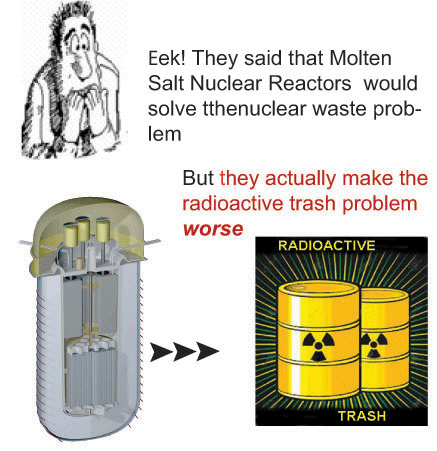
Research has poured cold water on some of the hype surrounding these proposed next-generation reactors, including liquid-sodium reactors. According to a report produced by the Union of Concerned Scientists in 2021, Natrium reactors may be less “uranium-efficient”, may not reduce the amount of nuclear waste produced, and may face safety risks that are unique to them and absent from their predecessors.
The new Natrium reactors promise to be more efficient and safer than traditional nuclear reactors, but is this the case?
Bill Gates Has Made Progress Towards Next-Generation Nuclear Reactors
IFLScience, DR. RUSSELL MOUL, Edited by Laura Simmons, 15 June 24
Bill Gates has helped “break ground” on the development of a new next-generation nuclear reactor. The project, which is run between TerraPower and the Department of Energy, plans to build a new sodium test reactor at a site in Kemmerer, Wyoming by 2030.
The nuclear industry has been in decline in the USA for decades. Despite the country being one of the first nations to generate nuclear energy for commercial civilian purposes, there have been few developments since the late 1970s. For instance, since 1978, only two nuclear power plants have started construction, and that only occurred in 2013.
This industry has stalled because of various broad challenges related to economics, regulatory frameworks, and technological problems, as well as declining respect within the public sphere.
All of the USA’s existing nuclear power plants are traditional pressurized water reactors, which rely on technologies developed over 40 years ago. They are expensive to build and even more so to maintain across their lifecycle. Costs do not just concern the initial construction, but also the ongoing price of fuels, operational costs, and engineering fees. And then there’s the problem of the nuclear waste, which in the US is mostly stored in tanks at sites owned by the Department of Energy.
The industry was also fatally wounded by the Three Mile Island partial meltdown in 1979, which caused new regulatory delays to the 51 new reactors that were under construction at the time. With the introduction of new safety procedures and back-fit requirements, the speed of construction was slowed down, and the costs skyrocketed for many reactors. After that, many contracts were canceled and the industry ground to a halt.
Today, nuclear power provides around one-fifth of the country’s electricity.
But in 2008, Bill Gates founded TerraPower with the aim of building a new generation of nuclear reactors in the US. The reactors, called Natrium, are 345-megawatt modular, pool type, liquid sodium reactors that run off low-enriched uranium (this is fuel that contains 5 to 20 percent fissile uranium). The reactors are also hooked up to a 1-gigawatt hour molten salt storage system…………………………………………………………..
Research has poured cold water on some of the hype surrounding these proposed next-generation reactors, including liquid-sodium reactors. According to a report produced by the Union of Concerned Scientists in 2021, Natrium reactors may be less “uranium-efficient”, may not reduce the amount of nuclear waste produced, and may face safety risks that are unique to them and absent from their predecessors. ……..https://www.iflscience.com/bill-gates-has-made-progress-towards-next-generation-nuclear-reactors-74667
Science Writer
No comments yet.
1 This Month


Tell the Ukrainian Government to Drop Prosecution of Peace Activist Yurii Sheliazhenko

Petition to revoke the licensing of the Near Surface Nuclear Disposal Facility (NSDF) at Chalk River. https://www.ourcommons.ca/petitions/en/Petition/Details?Petition=e-7247


of the week – STOP SMALL MODULAR REACTORS IN CANADA
To see nuclear-related stories in greater depth and intensity – go to https://nuclearinformation.wordpress.com
-
Archives
- March 2026 (204)
- February 2026 (268)
- January 2026 (308)
- December 2025 (358)
- November 2025 (359)
- October 2025 (376)
- September 2025 (258)
- August 2025 (319)
- July 2025 (230)
- June 2025 (348)
- May 2025 (261)
- April 2025 (305)
-
Categories
- 1
- 1 NUCLEAR ISSUES
- business and costs
- climate change
- culture and arts
- ENERGY
- environment
- health
- history
- indigenous issues
- Legal
- marketing of nuclear
- media
- opposition to nuclear
- PERSONAL STORIES
- politics
- politics international
- Religion and ethics
- safety
- secrets,lies and civil liberties
- spinbuster
- technology
- Uranium
- wastes
- weapons and war
- Women
- 2 WORLD
- ACTION
- AFRICA
- Atrocities
- AUSTRALIA
- Christina's notes
- Christina's themes
- culture and arts
- Events
- Fuk 2022
- Fuk 2023
- Fukushima 2017
- Fukushima 2018
- fukushima 2019
- Fukushima 2020
- Fukushima 2021
- general
- global warming
- Humour (God we need it)
- Nuclear
- RARE EARTHS
- Reference
- resources – print
- Resources -audiovicual
- Weekly Newsletter
- World
- World Nuclear
- YouTube
-
RSS
Entries RSS
Comments RSS
 nuclear-news
Leave a comment