Nuclear-armed countries spent $2,898 per second last year on nuclear weapons
The nine nuclear-armed countries spent more than $10 billion more on their nuclear arsenals last year than the year before, as ICAN shows in “Surge: 2023 Global Nuclear Weapons Spending”. Between them, they pumped $91.4 billion into the nuclear arms race, or $2,898 per second.
The biggest spender, also with the largest one-year increase, is the United States, which spent $51.5 billion, more than all other nuclear-armed countries combined. China expended $11.9 billion and Russia spent the third largest amount at $8.3 billion. The United Kingdom’s spending increased significantly for the second year in a row, to $8.1 billion.
The twenty corporations profiled in the report earned over $30 billion for nuclear weapons related work in 2023, about a third of overall nuclear weapons spending. These companies have $335 billion in contracts lined up, in some cases, until 2040 and spent more than $123 million buying influence through lobbyists and think tank contributions.
Who spent what on their nuclear arsenal in 2023?
In 2023 China, France, India, Israel, North Korea, Pakistan, Russia, the UK and US spent a combined $91.4 billion on their nuclear arms, which breaks down to $173,884 per minute, or $2,898 a second. The United States’ share of total spending, $51.5 billion, is more than all the other nuclear-armed countries put together and accounts for 80% of the increase in nuclear weapons spending in 2023. The next biggest spender was China which expended $11.8 billion with Russia spending the third largest amount at $8.3 billion. The United Kingdom’s spending was up significantly for the second year in a row with a 17% increase to $8.1 billion.
$387 billion in 5 years
“Surge” is the 5th edition of ICAN’s global nuclear weapons spending report. In the last 5 years, $387 billion has been spent on nuclear weapons, with the yearly spending increasing by 34% from $68.2 billion to $91.4 billion per year, as all nine nuclear-armed states continue to modernise, and in some cases expand, their arsenals. Alicia Sanders-Zakre, co-author of the report noted: “The acceleration of spending on these inhumane and destructive weapons over the past five years is not improving global security but posing a global threat.”
Who profits from this surge in nuclear spending?
Globally, nuclear-armed countries have ongoing contracts with companies to produce nuclear weapons worth a total of at least $387 billion, continuing in some cases through 2040. In 2023, companies involved in the production of nuclear weapons received new contracts worth just under $7.9 billion. In the US and France alone (the countries for which figures can be obtained) these firms spent $118 million on lobbying.
These large profits incentivise nuclear weapons manufacturers to spend millions – at least $6.3 million in 2023 – to influence government policy and public attitudes towards nuclear weapons through supporting think tanks. In 2023, at least $123 million was spent hiring over 540 lobbyists and providing financing for major think tanks that influence the nuclear debate. “Surge” exposes these connections.
The opportunity cost of nuclear weapons
The billions of dollars squandered on nuclear weapons every year is an unacceptable misallocation of public funds. Instead of pouring much-needed resources into a reckless race with weapons of mass destruction, the 9 nuclear-armed states could pay for vital services for their citizens or help address existential global crises. $91.4 billion a year could pay for wind power for more than twelve million homes to help combat climate change, or cover 27% of the funding gap to fight climate change, protect biodiversity and cut pollution. One minute of 2023 nuclear weapons spending could have instead paid for planting one million trees. Five years of nuclear weapons spending could have fed 45 million people who are currently facing famine- for most of their lives.
That is why ICAN is calling for a global week of action from September 16 to 22, 2024. Our week of action will take place just as countries around the world come together to find solutions to the greatest global challenges of our time. From now until states gather, we are inviting people all around the world to tell us what they would prefer to see the money spent on, and in September we will push together with one clear message: “No Money for Nuclear Weapons!”
Corporations are influencing government policy on nuclear weapons, a damning report shows

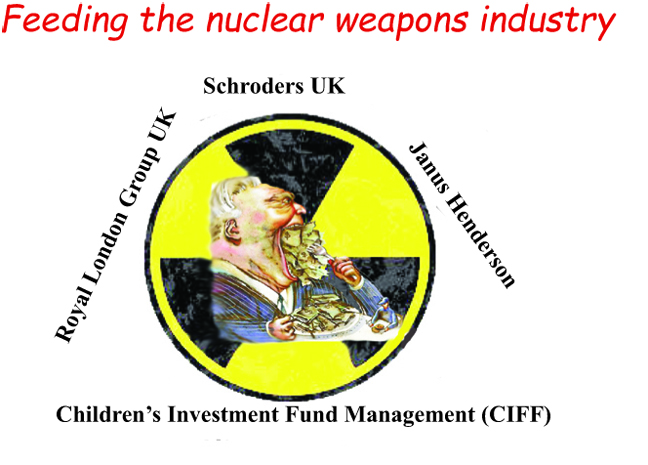
“This report also makes absolutely clear the influence of arms companies in the shaping of defence and foreign policy, their funding of think tanks, and their meetings with government officials.”
https://morningstaronline.co.uk/article/corporations-are-influencing-government-policy-on-nuclear-weapons-damning-report-shows 17 June 24
NUCLEAR weapons corporations have an “absolutely inappropriate” involvement in shaping government policy on the issue, a damning report shows.
It states that as Britain’s spending on nuclear weapons climbs inexorably, the companies who make and sell them spend millions of pounds funding think tanks that advise the government on the issue.
The report also reveals that nuclear manufacturers met top government officials last year ahead of its announcement of an increase in defence spending.
“Surge: 2023 Global Nuclear Weapons Spending” has been released today by the International Campaign to Abolish Nuclear Weapons (ICAN).
It states that global spending on nuclear weapons has surged by 34 per cent in the last five years and that the increase in British spending has risen by even more —over 43 per cent.
As schools across Britain crumble and the National Health Service teeters on the brink of collapse, the Tory government spent £6.5 billion of taxpayers’ money on nuclear weapons in 2023 alone, up 17.1 per cent on 2022, making Britain the fourth-highest nuclear spender after Russia, China and the United States — which spends more than the rest of the world combined.
The report was welcomed by the Campaign for Nuclear Disarmament, whose general secretary Kate Hudson said: “The billions of pounds being funnelled into these weapons of mass destruction are a gross misallocation of resources that could be used to address pressing issues such as climate change, biodiversity loss, and poverty alleviation.
“This report also makes absolutely clear the influence of arms companies in the shaping of defence and foreign policy, their funding of think tanks, and their meetings with government officials.
“This runs against all democracy and accountability, and must be exposed, investigated and ended.”
Labour has pledged to continue the Tories’ military spending increases if it is elected on July 4.
Ms Hudson said CND “urges voters to elect MPs who prioritise peace, disarmament, and justice.
“It is time for political parties to determine policy based on the interests of the people, not the arms companies,” she said.
“We want a decent peaceful future that does not include reckless expenditure on nuclear weapons but creates a safer, fairer world for all.
Propaganda vs. Pragmatism: Can US ATACMS Clear the way for F-16 Warplanes in Ukraine?
Update on the conflict in Ukraine for June 16, 2024… – Western media reports the shortcomings of both F-16s and French Mirage 2000-5 warplanes being transferred to Ukraine;
– Attempts by Ukraine to use ATACMS to “isolate” Crimea continue to fall far short of the required frequency and scale necessary to actually do so;
– Western media reports admit that Russia’s large inventory of air defense systems will not run out any time soon despite Ukrainian claims of successfully targeting S-300 and S-400 systems across the battlefield;
– The idea of ATACMS clearing a path for F-16s to conduct strikes behind enemy lines is betrayed by the reality of even Ukraine’s much more limited air defense capabilities still preventing Russian air power from operating freely across the whole of Ukraine;
For Daily Reports on Ukraine: The Duran (Telegram): https://t.me/thedurancom Scott of Kalibrated (Telegram): https://t.me/kalibrated Mark Sleboda (Telegram): https://t.me/TheRealPolitick
Nuclear black hole could deal a knock-out blow to UK Labour’s renewable targets

Labour’s ambitious target for offshore wind could be quietly shelved to make way for the giant funding commitment to pay for Sizewell C nuclear power plant
DAVID TOKE, JUN 17, 2024, https://davidtoke.substack.com/p/nuclear-black-hole-could-deal-a-knock?utm_source=post-email-title&publication_id=1068034&post_id=145716547&utm_campaign=email-post-title&isFreemail=true&r=ln98x&triedRedirect=true&utm_medium=email—
Much of Labour’s manifesto commitments for clean energy, a state-owned ‘Great British Energy’ company to promote new technologies and funds to support buildings-based insulation and low carbon measures, have been widely flagged already. But there’s not much attention being given to two big, interlinked, threats to Labour’s clean energy strategy. One is the looming black financial hole that the incoming Labour Government will trigger as it gives the financial go-ahead for Sizewell C. The second is the problem of organising a much more rapid build-up of renewable energy than the Conservatives have managed to achieve. Both will involve the Treasury having to commit themselves to supporting forward spending, and we know that money is tight!
The central problem is that the cost of Sizewell C could sink the prospects of the renewables target. It is not difficult to see the problem. The costs of building Hinkley C, the sister plant of Sizewell C, have been growing and growing, and the plant has a long way to go before it is finished. The costs have reached an astonishing £33 billion for just 3.2 GW. Few independent analysts can be found who would bet against this cost increasing a lot further.
Unlike Hinkley C, Sizewell C is, to cut a longer story short, mostly going to have to be financed by the taxpayer or energy consumers. These costs will increase the numbers for the Public Sector Borrowing Requirement. The Treasury will have serious indigestion over this.
EDF is responsible for the costs of building Hinkley C. However it has refused to take responsibility for financing more than a small portion of Sizewell C. Moreover, it is proving very difficult to get any private investors to take responsibility for paying the costs of Sizewell C (no surprises there!). Essentially that means the Government are going to have to take responsibility for paying for the large bulk of the projects, and large cost overruns are all but inevitable. A lot of billions worth of red ink is going to have to be written into Treasury estimates if Sizewell C is to be given the financial go-ahead.
Offshore wind, onshore and solar farms will be a lot cheaper for the consumer than nuclear power from Sizewell C. Nevertheless, if the Treasury allows tens of billions to be allocated to underwrite the costs of Sizewell C then this could blow a huge hole in any efforts to get Labour’s renewable energy programme funded. To meet Labour’s manifesto target of quadrupling offshore wind capacity by 2030 then the Government will need to get lots and lots of contracts and offshore wind project contracts and leases issued pretty damn quick. That is as well as contracting lots of onshore wind and solar farms which are likely to be cheaper than offshore wind for the next few years at least.
The offshore wind commitment (for around 45 GW of new capacity by 2030) is going to require some funds to be underwritten by the Treasury. How much depends on what the Treasury chooses as the future price, say in 2030, of power from natural gas-fired power plant. This is because energy consumers will fund the difference between the guaranteed contract prices to be paid for offshore wind power production and the wholesale power price.
Since we do not know the price of gas in 2030 now, since we do not know what the global price of natural gas (in the form of LNG) will be, the Treasury has to make a choice. This choice, of course, is heavily laced with political implications. But at the moment the Treasury has chosen quite a low number for the future cost of natural gas. This makes offshore wind look relatively expensive to fund. I discussed this in a post I did in March, see here: How the Government is gaslighting us about the cost of offshore wind.
Renewable energy is much more popular with the public compared to nuclear power. But big energy corporations, not to mention the GMB union, are going to be piling in to try and make sure that approval of Sizewell C is given priority ahead of Labour’s apparently ambitious renewable energy commitment. That could mean that the bold offshore wind target is going to be quietly thrown in the waste bin.
EDF Warns of ‘Huge’ Contract Losses If Convicted in Paris Criminal Trial
- EDF lawyer says probity conviction may affect Czech, UK deals
- Ex-EDF CEO also tried alongside consultants including Messier
At the heart of the trial is EDF’s former boss, Henri Proglio, who is suspected of
having set up the system to hire the consultants.
Electricite de France SA legal team warned at a Paris trial that the utility could end up losing
“huge contracts” abroad if convicted in a case over accusations it
favoured several consultants by awarding them advisory deals without
putting them up for tender.
The favouritism court case that began on
Tuesday centres on awards worth more than €20 million ($21.7 million)
given to 44 consultants, including the firm set up by former Vivendi SE
boss Jean-Marie Messier.
Bloomberg 21st May 2024
Ukraine, Continued Aid, and the Prevailing Logic of Slaughter

June 15, 2024, by: Dr Binoy Kampmark, https://theaimn.com/ukraine-continued-aid-and-the-prevailing-logic-of-slaughter/
War always commands its own appeal. It has its own frazzled laurels, the calling of its own worn poets tenured in propaganda. In battle, the poets keep writing, and keep glorifying. The chattering diplomats are kept in the cooler, biding their time. The soldiers die, as do civilians. The politicians are permitted to behave badly.

With Ukraine looking desperately bloodied at the hands of their Russian counterparts, the horizon of the conflict had seemingly shrunk of late. Fatigue and desperation had set in. Washington seemed more interested in sending such musically illiterate types as the Secretary of State Antony Blinken to Kyiv for moral cuddling rather than suitably murderous military hardware.
Russian President Vladimir Putin, mindful of the losses inflicted on his own side in the conflict, thought it opportune to spring the question of peace talks. On June 14, while speaking with members of the Russian Foreign Ministry, he floated the idea that Russia would cease combat operations “immediately” if Ukraine abandoned any aspirations of joining NATO and withdrew its troops from the regions of Donetsk, Luhansk, Kherson and Zaporizhzhia.
Rather than refrigerate the conflict into its previous frozen phase, Putin went further. It would end provided that Kyiv accepted Moscow’s sovereign control over the four regions as “new territorial realities”. Russian-speaking citizens in Ukraine would also be afforded protections; sanctions imposed by Western states would be lifted. “Today,” he stated, “we have put forward another concrete, genuine peace proposal. If Kyiv and Western capitals reject it as they have in the past, they will bear political and moral responsibility of the ‘continuation of the bloodshed.’”
He further added that, as soon as Ukraine began withdrawing its military personnel from Donbas and Novorossiya, with an undertaking not to join NATO, “the Russian Federation will cease fire and be ready for negotiations. I don’t think it will take long.”
Length and duration, however, remain the signal attributes of this murderous gambit. Ukraine’s defeat and humbling is unacceptable for the armchair strategists in the US imperium, along with their various satellites. NATO’s obsessive expansion cannot be thwarted, nor can the projection of Washington’s influence eastwards from Europe. And as for the defence contractors and companies keen to make a killing on the killings, they must also be considered.
This was unpardonable for the interests of the Biden administration. The Washington War Gaming Set must continue. Empires need their fill, their sullied pound of flesh. Preponderance of power comes in various forms: direct assault against adversaries (potentially unpopular for the voters), proxy enlistment, or the one degree removed sponsorship of a national state or entity as a convenient hitman. Ukraine, in this sense, has become the latter, a repurposed, tragic henchman for US interests, shedding blood in patriotic gore.
In keeping with that gore, US President Joe Biden, in announcing a funding package for Ukraine from the G7 group, promised that “democracies can deliver”. The amount on the ledger: $US50 billion. “We are putting our money to work for Ukraine, and giving another reminder to Putin that we are not backing down.” That particular amount is derived from frozen Russian assets outside Russian territory, most of it from the Russian Central Bank amounting to US$280 billion. The circumstances of such freezing will, in future, be the subject of numerous dissertations and legal challenges, but that very fact suggests that Ukraine’s allies are tiring from drawing from their own budgets. We support you, but we also hate to see the money of our taxpayers continually splurged on the enterprise.
Biden’s remarks from the Hotel Masseria San Domenico in Fasano have a haunting quality of repetition when it comes to US support for doomed causes and misguided goals. The fig leaf, when offered, can be withdrawn at any given movement: South Vietnam, doomed to conquest at the hands of North Vietnam; Afghanistan, almost inevitably destined to be recaptured by the Taliban; Kurds the Marsh Arabs, pet projects for US strategists encouraged to revolt only to be slaughtered in betrayal.
Thus goes Biden: “A lasting peace for Ukraine must be underwritten by Ukraine’s own ability to defend itself now and to deter future aggression anytime […] in the future,” Biden explains, drawing from the echo of Vietnamisation and any such exultation of an indigenous cause against a wicked enemy. The idea here: strengthen Ukrainian defence and deterrence while not sending US troops. In other words, we pay you to die.
Biden’s remarks from the Hotel Masseria San Domenico in Fasano have a haunting quality of repetition when it comes to US support for doomed causes and misguided goals. The fig leaf, when offered, can be withdrawn at any given movement: South Vietnam, doomed to conquest at the hands of North Vietnam; Afghanistan, almost inevitably destined to be recaptured by the Taliban; Kurds the Marsh Arabs, pet projects for US strategists encouraged to revolt only to be slaughtered in betrayal.
Thus goes Biden: “A lasting peace for Ukraine must be underwritten by Ukraine’s own ability to defend itself now and to deter future aggression anytime […] in the future,” Biden explains, drawing from the echo of Vietnamisation and any such exultation of an indigenous cause against a wicked enemy. The idea here: strengthen Ukrainian defence and deterrence while not sending US troops. In other words, we pay you to die.
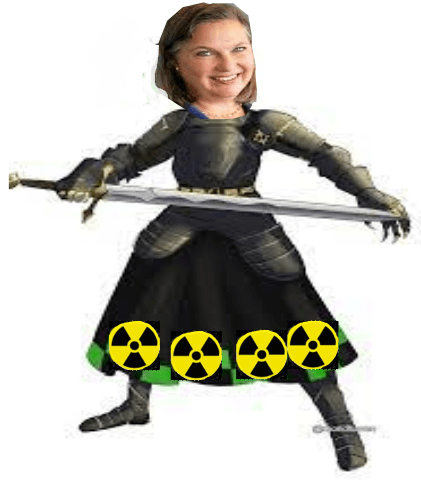
While Putin has turned his nose up at the UN Charter in its solemn affirmation of the sovereignty of states, Washington has taken its own wrecking ball to the text. It has meddled, fiddled and tampered with the internal affairs of states while accusing Russia of the very same thing. Spiteful of history and its bitter lessons, it has employed such saboteurs as former Assistant Secretary of State Victoria Nuland to undertake such tasks, poking the Russian Bear while courting and seducing the Ukrainian establishment. The horror is evident for all to see, and unlikely to halt.
Researchers have doubts, but Bill Gates is hyping his new liquid-sodium nuclear reactor
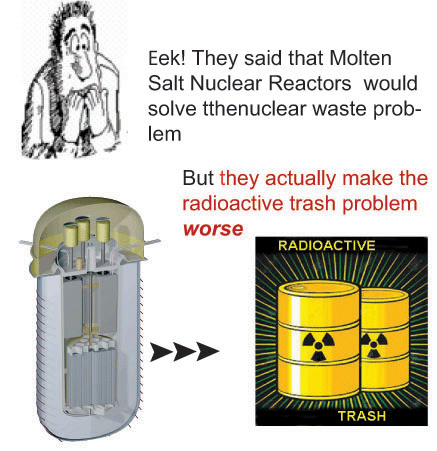
Research has poured cold water on some of the hype surrounding these proposed next-generation reactors, including liquid-sodium reactors. According to a report produced by the Union of Concerned Scientists in 2021, Natrium reactors may be less “uranium-efficient”, may not reduce the amount of nuclear waste produced, and may face safety risks that are unique to them and absent from their predecessors.
The new Natrium reactors promise to be more efficient and safer than traditional nuclear reactors, but is this the case?
Bill Gates Has Made Progress Towards Next-Generation Nuclear Reactors
IFLScience, DR. RUSSELL MOUL, Edited by Laura Simmons, 15 June 24
Bill Gates has helped “break ground” on the development of a new next-generation nuclear reactor. The project, which is run between TerraPower and the Department of Energy, plans to build a new sodium test reactor at a site in Kemmerer, Wyoming by 2030.
The nuclear industry has been in decline in the USA for decades. Despite the country being one of the first nations to generate nuclear energy for commercial civilian purposes, there have been few developments since the late 1970s. For instance, since 1978, only two nuclear power plants have started construction, and that only occurred in 2013.
This industry has stalled because of various broad challenges related to economics, regulatory frameworks, and technological problems, as well as declining respect within the public sphere.
All of the USA’s existing nuclear power plants are traditional pressurized water reactors, which rely on technologies developed over 40 years ago. They are expensive to build and even more so to maintain across their lifecycle. Costs do not just concern the initial construction, but also the ongoing price of fuels, operational costs, and engineering fees. And then there’s the problem of the nuclear waste, which in the US is mostly stored in tanks at sites owned by the Department of Energy.
The industry was also fatally wounded by the Three Mile Island partial meltdown in 1979, which caused new regulatory delays to the 51 new reactors that were under construction at the time. With the introduction of new safety procedures and back-fit requirements, the speed of construction was slowed down, and the costs skyrocketed for many reactors. After that, many contracts were canceled and the industry ground to a halt.
Today, nuclear power provides around one-fifth of the country’s electricity.
But in 2008, Bill Gates founded TerraPower with the aim of building a new generation of nuclear reactors in the US. The reactors, called Natrium, are 345-megawatt modular, pool type, liquid sodium reactors that run off low-enriched uranium (this is fuel that contains 5 to 20 percent fissile uranium). The reactors are also hooked up to a 1-gigawatt hour molten salt storage system…………………………………………………………..
Research has poured cold water on some of the hype surrounding these proposed next-generation reactors, including liquid-sodium reactors. According to a report produced by the Union of Concerned Scientists in 2021, Natrium reactors may be less “uranium-efficient”, may not reduce the amount of nuclear waste produced, and may face safety risks that are unique to them and absent from their predecessors. ……..https://www.iflscience.com/bill-gates-has-made-progress-towards-next-generation-nuclear-reactors-74667
Science Writer
Global spending on nuclear weapons up 13% in record rise
Global spending on nuclear weapons is estimated to have increased by 13%
to a record $91.4bn during 2023, according to calculations from the
International Campaign to Abolish Nuclear Weapons (Ican) pressure group.
The new total, which is up $10.7bn from the previous year, is driven
largely by sharply increased defence budgets in the US, at a time of wider
geopolitical uncertainty caused by Russia’s invasion of Ukraine and the
Israel-Hamas war.
All nine of the world’s nuclear armed nations are
spending more, Ican added, with China judged to be the second largest
spender with a budget of $11.9bn – though Beijing’s total is well below
the $51.5bn attributed to the US.
Guardian 17th June 2024
Australian Opposition leader plans for nuclear power, – (no mention of wastes) -opposes renewable energy.
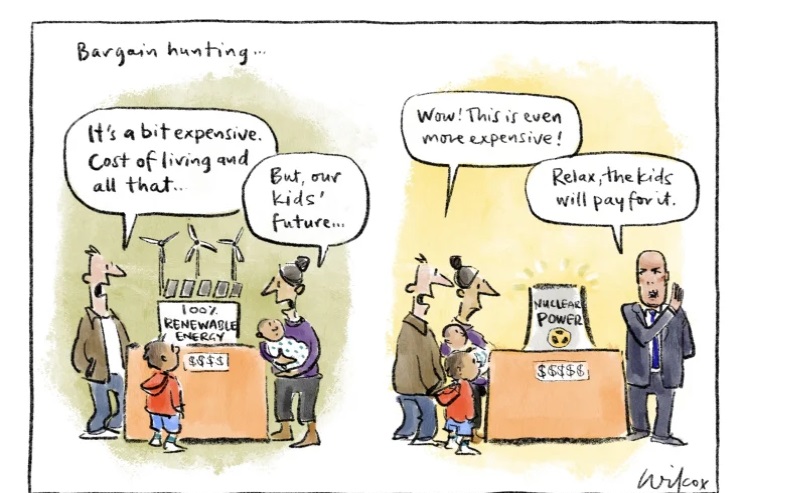
The Age’s cartoonist Cathy Wilcox sums it up!
1 This Month
10 March A LIVE WEBINAR THE REAL EFFECTS OF NUCLEAR POWER
What the Industry Isn’t Telling Us
1:00 PM Mountain, 2 pm Central, 3 pm Eastern. Live on the Keepers of the Water Facebook page


18 March Webinar @ 1 PM EST: An Assessment of SMR Projects: The Case of Canada
register for the zoom:
https://us02web.zoom.us/webinar/register/WN_o8BIIOUvQ2ONJR1nta65DQ#/registration


of the week – STOP SMALL MODULAR REACTORS IN CANADA
To see nuclear-related stories in greater depth and intensity – go to https://nuclearinformation.wordpress.com
-
Archives
- February 2026 (256)
- January 2026 (308)
- December 2025 (358)
- November 2025 (359)
- October 2025 (376)
- September 2025 (258)
- August 2025 (319)
- July 2025 (230)
- June 2025 (348)
- May 2025 (261)
- April 2025 (305)
- March 2025 (319)
-
Categories
- 1
- 1 NUCLEAR ISSUES
- business and costs
- climate change
- culture and arts
- ENERGY
- environment
- health
- history
- indigenous issues
- Legal
- marketing of nuclear
- media
- opposition to nuclear
- PERSONAL STORIES
- politics
- politics international
- Religion and ethics
- safety
- secrets,lies and civil liberties
- spinbuster
- technology
- Uranium
- wastes
- weapons and war
- Women
- 2 WORLD
- ACTION
- AFRICA
- Atrocities
- AUSTRALIA
- Christina's notes
- Christina's themes
- culture and arts
- Events
- Fuk 2022
- Fuk 2023
- Fukushima 2017
- Fukushima 2018
- fukushima 2019
- Fukushima 2020
- Fukushima 2021
- general
- global warming
- Humour (God we need it)
- Nuclear
- RARE EARTHS
- Reference
- resources – print
- Resources -audiovicual
- Weekly Newsletter
- World
- World Nuclear
- YouTube
-
RSS
Entries RSS
Comments RSS
 nuclear-news