G7 Leaders Agree To Provide Ukraine With $50 Billion Using Frozen Russian Assets
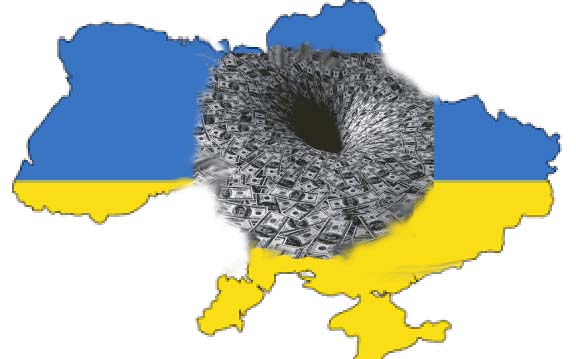
The step will mark a significant escalation in the economic war against Russia
by Dave DeCamp June 13, 2024
Group of Seven leaders agreed at a summit in Italy on Thursday to give Ukraine $50 billion using frozen Russian Central Bank assets, a step that marks a significant escalation in the economic war against Russia.
The plan is to provide the $50 billion to Ukraine by the end of the year in the form of a loan, which will be paid back using profits from the approximately $280 billion in frozen Russian assets held by the US and its allies.
The idea is seen as a compromise between the US and Europe, as President Biden wanted to steal all of the frozen Russian funds to give to Ukraine. But the vast majority of the money is held in Europe, and EU leaders were hesitant to do that.
Instead, the EU devised a separate plan to provide Ukraine with about $3 billion per year using the interest made by the Russian assets. Ukraine said that amount wasn’t enough, and the US proposed the $50 billion loan.

“This has been something that the United States has put a lot of energy and effort into,” National Security Advisor Jake Sullivan told reporters. “We see proceeds from these assets as a valuable source of resources for Ukraine at a moment when Russia continues to brutalize the country, not just through military action on the front but through the attempted destruction of its energy grid and its economic vitality.”
Russia has made clear it would view either plan as the theft of its sovereign funds and is preparing to retaliate. Stealing the money makes reconciliation between Russia and the West even less likely since lifting sanctions would mean having to give assets back to Moscow that have already been spent. The move will also reduce faith in the Western banking system and speed up global de-dollarization.
Proliferation warnings over enriched nuclear fuel for advanced reactors

BY JULIA ROBINSON, 13 JUNE 2024, https://www.chemistryworld.com/news/proliferation-warnings-over-enriched-nuclear-fuel-for-advanced-reactors/4019621.article—
Governments and others promoting the use of high-assay low-enriched uranium (HALEU) for nuclear power have not considered the potential terrorism risk that widespread adoption of this fuel creates, nuclear scientists have warned.
HALEU is a nuclear reactor fuel enriched with uranium-235 to between 5 and 20%. At 20% uranium-235 and above, the mixture is called highly-enriched uranium (HEU) and it is internationally recognised that it can be employed in nuclear weapons.
Historically, HALEU use has been limited to research reactors, where it is used in small quantities, while commercial reactors typically use fuels with low enrichments, in the range of 3 to 5% uranium-235, which cannot sustain an explosive chain reaction.
However, new advanced reactors are being designed to run on HALEU – most favouring 19.75% uranium-235 HALEU – in the hope that these reactors will be smaller, more flexible and less expensive.
In the US, the Department of Energy (DOE) and US Department of Defense are providing funds for more than 10 reactor concepts, while the UK’s Civil Nuclear Roadmap, announced on 11 January, promised up to £300 million of investment specifically to develop HALEU fuel production.
However, in a policy forum in Science, experts in nuclear science and global security highlight that in many of the designs, the amount of HALEU needed is ‘hundreds to thousands of kilograms’, which may mean that a single reactor contains enough HALEU to make a nuclear weapon.
The authors said that estimates indicate that quantities ranging from several hundred kilograms to about a tonne of 19.75% HALEU could produce explosive yields similar to or greater than that of the Little Boy bomb dropped on Hiroshima.
If this is the case, they said, commercialising HALEU fuels without ensuring that the material is ‘appropriately protected against diversion by national governments or theft by terrorists would pose a serious threat to security’.
‘The time has come to review policies governing the use of this material,’ the authors write. ‘We recommend that the US Congress direct the DOE’s National Nuclear Security Administration to commission a fresh review of HALEU proliferation and security risks by US weapons laboratory experts.’
They also suggested that, according to the information available, a reasonable balance of the risks and benefits could be struck if enrichment of uranium-235 was restricted to 12% or less.
Building Nuclear Power Is a Bridge Too Far for World’s Private Investors
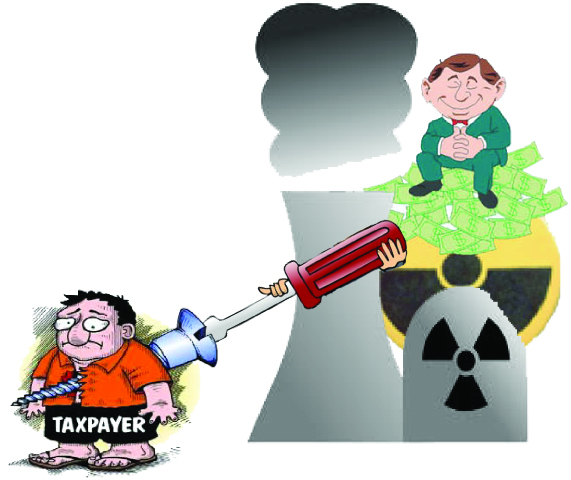
- Taxpayers seen needing to backstop construction costs and risk
- Window on new nuclear power to mitigate climate change closing
Bloomberg, 14 June 24
The next generation of nuclear reactors will need to be financed by taxpayers because private investors aren’t willing to bear the risks associated with building new plants.
That was the warning from bankers at a meeting of industry and government officials in Prague this week. The Nuclear Energy Agency event underscored the hard decisions Western economies soon need to make to keep one of their biggest clean energy sources going. While the public have warmed to nuclear in recent years, spiraling project costs have made private equity cautious.
Officials have estimated that the world needs to spend $5 trillion to triple nuclear-power generation over the next 25 years. The problem is that years of delays and billion-dollar budget overruns at European and the US projects are spooking investors, and scores of reactors already running on borrowed time will need to be replaced. No private investors want to take on construction risks, said Simon Taylor, a financier at the Cambridge Nuclear Energy Centre.
“We’re at a critical juncture of in the history of nuclear energy,” said William Magwood, director general of the Nuclear Energy Agency. “We have to move quickly. Financing is critical.”
Earlier this year, Electricite de France SA said its nuclear project at Hinkley Point in the UK would cost as much as £10 billion ($13 billion) extra to build and take several years longer than planned. In the US, Southern Co.’s Vogtle nuclear facility came in more than $16 billion over budget and seven years behind schedule.
While some private capital has gone toward designing small modular reactors — factory-built units theoretically cheaper to build than traditional plants — those projects have also been plagued by delays pushing full commercialization years later than expected. That leaves nuclear advocates struggling for investor support with the technology at hand.
Can Small Nuclear Reactors Really Help The Climate?
Rothschild & Co.’s Steven Vaughan, an adviser for UK’s proposed Sizewell C nuclear plant, echoed the view that investors are wary of taking on exposure to construction risk.
Equity investment interest in Sizewell, currently owned by the UK government and minority stakeholder EDF, has been muted, with Centrica Plc suggesting it could become a stakeholder.
Compounding nuclear power project risks are the long life span of the assets and the uncertain development of electricity markets. Historically, nations alleviated that risk by building reactors themselves. That’s still the case in China and Russia — the two countries building the most plants………….
“There is a vast need for state involvement,” said Marcin Kaminski, risk manager building Poland’s first reactors at Polskie Elektrownie Jadrowe. https://www.bloomberg.com/news/articles/2024-06-14/building-nuclear-power-is-a-bridge-too-far-for-world-s-private-investors
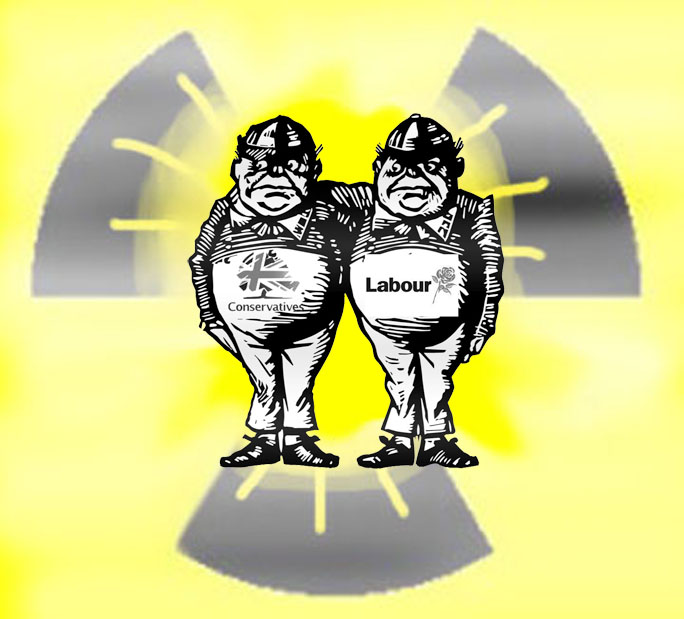
UK Labour and Conservatives commit to nuclear power in manifesto
14th June, By Isaac Cooper @isaaccoopernews, https://www.newsandstar.co.uk/news/24386336.labour-conservatives-commit-nuclear-power-manifesto/
The Labour Party have pledged to ‘ensure the long-term security’ of the nuclear industry as part of their manifesto.
The party set out their plan for government in their manifesto launch on Thursday, June 13 which said that a Labour government would back nuclear power.
The manifesto also said that small modular reactors (SMRs), will play ‘an important role’ in helping the UK achieve ‘energy security’ and ‘clean power’ while securing ‘thousands of good, skilled jobs.’
An SMR in West Cumbria has been mooted for some time and has the support of Cumberland Council leader, Mark Fryer, but the official green light has yet to be light by national government.
The Conservatives have also backed nuclear power and the Tory candidate for Penrith and the Solway, Mark Jenkinson, said he ‘welcomed’ the party’s commitment to nuclear power.
The Green Party have pledged to ‘phase out’ nuclear power which they say is ‘unsafe’ and much more expensive than renewables.
GAZA HORROR: UN FINDS ISRAELI FORCES GUILTY OF SEXUAL ABUSE AND TORTURE
JUNE 13TH, 2024, ROBERT INLAKESH, https://www.mintpressnews.com/un-report-sexual-violence-gaza-strip/287600/
UN-mandated Independent International Commission of Inquiry has uncovered evidence of egregious sexual violence committed against Palestinian men and women in the Gaza Strip. This adds to a mounting series of reports indicating the issue is widespread and systematic.
The United Nations report, released on June 12 under a Human Rights Council resolution, revealed that Israeli forces “systematically targeted and subjected Palestinians to SGBV [Sexual and Gender-Based Violence] online and in person since October 7, including through forced public nudity, forced public stripping, sexualized torture and abuse, and sexual humiliation and harassment.
The report noted specific types of sexual violence perpetrated by Israeli soldiers targeting men and boys during ground operations and arrests. Soldiers took videos and photos of Palestinians after stripping them partially or fully naked. The captives were also “coerced to do physical movements while naked.”
Families of men and boys taken captive were made to watch as they were paraded in the street, either fully naked or in their underwear while being subjected to sexual harassment.
The commission concluded that the gender-based violence “directed at Palestinian women was intended to humiliate and degrade the Palestinian population as a whole.” The report asserted that “forced public stripping and nudity and other types of abuse by Israeli military personnel were either ordered or condoned.
“Sexual violence has been perpetrated throughout the OPT [Occupied Palestinian Territories] during evacuation processes, before or during arrest, at civilian homes and at a shelter for women and girls,” the report stated.
Sexual acts were carried out by force, including under threats, intimidation and other forms of duress, in inherently coercive circumstances due to the armed conflict and the presence of armed Israeli soldiers.”
In February, a UN panel of experts stated there was “credible evidence” of sexual violence against Palestinian women in both Gaza and the West Bank. This followed a UN report noting two cases of rape and various other cases of sexual abuse against Palestinian women.
“We might not know for a long time what the actual number of victims are,” said Reem Alsalem, the UN’s special rapporteur on violence against women and girls.
A recently released UNRWA report included testimony from a 34-year-old Palestinian woman detained in the Sde Teiman detention center, a makeshift interrogation facility for detainees seized from Gaza:
“They asked the soldiers to spit on me, saying ‘she is a b****, she is from Gaza.’ They were beating us as we moved and saying they would put pepper on our sensitive parts [genitals]. They pulled us, beat us, they took us in the bus to the Damon prison after five days. A male soldier took off our hijabs and they pinched us and touched our bodies, including our breasts. We were blindfolded and we were feeling them touching us, pushing our heads to the bus. We started to squeeze together to try to protect ourselves from the touching. They said ‘b****, b****.’ They told the soldiers to take off their shoes and slap our faces with them.”
The testimonies in the UNRWA report correlate with those collected by The New York Times in their recent expose on the Sde Teiman facility, which included allegations of rape, including with metal rods, and one male detainee dying after experiencing anal rape as a form of sexual torture.
Various other accusations of rape have been recorded, including those from Canadian physicians working in Gaza, with one claiming a woman was “raped for two days until she lost her ability to speak.” There has been no extensive investigation into the mountains of evidence and allegations of rape of Palestinians. In contrast, unsubstantiated Israeli government claims of a mass rape campaign on October 7 have received significant international attention.
The newly issued UN report allocated roughly 3,400 words to its section on the singular day of October 7 and approximately the same amount to its segment on crimes committed by Israeli Security Forces until December 31, 2023, in their Advanced Unedited version of the report. The section on crimes committed since October 7 is roughly the same in length but contains 65 footnotes, while the section on crimes committed on October 7 has only 24. The report drew strong conclusions about both Hamas and Israel.
Putin details Ukraine peace proposal
Theo Burman, Newsweek, Fri, 14 Jun 2024 https://www.sott.net/article/492265-Putin-details-Ukraine-peace-proposal
Russian President Vladimir Putin on Friday promised a ceasefire in Ukraine, provided that several conditions are met by Kyiv.
During a wide-ranging speech to foreign ministry officials, Putin stated that Russia would be ready to enter talks as soon as “tomorrow” to negotiate an end to conflict in Ukraine, provided that Ukrainian troops are withdrawn from several key regions. He also demanded that Ukraine give up all plans to join NATO, saying that the “moral responsibility for the continuation of bloodshed” would be on the West if the proposal was rejected.
Putin said: “I want to emphasize, it must be from the entire territory of these regions within their administrative borders as they existed at the time of their incorporation into Ukraine.
“As soon as Kyiv says they’re ready for such a decision and start the real withdrawal of forces from these regions and officially declare rejection of plans to join NATO, from our side, immediately, literally the same minute, will come an order to stop the fire and start negotiations.
“We will do it immediately. Obviously, we will guarantee the uninterrupted and safe withdrawal of Ukrainian forces.”
In order for the ceasefire to go through, Kyiv would need to withdraw troops from the Zaporizhzhia, Kherson, Donetsk and Luhansk regions, effectively giving Moscow control.
Comment: Footage of the announcement: The essence of our proposal is not some kind of temporary truce or stop of fire, as the West wants, in order to restore losses, rearm the Kiev regime, and prepare it for a new offensive.
I repeat: we are not talking about freezing the conflict, but about its final but about its final completion. And I will say again: as soon as #Kiev agrees to a similar course of events proposed today, agrees to the complete withdrawal of its troops from the DPR and LPR, Zaporozhye and Kherson regions and really begins this process, we are ready to to begin negotiations w/out delaying them.
I repeat, our principled position is the following: the neutral, non-aligned, non-nuclear status of #Ukraine, its demilitarization and denazification. Moreover, everyone generally agreed with these parameters during the Istanbul negotiations.
Ukrainian President Volodymyr Zelensky has repeatedly said that he will continue to fight until all disputed regions of Ukraine have been liberated.
Ukraine has repeatedly lobbied to join NATO since before the escalation of the conflict. Putin has consistently branded the expansion of NATO, which admitted Finland into the organization in 2023, as a threat to Russian security and an escalation of tensions in the region.
Newsweek contacted Zelensky’s office for comment via email.
Putin also claimed that there was never an intention of Russian forces attacking Kiev directly, and that the original motive for the advance in 2022 was to force Ukraine to agree to a peace deal.
Russian media outlet Meduza reported that Putin was seeking a ceasefire beyond a “temporary truce”, and that peace negotiations would also require the lifting of Western sanctions on Russia, which have continued to damage the economy since the conflict began.
Putin said: “We would like such decisions — regarding the withdrawal of troops, non-aligned status, and starting a dialogue with Russia, on which the future existence of Ukraine depends — to be made independently in Kyiv, guided by the genuine national interests of the Ukrainian people. Not at the behest of the West. Although there are significant doubts about this.
“If Kyiv and Western capitals reject it, that is their choice, their political and moral responsibility for the continuation of bloodshed.”
Notably this occurs just a day or so after NATO announced its ‘readiness’ of 300,000 troops and their potential takeover of Europe, as well as Zelensky’s widely ridiculed ‘peace’ summit.
It also occurs amidst an unscheduled, ‘secret’ meeting of Prince William with MI6, the UK’s intelligence service for foreign operations; allegedly the last time he met with them was just prior to Russia’s SMO in Ukraine.
Rather than this being some kind of appeasement from Russia to NATO, one might suppose Putin is making one last ditch attempt to propose a resolution with the agreement-incapable West, before it is, yet again, forced to take extraordinary measures:
Why the West should take Russia’s nuclear threats more seriously.
Russian nuclear threats have returned to the forefront of the war in Ukraine, but
this time with a new feature: exercises involving tactical nuclear weapons.
These exercises come in response to Western powers signaling broader
support for Ukraine.
On April 29, for instance, French President Emmanuel
Macron reaffirmed his position that France remains open to sending ground
troops to Ukraine to bolster European security against Russian aggression.
Shortly after, the United Kingdom’s Foreign Secretary, David Cameron,
announced that the UK government would support Ukraine using UK-supplied
weapons against Russian territory.
In response, Russia characterized these
statements as a “completely new round of escalation of tension” and
announced on May 6 that it would conduct drills simulating the use of
tactical nuclear weapons, or—as Russia describes
them—“non-strategic” nuclear weapons. Although these drills
constitute a new kind of nuclear threat, they have been dismissed as not
credible by a growing number of European countries. But the fine line
between skepticism and complacency could pose significant risks for crisis
stability in Europe.
Bulletin of Atomic Scientists 12th June 2024
https://thebulletin.org/2024/06/why-the-west-should-take-russias-nuclear-threats-more-seriously/
Radiation could pose challenge to putting people on Mars
- A solar storm that hit Earth also impacted Mars
- Data showed how much radiation hit the planet’s surface
- High levels of radiation could be risky for astronauts
Steph Whiteside JUN 14, 2024
(NewsNation) — A massive solar storm that impacted Earth also affected Mars, and data suggests radiation levels on the red planet could pose a challenge to human exploration there.
A record-setting solar storm made the aurora borealis visible as far south as North Carolina, stunning people with a view of the dancing lights not usually seen in most of the U.S.
That same storm also hit Mars and also caused an aurora there. Data from NASA’s Odyssey and MAVEN (it stands for “Mars Atmosphere and Volatile Evolution”) orbiters and the Curiosity rover showed what happened when solar flares hit the planet……………………………………………………
Data showed that radiation near Curiosity was around 8,100 micrograys, which is the equivalent of 30 chest X-rays. While that isn’t a deadly amount for a person, it’s also a lot more than someone would want to be exposed to, especially since astronauts on Mars would likely face multiple exposures like that.
Astronauts could also face visual distortions similar to Curiosity’s cameras, with many on the International Space Station describing seeing “fireworks” behind their eyes when they close them during a radiation storm.
So, what does this mean for future exploration?
Scientists say the data shows that shielding on Mars will have to be a serious concern for any crewed missions, raising the possibility that cliffside or lava tubes could play a role in such efforts. That could also impact agriculture on the planet. That would be a necessity because it takes nine months to travel to Mars, and astronauts would have to wait a minimum of three months on the planet before a suitable window to make a return trip.
There is likely to be more data for research as the sunspot that caused the previous storms has continued to show activity. https://www.newsnationnow.com/space/radiation-challenge-people-mars/
The West has a 15-month opportunity for a new nuclear deal with Iran that precludes an Iranian Bomb

Bulletin, By Seyed Hossein Mousavian | June 11, 2024
The Board of Governors of the International Atomic Energy Agency (IAEA) voted last week to censure Iran for failing to cooperate fully in the inspection regime set up under the 2015 nuclear deal to make Iran’s program more transparent and to set limits that would prevent redirection of nuclear material to make weapons. But the deal has failed for many reasons, not just Iran’s interference with IAEA inspectors.
Censure resolutions by the IAEA board are not legally binding but send a strong political and diplomatic message. The representative of Iran’s mission to the United Nations stated, “The decision of the Western countries was hasty and unwise, and it will undoubtedly have a detrimental impact on the process of diplomatic engagement and constructive cooperation.” Today, Iran may be only weeks away from having material for several nuclear weapons. The new President and cabinet of Iran will be determined within the next two months.
The United States and Europe should try to negotiate a new nuclear deal with Iran’s new administration.
At the IAEA board meeting, China, Iran, and Russia issued a joint statement blaming the US for its “unlawful and unilateral withdrawal” from the 2015 Iran nuclear deal (official known as the Joint Comprehensive Plan of Action, or JCPOA) and the imposition of “unilateral and illegal sanctions” against Iran. The three countries wrote that “[s]hould the full implementation of the JCPOA be in place today, it would have alleviated the overwhelming majority of existing questions regarding Iran’s peaceful nuclear program on a mutually accepted basis. The IAEA Secretariat too would have had broader verification and monitoring means.”
The three countries confirmed their readiness to restore the agreement based on the text of a draft agreement initially circulated in August 2022 by European Union foreign policy chief Josep Borrell and blamed the United States and the European signatories to the 2015 deal for blocking the draft for “the sake of their own political considerations”.
The nuclear crisis with Iran began in 2003 when the world became aware that Iran was building a uranium enrichment plant. But the divergence between Iran and the West on nuclear issues started after the 1979 revolution in Iran. Now, 45 years later, a last chance is still open for a positive resolution……………………………………………………………………………………………………………………………………………………..
The global powers still have an opportunity to engage Iran in a “New Nuclear Deal”: lifting nuclear sanctions in exchange for Iran’s full and permanent commitment to implementing comprehensive transparency measures in the JCPOA, which would grant the agency full visibility into Iran’s nuclear activities. It is the best option for staving off the Iranian Bomb. https://thebulletin.org/2024/06/the-west-has-a-15-month-opportunity-for-a-new-nuclear-deal-with-iran-that-precludes-an-iranian-bomb/
‘Immense’ scale of Gaza killings amount to crime against humanity, UN inquiry says
Emma Farge, Wed 12 June 2024 https://uk.news.yahoo.com/news/immense-scale-gaza-killings-amount-070247585.html?guccounter=1&guce_referrer=aHR0cHM6Ly93d3cuc290dC5uZXQv&guce_referrer_sig=AQAAAE8HPcr-FwxjYBWBJjOvPs18KXTim4RNcN-godsX5YX41fMC7lw_jrtVU1-MxuWmywfp-JHc32RWkZntx35DRzp2lMCfrDUJBO9ZfyUj4cQQq1esBhASwVICNpPKfwUP3lrA83XfKI-Wh39AA2ZFjDPO2WQdeLFwaXz4qUyEPAva
GENEVA (Reuters) – Both Israel and Hamas committed war crimes in the early stages of the Gaza war, a U.N. inquiry found on Wednesday, saying that Israel’s actions also constituted crimes against humanity because of the immense civilian losses.
The findings were from two parallel reports, one focusing on the Oct. 7 Hamas attacks and another on Israel’s military response, published by the U.N. Commission of Inquiry (COI), which has an unusually broad mandate to collect evidence and identify perpetrators of international crimes committed in Israel and the occupied Palestinian territories.
Israel does not cooperate with the commission, which it says has an anti-Israel bias. The COI says Israel obstructs its work and prevented investigators from accessing both Israel and the occupied Palestinian territories.
Israel’s diplomatic mission to the U.N. in Geneva rejected the findings. “The COI has once again proven that its actions are all in the service of a narrow-led political agenda against Israel,” said Meirav Eilon Shahar, Israel’s Ambassador to the U.N. in Geneva.
Hamas did not immediately respond to a request for comment.
By Israel’s count more than 1,200 people were killed and 250 taken hostage in the Oct. 7 cross-border attacks that sparked a military retaliation in Gaza that has since killed over 37,000 people, by Palestinian tallies.
The reports, which cover the conflict through to end-December, found that both sides committed war crimes including torture; murder or willful killing; outrages upon personal dignity; and inhuman or cruel treatment.
Israel also committed additional war crimes including starvation as a method of warfare, it said, saying Israel not only failed to provide essential supplies like food, water, shelter and medicine to Gazans but “acted to prevent the supply of those necessities by anyone else”.
Some of the war crimes such as murder also constituted crimes against humanity by Israel, the COI statement said, using a term reserved for the most serious international crimes knowingly committed as part of a widespread or systematic attack against civilians.
“The immense numbers of civilian casualties in Gaza and widespread destruction of civilian objects and infrastructure were the inevitable result of a strategy undertaken with intent to cause maximum damage, disregarding the principles of distinction, proportionality and adequate precautions,” the COI statement said.
Sometimes, the evidence gathered by such U.N.-mandated bodies has formed the basis for war crimes prosecutions and could be drawn on by the International Criminal Court.
MASS KILLINGS, SEXUAL VIOLENCE AND HUMILIATION
The COI’s findings are based on interviews with victims and witnesses, hundreds of submissions, satellite imagery, medical reports and verified open-source information.
Among the findings in the 59-page report on the Oct. 7 attacks, the commission verified four incidents of mass killings in public shelters which it said suggests militants had “standing operational instructions”. It also identified “a pattern of sexual violence” by Palestinian armed groups but could not independently verify reports of rape.
The longer 126-page Gaza report said Israel’s use of weapons such as MK84 guided bombs with a large destructive capacity in urban areas were incompatible with international humanitarian law “as they cannot adequately or accurately discriminate between the intended military targets and civilian objects”.
It also said Palestinian men and boys were subject to the crime against humanity of gender persecution, citing cases where victims were forced to strip naked in public in moves “intended to inflict severe humiliation”.
The findings will be discussed by the U.N. Human Rights Council in Geneva next week.
The COI composed of three independent experts including its chair South African former U.N. human rights chief Navi Pillay was set up in 2021 by the Geneva council. Unusually, it has an open-ended mandate — a fact criticised by both Israel and some of its allies.
Russia was ready to withdraw from southern Ukraine – Putin
https://www.rt.com/russia/599297-putin-russia-kherson-zaporozhye-ukraine/ 13 June 24
Kiev could have retained sovereignty over two of its former regions if it had agreed to guarantee Moscow free land access to Crimea, the president has revealed
Russia was open to withdrawing its troops from Kherson and Zaporozhye Regions early in the Ukraine conflict on the condition that Kiev agreed to an uninterrupted land connection between Crimea and the mainland, President Vladimir Putin stated on Friday.
Speaking at a meeting with the country’s senior diplomats, Putin revealed that in early March 2022, as Russian troops were advancing into southern Ukraine, a senior foreign politician representing the West proposed mediating the conflict between Moscow and Kiev. While Putin did not name the leader, former Russian President Dmitry Medvedev identified him as then-Israeli Prime Minister Naftali Bennett.
According to the Russian president, Bennett asked officials in Moscow at the time why Russian troops were operating in Kherson and Zaporozhye Regions, given that their stated goal was to help Donbass.
Bennett was told the decision to send Russian troops to those regions was made based on the plans drawn by the General Staff, which sought to bypass heavily fortified Ukrainian positions in Donbass, Putin explained. According to the Russian leader, when Bennett asked whether Russian troops would remain in Kherson and Zaporozhye Regions after the end of the conflict, Putin said he was open to the idea of pulling them back to their bases.
“I replied that, in general, I do not rule out that Ukraine will retain its sovereignty over these territories, provided that Russia will have a solid land connection to Crimea.”
Putin noted that to secure the guarantee, Moscow and Kiev would have to sign a legally binding “servitude” agreement, a property law that ties rights and obligations to the ownership or possession of land.
The deal would then have to be finalized with the involvement of the UN Security Council, as well as local citizens and the Russian public.
However, when Bennett traveled to Kiev to present Moscow’s proposal to the Ukrainian government, it was rejected, and the Israeli leader was branded a Russian sympathizer, Putin noted.
Now, this proposal is off the table, given that Kherson and Zaporozhye Regions, along with the two Donbass republics, voted to join Russia in public referendums in the fall of 2022, Putin stated. “There can be no talk of violating our national unity… This question is closed forever and beyond any debate.”
At the same time, Putin signaled that Moscow was ready for talks with Ukraine on the condition that Kiev fully withdraws its troops from Donbass, Kherson, and Zaporozhye regions and abandons plans to join NATO. But the proposal has been rejected by Kiev, which insists upon returning the country to its 1991 borders.
1 This Month


Tell the Ukrainian Government to Drop Prosecution of Peace Activist Yurii Sheliazhenko

Petition to revoke the licensing of the Near Surface Nuclear Disposal Facility (NSDF) at Chalk River. https://www.ourcommons.ca/petitions/en/Petition/Details?Petition=e-7247


of the week – STOP SMALL MODULAR REACTORS IN CANADA
To see nuclear-related stories in greater depth and intensity – go to https://nuclearinformation.wordpress.com
-
Archives
- March 2026 (204)
- February 2026 (268)
- January 2026 (308)
- December 2025 (358)
- November 2025 (359)
- October 2025 (376)
- September 2025 (258)
- August 2025 (319)
- July 2025 (230)
- June 2025 (348)
- May 2025 (261)
- April 2025 (305)
-
Categories
- 1
- 1 NUCLEAR ISSUES
- business and costs
- climate change
- culture and arts
- ENERGY
- environment
- health
- history
- indigenous issues
- Legal
- marketing of nuclear
- media
- opposition to nuclear
- PERSONAL STORIES
- politics
- politics international
- Religion and ethics
- safety
- secrets,lies and civil liberties
- spinbuster
- technology
- Uranium
- wastes
- weapons and war
- Women
- 2 WORLD
- ACTION
- AFRICA
- Atrocities
- AUSTRALIA
- Christina's notes
- Christina's themes
- culture and arts
- Events
- Fuk 2022
- Fuk 2023
- Fukushima 2017
- Fukushima 2018
- fukushima 2019
- Fukushima 2020
- Fukushima 2021
- general
- global warming
- Humour (God we need it)
- Nuclear
- RARE EARTHS
- Reference
- resources – print
- Resources -audiovicual
- Weekly Newsletter
- World
- World Nuclear
- YouTube
-
RSS
Entries RSS
Comments RSS
 nuclear-news