The omnicidal and unnecessary Nuclear Triad
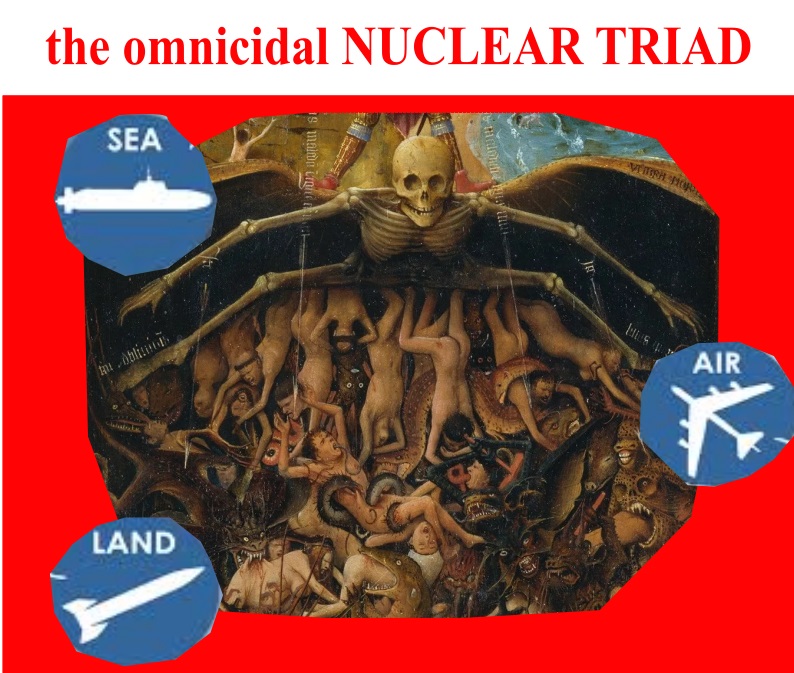
the U.S. military no longer needs nuclear strategic bombers and land-based ICBMs in order to threaten to destroy the planet.
that triad of potentially ultimate nuclear death had become so sacrosanct that it was untouchable
Even as the nuclear clock ticks ever closer to midnight, nobody is ducking and covering in America’s classrooms anymore (except against mass shooters).
Ending My Thermonuclear Odyssey
WILLIAM J. ASTORE, JUN 6, 2024, https://www.laprogressive.com/war-and-peace/ending-my-thermonuclear-odyssey
As a late-stage baby boomer, a child of the 1960s, I grew up dreaming about America’s nuclear triad. You may remember that it consisted of strategic bombers like the B-52 Stratofortress, land-based intercontinental ballistic missiles (ICBMs) like the Minuteman, and submarine-launched ballistic missiles (SLBMs) like the Poseidon, all delivery systems for what we then called “the Bomb.” I took it for granted that we needed all three “legs” — yes, that was also the term of the time — of that triad to ward off the Soviet Union (aka the “evil empire”).
It took me some time to realize that the triad was anything but the trinity, that it was instead a product of historical contingency. Certainly, my mind was clouded because two legs of that triad were the prerogative of the U.S. Air Force, my chosen branch of service. When I was a teenager, the Air Force had 1,054 ICBMs (mainly Minutemen missiles) in silos in rural states like Montana, North Dakota, and Wyoming, along with hundreds of strategic bombers kept on constant alert against the Soviet menace. They represented enormous power not just in destructive force measured in megatonnage but in budgetary authority for the Air Force. The final leg of that triad, the most “survivable” one in case of a nuclear war, was (and remains) the Navy’s SLBMs on nuclear submarines. (Back in the day, the Army was so jealous that it, too, tried to go atomic, but its nuclear artillery shells and tactical missiles were child’s play compared to the potentially holocaust-producing arsenals of the Air Force and Navy.)
When I said that the triad wasn’t the trinity, what I meant (the obvious aside) was this: the U.S. military no longer needs nuclear strategic bombers and land-based ICBMs in order to threaten to destroy the planet. As a retired Air Force officer who worked in Cheyenne Mountain, America’s nuclear redoubt, during the tail end of the first Cold War, and as a historian who once upon a time taught courses on the atomic bomb at the Air Force Academy, I have some knowledge and experience here. Those two “legs” of the nuclear triad, bombers and ICBMs, have long been redundant, obsolete, a total waste of taxpayer money — leaving aside, of course, that they would prove genocidal in an unprecedented fashion were they ever to be used.
Nevertheless, such thoughts have no effect on our military. Instead, the Air Force is pushing ahead with plans to field — yes! — a new strategic bomber, the B-21 Raider, and — yes, again! — a new ICBM, the Sentinel, whose combined price tag will likely exceed $500 billion. The first thing any sane commander-in-chief with an urge to help this country would do is cancel those new nuclear delivery systems tomorrow. Instead of rearming, America should begin disarming, but don’t hold your breath on that one.
A Brief History of America’s Nuclear Triad

It all started with atomic bombs and bombers. In August 1945, the Japanese cities of Hiroshima and Nagasaki were obliterated by two atomic bombs carried by B-29 bombers, ending World War II. However, in the years that followed, as the Cold War with the Soviet Union heated up, the only “delivery system” the military had for its growing thermonuclear arsenal was the strategic bomber. Those were the glory days of the Strategic Air Command, or SAC, whose motto (believe it or not) was “Peace Is Our Profession” — the “peace” of a mass nuclear grave, had those hydrogen bombs ever been dropped on their intended targets in the Soviet Union and China.
However, as this country’s weapons makers produced ever more powerful hydrogen bombs and strategic bombers, a revolution was afoot in missile technology. By the late 1950s, missiles tipped with nuclear warheads became a practical reality. By the 1960s, the Air Force was already lobbying for 10,000 ICBMs, even if my old service had to settle for a mere thousand or so of them during the administration of President John F. Kennedy. Meanwhile, the Navy was maneuvering its way into the act by demonstrating that it was indeed possible for mobile, difficult-to-detect submarines to carry nuclear-tipped missiles.
By the late 1960s, that triad of potentially ultimate nuclear death had become so sacrosanct that it was untouchable. More than half a century later, America’s nuclear triad has endured and, all too sadly, is likely to do so far longer than you or me (if not, of course, used).
You might wonder why that should be so. It’s not for any sensible military or strategic reason. By the 1980s, if not before, bombers and ICBMs were obsolete. That was why President Jimmy Carter canceled the B-1 bomber in 1977 (though it would be revived under President Ronald Reagan, with the Air Force buying 100 of those expensive, essentially useless aircraft). That was why the Air Force developed the “peacekeeper” MX ICBM, which was supposed to be mobile (shuffled around by rail) or hidden via an elaborate shell game. Such notions were soon abandoned, though not the missiles themselves, which were stuffed for a time into fixed silos. The endurance of such weapons systems owes everything to Air Force stubbornness and the lobbying power of the industrial side of the military-industrial complex, as well as to members of Congress loath to give up ICBM and bomber bases in their districts, no matter how costly, unnecessary, and omnicidal they may be.
In that light, consider the Navy’s current force of highly capable Ohio-class nuclear submarines. There are 14 of them, each armed with up to 20 Trident II missiles, each with up to eight warheads. We’re talking, in other words, about at least 160 potentially devastating nuclear explosions, each roughly five to 20 times more powerful than the Hiroshima bomb, from a single sub. In fact, it’s possible that just one of those submarines has an arsenal with enough destructive power not just to kill millions of us humans, but to tip the earth into a nuclear winter in which billions more of us could starve to death. And America has 14 of them!
Why, then, does the Air Force argue that it, too, “needs” new strategic bombers and ICBMs? The traditional arguments go like this: bombers can be launched as a show of resolve and, unlike missiles, recalled. They are also, allegedly, more flexible. In Air Force jargon, they can be rerouted against “targets of opportunity” in a future nuclear war. Of course, generals can always produce a scenario, however world-ending, to justify any weapons system, based on what an enemy might or might not do or discover. Nonetheless, strategic bombers were already nearing obsolescence when Stanley Kubrick made his classic antinuclear satire, Dr. Strangelove (1964), so prominently featuring them.
And what about land-based ICBMs? Once, the claim was that they had more “throw-weight” (bigger warheads) than SLBMs and were also more accurate (being launched from fixed silos rather than a mobile platform like a submarine). But with GPS and other advances in technology, submarine-launched missiles are now as accurate as land-based ones and “throw-weight” (sheer megatonnage) always mattered far less than accuracy.
Worse yet, land-based ICBMs in fixed silos are theoretically more vulnerable to an enemy “sneak” attack and so more escalatory in nature. The U.S. currently has 400 Minuteman III ICBMs sitting in silos. If possible incoming enemy nuclear missiles were detected, an American president might have less than 30 minutes — and possibly only 10 or so — to decide whether to launch this country’s ICBM force or risk losing it entirely.
That’s not much time to determine the all-too-literal fate of the planet, is it, especially given the risk that the enemy attack might prove to be a “false alarm“? Just before I arrived at Cheyenne Mountain, there were two such alarms (one stemming from a technical failure, the other from human error when a simulation tape was loaded into computers without any notification that it was just a “war game”). Until they were found to be false alarms, both led to elevated DEFCONs (defense readiness conditions) in preparation for possible nuclear war.
New ICBMs will only add “use them or lose them” pressure to the global situation. Mobile, elusive, and difficult to detect, the Navy’s submarine force is more than sufficient to deter any possible enemy from launching a nuclear attack on the United States. Strategic bombers and ICBMs add plenty of bang and bucks but only to the Air Force budget and the profits of the merchants of mass nuclear death who make them.
A Sane Path Forward for America’s Nuclear Force
I still remember the nuclear freeze movement, the stunningly popular antinuclear protest of the early 1980s. I also remember when President Reagan and Soviet leader Mikhail Gorbachev met in 1986 and seriously discussed total nuclear disarmament. I remember Barack Obama, as a 2008 presidential candidate, being joined by old Cold War stalwarts like Henry Kissinger and Sam Nunn in calling for the eventual elimination of nuclear weapons.
Today, we’re not supposed to recall any of that. Instead, we’re told to focus on the way a developing “new cold war” with Russia and China is driving a “requirement” for a “modernized” U.S. nuclear triad that could cost $2 trillion over the next 30 years. Meanwhile, we’re discouraged from thinking too much about the actual risks of nuclear war. The Biden administration, for example, professes little concern about the possibility that arming Ukraine with weaponry capable of hitting deep inside Russia could lead to destabilization and the possible use of nuclear weapons on the battlefield (something Vladimir Putin has threatened to do). Nor are we to fret about surrounding China with ever more U.S. military bases and sending ever more weaponry to Taiwan, while the Chinese are enlarging their own force of ICBMs; or, for that matter, about the fact that the last nuclear agreement limiting the size of the American and Russian arsenals will run out in less than 1,000 days.
To such issues, the only response America’s “best and brightest” ever have is this one: give us more/newer strategic bombers, more/newer ICBMs, and more/newer nuclear submarines (whatever the cost)! To those men, it’s as if nuclear war were a theoretical (and distinctly money-making) chess match—and yes, they are indeed still mostly men!—a challenging game whose only components are profits, jobs, money, and power. Yet when the only story to be told is one featuring more nuclear warheads and more delivery systems, it’s hard not to conclude that, in some horrific fashion, nuclear Armageddon is indeed us (or at least them).
And though few spend much time thinking about it anymore, that’s madness personified. What’s needed instead is a new conviction that a nuclear Armageddon must not be our fate and, to make that so, we must act to eliminate all ICBMs, cancel the B-21 bomber, retire the B-1s and B-2s, work on global nuclear disarmament, start thinking about how to get rid of those nuclear subs, and begin to imagine what it would be like to invest the money saved in rebuilding America. It sure beats destroying the world.
And again, in the most practical terms possible, if we’re set on preserving Armageddon, America’s existing force of Ohio-class nuclear submarines is more than enough both to do so and undoubtedly to “deter” any possible opponent.
There was a time, in the early stages of the first Cold War, when America’s leaders professed fears of “bomber” and “missile” gaps vis-à-vis the Soviet Union — gaps that existed only in their minds; or rather only in the reverse sense, since the U.S. was ahead of the Soviets in both technologies. Today, the bomber and missile “gaps” are, in fact, gaps in logic wielded by a Pentagon that insists strategic bombers and ICBMs remain a “must” for this country’s safety and security.
It’s all such nonsense, and I’m disgusted by it. I want my personal thermonuclear odyssey to come to an end. As a kid in the 1970s, I built a model of the B-1 bomber. As a ROTC cadet in the early 1980s, I made a presentation on the U.S./Soviet nuclear balance. As a young Air Force officer, I hunkered down in Cheyenne Mountain, awaiting a nuclear attack that fortunately never came. When I visited Los Alamos and the Trinity Test Site at Alamogordo, New Mexico, in 1992, I saw what J. Robert Oppenheimer’s original atomic “gadget” had done to the tower from which it had been suspended. When the Soviet Union collapsed, I genuinely hoped that this country’s (and the world’s) long nuclear nightmare might finally be coming to an end.
Tragically, it was not to be. The gloomy Los Alamos of 1992, faced with serious cuts to its nuclear-weapons-producing budget, is once again an ebullient boom town. Lots of new plutonium pits are being dug. Lots more money is flooding in to give birth to a new generation of nuclear weapons. Of course, it’s madness, sheer madness, yet this time, it’s all happening so quietly.
U.S. Considers Expanded Nuclear Arsenal, a Reversal of Decades of Cuts.
By Julian E. Barnes and David E. Sanger, Reporting from Washington, June 7, 2024 https://www.nytimes.com/2024/06/07/us/politics/us-nuclear-russia-china.html
A senior Biden administration official warned on Friday that “absent a change” in nuclear strategy by China and Russia, the United States may be forced to expand its nuclear arsenal, after decades of cutting back through now largely abandoned arms control agreements.
The comments on Friday from Pranay Vaddi, a senior director of the National Security Council, were the most explicit public warning yet that the United States was prepared to shift from simply modernizing its arsenal to expanding it. They were also a warning to President Vladimir V. Putin of Russia about the likely U.S. reaction if the last major nuclear arms control agreement, called New START, expires in February 2026 with no replacement.
Mr. Vaddi, speaking at the annual meeting of the Arms Control Association, a group that advocates limits on nuclear weapons, confirmed what officials have been saying in private conversations and closed congressional testimony for more than a year. It is the inevitable outgrowth, they have argued, of China’s rapid nuclear expansion and Russia’s repeated threats to use tactical nuclear weapons in Ukraine.
But it would be an epochal shift, and one fraught with dangers that many Americans thought they had left behind at the end of the Cold War and the collapse of the Soviet Union.
Fifteen years ago, President Barack Obama outlined a vision of moving toward a world without nuclear weapons, and he took steps to reduce their role in American strategy and defenses. While the nation’s nuclear complexes were improved and made safer, and old weapons were swapped out for more reliable or updated versions, the United States insisted it was only “modernizing” its arsenal, not expanding it.
As vice president in the Obama administration, President Biden became the spokesman for this strategy.
At the time, China was still maintaining its “minimum deterrent” policy, which dates back to its first nuclear test in 1964, and Mr. Putin appeared to have little interest in fiscally ruinous arms races. That has now changed.
China is on a path to match the number of American and Russian deployed nuclear weapons by 2035, according to the Pentagon’s public estimates. Mr. Putin has fixated on unusual weapons, including an undersea nuclear torpedo that could be launched across the Pacific to destroy the West Coast of the United States. And the United States has warned in recent months that Russia has a program underway to put a nuclear bomb into orbit.
There have been no discussions with Russia since it invaded Ukraine about negotiating a replacement for New START, which limits each country to 1,550 deployed strategic nuclear weapons, the kind that can be launched from one continent to another.
China has been unwilling to engage in deep nuclear talks with the United States, making it clear that it is not interested in arms control until its own arsenal is comparable to that of the two biggest nuclear powers. (Britain, France, India, Pakistan, Israel and North Korea all have arsenals of their own, though with much smaller numbers.)
While the Biden administration has not abandoned its rhetorical support of a world without nuclear weapons, officials have acknowledged that the prospects of new arms control deals are now so remote that they have to think about new strategies.
“Absent a change in the trajectory of the adversary arsenal, we may reach a point in the coming years where an increase from current deployed numbers is required, and we need to be fully prepared to execute if the president makes that decision,” he said.
The United States remains ready to pursue arms control agreements to reduce nuclear threats by “limiting and shaping” adversaries’ nuclear forces, Mr. Vaddi said. And citing the history of separate diplomatic tracks for such agreements, he suggested Russia’s war in Ukraine would not be a barrier to a discussion.
But he said Russia’s rejection of talks to a successor agreement to New Start has “cast a shadow” over diplomatic issues.
“At least in the near term, the prospects for strategic arms control are dim,” he said.
A year ago, at the same conference, Jake Sullivan, the national security adviser, pledged a renewed effort to bring China into arms control talks. Since that speech, the United States has tried to engage the Chinese on nuclear safety issues and recently conducted the first talks, in Geneva, to address whether it would be possible to reach an accord that artificial intelligence should never control nuclear weapons, among other limitations.
That meeting was preliminary, and it is unclear if others are to follow. While China has urged the United States to adopt what it calls its “no first use” policy for employing nuclear weapons, it has not engaged substantively with the American proposals.
One of the complications of the current nuclear environment, administration officials say, is the potential that Russia and China may coordinate their nuclear policies, part of the “partnership without limits” that Mr. Putin and Xi Jinping, the Chinese leader, announced in 2022.
The failure of Russia and China to engage in meaningful negotiations, Mr. Vaddi said, was “forcing the United States and our close allies and partners to prepare for a world where nuclear competition occurs without numerical constraints.”
Modernizing the American nuclear arsenal, he argued, will give both Russia and China an incentive to go back to the negotiating table and put Washington at a stronger place in those talks.
“We need to persuade our adversaries that managing rivalry through arms control is preferable to unrestrained competition,” he said.
Julian E. Barnes covers the U.S. intelligence agencies and international security matters for The Times. He has written about security issues for more than two decades. More about Julian E. Barnes
David E. Sanger covers the Biden administration and national security. He has been a Times journalist for more than four decades and has written several books on challenges to American national security. More about David E. Sanger
Keir Starmer’s Trident triple lock: how Britain’s obsession with nuclear weapons has become part of election campaigns

The nuclear debate is also wrapped up in a gendered narrative that sees a commitment to nuclear weapons as strong, sensible, rational and masculine, and anything else as weak, irrational and feminine
Nick Ritchie, Professor, Department of Politics & International Relations, University of York, June 7, 2024 https://theconversation.com/keir-starmers-trident-triple-lock-how-britains-obsession-with-nuclear-weapons-has-become-part-of-election-campaigns-231834
With a campaign slogan of “change”, Keir Starmer is on a mission to persuade the electorate that the Labour party of 2024 is different to the one of 2019. Part of this is his unequivocal “triple lock” commitment to Trident, the UK’s nuclear weapon system.
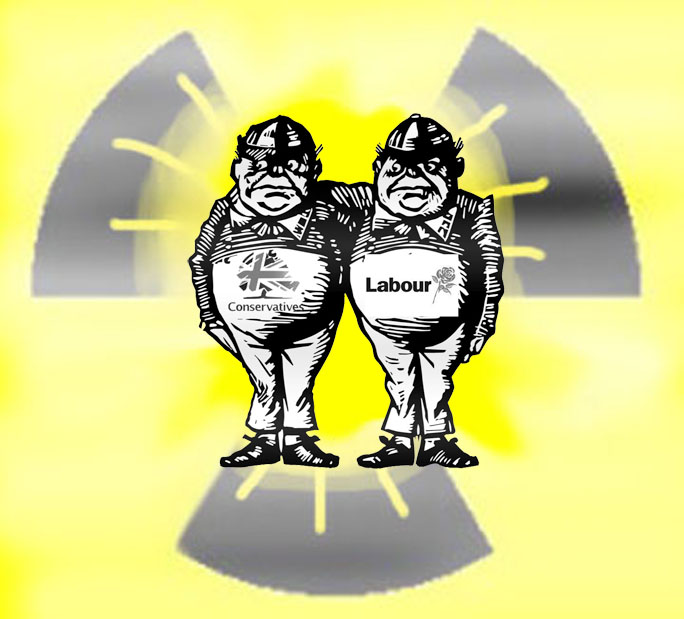
At a time when the risk of a major European war is higher than it has been for decades, Starmer has reiterated his support for a massive programme to replace the Trident system (submarines, warhead, missiles and infrastructure), initiated by former Labour prime minister Tony Blair, in 2006. The triple lock is a commitment to the current programme to build four new ballistic missile submarines, keep one of the four always at sea on operational patrol and keep the system up to date.
Starmer is pushing back against Conservative claims that Labour is “weak”, “cannot be trusted” and is a “danger to national security”, accusations that have plagued his predecessor Jeremy Corbyn, a lifelong opponent of nuclear weapons.
Ideas of British national identity and Britain’s place in the world connect to a commitment to nuclear weapons. This identity is also tied to the idea of Britain as a military power in Europe, and Labour’s current identity of being strong on defence.
Prospective prime ministers are effectively required to publicly declare that they would be prepared to use nuclear weapons. Commitment to nuclear deterrence has become a de facto criterion for entering No 10.
Corbyn found this out in 2017 when he told the BBC’s Andrew Marr he would never use nuclear weapons first, or perhaps ever, if he were prime minister. In an unprecedented intervention, serving and former chiefs of the defence staff said that Corbyn’s response showed he “should not be trusted … with the nation’s defence and security”, and was unfit to be prime minister. Corbyn’s opposition to Trident is still being used to attack Starmer and Labour years later.
Starmer first signalled his commitment to Trident in 2021. Two years later, shadow defence secretary John Healey and shadow foreign secretary David Lammy declared their “unshakable” commitment to nuclear weapons as part of “Labour’s heritage”. But concerns about the morality and efficacy of using nuclear weapons have long divided Labour.
This is quite different to how nuclear weapons, which are based in Scotland, are framed by the Scottish National Party. In their conception of an independent Scotland’s national identity nuclear weapons are associated with imposed, undemocratic, Tory “imperialism” in which Labour has been complicit, and contrary to the SNP’s version of progressive internationalism. The SNP has said they would remove nuclear weapons from Scotland in the event of Scottish independence.
The nuclear debate is also wrapped up in a gendered narrative that sees a commitment to nuclear weapons as strong, sensible, rational and masculine, and anything else as weak, irrational and feminine.
The nuclear ‘consensus’
This Whitehall nuclear consensus closes down democratic debate on if, how and why the prime minister might use nuclear weapons. But views in the country are far from settled.
Recent polling shows 53% supports or strongly supports the UK having nuclear weapons, with about 30% opposed or strongly opposed. For women, the split is 50:50. For under 25s, it is 28% in favour and 43% against. In Scotland it is 35% in favour and 41% against (the rest say they don’t know).
The UK prime minister is one of a handful of people in the world with the power to inflict truly catastrophic levels of violence upon another society. Nuclear weapons should therefore be subject to intense scrutiny and debate, especially in a liberal democratic society. Starmer should appreciate this as a human rights lawyer, since practically any use of nuclear weapons would transgress international humanitarian and human rights law.
The nuclear programme is also hugely expensive. At a time when public services including health and education are under serious pressure, this arguably makes democratic debate even more necessary.
In March 2024 the House of Commons public accounts committee reported that the cost of the Ministry of Defence’s 10-year equipment plan was over budget by £17 billion, despite a budget increase of £46.3 billion. The greatest cause of this was the nuclear programme, where costs have increased by £38.2 billion (62%) since the last plan. The nuclear programme is now 34.5% of the £288.6 billion defence equipment plan, which itself is 49% of the total MoD budget.
In particular, the programme to deliver the new Dreadnought ballistic missile submarines has become the MoD’s highest priority. The department will redirect funds from conventional military programmes to support it if it can’t get more money from the Treasury. Labour and the Conservatives have both committed to increase the defence budget, especially for conventional forces, but have not said where the money will come from.
There are other political reasons why Starmer has come out strong for Trident. In particular, the thousands of jobs that the production and maintenance of nuclear-powered submarines supports in England and Scotland, and the power of the unions in the Labour party. The “triple lock” language also mirrors the triple lock commitment on pensions. This may appeal to older voters, who are more likely to vote (and vote Conservative).
Starmer’s “triple lock” might make sense politically from his perspective, but it is symptomatic of a nuclear consensus in Whitehall politics that brooks little dissent. The result is that debate on these difficult and serious security, economic, legal and moral choices on nuclear weapons routinely gets shut down and reduced to political performance. In the words of retired senior British Army officer General Sir Richard Shirreff, it infantilises a deadly serious issue.
Guterres warns humanity on ‘knife’s edge’ as AI raises nuclear war threat

UN secretary general makes plea for nuclear states to agree on mutual pledge not to be first to use nuclear weapons.
Julian Borger in Washington, Sat 8 Jun 2024 https://www.theguardian.com/world/article/2024/jun/07/ai-nuclear-war-threat-un-secretary-general
The UN secretary general, António Guterres, has warned that the spread of artificial intelligence technology multiplies the threat of nuclear war, and that humanity is now “on a knife’s edge” as dangers to its existence coalesce.
Guterres’s warning is due to be shown on a recorded video to be played on Friday morning at the annual meeting of the US Arms Control Association (ACA) in Washington.
In the video, the secretary general makes his most impassioned plea to date for the nuclear weapons states to take their non-proliferation obligations seriously, and in particular, agree on a mutual pledge not to be the first to use nuclear weapons.
“The regime designed to prevent the use, testing and proliferation of nuclear weapons is weakening,” Guterres says in the recorded message, in a warning that comes with some 600 days to go before the expiry of the 2010 New Start accord between the US and Russia, the last remaining agreement limiting the strategic arsenals of the two nuclear superpowers.
Moscow has taken to making frequent threats of nuclear use, and China’s stockpile, while small compared with those of the US and Russia, is growing steadily.
More than 30 years since the end of the cold war, the US and Russia keep many of their intercontinental ballistic missiles on a hair-trigger alert, ready to launch at a few minutes’ warning. There are fears that in the drive to bolster each nation’s deterrent, launch procedures are being streamlined potentially with the help of AI.
“Humanity is on a knife’s edge; the risk of a nuclear weapon being used has reached heights not seen since the cold war,” Guterres says in his ACA address. “States are engaged in a qualitative arms race. Technologies like artificial intelligence are multiplying the danger.”
“All countries must agree that any decision on nuclear use is made by humans, not machines or algorithms,” Guterres insisted.
Two years ago, the US, UK and France issued a joint statement on the need to “maintain human control” of nuclear launches. Russia and China have yet to issue any comparable declaration.
According to estimates by the Federation of American Scientists (FAS), the number of nuclear weapons has declined dramatically since the cold war from a 1986 peak of about 70,300 weapons in 1986 to an estimated 12,100 this year. The total inventory continues to fall gradually as retired weapons are dismantled, but the total military stockpile of warheads available for use has begun to increase again, after the long post-cold war decline, the FAS warned.skip past newsletter promotion
Guterres said it was the responsibility of nuclear weapons states to lead a return to disarmament. “They must resume dialogue and commit to preventing any use of a nuclear weapon,” he said. “I also urge the United States and the Russian Federation to get back to the negotiating table, fully implement the New Start treaty and agree on its successor.”
At last year’s ACA meeting, the US national security adviser, Jake Sullivan, offered to engage in talks “without preconditions” on a new agreement to replace New Start, but the Kremlin has rejected the offer.
Guterres also repeated his previous appeals for the nuclear powers to reaffirm a moratorium on nuclear testing, and to “agree that none will be the first to launch” a nuclear warhead.
Earlier this year, China suggested a “no first use” treaty. The US responded by saying it was ready to engage in a discussion on the subject. Mallory Stewart, an assistant secretary of state, told the ACA in April she “would love to ask” Chinese officials about the idea in the context of a broader conversation about strategic risks. But US officials say there has not so far been a “substantive response” to the US suggestion of a dialogue, and has not so far agreed to arrange a sequel to a bilateral arms control meeting held last November.
US Bombs Used in Israeli Massacre of 40 in Gaza Refugee Camp
By Sharon Zhang / Truthout June 7, 2024, https://scheerpost.com/2024/06/07/us-bombs-used-in-israeli-massacre-of-40-in-gaza-refugee-camp/
The targeting of the UN school-turned-shelter is a “blatant” violation of international law, one UN official said.
n Israeli bombing that killed 40 Palestinians and wounded 74 sheltering in a UN school-turned-shelter in a refugee camp in central Gaza on Thursday was carried out using U.S.-made weapons, an analysis finds.
Fragments of at least two U.S.-made GBU-39 small diameter bombs were found at the scene of the bombing on the Nuseirat refugee camp, CNN found in a review that concluded they were used in the devastating overnight strike.
The bombing, which Gaza officials say killed at least 14 children and wounded 23, is a “blatant” violation of international law, human rights groups have said. International law prohibits targeting civilians and civilian infrastructure in war.
“Attacking, targeting or using UN buildings for military purposes are a blatant disregard of International Humanitarian law,” said UN Relief and Works Agency for Palestine Refugees (UNRWA) Commissioner-General Philippe Lazzarini. “UNRWA shares the coordinates of all its facilities (including this school) with the Israeli Army and other parties to the conflict. Targeting UN premises or using them for military purposes cannot become the new norm.”
Israeli human rights group B’Tselem said that the attack is a “suspected war crime.”
If these assessments are correct, this represents direct evidence that U.S. military assistance is being used by Israeli forces to commit war crimes. U.S. weapons have been used in many war crimes committed by Israeli forces in recent months, previous reports have found.
These assessments run contrary to a recent report released by the State Department concluding that it’s “reasonable to assess” that U.S. weapons have been used in violation of international law, but that there is not enough direct evidence of Israel’s culpability in slaughtering civilians en masse. If that report had directly concluded that U.S. weapons are being used to commit Israeli war crimes, it would have spurred the U.S. to consider withholding military aid to Israel in accordance with U.S. and international law.
The conclusions of the report raised an uproar. A U.S. State Department official who quit after the release of the report said that its conclusions were fabricated by higher ups in the department to provide cover for U.S. officials working to send Israel yet more aid to be used to commit atrocities against Palestinians.
Eyewitnesses say the attack on the Nuseirat school was horrific, with Israeli forces releasing two bombs on the building that was sheltering 6,000 Palestinians who had been displaced multiple times over the course of Israel’s genocide. At the site of the attack, the smell of blood hangs heavy in the air, reported Palestinian journalist Hind Khoudary.
“We were inside the school and suddenly we were bombed, people here turned to pieces on a harsh night … this building housed families and young people, and the shelling took place without warning,” survivor Anas al-Dahouk told Al Jazeera.
The school is one of the many UNRWA facilities that have been targeted by Israeli forces since October. According to Lazzarini, 180 UNRWA buildings have been attacked, killing at least 450 Palestinians in UN facilities alone.
According to the official death toll, Israel’s genocidal assault has killed at least 36,600 Palestinians. But the true death toll is likely far higher, as thousands more Palestinians are missing and presumed to be dead under the rubble of buildings bombed by Israel. The count also doesn’t include those who have died for reasons like starvation or illness outside of health facilities in the region.
Russia doesn’t need nuclear weapons to succeed: Putin

Canberra Times. June 8 2024
Russian President Vladimir Putin says there is no need to use nuclear weapons to deliver victory for Moscow in Ukraine, the strongest signal yet from the Kremlin chief that there will not be a nuclear strike.
Putin, whose forces have been making advances in eastern Ukraine in recent months, said on Friday he did not see the conditions for the use of such weapons and requested that people stop discussing the nuclear topic.
However Putin, who leads the world’s biggest nuclear power, said he did not rule out changes to Russia’s nuclear doctrine, which sets out the conditions under which such weapons could be used.
He also said that if necessary Russia could test a nuclear weapon, though he saw no need to do so at the present time……………………………………….
Russia’s published 2020 nuclear doctrine sets out the conditions under which a Russian president would consider using a nuclear weapon: broadly as a response to an attack using nuclear or other weapons of mass destruction, or to the use of conventional weapons against Russia “when the very existence of the state is put under threat”.
“If necessary, we will conduct tests. So far, there is no need for this either, since our information and computer capabilities allow us to produce everything in its current form.”……………………………….. more https://www.canberratimes.com.au/story/8656114/russia-doesnt-need-nuclear-weapons-to-succeed-putin/
The weapons potential of high-assay low-enriched uranium
Recent promotion of new reactor technologies appears to disregard decades-old concerns about nuclear proliferation
R. SCOTT KEMP , EDWIN S. LYMAN, MARK R. DEINERT, RICHARD L. GARWIN, AND FRANK N. VON HIPPEL, https://www.science.org/doi/10.1126/science.ado8693 6 June 24
Preventing the proliferation of nuclear weapons has been a major thrust of international policymaking for more than 70 years. Now, an explosion of interest in a nuclear reactor fuel called high-assay low-enriched uranium (HALEU), spurred by billions of dollars in US government funding, threatens to undermine that system of control.
HALEU contains between 10 and 20% of the isotope uranium-235. At 20% 235U and above, the isotopic mixture is called highly enriched uranium (HEU) and is internationally recognized as being directly usable in nuclear weapons. However, the practical limit for weapons lies below the 20% HALEU-HEU threshold. Governments and others promoting the use of HALEU have not carefully considered the potential proliferation and terrorism risks that the wide adoption of this fuel creates.
France to give fighter jets to Ukraine – Macron
The French president also reiterated that Kiev can carry out long-range missile strikes on Russian soil
French President Emmanuel Macron has announced that France will supply Kiev with Mirage 2000 fighter jets and train Ukrainian pilots on the jets. However, Macron did not specify how many planes would be provided, or when they would arrive.
“Tomorrow we will launch a new cooperation and announce the transfer of Mirage 2000-5 fighter jets to Ukraine, made by French manufacturer Dassault, and train their Ukrainian pilots in France,” Macron told France’s TF1 broadcaster on Thursday.
Alongside US-made F-16 fighters, Kiev has long requested Mirage 2000 warplanes. In a post on social media in January, the commander of the Ukrainian Air Force said that these jets – roughly comparable to the F-16 but considered more maneuverable – could “increase the combat potential” of Ukraine’s Soviet-era fleet.
France has around 26 Mirage 2000-5 and 65 older Mirage 2000-D aircraft in active service, according to Flight International’s World Air Forces rankings. It is unclear whether Macron intends to spare any of the French Air Force’s active duty fleet, or whether out-of-service jets will be recommissioned for Kiev.
Belgium, Denmark, the Netherlands, and Norway have all pledged to supply Ukraine with F-16 fighters, although none have actually been delivered. Last month, Ukrainian leader Vladimir Zelensky announced that Belgium would supply 30 1980s-built F-16s, bringing to 85 the number pledged in total.
At the outset of the Ukraine conflict, Macron positioned himself as a voice of caution, warning other NATO member states that sending heavy weapons to Kiev could be too escalatory a move. However, he has since emerged as one of the most pro-interventionist NATO leaders, declaring earlier this year that the idea of sending Western ground troops into combat against Russia “could not be ruled out.”
Ukrainian army chief Aleksandr Syrsky said last week that French military instructors would soon be deployed in Ukraine. While the Ukrainian defense ministry quickly walked back these claims, French Prime Minister Gabriel Attal said that the question of sending French instructors to the country was “not taboo.”
Russian Foreign Minister Sergey Lavrov has said that there are “numerous facts” indicating that French instructors are already working in Ukraine and warned that these operatives represent an “absolutely legitimate target” for Russia’s armed forces.
Macron told TF1 that he is not worried about escalating the conflict. The French president then announced that he would back the formation of a 4,500-strong “French brigade” of French-trained and equipped Ukrainian soldiers, and repeated his announcement last week that Ukraine can use French missiles for long-range strikes on Russian soil.
“We stand with the Ukrainians. Ukraine is allowed to strike targets where missiles have been fired [from],” he told the network, adding that “we forbid hitting civilians with our weapons.”
Speaking to reporters on Wednesday, Russian President Vladimir Putin said that Moscow would consider arming the enemies of Western nations who give Ukraine the means to carry out these strikes. “This is a recipe for very serious problems,” he warned.
No talk of peace at Zelensky’s ‘peace conference’ – Germany
Rt.com 6 Jun, 2024
Olaf Scholz has admitted that the high-profile summit is not aimed at ending the conflict
German Chancellor Olaf Scholz is not traveling to Vladimir Zelensky’s so-called ‘peace conference’ to initiate peace talks, but to rally as many countries as possible to the Ukrainian leader’s side, he told parliament on Thursday.
In a speech focusing on security issues, Scholz told lawmakers that “there will be no peace negotiations” at the summit, which is due to take place in Switzerland next weekend.
“We are still a long way from that,” Scholz continued, adding that he intends to use the conference “to engage countries around the world in order to make it clear to Moscow: We stand by international law and the Charter of the United Nations.”
Zelensky invited more than 160 delegations to the Swiss conference, with Russia not receiving an invitation. While dozens of Western leaders and diplomats will attend – including Scholz, French President Emmanuel Macron, and Canadian Prime Minister Justin Trudeau, US President Joe Biden will skip the event, with the White House announcing this week that Vice President Kamala Harris will attend in his stead.
Beijing has snubbed the gathering entirely, with the Chinese Foreign Ministry explaining on Monday that any peace conference aimed at ending the Ukraine conflict must involve the equal participation of Moscow and Kiev, and the consideration of multiple peace plans…………………………………………more https://www.rt.com/news/598889-scholz-zelensky-peace-conference/—
1 This Month


18 March Webinar @ 1 PM EST: An Assessment of SMR Projects: The Case of Canada
register for the zoom:
https://us02web.zoom.us/webinar/register/WN_o8BIIOUvQ2ONJR1nta65DQ#/registration


of the week – STOP SMALL MODULAR REACTORS IN CANADA
To see nuclear-related stories in greater depth and intensity – go to https://nuclearinformation.wordpress.com
-
Archives
- March 2026 (138)
- February 2026 (268)
- January 2026 (308)
- December 2025 (358)
- November 2025 (359)
- October 2025 (376)
- September 2025 (258)
- August 2025 (319)
- July 2025 (230)
- June 2025 (348)
- May 2025 (261)
- April 2025 (305)
-
Categories
- 1
- 1 NUCLEAR ISSUES
- business and costs
- climate change
- culture and arts
- ENERGY
- environment
- health
- history
- indigenous issues
- Legal
- marketing of nuclear
- media
- opposition to nuclear
- PERSONAL STORIES
- politics
- politics international
- Religion and ethics
- safety
- secrets,lies and civil liberties
- spinbuster
- technology
- Uranium
- wastes
- weapons and war
- Women
- 2 WORLD
- ACTION
- AFRICA
- Atrocities
- AUSTRALIA
- Christina's notes
- Christina's themes
- culture and arts
- Events
- Fuk 2022
- Fuk 2023
- Fukushima 2017
- Fukushima 2018
- fukushima 2019
- Fukushima 2020
- Fukushima 2021
- general
- global warming
- Humour (God we need it)
- Nuclear
- RARE EARTHS
- Reference
- resources – print
- Resources -audiovicual
- Weekly Newsletter
- World
- World Nuclear
- YouTube
-
RSS
Entries RSS
Comments RSS
 nuclear-news