TODAY. Nuclear weapons? I am so tired of the silly little boys inside the “important” men who risk all our lives.

I can’t see any difference. It’s all the same preoccupation – “Mine Is Bigger Than Yours”. We wouldn’t think of letting small boys with undeveloped frontal lobes take silly risks with our lives.
But, when those mentally and morally undeveloped brains are now inside important-looking big men in suits, it is not really apparent – how silly they actually are.
It is well and truly time to “take the toys from the boys”.
What prompted me today, was the proud claim from UK Labour leader Sir Keir Starmer.
He claimed “his party has left behind Jeremy Corbyn’s opposition to the Trident nuclear weapons system. If elected, Sir Keir said he would increase defence spending and update the UK’s nuclear arsenal………….. and push for the UK to assume a “leading” role in Nato.”
So UK Labour has expelled that wimp previous Labour leader, Jeremy Corbyn. I mean – Jeremy Corbyn-
supported the Treaty for the Prohibition of Nuclear Weapons,
criticised Israel for its treatment of Palestinians,
was a strong advocate for environmentalism,
campaigned for animal rights,
campaigner against apartheid in South Africa………….

Obviously a sissy little wimp. With a properly developed frontal lobe
Obviously a sissy little wimp. With a properly developed frontal lobe
But wait a minute. If we can’t have the “weaker sex” really in charge of anything (they’re not to be trusted) – then maybe it’s time to give these wimpy-frontal-lobe men a go.
Before it’s too late.
The Military-Industrial Complex Is Killing Us All
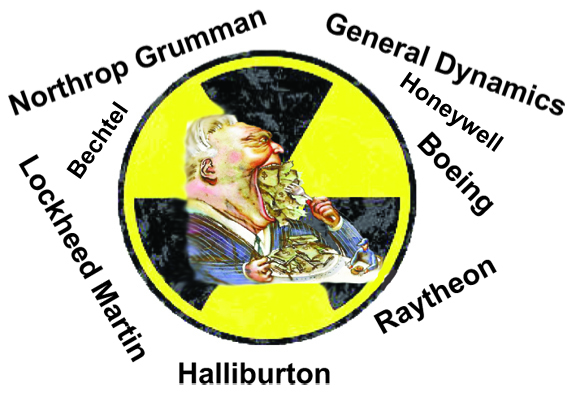
The bulk of our taxpayer dollars are seized by a relatively small group of corporate war profiteers led by the five biggest companies profiting off the war industry: Lockheed Martin, Northrop Grumman, Raytheon (RTX), Boeing, and General Dynamics.
The basic system works like this: First, Congress takes exorbitant sums of money from us taxpayers every year and gives it to the Pentagon. Second, the Pentagon, at Congress’s direction, turns huge chunks of that money over to weapons makers and other corporations via all too lucrative contracts, gifting them tens of billions of dollars in profits. Third, those contractors then use a portion of the profits to lobby Congress for yet more Pentagon contracts, which Congress is generally thrilled to provide, perpetuating a seemingly endless cycle.
Freeing Ourselves from the Monster Destroying Our Planet and Our Futures
TomDispatch, BY DAVID VINE AND THERESA (ISA) ARRIOLA, 2 June 24
We need to talk about what bombs do in war. Bombs shred flesh. Bombs shatter bones. Bombs dismember. Bombs cause brains, lungs, and other organs to shake so violently they bleed, rupture, and cease functioning. Bombs injure. Bombs kill. Bombs destroy.
Bombs also make people rich.
When a bomb explodes, someone profits. And when someone profits, bombs claim more unseen victims. Every dollar spent on a bomb is a dollar not spent saving a life from a preventable death, a dollar not spent curing cancer, a dollar not spent educating children. That’s why, so long ago, retired five-star general and President Dwight D. Eisenhower rightly called spending on bombs and all things military a “theft.”
The perpetrator of that theft is perhaps the world’s most overlooked destructive force. It looms unnoticed behind so many major problems in the United States and the world today. Eisenhower famously warned Americans about it in his 1961 farewell address, calling it for the first time “the military-industrial complex,” or the MIC.
Start with the fact that, thanks to the MIC’s ability to hijack the federal budget, total annual military spending is far larger than most people realize: around $1,500,000,000,000 ($1.5 trillion). Contrary to what the MIC scares us into believing, that incomprehensibly large figure is monstrously out of proportion to the few military threats facing the United States. One-and-a-half trillion dollars is about double what Congress spends annually on all non-military purposes combined.
Calling this massive transfer of wealth a “theft” is no exaggeration, since it’s taken from pressing needs like ending hunger and homelessness, offering free college and pre-K, providing universal health care, and building a green energy infrastructure to save ourselves from climate change. Virtually every major problem touched by federal resources could be ameliorated or solved with fractions of the cash claimed by the MIC. The money is there.
The bulk of our taxpayer dollars are seized by a relatively small group of corporate war profiteers led by the five biggest companies profiting off the war industry: Lockheed Martin, Northrop Grumman, Raytheon (RTX), Boeing, and General Dynamics. As those companies have profited, the MIC has sowed incomprehensible destruction globally, keeping the United States locked in endless wars that, since 2001, have killed an estimated 4.5 million people, injured tens of millions more, and displaced at least 38 million, according to Brown University’s Costs of War Project.
The MIC’s hidden domination of our lives must end, which means we must dismantle it. That may sound totally unrealistic, even fantastical. It is not. And by the way, we’re talking about dismantling the MIC, not the military itself. (Most members of the military are, in fact, among that the MIC’s victims.)
While profit has long been part of war, the MIC is a relatively new, post-World War II phenomenon that formed thanks to a series of choices made over time. Like other processes, like other choices, they can be reversed and the MIC can be dismantled.
The question, of course, is how?
The Emergence of a Monster
To face what it would take to dismantle the MIC, it’s first necessary to understand how it was born and what it looks like today. Given its startling size and intricacy, we and a team of colleagues created a series of graphics to help visualize the MIC and the harm it inflicts, which we’re sharing publicly for the first time.
The MIC was born after World War II from, as Eisenhower explained, the “conjunction of an immense military establishment” — the Pentagon, the armed forces, intelligence agencies, and others — “and a large arms industry.” Those two forces, the military and the industrial, united with Congress to form an unholy “Iron Triangle” or what some scholars believe Eisenhower initially and more accurately called the military-industrial–congressional complex. To this day those three have remained the heart of the MIC, locked in a self-perpetuating cycle of legalized corruption (that also features all too many illegalities).
The basic system works like this: First, Congress takes exorbitant sums of money from us taxpayers every year and gives it to the Pentagon. Second, the Pentagon, at Congress’s direction, turns huge chunks of that money over to weapons makers and other corporations via all too lucrative contracts, gifting them tens of billions of dollars in profits. Third, those contractors then use a portion of the profits to lobby Congress for yet more Pentagon contracts, which Congress is generally thrilled to provide, perpetuating a seemingly endless cycle.
But the MIC is more complicated and insidious than that. In what’s effectively a system of legalized bribery, campaign donations regularly help boost Pentagon budgets and ensure the awarding of yet more lucrative contracts, often benefiting a small number of contractors in a congressional district or state. Such contractors make their case with the help of a virtual army of more than 900 Washington-based lobbyists. Many of them are former Pentagon officials, or former members of Congress or congressional staffers, hired through a “revolving door” that takes advantage of their ability to lobby former colleagues. Such contractors also donate to think tanks and university centers willing to support increased Pentagon spending, weapons programs, and a hyper-militarized foreign policy. Ads are another way to push weapons programs on elected officials.
Such weapons makers also spread their manufacturing among as many Congressional districts as possible, allowing senators and representatives to claim credit for jobs created. MIC jobs, in turn, often create cycles of dependency in low-income communities that have few other economic drivers, effectively buying the support of locals.
For their part, contractors regularly engage in legalized price gouging, overcharging taxpayers for all manner of weapons and equipment. In other cases, contractor fraud literally steals taxpayer money. The Pentagon is the only government agency that has never passed an audit — meaning it literally can’t keep track of its money and assets — yet it still receives more from Congress than every other government agency combined.
As a system, the MIC ensures that Pentagon spending and military policy are driven by contractors’ search for ever-higher profits and the reelection desires of members of Congress, not by any assessment of how to best defend the country. The resulting military is unsurprisingly shoddy, especially given the money spent. Americans should pray it never actually has to defend the United States.
No other industry — not even Big Pharma or Big Oil — can match the power of the MIC in shaping national policy and dominating spending. ……………………………
Endless Wars, Endless Death, Endless Destruction…………………………………………………………………………..
The Environmental Toll…………………………………………..
Endless Wars at Home
As the MIC has fueled wars abroad, so it has fueled militarization domestically. Why, for example, have domestic police forces become so militarized? At least part of the answer: since 1990, Congress has allowed the Pentagon to transfer its “excess” weaponry and equipment (including tanks and drones) to local law enforcement agencies…………………………………..
An Existential Threat…………………………………………………………………….. members of the MIC are increasingly encouraging direct confrontations with Russia and China, aided by Putin’s war and China’s own provocations. In the “Indo-Pacific” (as the military calls it), the MIC is continuing to cash in as the Pentagon builds up bases and forces surrounding China in Australia, Guam, the Federated States of Micronesia, Japan, the Marshall Islands, the Northern Mariana Islands, Palau, Papua New Guinea, and the Philippines……………………………………………
The Urgency of Dismantling
The urgency of dismantling the military-industrial complex should be clear. The future of the species and planet depends on it.
…………………………………………………….In short, we’re working on the answers. With the diverse group of experts who helped produce this article’s graphics, we’re exploring, among other ideas, divestment campaigns and lawsuits; banning war profiteering; regulating or nationalizing weapons manufacturers; and converting parts of the military into an unarmed disaster relief, public health, and infrastructure force……………………………………………………… we must take on the MIC to build a world focused on making human lives rich (in every sense) rather than one focused on bombs and other weaponry that brings wealth to a select few who benefit from death. https://tomdispatch.com/the-military-industrial-complex-is-killing-us-all/—
Energy buffs give small modular reactors a gigantic reality check
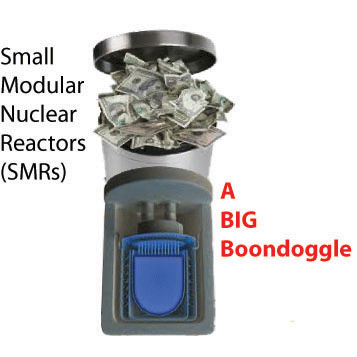
John Ketchum, CEO of nuclear power firm NextEra, has even said SMRs were nothing but “an opportunity to lose money in smaller batches”
Before signing any contract for an SMR, just get a fixed price in writing. If a developer won’t agree to it, they probably don’t have faith in their own estimates.
Too expensive, slow, and risky for investors, and they’re taking focus off renewables, say IEEFA experts
Brandon Vigliarolo, Mon 3 Jun 2024 , https://www.theregister.com/2024/06/03/small_modular_reactor_criticism/
Miniature nuclear reactors promise a future filled with local, clean, safe zero-carbon energy, but those promises quickly melt when confronted with reality, say a pair of researchers.
Known as small modular reactors, or SMRs, miniaturized atomic power plants have been touted as a way to ensure the world meets climate change mitigation goals as fossil fuels are phased out in favor of renewables and nuclear sources.
With a few SMR projects built and operational at this point, and more plants under development, the Institute for Energy Economics and Financial Analysis (IEEFA) concludes in a report that SMRs are “still too expensive, too slow to build, and too risky to play a significant role in transitioning away from fossil fuels.”
IEEFA doesn’t have many data points to pull from, with only three SMRs actually online around the world – one in China and two in Russia. A fourth, in Argentina, is still under construction and perfectly illustrates the point IEEFA researchers try to make: It’s running far over cost and is facing budget constraints that could affect its future.
The other three SMRs have run into similar issues. They’ve all been way more expensive than initially agreed upon, and proposals for SMRs in the US face related issues, the report finds.
Per-kilowatt hour costs for SMRs proposed in the US by NuScale, the first company to receive US regulatory approval for SMRs, have more than doubled since 2015. Costs projected by X-Energy and GE-Hitachi for their SMRs have similarly risen since initial proposals.
In most cases, these costs are rising before the US Nuclear Regulatory Commission has even given its approval, IEEFA notes.
Pick none: Fast, good, low risk
If the cost of an SMR were high but the risk low, or if construction were quick, it might be worth considering further development. The report finds that SMRs are neither cheap, quick, nor reliable.
Along with those costs, IEEFA research points out that none of the SMRs built so far have come anywhere close to meeting proposed construction timelines. The two Russian units were supposed to be built in three years, but both took 13. The Shidao Bay SMR in China was estimated as a four-year project but took 12, while the ongoing CAREM 25 in Argentina was also proposed as a four-year development but has so far taken 13.
Similarly optimistic construction estimates have consistently shown up in US SMR project development presentations,” the report notes. Without speed or value to rely on, one would hope that an SMR project was at least low risk, but that doesn’t appear to be the case either.
Leaders at two nuclear power companies whose quotes are carried in the report “endorsed nuclear power in the abstract” as a way to transition away from fossil fuels, but both expressed concern over the investment risk.
John Ketchum, CEO of nuclear power firm NextEra, has even said SMRs were nothing but “an opportunity to lose money in smaller batches” at this point in time, which was cited in the report. Chris Womack, CEO at Southern Company, which recently finished building the first new US nuclear reactor this century, similarly expressed concerns about expanding his company’s nuclear portfolio.
Quit hogging the energy transition spotlight
The report’s data makes it seem like there’s not a lot going for SMRs, but “loud and persistent” advocates for the technology have managed to capture the spotlight anyway, say report authors David Schlissel, IEEFA director of resource planning analysis, and Dennis Wamsted, IEEFA energy analyst.
“A key argument from SMR proponents is that the new reactors will be economically competitive,” said Schlissel. “But the on-the-ground experience with the initial SMRs that have been built or that are currently under construction shows that this simply is not true.”
Meanwhile, all the time, energy, and money spent constructing SMRs is taking resources away from renewables that work, and would work now, the duo said. It’s also likely that, even though SMR operators intend their reactors to be complementary to other power sources on the grid, they’re far more likely to do the opposite, the report concludes – especially given the rise in construction costs and the need to break even.
“Developers bringing multibillion-dollar SMRs onto the electric grid would have every incentive to run them as much as possible,” the report surmises. “The less they run, the more their per megawatt-hour costs rise and the harder it will be for them to compete in the market.”
“Having invested billions, it is unlikely developers will willingly cycle their plants to accommodate renewables,” the report adds.
While some have predicted it might take a decade to get SMR technology to the point where it’s reliable, Schlissel and Wamsted believe the mini-reactors will continue to be too expensive, slow, and risky to play a reliable role in fossil fuel transition in the next 15 years. That said, developers are still going to push for the projects, so the pair reckon there’s a few things prospective buyers and investors should ensure – like crafting restrictions into contracts that prevent delays and risking costs from being pushed onto ratepayers.
Schlissel and Wamsted make several more recommendations for how to keep SMR projects from becoming too costly or blocking renewables, but the best one is the simplest: Before signing any contract for an SMR, just get a fixed price in writing. If a developer won’t agree to it, they probably don’t have faith in their own estimates.
Wamsted appears to have little faith SMR developers would agree to those terms.
“The comparison between building new SMRs and building renewable energy couldn’t be clearer,” Wamsted said of the pair’s recommendations. “Regulators, utilities, investors, and government officials should acknowledge this and embrace the available reality: Renewables are the near-term solution.”
UK Labour talks up nuclear weapons to banish Corbyn’s shadow

Keir Starmer says he would be prepared to use nuclear weapons, unlike his predecessor.
JUNE 3, 2024 BY ANDREW MCDONALD, https://www.politico.eu/article/uk-labour-talks-nukes-escape-jeremy-corbyn-shadow/—
LONDON — Want to show you’ve moved on from your far-left predecessor? Try a nuclear strike.
Labour leader Keir Starmer on Monday told reporters he would push the button on Britain’s nuclear deterrent if necessary, as the party aims for election victory on July 4 and tries to demonstrate it’s moved on from the tenure of former party chief Jeremy Corbyn.
“On the nuclear deterrent, it is fundamental, it is a vital part of our defense — and of course that means we have to be prepared to use it,” Starmer said.
In keeping with Western nuclear doctrine, Starmer did not set out the circumstances in which he would actually use the U.K.’s nuclear arsenal — at the center of which is the Trident program of nuclear submarines based in Scotland.
But the commitment alone was an eye-opening moment in the campaign — and an important one for Starmer, who has sought to define himself in contrast to Corbyn, the NATO skeptic and lifelong opponent of nuclear weapons who shifted Labour to the left from 2015 to 2019.
Distance from Corbyn
Corbyn was a long-time supporter of the anti-nukes Campaign for Nuclear Disarmament and voted against renewing Trident in 2016, after giving his MPs a free vote on the issue. Despite his own views, however, he did not shift his party’s overall position on the nuclear deterrent, and Labour manifestos under Corbyn did not commit to scrapping Trident.
But Corbyn did come under fire when, in one of his first interviews as Labour leader in 2015, he said he would instruct the U.K.’s defense chiefs never to use nuclear weapons if he became prime minister. “I am opposed to the use of nuclear weapons,” he said at the time. “I am opposed to the holding of nuclear weapons. I want to see a nuclear-free world. I believe it is possible.”
Starmer, who served under Corbyn as a shadow minister, has tried to distance himself from his former boss since becoming leader — despite initially talking up the policies of his “friend” while running for the party leadership in 2020. Corbyn has since been expelled from the party.
Speaking Monday, Starmer sought to hammer home the party’s new direction under his leadership.
With my changed Labour Party, national security will always come first,” Starmer said.
The Labour leader also stressed that his top team is fully behind him in supporting the nuclear deterrent — even though his Shadow Foreign Secretary David Lammy and Deputy Leader Angela Rayner joined Corbyn to vote against the renewal of Trident in 2016.
“I lead this party, I’ve changed this party … and I’ve got my whole shadow cabinet behind me,” Starmer said.
UK Labour leader Starmer says he is prepared to use nuclear weapons

COMMENT. When I contemplate the situation where I am incinerated, along with millions of others, by a nuclear weapon, ….
I get no satisfaction at all, from thinking that in Russia, millions of civilians, just like me, are getting incinerated in return.
No satisfaction at all. What have we become? Labour is useless

BBC News, Sam Francis, Political Reporter, 3 June 24
Sir Keir Starmer has said he would be prepared to use nuclear weapons if needed to defend the UK as he set out Labour’s defence plans.
The Labour leader said “security will always come first” under his leadership and claimed his party has left behind Jeremy Corbyn’s opposition to the Trident nuclear weapons system.
If elected, Sir Keir said he would increase defence spending and update the UK’s nuclear arsenal.
Conservative defence secretary Grant Shapps said Labour represented a “danger to our national security”………………………..
The Labour party was split when the House of Commons last voted to renew the UK’s Trident nuclear weapons system, with 140 of the party’s 230 MPs defying leader Mr Corbyn to back the motion.
But Sir Keir – who did vote to renew Trident – claimed he had his “whole shadow cabinet behind me” on plans to maintain the nuclear deterrent.
“This is a changed Labour party and the most important thing is I voted in favour of a nuclear deterrent,” he said.
“I lead from the front, I’ve always lad from the front.”
Asked by BBC Political Editor Chris Mason, if he would authorise the firing of nuclear weapons if he was prime minister, Sir Keir said: “We have to be prepared to use it…………………..
He committed Labour to a “nuclear triple lock”: continuing to build four new nuclear submarines in Barrow-in-Furness, maintaining Britain’s at-sea deterrent, and delivering all future upgrades for submarine patrols.
The Trident system, based near the Firth of Clyde, includes four nuclear-powered Vanguard-class submarines, missiles and warheads.
Each submarine is designed to carry 16 Trident missiles, capable of delivering multiple warheads – but in recent years, they have carried eight missiles each, with a maximum of 40 warheads per boat.
The UK is already in the process of building four new nuclear submarines in Barrow in-Furness at a cost of £31bn over the lifetime of the programme. The country maintains a continuous at sea nuclear deterrent with its existing fleet.
The Conservatives have also commitment to continue this polices as well as delivering future upgrades.
SNP Spokesman Martin Docherty-Hughes said: “In the middle of a cost-of-living crisis, it is objectively wrong that Keir Starmer would funnel billions of pounds of public money into keeping weapons of mass destruction on our doorstep in Scotland, while families are still living in poverty after 14 years of Tory austerity, and our budget from the UK government keeps getting slashed.
“Nuclear weapons have no place in Scotland, and only a vote for the SNP in July will protect Scotland’s interest against the Labour and Tories – neither of whom will do what the people in Scotland want and scrap Trident nuclear weapons for good.”
In another break from Mr Corbyn’s leadership, Sir Keir used his speech to push for the UK to assume a “leading” role in Nato.
Sir Keir’s predecessor criticised Nato’s role and expansion, particularly in conflicts he found unjust – though did not push for the UK to leave.
These positions led to accusations from its opponents that Labour was weak on national security during Mr Corbyn’s tenure.………………………………………………… more https://www.bbc.com/news/articles/czvvy0ppdxko—
UN offers nuclear inspection deal to Iran’s new leadership
IAEA’s Rafael Grossi wants to resume talks delayed by death of Iran’s president and foreign minister
MENA Tim Stickings, Jun 03, 2024
The UN’s atomic watchdog says it is willing to make a deal on inspections with Iran‘s new leadership that could renew nuclear diplomacy with Tehran.
Rafael Grossi, the head of the International Atomic Energy Agency, has spoken to Iran’s acting chief diplomat since a helicopter crash killed president Ebrahim Raisi and foreign minister Hossein Amirabdollahian on May 19.
Mr Grossi told the IAEA‘s ruling board on Monday that Iran had agreed to resume talks postponed by a mourning period.
Under an agreement, the IAEA could be given wider access to nuclear centres in Iran, which is increasing its stockpile of enriched uranium.
Britain, France and Germany have submitted a wide-ranging draft resolution against Iran to the UN nuclear watchdog’s 35-nation board of governors to be voted on this week, Reuters reported later on Monday.
The European powers are pushing for the resolution despite US concerns that the move could lead Iran to respond by escalating its nuclear activities.
Although Iran denies seeking a nuclear weapon, the IAEA says it cannot confirm its intentions are peaceful while its monitoring is incomplete.
Alarm bells have been rung at the IAEA’s Vienna headquarters by a recent Iranian warning that its nuclear doctrine could change if it is threatened by Israel.
Iran has also indicated that it will respond if the US and European powers push a new resolution through the IAEA’s board condemning Tehran’s activities.
Mr Grossi said that any wider resumption of talks, such as a new version of the 2015 deal that lifted sanctions on Iran, would need the IAEA to have full oversight.
Iran has openly stopped complying with limits on its nuclear activity since the US pulled out of the Joint Comprehensive Plan of Action in 2018……………………………………………. https://www.thenationalnews.com/news/mena/2024/06/03/un-offers-nuclear-inspection-deal-to-irans-new-leadership/
“In Ukraine, a war for memory.”

In defense of what is remembered. At Savur–Mohila hill, Horlivka province. (Guy Mettan.) Report from Donbas, Part 2.
The Floutist, JUN 03, 2024
To destroy the shared past of a people is to go some way toward destroying a people—the coherence and solidity of their identity, their ability to think and act collectively, their collective confidence in themselves, altogether their place in the world.…………………….
Guy Mettan
It is now two years and several months since the Russian military began its intervention in Ukraine. And between Russia and the West, between the Ukrainians in Kiev and the former Ukrainians who have become Russians again, the battle is not just a military struggle. It is also a struggle in defence of memory against those who would obliterate it.
In the West, the 80th anniversary of the D–Day landings on 6 June will be commemorated without the Russians. This is an official if symbolic denial that the victory over Nazi Germany was first and foremost a Soviet victory and that Operation Overlord could not have succeeded without the Red Army’s Operation Bagration in the east, to hold off German tank divisions.
Attempts to erase the past in this manner are not at all new. One finds cases of it throughout history. But in the lands to Europe’s east and the Russian Federation’s west it has greatly intensified since 2014, a decade back, when, some months after the U.S.–cultivated coup in Kiev, the Western powers marked the 70th anniversary of the D–Day landings and refused to invite Russians to the ceremonies held on the Normandy beaches—this while inviting representatives of the former enemy, among them German Chancellor Angela Merkel.
Across Eastern Europe, the Baltic states, and in Ukraine in particular, history is being turned upside down. Historical statues and war memorials honouring those who defeated the Reich in the Second World War are being demolished to erect steles, inscribed stone pillars, that commemorate not the Soviet’s hard-won victory but the victims of the Soviets. These monuments are also intended to mark the glory of the nationalists who fought alongside the Nazis and massacred Jews, such as Stepan Bandera, Yaroslav Stetsko, and Roman Shukhevich.
Every day, monuments are taken down and others erected in their place—on the sly, in the silence of the Western media. We seem to forget, to take but one example of many, that the Treblinka death camp was run by a group of some 20 German SS troops and that the exterminations were carried out by a hundred Ukrainian and Lithuanian guards.
This rewriting of history amounts to a war on the past of a people. And if it is waged not on battlefields but at sites of memory, the outcome of this struggle is comparably important. To destroy the collective memories of a people is to destroy their common identity. In this way it also destroys their understanding of their place in the world and their ability to act effectively—and so their ability to go forward. If you have no past you have no future, it has been said: This is the ultimate objective of those who attack the shared memories of others.
None of this has gone unnoticed by the people of Donbas. And, true to their motto, “Never forget, never forgive,” they are in response redoubling their commemorative faith and monuments to fallen heroes……………………………………………………………………………………………………………………….
It is estimated that 75,000 to 102,000 people were massacred at 4/4–bis from the end of 1941 to September 1943, two or three times as many as at the better documented massacre in 1941 at the ravine in Kiev known as Babi Yar. The entire Jewish community of Donetsk (called Stalino at the time) was thrown into the pit, along with tens of thousands of others. …………………………………………………….
A visit to No. 4/4–bis is all it takes to understand why the people of Donbas rose up against Kiev in April 2014, when the regime that emerged from the U.S.–backed Maidan coup wanted officially to ban their language while sending the heirs of their forebears’ executioners to suppress them. This region has a strong tradition of resistance to any kind of invaders, from German Nazis to west–Ukrainian ultranationalists in Nazi–style uniforms. If No. 4/4–bis is about remembering, it is also about determination.
You can destroy monuments, but not memories.
Seventy kilometres northeast of Donetsk, in the direction of Bakhmut, in the province of Horlivka, the monumental Savur–Mohila cenotaph is another testimony to the battles of the last century. It is erected at the top of the highest hill in the Donbas, on the site of one of the great clashes of the Second World War. That took place in July–August 1943, at the same time as the famous tank battle of Kursk, which was to break the Wehrmacht……………………………………………………………………………….
This battle to preserve memory against its destruction is probably most intense in Lugansk. I’m welcomed there by Anna Soroka, a historian who has been fighting in the republic’s regiments since 2014.
The first monument she shows me commemorates the 67 children killed by Ukrainian militias from the Kraken and Aïdar battalions, both of them neo–Nazi, who tried to take the city in 2014, failed, and then proceeded to shell it until the Russian intervention in 2022. It was built in the middle of a park that serves today as a kindergarten. Several kids were killed there by targeted Ukrainian shelling—targeted, surely, as the surrounding buildings were not hit.
Children are the objects of an unrelenting information war on both sides. The Ukrainians have filed war crimes charges against the Russians, and the International Criminal Court has indicted Vladimir Putin and the head of Russia’s children’s affairs agency, Maria Lvova–Belova, for allegedly kidnapping Ukrainian children. Western propaganda repeats these accusations over and over, in media and in the cinema: A full-length documentary, 20 Days in Mariupol, directed by Mstyslav Chernov, Michelle Mizner, and Raney Aronson–Rath, featured these allegations and has just won this year’s Oscar for best documentary.
Western media reports naturally fail to pass on the point of view of the inhabitants of the Donbas—who say it is the Ukrainians who are taking children hostage. There is, in fact, a volunteer organization in Ukraine called the White Angels, modelled on the infamous Syrian White Helmets, who, as you will recall, were far from the neutral rescue workers they posed as and, in fact, were covertly funded by Western intelligence and acted in behalf of jihadist groups.
These White Angel detachments were formed in February 2022 by a certain Rustam Lukomsky. The Western (or Western-backed) press has mentioned them on several occasions. The Kyiv Independent (24 March 2024), Le Monde (7 February 2023), the BBC (30 January 2024) are among the media that have reported on this group. “Amid the thud of explosions and rattle of gunfire,” a typical report reads, “a special police unit called the White Angels goes door-to-door helping evacuate the town’s remaining civilians.” Lukomsky, whose background remains unclear, is portrayed invariably as a hero of these operations.
For those in Donbas, the White Angels are something very different. The group’s aim, residents here say, is to force parents in front-line areas to separate from their children under the pretext of protecting them. The children are thus isolated and “taken to safety” in the rear, where they are used as a means of blackmail against their families.
These families are in this way torn between two equally unbearable choices: Either they abandon their homes to join their children, or they remain near the front and are forced to collaborate with the Ukrainian army, which invites them to denounce or sabotage the movements of the Russian army………………………………
The second Lugansk monument is located in a wood just outside the city. Like Donetsk’s Mine No. 4/4–bis, it does not appear on our search-engine result pages. And like Donetsk’s Mine No. 4/4–bis, it commemorates the site of the massacre of Lugansk’s Jewish community. About 3,000 mainly Jewish women and children and 8,000 adults of various faiths were executed here by the Nazis during the Wehrmacht’s occupation of the city.
“We can’t understand why, today, Kiev is honouring the descendants of those who killed so many of our people during the Second World War,” Anna Soroka, the historian and soldier, tells me as we tour the site. It has been abandoned to brambles since 1991, when Luhansk Oblast, which was previously part of the USSR, became part of Ukraine following the referendum on independence. The new authorities of the republic decided recently to cut the bushes and to restore it.
A little further along, on the other side of the road, the republic’s authorities have erected a vast memorial honouring the combatants and civilians killed in the 2014–2022 war. Nearly 400 graves are lined up on either side of a walkway that leads from a Rodin-inspired statue near the entrance to a column and a small chapel at the centre of the site.
Anna personally knew most of the people buried here………………………………………………………………..
On our way back into Lugansk we pass a large monument to the Soviet soldiers who liberated the city in 1943. And then, after a few more miles, we come upon a Ukrainian tank decorated with flowers and set on a concrete base beside the freeway: Local inhabitants put it there as a reminder that this tank bombed their homes 10 years ago. Below, there is a field still littered with mines where people are strongly advised against walking.
The last monuments on this mournful tour of the city are perhaps the most emblematic of the tragic fate of Donbas over the last hundred years. These comprise the Hostra Mohyla memorial, which is set on a small hill southeast of the city…………………………………………………………………………….
The largest of these memorials, which crowns the top of the complex, holds the key to the psychology of the region’s inhabitants. I studied it carefully.
It features four giant statues of soldiers, heroes-in-arms of the four wars that mark the collective consciousness of Donbas: There is a bronze fighter from the Civil War of 1917–1921, a Soviet soldier from the Great Patriotic War, a militant from the anti–Kiev resistance of 2014–2018, and, finally, a fighter from the war of liberation of the oblast that began in 2022 and continues to the present day. Again, the past lives on and informs the present.
More erasure: For the Hostra Mohyla site, as for others, there is absolutely no information to be found on Western search engines despite its popularity with the locals. Google and Wikipedia ignore or have banned these sites from their directories. Only the German Stiftung Denkmal für die ermordeten Juden Europas, the Foundation Memorial to the Murdered Jews in Europe, provides any information on the Jewish victims……………………. https://thefloutist.substack.com/p/in-ukraine-a-war-for-memory?utm_source=post-email-title&publication_id=112164&post_id=144941821&utm_campaign=email-post-title&isFreemail=true&r=ln98x&triedRedirect=true&utm_medium=email
Peace talks without Russia ‘laughable’ – John Mearsheimer
https://www.rt.com/russia/598638-mearsheimer-zelensky-peace-talks/ 3 June 24
Vladimir Zelensky’s Swiss ‘peace conference’ will achieve nothing without Moscow’s involvement, the professor argues.
Vladimir Zelensky’s so-called ‘peace conference’ in Switzerland is “not serious” – only face-to-face talks between Moscow and Kiev will settle the Ukraine conflict, American political scientist John Mearsheimer has said.
The Ukrainian leader’s summit is scheduled to take place on June 15-16 at the Burgenstock Resort near Lucerne. Russia has not been invited to the conference, China has declined to attend and US President Joe Biden is reportedly skipping the event to attend a fundraising gala with George Clooney in Hollywood.
“This is not serious,” Mearsheimer told American podcast host Daniel Davis this week. “If you’re going to have a meaningful set of peace negotiations where you’re going to try and settle this war, it’s going to have to involve the Ukrainians directly negotiating with the Russians.”
Since the conflict began in 2022, Mearsheimer noted that only two peace initiatives have made “substantial progress” – Turkish-brokered talks in Istanbul that March, and separate back-channel negotiations mediated by then-Israeli Prime Minister Naftali Bennett.
Under preliminary terms agreed in Istanbul, Ukraine would have become a neutral state with a restricted military in exchange for international security guarantees. However, then-British Prime Minister Boris Johnson convinced Kiev to withdraw from the talks, according to multiple media reports and an admission by David Arakhamia, who headed the Ukrainian delegation.
Bennett has also claimed that any chance at peace in 2022 was torpedoed by the US and its allies, which ordered Ukraine to “keep striking [Russian President Vladimir] Putin” and “blocked” the Istanbul agreement.
Zelensky will likely use this month’s conference to promote his proposed roadmap for ending the conflict with Russia. The ten-point document demands a complete withdrawal of Russian forces from all territories Ukraine considers its own, for Moscow to pay reparations, and for Russian officials to present themselves to war crimes tribunals.
Russia has dismissed the plan as “detached from reality.” Speaking to journalists last month, President Vladimir Putin stated that while Moscow is ready for serious talks, Kiev plans to “gather as many nations as possible, convince everyone that the best proposal is the terms of the Ukrainian side, and then send it to us in the form of an ultimatum.”
“This conference is completely without prospects… because getting together and seriously discussing the Ukraine conflict without [Russia’s] participation is absurd,” Kremlin spokesman Dmitry Peskov told RT on Tuesday.
“The Ukrainians and the Russians have to be face to face talking about what will be an acceptable deal to both sides,” Mearsheimer told Davis. “The idea that you can have peace negotiations in Switzerland without the Russians is laughable.”
A professor of political science at the University of Chicago, Mearsheimer has drawn intense criticism in the West for arguing that NATO’s post-Cold War expansion was the primary cause of the Ukraine conflict. Mearsheimer has argued since 2014 that “encouraging the Ukrainians to play tough with the Russians” would end in their country getting “wrecked.”
Journalist, critic of U.S. Ukraine policy, pulled off plane, U.S. seizes his passport
Judge Napolitano of Judging Freedom was also escorted off the plane according to some reports.
https://www.rt.com/news/598711-us-seizes-scott-ritters-passport/, 3June 24
The RT contributor was stopped from visiting Russia
The US State Department has seized the passport of former Marine and UN weapons inspector Scott Ritter, he told RT on Monday.
Ritter was on his way to Russia for the St. Petersburg International Economic Forum (SPIEF) when he was pulled off the plane and had his documents confiscated.
“I was boarding the flight. Three [police] officers pulled me aside. They took my passport. When asked why, they said ‘orders of the State Department’. They had no further information for me,” Ritter told RT. “They pulled my bags off the plane, then escorted me out of the airport. They kept my passport.”
“Was this done in accordance with the First Amendment, or the Fourth,” Russian Foreign Ministry spokeswoman Maria Zakharova said, commenting on the news. The first amendment to the US constitution protects freedom of speech, press and assembly, while the fourth bars the government from “unreasonable searches and seizures.”
Ritter is a former US Marine Corps intelligence officer, who later served as the US and UN weapons inspector in Iraq. He is also a RT contributor, writing about international security, military affairs, Russia, and the Middle East, as well as arms control and nonproliferation.
He most recently visited Russia in January, spending time in Chechnya, Moscow and St. Petersburg, among other places.
The most recent post on Ritter’s Telegram channel put the Clooney Foundation for Justice on notice for its alleged crusade against “Russian propagandists.”
“Here I am. In your face. If telling the truth about Russia makes me a propagandist in your book, then I accept the title,” he wrote. “Bring it on. I’ll school you on the First Amendment.”
“You have zero concept of what free speech is. Try and arrest me and you’ll find out. In spades. It’s war,” he added.
Restarting Zaporizhzhia nuclear plant ‘difficult to envisage’ during war, says IAEA chief
Kiev Independent, by Chris York, June 3, 2024
The head of the International Atomic Energy Agency (IAEA) said on June 3 “it’s difficult to envisage” restarting the Russian-held Zaporizhzhia Nuclear Power Plant while fighting between Russia and Ukraine continues.
Speaking at a news conference during a meeting of the IAEA’s 35-nation Board of Governors, Rafael Grossi said Moscow is not planning to decommission the facility and “the idea, of course, they have is to restart at some point.”
The Zaporizhzhia nuclear plant, the largest nuclear power station in Europe, has been under Russian occupation since March 2022……………………
Grossi said there was a “need to have a discussion” about restarting the plant, but stressed there were several important steps to take before this would be possible.
“In terms of what needs to happen … there shouldn’t be any bombing or any activity of this type,” he said in comments reported by Reuters.
“Then there should be a more stable assurance of external power supply. This requires repairs, important repairs of existing lines, which at the moment, and because of the military activity, are very difficult to envisage.”…………………………………… https://kyivindependent.com/restarting-zaporizhzhia-nuclear-plant-difficult-to-envisage-during-war-says-iaea-chief/
1 This Month


18 March Webinar @ 1 PM EST: An Assessment of SMR Projects: The Case of Canada
register for the zoom:
https://us02web.zoom.us/webinar/register/WN_o8BIIOUvQ2ONJR1nta65DQ#/registration


of the week – STOP SMALL MODULAR REACTORS IN CANADA
To see nuclear-related stories in greater depth and intensity – go to https://nuclearinformation.wordpress.com
-
Archives
- March 2026 (146)
- February 2026 (268)
- January 2026 (308)
- December 2025 (358)
- November 2025 (359)
- October 2025 (376)
- September 2025 (258)
- August 2025 (319)
- July 2025 (230)
- June 2025 (348)
- May 2025 (261)
- April 2025 (305)
-
Categories
- 1
- 1 NUCLEAR ISSUES
- business and costs
- climate change
- culture and arts
- ENERGY
- environment
- health
- history
- indigenous issues
- Legal
- marketing of nuclear
- media
- opposition to nuclear
- PERSONAL STORIES
- politics
- politics international
- Religion and ethics
- safety
- secrets,lies and civil liberties
- spinbuster
- technology
- Uranium
- wastes
- weapons and war
- Women
- 2 WORLD
- ACTION
- AFRICA
- Atrocities
- AUSTRALIA
- Christina's notes
- Christina's themes
- culture and arts
- Events
- Fuk 2022
- Fuk 2023
- Fukushima 2017
- Fukushima 2018
- fukushima 2019
- Fukushima 2020
- Fukushima 2021
- general
- global warming
- Humour (God we need it)
- Nuclear
- RARE EARTHS
- Reference
- resources – print
- Resources -audiovicual
- Weekly Newsletter
- World
- World Nuclear
- YouTube
-
RSS
Entries RSS
Comments RSS
 nuclear-news