How Nato seduced the European Left. The anti-war movement has fallen for a progressive circus.
UnHerd, Lily Lynch, MAY 16, 2023
In January 2018, Nato secretary-general Jens Stoltenberg held an unprecedented press conference with Angelina Jolie. While InStyle reported that Jolie “was dressed in a black off-the-shoulder sheath dress, a matching capelet and classic pumps (also black)”, there was a deeper purpose to this meeting: sexual violence in war. The pair had just co-authored a piece for the Guardian entitled “Why NATO must defend women’s rights”. The timing was significant. At the height of the #MeToo movement, the most powerful military alliance in the world had become a feminist ally. “Ending gender-based violence is a vital issue of peace and security as well as of social justice,” they wrote. “NATO can be a leader in this effort.”
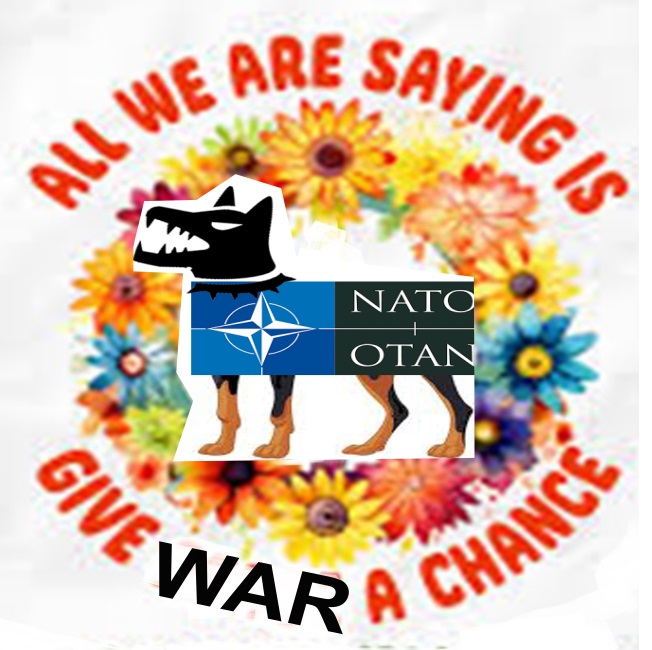
This was a new and progressive face for Nato, the same one it has since used to seduce much of the European Left. Previously, in the Nordic countries, Atlanticists have had to sell war and militarism to largely pacifist publics. This was achieved in part by presenting Nato not as a rapacious, pro-war military alliance, but as an enlightened, “progressive” peace alliance. As Timothy Garton Ash effused in the Guardian in 2002, “NATO has become a European peace movement” where one could watch “John Lennon meet George Bush”. Today, by contrast, following Russia’s full-scale invasion of Ukraine, Sweden and Finland abandoned their long-standing traditions of neutrality and opted for membership. Nato is portrayed as a military alliance — and Ukraine a war — that even former pacifists can get behind. All its proponents seem to be singing is “Give War a Chance”.
The Jolie campaign marked a dramatic turn in what Katharine A.M. Wright and Annika Bergman Rosamond call “Nato’s strategic narrative” in several ways. First, the alliance embraced celebrity star power for the first time, imbuing its unremarkable brand with elite glamour and beauty. Jolie’s star power meant that the alluring images of the event reached apolitical audiences with little knowledge of Nato. Second, the partnership seemed to usher in an era in which women’s rights, gendered violence and feminism would assume a more prominent role in Nato rhetoric. Since then, and especially in the past 12 months, telegenic female leaders such as the Finnish Prime Minister, Sanna Marin, German Foreign Minister, Annalena Baerbock, and Estonian Prime Minister, Kaja Kallas, have increasingly served as the spokespersons of enlightened militarism in Europe. The alliance has also intensified its engagement with popular culture, new technologies, and youth influencers.
Of course, Nato has always been PR-conscious, and has long engaged culture, entertainment, and the arts. Who could forget the 1999 album Distant Early Warning from electronic duo Icebreaker International, recorded with funding from the defunct “NATOarts” and inspired by the radar stations along Alaska and Canada’s northern periphery built to alert Nato of an incoming Soviet nuclear strike? Or the 2007 feature film HQ, produced by Nato’s public diplomacy division, which depicts life inside the alliance and a mock diplomatic response to a crisis in the fictional state of Seismania? Just about everyone it turns out. But what makes Nato’s more recent strategic turn so effective is that it has successfully echoed candidate countries’ progressive local traditions and identities.
No political party in Europe better exemplifies the shift from militant pacifism to ardent pro-war Atlanticism than the German Greens. Most of the original Greens had been radicals during the student protests of 1968; many had demonstrated against American wars. The early Greens advocated for West Germany’s withdrawal from Nato. But as the founding members entered middle age, fissures began to appear in the party that would one day tear it apart. Two camps began to coalesce: the “Realos” were the moderate Greens, politically pragmatists. The “Fundis” were the radical, uncompromising camp; they wanted the party to remain faithful to its fundamental values no matter what.
…………………………………………………………………………………. Earlier this year, Germany’s Federal Foreign Office also rolled out a new “Feminist Foreign Policy”, the latest of several European foreign ministries to have done so. This new orientation, also adopted by France, the Netherlands, Luxembourg and Spain, paints cosmopolitan militarism with a faux-radical feminist gloss, opening the domain of war and security to women’s rights activists. No-nonsense feminist leaders are depicted as the ideal foil to authoritarian “strongmen”.
Sweden was the first country to adopt such a policy in 2014, permitting it to project its longstanding state feminism abroad, and to assume a new moral posture in the international arena. Domestically, there were positive Atlanticist stories in women’s magazines. In the “Mama” section of the Swedish newspaper Expressen, targeted at female readers, one interview with Angelina Jolie emphasised that Nato can protect women from sexual violence in war. Jolie also stressed that there is little difference between humanitarian aid workers and Nato soldiers, as they “are striving towards the same goal: peace”.
…………………….. Nato’s “Protect the Future” campaign. This year it included a graphic novel competition for young artists. The alliance also courted dozens of influencers with large followings on TikTok, YouTube, and Instagram, and brought them out to the headquarters in Brussels. Other influencers were dispatched to last year’s Nato Summit in Madrid, where they were asked to create content for their audiences.
The European Left has been utterly captivated by this show. Following the path taken by the German Greens, major Left-wing parties have abandoned military neutrality and opposition to war and now champion Nato. It is a stunning reversal. During the Cold War, the European Left organised mass protests attended by millions against US-led militarism and Nato’s deployment of Pershing-II and cruise missiles in Europe. Today, little more than the hollowed-out radical rhetoric remains. With hardly any remaining opposition to Nato left in Europe, and the alliance’s creeping expansion beyond the Euro-Atlantic area, its hegemony is now nearly absolute. https://unherd.com/2023/05/how-nato-seduced-the-european-left/
No comments yet.
1 This Month


18 March Webinar @ 1 PM EST: An Assessment of SMR Projects: The Case of Canada
register for the zoom:
https://us02web.zoom.us/webinar/register/WN_o8BIIOUvQ2ONJR1nta65DQ#/registration


of the week – STOP SMALL MODULAR REACTORS IN CANADA
To see nuclear-related stories in greater depth and intensity – go to https://nuclearinformation.wordpress.com
-
Archives
- March 2026 (138)
- February 2026 (268)
- January 2026 (308)
- December 2025 (358)
- November 2025 (359)
- October 2025 (376)
- September 2025 (258)
- August 2025 (319)
- July 2025 (230)
- June 2025 (348)
- May 2025 (261)
- April 2025 (305)
-
Categories
- 1
- 1 NUCLEAR ISSUES
- business and costs
- climate change
- culture and arts
- ENERGY
- environment
- health
- history
- indigenous issues
- Legal
- marketing of nuclear
- media
- opposition to nuclear
- PERSONAL STORIES
- politics
- politics international
- Religion and ethics
- safety
- secrets,lies and civil liberties
- spinbuster
- technology
- Uranium
- wastes
- weapons and war
- Women
- 2 WORLD
- ACTION
- AFRICA
- Atrocities
- AUSTRALIA
- Christina's notes
- Christina's themes
- culture and arts
- Events
- Fuk 2022
- Fuk 2023
- Fukushima 2017
- Fukushima 2018
- fukushima 2019
- Fukushima 2020
- Fukushima 2021
- general
- global warming
- Humour (God we need it)
- Nuclear
- RARE EARTHS
- Reference
- resources – print
- Resources -audiovicual
- Weekly Newsletter
- World
- World Nuclear
- YouTube
-
RSS
Entries RSS
Comments RSS
 nuclear-news
Leave a comment