This week’s counteracting the nuclear spin

Some bits of good news: European cities embrace nature-based solutions, What went right this week: in the UK green energy records hit . China’s Falling Emissions Signal Peak Carbon May Already Be Here – Carbon Brief notes first decline since the end of the pandemic.- Renewables meet nearly all of nation’s additional power needs
TOP STORIES. Small Modular Reactors: Still too expensive, too slow and too risky. US Endgame in Ukraine — War Without End, Amen.Biden Lets Ukraine Strike Russia With US Weapons While Ukraine Attacks Russian Nuclear Defenses.Presidents Who Gamble With Nuclear Armageddon.
Climate. Humanity’s survival is still within our grasp – just. But only if we take these radical steps. ‘Unliveable’: Delhi’s residents struggle to cope in record-breaking heat. Heatwaves increase risk of early births and poorer health in babies, study finds. “Truly the stuff of nightmares”: unprecedented low in Antarctic sea ice recorded.
Noel’s notes. “Don’t let the people see what is happening” – the forgotten lesson from the Vietnam war. Turning Point .The bomb and the cold war. Episode 4: The Wall – outlines the nuclear weapons race. Jobs jobs jobs in the nuclear industry – but is it true? What is criminal in Ukraine, is God’s righteousness in Gaza
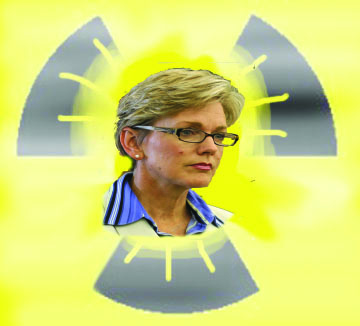
Nuclear. The USA’s intrepid nuclear saleswoman, Jennifer Graholm, touts big nuclear reactors as a great success, speaking of the greatest U.S. financial nuclear boondoggle – the Vogtle nuclear reactors. Does anybody believe this?
*************************************************
NUCLEAR ISSUES.
| ATROCITIES. Gaza: After ICJ order to halt attacks on Rafah, Israel launches over 60 air raids on the city in 48 hours., | CULTURE. The US Empire Isn’t A Government That Runs Nonstop Wars, It’s A Nonstop War That Runs A Government. | EDUCATION. Ukrainian Grad Students Complete Nuclear Internship Program in the United States. | EMPLOYMENT. Dounreay nuclear site workers strike in pay dispute. |
| ENERGY. The (currently terrible) mood in renewables… is largely irrelevant. ‘Offshore wind farms could have averted Fukushima disaster’. A global review of Battery Storage: the fastest growing clean energy technology today. | EVENTS.10 June WEBINAR: Using JFK’s wisdom to make peace today – with Jeffrey Sachs16 June .WEBINAR. Gaza and Ukraine to WWIII: The NATO Problem. 16 June – WEBINAR -“NATO IN THE ARCTIC” |
| LEGAL. To continue the Gaza genocide, Israel and the US must destroy the laws of war. Tribunal judge accused of covering up complaints – about bullying at Sellafield nuclear plant and other sites. | MEDIA. SOS – An Antidote to Crackpot Neo-Nuclearism. https://www.youtube.com/watch?v=FDF1bLN9K8c Searchlight Journalist Receives 2024 MOLLY Award for Story on Trucheña Whose Plutonium Count Was New Mexico’s Highest. | PLUTONIUM. Plutonium found in Indiana Street air filters near Rocky Flats; Boulder Commissioners reconsider trail project. |
| POLITICS. White House to support new nuclear power plants in the U.S. US Energy Secretary calls for more nuclear power while celebrating $35 billion Georgia reactors. Trump and Elon Musk discussing advisory role in next administration. The UK Is Ramping Up Its Nuclear Energy Ambitions. Call for next UK government to make ‘big decisions’ on nuclear power projects Summary of Australian federal and state/territory nuclear/uranium laws and prohibitions. | POLITICS INTERNATIONAL and DIPLOMACY. Rare spat shows China and North Korea still at odds on nuclear weapons. China and Russia Issue Nuclear Warnings. Russian think tank proposes ‘demonstrative’ nuclear blast to deter Western support for Ukraine.The ghost of Concorde stalks the Franco-British nuclear renaissance. |
| SAFETY. 2 aging central Japan nuclear reactors get 20-yr service extensions. Drone sightings reported over British nuclear facilities. | SPACE. EXPLORATION, WEAPONS.US-NATO attack 3 Russian space early warning facilities. Space junk is raining from the sky. Who’s responsible when it hits the Earth?. Elon’s Gone to Mars-https://www.youtube.com/watch?v=xi0mVvE9nYQ |
| TECHNOLOGY. Small modular nuclear reactors get a reality check in new report. | URANIUM. Iran’s Near Bomb-Grade Uranium Stock Grows Ahead of Election | WASTES. Pledge sought that laid-up Rosyth subs won’t go to Australia. A robot will soon try to remove melted nuclear fuel from destroyed Fukushima reactor. Fukushima nuclear debris removal to begin as early as August. |
| WAR and CONFLICT. US strike on Russian targets would be ‘start of world war’ – Medvedev. Putin warns West about consequences of long-range strikes on Russia. U.S. concerned about Ukraine strikes on Russian nuclear radar stations. Italy opposes Ukraine using long-range weapons to strike Russia. Israel Continues Gaza Attacks Despite UN Court Order To ‘Immediately Halt’ Rafah Offensive. Operation al-Aqsa Flood’ Day 237: As Israel’s invasion of Rafah and northern Gaza continues, Smotrich calls for ‘war’ on West Bank | WEAPONS and WEAPONS SALES. CNN Analysis Reveals US-Made Munitions Used in Rafah Massacre. Top Biden aides signal openness to letting Ukraine strike Russia with US weapons. US doubtful it could help Korea on nuclear-powered subs. |
Senior U.S. Diplomats, Journalists, Academics and Secretaries of Defense Say: the U.S. Provoked Russia in Ukraine
Progressive Memes, by Donald A. Smith, PhD 3 June 24
It took some years for Americans to realize they’d been lied to about the war in Vietnam. Thanks to the publication of the Pentagon Papers, and thanks to the antiwar movement, Americans eventually learned about the injustices and failures of that war.
Likewise, it took several years after the starts of the wars in Iraq and Afghanistan for Americans to realize they’d been lied to about those wars as well.
Americans are just now starting to realize that they’ve been lied to about the war in Ukraine. (The propaganda effort has been quite effective, with the New York Times, in particular, acting as a mouthpiece for the government’s position.) More and more mainstream publications are exposing the lies, and a majority of Americans now oppose further arming of Ukraine.
This essay is a summary of what the U.S. government has been hiding about the war in Ukraine, with links to sources for further information.
According to Brown University’s Costs of War project, U.S. military actions since 9/11 directly killed over 900,000 people, with an additional 3.5 million people dying from indirect effects. The wars cost Americans at least $8 trillion and displaced over 38 million people from their homes. The U.S. spends over a trillion dollars a year on its military, if you count all expenditures.
If we go back to the 1960s, the number killed by U.S. wars includes the several million killed in the Vietnam war, the approximately 1 million killed by U.S. support for Indonesian military’s attacks on left wing groups, and the hundreds of thousands, at least, killed in proxy wars and government overthrows in Latin America.
The wars, overthrows, and associated sanctions caused mass migrations worldwide — particularly in Europe and at the southern U.S. border — and destabilized politics. Yet almost nobody (except for whistleblowers) was held accountable for these disasters; indeed, many of the same people are in Congress or work for the government or the weapons industry.
Moreover, the U.S. government lied about almost all the wars — in particular, about the wars in Vietnam, Iraq, and Afghanistan, but also about the war in Yugoslovia, as documented in Harper’s Magazine and here. (In short, the Kosovo Liberation Army that the U.S. supported was, basically, a terrorist organization funded by the CIA, and U.S. propaganda greatly overstated the nobility of the U.S. intervention.)
So, it should come as no surprise that our government is lying now about the war in Ukraine. Specifically, claims by President Biden and others that the Russian invasion was “unprovoked” are greatly exaggerated.
Read what these diplomats, secretaries of Defense, journalists, academics, and politicians have to say:
Former U.S. Ambassador to the USSR Jack Matlock says in Ukraine: Tragedy of a Nation Divided:
“Interference by the United States and its NATO allies in Ukraine’s civil struggle has exacerbated the crisis within Ukraine, undermined the possibility of bringing the two easternmost provinces back under Kyiv’s control, and raised the specter of possible conflict between nuclear-armed powers. Furthermore, in denying that Russia has a ‘right’ to oppose extension of a hostile military alliance to its national borders, the United States ignores its own history of declaring and enforcing for two centuries a sphere of influence in the Western hemisphere.”
Diplomat and historian George Kennan, quoted in Thomas Friedman’s This Is Putin’s War. But America and NATO Aren’t Innocent Bystanders, discussing NATO expansion:
“I think it is the beginning of a new cold war. I think the Russians will gradually react quite adversely and it will affect their policies. I think it is a tragic mistake. There was no reason for this whatsoever. No one was threatening anybody else. This expansion would make the founding fathers of this country turn over in their graves.”
William J. Perry, Secretary of Defense under President Bill Clinton, wrote How the US Lost Russia – and How We Can Restore Relations in Sept. of 2022:
“Many have pointed to the expansion of NATO in the mid-1990s as a critical provocation. At the time, I opposed that expansion, in part for fear of the effect on Russian-U.S. relations….Still, the first step in finding a solution [to the war in Ukraine] is acknowledging the problem and recognizing that our actions have contributed to that hostility.”
Robert Gates, Secretary of Defense under George W. Bush, in We Always Knew the Dangers of NATO Expansion:
“[T]rying to bring Georgia and Ukraine into NATO was truly overreaching, … recklessly ignoring what the Russians considered their own vital national interests.”
Ambassador Michael Gfoeller and David H. Rundell: in Newsweek‘s Lessons From the US Civil War Show Why Ukraine Can’t Win:
“Before the war, far right Ukrainian nationalist groups like the Azov Brigade were soundly condemned by the US Congress. Kiev’s determined campaign against the Russian language is analogous to the Canadian government trying to ban French in Quebec. Ukrainian shells have killed hundreds of civilians in the Donbas and there are emerging reports of Ukrainian war crimes. The truly moral course of action would be to end this war with negotiations rather than prolong the suffering of the Ukrainian people in a conflict they are unlikely to win without risking American lives.”
Christopher Caldwell: in the New York Times‘ The War in Ukraine May Be Impossible to Stop. And the US Deserves Much of the Blame:
“In 2014 the United States backed an uprising – in its final stages a violent uprising – against the legitimately elected Ukrainian government of Viktor Yanukovych, which was pro-Russian.”
Chas W. Freeman, former U.S. Ambassador to Saudi Arabia and a Lifetime Director of the Atlantic Council, says in The Many Lessons of the War in Ukraine: “Less than a day after the US-engineered coup that installed an anti-Russian regime in Kyiv in 2014, Washington formally recognized the new regime… The United States and NATO began a multi-billion-dollar effort to reorganize, retrain, and re-equip Kyiv’s armed forces. The avowed purpose was to enable Kyiv to reconquer the Donbas and eventually Crimea…. Crimea was Russian-speaking and had several times voted not to be part of Ukraine.” And: “From 2014 to 2022, the civil war in Donbas took nearly 15,000 lives.” Freeman says that the U.S. undermined several possible peace deals. “Ukraine is being eviscerated on the altar of Russophobia” but Russia has not, after all, been weakened. See this.
William J. Burns, then Ambassador to Russia, current director of the CIA, wrote in a 2008 cable, as revealed by Wikileaks:
Foreign Minister Lavrov and other senior officials have reiterated strong opposition, stressing that Russia would view further eastward expansion as a potential military threat. NATO enlargement, particularly to Ukraine, remains “an emotional and neuralgic” issue for Russia, but strategic policy considerations also underlie strong opposition to NATO membership for Ukraine and Georgia. In Ukraine, these include fears that the issue could potentially split the country in two, leading to violence or even, some claim, civil war, which would force Russia to decide whether to intervene.
MFA: NATO Enlargement “Potential Military Threat to Russia”
Thomas Friedman: in the New York Times‘ This Is Putin’s War. But America and NATO Aren’t Innocent Bystanders:
“The mystery was why the US – which throughout the Cold War dreamed that Russia might one day have a democratic revolution and a leader who, however haltingly, would try to make Russia into a democracy and join the West – would choose to quickly push NATO into Russia’s face when it was weak. A very small group of officials and policy wonks at that time, myself included, asked that same question, but we were drowned out.”America and NATO Aren’t Innocent Bystanders [from the title]
U.S. Senator Chris Murphy said in an interview in 2014:
“With respect to Ukraine, we have not sat on the sidelines. We have been very much involved. Members of the Senate have been there, members of the State Department who have been on the square …. I really think that the clear position of the United States has been in part what has helped lead to this change in regime…. I think it was our role, including sanctions and threats of sanctions, that forced, in part, Yanukovich from office.”
Henry Kissinger in an interview with The Wall Street Journal:
“We are at the edge of war with Russia and China on issues which we partly created, without any concept of how this is going to end or what it’s supposed to lead to.”
Neoconservative Robert Kagan writes in an otherwise hawkish Foreign Affairs essay from May, 2022, The Price of Hegemony: Can America Learn to Use its Power?:
“Although it is obscene to blame the United States for Putin’ inhumane attack on Ukraine, to insist that the invasion was entirely unprovoked is misleading. …. the invasion of Ukraine is taking place in a historical and geopolitical context in which the United States has played and still plays the principal role, and Americans must grapple with this fact.”
Fiona Hill, former official at the U.S. National Security Council during the administration of George W. Bush, in the New York Times’ Putin has the U.S. right where he wants it:
“At the time, I was the national intelligence officer for Russia and Eurasia, part of a team briefing Mr. Bush. We warned him that Mr. Putin would view steps to bring Ukraine and Georgia closer to NATO as a provocative move that would likely provoke pre-emptive Russian military action. But ultimately, our warnings weren’t heeded.”
Pope Francis in Yahoo News’ Pope Francis Says NATO Started War in Ukraine by “Barking at Putin’s Door”:
The real “scandal” of Putin’s war is NATO “barking at Putin’s door.”
James W. Carden, journalist and former adviser to the US-Russia Bilateral Presidential Commission at the U.S. Department of State, in Simone Weil Center’s America’ Crisis of Reality and Realism: A Symposium (Part I):
“The de facto alliance of Ukrainian westernizing liberals and the fascist Ukrainian far-Right which together drove the so-called Revolution of Dignity in 2013-14 ignored their obligation to respect the democratic process.”
John J. Mearsheimer, University of Chicago
“The West is leading Ukraine down the primrose path, and the end result is that Ukraine is going to be wrecked.” (2015)
Former Ambassador Thomas Graham, who served under six U.S. presidents and is a member of the Council on Foreign Relations, wrote in Was the Collapse of US-Russia Relations Inevitable?: “US hubris and Russian paranoia undermined partnership.” After the collapse of the Soviet Union, a weakened Russia sought closer ties to the West and even helped George W. Bush fight the war on terror. But instead of helping Russia fight Chechen rebels, which Russia considered to be terrorists, the U.S. lent support to those rebels. The U.S. pressed its advantage, aggressively expanding NATO, instigating regime change operations in countries friendly to Russia, and undermining Russian energy exports.
Finally, in light of the growing problems with Russia in the former Soviet bloc, the US push in 2008 to bring Georgia and Ukraine into NATO was ill-advised at best. It tied together the two strands of the Bush administration’s hedging policy—NATO expansion and Eurasian geopolitical pluralism—in a way guaranteed to provoke a powerful Russian backlash. Key allies, notably France and Germany, were adamantly opposed. Bush’s own ambassador in Moscow warned that extending an invitation to Ukraine would cross the “brightest of red lines” and elicit sharp condemnation across the political spectrum.
NATO Secretary Jens Stoltenberg, in Opening remarks at the joint meeting of the European Parliament’s Committee on Foreign Affairs (AFET) and the Subcommittee on Security and Defence (SEDE):
Putin “went to war to prevent NATO, more NATO, close to his borders.”
Stephen M. Walt, professor at Harvard University’s Kennedy School, in an essay in Foreign Policy:
“This war would have been far less likely if the United States had adopted a strategy of foreign-policy restraint…. The Biden Administration and its predecessors are far from blameless.”
Michael Brenner, professor at University of Pittsburgh, in How to Think about the Ukraine War after 18 Months:
“[T]he provocations as you enumerated them were very great. And whether there was any alternative for Russia other than this recourse to a military solution, is a difficult question.”
Richard Sakwa, Professor at Univ. of Kent and author of multiple books on Russia and Ukraine in Book Talk: The Lost Peace:
“The argument that the invasion was unprovoked is completely false.”
“The global north, once again, it’s got this obsession, obsessive tendency to fall into war, endlessly. So the global north clearly is shooting itself in the foot. Blowback is going to be massive.”
Ted Galen Carpenter of the Cato Institute in The US and NATO Helped Trigger the Ukraine War. It’s Not ‘Siding With Putin’ to Admit It:
“One can readily imagine how Americans would react if Russia, China, India, or another peer competitor admitted countries from Central America and the Caribbean to a security alliance that it led – and then sought to add Canada as an official or de facto military ally. It is highly probable that the United States would have responded by going to war years ago. Yet even though Ukraine has an importance to Russia comparable to Canada’s importance to the United States, our leaders expected Moscow to respond passively to the growing encroachment.They have been proven disastrously wrong, and thanks to their ineptitude, the world is now a far more dangerous place.”
Alfred de Zayas, a former senior lawyer with the Office of the UN High Commissioner for Human Rights, says in The Ukraine War in the Light of the UN Charter:
“The war in Ukraine did not start on 24 February 2022, but already in February 2014. The civilian population of the Donbas has endured continued shelling from Ukrainian forces since 2014, notwithstanding the Minsk Agreements. These attacks on Lugansk and Donetsk significantly increased in January-February 2022, as reported by the OSCE Special Monitoring Mission to Ukraine.”
George Beebe, former director of the CIA’s Russia analysis group and former advisor to Dick Cheney, writes in When does NATO actually promote US interests?:
“NATO’s eastward expansion exacerbated the threat of Russian aggression that the alliance was originally intended to prevent. …. While not the sole cause of Medvedev’s invasion of Georgia in 2008 and Putin’s invasion of Ukraine in 2022, the desire to block a Western military presence in these key states was a fundamental Kremlin motivation.”
Beebe said that NATO was unwilling to “respect Russia’s concerns.”……………………………………………………………………………………………………………………………………………..
………………………………………………………….For copious detail about U.S. provocations see How the U.S. provoked Russia in Ukraine: A Compendium.
The propagandists who continue to push for arming Ukraine say that the people of Ukraine were eager to join the West and that the Maidan Revolution was a grassroots expression of pro-Western sentiment. Instead, there is evidence that the revolution was largely the creation of U.S. regime change meddling, aided by the so-called National Endowment for Democracy (a CIA offshoot); see the Compendium above for documentation. Certainly, most of the people in Eastern Ukraine and Crimea did not want closer ties with the West. (Carnegie Endowment for Peace and Foreign Affairs documented that a majority of the people of Crimea welcomed Russia’s annexation of their territory in 2014: Denis Volkov and Andrei Kolesnikov’s My Country, Right or Wrong: Russian Public Opinion on Ukraine (Carnegie Endowment for International Peace, September 7, 2022); John O’Loughlin, Gerad Toal and Kristin M. Bakke’s To Russia With Love: A Majority of Crimeans are Still Glad for Their Annexation (Foreign Affairs, April 3, 2020).) Likewise, in Afghanistan, Yugoslavia, Syria, Libya, Chechnya and elsewhere, the U.S. instigated military and interference operations to bring down pro-Russian governments.
So, the U.S. intervened to aid “liberation” movements against Russian allies in Afghanistan, Yugoslavia, Libya, and Syria — allying with Muslim extremists to do so — but the U.S. condemns Russia for intervening to aid Russian-speaking people along Russia’s own borders, in a conflict against Nazi militias supported by the U.S. and driven by aggressive NATO expansion.
Moreover, the U.S. occupies one third of the sovereign nation of Syria, with help from its proxy army, the Syrian Defense Forces. In fact, the U.S. allied with al Qaeda and other extremist groups in Syria, as reported here, here and here.
Likewise, U.S. troops remain in Iraq, despite the opposition of the Iraqi government. So, it’s quite hypocritical for the U.S. to reject a ceasefire which allows Russia to occupy Russian-speaking areas of Ukraine which voted overwhelmingly for closer ties with Russia.
These facts and opinions do not justify Russia’s brutal invasion, but they certainly give the lie to statements by President Biden and others that the invasion was “unprovoked.” Even the Russian occupation of Crimea in 2014 was provoked: it occurred after, and partially in response to, the U.S.-backed overthrow of the pro-Russian government of Ukraine.
And the facts expose amazing hyprocrisy. The U.S. launched numerous unjustified wars and proxy wars; surrounded Russia and China with pro-US allies and military bases (about 800 worldwide); exited multiple arms treaties; and increased military spending to about $1 trillion a year despite $34 trillion in debt and dire domestic needs. Yet we accuse Russia and China of being the aggressors.
Both sides can be at fault in a conflict. The U.S. too has blood on its hands.
Finally, the facts are strong reasons why the U.S. should not be arming Ukraine to the teeth, pushing it to fight to the last Ukrainian and risking a nuclear war. Instead, it should push for a negotiated end to the war.
https://progressivememes.org/senior-US-diplomats-academics-journalists-and-secretaries-of-defense-say-the-US-provoked-Russia-in-Ukraine.html
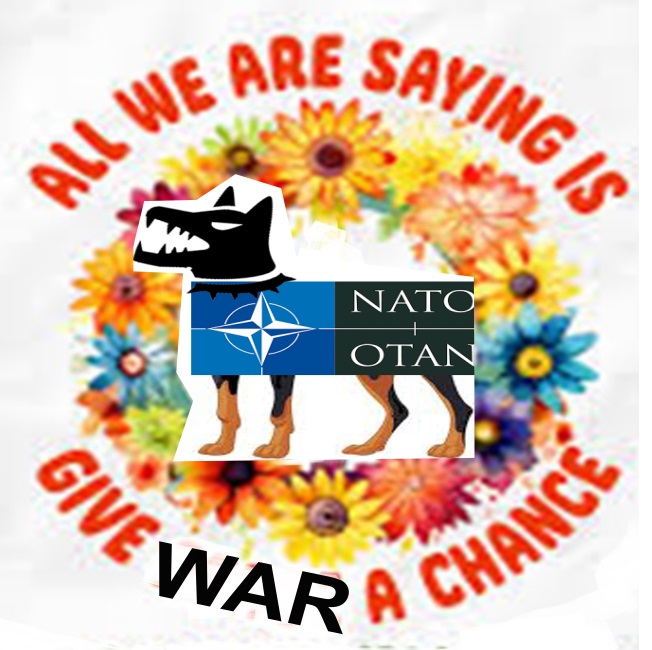
How Nato seduced the European Left. The anti-war movement has fallen for a progressive circus.
UnHerd, Lily Lynch, MAY 16, 2023
In January 2018, Nato secretary-general Jens Stoltenberg held an unprecedented press conference with Angelina Jolie. While InStyle reported that Jolie “was dressed in a black off-the-shoulder sheath dress, a matching capelet and classic pumps (also black)”, there was a deeper purpose to this meeting: sexual violence in war. The pair had just co-authored a piece for the Guardian entitled “Why NATO must defend women’s rights”. The timing was significant. At the height of the #MeToo movement, the most powerful military alliance in the world had become a feminist ally. “Ending gender-based violence is a vital issue of peace and security as well as of social justice,” they wrote. “NATO can be a leader in this effort.”
This was a new and progressive face for Nato, the same one it has since used to seduce much of the European Left. Previously, in the Nordic countries, Atlanticists have had to sell war and militarism to largely pacifist publics. This was achieved in part by presenting Nato not as a rapacious, pro-war military alliance, but as an enlightened, “progressive” peace alliance. As Timothy Garton Ash effused in the Guardian in 2002, “NATO has become a European peace movement” where one could watch “John Lennon meet George Bush”. Today, by contrast, following Russia’s full-scale invasion of Ukraine, Sweden and Finland abandoned their long-standing traditions of neutrality and opted for membership. Nato is portrayed as a military alliance — and Ukraine a war — that even former pacifists can get behind. All its proponents seem to be singing is “Give War a Chance”.
The Jolie campaign marked a dramatic turn in what Katharine A.M. Wright and Annika Bergman Rosamond call “Nato’s strategic narrative” in several ways. First, the alliance embraced celebrity star power for the first time, imbuing its unremarkable brand with elite glamour and beauty. Jolie’s star power meant that the alluring images of the event reached apolitical audiences with little knowledge of Nato. Second, the partnership seemed to usher in an era in which women’s rights, gendered violence and feminism would assume a more prominent role in Nato rhetoric. Since then, and especially in the past 12 months, telegenic female leaders such as the Finnish Prime Minister, Sanna Marin, German Foreign Minister, Annalena Baerbock, and Estonian Prime Minister, Kaja Kallas, have increasingly served as the spokespersons of enlightened militarism in Europe. The alliance has also intensified its engagement with popular culture, new technologies, and youth influencers.
Of course, Nato has always been PR-conscious, and has long engaged culture, entertainment, and the arts. Who could forget the 1999 album Distant Early Warning from electronic duo Icebreaker International, recorded with funding from the defunct “NATOarts” and inspired by the radar stations along Alaska and Canada’s northern periphery built to alert Nato of an incoming Soviet nuclear strike? Or the 2007 feature film HQ, produced by Nato’s public diplomacy division, which depicts life inside the alliance and a mock diplomatic response to a crisis in the fictional state of Seismania? Just about everyone it turns out. But what makes Nato’s more recent strategic turn so effective is that it has successfully echoed candidate countries’ progressive local traditions and identities.
No political party in Europe better exemplifies the shift from militant pacifism to ardent pro-war Atlanticism than the German Greens. Most of the original Greens had been radicals during the student protests of 1968; many had demonstrated against American wars. The early Greens advocated for West Germany’s withdrawal from Nato. But as the founding members entered middle age, fissures began to appear in the party that would one day tear it apart. Two camps began to coalesce: the “Realos” were the moderate Greens, politically pragmatists. The “Fundis” were the radical, uncompromising camp; they wanted the party to remain faithful to its fundamental values no matter what.
…………………………………………………………………………………. Earlier this year, Germany’s Federal Foreign Office also rolled out a new “Feminist Foreign Policy”, the latest of several European foreign ministries to have done so. This new orientation, also adopted by France, the Netherlands, Luxembourg and Spain, paints cosmopolitan militarism with a faux-radical feminist gloss, opening the domain of war and security to women’s rights activists. No-nonsense feminist leaders are depicted as the ideal foil to authoritarian “strongmen”.
Sweden was the first country to adopt such a policy in 2014, permitting it to project its longstanding state feminism abroad, and to assume a new moral posture in the international arena. Domestically, there were positive Atlanticist stories in women’s magazines. In the “Mama” section of the Swedish newspaper Expressen, targeted at female readers, one interview with Angelina Jolie emphasised that Nato can protect women from sexual violence in war. Jolie also stressed that there is little difference between humanitarian aid workers and Nato soldiers, as they “are striving towards the same goal: peace”.
…………………….. Nato’s “Protect the Future” campaign. This year it included a graphic novel competition for young artists. The alliance also courted dozens of influencers with large followings on TikTok, YouTube, and Instagram, and brought them out to the headquarters in Brussels. Other influencers were dispatched to last year’s Nato Summit in Madrid, where they were asked to create content for their audiences.
The European Left has been utterly captivated by this show. Following the path taken by the German Greens, major Left-wing parties have abandoned military neutrality and opposition to war and now champion Nato. It is a stunning reversal. During the Cold War, the European Left organised mass protests attended by millions against US-led militarism and Nato’s deployment of Pershing-II and cruise missiles in Europe. Today, little more than the hollowed-out radical rhetoric remains. With hardly any remaining opposition to Nato left in Europe, and the alliance’s creeping expansion beyond the Euro-Atlantic area, its hegemony is now nearly absolute. https://unherd.com/2023/05/how-nato-seduced-the-european-left/
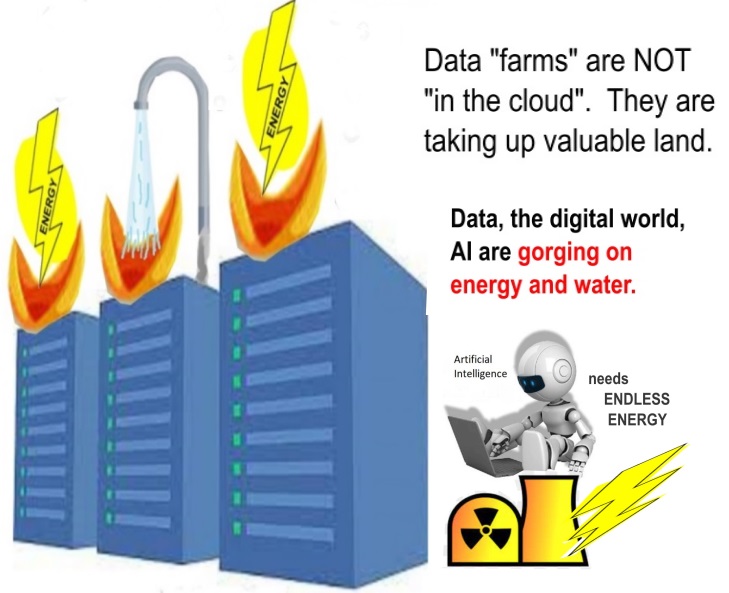
The ugly truth behind ChatGPT: AI is guzzling resources at planet-eating rates
Mariana Mazzucato, Mariana Mazzucato is professor of economics at UCL, and director of the Institute for Innovation and Public Purpose, https://www.theguardian.com/commentisfree/article/2024/may/30/ugly-truth-ai-chatgpt-guzzling-resources-environment
Big tech is playing its part in reaching net zero targets, but its vast new datacentres are run at huge cost to the environment.
hen you picture the tech industry, you probably think of things that don’t exist in physical space, such as the apps and internet browser on your phone. But the infrastructure required to store all this information – the physical datacentres housed in business parks and city outskirts – consume massive amounts of energy. Despite its name, the infrastructure used by the “cloud” accounts for more global greenhouse emissions than commercial flights. In 2018, for instance, the 5bn YouTube hits for the viral song Despacito used the same amount of energy it would take to heat 40,000 US homes annually.
This is a hugely environmentally destructive side to the tech industry. While it has played a big role in reaching net zero, giving us smart meters and efficient solar, it’s critical that we turn the spotlight on its environmental footprint. Large language models such as ChatGPT are some of the most energy-guzzling technologies of all. Research suggests, for instance, that about 700,000 litres of water could have been used to cool the machines that trained ChatGPT-3 at Microsoft’s data facilities. It is hardly news that the tech bubble’s self-glorification has obscured the uglier sides of this industry, from its proclivity for tax avoidance to its invasion of privacy and exploitation of our attention span. The industry’s environmental impact is a key issue, yet the companies that produce such models have stayed remarkably quiet about the amount of energy they consume – probably because they don’t want to spark our concern.
Google’s global datacentre and Meta’s ambitious plans for a new AI Research SuperCluster (RSC) further underscore the industry’s energy-intensive nature, raising concerns that these facilities could significantly increase energy consumption. Additionally, as these companies aim to reduce their reliance on fossil fuels, they may opt to base their datacentres in regions with cheaper electricity, such as the southern US, potentially exacerbating water consumption issues in drier parts of the world. Before making big announcements, tech companies should be transparent about the resource use required for their expansion plans.
Furthermore, while minerals such as lithium and cobalt are most commonly associated with batteries in the motor sector, they are also crucial for the batteries used in datacentres. The extraction process often involves significant water usage and can lead to pollution, undermining water security. The extraction of these minerals are also often linked to human rights violations and poor labour standards. Trying to achieve one climate goal of limiting our dependence on fossil fuels can compromise another goal, of ensuring everyone has a safe and accessible water supply.
Moreover, when significant energy resources are allocated to tech-related endeavours, it can lead to energy shortages for essential needs such as residential power supply. Recent data from the UK shows that the country’s outdated electricity network is holding back affordable housing projects. This will only get worse as households move away from using fossil fuels and rely more on electricity, putting even more pressure on the National Grid. In Bicester, for instance, plans to build 7,000 new homes were paused because the electricity network didn’t have enough capacity.
In an era where we expect businesses to do more than just make profits for their shareholders, governments need to evaluate the organisations they fund and partner with, based on whether their actions will result in concrete successes for people and the planet. In other words, policy needs to be designed not to pick sectors or technologies as “winners”, but to pick the willing by providing support that is conditional on companies moving in the right direction. Making disclosure of environmental practices and impacts a condition for government support could ensure greater transparency and accountability. Similar measures could promote corporate accountability in global mineral supply chains, enforcing greater human rights compliance.
In navigating the intersection of technological advancement and environmental sustainability, policymakers are facing the challenge of cultivating less extractive business models. This is not just about adopting a piecemeal approach; it’s about taking a comprehensive systematic view, empowering governments to build the needed planning and implementation capacity. Such an approach should eschew outdated top-down methods in favour of flexible strategies that integrate knowledge at all levels, from local to global. Only by adopting a holistic perspective can we effectively mitigate the significant environmental impacts of the tech industry.
Ultimately, despite the unprecedented wave of innovation since the 1990s, we have consistently overlooked the repercussions of these advances on the climate crisis. As climate scientists anticipate that global heating will exceed the 1.5C target, it’s time we approach today’s grand challenges systemically, so that the solution to one problem does not exacerbate another.
The US Empire Isn’t A Government That Runs Nonstop Wars, It’s A Nonstop War That Runs A Government

CAITLIN JOHNSTONE, JUN 01, 2024,
It clears up a lot of confusion when you understand that the US empire is not a national government which happens to run nonstop military operations, it’s a nonstop military operation that happens to run a national government.
The wars are not designed to serve the interests of the United States, the United States is designed to serve the interests of the wars. The US as a country is just a source of funding, personnel, resources and diplomatic cover for a nonstop campaign to dominate the planet with mass military violence and the threat thereof.
This campaign is not waged to benefit the American people or their security, but to benefit the loose international alliance of plutocrats and unelected empire managers whose wealth and power are premised on the world order of continuous violence, exploitation and extraction which the campaign of global domination upholds. This campaign of global domination and its manifestations as a whole may be referred to as the US empire, which has very little in common with the US as an individual nation
Until you understand this, nothing the US government or the US war machine does will make sense. You won’t understand why military operations are being waged which don’t seem to benefit the American people in any way, and which if anything actually harm the national security interests of the United States. You won’t understand why US foreign policy remains the same no matter who’s in office, regardless of party or platform. You won’t understand why the US and its allies do crazy things that otherwise make no sense for governments to do, like backing an increasingly unpopular genocide in Gaza, starting a cold war with China, or tempting nuclear armageddon with Russia.
And the answer is that these aggressions are not happening because they benefit the US as a nation, or even because they serve the political agendas of any elected officials. The nonstop violence is a means to a completely different end, and is almost an end in and of itself — benefiting war profiteers, shoring up geostrategic control, and expanding the sphere of the US empire’s particular brand of global capitalism.
There’s the nonstop worldwide military operation, and then there’s the theatrical set pieces of an official government slapped together in the foreground which we’re all meant to pretend has something to do with all the wars and militarism we are seeing. In reality the war machine just does what it’s going to do while the official elected suits in Washington put on these performances where they argue about abortion and Donald Trump to make it look like the US has a real government that’s making real decisions.
It was decided long ago that war is too important to be left to the will of the electorate, so now there’s this fake dummy political system that the American people are given to play with so they won’t meddle with the gears of the imperial machine. The local inhabitants of the hub of the globe-spanning empire are kept too propagandized, entertained, distracted, busy, poor, and sick to have a truth-based relationship with what’s being done in their name around the world, and if they do make some space in their life to become politically engaged they are herded into a kayfabe two-party system where both factions support war, militarism, imperialism, plutocracy and ecocidal capitalism but put immense amounts of energy into empty culture warring over issues that nobody with any real power cares about.
Trying to talk about this to people who are still plugged into the mainstream imperial worldview is like if Amazon had a children’s cartoon show called Andy Amazon & Friends, and the public believed the cartoon show was Amazon — they didn’t know anything about the sprawling trillionaire megacorporation that’s devouring the global economy. You’d try to talk about the gargantuan e-commerce company and they’d think you were talking about the cartoon, and object that what you’re saying doesn’t line up with what they know about the show and its characters.
Once you see the corporation behind the cartoon, once you see the empire behind the performative puppet show of official politics, you see it everywhere. You see it in the movements of the imperial war machine. You see it in the news headlines. You see it in the phony justifications and narratives that are being spouted by the western political-media class. You see it in our education system. You see it throughout our vapid mainstream western culture of interminable diversion and capitalist indoctrination.

And you stop caring about the puppet show. You stop caring about presidential elections, about Stormy Daniels and Donald Trump, about the culture war wedge issue of the day and the latest hot topic that everyone’s saying you need to take a position on. It becomes as interesting to you as some Youtube video your kid has on in the background when you’re busy dealing with a home emergency.
And the behavior of the empire absolutely is an emergency. The escalations against Russia and China that these freaks are pushing have the world on a trajectory that’s going to get us all killed, and the horrors they are inflicting in Gaza and elsewhere are creating a nightmare on earth right here and now. The empire is only getting crazier and more violent as its planetary domination becomes more challenged, and until people can see it for what it really is, it’s going to be very hard to build up the necessary public opposition against it to use the power of our numbers to force them to stop.
Blinken Confirms Biden Change On Policy Toward Ukraine Using U.S. Weapons Inside Russia
Radio Free Europe, By Mike Eckel and Rikard Jozwiak 31 May 24

PRAGUE — U.S. Secretary of State Antony Blinken says President Joe Biden has given Ukraine the go-ahead to use U.S. weapons to strike inside Russia for the limited purpose of defending the eastern city of Kharkiv amid pleas from Ukraine to allow its forces to defend the country against attacks originating from Russian territory.
Speaking in Prague on May 31 at an informal meeting of NATO-member foreign ministers, Blinken said Ukraine had asked Washington for authorization to use U.S. weapons to strike inside Russia as it tries to defeat Russian troops that began a full-scale invasion in February 2022.
“Over the past few weeks, Ukraine came to us and asked for the authorization to use weapons that we’re providing to defend against this aggression, including against Russian forces that are massing on the Russian side of the border and then attacking into Ukraine,” Blinken said.
nd that went right to the president, and as you’ve heard, he’s approved use of our weapons for that purpose. Going forward, we’ll continue to do what we’ve been doing, which is as necessary adapt and adjust,” Blinken said.
Blinken’s confirmation came after media reports quoting U.S. officials — including one who spoke to RFE/RL — that Biden has partially lifted the ban.
NATO Secretary-General Jens Stoltenberg had already added his backing to such a move saying during the Prague meeting that allies should consider lifting restrictions on the use of NATO weapons by Ukraine to hit targets on Russian territory.
The decision is a reversal of the U.S. refusal to let Ukraine use American weapons to hit targets inside Russia over fears that it would cause an escalation in the conflict.
Germany, for example, has expressed opposition to allowing the use of NATO-provided weapons to strike inside Russia, though a government spokesman on May 31 said it had also agreed that Kyiv could now use weapons supplied by Berlin to defend itself against strikes from positions just inside Russia………………………………………..
Russian President Vladimir Putin has promised a response, warning of “serious consequences,” especially for what he called “small countries” in Europe.
Russia’s RIA Novosti news agency quoted Andrei Kartapolov, the head of the Russian parliament’s lower house Defense Committee as saying on May 31 that Biden’s decision would have no impact on Moscow’s military operations against Ukraine. https://www.rferl.org/a/us-biden-policy-ukraine-strikes-inside-russia/32974016.html
UK’s nuclear deterrent key to Starmer’s plans to keep Britain safe

Labour leader Keir Starmer will meet with forces veterans and a group of his party’s candidates when he campaigns in the North West of England on Monday
Independent, Richard Wheeler, 3 June 24
Sir Keir Starmer will pitch Labour as the “party of national security” as he seeks to switch attention to defence matters during the general election campaign.
The Labour leader is expected to meet with forces veterans and a group of his party’s candidates when he campaigns in the North West of England on Monday.
Sir Keir will reaffirm his commitment to a “nuclear deterrent triple lock” as well as his ambition to increase defence spending to 2.5 per cent of gross domestic product (GDP), a measure of the size of the economy.
Prime Minister Rishi Sunak has made clear he wants to meet the 2.5 per cent target by 2030 although Labour has so far declined to outline its timeline, only noting they would do so when economic conditions allow.
Labour says its nuclear deterrent triple lock involves: a commitment to construct the four new nuclear submarines in Barrow-in-Furness; maintaining Britain’s continuous at-sea deterrent; and the delivery of all future upgrades needed for the submarines to patrol the waters.
The Vanguard-class submarines are due to be replaced by the bigger Dreadnought-class submarines in the 2030s.
Between £31 billion and £41 billion has been set aside for the wider programme of replacing the Vanguard-class submarines, according to figures from the House of Commons Library.
Sir Keir has been attempting to shift perceptions of Labour’s defence stance following the party’s time under the leadership of Jeremy Corbyn, a long-standing critic of Nato and Trident………………………………..
” alongside our unshakeable commitment to Nato, an incoming Labour government will introduce a ‘triple lock’ commitment on our nuclear deterrent – providing vital protection for the UK and our Nato allies in the years ahead, as well as supporting thousands of high paying jobs across the UK.”
Defence Secretary Grant Shapps said: “Twelve members of Starmer’s front bench team, including Angela Rayner and David Lammy, voted against Trident. https://www.independent.co.uk/news/uk/politics/labour-keir-starmer-nuclear-deterrent-monday-b2555401.html
Labour pledges to launch Great British Energy ‘within months’ of general election victory: it includes nuclear power.
The Labour Party has unveiled more details on its plans to set up a
publicly owned energy company, Great British Energy, confirming its
intention to launch the firm as a priority should the Party win July’s
general election.
The Great British Energy website went live late on
Thursday night (30 May), providing more information on how the company
would work and the benefits it could bring in terms of lower energy bills,
new green jobs and future-proofing the UK.
Labour leader Kier Starmer has
stated that setting up Great British Energy would be one of his
government’s first steps after the election on 4 July. Great British
Energy would focus on energy generation in the first instance, the website
confirms. It would be backed with public funding from Labour’s
slimmed-down multi-billion-pound annual green investment coffers.
This funding would be raised through an enhanced windfall tax on North Sea oil
and gas operators, who already pay a 75% tax rate which would be hiked to
78% under a Labour Government. Labour wants to use Great British Energy
support both mature renewable and nuclear technologies, and emerging
technologies such as floating offshore wind, tidal and renewable hydrogen.
Regardless of a technology’s maturity, the aim will be to crowd in
private investment by offering the public funding and government expertise
needed to reduce risks for investors. Great British Energy would be based
in Scotland, and Labour has a vision to ensure that it supports energy
generation assets in all UK regions. It will partner with other
organisations to deliver at least 8GW of community renewables over the
course of the next Parliament.
Edie 31st May 2024
University of Ghent to cease all collaboration with Israeli institutions
Friday 31 May 2024, By The Brussels Times with Belga
Ghent University (UGent) plans to end all partnerships with Israeli institutions, citing serious human rights violations and breaches of international law in Gaza, according to chancellor Rik Van de Walle.
Pro-Palestinian activists have occupied the UFO building at UGent for several weeks, demanding a comprehensive boycott against Israeli academic bodies. Hundreds of students have set up encampments in the building’s entrance hall, hoisting flags in protest.
Van de Walle had asked the university’s human rights commission to review all cooperations with Israeli universities and research centres, to bolster Ghent University’s human rights policy. Previously, the university terminated three contracts involving Israeli organisations suspected of involvement in human rights violations……………………………………………
UGent explained that the connection with other organisations or authorities prevents further cooperation. “UGent doesn’t want to be implicated in the very serious human rights and international law violations in Gaza… [or] cooperate with partners involved in these serious human rights violations,” the Flemish institution declared.
The university’s human rights commission – support by the chancellor – advises that for ongoing projects, the consortium should ascertain whether collaboration with the Israeli partner can be ended and take appropriate measures. If this isn’t feasible, “UGent must take the necessary steps to withdraw from the project” itself…….. https://www.brusselstimes.com/1070115/university-of-ghent-to-cease-all-collaboration-with-israeli-institutions
The Widespread Harm of Nuclear Testing
June 2, 2024, https://www.nytimes.com/2024/06/02/opinion/nuclear-testing.html
To the Editor:
Re “Nuclear Testing Victims Deserve More,” by W.J. Hennigan (Opinion, May 26):
The federal government’s nuclear weapons testing program was an assault on its own citizens — an assault that didn’t stop with the end of the Cold War.
Radioactive fallout moved across the country and entered bodies through breathing, food and water. Official denials of any harm followed, while Americans suffered and died from cancers caused by fallout.
The 1990 Radiation Exposure Compensation Act to compensate “downwinders” with cancer was a first step, but originally was limited only to those who lived in 20 counties in Utah, Nevada and Arizona. Current efforts to expand compensation are struggling to overcome congressional resistance; without action, the law is set to expire on June 7.
Government failure to act continues even as evidence of harm grows. Studies of radioactive Strontium-90 found in milk and in 320,000 baby teeth proved fallout was building up in bodies. Early results of an ongoing health study show Strontium-90 levels in baby teeth of Americans who died of cancer were more than double that of healthy Americans.
The injustice to those victimized by bomb tests is staggering. The federal government has harmed — rather than protected — its people and has failed to take responsibility. It is crucial that leaders finally recognize the true impact of bomb testing, and expand the law; to not act and let it expire would be unthinkable.
Christie Brinkley
Sag Harbor, N.Y.
The writer, the model, is the vice president of the Radiation and Public Health Project.
To the Editor:
We must finally close the door on nuclear testing forever.
The United States Senate should approve the Comprehensive Nuclear Test Ban Treaty, which bans all nuclear test explosions. The Senate’s failure to approve the treaty has stalled progress in nuclear arms control and disarmament.
We need to be taking steps to calm international tensions and prevent a costly nuclear arms race with Russia and China. Ratifying the test ban treaty would be an olive branch of peace to other nuclear powers and encourage disarmament negotiations.
The alternative is to drift along with a dangerous and expensive nuclear arms buildup. The resumption of nuclear test explosions will linger over us without diplomatic action.
Presidents Eisenhower and Kennedy were both right to pursue a treaty ending all nuclear testing. We have to finish the job today and take a big step to make the world safe from nuclear weapons.
William Lambers
Cincinnati
The writer is the author of “The Road to Peace: From the Disarming of the Great Lakes to the Nuclear Test Ban Treaty.”
US Energy Secretary calls for more nuclear power while celebrating $35 billion Georgia reactors
AP News, BY JEFF AMY, June 3, 2024
WAYNESBORO, Ga. (AP) — U.S. Energy Secretary Jennifer Granholm on Friday called for more nuclear reactors to be built in the United States and worldwide. But the CEO of the Georgia utility that just finished the first two scratch-built American reactors in a generation at a cost of nearly $35 billion says his company isn’t ready to pick up that baton.
Speaking in Waynesboro, Georgia, where Georgia Power Co. and three other utilities last month put a second new nuclear reactor into commercial operation, Granholm said the United States needs 98 more reactors with the capacity of units 3 and 4 at Plant Vogtle to produce electricity while reducing climate-changing carbon emissions. Each of the two new reactors can power 500,000 homes and businesses without releasing any carbon.

COMMENT. That’s if you don’t count radioactive emissions, and the huge carbon emissions from the entire nuclear fuel chain.
“It is now time for others to follow their lead to reach our goal of getting to net zero by 2050,” Granholm said. “We have to at least triple our current nuclear capacity in this country.”
The federal government says it is easing the risks of nuclear construction, but the $11 billion in cost overruns at Plant Vogtle near Augusta remain sobering for other utilities. Chris Womack is the CEO of Southern Co., the Atlanta-based parent company of Georgia Power. He said he supports Granholm’s call for more nuclear-power generation, but he added that his company won’t build more soon………….
Friday’s event capped a week of celebrations, where leaders proclaimed the reactors a success, even though they finished seven years late…….
The new Vogtle reactors are currently projected to cost Georgia Power and three other owners $31 billion, according to calculations by The Associated Press. Add in $3.7 billion that original contractor Westinghouse paid Vogtle owners to walk away from construction, and the total nears $35 billion.
Electric customers in Georgia already have paid billions for what may be the most expensive power plant ever. The federal government aided Vogtle by guaranteeing the repayment of $12 billion in loans, reducing borrowing costs…………..

The Biden administration promised that the military would commission reactors, which could help drive down costs for others. It also noted support for smaller reactors, suggesting small reactors could replace coal-fueled electric generating plants that are closing. The administration also pledged to further streamline licensing.
………………………… In Michigan, where Granholm was a Democratic governor, she announced in March up to $1.5 billion in loans to restart the Palisades nuclear power plant, which was shut down in 2022 after a previous owner had trouble producing electricity that was price-competitive.
But with much of the domestic effort focused on building a series of smaller nuclear reactors using mass-produced components, critics question whether they can actually be built more cheaply. Others note that the United States still hasn’t created a permanent repository for nuclear waste, which lasts for thousands of years. Other forms of electrical generation, including solar backed up with battery storage, are much cheaper to build initially.
…………….Regulators in December approved an additional 6% rate increase on Georgia Power’s 2.7 million customers to pay for $7.56 billion in remaining costs at Vogtle, with the company absorbing $2.6 billion in costs. That is expected to cost the typical residential customer an additional $8.97 a month in May, on top of the $5.42 increase that took effect when Unit 3 began operating. https://apnews.com/article/georgia-nuclear-plant-energy-secretary-granholm-05a6e2444a8b5a9e9c7c61b111b87192
A global review of Battery Storage: the fastest growing clean energy technology today

Energy Post 27th May 2024 by IEA
The IEA report “Batteries and Secure Energy Transitions” looks at the impressive global progress, future projections, and risks for batteries across all applications. 2023 saw deployment in the power sector more than double. Strong growth occurred for utility-scale batteries, behind-the-meter, mini-grids, solar home systems, and EVs. Lithium-ion batteries dominate overwhelmingly due to continued cost reductions and performance improvements. And policy support has succeeded in boosting deployment in many markets (including Africa).
Further innovations in battery chemistries and manufacturing are projected to reduce global average lithium-ion battery costs by a further 40% by 2030 and bring sodium-ion batteries to the market. The IEA emphasises the vital role batteries play in supporting other clean technologies, notably in balancing intermittent wind and solar.
New successes include the fact that solar PV plus batteries is now competitive with new coal-fired power in India and, in the next couple years, should become competitive with new coal in China and new natural gas-fired power in the U.S. Looking ahead, deployment must increase sevenfold by 2030. The prospects are good: if all announced plants are built on time this would be sufficient to meet the battery requirements of the IEA’s net-zero scenario in 2030. And although, today, the supply chain for batteries is very concentrated, the fast-growing market should create new opportunities for diversifying those supply chains.
Batteries are an essential part of the global energy system today and the fastest growing energy technology on the market
Battery storage in the power sector was the fastest growing energy technology in 2023 that was commercially available, with deployment more than doubling year-on-year.
Strong growth occurred for utility-scale battery projects, behind-the-meter batteries, mini-grids and solar home systems for electricity access, adding a total of 42 GW of battery storage capacity globally. Electric vehicle (EV) battery deployment increased by 40% in 2023, with 14 million new electric cars, accounting for the vast majority of batteries used in the energy sector.
Despite the continuing use of lithium-ion batteries in billions of personal devices in the world, the energy sector now accounts for over 90% of annual lithium-ion battery demand. This is up from 50% for the energy sector in 2016, when the total lithium-ion battery market was 10-times smaller. With falling costs and improving performance, lithium-ion batteries have become a cornerstone of modern economies, underpinning the proliferation of personal electronic devices, including smart phones, as well the growth in the energy sector. In 2023, there were nearly 45 million EVs on the road – including cars, buses and trucks – and over 85 GW of battery storage in use in the power sector globally.
Lithium-ion batteries dominate battery use due to recent cost reductions and performance improvements…………………………………………………………….
US doubtful it could help Korea on nuclear-powered subs
Korea Times 3 June 24
The United States is unlikely to help Korea build nuclear-powered submarines at the moment, as it is stretched by AUKUS commitments to Australia, U.S. Defense Secretary Lloyd Austin said at the Shangri-La security dialogue in Singapore.
In 2021 the United States signed the AUKUS pact with Britain and Australia to share nuclear-powered submarine technology and to sell at least three Virginia-class boats to Australia in the 2030s.
Several other allies, including Korea, have expressed interest in involvement.
Asked on Saturday at the security summit how he would respond to a direct Korean request for help obtaining nuclear submarines, Austin said it would be “very, very difficult” for Washington to accommodate that “on top of what we do right now.”
“(AUKUS) is no small endeavour,” he said. “We just started down this path with Australia. (It’s) highly doubtful that we could take on another initiative of this type anytime in the near future.”…………………….. https://www.koreatimes.co.kr/www/nation/2024/06/113_375778.html
1 This Month


18 March Webinar @ 1 PM EST: An Assessment of SMR Projects: The Case of Canada
register for the zoom:
https://us02web.zoom.us/webinar/register/WN_o8BIIOUvQ2ONJR1nta65DQ#/registration


of the week – STOP SMALL MODULAR REACTORS IN CANADA
To see nuclear-related stories in greater depth and intensity – go to https://nuclearinformation.wordpress.com
-
Archives
- March 2026 (146)
- February 2026 (268)
- January 2026 (308)
- December 2025 (358)
- November 2025 (359)
- October 2025 (376)
- September 2025 (258)
- August 2025 (319)
- July 2025 (230)
- June 2025 (348)
- May 2025 (261)
- April 2025 (305)
-
Categories
- 1
- 1 NUCLEAR ISSUES
- business and costs
- climate change
- culture and arts
- ENERGY
- environment
- health
- history
- indigenous issues
- Legal
- marketing of nuclear
- media
- opposition to nuclear
- PERSONAL STORIES
- politics
- politics international
- Religion and ethics
- safety
- secrets,lies and civil liberties
- spinbuster
- technology
- Uranium
- wastes
- weapons and war
- Women
- 2 WORLD
- ACTION
- AFRICA
- Atrocities
- AUSTRALIA
- Christina's notes
- Christina's themes
- culture and arts
- Events
- Fuk 2022
- Fuk 2023
- Fukushima 2017
- Fukushima 2018
- fukushima 2019
- Fukushima 2020
- Fukushima 2021
- general
- global warming
- Humour (God we need it)
- Nuclear
- RARE EARTHS
- Reference
- resources – print
- Resources -audiovicual
- Weekly Newsletter
- World
- World Nuclear
- YouTube
-
RSS
Entries RSS
Comments RSS
 nuclear-news