Solar and wind generation will soon pass nuclear, hydro

In a new monthly column for pv magazine, the International Solar Energy Society (ISES) explains how solar and wind are dominating power plant construction.
MAY 20, 2024 INTERNATIONAL SOLAR ENERGY SOCIETY (ISES) Authors: Prof. Ricardo Rüther (UFSC), Prof. Andrew Blakers /ANU https://www.pv-magazine.com/2024/05/20/solar-and-wind-generation-will-soon-pass-nuclear-and-hydro/
Our ISES pv magazine column in April showed that the fastest energy change in history is continuing. In 2023, solar and wind together constituted 80% of global net power capacity additions. Growth in power capacity is followed by growth in annual energy generation.
Over the past decade, global solar generation has grown ninefold to reach 1,500 TWh per year while wind generation has tripled to 2300 TWh per year (Figure 1 on original). This corresponds to compound growth rates of 22% and 11% per year respectively. In contrast, hydro, nuclear and coal generation had growth rates of about 1% per year, and gas 3%.
The solar growth rate of 22% per year is equivalent to doubling every 3 years. At this growth rate, solar generation will reach 100,000 TWh per year in 2042 which is enough to fully decarbonize the global economy.
Nuclear has a global average capacity factor of 74%, followed by coal (50% to 70%), combined cycle gas (40% to 60%), wind (30% to 60%), large hydro (30% to 50%), and solar photovoltaics (12% to 25%).
Despite its relatively low capacity factor, solar generation is tracking to surpass nuclear generation in 2026, wind in 2027, hydro in 2028, gas in 2030 and coal in 2032.
Solar and wind are strongly dominating powerplant construction, whereas construction of all other generation technologies is both small and stagnant. Coal, gas and nuclear could be mostly gone by mid-century once retirements outpace new construction.
The leading countries for per capita solar and wind generation are all in Europe, except Australia (Figure 2 on original). Also shown in Figure 2 is global per capita generation from hydro and nuclear. Combined generation from solar and wind in the leading countries is now fourfold larger than the global average generation from hydro and nuclear combined.
Australia is a global pathfinder because, unlike in Europe, it cannot share electricity across national boundaries to reduce the effects of variable weather and demand. Australia must go it alone. Australia is convincingly demonstrating that change can happen quickly with good policies. Over the period 2020 to 2030, fossil generation is falling from 75% to 18%, while solar and wind generation is rising from 19% to 75%.
Brazil and Chile are middle income pathfinder countries, with about 81% and 60% respectively of electricity generation coming from hydro, wind and solar. Pathfinder countries are driven by a desire to reduce both electricity prices and emissions. There are few serious concerns about future grid stability because there will be sufficient investment in storage, transmission, and demand management.
Iran appoints nuclear negotiator Ali Bagheri as interim foreign minister
First Post FP Staff • May 20, 2024
Following the horrific helicopter crash that killed Iran’s Foreign Minister and President, Ali Bagheri, the country’s seasoned nuclear negotiator, was named acting Foreign Minister on Monday.
Hossein Amir-Abdollahian, the late foreign minister, had Bagheri, 56, as his deputy. He is well-known for his strong connections to Iran’s ultraconservatives and his membership in the inner circle of Supreme Leader Ayatollah Ali Khamenei.
Bagheri was known for his composed manner throughout his tenure, even though he took strong positions, especially when it came to denouncing intervention from the West.
Bagheri is well-versed in Iran’s nuclear dossier, a divisive topic that has soured relations between Tehran and major international players, notably Israel. He became a prominent opponent of the 2015 nuclear agreement, charging that Iran’s interests were compromised by the previous government…………………………………………….
With nuclear talks at a stalemate due to major differences, especially with the United States, Baghari’s nomination as interim foreign minister comes at a difficult moment. https://www.firstpost.com/world/iran-appoints-nuclear-negotiator-ali-bagheri-as-interim-foreign-minister-13772964.html
In Nuclear Crosshairs, Guam Still Doesn’t Control Its Own Affairs
… because its inhabitants are not fully considered Americans when it matters.
WORDS: APRIL ARNOLD, PICTURES: JAZMIN SMITH, MAY 20, 2024, https://inkstickmedia.com/in-nuclear-crosshairs-guam-still-doesnt-control-its-own-affairs/
At the core of Guam’s indigenous CHamoru culture are the concepts of inafa’maolek – inafa meaning “to make together” and maolek meaning “good.” It is the idea that something was once bad or broken and is in need of repair, and that repair comes from doing good together and restoring harmony. If there is one thing the CHamoru have known for nearly 500 years, it is how to make the best of broken circumstances.
In recent years, Guam has found itself at the center of tensions between the United States and countries in the Pacific. As the tiny island sits on the frontlines of the competition for influence in the region, Guam has increasingly come under threat of being a prime target for nuclear attack by China or North Korea.
In 2022, North Korea confirmed a test launch of an intermediate-range ballistic missile that could reach Guam. In 2023, the country confirmed launching spy satellites that targeted military installations in Japan, on the US mainland and on Guam. Equally concerning was North Korea’s response that attempts to interfere with their satellites would be considered a declaration of war. In April 2024, North Korea conducted a test launch of another intermediate-range ballistic missile that could also reach Guam.
“Guam Killer”
As for China, during a military parade in September 2015, the Chinese government unveiled a new missile that quickly became known as the “Guam Killer.” Following the introduction of this new missile, the US-China Economic Security Commission published a 2016 report detailing China’s military expansion and its implications for Guam.
Yet, despite the threat to the island, it still does not have a full say over many aspects of its strategic role in international affairs. Its citizens are not allowed to vote in US presidential elections, with straw polls showing that voting trends of the territory do not guarantee one political party leverage over the other.
Nor does Guam have full representation in US Congress, limiting its ability to lobby for the island’s interests, despite being in harm’s way militarily and environmentally. As the US promotes democracy worldwide, it should start at home by affording Guam statehood. This, in turn, could help temper the aggression and rhetoric China and North Korea have directed at the island, giving the US an even stronger foothold in the region.
History of Foreign Rule
Guam has been under foreign rule since 1565 and foreign aggression since 1521 when Ferdinand Magellan landed on the island. As a strategic trade outpost for Spain for over 300 years, the CHamoru were forced to convert to Catholicism by the Jesuits and subservient to Spanish governance that ravaged the island’s natural resources and culture. In the book “Destiny’s Landfall,” author Robert F. Rogers detailed stories of the abuse the CHamoru people experienced at the hands of governors who had a recurring penchant for excessive greed and virile priests seeking to exact their purportedly divine authority.
Then, as a concession of the Spanish-American War, Spain transferred Guam to the US under the Treaty of Paris of 1898. This was a controversial transaction at the time as Congress was amid the throes of the debate over Manifest Destiny and expansion into the Pacific.
Much to the surprise of the citizens of Guam, the transfer did not result in its incorporation into the country as a state, despite establishing a local democratic government to aid this effort.
Military Oversight
Instead, the island was placed under the oversight of the Department of the Navy for 52 years, where military governance had absolute authority. As a result of the treaty, the US government faced a new hurdle of incorporating these newly-acquired territories.
Through a series of Supreme Court rulings known as the Insular Cases, the US decided that Guam among other islands such as Puerto Rico, Hawaii, and the Philippines, would be considered territories without full citizenship rights.
Language from one of the Insular Cases, Downes vs. Bidwell, states, in part, the following about foreign territories: “If those possessions are inhabited by alien races, differing from us in religion, customs, laws, methods of taxation, and modes of thought, the administration of government and justice, according to Anglo-Saxon principles, may for a time be impossible.”
Taking Advantage
In short, even though Guam had been under Catholic influence and rule for more than 300 years and had adopted many Catholic practices, it was not enough to be accepted into the US as more than an “alien race.”
Meanwhile, the US had begun taking full advantage of Guam’s position in the Pacific, constructing military bases starting in WWII. It wasn’t until 1950 that the Department of the Navy would transfer its oversight of Guam to the Department of the Interior, designating the island as an unincorporated territory through the Guam Organic Act.
With the steady military buildup of US forces on Guam over the decades, the US would gain more influence in the Pacific while pushing CHamoru off their lands and creating waste management nightmares that now include two Superfund sites used to dispose of hazardous chemicals.
Military Buildup
Even as tensions have grown, military officials have called for increased investment in a missile defense capability on the island to counter China’s capabilities development and aggression in the region. This includes relocating 5,000 US Marines to Camp Blaz on Guam later in 2024, with some concerned over impacts to the local ecosystem and historical sites.
Meanwhile, Guam continues to wrestle with the US government on waste management funding to clean up the Superfund site, Ordot Landfill. The landfill was formerly owned and used by the Department of the Navy during WWII, with some of its contents allegedly being toxic chemicals such as Agent Orange. Even upon returning the landfill to the island after Congress passed the Guam Organic Act in 1950, the Navy continued to use the dump until the 1970s.
After its closure in 2011, Guam’s local government began clean-up efforts and filed a lawsuit under the Superfund Act to seek financial help from the US government on the $160 million estimated cost. A lower court ruled that Guam’s lawsuit surpassed the statute of limitations under the Comprehensive Environmental Response, Compensation and Liability Act. As one article states, “Shouldering the cost alone would be unduly difficult for the small island, as the bill exceeds the combined annual budget of its health, social services, police, fire, public works, solid waste and environmental departments.”
In May 2021, the Supreme Court reversed the ruling, and in September 2023 the US government agreed to pay $48.9 million in cleanup costs that were incurred prior to Aug. 10, 2022. The remaining $110 million in costs will still have to be covered by Guam’s local government.
Self-Determination
The conversation of Guam’s self-determination starts at the local level. Guam’s Commission on Decolonization was formed in 1997 to promote domestic education and outreach on the island’s options for self-determination. These options include statehood, free association, or independence. The first step in this process is the self-determination vote, where voters decide which of the decolonization options to pursue. Yet, efforts for a referendum have already run into issues at the federal level.
Before conducting the vote, Guam’s government needs to decide who is included in the definition of self-determination, which it has already done. According to the commission’s website, the right of self-determination belongs to those who were colonized, with the definition of “native inhabitants of Guam,” referring to people who became US citizens through the 1950 Guam Organic Act, as well as their descendents.
In 2020, the Supreme Court declined to review Guam’s appeal of a previous lower court ruling on conducting a nonbinding plebiscite to determine whether native inhabitants preferred statehood, free association, or independence because the vote was discriminatory on the grounds of race.
In February 2024, Guam’s government began looking into better defining the term so that it meets expectations in local law and was not “considered again a ‘proxy for race’ and therefore unconstitutional.”
On May 13, 2024, Guam’s Attorney General published an opinion that there was “no room” for Guam’s definition of the phrase that would be deemed constitutional. Instead, the AG recommended Guam’s Governor take other legal routes, such as lobbying Congress to recognize Guam’s unique history and work with the island to develop a path towards self-determination as well as petition support from the United Nations.
Reluctance
Separately, politicians on Guam are also reluctant to pursue tribal classification for the CHamoru people, especially after the US federal government sued Guam over land trust issues.
In 2017, Madeleine Bordallo, then the Guam delegate to the US House of Representatives, expressed concerns over the implications of enrolling the CHamoru as a tribe when the island would have to transfer ownership of the tribal lands to the federal government.
Each of these issues has made it difficult for Guam to gain traction in pursuing any form of self-determination, let alone statehood.
While it is unlikely that the majority of US elected officials would support anything other than statehood for Guam, leaving the island in a position that forces them to either lobby Congress for any self-determination support or solicit help from the United Nations could strain the relationship at a delicate time internationally.
Path Forward
After a referendum favoring statehood, all that is required for Guam to become a state is a simple majority vote on a joint resolution in both houses of Congress and approval by the President. The biggest hurdle is often lobbying Congress for the votes. The CHamoru have had their land taken from them to support US military demands with little-to-no reconciliation efforts from the US government.
Yet, the tiny island finds itself in the crosshairs of growing tensions between multiple nuclear weapons states, with barely a voice to hold the US government accountable for its actions. Many arms control and nonproliferation experts lament the lack of US public interest in the threat of nuclear war. Perhaps, it is because those most at risk are not fully considered Americans when it matters. If the US truly cares about ensuring democracy around the world, it should start at home.
North Korea vows to boost nuclear posture after US subcritical nuke test
DPRK slams US for destabilizing global security through no-expolosion experiment, though expert downplays threat
NK News Jeongmin Kim , May 20, 2024
North Korea has condemned the U.S. for conducting a no-explosion nuclear experiment that it claims destabilizes global security, vowing to recalibrate its own nuclear deterrence measures in response.
The U.S. Energy Department’s National Nuclear Security Administration (NNSA) announced last week that it conducted a “subcritical experiment at an underground facility in Nevada on May 14 to collect information about the reliability and effectiveness of American nuclear warheads.
“This is a dangerous act that renders the extremely worsening global security environment more unstable, having seriously negative impact on the strategic balance among major nuclear powers,” an unnamed spokesperson of North Korea’s foreign ministry said in a statement on Monday.
Both the externally facing Korean Central News Agency and the domestic party daily Rodong Sinmun carried the statement.
The spokesperson called the U.S. the “world’s biggest nuclear weapons state” with a “strategic goal to militarily control other countries,” disqualifying it from discussing the threat of nuclear war.
It is “nothing but rhetoric,” the statement continues before referencing the strategic assets that visited South Korea in the past couple of years, the U.S.-ROK Nuclear Consultative Group on discussing joint nuclear planning and the joint tabletop exercise slated for August on North Korean nuclear use scenarios.
The latest test in Nevada has “added new tension to the military showdown among nuclear weapons states, fomenting the international nuclear arms race,” the statement reads, vowing to improve its nuclear defense posture against this threat.
However, Shin Seung-ki, a senior analyst at the Korea Institute for Defense Analyses (KIDA), told NK News that the U.S. test is not as threatening or new as North Korea described it. ………………………………………….
South Korean and U.S. authorities have said North Korea completed preparations for a seventh nuclear test around two years ago, but Pyongyang has not conducted one so far. https://www.nknews.org/2024/05/north-korea-vows-to-boost-nuclear-posture-after-us-subcritical-nuke-test/
North Korea says it forced to take measures to increase nuclear deterrence
20 May 2024, By Alimat Aliyeva, https://www.azernews.az/region/226324.html
The subcritical nuclear test conducted by the United States at the Nevada test site leads to an escalation of the global nuclear arms race, and Pyongyang is forced to take the necessary measures in this regard, Azernews reports.
It notes that the test “creates new tensions in the military confrontation between nuclear states and accelerates the global nuclear arms race.”
“In no case should the influence of this nuclear test on the military security situation in the region of the Korean Peninsula be allowed. In order to prepare for the strategic instability that is being created in the region and globally due to the unilateral action of the United States, we are forced to take the necessary measures to increase universal readiness for nuclear deterrence within the framework of our sovereign right and possible options,” the representative of the department added.
It is not said exactly what measures can be taken, but it is noted that the DPRK will “consistently protect the security, rights and interests of the state “by these actions, as well as “prevent the creation of a strategic imbalance and a security vacuum in the region of the Korean Peninsula.”
US-Saudi officials meet for security and nuclear deal

the Biden administration is offering a strategic deal on nuclear deal to the Saudis to assist a Saudi civilian nuclear program, as Iran has reached the weapons threshold under President Joe Biden’s watch.
May 20, 2024 , https://www.middleeastmonitor.com/20240520-us-saudi-officials-meet-for-security-and-nuclear-deal/
US National Security Adviser, Jake Sullivan, and Saudi Crown Prince, Mohammed Bin Salman, met in Dhahran to discuss a range of issues, including normalisation of ties with Israel, Reuters reports.
According to the report, a Saudi statement on Sunday also said, “the semi-final version of the draft strategic agreements between the two countries, which are almost being finalised”, were discussed.
The report added that the Biden administration is offering a strategic deal on nuclear deal to the Saudis to assist a Saudi civilian nuclear program, as Iran has reached the weapons threshold under President Joe Biden’s watch.
The meeting also covered “what is being worked on between the two sides on the Palestinian issue to find a credible path towards a two-state solution”, as well as attempts to stop the war in Gaza and facilitate the distribution of humanitarian aid there.
UN watchdog warns on nuclear trafficking
https://www.aljazeera.com/news/2024/5/20/un-watchdog-warns-on-nuclear-trafficking
The IAEA reports thousands of pieces of nuclear materiel have gone missing over last three decades.
The United Nations’ nuclear watchdog has called for “vigilance” as it warned of thousands of instances of radioactive materials going missing.
The International Atomic Energy Agency’s (IAEA) Incident and Trafficking database reported on Monday that 31 countries reported 168 incidents in which nuclear or other radioactive material was lost, stolen, improperly disposed of or otherwise neglected last year, “in line with historical averages”. The watchdog has recorded more than 4,200 thefts or other incidents over the past 30 years.
The IAEA noted that six of last year’s incidents were “likely related to trafficking or malicious use”, also known as Group I, representing a slight increase from 2022 but a drop from 2021.
The trafficking database covers three types of incidents where nuclear or radioactive material escaped regulatory control, with Group I being the most serious.
Incidents where trafficking or malicious use is unlikely or can be ruled out are known as Group II and those where any connection is unclear fall into Group III.
The trafficking database was set up to track the illicit trafficking of nuclear material, such as uranium and plutonium, which can be used in atom bombs, and radioactive material, such as isotopes used in hospital equipment.
The IAEA released its latest finding as it opened its fourth international conference on nuclear security, which will run until Friday in the Austrian capital, Vienna.
Since 1993, the nuclear watchdog has recorded 4,243 incidents, 350 of them connected or likely to be connected to trafficking or malicious use.
“The reoccurrence of incidents confirms the need for vigilance and continuous improvement of the regulatory oversight to control, secure and properly dispose radioactive material,” said Elena Buglova, director of the IAEA’s nuclear security division.
The IAEA noted a decline in incidents involving nuclear material, such as uranium, plutonium and thorium.
The nuclear lobby’s education invasion – masters of the weasel word.

Look it’s just one little word – or sort of two-bit word – “DE-RISK”.
I came across it today, and puzzled over it. T’was in a rapturous article about Sheffield University, launching a major new manufacturing and testing facility in South Yorkshire, in partnership with Rolls Royce.
“SMRs are advanced nuclear reactors that are designed to be factory-built and transported to operational sites for installation. The technology is seen as a clean energy solution that is easier to deliver, scale and is more affordable than building new larger nuclear power stations. Each Rolls-Royce SMR could provide enough low-carbon electricity to power a million homes for more than 60 years.“
There were other words to ponder about – for example “The technology is seen as a clean energy solution” – seen by whom?
But I will stay with “de-risk”, because it’s a lovely word – chosen to impress, – and also to confuse and obfuscate the financial realities of the situation.
These are the meanings that I found
- To de-risk to take steps to make (something) less risky or less likely to involve a financial loss.
- De-Risking is a strategy that companies apply when they cannot manage the money laundering risks that they have obligations to.
- De–risking. means mitigating the risks of doing business in high-risk environments through concessionary finance or investment guar- antees.
- The de-risking process involves a strategic assessment by companies to reduce exposure to high-risk activities in order to minimize compliance- and operations-related risks
Well, to cut to the chase.
ECONOMICS. There is a wealth of information about the costs of small nuclear reactors (SMRs). Those in submarines are not suitable for electricity production. The only operating SMRs are in China (The HTR-PM) and Russia (The KLT-40S), and they’re not doing too well.
Meanwhile we have the fiasco of the NuScale SMR venture in the USA – . And with dozens of SMR designs on paper – none are even licensed let alone operative.
And here’s what that radical industrial journal Utility Dive has to say:
“Small modular reactors are at an economic disadvantage. The lower power output of these reactors, less than 300 MW per unit by definition as compared to the roughly 1,000 MW for the typical reactors that have been constructed for over four decades, means less revenue for the owning utility. But the cost of construction is not proportionately smaller. Engineers call this economies of scale. In terms of cost per unit (megawatt) of generation capacity, SMRs and the electricity they produce will be more expensive than power from large nuclear plants currently under construction. As the Lazard estimates show, these large plants are themselves not competitive with renewables.“
In Mirage News’ glowing regurgitation of nuclear hype for small nuclear reactors – not a word about their relatively more toxic radioactive wastes, not a word about their military and weapons, connection not a word about the long time scale, that makes them irrelevant to action on climate change.
But the military-industrial-nuclear-media-complex juggernaut rolls on – conning us with their weasel words – like “de-risk”.
Assange Wins Right to Appeal on 1st Amendment Issue
The High Court in London ruled Monday that Julian Assange can appeal his extradition to the U.S. on the grounds that he is being denied his First Amendment rights.
May 20, 2024, By Joe Lauria in London Consortium News, https://consortiumnews.com/2024/05/20/assange-wins-right-to-appeal-on-1a-issue/—
The High Court in London on Monday granted Julian Assange the right to appeal the order to extradite him to the United States on the grounds that the U.S. did not satisfy the court that it would allow Assange a First Amendment defense in a U.S. court.
“We spent a lot of time listening to the United States putting lipstick on a pig, but the judges didn’t buy it,” Stella Assange told reporters outside the court building. “As a family we are relieved but how long can this go on? The United States should read the situation and drop the case now.”
Assange has been imprisoned in London’s notorious Belmarsh Prison for more than five years on remand pending the outcome of his extradition. He must now spend an untold number of more months in the maximum security prison awaiting the start of his appeal.
In that sense it was a bitter victory for Assange. He gets to stay in prison another year or more, Joe Biden doesn’t have to worry about a journalist showing up in chains in Alexandria, VA during a presidential campaign and of course Assange could lose his appeal and arrive in the U.S. at a more opportune time for Biden.
In another sense, it was a victory for the supremacy of European law when it comes to free speech,
Background to Monday’s Action
The High Court in London on March 26 had ruled that Assange had three grounds to appeal, because 1). his extradition was incompatible with his free speech rights enshrined in the European Convention on Human Rights; 2.) that he might be prejudiced because of his nationality (not being given 1st Amendment protection as a non-American) and 3). because he had inadequate protection against the death penalty. (Without such protection Britain cannot extradite him.).
Rather than proceed with the appeal on those three grounds, the High Court gave the U.S. the chance, fours years after the extradition process began, to promise it would not use the death penalty, and to guarantee his free speech rights.
Because it is an executive branch decision, the U.S. was able to assure the British government that it would not seek the death penalty, and Assange’s lawyers on Monday said they did not contest that. Left unexplained, however, was why the British home office waited four years to seek what is normally a routine assurance in an extradition case.
The free speech issue was more complicated because a decision about Assange asserting a First Amendment defense at trial will be up to a U.S. federal court and not the Department of Justice. Therefore the DOJ could not issue such an assurance on the free speech issue.
That ultimately led the two judges, Justice Jeremy Johnson and Victoria Sharp, to allow Assange to launch a formal appeal of his extradition because of an apparent violation of British extradition law, based on the European Convention on Human Rights, that requires the receiving country to allow an extradited person the right to free speech.
Johnson and Sharp did not buy the convoluted argument of James Lewis KC for the United States, on why the U.S. should get their hands on Assange despite being unable to guarantee his freedom of expression.
Edward Fitzgerald KC, and Mark Summers KC, barristers for Assange, easily picked apart three pieces of Lewis’ somewhat desperate presentation:
- pointing out how Lewis had misled the court by saying the U.S. assurance would allow Assange to rely on the First Amendment, when in fact it says he can “seek to rely” on it;
- how none of a slew of case law Lewis cited to supposedly bolster his argument actually dealt with a trial, which of course Assange will, if he goes to the U.S.;
- that saying Chelsea Manning was not able to invoke First Amendment rights in defense of leaking classified defense information meant Assange shouldn’t either was “nonsense” because Manning was a government whistleblower who had signed non-disclosure agreements and Assange is a publisher.
The judges apparently also rejected a drawn-out, arcane and overly lawyered argument from Lewis about the difference between citizenship and nationality that to most laymen was nearly incomprehensible.
A Watershed Moment
“This was a watershed moment in this very long battle,” said WikiLeaks Editor-in-Chief Kristinn at an event following the hearing. “Today marked the beginning of the end of the persecution. The signaling from the courts here in London was clear to the U.S. government: We don’t believe your guarantees, we don’t believe in your assurances.”
1st Amendment & Espionage Act
The First Amendment is at the core of the unconstitutionality of the Espionage Act, which makes no exception for a journalist to possess and disseminate defense information.
The Assange case could lead to a constitutional challenge of it, said Marjorie Cohn, former president of the National Lawyers’ Guild. That may be one reason the Department of Justice does not want Assange to invoke the First Amendment in court.
The U.S.-U.K. Extradition Act “bars extradition if an individual might be prejudiced due to his nationality and due to the centrality of the First Amendment to his defense,” Cohn told CN Live! last month. “If he’s not permitted to rely on the First Amendment because of his status as a foreign national, he’ll thereby be prejudiced, potentially very greatly prejudiced by reason of his nationality.”
Assange contends that if he’s given First Amendment rights, “the prosecution will be stopped,” Cohn said. “The First Amendment is therefore of central importance to his defense.”
Cohn added: ‘If he has the right to free expression and freedom of speech, then what he did, what he’s accused of doing, would not violate the law.”
[See: 1st Amendment Authorized Assange’s Possession of Classified Data]
Though allowing First Amendment rights at trial would be ultimately a judge’s decision, and not the executive branch’s, Assistant U.S. Attorney Gordon Kromberg, who is prosecuting Assange, has not only not indicated that he wouldn’t file a motion against it in court, but has said explicitly that non-U.S. citizens do not have First Amendment rights in the U.S. for acts committed abroad.
A date has not yet been set for Assange’s appeal to begin.
UK plans new nuclear plant in Scotland despite Scottish government opposition

the Scottish Parliament has the ability to block projects it opposes as planning powers are devolved.
17 MAY, 2024 BY THOMAS JOHNSON, https://www.newcivilengineer.com/latest/uk-plans-new-nuclear-plant-in-scotland-despite-scottish-government-opposition-17-05-2024/
Recent parliamentary discussions have revealed the UK is exploring the possibility of constructing a new nuclear power plant in Scotland despite fierce opposition from the Scottish government.
The UK government secretary of state for Scotland Alister Jack revealed in a House of Lords committee meeting that discussions were taking place on siting a small modular reactor (SMR) north of the border and that it is part of UK-wide plan.
He said: “On the small nuclear reactors, I have asked the energy minister to plan for one in Scotland.
“I believe that in 2026 we’ll see a unionist regime again in Holyrood and they will move forward with that.”
He also made reference to the shortness of the “timescales in front of us”, which could either be regarding the breadth and speed required for the energy transition or to the looming General Election.
The subject was then brought up in Scottish Parliament’s first minister’s questions (FMQs) on Thursday 16 May.
During FMQs, Member of Scottish Parliament Rona Mackay asked: “Despite opposition from the democratically elected Scottish government, where Scotland does not need expensive nuclear power; we already have abundant natural energy resources, can the first minister advise whether the United Kingdom government has approached Scottish ministers about those apparent plans?
“Can he confirm that the Scottish government will oppose those plans and, instead, focus on Scotland’s substantial renewable energy potential?”
First minister John Swinney responded to say how he was appalled no mention of the discussions had been made to the Scottish government by the secretary of state for Scotland.
Swinney said: “I am often lectured in parliament about the importance of good intergovernmental relations. The secretary of state for Scotland has made no mention of the proposal to the Scottish government.
“That is utterly and completely incompatible with good intergovernmental working and is illustrative of the damaging and menacing behaviour of the secretary of state for Scotland.”
He continued: “The Scottish government will not support new nuclear power stations in Scotland.
“I was in Ardersier on Monday and the cabinet secretary for net zero and energy was in Nigg on Tuesday to support the announcements of formidable investments in Scotland’s renewable energy potential.
Those are massive investments that will bring jobs and opportunities to the Highlands and Islands and deliver green, clean energy for the people of Scotland. That is the government’s policy agenda, and we will have nothing to do with nuclear power.”
Nuclear in Scotland
Scotland already has a nuclear power plant, Torness in East Lothian, which is scheduled to be shut down by 2028, two years earlier than was planned when it was constructed.
Another nuclear power station located within the country, the Hunterston B plant in North Ayrshire, ceased operation in January 2022.
The UK has an ambition of generating a quarter of its electricity from nuclear power by 2050, which is to be delivered by new public body Great British Nuclear.
Currently, energy policy is run by the UK government but the Scottish Parliament has the ability to block projects it opposes as planning powers are devolved.
Department for energy security and net zero under secretary Andrew Bowie, said: “We can’t go beyond preliminary discussions because of the current Scottish government hampering us but if the planning block was lifted then we could make a site north of the border; one of the eight across the UK.”
A Scottish government spokesperson said: “The Scottish government is absolutely clear in defence of the devolution settlement, and in our opposition to the building of new traditional nuclear fission energy plants in Scotland under current technologies.
“Small modular reactors, while innovative in construction and size, still generate electricity using nuclear fission and therefore the process presents the same environmental concerns as traditional nuclear power plants.
“We believe that significant growth in renewables, storage, hydrogen and carbon capture provides the best pathway to net zero by 2045 and will deliver secure, affordable and clean energy supplies for Scotland’s households, business and communities.”
Julian Assange faces judgment day over US extradition

May 19, 2024, https://michaelwest.com.au/julian-assange-faces-judgment-day-over-us-extradition/
A British court could give a final decision on whether WikiLeaks’ founder Julian Assange should be extradited to the United States over the mass leak of secret US documents – the culmination of 13 years of legal battles and detentions.
Two judges at the High Court in London are set to rule on Monday on whether the court is satisfied by US assurances that Assange, 52, would not face the death penalty and could rely on the First Amendment right to free speech if he faced a US trial for spying.
Assange’s legal team say he could be on a plane across the Atlantic within 24 hours of the decision, could be released from jail, or his case could yet again be bogged down in months of legal battles.
“I have the sense that anything could happen at this stage,” his wife Stella said during the week.
“Julian could be extradited or he could be freed.”
She said her husband hoped to be in court for the crucial hearing.
WikiLeaks released hundreds of thousands of classified US military documents on Washington’s wars in Afghanistan and Iraq – the largest security breaches of their kind in US military history – along with swathes of diplomatic cables.
In April 2010 it published a classified video showing a 2007 US helicopter attack that killed a dozen people in the Iraqi capital, Baghdad, including two Reuters news staff.
The US authorities want to put the Australian-born Assange on trial over 18 charges, almost all under the Espionage Act, saying his actions with WikiLeaks were reckless, damaged national security and endangered the lives of agents.
His many global supporters call the prosecution a travesty, an assault on journalism and free speech, and revenge for causing embarrassment.
Calls for the case to be dropped have ranged from human rights groups and some media bodies to Australian Prime Minister Anthony Albanese and other political leaders.
Assange was first arrested in Britain in 2010 on a Swedish warrant over sex crime allegations that were later dropped.
Since then he has been variously under house arrest, holed up in Ecuador’s embassy in London for seven years, and held since 2019 in the top-security Belmarsh jail while he waited for a ruling on his extradition.
“Every day since the seventh of December 2010 he has been in one form of detention or another,” said Stella Assange, who was originally part of his legal team and married him in Belmarsh in 2022.
If the High Court rules the extradition can go ahead, Assange’s legal avenues in Britain are exhausted, and his lawyers will immediately turn to the European Court of Human Rights to seek an emergency injunction blocking deportation pending a full hearing by that court into his case at a later date.
On the other hand, if the judges reject the US submissions, Assange will have permission to appeal his extradition case on three grounds, and that might not be heard until 2025.
It is also possible the judges could decide that Monday’s hearing should consider not just whether he can appeal but also the substance of that appeal.
If they find in his favour in those circumstances, he could be released.
Stella Assange said whatever the outcome, she would continue to fight for his liberty.
She plans to follow him to Australia or wherever he is safe if he is freed.
If he is extradited, she said all the psychiatric evidence presented at court had concluded he was at serious risk of suicide.
“We live from day to day, from week to week, from decision to decision,” she told Reuters.
“This is a way that we’ve been living for years and years.
“This is just not a way to live – it’s so cruel.
“And I can’t prepare for his extradition – how could I?
“But if he’s extradited, then I’ll do whatever I can, and our family is going to fight for him until he’s free.”
Militarism will inevitably lead America to bankruptcy
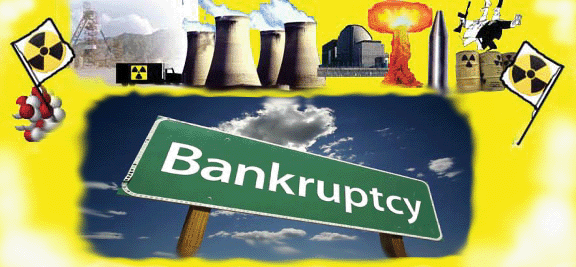
Drago Bosnic, independent geopolitical and military analyst, , October 16, 2023 https://infobrics.org/post/39611
The United States likes to boast about its much-touted industrial might and how it’s still “the world’s largest and most advanced economy”. Indeed, Washington DC holds several absolute world records when it comes to the economy. Namely, it has the highest national debt in the history of mankind, incurred by going all over the world, burning, pillaging, murdering and generally destroying the lives of hundreds of millions. Back in mid-September, the US national debt topped $33 trillion for the first time. Worse yet, by October 12 (just a bit more than 20 days later) it already grew another $520 billion. In August, it was estimated that the US budget deficit will be $1.7 trillion by year’s end, although experts now believe it’s extremely likely to go past that and reach around $2 trillion. If true, this means the deficit will grow by over 40% in comparison to last year when it stood at around $1.4 trillion.
The US debt-to-GDP ratio is nearly 130%, but Washington DC keeps raising the debt ceiling. Namely, in January 2023, the belligerent thalassocracy hit its debt limit and by June 2023, it was forced to suspend it to avoid default. We all remember last year and how the political West kept patting itself on the back for effectively stealing hundreds of billions in Russian foreign reserves and denying Moscow the ability to service its debt. The mainstream propaganda was maliciously overjoyed with the prospect of Russia’s artificially induced default. And yet, this never happened, while the US is the one that found itself in a near-default situation. What’s more, the only way to avoid it was to use a perpetual “cheat code” that simply enables it to incur more debt. A responsible government would do something to prevent the escalation of the crisis, but Washington DC has other plans.
Apart from making sure that its economic issues spill over to the rest of the world, where impoverished and heavily exploited countries pay the price of US imperialism, the belligerent thalassocracy keeps militarizing and creating enemies in order to feed the monstrosity called the American Military Industrial Complex (MIC). Back in late March, as the debt ceiling crisis was unfolding, General Mark Milley, Chairman of the Joint Chiefs of Staff, stated that the Pentagon would be doubling its military budget. At the time, Milley kept parroting about “a looming global conflict”, but clearly “forgot” to explain that if there were to ever be one, its sole cause would be the US itself, as it’s the only country on the planet with an openly stated strategy of “full spectrum dominance”. However, the only way to accomplish this is to keep spending funds that Washington DC simply doesn’t have.
Global military spending for 2022 was around $2.1 trillion, meaning that the US is already at over 40% of the world’s total with its current budget. Doubling it, even over the next several years (also taking into account that other superpowers would certainly respond to it), could push that figure close to 60%. In terms of the US federal budget, it would also require further cuts to investment in healthcare, infrastructure, education, etc. As the military currently spends approximately 15% of the entire US federal budget, obviously, doubling it would mean the percentage would go up to (or even over) 30%. Such figures are quite close to what the former Soviet Union was spending, which was one of the major factors that contributed to its unfortunate dismantlement and the later crisis in all post-Soviet countries that needed approximately a decade to recover.
As previously mentioned, such a move would also force others to drastically increase their own military spending in response to US belligerence. If China were to follow suit, its military budget would then rise to approximately $500 billion, while Russia’s military budget would be close to $200 billion. In fact, Moscow is already in the process of doing this, as it recently increased its defense spending by 70% in 2024 alone in order to tackle NATO aggression in Europe. As we can see, this is causing a military spending “death spiral” that’s extremely difficult to control and is leading the world into an unprecedented arms race. However, it seems that’s exactly what Washington DC wants. On October 12, the US Congress Strategic Posture Commission issued its final report and called for further expansion of America’s already massive arsenal of thermonuclear weapons.
It should be noted that the reasoning (although there’s hardly anything reasonable in it) behind such a decision is a simultaneous confrontation with both Russia and China. This includes massive investment into new weapons systems such as the B-21 “Raider” strategic bomber/missile carrier and Columbia-class SSBN (nuclear-powered ballistic missile submarine), as well as the replacement of the heavily outdated “Minuteman 3” ICBMs (intercontinental ballistic missiles) with new LGM-35 “Sentinel” missiles. All three types are in different stages of development and are expected to be fully operational by the early 2030s. However, with the US debt projected to reach over $50 trillion in less than ten years (the best-case scenario), the viability of such a massive expansion in American military spending is highly questionable (if possible at all).
By 2027, interest payments alone are expected to surpass the Pentagon’s entire budget. What’s more, America’s ability to keep up with the technological advances of its geopolitical adversaries is also falling short, particularly in the development of hypersonic weapons, a field in which Russia has an absolute advantage, despite spending approximately 20-25 times less on its armed forces. The only way for the US to avoid bankrupting itself is to finally leave the world alone and focus on the mountain of domestic issues that keep piling up.
Source: InfoBrics
Greenpeace Central and Eastern Europe (CEE) condemn Russian government plans to restart nuclear reactors at the Zaporizhzhia nuclear plant
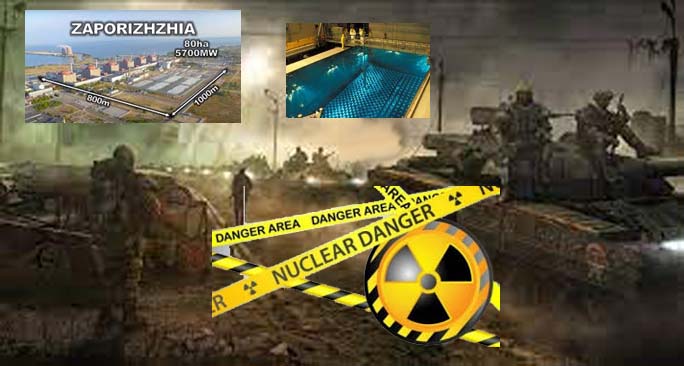
Russian government publishes first detailed plans for restart of Zaporizhzhia nuclear plant – Greenpeace condemns nuclear blackmail.
Kyiv, May 17, 2024 – Greenpeace Central and Eastern Europe (CEE) condemns in the strongest possible terms the plans of Rosatom, the Russian State Nuclear Corporation, and the Russian government to proceed with the restart of nuclear reactors at the Zaporizhzhia nuclear plant. The first details of Rosatom’s plans are contained in an official document submitted to the International Atomic Energy Agency (IAEA) by the Russian government on 14 May, 2024 [1]. The submission reveals plans for the construction of a large pumping station, designed to supply water for the nuclear plant. Following the demolition of the Nova Kakhovka dam on 6 June 2023, the Zaporizhzhia nuclear plant no longer was able to access water from the Kakhovka reservoir. The six reactors at Zaporizhzhia have been shut down since 2022. In an analysis published in February 2024, Greenpeace CEE warned that the nuclear plant site would require a new pumping system to extract water from the Dnipro river channels near the Zaporizhzhia nuclear plant. [2]
“Since Russia attacked, damaged and occupied the Zaporizhzhia nuclear plant on March 4, 2022, the risk of a nuclear disaster has been high. But if plans proceed to restart reactors at the plant the level of risk and the consequences will be much more severe. This submission to the IAEA is outrageous, with Russia claiming that its, “main task is to prevent threats to the safety and security of the plant created by the Kyiv regime.” No – the threat of a nuclear disaster is entirely due to Russia’s war and occupation of the plant – and this is another case of Russian nuclear blackmail which has the potential to explode across Ukraine and Europe,” said Shaun Burnie, nuclear specialist at Greenpeace Central and Eastern Europe.
The Russian submission to the IAEA discloses for the first time that a pumping station is to be constructed. The station would have capacity to supply up to 18,000 cubic meters of water per hour to the cooling pond. Greenpeace analysis has indicated two potential locations for the new pumping station.
In February 2024, Greenpeace CEE in its analysis of the many obstacles to restart, focused on the water problem, and urged the IAEA Director General to take a strong position against any Russian plans for restarting the Zaporizhzhia reactors. In March 2024, Greenpeace issued a warning that restart of one or more reactors at the nuclear plant site could lead to a disaster greater than Fukushima or even Chornobyl.[3] Last month, Greenpeace International wrote wrote to the IAEA Director General, Rafael Mariano Grossi, seeking assurances that the IAEA will not in any way facilitate Rosatom in the restart the reactors at the Zaporizhzhia nuclear plant.(4)
“Rosatom has no legal authority to operate the Zaporizhzhia plant – that lies entirely with the Ukrainian regulator and owner. It also lacks a sufficient number of skilled and qualified workers familiar with the Zaporizhzhia nuclear plant. For more than two years maintenance of critical installations has been wholly inadequate and on eight occasions the plant has lost all off site electrical power due to the war. The electricity supply is essential for the water cooling pumps to the reactors and spent nuclear fuel as well as other safety systems and remains highly unstable. The water supply to the cooling pond has been significantly compromised since the destruction of Nova Kakhovka dam by the Russian armed forces. Restarting one or more reactors in such a situation is not only outrageous it shows a blatant disregard for nuclear safety protocols. Urgent efforts by the international community, including the IAEA, must be made to stop these plans from being implemented,” said Jan Vande Putte, nuclear specialist at Greenpeace Belgium.
Greenpeace CEE is campaigning for comprehensive European Union sanctions against Rosatom and their nuclear partners in Europe and worldwide and actively supporting the development of renewable energy in Ukraine.
For further information:
Daryna Rogachuk, communication officer
daryna.rogachuk@greenpeace.org
1 – Communication from the Permanent Mission of the Russian Federation to the Agency, INFCIRC/1208, 15 May 2024, see www.iaea.org/sites/default/files/publications/documents/infcircs/2024/infcirc1208.pdf
2 – Greenpeace CEE, Is Rosatom Planning The Restart Of Zaporozhzhia Reactor(s)?, 3 February 2024, see https://drive.google.com/file/d/1mipUyMmnA0XXlD57UOQfduYkvj6LcANb/view
3 – Greenpeace Germany, Second anniversary of Russia’s nuclear plant attack in Ukraine, 5 March 2024, see https://www.greenreconstruction.com/news/second-anniversary-of-russias-nuclear-plant-attack-in-ukraine
4 – Greenpeace CEE, Grim anniversary: Zaporizhzhia nuclear plant must not become the next Chornobyl, 26 April 2024, see https://greenpeace.at/cee-press-hub/chornobyl-38-anniversary/
A New Russian Offensive Stretches Ukrainian Forces. Possibly To The Breaking Point.
Just as important an explanation for Ukraine’s struggles is the lack of men. Ukrainian troops are outmanned and exhausted, and casualty rates are soaring.
Radio Free Europe, By Mike Eckel , May 17, 2024
Ukrainian civilians evacuated from border regions with Russia. An important east-west highway in the eastern Donetsk region threatened by encroaching Russian forces. A village captured by Ukraine during last year’s counteroffensive about to return to Russian control. Ukraine’s president cancels all foreign trips.
The news from Ukraine’s battlefield these days is grim: Russia is advancing. Ukraine is struggling to hold its positions, if not outright retreating.
Still, there’s little doubt that Ukraine’s exhausted, outmanned, and possibly still-outgunned forces are struggling in a way not seen possibly since the opening days of the invasion.
“By stretching Ukrainian forces along a wide front, Russia is overcoming the limitations of its undertrained army,” Jack Watling, a senior research fellow at the Royal United Services Institute, said in a report released this week. “Russia has now started the early phases of its anticipated summer offensive with renewed attacks on Kharkiv.”
Here’s where things stand at present on Ukraine’s battlefield.
Ukrainian forces were already under severe pressure in several locations along the 1,100-kilometer front line even before Russia launched a localized offensive north of Ukraine’s second largest city, Kharkiv, last week. Troops moved into a “gray zone” — Ukrainian territory that’s not fully controlled by either Ukrainian or Russian forces. On May 16, Russian units appeared to have entered the town of Vovchansk, about 5 kilometers from the border, and the site of the fiercest fighting in the north.
By some estimates, the amount of territory Ukrainian troops have ceded in recent months is greater than the earliest months after the full Russian invasion in February 2022.
Western military officials, however, downplay Russian chances for a wider breakthrough.
“They don’t have the skill and the capability to do it, to operate at the scale necessary to exploit any breakthrough to strategic advantage,” U.S. Army General Christopher Cavoli said on May 17. “They do have the ability to make local advances and they have done some of that.”
Still, there’s little doubt that Ukraine’s exhausted, outmanned, and possibly still-outgunned forces are struggling in a way not seen possibly since the opening days of the invasion.
“By stretching Ukrainian forces along a wide front, Russia is overcoming the limitations of its undertrained army,” Jack Watling, a senior research fellow at the Royal United Services Institute, said in a report released this week. “Russia has now started the early phases of its anticipated summer offensive with renewed attacks on Kharkiv.”
Here’s where things stand at present on Ukraine’s battlefield.
What’s Happening On The Ground?
After Ukraine’s much-hyped counteroffensive fizzled late last year both sides began retooling and resupply, girding for the next major clashes. Russia, however, seized the initiative to push into the industrial city of Avdiyivka, where Ukraine was able to threaten the Russian-controlled regional administrative center of Donetsk to the southeast. The city fell to Russian forces in February.
Last month, Russian troops took advantage of a Ukrainian troop rotation — some reports say botched — and pushed northwest of Avdiyivka to take control of the village of Ocheretyne. Creeping north and northwest, Russian forces have moved closer to threatening the N32 highway, which runs from Pokrovsk, northeast to the railway town of Kostyantynivka.
Just east of Kostyantynivka is Chasiv Yar, a village on high ground that Russia is hellbent on capturing.
Ukrainian forces have repelled the effort so far, in part by using a water canal that runs through its eastern district as a holding line. Captain Oleh Kalashnikov, a spokesman for the 26th Separate Mechanized Brigade, told Current Time that Russia had fielded as many as 25,000 troops, including elite paratroop units, in their push to take the city.
Seizing Chasiv Yar would allow Russia to threaten Kostyantynivka and its rail and roadway used by Ukraine to resupply its forces. It would crack the door toward Kramatorsk to the north, and Slovyansk, both large population centers and redoubts of Ukrainian troops and supplies.
On May 10, meanwhile, Russian infantry crossed the border north and northeast of Kharkiv, attacking in two different locations, seizing a handful of small settlements, and opening a new front The village of Vovchansk came under some of the worst shelling, forcing rescuers to rush to evacuate civilians………………………………………………
Hundreds of kilometers to the southwest, in the Zaporizhzhya region, Russian forces claimed to have retaken Robotyne, one of a handful of villages that Ukraine succeeded in capturing in its counteroffensive — their biggest to date. Ukrainian officials denied the claim, but if the village does fall, its loss would be a symbolic blow.
“It’s a challenging situation on the battlefield right now in Ukraine,” U.S. Major General Pat Ryder, a Pentagon spokesman, said this week.
“The Russians have exploited the situation on the battlefield, and are attempting to make advances,” he said. “Incremental as they may be, it’s certainly concerning.”
Why Is It Happening?
Continue readingIran’s new leaders stand at a nuclear precipice
The world’s atomic watchdog fears a terrifying regional arms race
The Economist 20 May 24
On may 6th Rafael Grossi, the director-general of the International Atomic Energy Agency (iaea), travelled to Tehran and met Hossein Amirabdollahian, Iran’s foreign minister. Less than two weeks later, on May 19th, Mr Amirabdollahian was dead, killed in a helicopter crash that also took the life of Ebrahim Raisi, Iran’s president, among others.
Their deaths throw Iran’s sclerotic theocracy into a moment of confusion and uncertainty, one with far-reaching implications for the country’s nuclear programme. Mr Grossi, fresh from his trip to Iran, recently spoke to The Economist about the Iranian nuclear file, as well as the other items on his forbidding to-do list, from the Russian-occupied Zaporizhia nuclear-power plant in Ukraine to the “growing attraction” of nuclear weapons worldwide……………………(Subscribers only) https://www.economist.com/international/2024/05/20/irans-new-leaders-stand-at-a-nuclear-precipice
—
-
Archives
- February 2026 (220)
- January 2026 (308)
- December 2025 (358)
- November 2025 (359)
- October 2025 (376)
- September 2025 (258)
- August 2025 (319)
- July 2025 (230)
- June 2025 (348)
- May 2025 (261)
- April 2025 (305)
- March 2025 (319)
-
Categories
- 1
- 1 NUCLEAR ISSUES
- business and costs
- climate change
- culture and arts
- ENERGY
- environment
- health
- history
- indigenous issues
- Legal
- marketing of nuclear
- media
- opposition to nuclear
- PERSONAL STORIES
- politics
- politics international
- Religion and ethics
- safety
- secrets,lies and civil liberties
- spinbuster
- technology
- Uranium
- wastes
- weapons and war
- Women
- 2 WORLD
- ACTION
- AFRICA
- Atrocities
- AUSTRALIA
- Christina's notes
- Christina's themes
- culture and arts
- Events
- Fuk 2022
- Fuk 2023
- Fukushima 2017
- Fukushima 2018
- fukushima 2019
- Fukushima 2020
- Fukushima 2021
- general
- global warming
- Humour (God we need it)
- Nuclear
- RARE EARTHS
- Reference
- resources – print
- Resources -audiovicual
- Weekly Newsletter
- World
- World Nuclear
- YouTube
-
RSS
Entries RSS
Comments RSS
 nuclear-news