Radiation Exposure Compensation Act (RECA) set to expire soon, while many nuclear test victims await justice .
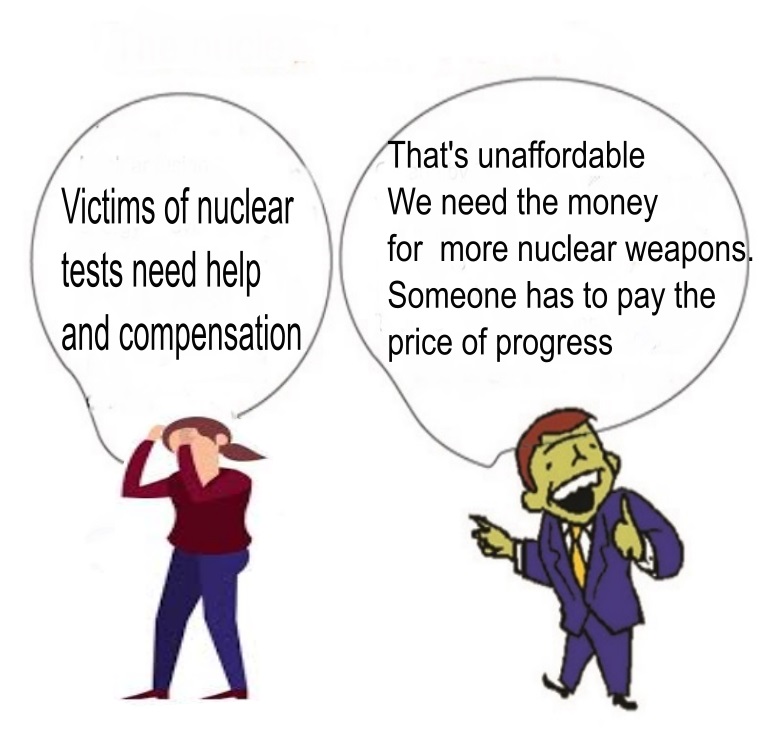
The defense spending bill for 2024 was signed into law on Dec. 22 by Biden, but the RECA expansion was cut from the final bill before it landed on his desk.
Without an extension, RECA is set to expire in June, and the deadline for claims to be postmarked is June 10, 2024, according to the DOJ.
‘Time is running out’
by beyondnuclearinternational by Shondiin Silversmith, Arizona Mirror
Navajo Nation urges Congress to act on RECA expansion bill
Kathleen Tsosie remembers seeing her dad come home every evening with his clothes covered in dirt. As a little girl, she never questioned why, and she was often more excited to see if he had any leftover food in his lunchbox.
“We used to go through his lunch and eat whatever he didn’t eat,” Tsosie said, recalling when she was around 4 years old. “And he always had cold water that came back from the mountain.”
Tsosie’s father, grandfather, and uncles all worked as uranium miners on the Navajo Nation near Cove, Arizona, from the 1940s to the 1960s. The dirt Tsosie’s father was caked in when he arrived home came from the mines, and the cold water he brought back was from the nearby springs.
Tsosie grew up in Cove, a remote community located at the foothills of the Chuska mountain range in northeastern Arizona. There are 56 abandoned mines located in the Cove area, according to the Environmental Protection Agency.
In the late 1960s, Tsosie said her grandfather started getting sick. She remembers herding sheep with him and how he would often rest under a tree, asking her to push on his chest because it hurt.
Tsosie said she was about 7 years old when her uncles took her grandfather to the hospital. At the time, she didn’t know why he was sick, but later on, she learned he had cancer. Her grandfather died in October 1967.
Over a decade later, Tsosie’s father also started getting sick. She remembers when he came to visit her in Wyoming; she was rubbing his shoulders when she felt a lump. She told him to get it checked out because he complained about how painful it was.
Her father was diagnosed with cancer in 1984 and went through treatments, but died in April 1985.
“When my dad passed away, everybody knew it was from the mine,” Tsosie said. He was just the latest on a long list of Navajo men from her community who worked in the uranium mines and ended up getting sick and passing away.
Because of that history, Tsosie became an advocate for issues related to downwinders and uranium mine workers from the Navajo Nation, including the continuation of the Radiation Exposure Compensation Act.
The Radiation Exposure Compensation Act, or RECA, provides a program that compensates individuals who become ill because of exposure to radiation from the United States’ development and testing of nuclear weapons.
RECA was initially set to expire in 2022, but President Joe Biden signed a measure extending the program for two more years. Now, it’s set to expire in less than a month…………………………………………………………………………………
In July 2023, the U.S. Senate voted to expand and extend the RECA program, and it was attached as an amendment to the National Defense Authorization Act, which funds the Department of Defense.
It could have extended health care coverage and compensation to more uranium industry workers and “downwinders” exposed to radiation in several new regions — Colorado, Missouri, New Mexico, Idaho, Montana, and Guam — and expanded coverage to new parts of Arizona, Nevada and Utah.
The defense spending bill for 2024 was signed into law on Dec. 22 by Biden, but the RECA expansion was cut from the final bill before it landed on his desk.
When she heard that the Radiation Exposure Compensation Act amendments failed to pass, Tsosie said it really impacted her, and she cried because so many people deserve that funding.
“I know what it feels like. I know what it feels like to suffer,” she said.
Without an extension, RECA is set to expire in June, and the deadline for claims to be postmarked is June 10, 2024, according to the DOJ.
The sunset of the Radiation Exposure Compensation Act is approaching fast, and leaders from the Navajo Nation are urging Congress to act on the expansion bill that has been waiting for the U.S. House of Representatives to take it up for more than two months.
“Time is running out,” Justin Ahasteen, the executive director of the Navajo Nation Washington Office, said in a press release.
“Every day without these amendments means another day without justice for our people,” he added. “We urge Congress to stand on the right side of history and pass these crucial amendments.”
Republican Sen. Josh Hawley from Missouri introduced S. 3853 – The Radiation Exposure Compensation Reauthorization Act, which funds RECA past its June sunset date for another six years.
The bill passed through the U.S. Senate with a bipartisan 69-30 vote on March 7. But since being sent to the House on March 11, the bill hasn’t moved.
The RECA expansion bill would include more communities downwind of nuclear test sites in the United States and Guam. It would extend eligibility for uranium workers to include those who worked after 1971. Communities harmed by radioactive waste from the tests could apply for the program, and expansion would also boost compensation payments to account for inflation.
“The Navajo Nation calls for immediate passage of S. 3853,” Ahasteen said in a press release. “This is to ensure that justice is no longer delayed for the Navajo people and other affected communities.”
Ahasteen told the Arizona Mirror in an interview that congressional leaders holding the bill back due to the program’s expense is not a good enough reason not to pass it.
“They keep referencing the cost and saying it’s too expensive,” he said. But, he explained, the RECA expansion is only a sliver of U.S. spending on foreign aid or nuclear development.
And it shouldn’t even be a matter of cost, Ahasteen said, because people have given their lives and their health in the interest of national security.
“The bill has been paid with the lives and the health of the American workers who were exposed unjustly to radiation because the federal government kept it from them and they lied about the dangers,” he said.
From 1945 to 1992, the U.S. conducted a total of 1,030 nuclear tests, according to the Arms Control Association.
Many were conducted at the Nevada Test Site, with 928 nuclear tests conducted at the site between 1951 and 1992, according to the Nevada National Security Site. About 100 of those were atmospheric tests, and the rest were underground detonations.
According to the United Nations Scientific Committee on the Effects of Atomic Radiation, atmospheric tests involved unrestrained releases of radioactive materials directly into the environment, causing the largest collective dose of radiation thus far from man-made radiation sources………………………………………………………………………
The legacy of uranium mining has impacted the Navajo Nation for decades, from abandoned mines to contaminated waste disposal.
From 1944 to 1986, nearly 30 million tons of uranium ore were extracted from Navajo lands, according to the EPA, and hundreds of Navajo people worked in the mines, often living and raising families in close proximity to the mines and mills.
Ahasteen said those numbers show exactly how large the uranium operations were on the Navajo Nation and the impact it would have on the Navajo people.
“There are photos on record to show Navajo people being exploited, not given any proper protective equipment, but (the federal government) knew about the dangers of radiation since the ’40s,” Ahasteen said. “They were given a shovel and a hard hat, and they were told: Go to work. You’ll earn lots of money. You’ll have a nice life, and we did that, but it didn’t work so well for us.”……………………………………………………………………………………………………………………
WHAT YOU CAN STILL DO BEFORE JUNE 7TH
Urge your U.S. Representative to push for a House floor vote on, and to vote in favor of, extending/expanding RECA, the Radiation Exposure Compensation Act. And urge House Speaker Mike Johnson to allow the vote on the House floor, on the Hawley version of RECA (the most expansive). There is likely enough support to pass the bill. Johnson’s phone is: 202-225-4000.
Shondiin Silversmith is an award-winning Native journalist based on the Navajo Nation. Silversmith has covered Indigenous communities for more than 10 years, and covers Arizona’s 22 federally recognized sovereign tribal nations, as well as national and international Indigenous issues. This article was first published by the Arizona Mirror, https://beyondnuclearinternational.org/2024/05/26/time-is-running-out-2/
16 June – WEBINAR -“NATO IN THE ARCTIC”
Sunday June 16, 2024 organized by the Global Women for Peace – United Against NATO (GWUAN)
Registration/program https://us06web.zoom.us/meeting/register/tZcrdO2tqTIuHNU2kgT-PS1xUzWZcR2tgxXQ
19.00 Helsinki/St. Petersburg time
18.00 Stockholm/Oslo/Copenhagen time
17.00 London time
12.00 Toronto/Washington time
09.00 Seattle time
08.00 Anchorage time
Description
Webinar organized by the Global Women for Peace – United Against NATO (GWUAN)
Moderator: Pippa Bartolotti – author and politician working with United National Anti-war Coalition and Global Women United for Peace against NATO
Opening words: Sean Conner – Executive Director of IPB
Event order: 1. US, Canada, Russia – 30 min
US: Bruce Gagnon, Coordinator Global Network Against Weapons & Nuclear Power in Space – Breaking Russia up to get at Arctic resources
Canada: Tamara Lorincz – Pugwash Group, Voice of Women for Peace, WILPF – The militarization of Canada’s Arctic
Russia: Oleg Bodrov – physicist, ecologist, board member of the International Peace Bureau, Chairman of the Public Council of the South Coast of the Gulf of Finland, St. Petersburg, Russia – Victory With Weapons is Impossible in the Atomic World
Discussion 20 min
2. Norway, Sweden, Denmark/Greenland, Finland – 40 min
Norway: Ingeborg Breines – Former Chair of IPB and UNESCO Director – The militarization especially in the Norwegian Arctic, new American bases and the Arctic Council
Sweden: Lars Drake – Environmental economist and former adjunct professor at the Swedish University of Agricultural Sciences – Natural resources in the Arctic – extraction, environment and international conflicts
Denmark/Greenland: Palle Bendsen – long time climate, environmental, anti-nuclear activist, involved in opposition to uranium mining plans in Southern Greenland. Engaged in the Danish Centre for Conflict Resolution and the Council for International Conflict Resolution, where he in 2019 authored an analysis of the “changing Arctic” – The Arctic is Changing – AGAIN
Finland: Teemu Matinpuro, executive director of the Finnish Peace Committee – Finland – NATO – DCA – the Arctic
Discussion 30 min
Supporters of the webinar: – GWUAN (Global Women for Peace United Against NATO) – IPB (International Peace Bureau) – Global Network Against Weapons & Nuclear Power in Space – World BEYOND War
Biden and the ballot box
We’ve learned too late that the love affair between Butcher Bibi and Genocide Joe is an unbreakable bond, writes LINDA PENTZ GUNTER

LET ME be clear. I have never had a love affair with Joe Biden. Not that kind of love affair. But politically, like many on the left, I’ve been willing to check his name at the ballot box while overlooking a few of his political shortcomings because, so we told ourselves, Biden is at heart a decent human being.
At first, as Israel’s genocidal retaliation for the October 7 Hamas attacks continued, I remained reluctantly in the camp willing to vote for Biden in November. However tightly one might have to hold one’s nose, it was imperative to preserve our democracy and keep Donald Trump out of the White House. In the meantime, surely Biden would step up and stop the bloodshed in Gaza.
That was then. This is now.
For months we rallied and lobbied, voted “uncommitted” in the primaries and called for a ceasefire. President Biden ignored all of it. He has now fully earned the nickname given to him by the thousands of students occupying their campuses across the country: “Genocide Joe.”
I cannot vote for Biden in November.
I had already written this column last week but democratic socialist, Senator Bernie Sanders, kept insisting a vote for Biden was essential to keep fascism from our door. So I hesitated. Then I read Biden’s response to the International Criminal Court’s announcement on Monday that it would seek arrest warrants for Israeli Prime Minister Benjamin Netanyahu and Minister of Defence Yoav Gallant.
I hit “Send.”
Biden called the ICC announcement “outrageous” and said unambiguously, “there is no equivalence — none — between Israel and Hamas. We will always stand with Israel against threats to its security.”
That’s the true love affair: Butcher Bibi and Genocide Joe. We’ve learned too late that it’s an unbreakable bond and that Joe Biden is not, in fact, a “decent human being.”
To be unmoved by a genocide is incomprehensible. To be unmoved when you could stop it, is unforgivable. To actively aid and abet it by supplying the arms that do the killing, is abhorrent. The Biden administration is guilty on all three counts.
And entirely unrepentant. The White House has played a craven game of deception for months, purely for political ends. There have been many low points but one of the worst was the recent announcement that the US would withhold transfer of certain larger, more destructive weapons to Israel. This seemed, on the surface, a step in the right direction, and was initially welcomed as such.
However, it was followed two days later by the release of a likely deliberately delayed White House report that said there was “insufficient information” to be sure that US-supplied weapons were being used by Israel in violation of human rights law. The green light was back on to keep US arms to Israel flowing.
Worse, the report actually stated that Israel “has had to confront an extraordinary military challenge.” Fewer than 300 Israeli soldiers have been killed so far since Israel’s assault on Gaza began. More than 35,000 Palestinians have died, almost all civilians and mostly women and children.
Who, exactly, is facing “an extraordinary military challenge” here? But Biden says there is “no equivalence.” Incredible.However, it was followed two days later by the release of a likely deliberately delayed White House report that said there was “insufficient information” to be sure that US-supplied weapons were being used by Israel in violation of human rights law. The green light was back on to keep US arms to Israel flowing.
Worse, the report actually stated that Israel “has had to confront an extraordinary military challenge.” Fewer than 300 Israeli soldiers have been killed so far since Israel’s assault on Gaza began. More than 35,000 Palestinians have died, almost all civilians and mostly women and children.
Who, exactly, is facing “an extraordinary military challenge” here? But Biden says there is “no equivalence.” Incredible.
Not voting for Biden in November will be a choice made under the threat of a massive campaign of blame shifting. Should Donald Trump win back the White House, those of us who could not vote for Biden will be told it was our fault.
But the responsibility for preventing what would be an unarguable catastrophe should Trump prevail lies with Biden, not us. To stave off fascism, Biden needs to give us an actual choice and win the White House on merit, not by default.
Linda Pentz Gunter is a writer based in Takoma Park, Maryland.
Texas A&M University System To Bring Nuclear Reactors To Texas A&M-RELLIS

Initiative aims to enhance Texas’ power grid and support technological growth with advanced nuclear energy solutions.
By Texas A&M University System, MAY 29, 2024
Leaders at The Texas A&M University System announced plans Wednesday to bring the latest nuclear reactors to Texas A&M-RELLIS.
John Sharp, chancellor of the Texas A&M System, said the System seeks to provide a platform for companies to test the latest reactors and technologies. It also will address the pressing need for increased power supply…………………………………….
To kickstart the latest nuclear initiative, the Texas A&M System will be seeking information — and later proposals — from manufacturers of nuclear reactors. Ultimately, the site could host multiple electrical power-generating facilities, and it could host first-of-a-kind reactors with a net increase of up to 1 GW of capacity that will have a direct connection to the grid operated by Electric Reliability Council of Texas, Inc., or as it is more commonly called, ERCOT..
Representatives from the System and from the companies hope to stand up operational reactors within the next five to seven years. https://today.tamu.edu/2024/05/29/texas-am-university-system-to-bring-nuclear-reactors-to-rellis/
Rare spat shows China and North Korea still at odds on nuclear weapons
Japan Times, BY JOSH SMITH, SEOUL, May 29, 2024
North Korea’s rare swipe at China this week underscored how Beijing and Pyongyang do not entirely see eye-to-eye on the latter’s illicit nuclear weapons arsenal, despite warming ties in other areas, analysts and officials in South Korea said.
The North condemned China, Japan and South Korea on Monday for discussing denuclearization of the peninsula, calling their joint declaration after a summit in Seoul a “grave political provocation” that violates its sovereignty.
Even though Beijing helped tone down the statement by advocating mention of the peninsula rather than the North specifically, that was enough to raise its neighbor’s hackles, one analyst said.
“It is notable that North Korea criticized a joint statement that China had signed onto, even after Beijing helped water down the statement,” added Patricia Kim, of the Brookings Institution in the United States.
In their remarks, the three nations “reiterated positions on regional peace and stability, denuclearization of the Korean Peninsula” but unlike the last such statements in 2019 and earlier, did not commit to pursue denuclearization.
Since international talks with the United States and other countries stalled in 2019, North Korea has moved to reject the concept of ever giving up its nuclear weapons.
“This is about North Korea emphasizing its stance that any diplomatic rhetoric suggesting Pyongyang should eventually denuclearize is unacceptable,” said Tong Zhao, a nuclear expert at the Carnegie Endowment for International Peace.
“After enshrining its nuclear status in the constitution and reprimanding anyone who questions it, North Korea is raising demands for formal international recognition as a nuclear-armed country.”……………………………………… more https://www.japantimes.co.jp/news/2024/05/29/asia-pacific/politics/china-north-korea-nuclear-weapons/—
Protest continues against Japan’s further discharge of nuke-contaminated water
By Jiang Xueqing in Tokyo https://www.chinadaily.com.cn/a/202405/26/WS66531eb9a31082fc043c9296.html
2024-05-26
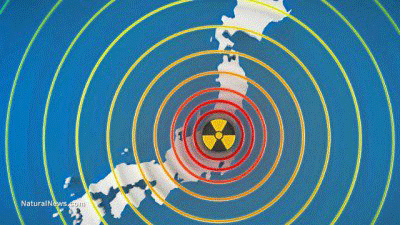
Japanese people continued to strongly oppose the discharge of nuclear-contaminated water from the wrecked Fukushima Daiichi nuclear power plant into the ocean during the latest round of radioactive water release.
Tokyo Electric Power Company, the operator of the Fukushima plant, started the sixth round of releasing nuclear-contaminated water into the sea on May 17. The company said it plans to discharge approximately 7,800 metric tons of radioactive water through June 4.
During a rally in front of the Prime Minister of Japan’s office in Tokyo on Friday, Kem Komdo, a 61-year-old Tokyo resident, said the discharge of nuclear-contaminated water into the ocean has no benefits at all, and the main risk is marine pollution.
Although Japanese media is promoting that the water treated through the Advanced Liquid Processing System, or ALPS, only contains tritium, Komdo said that is not true. He emphasized that the radioactive water contains various hidden contaminants that have come into contact with fuel debris, so the actual situation must be made clear.
“The (Japanese) government and TEPCO always tell the media to call it ‘ALPS-treated water’, not nuclear-contaminated water, saying that calling it nuclear-contaminated water causes harmful rumors. But that statement is clearly wrong because this is indeed contaminated water,” Komdo said. “By forcing us to call it ‘ALPS-treated water,’ TEPCO and the government are trying to evade responsibility for the Fukushima nuclear accident.”
The Fukushima Daiichi nuclear power plant suffered a triple meltdown following a major earthquake and subsequent tsunami on March 11, 2011.
Komdo said the Japanese government should change its policy to avoid discharging nuclear-contaminated water into the ocean and immediately switch to land storage as there is still space available.
“Otherwise, the government won’t gain the trust of China and other Pacific island countries, and it will also affect other diplomatic relations,” he said.
CNN Analysis Reveals US-Made Munitions Used in Rafah Massacre

Multiple weapons experts have confirmed that munitions manufactured by Boeing were used in the deadly strike that sees at least 45 dead.
By Diego Ramos / ScheerPost May 29, 2024
ACNN report revealed that Israel used American made munitions in Sunday’s deadly strike on the displacement camp in Rafah. Scenes of the assault, which killed at least 45 people and injured hundreds more, have spread across social media, showing burned bodies, beheaded children and civilians frantically attempting to escape.
According to the CNN analysis, the attack occurred at “Kuwait Peace Camp 1.” Videos shared on social media enabled reporters to identify the tail of a GBU-39 small diameter bomb, a U.S.-made weapon manufactured by Boeing. The analysis also revealed serial numbers on the bomb remnants, tracing the manufacturer of certain components to facilities in California.
CNN spoke to several weapons experts and veterans regarding the bomb’s identification as a Boeing GBU-39. According to Trevor Ball, a former U.S. Army senior explosive ordnance disposal team member:
“The warhead portion [of the munition] is distinct, and the guidance and wing section is extremely unique compared to other munitions. Guidance and wing sections of munitions are often the remnants left over even after a munition detonates. I saw the tail actuation section and instantly knew it was one of the SDB/GBU-39 variants.”
Chris Cobb-Smith, an explosive weapons expert and former British Army artillery officer, told CNN that the GBU-39 is a high-precision munition but “using any munition, even of this size, will always incur risks in a densely populated area.”
Richard Weir, senior crisis and conflict researcher at Human Rights Watch, and Chris Lincoln-Jones, a former British Army artillery officer and weapons and targeting expert also identified the fragments of the U.S.-made GBU-39 for CNN.
Despite pledging to stop supplying weapons “if they go into Rafah,” President Joe Biden is not expected to alter his support for Israel. https://scheerpost.com/2024/05/29/cnn-analysis-reveals-us-made-munitions-used-in-rafah-massacre/
Dounreay nuclear site workers strike in pay dispute
More than 500 workers at the Dounreay nuclear site have gone on strike in
a dispute over pay. Unite and GMB members have walked out after rejecting a
revised offer from Nuclear Restoration Services (NRS) made earlier this
month. Prospect union members accepted the deal after previously being
involved in the dispute at the complex near Thurso. Unite and GMB are
planning a further 24-hour strike on 19 June.
BBC 28th May 2024
Damning scientific report condemns the Australian Opposition’s push for nuclear power
Coalition’s brave nuke world a much harder sell after new CSIRO report
Graham Readfearn, https://www.theguardian.com/australia-news/article/2024/may/26/coalitions-brave-nuke-world-a-much-harder-sell-after-new-csiro-report?CMP=soc_568
The agency’s GenCost analysis says a first nuclear plant for Australia would deliver power ‘no sooner than 2040’ and could cost more than $17bn
The Coalition’s pitch on nuclear energy for Australia has had two recurring themes: the electricity will be cheap and it could be deployed within a decade.
CSIRO’s latest GenCost report – a document that analyses the costs of a range of electricity generation technologies – contradicts both of these points. It makes the Coalition’s job of selling nuclear power plants to Australians ever more challenging.
For the first time, the national science agency has calculated the potential costs of large-scale nuclear electricity in a country that banned the generation technology more than a quarter of a century ago.
Even using a set of generous assumptions, the CSIRO says a first nuclear plant would deliver power “no sooner than 2040” and could cost more than $17bn.
It is likely to spark an attack on the credibility of the report from nuclear advocates and those opposed to the rollout of renewable energy. Opposition leader, Peter Dutton, has already attacked the report.
In the meantime, Australia waits for the Coalition to say what kind of reactors it would deploy, where it would put them and how much it thinks they would cost.
Now that CSIRO has released its report, here’s what we know about the viability of a nuclear industry in Australia.
What’s new on nuclear costs?
CSIRO’s GenCost report says a 1,000 megawatt nuclear plant would cost about $8.6bn to build, but that comes with some large caveats. The main one is that this was the theoretical cost of a reactor in an Australia that already had an established and continuous program of building reactors.
The $8.6bn is based on costs in South Korea, which does have a continuous reactor building program and is one country the least beset by cost blowouts.
To make the cost more relevant, CSIRO compared the Australian and South Korean costs of building modern coal plants. Costs were more than double in Australia.
But CSIRO warns the first nuclear plants in Australia would be subject to a “first of a kind” premium that could easily double the $8.6bn build cost.
In the UK, a country that has been building reactors intermittently, costs for its under-construction Hinkley C reactor (more than three times the size of a theoretical 1,000MW reactor in Australia) started at $34bn and could now be as high as $89bn.
In the United States, the country’s largest nuclear plant has just turned on its final unit seven years behind schedule and at double the initial cost. There are no more nuclear plants under construction in the country.
What about the cost of the electricity?
CSIRO also offers cost estimates for the electricity produced by large-scale reactors, but those too assume a continuous nuclear building program in Australia.
Electricity from large-scale reactors would cost between $141 per megawatt hour and $233/MWh if they were running in 2030, according to GenCost.
Combining solar and wind would provide power at between $73 and $128/MWh – figures that include the costs of integrating renewables, such as building transmission lines and energy storage.
What about those small modular reactors?
The Coalition has also advocated for so-called “small modular reactors” which are not commercially available and, CSIRO says, are unlikely to be available to build in Australia until 2040.
One United States SMR project lauded by the Coalition collapsed in late 2023 because the cost of the power was too high.
That project, CSIRO says, was significant because its design had nuclear commission approval and was “the only recent estimate from a real project that was preparing to raise finance for the construction stage. As such, its costs are considered more reliable than theoretical projects.”
GenCost reports that power from a theoretical SMR in 2030 would cost between $230 and $382/MWh – much higher than solar and wind or large-scale nuclear.
How quickly could Australia build a nuclear plant?
Nuclear advocates tend to point to low nuclear power costs in countries that have long-established nuclear industries.
Australia has no expertise in building nuclear power, no infrastructure, no regulatory agency, no nuclear workforce and a public that is yet to have a serious proposition put in front of it.
Australia’s electricity grid is fast evolving from one dominated by large coal-fired power plants to one engineered for and dominated by solar, wind, batteries and pumped hydro with gas-fired power working as a rarely used backup.
This creates a major problem for the Coalition, because CSIRO estimates “if a decision to pursue nuclear in Australia were made in 2025, with political support for the required legislative changes, then the first full operation would be no sooner than 2040.”
Tony Wood, head of the Grattan Institute’s energy program, says: “By 2040, the coal-fired power stations will be in their graves. What do you do in the meantime?”
“You could keep the coal running, but that would become very expensive,” he says, pointing to the ageing coal fleet that is increasingly beset by outages.
Wood says the GenCost report is only a part of the story when it comes to understanding nuclear.
The Coalition, he says, would need to explain how much it would cost to build an electricity system to accommodate nuclear.
Could you just drop nuclear into the grid?
The biggest piece of generation kit on Australia’s electricity grid is a single 750 megawatt coal-fired unit at Kogan Creek in Queensland. Other power stations are larger but they are made up of a series of smaller units.
But the smallest of the “large-scale” nuclear reactors are about 1,000MW and most are 1,400MW.
Electricity system engineers have to build-in contingency plans if large units either trip or have to be pulled offline for maintenance. That contingency costs money.
In Australia’s current electricity system, the GenCost report says larger nuclear plants would probably “require the deployment of more generation units in reserve than the existing system consisting of units of 750MW or less.”
But by the time a theoretical nuclear plant could be deployed, most if not all the larger coal-fired units will be gone.
Who might build Australian nukes?
Some energy experts have questioned whether any company would be willing to take up a contract to build a reactor in Australia when there are existing nuclear nations looking to expand their fleets.
Right now, nuclear reactors are banned federally and in several states.
The GenCost report also points to another potential cost-raiser for nuclear – a lack of political bipartisanship.
The report says: “Without bipartisan support, given the historical context of nuclear power in Australia, investors may have to consider the risk that development expenses become stranded by future governments.”
Attacks on ICC Show ‘Condemning Hamas’ Is Really About Absolving Israel
FAIR ARI PAUL, 29 May 24
“Do you condemn Hamas?” This question is a familiar response from corporate journalists and pro-Israel advocates whenever anyone urges the Israeli military to stop its offensive in Gaza (Declassified UK, 11/4/23; Forward, 11/10/23; Jewish Journal, 11/29/23). If you denounce Israel’s response to the attacks without condemning Hamas, the insinuation goes, you are defending the militant group and the killing of Israeli civilians.
If you don’t start off by condemning Hamas’ attack, the British pundit Piers Morgan (Twitter, 11/23/23) said, “why should anyone listen to you when you condemn Israel for its response?”
The International Criminal Court surely condemned Hamas when an ICC prosecutor, Karim Khan, sought arrest warrants for Hamas’ three principal leaders along with Israeli Prime Minister Benjamin Netanyahu and his defense minister (Reuters, 5/21/24). That hasn’t helped the ICC in the press. By condemning both Hamas and Israel leaders for illegal acts of violence, the ICC is delegitimizing Israel, editorialists say.
‘A slander for the history books’
“Lumping them together is a slander for the history books. Imagine some international body prosecuting Tojo and Roosevelt, or Hitler and Churchill, amid World War II,” the Wall Street Journal editorial board (5/20/24) said. It added that “Israel has facilitated the entry of 542,570 tons of aid, and 28,255 aid trucks, in an unprecedented effort to supply an enemy’s civilians.”
For the record, the UN has estimated that Gaza needs 500 truckloads of humanitarian aid a day—so nearly four times as many as Israel has allowed in. Israeli soldiers have reportedly helped protesters block aid trucks (Guardian, 5/21/24), while the IDF has relentlessly targeted medical facilities (Al Jazeera, 12/18/23). And Israeli “forces have carried out at least eight strikes on aid workers’ convoys and premises in Gaza since October 2023,” according to Human Rights Watch (5/14/24).
The New York Post editorial board (5/20/24) engages in the same logic, saying Hamas leaders are “cold-blooded savages—who target innocent civilians for murder, rape and kidnapping,” while Israel is pure at heart: “law-abiding, democratic victims, who merely seek to eradicate the terror gang.”
Back on Planet Earth, Israel has targeted hospitals, journalists, schools and aid workers. The United Nations has declared a famine is underway (AP, 5/6/24), and its data show the death toll for Palestinians since October 7 is nearly 30 times larger than for Israelis, a testament to the conflict’s imbalance of might and ferocity. The UN estimates nearly 8,000 Gazan children have been killed (NPR, 5/15/24)…………………………………………………………………………………………………….
Some editorial boards have been calling for an end to the butchery in Gaza (LA Times, 11/16/23; Boston Globe, 2/23/24). But there is still a loud, booming editorial voice that is in line with official thinking in Washington: There is no red line for Israel. Anything goes. No matter what atrocity it commits, editorialists will ignore it and proclaim Israel the victim. https://fair.org/home/attacks-on-icc-show-condemning-hamas-is-really-about-absolving-israel/
TODAY: What is criminal in Ukraine, is God’s righteousness in Gaza
RUSSIA. US President Joe Biden welcomed the International Criminal Court’s issuing of an arrest warrant against his Russian counterpart, Vladimir Putin.
The ICC accused President Putin of committing war crimes in Ukraine – something President Biden said the Russian leader had “clearly” done…… President Biden said that … the issuing of the warrant “makes a very strong point”. The claims focus on the unlawful deportation of children from Ukraine to Russia since Moscow’s invasion in 2022.
“He’s clearly committed war crimes,” he told reporters.
His administration had earlier “formally determined” that Russia had committed war crimes during the conflict in Ukraine, with Vice-President Kamala Harris saying in February that those involved would “be held to account”.
****************************
ISRAEL. President Joe Biden denounced the chief prosecutor of the world’s top war crimes court for seeking arrest warrants for Israeli and Hamas leaders.
“What’s happening in Gaza is not genocide. We reject that,” Mr Biden said at a Jewish American Heritage Month event at the White House.
He said American support for the safety and security of Israelis is “ironclad”.
Biden administration presents its policies to overcome legal and political questions about its unconditional support for Israel, and continues to send weapons to Israel.
The US has vetoed three separate ceasefire draft resolutions at the United Nations Security Council and voted against two at the General Assembly.
Rights groups have documented numerous violations of international humanitarian law by the Israeli military, which extensively uses US weapons. Those reports include evidence of indiscriminate bombing, torture and targeting civilians.
38 Years After Chernobyl Disaster, 12% of Belarus’s Territory Is Still Contaminated
Belarus is not communicating anything about Chernobyl to other countries.
May 26, 2024 by Global Voices, By Daria Dergacheva, https://goodmenproject.com/featured-content/38-years-after-chernobyl-disaster-12-of-belaruss-territory-is-still-contaminated/
On April 26, 1986, a catastrophic accident occurred at the Chernobyl Nuclear Power Plant. A planned shutdown of the reactor, lasting 20 seconds, seemed like a routine check of electrical equipment. However, a few seconds later, a chemical explosion released about 520 types of dangerous radionuclides into the atmosphere. Thirty-eight years later, Belarusian officials say 12 percent of the country’s territory is still contaminated.
The Chernobyl Nuclear Power Plant was located near the city of Pripyat in northern Ukraine, then part of the Ukrainian SSR, close to the border with the Byelorussian SSR. Pripyat has been abandoned since the year of the accident, and an exclusion zone was created with a radius of 30 km around the plant. Over 100,000 people were evacuated from the zone
To the north of the Ukrainian part of the Exclusion Zone is the Polesie State Radiation-Ecological Reserve, which belongs to the territory of the Republic of Belarus. There are 96 abandoned settlements in the area, where more than 22,000 residents lived before the accident and evacuation in 1986.
According to Belarus state media, in the end of April 2024, the first deputy head of the State Atomic Inspectorate in Belarus Leonid Dedul said during a press-conference:
As a result of explosions and fires, about 200 types of radionuclides with half-lives ranging from a few hours to hundreds of thousands of years were released into the atmosphere, with Belarus taking the main blow. For example, if we consider the radionuclide cesium-137, 35 percent of the total amount that fell down landed in our country. This radionuclide accounts for about 90 percent of the radiation dose load on the population. Since the post-accident period, the area of contaminated territory in Belarus by cesium-137 has decreased by almost half and now amounts to about 25.5 thousand square kilometers, or 12 percent of the country’s total area.
Today, more than 2,000 populated areas are located in radioactive contamination zones, with approximately 930,000 people (185,000 of whom are children) living in them.
Although the state media reports on the success of Belarusian state-sponsored Chernobyl program that deals with economic, social and environmental consequences of the disaster, those outside the country are skeptical about it.
Alyaksandr Lukashenka, who has been the leader of Belarus for 30 years now, said that the program worked so well that it has “beaten Chernobyl in the face.”
However, Belarusian historian Alexander Fridman thinks that Lukashenka’s regime, through propaganda, is manipulating public memory and opinion around the tragedy. Economic goals, he says, and the ability to use contaminated territories for them, were the driver of Lukashenka’s Chernobyl program. In his opinion piece for DW, he says the people were overlooked, and research that showed grave consequences of using the land even after years have passed was repressed.
One of the researchers was Yury Bandazhevsky, former director of the Medical Institute in Gomel, a scientist working on the consequences of the Chernobyl disaster. He was sentenced to eight years imprisonment in Belarus in 2001. According to many human rights groups Dr. Bandazhevsky was a prisoner of conscience. His arrest came soon after he published reports critical of the official research being conducted into the Chernobyl incident.
He was released on parole in 2005, and is now working in Ukraine. Bandazhevsky said in one of his interviews to the DW 30 years after the disaster:
I believe that even three decades after the Chernobyl disaster, the situation hasn’t changed enough to allow for safe living and agricultural activities in these territories. Yes, the radiation levels of cesium-137 and strontium-90, which have a half-life of about 30 years, have indeed decreased. However, cesium’s half-life product is barium, which hardly exits cells.
Radionuclides have migrated into the soil, entering biological chains into plants, animals, and humans, affecting the cells of vital organs. This is ignored by those [officials] who speak of safe living in areas affected by the nuclear power plant accident.
We began to study the changes occurring in the human body under the influence of radioactive elements in the fifth year after the explosion. At that time, we recorded serious pathologies of internal organs — brain, heart, and endocrine system — that could be assessed as a result of direct radiotoxic exposure. But [Belarusian] officials didn’t want to connect cause and effect. Meanwhile, in the Vetka district of Belarus, many of the children we observed in 1993–1995 have died.
We must consider that victims can also include those who live far from the Chernobyl area but consume products from there. In Belarus, after the Chernobyl accident, some “smart” individuals came up with the idea to mix “clean” products with “dirty” ones. In the Gomel region, contaminated lands were initially secretly, then openly, used to produce agricultural products, with livestock being fed grain from there. Products from the region continue to be distributed throughout the republic. Now, the situation has reached the point where these territories are reclassified as “clean,” saving on social payments.
In October 2023, as the media reported, an NGO, Children of Chernobyl, which had helped thousands of kids from contaminated areas to visit European countries in order to receive health and psychological support, was shut down by a Belarusian court as part of ongoing crack down on Belarusian civil society. In addition, for over two years since the Russian full-scale invasion of Ukraine started (supported by Lukashenka), Belarus is not communicating any research or other issues about Chernobyl to other countries, apart from rare meetings of IAEA, Belarusian state media reports. Thus, it is impossible to conduct an independent evaluation of what is going on in contaminated areas of Belarus. It is safe to suggest that, until Lukashenka’s regime fails, the public within and outside the country will not know the real cost of the 1986 Chernobyl disaster for Belarus.
Space junk is raining from the sky. Who’s responsible when it hits the Earth?

With more rockets launching each year, there’s more risk of falling debris causing damage — or hitting someone
Nicole Mortillaro · CBC News ·May 28, 2024 , https://www.cbc.ca/news/science/space-debris-responsibility-1.7211473#:~:text=It%20says%20that%20countries%20are,absolute%20liability%2C%22%20she%20said.
In March 2022, a couple living in the rural town of São Mateus do Sul, Brazil, were shocked to find a 600-kilogram piece of smashed metal lying just 50 metres from their home.
Four months later, two Australian sheep farmers found a strange, black object that appeared to have embedded itself in a field.
Then last week, a farmer in Ituna, Sask., found a similar object in his wheat field.
Alien invasion? Nope. All pieces of SpaceX debris that had fallen from the sky.
In the past, these events were rare. Instead, it was often said that because our planet is more than 70 per cent ocean, the chances of space debris reaching the ground in a populated area were slim.
While that is still largely true, the chances may be on the rise, said Cassandra Steer, the deputy director of mission specialists at Australian National University’s Institute for Space.
“The odds are increasing just because of the amount of space traffic that we are creating,” she said. “I mean, in the first 50 years of [spaceflight] since 1957, when Sputnik was launched, … there were something like 2,000 launches in total.
“These days, we’re seeing 1,000 launches per year.”
This leads to a big question: Who is responsible for this space debris?
The answer is complicated. There are a few United Nations agreements in place, but for the most part, it’s rare for any one country to take another country to international court over space junk.
Space law
Yes, space law is a thing.
The Outer Space Treaty, of which Canada is a signatory, was adopted in 1967 to govern the peaceful use of space. It says that countries are liable for any damage caused by space objects they’ve launched. Commercial activities are covered by the treaty’s Liability Convention, Steer said.
“The Liability Convention says if there’s damage caused on Earth, or in the air, then it’s absolute liability,” she said. “In other words, you don’t have to prove faults, you just have to figure out where this debris came from.”
That convention was put to the test in 1978, when a Soviet nuclear satellite called Cosmos 954 re-entered Earth’s atmosphere and exploded over Northern Canada, scattering radioactive debris from present-day Nunavut to northern Alberta. The Canadian government spent more than $14 million CAD in cleanup efforts.
Canada used the Liability Convention to request $4.4 million in compensation from the Soviet Union. In the end, it received $3 million.
In addition to physical damage, countries could potentially seek compensation for economic costs that come from planes or ships being forced to divert due to debris re-entry, said Ewan Wright, a PhD candidate at the University of British Columbia studying the sustainability of the outer space environment.
Geopolitical tensions can also influence how countries respond to such incidents, he said.
“The states are wary of setting a precedent because, you know, last month it was U.S. debris hitting Canada. But what if it was Canadian debris hitting China?”
In response to last week’s incident, the Canadian Space Agency said, “We are working with our partners at Global Affairs Canada and Department of National Defence on the management of space debris.”
There might not be any liability issues to sort out in this particular case. That’s because liability hangs on one word: damage.
And since no damage was done, the U.S. — the country where the debris originated — has no real obligation.
A growing problem
What fell in Barry Sawchuk’s Saskatchewan field was part of a private SpaceX mission called Axiom-3.
Many people are aware that SpaceX returns the first stage of their rockets to be reused again and again. But there is also a second stage to those rockets, and in some cases — such as with the Axiom missions and resupply missions to the International Space Station (ISS) — a trunk that holds pressurized cargo. Both of those are expected to fall out of orbit on their own and burn up completely as they re-enter the Earth’s atmosphere.
But tell that to Sawchuk.
Samantha Lawler, an associate professor of astronomy at the University of Regina who keeps a close eye on satellites and their orbits, said it’s concerning that the Saskatchewan debris made it to Earth.
“The farmer found a one-hundred-pound piece of junk, four feet by six feet,” she said. “It’s huge. So yeah, clearly it is not burning up, and others in the area have found other pieces, too.”
Part of that may be explained by the materials used in the rockets — like carbon fibre, which was used in that SpaceX trunk. While aluminum will burn up fairly well, carbon fibre doesn’t.
This isn’t just a SpaceX problem. In 2023, a massive cylindrical object washed up on shore in Western Australia. The Australian Space Agency reported that it was part of a launch vehicle from India’s space agency.
There have also been incidents involving space junk from China. In 2007, a plane narrowly avoided being hit by Russian space debris. And last month, a piece of space junk from the ISS that was expected to burn up ended up slamming through the roof and two floors of a Florida home.
Chances of being hit
And that’s what’s most concerning: that one day debris will hit a plane or someone on the ground.
Aaron Boley is an associate professor at UBC’s physics and astronomy department and co-director at the Outer Space Institute, a group of experts dedicated to space exploration. He’s been crunching the numbers on orbital debris re-entering Earth’s atmosphere.
“There’s a lot of work that’s been done on this. And people have been kind of screaming and pounding things and saying, ‘Look, you can’t just keep dropping things thinking it’s not going to matter,'” he said.
He’s deeply concerned that people are looking the other way.
“[NASA] said it was going to entirely demise and ablate in the atmosphere and instead somebody had something that went through their roof, went through the first floor, went through the next floor,” he said. “And so there are all these assumptions that I think we are seeing being challenged just because there’s so much activity taking place right now.”
For the most part, space companies and agencies are responsible for the end of life of their satellites and rockets. For some, that means putting them in a high orbit that is a sort of graveyard around Earth. Others use their craft’s remaining fuel to do a controlled de-orbit.
But then there are those spent rocket stages that are left to orbit Earth. The planet is always pulling them down, so eventually their orbits “decay” and they fall back down, and they don’t always burn up in the atmosphere when they do.
So what are the chances of space debris crashing into a person?
“We estimate the chance of somebody getting hit by one of the rocket bodies over the next 10 years to be about 20 to 30 per cent,” PhD candidate Wright said. “So that worked out to about a three or four per cent chance each year that someone, somewhere will get hit by a piece of space debris.”
Part of that also has to do with how much our population has increased since the start of the space program.
With a record number of launches every year, the risk is only going to grow, Wright said.
“We’re putting thousands of satellites up and nothing is really being done about this re-entry issue. And even if we stop launching today, there would still be space debris that comes down over the next century.”
US strike on Russian targets would be ‘start of world war’ – Medvedev
https://www.rt.com/russia/598254-medvedev-us-strike-targets-polish/ 27 May 24
The former president’s warning comes after Poland said Washington would hit Russian targets if Moscow were to use nukes in Ukraine.
Any US attack on Russian targets in Ukraine would automatically trigger a world war, former Russian President Dmitry Medvedev has warned.
The official, who currently serves as Deputy Chair of Russia’s Security Council, made the remarks after Polish Foreign Minister Radoslaw Sikorski claimed Washington had threatened to conduct such a strike should Russia use nuclear weapons in Ukraine.
In a post on X (formerly Twitter) on Sunday, Medvedev suggested that Sikorski “apparently, has decided to scare his masters.” He noted that Washington, unlike Warsaw, has so far refrained from making any such threats publicly “because they are more cautious” than the Poles.
“Americans hitting our targets means starting a world war, and a Foreign Minister, even of a country like Poland, should understand that,” Medvedev added.
The former Russian president also cited remarks made by Polish President Andrzej Duda last month, when he said his country would be willing to host US nuclear weapons if offered such an opportunity under NATO’s sharing mechanism. Medvedev warned that in case of a nuclear confrontation “Warsaw won’t be left out, and will surely get its share of radioactive ash,” asking if this is the outcome the Polish leadership really wants.
On Saturday, in an interview with the Guardian newspaper, Sikorski expressed skepticism regarding a hypothetical Russian nuclear strike in Ukraine.
“The Americans have told the Russians that if you explode a nuke, even if it doesn’t kill anybody, we will hit all your targets [positions] in Ukraine with conventional weapons, we’ll destroy all of them,” he claimed, describing the presumed warning as a “credible threat.” The Polish diplomat alleged that China and India have also warned Russia against a nuclear escalation.
The minister also suggested that Ukraine’s Western backers should allow Kiev to use their weapons to strike military targets on Russian territory as “apart from not using nuclear weapons, [Moscow] does not limit itself much.”
According to Sikorski, the EU should not be afraid to escalate the situation, and should not impose limits on itself regarding the Ukraine conflict, so that Moscow is left guessing what the next step will be.
While the US and its allies have on several occasions accused Moscow of nuclear saber-rattling, President Vladimir Putin insisted in March that at no point during the Ukraine conflict has Russia considered using such weapons. Around the same time, Kremlin spokesperson Dmitry Peskov stressed that Russia’s nuclear doctrine envisages the use of weapons of mass destruction only “if something threatens the existence of our country,” echoing a previous statement by the head of state. The official also described the deterrent as a “farewell weapon.”
During his annual address to the Federal Assembly in late February, Putin warned would-be aggressors that the nuclear arsenal was in a state of “complete readiness for guaranteed deployment.”
Earlier this month, the Russian leader ordered an exercise in the use of tactical nuclear weapons in the Southern Military District, which borders Ukraine. According to statements by the Foreign and Defense Ministries, the exercises were meant as a warning to the US and its allies, following escalatory rhetoric from the West.
“Crisis of radioactive waste mismanagement in the Ottawa River watershed”
Hill Times letter: “Crisis of radioactive waste mismanagement in the Ottawa River watershed,” Chief Lance Haymond and Dr. Gordon Edwards Monday May 20, 2024
We are writing to alert Hill Times readers to what we see as a crisis of radioactive waste mismanagement in the Ottawa River watershed. Components of the crisis include:
A giant, above-ground landfill for one million tonnes of radioactive waste at Chalk River Laboratories, less than one kilometre from the Ottawa River. According to the licensed inventory for the facility, more than half of the radionuclides are long-lived with half-lives exceeding the design life of the facility by thousands of years. Experts say the waste is “intermediate level,” and should be stored underground. There are concerns the facility will leak radioactive contaminants during operation, and break down due to erosion after a few hundred years.
There is a proposal to entomb “in situ” a defunct nuclear reactor less than 400 meters from the Ottawa River at Rolphton, Ont. In our view, the proposal flouts international safety standards that say entombment should not be used except in emergencies.
A multinational private-sector consortium is transporting all federal radioactive wastes, including high-level irradiated fuel waste, to Chalk River. These imports are occurring, despite an explicit request by the City of Ottawa in 2021 for cessation of radioactive waste imports to the Ottawa Valley which is seismically-active, and a poor location for long-term storage of radioactive waste.
All of the above is taking place despite the opposition of the Algonquin People on whose unceded territory the Chalk River Laboratories and defunct Rolphton reactor are located. This contravenes Canada’s United Nations Declaration on the Rights of Indigenous Peoples Act.
In our view, this crisis is a direct result of Canada’s inadequate nuclear governance regime under which almost all aspects of nuclear governance are entrusted to one agency, the Canadian Nuclear Safety Commission, which is widely perceived to be captured by the nuclear industry, and to promote the projects it is supposed to regulate. Other concerns include conflicts of interest, lack of checks and balances, and an inadequate nuclear waste policy.
Despite repeated resolutions of concern by the Assembly of First Nations and more than 140 downstream municipalities—including Ottawa, Gatineau, and Montreal—the current government appears unwilling or unable to take meaningful action to address this crisis. We are therefore appealing to the International Atomic Energy Agency and requesting a meeting with its peer review team that is scheduled to visit Canada next month.
Chief Lance Haymond, Kebaowek First Nation
Gordon Edwards, PhD, Canadian Coalition for Nuclear Responsibility
-
Archives
- February 2026 (211)
- January 2026 (308)
- December 2025 (358)
- November 2025 (359)
- October 2025 (376)
- September 2025 (258)
- August 2025 (319)
- July 2025 (230)
- June 2025 (348)
- May 2025 (261)
- April 2025 (305)
- March 2025 (319)
-
Categories
- 1
- 1 NUCLEAR ISSUES
- business and costs
- climate change
- culture and arts
- ENERGY
- environment
- health
- history
- indigenous issues
- Legal
- marketing of nuclear
- media
- opposition to nuclear
- PERSONAL STORIES
- politics
- politics international
- Religion and ethics
- safety
- secrets,lies and civil liberties
- spinbuster
- technology
- Uranium
- wastes
- weapons and war
- Women
- 2 WORLD
- ACTION
- AFRICA
- Atrocities
- AUSTRALIA
- Christina's notes
- Christina's themes
- culture and arts
- Events
- Fuk 2022
- Fuk 2023
- Fukushima 2017
- Fukushima 2018
- fukushima 2019
- Fukushima 2020
- Fukushima 2021
- general
- global warming
- Humour (God we need it)
- Nuclear
- RARE EARTHS
- Reference
- resources – print
- Resources -audiovicual
- Weekly Newsletter
- World
- World Nuclear
- YouTube
-
RSS
Entries RSS
Comments RSS
 nuclear-news