Pentagon sees no change in Russia’s strategic nuclear force posture
By Reuters, May 7, 2024
WASHINGTON, – The Pentagon has not seen a change to Russia’s disposition of its strategic nuclear forces, it said on Monday, despite what it called “irresponsible rhetoric” from Moscow detailing plans for exercises involving the deployment of tactical nuclear weapons.
Russia said on Monday it would hold military drills that will include practicing the deployment of tactical nuclear weapons after what Moscow said were threats from France, Britain and the United States. It said the exercises were ordered by Russian President Vladimir Putin.
Russia said on Monday it would hold military drills that will include practicing the deployment of tactical nuclear weapons after what Moscow said were threats from France, Britain and the United States. It said the exercises were ordered by Russian President Vladimir Putin
Missile forces in the Southern Military District, aviation and the navy will take part, the defense ministry said.
“We’ve not seen any change in their strategic force posture. Obviously, we’ll continue to monitor,” said U.S. Air Force Major General Patrick Ryder, a Pentagon spokesperson.
The exercise of what Russia calls its non-strategic nuclear forces were aimed at ensuring Russia’s territorial integrity and sovereignty, its defense ministry said.
Russia’s foreign ministry said the drills also aimed to cool down “hotheads” in the West, who Moscow accused of pushing for a direct military confrontation between the U.S.-led NATO military alliance and Russia…………………………. https://www.reuters.com/world/us/pentagon-sees-no-change-russias-strategic-nuclear-force-posture-2024-05-06/
The detonation of even a single nuclear weapon in space could destroy a significant proportion of satellites in orbit around Earth: UK statement at the UN General Assembly
Statement by Ambassador Barbara Woodward at the UN General Assembly debate on the Outer Space Treaty.
Gov.UK Foreign, Commonwealth & Development Office and Dame Barbara Woodward DCMG OBE, 6 May 2024
On 24 April, the Security Council voted on a resolution tabled by the United States and Japan, which reaffirmed our commitment to the Outer Space Treaty. Thirteen Member States voted in favour. One, the Russian Federation, used its veto.
Outer space belongs to all humankind and space technologies are critical to our daily lives. From using maps and checking the weather on our phones, to international shipping and large-scale disaster risk reduction programmes, the far-reaching applications of space technologies are embedded in all of our economies.
For this reason, we need to protect and regulate the safe use of space, while taking appropriate steps to prevent it becoming the backdrop of the next arms race.
To that end, this draft resolution would have reaffirmed the existing obligation not to place nuclear weapons in orbit around the Earth. It also called on states not to develop nuclear weapons specifically designed for such purposes. After all, if states intend, as they must, to comply with the Outer Space Treaty, they shouldn’t be preparing to breach it…………………………………………………………………. https://www.gov.uk/government/speeches/the-detonation-of-even-a-single-nuclear-weapon-in-space-could-destroy-a-significant-proportion-of-satellites-in-orbit-around-earth-uk-statement-at-th
Warren Buffett compares AI to nuclear weapons in stark warning

Yahoo! Finance, Nicole Goodkind, CNN, Tue, 7 May 2024
Warren Buffett is worried about artificial intelligence.
At his annual shareholder meeting in Omaha, Nebraska, the 93 year-old co-founder, chairman and CEO of Berkshire Hathaway issued a stark warning about the potential dangers of the technology.
“We let a genie out of the bottle when we developed nuclear weapons,” he said Saturday. “AI is somewhat similar — it’s part way out of the bottle.”
The so-called Oracle of Omaha acknowledged to his audience that he has little idea about the tech behind AI, but said he still fears its potential repercussions. His image and voice were recently replicated by an AI-backed tool, he said, and they were so convincing that they could have fooled his own family. Scams using these deep fakes, he added, will likely become increasingly prevalent.
“If I was interested in investing in scamming, it’s going to be the growth industry of all time,” he told the crowd…………………………………………………………………………………..
Forty-two percent of CEOs surveyed at the Yale CEO Summit last summer said AI has the potential to destroy humanity five to 10 years from now, according to survey results shared exclusively with CNN.
“It’s pretty dark and alarming,” Yale professor Jeffrey Sonnenfeld said of the findings.
Sonnenfeld said the survey included responses from 119 CEOs from a cross-section of business,…………………………..
Dozens of AI industry leaders, academics and even some celebrities have signed a statement warning of an “extinction” risk from AI.………………………………. “Mitigating the risk of extinction from AI should be a global priority alongside other societal-scale risks such as pandemics and nuclear war,” the statement said. https://au.finance.yahoo.com/news/warren-buffett-compares-ai-nuclear-181451339.html
Floods in Brazil, Kenya, and Texas USA

At least 78 people have been killed and more than 115,000 displaced after
a week of extremely heavy rain in southern Brazil, causing flood damage
which the local governor has described as a “war scenario”. Nearly two
thirds of the almost 500 cities in the vast state of Rio Grande do Sul,
which borders Uruguay and Argentina, have been affected. The state’s
capital, Porto Alegre, has experienced the worst flooding in its history,
with the Guaiba river reaching higher levels than those recorded during a
disastrous flood in 1941. The city’s international airport has suspended
all flights since Friday.
Times 6th May 2024
https://www.thetimes.co.uk/article/brazil-flood-at-least-78-dead-and-more-missing-6c0hv7jwn
The number of people killed by flooding and other impacts of the heavy
rains battering Kenya has risen to 228, the interior ministry said on
Sunday. The torrential rains that have caused widespread flooding and
landslides across the country in recent weeks are forecast to worsen in
May.
Reuters 5th May 2024
https://www.reuters.com/world/africa/death-toll-kenya-floods-rises-228-2024-05-05
High waters flooded neighborhoods around Houston on Saturday following
heavy rains that have already resulted in crews rescuing more than 400
people from homes, rooftops and roads engulfed in murky water. Others
prepared to evacuate their property.
AP 5th May 2024
https://apnews.com/article/flooding-texas-houston-rain-bdac71b839dc0966cd03288113956279
Forces of Impunity: The US Threatens the International Criminal Court

May 7, 2024, by: Dr Binoy Kampmark, https://theaimn.com/forces-of-impunity-the-us-threatens-the-international-criminal-court/
The International Criminal Court is a dusty jewel, a creation of heat, tension and manufacture in the international community. Various elements have gone into its creation. As with any international institution which draws its legitimacy from nation states and the like, its detractors are many, the invective against it frequent. Some 124 countries have signed the Rome Charter of 1998 that gives the body its authority and jurisdictional force, but no one is foolish enough to think that its reach can ever be anything but tempered by political consideration and self-interest.
Be it issuing a problematic arrest warrant for Russian President Vladimir Putin, attempting to investigate alleged US war crimes in Afghanistan, or busying itself with some nasty examples of African despotism, the scope of the body is potentially extensive. At present, ICC prosecutor Karim Khan is sniffing out the prospect of issuing arrest warrants against senior Israeli officials in the context of the war in Gaza. The sniff, however, has come with a rebuking blast from Israel, joined by various politicians in the United States champing at the bit to take a swipe at the body.
Such attacks have only been emboldened by the American Service-Members’ Protection Act, an instrument from 2002 that prohibits federal, state and local governments from furnishing the ICC with assistance in any way while authorising the US president “to use all means necessary and appropriate to bring about the release” of any “US person” or “allied persons” detained or imprisoned by, on behalf of, or at the request,” of the ICC.
In what is expedient and legally anomalous, Washington has chosen not only to avoid signing the Rome Statute but reject ICC jurisdiction over the Palestinian territories. The ICC begs to differ, noting the acceptance of the court’s jurisdiction on the part of “the Government of Palestine” and its accession to the Rome Statute in January 2015.
In late October 2023, Israel announced that it would not be permitting Khan to enter Israel, signalling its intention to frustrate, as far as possible, his investigative functions. In April this year, Axios revealed that Israeli Prime Minister Benjamin Netanyahu had requested US President Joe Biden to prevent the ICC from issuing arrest warrants against senior Israeli officials. A broader lobbying effort of the US Congress by the Netanyahu government is also taking place.
On May 1, a bipartisan group of US senators held a virtual meeting with members of seniority from the ICC, worried about the prospect that arrest warrants for top Israel might issue from the prosecutorial pipeline. In a threatening letter to Khan from a dozen Republican senators led by Tom Cotton, the promise for retaliation was unequivocal: “Target Israel, and we will target you.” Issuing such warrants would be “illegitimate and lack legal basis, and, if carried out, will result in severe actions against you and your institution.” They would “not only be a threat to Israel’s sovereignty but to the sovereignty of the United States.”
This was hardly novel and was unlikely to have phased Khan or his staff. In June 2020, President Donald Trump implemented an executive order directed at the ICC. The order authorised the blocking of assets and imposed family entry bans into the US in response to the court’s efforts to investigate the alleged commission of war crimes in Afghanistan by US personnel. In September that year, pursuant to the executive order, targeted sanctions were imposed on then ICC prosecutor Fatou Bensouda and senior prosecution official Phakiso Mochochoko.
Since 2021, the ICC has been vested in examining alleged war crimes committed by both the Israeli Defense Forces and Palestinian militants stretching back to the 2014 Israel-Hamas war. “Upon the commencement of my mandate in June 2021,” Khan states, “I put in place for the first time a dedicated team to advance the investigation in relation to the Situation in the State of Palestine.” Its mission is to collect, preserve and analyse “information and communications from key stakeholders in relation to relevant incidents.”
-ADVERTISEMENT-
In November 2023, the office of the prosecutor received a referral from South Africa, Bangladesh, Bolivia, Comoros and Djibouti to investigate “the Situation in the State of Palestine.” The referral requests the prosecutor “to vigorously investigate crimes under the jurisdiction of the Court allegedly committed” on various grounds, including, among others, the unlawful appropriation and destruction of private and public properties, the forcible transfer of Palestinians, the unlawful transfer of Israel’s population into Occupied Palestinian Territory and a discriminatory system amounting to apartheid.
The spectacularly brutal Israeli campaign in Gaza following the October 7 attacks by Hamas also enlivened interest in using the ICC’s jurisdiction to investigate allegations of genocide, crimes against humanity and relevant war crimes. But the notable catch, and bound to be threatening to its intended targets, was the request that culprits be found, and perpetrators be outed and held accountable. South Africa, more specifically, requested that the prosecutor “investigate the Situation for the purpose of determining whether one or more specific persons should be charged with the commission of such crimes.”
On May 3, officials from the ICC openly reproached efforts to tamper and modify any opinions on the part of the body regarding its activities. The ICC welcomed, according to Khan, “open communication” with government officials and non-governmental entities, and would only engage in discussions so long as they were “consistent with its mandate under the Rome Statute to act independently and impartially.”
As he continued to explain in his statement, Khan argued “That independence and impartiality are undermined … when individuals threaten to retaliate … should the office, in fulfilment of its mandate, make decisions about investigations or cases falling within its jurisdiction.” He demanded that “all attempts to impede, intimidate or improperly influence its officials cease immediately.”
Netanyahu had previously promised that, under his leadership, “Israel will never accept any attempt by the ICC to undermine its inherent right of self-defense.” He regarded any “threat to seize the soldiers and officials of the Middle East’s only democracy and the world’s only Jewish state” as “outrageous.” Going heavy on the forces of light battling those of darkness – a favourite theme of his – the Israeli PM went on to claim that such actions “would set a dangerous precedent that threatens the soldiers and officials of all democracies fighting savage terrorism and wanton aggression.”
Far from threatening democracies of whatever flavour, the actions of the ICC can serve the opposite purpose, holding individuals in high office accountable for egregious crimes in international law. In doing so, it can contribute, in no small part, to efforts in defeating impunity and rebutting brutal and often callous assertions of self-defence.
Nuclear waste at center of testy Nevada Senate race

The Hill , BY NICK ROBERTSON AND ZACK BUDRYK – 05/05/24
Nevada Republican Senate candidate Sam Brown is under fire from Democrats for 2022 remarks in which he expressed support for plans to store federal nuclear waste at Yucca Mountain.
Nevada lawmakers from both parties have strongly resisted a federal plan to turn the isolated southwest Nevada mountain — about 90 miles northwest of Las Vegas — into a nuclear waste storage facility since the idea was first proposed in the 1980s.
But Brown has expressed support for the idea in the past, and he can be heard in a new recording from his 2022 campaign saying the state risked losing out on an opportunity if it blocked the plans.
“If we don’t act soon, other states … are assessing whether or not they can essentially steal that opportunity from us,” he said in the recording, first obtained by The Los Angeles Times.
Brown, who is seen as a favorite in Nevada’s GOP Senate primary this June, said in a statement to The Hill he was not actively calling for the reopening of Yucca Mountain, but that future proposals should be considered.
“I am not strictly committed to opening Yucca Mountain at this time,” Brown said. “However, I will consider all thoroughly vetted future proposals, with the safety of Nevadans being my top priority, while ensuring the proposals are substantially economically beneficial.”
Sen. Jacky Rosen (D-Nev.), who is running for reelection, quickly seized on the comments. Rosen is seen as vulnerable this fall in a state where former President Trump is up in polls. The Cook Political Report lists her seat as a toss-up.
“For decades, Nevadans across party lines have been clear that we will not allow our state to become the dumping ground for the rest of the nation’s nuclear waste,” Rosen said in a statement. “I’ve been fighting against Washington politicians trying to force nuclear waste storage at Yucca Mountain since Sam Brown was still living in Texas, and his extreme support for this dangerous and unpopular project underscores how little he understands the needs of our state.”…………………………………………………. more https://thehill.com/homenews/state-watch/4642131-nuclear-waste-at-center-of-testy-nevada-senate-race/
The mad waste of public money by UK’s leading nuclear giants to pursue costs against a whistleblower at your expense

But perhaps this is the real reason for using public money in this way is to silence anybody else who might be thinking of exposing the dark secrets inside Sellafield. She is not the only whistleblower.
by davidhencke
One aspect of the second recent cost hearing against whistleblower and human resources consultant Alison McDermott by Sellafield and the Nuclear Decommissioning Authority which was not covered is the cost to the public and us the taxpayer.
During the hearing Deshpal Panesar, KC Sellafield’s lawyer from Old Square Chambers, rather pompously told the hearing that the fact Sellafield was claiming £20,000 off Alison was ” to protect the public purse”. He and the Nuclear Commissioning Authority which was also claiming £20,000 made a huge point that her “unreasonable behaviour” by pursing them at a tribunal meant she should pay a penalty.
What is now emerging from Freedom of Information requests is that the cost to bring this action far outweighs the money they will receive even if they are 100 per cent successful.
Both nuclear giants have already spent a huge sum – nearly £700,000 of taxpayer’s money – fighting Alison, whose consultancy was terminated, after her report revealed bullying and fear among staff at the nuclear site in Sellafield.
Now it is known from FOI that both organisations have spent £59,000 between them on preparing the case for the second hearing on top of money they had already spent for the first costs hearing. This doesn’t include the cost of hearing itself which is about another £20,000 considering Sellafield’s lawyers Deshpal Paneser. KC charges £5500 a day for the hearing and Emma Mills, from DLA Piper, who charges £3000 a day . The NDA employed another barrister, Rachel Levene and solicitors Pinsent Mason. Plus there were paralegals at the hearing.
Now one would think that after a High Court judge had ruled that the first costs decision was ” unsafe” and said his view should be taken into account by judge Stuart Robertson, who has heard the second hearing, there would be pause for thought. Both nuclear organisations are also lucky they will not face an appeal. So any sane organisation would decide to leave it there.
Instead we have the economic madness, which no commercial company conducting a risk assessment would follow, of throwing more money at bringing a second case when there is not the slightest chance of getting their money back. Indeed even if they were 100 per cent successful they stand to lose £40,000 and that is by no means certain they will get that. It is only that it is our money from the taxpayer they can throw it around like confetti.
So why are they doing it? The decision must have been endorsed by Euan Hutton, the new chief executive.
Despite previously serving as a Mental Health Champion alongside Ms. McDermott to foster a kinder and more supportive work environment, Mr. Hutton is now relentlessly pursuing costs against her.
In various YouTube videos, Mr. Hutton espouses the importance of treating people with kindness, yet his actions towards Ms. McDermott are anything but. He actually says that “kindness is putting in the time to think about how different people act differently, that’s what kindness is all about” [second video from 20 seconds onwards]. By hounding her for costs related to her whistleblowing for the second time, he has subjected her to immense stress and anguish, betraying the values he once claimed to champion.
See https://www.facebook.com/watch/?v=1938802916244720
Now Sellafield receives £6.7 million daily from taxpayers. Mr. Hutton’s decision to waste these funds on a vindictive legal battle against a whistleblower is an egregious misuse of public money. It is a slap in the face to taxpayers who trust Sellafield to use their contributions responsibly.
The Guardian has reported that the National Audit Office will investigate Sellafield’s substantial expenditure.
https://www.theguardian.com/business/2024/feb/15/spending-watchdog-launches-investigation-into-sellafieldI intend to make the National Audit Office aware of this blog post, as it highlights the unethical and hypocritical behaviour of Mr. Hutton. I think the public would strongly disapprove of their money being used to persecute a brave individual who spoke out against wrongdoing.
Mr. Hutton should be held accountable for his actions, which have caused harm to Ms. McDermott and undermined Sellafield’s commitment to employee wellbeing and to a culture of openness.
But perhaps this is the real reason for using public money in this way is to silence anybody else who might be thinking of exposing the dark secrets inside Sellafield. She is not the only whistleblower.
I approached Sellafield and the NDA about this waste of money but both said
“These issues are still subject to legal proceedings. We cannot comment further at this stage.”
Putin orders tactical nuclear weapons drills
SOTT, Mon, 06 May 2024
An exercise to check the military’s ability to use smaller-range systems was announced by the Defense Ministry on Monday
Russia will test its ability to deploy tactical nuclear weapons, the Defense Ministry announced on Monday. The drill will be conducted “in the near future” and was ordered by President Vladimir Putin, the statement said.
Missile forces of the Southern Military District will be directly involved in the exercise. It will also require the participation of military aircraft and the Russian Navy, the ministry said.
The goal of the exercise is to iron out “the practical aspects of the preparation and deployment of non-strategic nuclear weapons,” it added.
The military cited “provocative statements and threats against Russia by certain Western officials” as the reason for the drill. The troops will confirm that they can “ensure unconditional territorial integrity and sovereignty” of the nation, it added.
Moscow has a wide range of nuclear-capable weapons, from long-range intercontinental ballistic missiles to smaller-range tactical nukes. Amid the Ukraine conflict, senior Russian officials, including Putin, have stated that the country’s nuclear doctrine allows the use of these weapons when the existence of the nation is at stake.
The US and its allies have accused Moscow of nuclear saber-rattling. Putin said in March that at no point in the conflict has the situation required such a radical move as a nuclear strike.
Comment: From the same source:
28 Apr, 2024
Macron calls for EU nuclear force
more https://www.sott.net/article/491187-Putin-orders-tactical-nuclear-weapons-drills
Ending the Logic of War
Why Western societies need to find new responses to violence and crises
FABIAN SCHEIDLER, MAY 06, 2024 https://fabianscheidler.substack.com/p/ending-the-logic-of-war
Over more than two decades, the Western world has moved further and further into a permanent state of crisis and emergency, which, according to the rhetoric of some of our leading politicians, has now escalated into an outright state of war. It began with the “war on terror” after September 11 and the subsequent attacks in Europe, followed by the responses to Russia’s invasion of Ukraine and finally the Gaza war, which especially the US and Germany are supporting with massive arms supplies. A state of war was also declared by many Western heads of state in response to the pandemic, with Emmanuel Macron famously proclaiming: “We are at war. And that requires our general mobilization.”
In the name of fighting the respective enemies, a massive rearmament of the military, police and surveillance technologies was set in motion, basic civil rights were restricted. Urgent concerns such as social justice and climate protection have been and continue to be marginalized with reference to ever new states of emergency and the overpowering threat posed by the current enemy. In Germany, we are hearing increasingly militaristic tones from top politicians that are reminiscent of the late days of the German Empire, with the Minister of Defense, Boris Pistorius, calling on the country to become “ready for war”.
While the capitalist world-system is in a permanent structural crisis and the legitimacy of Western political elites is dwindling, governments tend to resort to states of war and emergency, as this allows them to silence domestic conflicts and to justify massive crackdowns on dissidents. In the logic of war, the view is narrowed to the external enemy, societies are called upon to close ranks. Anyone who disagrees runs the risk of being declared an ally of the enemy.
It is obvious that these developments are extremely dangerous for a democracy. In view of the global challenges that are likely to increase in the coming decades due to geopolitical shifts, growing environmental crises and scarcity of resources, it is high time question the logic of war and to highlight different responses to current and future crises.
First of all, when we look back, it should be noted that neither the US nor any EU country has been attacked militarily since the Second World War (apart from the conflict over the British colony of the Falkland Islands in 1982). The attack on September 11, 2001 was a serious crime, but – as the term terrorist attack implies – by definition not a military attack. Since then, despite all internal conflicts, peace has prevailed in these countries. The situation, however, is different when we look the other way around: The US alone has been involved in around 200 military interventions around the globe since 1950. In addition, it has engaged in more than 70 covert regime change operations – often against democratically elected governments – plunging the affected nations into decades of chaos or authoritarian rule. The UK, France, Germany and other Western countries were also involved in numerous military operations abroad, most of which were sold to the public as noble missions in defense of human rights. But the real balance sheet looks different.
The war in Afghanistan alone, the centerpiece of the “war on terror”, has cost 176,000 lives, 98 percent of them Afghans. The September 11 attacks, to which this war was the response, claimed 2996 lives – one sixtieth of the victims of the subsequent war. While 80 percent of Afghans lived in poverty before the war, 97 percent did so after the withdrawal of the USA and its allies. Terrorism has exploded worldwide as a result of these “wars on terror”. Whether in Afghanistan, Iraq or Libya: wherever Western missions have been active, they have left behind failed states and a trail of devastation.
As a result of these interventions, terror finally arrived in Europe. Western societies did not respond to the attacks in Madrid, London, Paris and elsewhere with self-reflection and a change in their policy towards Arab states, but with more military operations abroad, while boosting mass surveillance, militarization of the police, and restrictions on civil liberties domestically. This is despite the fact that even in the years of the most bloody attacks in Europe, more than 100 times as many people died from multi-resistant hospital germs as from terror. If the money had been invested in the healthcare system, ruined by decades of austerity, instead of the military, tens of thousands of lives could have been saved instead of sparking new wars.
We encounter here two essential characteristics of Western responses to crises and violence: firstly, the extreme disproportionality between event and reaction. The threat posed by the enemy is magnified out of all proportion, the responses are completely out of scale in relation to the original act and can even cause orders of magnitude more damage and casualties. Secondly, the inability to grasp the cycle of cause and effect. Acts of violence such as terrorist attacks are interpreted as manifestations of a primordial evil without a history; the world disintegrates into a Manichean duality of good and evil that no longer allows for any complexity or shades. There is no analysis of the causes and prehistory, especially not when it comes to one’s own mistakes or even complicity. On the contrary: anyone who addresses the genesis of the violence and the role of their own governments in it is accused of relativizing and trivializing the enemy.
After the Hamas attacks on Israel, which claimed the lives of 1140 people, one might have expected that lessons would have been learned from the disastrous outcome of the war on terror. But instead, Western governments supported the Israeli government in repeating the mistakes of that time. Once again we are witnessing an almost obscene disproportionality in the military response, which has now claimed the lives of 34,000 people, 14,000 of them children. This is 30 times as many deaths as on October 7. The causes of the violence are not only being ignored, but are even being exacerbated by the permanent traumatization and humiliation of the enemy. An analysis of the roots of the escalation, such as Israel’s 16-year blockade of the Gaza Strip in violation of international law, is denounced as a legitimization of Hamas’ deeds and a betrayal of Israel. Hence, the Israeli government and the Western states supporting it have embarked on a maelstrom of blind destruction without any realistic political goal.
The inability or reluctance to understand the connection between cause and effect, the excessiveness of reactions, the pompous and narcissistic self-adulation as representatives of the good, the denunciation and suppression of criticism, the lack of empathy towards the victims and the inability to comprehend even a minimum of complexity are signs of an alarming mental regression among the political elites of the Western world. Indeed, this regression is disturbingly reminiscent of the “sleepwalkers” on the eve of the First World War.
And that brings us to the war in Ukraine, which, like the Gaza war, carries the risk of global escalation. Russia’s invasion of Ukraine on February 24, 2022 was undoubtedly a serious violation of international law and a crime against the Ukrainian people. And yet these findings do not exempt us from analyzing the causes and the question of whether and how this war could have been avoided, what role the West played in it – and how it can be ended. It should be a matter of course in political analysis that investigating causes has nothing to do with legitimizing crimes, that there can be more than one culprit in a conflict and that the misdeeds of the one in no way justify those of the other.
But even these minimal requirements for rational thinking seem to go beyond the grasp of Western foreign policymakers and media pundits. Instead of seeing the war in Ukraine as an expression of geopolitical and regional conflicts of interest that have a history and could possibly even be resolved diplomatically, it is portrayed as a Manichean struggle between the ever virtuous, God-sent West against the diabolical dragon from the East, which is driven by an insatiable greed for power, blood and land. A typical indication of this relapse into mythical thinking and propagandistic demonization is the inflation of comparisons between Putin and Hitler, which both the press and top politicians on both sides of the Atlantic routinely indulge in. This tendency culminates in the fully-fledged regressive fantasy that the satanic beast in Moscow wants to devour us all – in other words, the whole of Europe and eventually the rest of the world. In Germany, defense minister Pistorius has already prophesied that the time for a Russian attack on NATO will come in “five to eight years”. Apparently he either disposes of a crystal ball or he sees, like John of Patmos, the approach of the apocalypse in nightly visions. Yet there is not the slightest indication that the Russian leadership would ever be so suicidal as to attack a NATO country and thus send itself to nuclear nirvana.
No, we are not dealing here with an incarnation of primeval evil, not with Voldemort or Sauron, nor with a new Hitler, but with a thoroughly rational, albeit often unscrupulous, actor who in this respect is hardly any different from the major Western powers – just think of the Iraq war. The Russian leadership is pursuing very clearly defined and regionally limited goals with this war. This includes, in particular, the neutrality of Ukraine. According to a recently leaked document on the negotiations between Russia and Ukraine, this was also at the heart of a possible ceasefire agreement in spring 2022 – with Ukraine’s express consent. At the time, Russia had held out the prospect of withdrawing to the lines of February 23, 2022 in return.
Today, this option is practically off the table and Ukraine is in a much worse negotiating position. The suppression of sober analysis by mythical thinking has prevented the West from engaging in de-escalation and peacemaking. Instead of participating in the numerous negotiating missions of the Turkish government, of Israeli Prime Minister Naftali Bennet and later of the South African, Brazilian and Chinese governments, Western politicians, led by the US, have rejected or even sabotaged all diplomacy and opted for the pipe dream of a complete reconquest of the occupied territories, which even according to the Pentagon and the long-time commander-in-chief of the Ukrainian armed forces, Valerii Zaluzhnyi, has long been completely unrealistic. Once again, the West is lurching towards a permanent escalation with pompous rhetoric, but without a political goal, while a new Verdun is looming in Ukraine. The only answer our political leadership has given to the geopolitical changes associated with the rise of China and the decline of the US hegemony is: more weapons. Almost all other pressing tasks, from social justice to a serious protection of the biosphere, are sacrificed on the altar of rearmament, which supposedly has no alternative. Cults of sacrifice are always part of the logic of war.
But the logic of war is not destiny. The answer to the acts of violence of the recent past lies in our hands. Neither the Russian invasion of Ukraine nor the Hamas attack are forcing us into a spiral of militarization, armament and war. On the contrary, this spiral only makes our lives and the survival of our species on the battered planet Earth even more precarious. We can only achieve security by tackling the causes of violence and creating a new peace order that takes equal account of the security interests of all parties involved: Israelis and Palestinians, Ukrainians and Russians, Americans and Chinese. To achieve this, we must learn to see the world through the eyes of others. The West is not God’s chosen force for good in the world; on the contrary, it has left a 500-year trail of violence on Earth. Its dominance will inevitably come to an end in the 21st century. May we find the wisdom to accept this transition and perhaps even see it as an opportunity for a more peaceful world.
This article was first punished in German by the Berliner Zeitung.
Inside abandoned ghost town at Fukushima after nuclear power plant meltdown
Tokyo Matilda from Sheffield is one of the few to visit the nuclear ghost town of Fukushima in Japan
Mirror UK, Cecilia Adamou, 5 May 24
Tokyo Matilda, a 20-year-old from Sheffield, England, embarked on a mission to delve into this deserted ghost town of Fukushima in Japan. The area was subject to disaster when the Fukushima Daiichi Nuclear Power Plant nearby went into meltdown following the 2011 earthquake and subsequent tsunami, leaking toxic nuclear waste into the environment and deeming it uninhabitable due to radiation.
As residents evacuated the town, never to return, it is now frozen in time and has been left subject to the elements for the 13 years since the catastrophe. What remains is an abandoned, apocalyptic wasteland similar to the setting of the Fallout games and TV series. The only people that remain are those trying to bring it back from extinction.
While visiting the disaster site, Tokyo explored a theme park, a school and even a ramen café that have all been empty since 2011. She said: “It reminded me of Fallout as it had such a heavy apocalyptic feeling. The only people who were walking around were the workers who try everyday to get rid of the radiated soil and to make it safe once again.”
The danger of radiation poisoning was a very real risk for Tokyo as she explored the many sights. She explained: “The hospital was the highest radiated place we explored located in the Red Zone. We had the fear of staying too long and having radiation sickness, I have never been as scared as I was in there.”…………………. more https://www.mirror.co.uk/news/weird-news/inside-abandoned-ghost-town-fukushima-32696396
Token gesture: Biden puts hold on approved shipments of ammo to Israel
SOTT, Hayden Cunningham, The Post Millennial, Mon, 06 May 2024
The Biden administration has halted a shipment of ammunition previously approved to aid Israel in its war efforts with Hamas.
This suspension of munition delivery is the first of its kind since the beginning of the recent conflict between Israel and Hamas last October, when Hamas attacked Israel, murdering 1,200, and Israel launched a full-scale retaliation. According to two Israeli officials who spoke to Axios, the ammunition shipment was stopped last week.
The White House has yet to officially comment on the decision.
In April, Nancy Pelosi and other Democratic representatives issued a signed letter that called on Biden to halt the sale of weapons to Israel, even as they encourage munitions to be sent to Ukraine. The lawmakers called it “unjustifiable” to approve weapons transfers to Israel after an Israeli airstrike that inadvertently killed several humanitarian workers
This recent move comes amidst growing criticism within President Biden’s own base regarding US support for Israel. As left-wing activists across the country have continually called for the US to withdraw its support from Israel, the Biden administration has appeared to soften its initial support for the Jewish state.

The timing of this decision also follows US Secretary of State Antony Blinken’s visit to Israel last Wednesday. During his visit, Blinken held discussions with Israeli Prime Minister Benjamin Netanyahu about potential military operations in Gaza.
Netanyahu has recently signaled Israel’s intention to launch an invasion of Rafah, a city in southern Gaza where there is a checkpoint between Gaza and Egypt that Egypt keep strictly controlled to prevent the flow of Palestinians into their nation. There have been ongoing efforts to negotiate a ceasefire with Hamas and secure the release of hostages, though Hamas has refused many of these attempts.
Comment: Actually it’s Israel who’s turned down most of the proposals. Any deal requiring them to withdraw from Gaza will interfere with their ongoing ethnic cleansing/genocide project.
…………………………………………… Last February, the Biden administration requested assurances from Israel that any US-made weapons would be used in compliance with international law. Israel responded by providing a signed letter in March affirming its commitment to this standard.
Comment: Biden’s floundering campaign is uppermost in the minds of his handlers. Given the unrest across US. campuses over the Palestinian genocide, it seems that he’s been advised to throw them a bone.
TODAY. Time to rise above the tit-for-tat mentality – “Turning Point: the Bomb and the Cold War” (and this is not an ad)
This is a Netflix series. And I’m sorry to be looking as if I am advertising. But the thing is – life is too serious, too important – to worry about this.
To me, the important thing about this series is that it rises above political and national loyalties. Produced by Luminant Media and director Brian Knappenberger, this really is the definitive documentary on the Cold War and the Atomic Bomb.
I didn’t know that Americans were capable of creating an unbiased factual history of nuclear weapons – that didn’t justify all American actions, and demonise all Russian’s. But this is it.
I find this lengthy detailed comprehensive study quite gripping, and also believable – authentic. I’m actually now only halfway through it, but I feel so reassured – that there exists such a visual media – that sees all sides as made up of human beings, that respects our common humanity, – while it still sets out the stupidities and atrocities done , and makes no excuses for them.
In this era of short, snappy, unreliable media of all types, there is a desperate need for longer, thoughtful, thorough, properly researched studies on our troubled world situation. We need to be getting past those lofty myths of “honour” “patriotism” “loyalty” – to try to see clearly what is actually happening now, and how we got to the crises of today.
The End of the World as We Know It
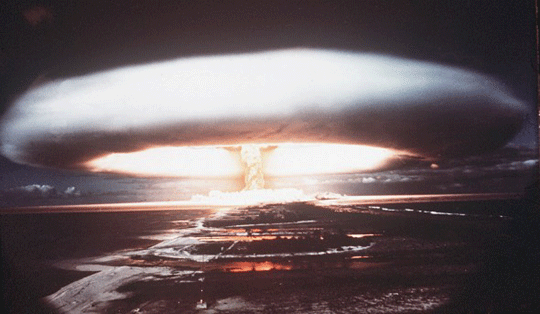
and Democratic presidents, in particular, are often worried about appearing soft on defence—they are easily swayed by their military advisors.
Most of the US public thinks that America has renounced the optional first use of nuclear weapons. But while many presidential candidates have promised to do so, no one in office has ever made it an official policy.
Far from enhancing American national security, or the security of the world, nuclear weapons will lead us to the edge of destruction.
Lawrence M. Krauss 6 May 24, https://quillette.com/2024/05/06/the-end-of-the-world-nuclear-war-weapons-apocalypse

A review of Nuclear War: A Scenario by Annie Jacobsen; 400 pages; New York: Dutton (March 2024)
As Chair of the Board of Sponsors of the Bulletin of the Atomic Scientists from 2008–2018, I helped unveil the Doomsday Clock every year for a decade. That meant that each year, I sat down with my colleagues for several days and seriously contemplated how close we might be to the end of civilisation. But even that sombre preparation could not prepare me for the grim realities unveiled in the recent book, Nuclear War: A Scenario, by veteran national security journalist Annie Jacobsen
Jacobsen details the events that would take place, minute by minute, in the 72 minutes from the launch of a rogue intercontinental ballistic missile (ICBM) by North Korea to the destruction of modern civilization and the death of up to five billion people.
Jacobsen imagines the following scenario:
0 min) A lone ICBM is launched from North Korea.
(19 min) The US launches 50 ballistic missiles at targets in North Korea and instructs submarines to launch 32 additional missiles.
(21 min) Most of Southern California becomes uninhabitable due to a North Korean submarine-launched ballistic missile (SLBM) attack on the Diablo Canyon nuclear reactor.
(33 min) Washington DC, together with almost all its 6 million inhabitants, is vaporized by the impact and explosion of the North Korean ICBM.
(49 min) Fearing they are under attack from the US missiles heading toward North Korea, Russia launches 1,000 missiles at US targets. On detection of these, the US launches an ICBM and SLBM attack on 975 Russian targets.
(51 min) NATO pilots launch an aerial nuclear attack on the Russian targets.
(52 min) North Korea is effectively wiped off the map, following the impact of 32 SLBM and 50 ICBM missiles.
(57 min) All land-based US military bases are destroyed by Russian SLBMs.
(58 min) Much of Europe is destroyed by a Russian SLBM attack on NATO bases. (59 min) The US launches the remainder of its stock of SLBMs at Russia.
(72 min) 1,000 locations in the United States are hit by Soviet ICBMs. A large fraction of the US population is killed immediately and most of the rest have little or no means of survival. A similar fate befalls Russia several minutes later.
Meanwhile, 52 minutes into this apocalyptic exchange, a nuclear device explodes in space high above the US, producing an electromagnetic pulse that renders almost all communication systems in the continental US inoperative, destroying much of the country’s infrastructure and causing widespread floods and fires, thus further complicating life for the few remaining survivors.
Whether or not one finds the specific scenario Jacobsen outlines plausible, it is clear that any major nuclear confrontation would have apocalyptic consequences. As Soviet Chairman Nikita Khrushchev said shortly after the Cuban Missile Crisis, in such a situation, “the survivors would envy the dead.”
Military planners have been preparing for scenarios like this since at least 1960, when the first comprehensive nuclear war planning exercise was carried out in the US.
As Jacobsen describes, in 1949, experts estimated that as few as 200 fission-type weapons of the kind that destroyed Hiroshima and Nagasaki would have been sufficient to essentially wipe out the Soviet Union. But despite this, both the US and the Soviets continued to amass weapons. By 1967, the US and USSR had around 30,000 nuclear and thermonuclear warheads each. While their arsenal has since been reduced, the US still has over 1,700 warheads on hair-trigger, launch-on-warning alert. Russia has only slightly fewer. Both countries have over 3,000 additional nuclear weapons stockpiled and available for use.
For the past 79 years, we have been living under the Damoclean sword of mutually assured destruction (MAD), the basis of modern nuclear deterrence. It is argued that since any act of nuclear aggression would lead to the annihilation of most of the world, no rational leader would launch a first strike. What is less frequently stressed, however, is that for this to work, deterrence must never, ever fail. Because once it does, the world as we know it will end.
The madness of having almost 2,000 nuclear weapons on hair-trigger alert, capable of being irretrievably launched on their missions of destruction at the mere warning of an incoming nuclear attack—before a single nuclear explosion has even occurred—has not been lost on US presidential candidates from both parties. Both George W. Bush, and Barack Obama vowed to take us back from the razor’s edge while running for president, but neither made good on this promise while in the White House. I was on Obama’s science policy team during his first run for the presidency. I was gratified when he won because I thought he would fix this lunacy. I was profoundly disappointed when he didn’t.
Most of the US public thinks that America has renounced the optional first use of nuclear weapons. But while many presidential candidates have promised to do so, no one in office has ever made it an official policy.
I have often wondered why successful presidential candidates change their tune once they get into the Oval Office. I suspect that the generals who advise the President and the Secretary of Defence have lived with the idea of launch-on-warning throughout their whole careers and cannot even imagine that a US president might allow a nuclear weapon to explode on American soil without having already launched a response. Since most presidents have no experience with war game planning—and Democratic presidents, in particular, are often worried about appearing soft on defence—they are easily swayed by their military advisors.
The maddening ramping-up of nuclear arsenals is a real-world example of the well-known game theory scenario called The Prisoner’s Dilemma, in which two prisoners, who cannot communicate with either other, are motivated by mistrust to make choices that are in neither party’s best interests. Likewise, each of the superpowers assumes that its adversary will stockpile ever more nuclear weapons, so it seems logical to stockpile more themselves.
There is a simple way out of this dilemma. Unlike in the game theory example, the prisoners here can talk to each other and, through diplomacy, can jointly arrive at a win-win strategy. The problem is that there are currently almost no front-door communications between either Russia and the US or China and the US on strategic nuclear issues. The resulting perils are clear—especially at this time, with the continuing war in Ukraine, tensions between China and Taiwan, and the brewing catastrophe in the Middle East.
The American public has been misinformed about the gravity of this threat because of a false narrative regarding anti-ballistic missile (ABM) defence. Having witnessed Israel’s recent success in defending itself against conventional missiles launched from Iran, many people assume that the US has a working ABM system (a false claim first touted by George W. Bush in around 2004). We don’t—despite having spent almost 176 billion dollars trying to create such a system. As Jacobsen emphasizes in her book, we have only 44 ABM interceptors in place. Moreover, in carefully controlled tests that did not realistically reproduce the many uncertainties inherent in an actual nuclear exchange—including the possible use of decoys—the prototypes of those interceptors have failed more than 50 percent of the time. We have essentially no defences against nuclear weapons. All we can do is try to ensure that they are never used.
For the arms industry, however, nuclear weapons—as horrifying as they are—are the gift that keeps on giving. The Biden administration’s $850 billion defence budget for 2025 allocates $69 billion to nuclear weapons operations and modernisation. Plans for 400 new ICBMs, new nuclear submarines and bombers, and upgrades to existing warheads are currently in the works, at a projected cost of three quarters of a trillion dollars over the next decade. MAD isn’t mad enough, it seems. Defence contractors, lobbyists, and right wing think tanks are concerned that 1,700 nuclear weapons are not enough and that “America’s enemies will become even more emboldened… while facing a hobbled and undersized American nuclear deterrent.”
Almost all the nuclear war games that military strategists have engaged in have invariably escalated to the point of Armageddon. Spending further billions to produce weapons whose sole purpose is to lead to nuclear annihilation will not make us safer. Far from enhancing American national security, or the security of the world, nuclear weapons will lead us to the edge of destruction.
I was proud to take the helm of the group established in 1947 by Albert Einstein and Robert Oppenheimer to warn the world of the dangers of nuclear weapons, in part through the annual setting of the Doomsday Clock. But, sadly, that effort has been an abject failure. Perhaps Jacobsen’s new book, reportedly soon to be adapted for the big screen, may bring people to their senses. For the past 79 years, we have been lucky, but our luck may not hold forever. Even a single ICBM launch could lead to a war that abruptly ends over 400,000 years of modern hominid evolution, leaving little or no trace of human existence and of our other technological achievements—all in less time than it took me to write these words.
Lawrence M. Krauss
Lawrence M. Krauss, a theoretical physicist, is President of the Origins Project Foundation. His most recent book is “The Edge of Knowledge: Unsolved Mysteries of the Cosmos.”
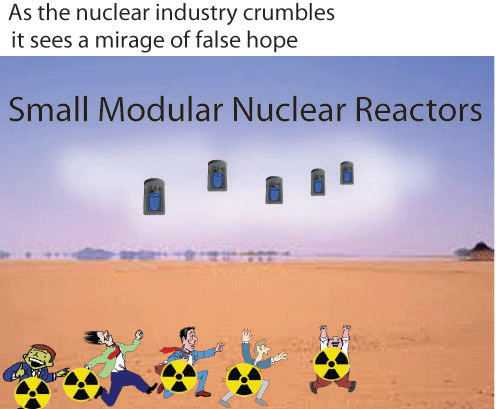
Small reactors don’t add up as a viable energy source
By M.V. Ramana and Sophie Groll. 6 May 24, https://cosmosmagazine.com/science/engineering/small-reactors-dont-add-up/
The nuclear industry has been offering so-called Small Modular Reactors (SMRs) as an alternative to large reactors as a possible solution to climate change.
SMRs are defined as nuclear reactors with a power output of less than 300 megawatts of electricity, compared to the typically 1000 to 1,500 megawatts power capacity of larger reactors.
Proponents assert that SMRs would cost less to build and thus be more affordable.
However, when evaluated on the basis of cost per unit of power capacity, SMRs will actually be more expensive than large reactors.
This ‘diseconomy of scale’ was demonstrated by the now-terminated proposal to build six NuScale Power SMRs (77 megawatts each) in Idaho in the United States.
The final cost estimate of the project per megawatt was around 250 percent more than the initial per megawatt cost for the 2,200 megawatts Vogtle nuclear power plant being built in Georgia, US.
Previous small reactors built in various parts of America also shut down because they were uneconomical.
The high cost of constructing SMRs on a per megawatt basis translates into high electricity production costs.
According to the 2023 GenCost report from the Australian Commonwealth Scientific and Industrial Research Organisation (CSIRO) and the Australian Energy Market Operator, the estimated cost of generating each megawatt-hour of electricity from an SMR is around AUD$400 to AUD$600.
In comparison, the cost of each megawatt-hour of electricity from wind and solar photovoltaic plants is around AUD$100, even after accounting for the cost involved in balancing the variability of output from solar and wind plants.
Building SMRs has also been subject to delays. Russia’s KLT-40 took 13 years from when construction started to when it started generating electricity, instead of the expected three years.
Small reactors also raise all of the usual concerns associated with nuclear power, including the risk of severe accidents, the linkage to nuclear weapons proliferation, and the production of radioactive waste that has no demonstrated solution because of technical and social challenges.
One 2022 study calculated that various radioactive waste streams from SMRs would be larger than the corresponding waste streams from existing light water reactors.
The bottom line is that new reactor designs, such as SMRs, will not rescue nuclear power from its multiple problems. Any energy technology that is beset with such environmental problems and risks cannot be termed sustainable.
Nuclear energy itself has been declining in importance as a source of power: the fraction of the world’s electricity supplied by nuclear reactors has declined from a maximum of 17.5 percent in 1996 down to 9.2 percent in 2022. All indications suggest that the trend will continue if not accelerate.
The decline in the global share of nuclear power is driven by poor economics: generating power with nuclear reactors is costly compared to other low-carbon, renewable sources of energy and the difference between these costs is widening.
Nuclear reactors built during the last decade have all demonstrated a pattern of cost and time overruns in their construction.
The Vogtle nuclear power plant being built in Georgia, involving two reactors designed to generate around 1,100 megawatts of electricity each, is currently estimated to cost nearly USD$35 billion.
In 2011, when the utility company building the reactor sought permission from the American Nuclear Regulatory Commission, it projected a total cost of USD$14 billion, and ‘in-service dates of 2016 and 2017’ for the two units.
In France, the 1,630-megawatt European Pressurised Reactor being built in Flamanville was originally estimated to cost 3 billion euros and projected to start in 2012, but the cost has soared to an estimated 13.2 billion euros and is yet to start operating as of March 2024.
These cost increases and delays confirm the historical pattern identified in a study published in 2014: of the 180 nuclear power projects around the world it studied, 175 had exceeded their initial budgets, by an average of 117 percent, and took 64 percent longer than initially projected.
However, the recent projects are even more extreme in the magnitude of the disconnect between expectations and reality.
These reactor projects, and the Hinkley Point C project under construction in the United Kingdom, also confirm another historical pattern: costs of nuclear power plants go up with time, not down. This is unlike other energy technologies, such as solar and wind energy, where costs have declined rapidly with experience.
The climate crisis is urgent. The world has neither the financial resources nor the luxury of time to expand nuclear power. As physicist and energy analyst Amory Lovins argued: “… to protect the climate, we must save the most carbon at the least cost and in the least time.”
Expanding nuclear energy only makes the climate problem worse.
The money invested in nuclear energy would save far more carbon dioxide if it were instead invested in renewables.
And the reduction in emissions from investing in renewables would be far quicker.
M.V. Ramana is the Simons Chair in Disarmament, Global and Human Security and Professor at the School of Public Policy and Global Affairs, at the University of British Columbia in Vancouver, Canada. He is the author of The Power of Promise: Examining Nuclear Energy in India (Penguin Books, 2012) and Nuclear is not the Solution: The Folly of Atomic Power in the Age of Climate Change (forthcoming from Verso Books).
Sophie Groll is a master’s student at the School of Public Policy and Global Affairs, at the University of British Columbia in Vancouver, Canada studying public policy and global affairs. Her focus is on environmental policy, low-carbon energy sources, and net-zero transition discourses.
Originally published under Creative Commons by 360info™.
UK’s Nuclear roadmap is a massive detour

UK plan reveals true ‘energy’ agenda is pathway to nuclear weapons sector
By Jonathon Porritt, Beyond Nuclear 6 May 24
After 14 years of Tory mismanagement, the UK finds itself bereft of an energy strategy.
This was finally confirmed in the release of the Government’s new Nuclear Roadmap. At one level, it’s just the same old, same old, the latest in a very long line of PR-driven, more or less fantastical wishlists for new nuclear in the UK. But at another, it’s a total revelation.
For years, a small group of dedicated academics and campaigners have suggested that the UK Government’s Nuclear Energy Strategy is being driven more by the UK’s continuing commitment to an “independent” nuclear weapons capability than by any authoritative energy analysis. For an equal number of years, this was aggressively rebutted by one Energy Minister after another, both Tory and Labour.
The new Nuclear Roadmap dramatically changes all that. It sets to one side any pretence that the links between our civil nuclear programme and our military defence needs were anything other than small-scale – and of no material strategic significance. With quite startling transparency and clarity, the Roadmap not only reveals the full extent of those links, but positively celebrates that co-dependency as a massive plus in our ambition to achieve a Net Zero economy by 2050.
“Startling” is actually an understatement. Such a comprehensive volte-face is rare in policy-making circles. Every effort is usually made by Ministers to obscure the scale (let along the significance) of any such screeching handbrake turns. That is so not the case with the new Roadmap.
Courtesy of the latest forensic work done by Professors Andy Stirling and Phil Johnstone at Sussex University (who have been absolutely at the forefront of seeking to bring these links into the public domain over many years – often with mighty little support from mainstream environmental organisations, let alone “independent” commentators), chapter and verse of this volte-face can be laid bare. Just a couple of examples from the Roadmap:
- “Not only does this Roadmap set a clear path for the growth of nuclear fission…it acknowledges the crucial importance of the nuclear industry to our national security, both in terms of energy supply and the defence nuclear enterprise.”
- “Government will proactively look for opportunities to align delivery of the civil and nuclear defence enterprises, whilst maintaining the highest standards of non-proliferation.”
- “To address the commonalities across the civil and defence supply chains, and the potential risk to our respective nuclear programmes due to competing demand for the supply chain, the Department of Energy Security and Net Zero (DESNZ) is working closely with the Ministry of Defence and the Defence Nuclear Sector.”
And there’s a whole lot more than that! As Andy Stirling has said: “Without any reflection on what this says about previous efforts to suppress discussion of this issue, the Government is now openly emphasising its significance.”
Indeed!
As usual, the UK’s ill-informed and unbelievably gullible mainstream media would appear to have missed the significance of this gobsmacking inflection point. So one can hardly expect them to have grasped its even more significant implications for UK energy strategy as a whole. In every single particular.
Let me briefly unpack some of those particulars:
- Nuclear
The new Roadmap reads like an outing to a massive nuclear sweet shop. On top of Hinkley Point C and Sizewell C, we’ll have one more big one. And then we’ll have lots of Small Modular Reactors, all over the country. And we’ll have a new fuel processing plant. And a new Geological Disposal Facility – at some much more distant point. And so on and on. 24 fantastical Gigawatts to be designed and delivered by 2050.
The reality couldn’t be more different:
- We will indeed end up with Hinkley Point C – at a staggering of cost of somewhere between £26 billion and £30 billion, with consumers paying twice as much for its electricity as they will for offshore wind. And it will almost certainly not come online until the end of the decade, 15 years on from the time it was meant to be up and running.
- We may possibly get Sizewell C, though the Government cannot currently guarantee the required level of investment. So a Final Investment Decision is unlikely before the next Election. At which point, Starmer may come to his senses and kill off this absurd white elephant.
- We will never get a third big reactor. The economics are literally impossible to justify.
- We are unlikely to get more than a couple of hugely expensive Small Modular Reactors, at some indeterminate point in the future, even with a new “flexible approach” to planning and financial inducements. Even that may prove to be an illusion. As Professor Steve Thomas has written: “Advocates of Small Nuclear Reactors claim they are cheaper and easier to build, safer, generate less waste, and will create many jobs compared to existing large reactor designs. These claims are unproven, misleading, or just plain wrong. Worldwide, no commercial design of SMR has even received a firm order yet.”
- And we may or may not get life extensions for the last five power stations in the “legacy fleet” – subject to regulatory approval, which may not be all that easy given extensive cracking in their reactor cores.
In short, the Roadmap is just a massive diversion from reality. Entailing incalculable opportunity costs. And putting at risk our entire Net Zero by 2050 strategy.
Ministers know all that. But they don’t really care. Our nuclear weapons programme (including upgrading Trident) will be protected as a consequence of this, via an unceasing flow of public money into the civil nuclear cul-de-sac, at a time when our defence budget is already massively overstretched. So who cares about the missing 24GW?
- Renewables
We’ll continue to see new investment into renewables here in the UK, despite (not because of) government policy, which has seriously messed up our offshore wind industry, maintained a de facto ban on onshore wind, couldn’t care less about solar, witters on vapidly about tidal without doing anything etc etc.
Meanwhile, on a global basis, renewables continue to boom………………………………………………………………………………………………………………………………..
The reasons for this almost complete silence can be traced back to successive governments’ grim intent to hang onto our so-called “independent nuclear deterrent”. At literally any costs……………………………… more https://beyondnuclearinternational.org/2024/05/06/nuclear-roadmap-is-massive-detour/
-
Archives
- February 2026 (228)
- January 2026 (308)
- December 2025 (358)
- November 2025 (359)
- October 2025 (376)
- September 2025 (258)
- August 2025 (319)
- July 2025 (230)
- June 2025 (348)
- May 2025 (261)
- April 2025 (305)
- March 2025 (319)
-
Categories
- 1
- 1 NUCLEAR ISSUES
- business and costs
- climate change
- culture and arts
- ENERGY
- environment
- health
- history
- indigenous issues
- Legal
- marketing of nuclear
- media
- opposition to nuclear
- PERSONAL STORIES
- politics
- politics international
- Religion and ethics
- safety
- secrets,lies and civil liberties
- spinbuster
- technology
- Uranium
- wastes
- weapons and war
- Women
- 2 WORLD
- ACTION
- AFRICA
- Atrocities
- AUSTRALIA
- Christina's notes
- Christina's themes
- culture and arts
- Events
- Fuk 2022
- Fuk 2023
- Fukushima 2017
- Fukushima 2018
- fukushima 2019
- Fukushima 2020
- Fukushima 2021
- general
- global warming
- Humour (God we need it)
- Nuclear
- RARE EARTHS
- Reference
- resources – print
- Resources -audiovicual
- Weekly Newsletter
- World
- World Nuclear
- YouTube
-
RSS
Entries RSS
Comments RSS
 nuclear-news