Moscow threatens to strike British military facilities following Cameron’s remarks
U.K. foreign secretary’s words confirm London’s growing involvement in military operations on the side of Kyiv, according to the Kremlin.
Politico, BY PIERRE EMMANUEL NGENDAKUMANA, 6 May 24
Russia said on Monday it could strike British military installations and equipment both “inside and beyond” Ukraine if British weapons are used by Kyiv to attack its territory.
“Any British military facilities and equipment on the territory of Ukraine and beyond could be a response to Ukrainian strikes with the use of British weapons on the territory of Russia,” the Russian ministry of foreign affairs said in a statement.
The Kremlin also summoned the British Ambassador to Moscow “to express a strong protest” in connection with recent comments by U.K. Foreign Secretary David Cameron……………………….
Cameron told Reuters last week that Ukraine has the “right” to use British-supplied weapons to strike Russia inside its own territory.
“Russian side views Cameron’s words as evidence of a serious escalation and confirmation of London’s growing involvement in military operations on the side of Kyiv,” according to the Russian foreign affairs ministry……………………
Earlier on Monday, Russia announced it has started preparing for nuclear weapons exercises, accusing Western officials of making “provocative statements and threats” by deepening their support for Ukraine. https://www.politico.eu/article/russia-threaten-strike-british-military-facility-david-camerons-remark-war-ukraine/
Nuclear lobby infiltrates West Lakes Academy and the Energy Coast University Technical College

West Cumbrian students challenged to design nuclear decommissioning robots
Business Crack, by Adam Lewis, May 9, 2024
West Cumbrian youngsters have been tasked by the Robotics and AI Collaboration (RAICo) and the Industrial Solutions Hub (iSH) to design and build robots which will be showcased at a major robotics and artificial intelligence industry event.
The students, aged between 16 and 18 from West Lakes Academy and the Energy Coast University Technical College are taking part in the challenge, with the aim of each school developing a small robot capable of transporting a mock nuclear waste barrel.
…………………..The RAICo-supported event is designed to showcase the region’s RAI capability and offers a chance for students to network with industry professionals, listen to keynote speeches and find out about career opportunities in the sector.
………..RAICo is a collaboration between the UK Atomic Energy Authority, the Nuclear Decommissioning Authority (NDA), Sellafield Ltd and the University of Manchester.
……..Sophie Finlinson, project manager at RAICo said: “This educational outreach initiative offers practical exposure to students interested in STEM subjects. It could represent a pivotal step in someone’s journey towards a successful career in our industry. ………………………….. https://businesscrack.co.uk/2024/05/09/west-cumbrian-students-challenged-to-design-nuclear-decommissioning-robots/
The UK makes licensing for nuclear fusion easier: developers can lead site selection

Fusion plants will not be subject to the same nuclear site licensing
process as fission reactors, with the UK government instead proposing
developer-led site selection and their designation as nationally
significant infrastructure projects.
World Nuclear News 9th May 2024
https://www.world-nuclear-news.org/Articles/UK-consults-on-new-planning-process-for-fusion-rea
NATO escalation in Ukraine threatens nuclear war with Russia
Now, however, Macron says NATO aims not to seek a negotiated peace, but to force the Russian military to assume that NATO may adopt the most aggressive possible policy. This includes possibly launching not only a large-scale land invasion of Russia, but also—since France, Britain and the United States all refuse to rule out initiating the use of nuclear weapons in a war—a pre-emptive nuclear strike on Russian forces in Ukraine or on Russian cities.
It is high time for Biden and his NATO colleagues to tell the people that their pursuit of “victory in Ukraine” means risking nuclear war
Alex Lantier, 6 May 2024 https://www.wsws.org/en/articles/2024/05/07/qtgn-m07.html
There are growing indications that NATO’s war against Russia is entering a new stage of escalation that threatens to lead to the use of nuclear weapons. Top NATO officials are publicly talking about resorting to missile strikes and ground war against Russia, while Russian officials are warning they may launch counter-strikes on NATO countries.
Last week, 100 artillerymen and surveillance specialists of the French Foreign Legion were deployed to the front lines at Slavyansk in Ukraine, according to a report by former US Undersecretary for Defense Stephen Bryen in the Asia Times. Bryen said a further 1,500 French Foreign Legionnaires could soon deploy to Ukraine. He wrote that one consequence of this is “potentially triggering a pan-European war.”
While the French Foreign Ministry denied Bryen’s report, it is in line with President Emmanuel Macron’s previous calls for a ground war with Russia. Macron and other top NATO officials are now reasserting these comments in an aggressive press campaign. Last week, in The Economist, Macron again demanded that NATO be ready to send ground troops to Ukraine:
If the Russians were to break through the front lines, if there were a Ukrainian request—which is not the case today—we would legitimately have to ask ourselves this question.
This weekend, the Italian daily La Repubblica reported on further NATO war plans. It cited secret NATO agreements allegedly defining two “red lines,” Belarus’ entry into the war and a Russian “provocation” targeting Poland, Hungary or the Baltic States. If either of these “red lines” were crossed, NATO would mobilize 100,000 troops across Eastern Europe, from the Baltic states to Romania.
Also, last Thursday, UK Foreign Minister David Cameron went to Kiev, where he said Ukraine has the “absolute right” to use British long-range missiles to bomb Russia.
This weekend, Macron told the French financial newspaper La Tribune that NATO must create total uncertainty about its actions in Russia’s military command:
President Putin has constantly brandished the nuclear threat. Faced with such an adversary, it is such an act of weakness to give a priori limits on one’s own actions! We must on the contrary deny him any idea of what we might do. This is how we can deter him from taking action.
Macron’s statements illustrate the mood of utter recklessness prevailing in ruling circles. During the Cold War, US and Soviet officials installed an emergency hotline between the White House and the Kremlin, fearing that nuclear war could erupt accidentally if one side misread the intentions of the other and believed the opponent had launched a nuclear strike. On September 26, 1983, this nearly occurred, when Soviet early warning systems falsely indicated that US forces had launched nuclear missiles at the Soviet Union.
Now, however, Macron says NATO aims not to seek a negotiated peace, but to force the Russian military to assume that NATO may adopt the most aggressive possible policy. This includes possibly launching not only a large-scale land invasion of Russia, but also—since France, Britain and the United States all refuse to rule out initiating the use of nuclear weapons in a war—a pre-emptive nuclear strike on Russian forces in Ukraine or on Russian cities.
Whether or not French troops are already deployed in Ukraine, the Kremlin is clearly taking these reports seriously. The “strategic ambiguity” Macron said he wanted to build in NATO relations with Russia has been established. Increasingly convinced that NATO may catastrophically escalate the conflict, Russian officials are calling to prepare the most drastic measures in response, creating conditions for a disastrous escalatory spiral in the war.
Yesterday, the Kremlin announced that it would hold military exercises simulating the use of nuclear weapons. Kremlin spokesman Dmitri Peskov called the nuclear exercises a response to an “unprecedented stage in the escalation of tensions initiated by the French president and the British foreign secretary,” including “an intention to send armed contingents to Ukraine—that is, to actually put NATO soldiers in front of Russian troops.”
Extraordinary warnings emerged after the Russian foreign ministry summoned the British and French ambassadors yesterday to protest the statements of Cameron and Macron.
It warned UK Ambassador to Russia Nigel Casey that Cameron’s statements made Britain “a de facto party to the conflict” between Ukraine and Russia, the Guardian wrote. “Casey was told that in response to Ukrainian attacks on Russian territory with British weapons, any British military facilities and equipment on the territory of Ukraine and abroad could be targeted,” the Russian Foreign Ministry said.
Yesterday, on his Telegram channel, former Russian President Dmitri Medvedev bluntly stated that if NATO continues on its course, Russia could bomb Washington, Paris and London amid a “world catastrophe.” Medvedev wrote:
There is some kind of total degradation of the ruling class in the West. This class really does not want to logically connect elementary things. Sending your troops to the territory of Ukraine will entail the direct entry of their countries into the war, to which we will have to respond. And, alas, not only in the territory of Ukraine.
In this case, none of them will be able to hide either on Capitol Hill, or in the Elysée Palace, or in 10 Downing Street. A world catastrophe will come.
On May 4, introducing the International Committee of the Fourth International’s (ICFI) May Day online rally, David North warned of the danger that the NATO war against Russia in Ukraine could escalate into a nuclear world war. Citing US-UK pledges to arm NATO’s Ukrainian puppet regime with long-range missiles that can strike major Russian cities, North said:
But what if Putin, invoking the precedent set by President John F. Kennedy during the Cuban missile crisis in 1962, declares, paraphrasing Kennedy’s warning, that attacks on Russian territory by Ukraine with missiles supplied by NATO “will be regarded as an attack” by NATO upon Russia, “requiring a full retaliatory response” upon NATO countries?
It is high time for Biden and his NATO colleagues to tell the people that their pursuit of “victory in Ukraine” means risking nuclear war and describe in necessary detail what will happen to their countries and the world if the confrontation with Russia goes nuclear.
There was no trace of exaggeration in this warning, which has been confirmed in barely three days.
The strongest possible appeal must be made to workers and youth around the world: If the working class does not intervene against the capitalist governments to stop this escalation, one or another confrontation will ultimately escalate into nuclear war.
The greatest danger is that masses of workers and youth are not fully aware of the urgency of the risk of a catastrophic global war. They must be alerted and mobilized through an international movement of meetings, protests and strikes, aiming to build a mass, socialist anti-war movement in the international working class.
UK Taxpayers to fund fast-tracked nuclear fusion reactors
Planning exemptions and financial support proposed in bid to boost UK energy industry
Jonathan Leake, 8 May 2024
Pioneering nuclear fusion power plants are to be fast tracked through the planning process and supported with taxpayer money as Britain attempts to become a world leader in the technology……………. (Subscribers only) https://www.telegraph.co.uk/business/2024/05/08/nuclear-fusion-reactors-britain-fast-tracked-taxpayer/
Congress Restricts Russian Uranium Imports, Unlocks $2.7 Billion for Domestic Fuel
Rifka Handelman, MAY 08, 2024, https://ww2.aip.org/fyi/congress-restricts-russian-uranium-imports-unlocks-2-7-billion-for-domestic-fuel
The bill allows the energy secretary to issue waivers but aims to wean the U.S. off Russian nuclear fuel.
Legislation that restricts imports of unirradiated low-enriched uranium (LEU) from Russia is now headed to the president’s desk after the Senate passed it by unanimous consent last week.
The restriction will take effect 90 days after the president signs the legislation, which is expected to occur.
The act allows the secretary of energy to issue waivers for imports up to certain limits if there is no other viable source of LEU available. As of 2022, U.S. civilian nuclear power plants collectively sourced about 12% of their uranium from Russia.
Once the restriction is in place, the Department of Energy is permitted to spend up to $2.72 billion to support domestic production of LEU and high-assay low-enriched uranium (HALEU), which is a more concentrated fuel intended for use in prospective advanced reactors.
Congress allocated these funds through the final appropriations legislation for fiscal year 2024 but made them contingent on the U.S. restricting imports of Russian uranium.
The funds will specifically go toward implementing the Nuclear Fuel Security Act, which aims to expand U.S. capacity to make HALEU fuel and ensure there is a reserve of uranium that can sustain U.S. reactors in the event of supply chain disruption.
Rafah residents call on the world to act
May 9, 2024, by: The AIM Network, https://theaimn.com/rafah-residents-call-on-the-world-to-act/
“We are calling urgently on the international community to act”: Rafah residents plunged into fear and panic as attacks intensify and a full-scale invasion looms.
People in Rafah have been left terrified and panicked as airstrikes on the city intensify, thousands flee, and aid delivery is disrupted. Near continuous shelling in some parts of the city have left dozens dead or injured: medics at the Kuwaiti Hospital, in western Rafah, said they had received the bodies of 35 people killed and 129 wounded in the last 24 hours alone, according to Al Jazeera.
Thousands of people – including some of our colleagues and partners – are fleeing after evacuation orders were issued for the eastern part of the city on Monday, yet there is nowhere safe for them to go, nor do areas which have been designated as ’safe zones’ have the infrastructure or capacity to receive them. Al-Mawasi, for example is already hugely overcrowded with more than 400,000 people living there, according to UNRWA.
In Rafah, fears are growing that the already dire humanitarian situation is about to get a lot worse as aid delivery and distribution is disrupted by the ongoing military activity. No aid entered via Gaza’s two key crossings at all yesterday, according to a joint briefing note by NGOs, and while the Israeli military said the Kerem Shalom had reopened today, the Rafah crossing – which was seized by the military on Monday – remains closed. With much of the population facing catastrophic levels of hunger, any reduction in aid risks pushing people further towards famine. Fuel, which is essential for hospitals and for trucks to be able to distribute aid within Gaza, is already running dangerously low, according to UNOCHA. We call for the Rafah crossing to be reopened immediately.
Amjad Al Shawa, who is based in Rafah, is the director of the Palestinian NGOs Network (PNGO), an umbrella organisation of 30 Palestinian NGOs and a partner of ActionAid Palestine, which works in Gaza. In a voicenote message, he told ActionAid about his fears regarding the situation in Rafah:
“We have serious concerns regarding the military land operation in Rafah and the Israeli control of Rafah crossing…we warn [against] famine and these continuous Israeli [military] attacks on the Palestinian civilians. At the same time the shortage of medication, food items and other needed items, which will lead to [further] deepening of the humanitarian catastrophe in Gaza.
“We are calling urgently on the international community to act in order to stop such a military incursion and the Israeli [military’s] massacres on the Palestinian people and to open all the crossings for the passengers and for different humanitarian and commercial items. Also, mainly for the patients and the injured people who are in bad need [of] medical treatment outside the Gaza strip as this will lead to [deteriorating] their health conditions.”
Riham Jafari, Advocacy and Communications Coordinator at ActionAid Palestine said:
-ADVERTISEMENT-
“The ongoing military offensive in Rafah is already having a devastating impact on its residents, thousands of whom have been forced to flee for the fourth, fifth, sixth time or more time in seven months. The number of deaths and injuries is rising and the humanitarian situation is worsening as aid delivery is disrupted.
“If the Israeli military continues with a full-scale ground invasion of Rafah, it will be full blown disaster. There is no doubt that an unthinkable number of men, women and children will die. It would be indefensible to order the evacuation of more than a million people from the area when there is nowhere safe for them to go, nor with the capacity to receive them. Any attempt to do so may well amount to forcible transfer – a grave violation of international humanitarian law.
“We call on the Israeli authorities to abandon this catastrophic plan and demand that all states do everything in their power to prevent a military assault in Rafah. The international community has repeatedly warned that this cannot be allowed to take place. Now is the time to act.
“As negotiations resume today, reaching a ceasefire is of the utmost importance: it is the only way to put an end to the killing and ease the horrific humanitarian crisis in Gaza.”
Israel carpet bombs Rafah after Hamas accepts ceasefire proposal, key border crossing with Egypt seized
The Cradle, Tue, 07 May 2024 https://www.sott.net/article/491214-Israel-carpet-bombs-Rafah-after-Hamas-accepts-ceasefire-proposal-key-border-crossing-with-Egypt-seized
An Israeli official said on 7 May that Tel Aviv is carrying out a “limited” operation in Rafah after Israel announced taking control of the southernmost city’s border crossing with Egypt.
This is a “limited operation,” the official told the Times of Israel. “It is being implemented to pressure Hamas” into accepting a ceasefire proposal.
CNN also cited a source saying that the “limited Israeli operation into Rafah is intended to keep pressure on Hamas to agree to a deal.”
Comment: Is this ‘limited operation’, apparently consisting of cowardly airstrikes, because even Israeli officials have admitted that, after their failed ground invasion in Gaza, to attempt the same in Rafah would likely be a ‘disaster‘ for the IDF?
srael announced Tuesday morning that it seized Gaza’s side of the Rafah border crossing.
“IDF forces led by Division 162 began a targeted activity to thwart terrorist targets of the terrorist organization Hamas in East Rafah; As part of the operation, the forces gained operational control over the Rafah crossing on the Gaza side, following intelligence information about terrorists using the crossing for terrorist purposes,” an army spokesman said.
Video footage on social media showed Israeli tanks at the Rafah crossing. The army had begun moving towards the crossing on Monday evening.
The launch of the operation at the crossing was accompanied by heavily intensified Israeli bombardment of Rafah, which has been under continuous Israeli airstrikes for weeks.
The UN warned on 7 May that the Israeli operation at the Rafah crossing poses a threat to aid deliveries into Gaza.
Rafah, Gaza’s southernmost city, is desperately overcrowded with over one million besieged Palestinians, most of whom were displaced from other places of the strip throughout the war. Israel claims the city is Hamas’ final stronghold and its key to victory in the war, and has for months been promising to invade the city.
Hundreds of Palestinians began fleeing the besieged city on 6 May.
The storming of Rafah came a day after Hamas informed Qatari and Egyptian mediators that it had accepted an updated proposal for a truce and prisoner exchange agreement. The resistance group had major issues with a previous Egyptian-drafted initiative that failed to guarantee a permanent ceasefire, an end to the war, and full Israeli withdrawal from Gaza.
The proposal approved by Hamas includes three 42-day phases, the Deputy Head of Hamas in Gaza, Khalil al-Hayya, told Al Jazeera, adding that the proposal would see “the complete withdrawal of Israel from Gaza, the return of the displaced, and a [prisoner-exchange deal].”
“The proposal includes in its second phase the direct announcement of a permanent cessation of military and hostile operations,” the Hamas official said, adding that “the ball is now in the court of the Israeli occupation.”
Sources in Israel told Hebrew Channel 13 on 6 May that Hamas has agreed to a “modified” Egyptian proposal that is “unacceptable” to Israel.
An Israeli official told AP on 4 May that Israel remains committed to attacking Rafah and will not accept a deal that includes an end to the war.
Venezuela loses its last glacier as it shrinks down to an ice field

Scientists reclassify Humboldt glacier, also known as La Corona, after it melted faster than expected
Neelima Vallangi, 8 May 24
Venezuela has lost its last remaining glacier after it shrunk so much that
scientists reclassified it as an ice field. It is thought Venezuela is the
first country to have lost all its glaciers in modern times. The country
had been home to six glaciers in the Sierra Nevada de Mérida mountain
range, which lies at about 5,000m above sea level. Five of the glaciers had
disappeared by 2011, leaving just the Humboldt glacier, also known as La
Corona, close to the country’s second highest mountain, Pico Humboldt.
France’s mini nuclear reactor plan – Nuward, gets another financial handout from the European Commission

The European Commission (EC) has approved, under European Union (EU) state
aid rules, a €300m ($320m) French measure to support Electricité de
France’s (EDF) subsidiary Nuward in researching and developing small
modular nuclear reactors (SMRs). The EC said the measure will contribute to
the achievement of the strategic objectives of the European industrial
strategy and the European Green Deal.

France notified to the Commission its
plan to grant €300m to Nuward to support its research and development
(R&D) project on SMR technology. The project aims to develop processes for
the design and construction of SMRs based on a simple and modular design
and with a power output equivalent to or less than 300 MWe. The front-end
design is the third phase of the overall Nuward project, which contains
five distinct phases.
In December 2022, the Commission already approved a
€50m French measure to support the second phase of the project, aimed at
acquiring new knowledge for the design and construction of SMRs. The aid
will take the form of a direct grant of up to €300m that will cover the
R&D project until early 2027. The measure will support Nuward in sizing the
modules and components of the SMRs and validating their integration in the
SMRs by means of numerical simulators and laboratory tests. Nuward will
also carry out industrialisation studies relating to the modular design and
mass production of SMRs. Finally, the measure will also support Nuward in
the preparation of the required safety demonstrations for the approval of
the project by the national nuclear safety authorities.
Nuclear Engineering International 1st May 2024
https://www.neimagazine.com/news/newseuropean-commission-approves-state-aid-for-nuward-smr-11725920
Hinkley Point C: New public inquiry planned over environmental impact
New saltmarshes could be created to mitigate the power station
Somerset Live, By Daniel Mumby, Local Democracy Reporter, 8 May 24
The environmental impact of Somerset’s new nuclear power station will be the subject of a new planning inquiry which could be held in the next 18 months. Around 11,000 people are currently working at the Hinkley Point C construction site near Stogursey, with this number expected to rise to 12,000 in the coming months.
EDF Energy secured planning consent for the power station back in 2013, with construction beginning three years later – a consent which include a number of measures to offset the environmental impact of the new facility. The company is seeking to make a number of changes to the agreed measures, which will require the approval of the Planning Inspectorate – resulting in a new public inquiry where residents can have their say.
The new inquiry was confirmed in a recent report by Councillor Ros Wyke, Somerset Council‘s portfolio holder for economic development, planning and assets. She said: “EDF Energy is proposing to make some material (and non-material) changes to the development consent order (DCO) for the Hinkley Point C project.
“As a DCO, any material changes will need to be authorised by the relevant secretary of state. EDF Energy expect to submit proposals to the secretary of state in the spring of 2025.
“This is likely to result in a public examination, which would begin by the autumn of 2025.” DCOs are detailed planning consents which are issued by central government for major infrastructure projects, such as the dualling of the A303 between Podimore and Sparkford.
EDF is proposing to make the following changes to the current DCO:
- Removing the need to install an acoustic fish deterrent in the Bristol Channel
- Providing ecological mitigation to counter the potential loss of fish stocks from this deterrent – taking the form of new saltmarshes near the River Parrett
- Changing the agreed interim spent fuel store from a wet store to a larger dry
store…………………………………………………………………………………………………..
Councillor Leigh Redman, who is standing for Labour in the new Bridgwater constituency, said that he had serious concerns about the saltmarshes proposal, including how effective it would be given the other environmental factors at play. Mr Redman (who represents the Bridgwater North and Central division on the council) said: “The Bristol Channel and Severn estuary are hugely important habitats for species including salmon and eel.
“According to the government’s Centre for Environment, Fisheries and Aquaculture Science, between 18 and 46 tonnes of fish could be lost a year if the acoustic fish deterrent plan is abandoned. Saltmarshes are vulnerable to erosion caused by factors, such as stormy conditions, wave action, and human activities, particularly in this area of the tidal River Parrett.
“This erosion can lead to habitat loss and a decrease in the protective function of the marsh against flooding and coastal erosion. I really do feel that we must listen to local people that know their area.
I feel that this particular element of the mitigation needs much more thought before any decision can be made, particularly in this area of the Parrett.” Councillor Claire Sully – who is standing for the Liberal Democrats in the same constituency – has been fighting against the new saltmarshes as part of the Save Pawlett Hams campaign.
The action group held a ‘Run the Hams’ event on Sunday (May 5) to raise awareness of the issues, following a ‘Rock the Hams’ concerns held at Pawlett Pavillion at the end of April. Ms Sully – who represents the Mendip South division on the council – claimed that the new nature reserve would cost up to £50m to deliver, arguing the acoustic fish deterrent was “essential” to preventing damage to the Severn estuary.
………..Pawlett Hams is well known in aquatic beetle circles and the EDF proposals would certainly lead to a serious diminishing of freshwater aquatic biodiversity for little seeming biodiversity gain, and a huge loss of fish from the Severn estuary.
“Other wildlife that could be lost include great crested newts, water voles in the ditches, and hares.” The Planning Inspectorate will confirm the precise dates of the public inquiry once EDF has formally submitted its plans to alter the DCO for the power station.
Hinkley Point C is currently expected to be operational by 2031, following EDF’s announcement in January 2023 that it would not meet its then-target date of 2027.
https://www.somersetlive.co.uk/news/somerset-news/hinkley-point-c-new-public-9268906
—
UK Environment Agency ponders on its concerns over Hinkley Point C nuclear effects on fish and the marine habitat

EDF’s Hinkley Point C company, NNB Generation Company (HPC) Ltd, is
proposing to make changes to the Development Consent Order for Hinkley
Point C. It held a consultation from 9 January to 29 February 2024.
The Environment Agency, in its role as a statutory consultee, is responding to
the pre-application consultation to materially change the original
Development Consent Order. This document sets out the Environment
Agency’s advice on HPC’s obligations in providing an Environmental
Impact Assessment, Habitats Regulations Assessment, Water Framework
Directive Compliance Assessment, Flood Risk Assessments, Environmental
Permits, and other areas within our remit.
This response does not represent
the Environment Agency’s final view and is provided without prejudice in
relation to any future Development Consent Order application or
Environmental Permit applications made to us.
In summary our main concerns
include: we are currently unable to agree with the calculated level of harm
from removing the acoustic fish deterrent (AFD); more justification is
required for the scale and proposed delivery timescales of the compensation
package; the lack of finalised Flood Risk Assessment (including flood risk
modelling), Water Framework Directive and other environmental assessments
required to agree the suitability of Pawlett Hams, the marine habitats, and
fish pass removal/easement proposals
Environment Agency 7th May 2024
Sizewell C in Suffolk granted nuclear site licence

Campaigners ‘appalled’ as French energy company EDF gets go-ahead for next stage of project
Jillian Ambrose, 8 May 24, https://www.theguardian.com/business/article/2024/may/07/sizewell-c-suffolk-granted-nuclear-site-licence-edf
A planned nuclear power station at Sizewell in Suffolk has been granted the first site licence in more than a decade as investors and government officials race to finalise a deal for the multibillion-pound project this year.
The licence from the nuclear regulator is considered a milestone for EDF, which plans to build Sizewell C as a replica of its Hinkley Point C project in Somerset, which has been dogged by delays and cost overruns.
The Office for Nuclear Regulation (ONR) has granted only two site licences to build new nuclear plants in more than 35 years: the first for Hinkley Point C in 2012, and the second for Sizewell.
It was granted as EDF works to reach a final investment decision on the Sizewell C project by the end of this year, depending on a government framework to finance the project and fresh investment to cover its construction costs.
EDF holds just under 50% stake in the project, while the UK government holds just over 50%. They are searching for further investment after EDF’s partner at Hinkley Point, China’s CGN, was barred from the successor project over security concerns.
Mina Golshan, a director at Sizewell C, said the licence was a “show of confidence” from the UK’s nuclear regulator that the company had a suitable site and was ready to begin large-scale construction work on a safe design replicated from Hinkley Point C.
“It’s a huge milestone and demonstrates that this project is firmly on track,” Golshan said.
EDF has blamed inflation, Covid and Brexit for a four-year delay and cost overruns at the Hinkley Point C site. It believes that by learning the lessons from Hinkley it will be able to build Sizewell C in about nine years.
Mark Foy, the ONR chief nuclear inspector and its chief executive, said the licence was granted after “extensive engagement and review” by the ONR team and would allow the regulator to take greater regulatory oversight and challenge the company as it progressed its plans.
“The licensing process is fundamental in confirming that operators of a nuclear site are ready and able to meet their obligations under the nuclear site licence, to protect their workforce and the public,” Foy said.
A group campaigning against the nuclear plant, Stop Sizewell C, said it was “appalled that a nuclear site licence has been issued when matters critical to the future safety of the site remain unresolved.
“There isn’t even a final design of the sea defences, which will be necessary to keep this vulnerable site safe for the next century and a half, at the very least. This seems to us like kicking the can down the road, on the assumption that some future generation will be able to clear up the mess,” the group said.
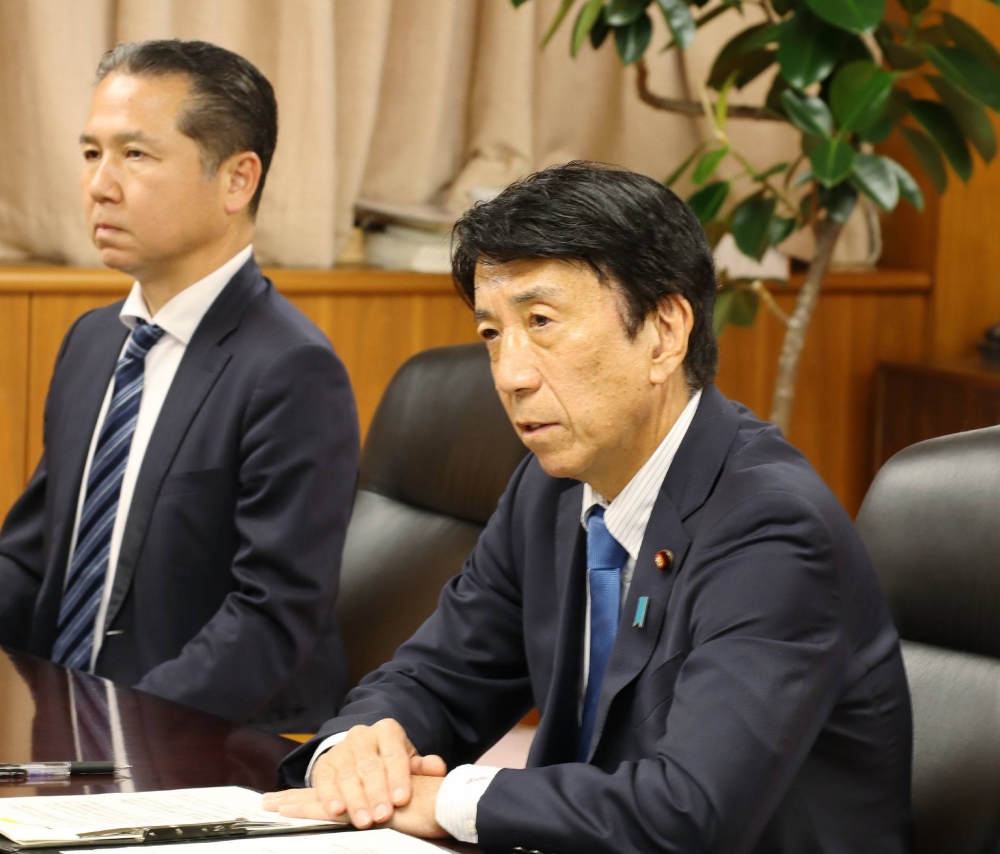
Government asks Genkai mayor to accept site survey to host nuclear waste
Industry minister Ken Saito has asked the mayor of the town of Genkai in Saga Prefecture to accept a so-called literature survey, as part of the process for selecting a final disposal site for high-level radioactive waste from nuclear plants.
Saito sought understanding from Genkai Mayor Shintaro Wakiyama at a meeting in Tokyo on Tuesday, saying that “the literature survey is not directly connected to the selection.”
Last month, the Genkai town assembly approved a petition submitted by local business groups asking for the literature survey request to be accepted.
“I’m torn between the town assembly’s decision and my thinking,” Wakiyama told reporters after the meeting with Saito. The mayor said that he will make a decision by the end of this month.
A literature survey is the first of three stages in the selection process for disposal sites, and involves the condition of geological strata being examined on paper, based on maps and other data.
So far, a literature survey has been accepted only by the town of Suttsu and the village of Kamoenai, both in Hokkaido.
For a literature survey to be conducted, a local government must apply for or accept a central government request.
TODAY. What is special about “Turning Point -The Bomb and Cold War”?

“This is the most important turning point of the human race.“
EPISODE 1 – The Sun Came Up Tremendous
This Netflix series is well researched, and visually brilliant. What makes it so different, and remarkable, is its study of the psychological aspect, especially the powerful effect of mass psychology.
Like all historical documentaries, it’s all about the men. However, Ironically, Lisa Meitner, discoverer of nuclear fission, does get a mention. But still they don’t mention that this illustrious nuclear physicist was invited to join the Manhatton Project, but refused – “would have nothing to do with a bomb”
By the way – this documentary uses authentic film and dialogue. I was impressed to see how accurately the ‘”fictionalised” version – the film “Oppenheimer”, had portrayed the people and the events – uncanny likenesses in several cases.
**********************************************
Cold war – it’s a state of conflict with a nuclear-armed opponent, functionally hostile to each other where you can’t get at each other. We’re in a new cold war with the Russians.
The Ukraine war brings the return of the cold war.
*************************************
Cold war at its peak, touched every country. The Cold War set off an arms race, for the first war that could destroy civilisation. The Bomb disrupted international relationships. It brought new scale of awfulness. There have been close shaves – we were lucky.
“once humans stop seeing each other as humans, the most horrific acts are possible”
This episode covers the history of the bomb, from the discovery of nuclear fission by Lisa Meitner and Otto Hahn 1938. That lead to Oppenheimer forming the idea of the bomb
With the rise of Hitler came the fear of a 1000 year Reich armed with atomic bombs? Einstein was alarmed and encouraged Roosevelt to develop the atomic bomb. Germany and Russia formed a non aggression pact. Then the Japan dictatorship joined them.
The 1941 Japanese attack on Pearl Harbour hastened the Manhattan Project in USA to build the bomb Russia joins Britain, France and USA – as Germany invades Russia. The USA sends weapons to Russia.
In 1942 control of Manhattan Project was turned over from the scientists to the military . General Groves picks Oppenheimer. Secrecy ++. Aim was to beat Hitler
Roosevelt dies April 1945. Truman knows nothing about the Manhattan Project. Henfy Stimson, Secretary of war warns President Truman in a ‘memo – “What is the world going to look like, after an atomic bomb is used?”
This is the most important turning point of the human race.
Truman’s next task :- the war against Japan could last for months, years, How to galvanise public opinion – the enormous task of making the Americans hate the Japanese enough. to fight them in a war. Germans were depicted as sinister enemies – but they were still seen as icy human beings- but the Japanese were portrayed as a sub-species.
Leading up to the bomb- USA fire-bombed Tokyo – 87000 killed -people burned like matchsticks. Then Battle of Okinawaa – 12000 US soldiers killed
Truman needed to find a way to end a war without an invasion – at the lowest cost to American lives. Already there’d been 65 million deaths in WW2. People thought of a quick ending as a deliverance. The hastily tested the atomic bomb in the Mexican desert -Trinity test. New Mexicans werecnot evacuated, At a girls’ dance camp 40 mikes away- white ash – “hot snow” – their health seriously affected;
There was general relief that the bomb worked.
Oppenheimer reacted – “We knew the world would never be the same – I am become death – the destroyer of worlds”.
The Potsdam conference brought up the idea of the arrangements for the end of the war in Japan. Following the division of Berlin., Truman didn’t want division of Japan, was keen to get the war over. Churchill said, on hearing of the atomic bomb – “Now we can tell the Russians where to get off”
Truman sought unconditional surrender from Japan. There was a prevailing hatred between the US and Japan.
We see and hear the tragic personal stories of Japanese-Americans – in concentration camps – the racial factor against Japan
Atomic bomb was aimed to convince the Japanese to surrender. Hiroshima was not a military site – 90% civilians.
Here again -compelling Personal stories. Excellent film footage of the bombing and its results. The fireball had a core temperature of several million degrees – ferocious heat unleashed on the city – survivors burnt – severe burns. Rivers littered with corpses. horrendous injuries due to black rain.
Nagasaki Fat Man was a plutonium bomb. Again – Fearful shots of injuries.
Truman initially was thrilled – but learning of reports from Hiroshima and Nagasaki, changed – ordered no further bombs without president’s authorisation.
The dispute over Truman’s choice to use the atomic bomb. Truman’s advisor Stimson wrote that Japan was effectively beaten. No need to use the atomic bomb.
It was dropped in non-military cities The atom bomb was the first strike in the cold war? When the Russians came in, that would end the war. It was not a question of ending the war. It’s a brutal question of ending the war without the Russians The USA desperately wanted to end the war before the Russians got to Japan.
That is certainly not the dominant point of view. There was overwhelming support, especially in the USA for the use of the bomb. A strong feeling of vengeance,
But then – from 1946, there were voices, including senior military voices, that the use of the bomb was not necessary
The wartime alliance with the Soviet Union broke down quickly
The Soviet Union now controlled half of Europe. In a strong position? The bomb introduces a whole new element of uncertainty into the balance of power. Stalin’s decree: 2 weeks after the Hiroshima bombing Stalin signs a decree “Build the bomb as soon as possible”
USA, Europe Russia lurch towards the cold war – A cold war, not a hot one, because these weapons could never be used
Now instead of direct war – there would be economic rivalry, and proxy wars across the world. The driving force became fear.
-
Archives
- February 2026 (228)
- January 2026 (308)
- December 2025 (358)
- November 2025 (359)
- October 2025 (376)
- September 2025 (258)
- August 2025 (319)
- July 2025 (230)
- June 2025 (348)
- May 2025 (261)
- April 2025 (305)
- March 2025 (319)
-
Categories
- 1
- 1 NUCLEAR ISSUES
- business and costs
- climate change
- culture and arts
- ENERGY
- environment
- health
- history
- indigenous issues
- Legal
- marketing of nuclear
- media
- opposition to nuclear
- PERSONAL STORIES
- politics
- politics international
- Religion and ethics
- safety
- secrets,lies and civil liberties
- spinbuster
- technology
- Uranium
- wastes
- weapons and war
- Women
- 2 WORLD
- ACTION
- AFRICA
- Atrocities
- AUSTRALIA
- Christina's notes
- Christina's themes
- culture and arts
- Events
- Fuk 2022
- Fuk 2023
- Fukushima 2017
- Fukushima 2018
- fukushima 2019
- Fukushima 2020
- Fukushima 2021
- general
- global warming
- Humour (God we need it)
- Nuclear
- RARE EARTHS
- Reference
- resources – print
- Resources -audiovicual
- Weekly Newsletter
- World
- World Nuclear
- YouTube
-
RSS
Entries RSS
Comments RSS
 nuclear-news