TODAY. Jobs jobs jobs in the nuclear industry – but is it true?

Go to Google news for nuclear information, and you’ll be swamped with glowing stories from the World Nuclear Association, the IAEA, and the big corporate media outlets – all about the wonderful future for the nuclear industry- –
all those jobs! including in the lovely nuclear weapons industry.
Jobs in renewable energy. This year’s report finds that renewable energy employment worldwide has continued to expand – to an estimated 13.7 million direct and indirect jobs in 2022. We can expect the creation of many millions of additional jobs in the coming years and decades. https://mc-cd8320d4-36a1-40ac-83cc-3389-cdn-endpoint.azureedge.net/-/media/Files/IRENA/Agency/Publication/2023/Sep/IRENA_Renewable_energy_and_jobs_2023.pdf?rev=4f65518fb5f64c9fb78f6f60fe821bf2

Jobs in nuclear power. I have not been able to find any kind of authoritative report on global jobs in nuclear power. I did find one source (on Quora) stating that each nuclear reactor in construction provides 1400-1800 jobs, and in operation 400 -700 jobs. The nuclear industry claims many more, but for construction, we must remember – this is all in the rather distant future.
The figure below is a prediction from many years ago. If we are to believe the nuclear lobby, this prediction should change rapidly.


What we do know is that at present, renewable energy jobs are increasing exponentially, and nuclear power building is almost at a standstill.
The figure on the left is also from many years ago. But I doubt that much has changed.
Of course – this is all about the actual reactors. There are many jobs in uranium mining, milling, transport etc, and of course, in nuclear weapons-making
The quality of jobs.
In energy efficiency there are many interesting and clean jobs. Also, workers know that they are contributing to a healthier planet – something to be proud of.
In renewable energy the jobs are relatively clean and healthy, and there’s again, the knowledge of being in an alternative to the polluting industries – coal and nuclear.
In nuclear energy and nuclear fuel, the workers are involved in the risky area of ionising radiation. There’s a huge amount of documentation on this. It is NOT a healthy job, though I suppose that it’s better to be a highly paid nuclear executive or lobbyist, safe in a nice office.
I doubt that nuclear workers can get much satisfaction about “helping the planet”, as the “peaceful” nuclear industry is so dirty, dangerous, and intimately connected with nuclear weapons.
No doubt some nuclear workers get paid a lot more than renewable energy workers do. But, there’s real value in knowing that your contribution to society is a clean and positive one.
US Endgame in Ukraine — War Without End, Amen

Even the mainstream press, loathe to report the setbacks the Armed Forces of Ukraine (AFU) have suffered, describes Russia’s northeast campaign, which began a few weeks ago, as a rout. The Kremlin says it has no interest in taking Kharkiv, and this so far appears to be the case.
the well-coordinated if not very artful American propaganda machine has begun preparing the public for a wider war that is to extend, as a matter of policy and military strategy, into Russian territory.
What happens when a powerful nation cannot afford to lose a war it has already lost?
By Patrick Lawrence, Special to Consortium News May 28, 2024
It is now two and a half years since Moscow sent two draft treaties, one to Washington, one to NATO in Brussels, as the proposed basis of talks toward a new security settlement — a renovation of relations between the trans–Atlantic alliance and the Russian Federation.
An urgently needed renovation, we must quickly add. And after that we must also quickly add the Biden regime’s rejection of Russia’s proposals as a “nonstarter” faster than you can say “deluded.”
Let us pause for a sec to bring to mind all those who have died in the war that erupted in Ukraine a year and a few months after Joe Biden refused, even mocked, Vladimir Putin’s honorable diplomatic demarche. All the maimed and displaced, all the towns and cities destroyed, all the farmland turned into moonscape.
And the all-but-complete peace accord, negotiated in Istanbul a few weeks into the war that the U.S. and Britain rushed to scuttle. And of course all the billions of dollars, somewhere north of $100 billion now, not spent on improving Americans’ lives but spent instead on arming a regime in Kiev that steals aid extravagantly while fielding an army with professed neo–Nazis.
It is useful to recall these things because they give context to a string of recent developments it’s important to understand, even if our corporate media discourage any such understanding.
If we keep recent history in mind, we will be able to see that the viscously irresponsible decisions of a couple of year ago, so wasteful of human life and common resources, are now repeated such that it is now certain the brutalities and waste will continue indefinitely even as their pointlessness is now way, way, way beyond denying.
The doorway opening on to this new sequence of events is the recent advance of the Russian military in Ukraine’s northeast. This new incursion now threatens Kharkiv, which is Ukraine’s second-largest city and lies a mere 25 miles from the Russian border.
Even the mainstream press, loathe to report the setbacks the Armed Forces of Ukraine (AFU) have suffered, describes Russia’s northeast campaign, which began a few weeks ago, as a rout. The Kremlin says it has no interest in taking Kharkiv, and this so far appears to be the case.
But the AFU’s rapid retreat bears a strong whiff of final defeat wafting in from not so far off in the distance. “Several Ukrainian combat brigades have not defected, or considered doing so,” Seymour Hersh, quoting his customary “I have been told” sources, reported in his newsletter last week, “but have made it known to their superiors that they will no longer participate in what would be a suicidal offensive against a better trained and better equipped Russian force.”
Brigades average 4,000 to 5,000 soldiers each and can run to 8,000 or even more. Hersh’s report suggests that a considerable number of Ukrainian troops, and maybe a very considerable number, are now effectively in mutiny against the AFU’s high command.
In evident response to Russia’s swift new incursion and the direction of the war altogether, the well-coordinated if not very artful American propaganda machine has begun preparing the public for a wider war that is to extend, as a matter of policy and military strategy, into Russian territory. This effort began with a New York Times interview with Volodymyr Zelensky, which was videoed and published in last Wednesday’s editions. A transcript of the interview is here.
This document is plainly intended to appeal to kale-consuming, Biden-supporting liberals who must be assured of the Ukrainian president’s just-like-us humanity and good judgment. He talked about his children and his dogs — there must be dogs in this sort of imagery — and how he reads fiction every night but is too tired to get very far.
But the core point, beyond the window dressing, was to insist that it is time to begin bombing Russian territory and that the Biden regime must reverse its prohibition of such operations.
A key passage:
“So my question is, what’s the problem? Why can’t we shoot them down? Is it defense? Yes. Is it an attack on Russia? No. Are you shooting down Russian planes and killing Russian pilots? No. So what’s the issue with involving NATO countries in the war? There is no such issue.
Shoot down what’s in the sky over Ukraine. And give us the weapons to use against Russian forces on the borders.”
Zelensky, a television actor we must not forget, has played this role on numerous occasions: Badger us for tanks, planes, long-range artillery, and missiles, the script written in Washington reads, and we will hesitate briefly before granting you your pressing needs as you defend democracy, the free world, and all those other “values” in the Cold War inventory.
Two days later, two, the Times reported exclusively that U.S. Secretary of State Antony Blinken, returning from “a sobering visit to Kyiv,” has of a sudden decided it is indeed time to broaden the war in the direction of a direct confrontation with Russia…………………………………………………………..
Let us all declare we feel unsafe as we realize what these people are talking about and what they are risking. Any allowance for expanded use of U.S.–made weapons against Russian targets, which will require American personnel on the ground in Ukraine, will unambiguously escalate the proxy war into a direct conflict between the U.S. and the Russian Federation.
Quagmire, anyone?
Reuters filed an impressive, equation-changing exclusive last week featuring unmistakably intentional leaks from the Kremlin signaling President Putin’s desire to stop the war in Ukraine and negotiate a ceasefire. Guy Faulconbridge and Andrw Osborn cited interviews with “five people who work with or have worked with Putin at a senior level in the political and business worlds.”
Time to sit up.
“Three of the sources, familiar with discussions in Putin’s entourage,” the two correspondents reported, “said the veteran Russian leader had expressed frustration to a small group of advisers about what he views as Western-backed attempts to stymie negotiations and Ukrainian President Volodymyr Zelenskiy’s decision to rule out talks.”
They then quoted one of their sources, “a senior Russian source who has worked with Putin and has knowledge of top-level conversations in the Kremlin,” as asserting, “‘Putin can fight for as long as it takes, but Putin is also ready for a ceasefire—to freeze the war.’”
While Putin has sent such signals on numerous occasions over the course of the past decade of war, this is big, in my view. For one thing, it strongly indicates what the new Kharkiv campaign is all about. Moscow does not want to take Kharkiv, the Faulconbridge and Osborn reporting suggests: It wants to enter talks from the position of strength all sides in all conflicts seek in the pre-negotiation phase.
Some other details confirm what distinguishes this set of signals from the Kremlin from others sent previously…………………………………………………………………………………………………..
Via his leaky confidants, who were almost certainly authorized, Putin proposes what amounts to an armistice. Both sides would stop shooting, and territorial dominion would remain as it is—not necessarily etched into the earth, but until both sides can negotiate on to another step toward a lasting settlement.
No, Kiev would not regain Crimea or the four republics that voted in September 2022 to rejoin Russia; and no, Russia would neither have demilitarized nor de–Nazified Ukraine, as it has many times stated as its aims……………………………………………………………………
The net response to the new Russian advances toward Kharkiv and the Kremlin’s artful leaks last week is to launch a new phase in a proxy war the West has already lost — a phase that also seems to have little chance of success, but holds more danger than any truly responsible statesman would ever risk.
Dmitry Peskov, the Kremlin’s dapper spokesman, told Faulconbridge and Osborn the other day that Russia didn’t want “an eternal war,” a forever war in the American idiom. This is a good thing not to want.
Neither Biden nor Zelensky, on the other hand, wants this war to end: They cannot afford it for a variety of reasons. This is the reality. They are the main impediment to peace. They have painted the conflict as some kind of cosmic confrontation between good and evil, and in so doing they have also painted themselves into a corner.
But what happens when a powerful nation cannot lose a war it has already lost? https://consortiumnews.com/2024/05/28/patrick-lawrence-us-endgame-in-ukraine-war-without-end-amen/?eType=EmailBlastContent&eId=aed8d1d4-5275-4b05-9f51-750290521dba
Small Modular Reactors: Still too expensive, too slow and too risky.

Institute for Energy Economics and Financial Analysis.
1 Report SMRs (Small Modular Reactors) Nuclear Transition United States
Institute for Energy Economics and Financial Analysis. May 29, 2024, David Schlissel and Dennis Wamsted more https://ieefa.org/resources/small-modular-reactors-still-too-expensive-too-slow-and-too-risky?fbclid=IwZXh0bgNhZW0CMTEAAR1jnn-FMHaMbUkjLSR0kbe-ku3uRRLcwq5jFcZfx62d4vHIZilLTK73YOg_aem_Abj940YmQyHY2fHN3alfZYFxXGCjmhy7qqSR1SLZ7HipqrGxyOaplVTSCuk7GjV3z8ZxriI0DSoGaIg4KFv_B5L1
Key Findings
Small modular reactors still look to be too expensive, too slow to build, and too risky to play a significant role in transitioning from fossil fuels in the coming 10-15 years.
Investment in SMRs will take resources away from carbon-free and lower-cost renewable technologies that are available today and can push the transition from fossil fuels forward significantly in the coming 10 years.
Experience with operating and proposed SMRs shows that the reactors will continue to cost far more and take much longer to build than promised by proponents.
Regulators, utilities, investors and government officials should embrace the reality that renewables, not SMRs, are the near-term solution to the energy transition.
The rhetoric from small modular reactor (SMR) advocates is loud and persistent: This time will be different because the cost overruns and schedule delays that have plagued large reactor construction projects will not be repeated with the new designs. But the few SMRs that have been built (or have been started) paint a different picture—one that looks startingly similar to the past. Significant construction delays are still the norm and costs have continued to climb.
IEEFA has taken a close look at the data available from the four SMRs currently in operation or under construction, as well as new information about projected costs from some of the leading SMR developers in the U.S. The results of the analysis show little has changed from our previous work. SMRs still are too expensive, too slow to build, and too risky to play a significant role in transitioning from fossil fuels in the coming 10 to 15 years.
We believe these findings should serve as a cautionary flag for all energy industry participants. In particular, we recommend that:
- Regulators who will be asked to approve utility or developer-backed SMR proposals should craft restrictions to prevent delays and cost increases from being pushed onto ratepayers.
- Utilities that are considering SMRs should be required to compare the technology’s uncertain costs and completion dates with the known costs and construction timetables of renewable alternatives. Utilities that still opt for the SMR option should be required to put shareholder funds at risk if costs and construction times exceed utility estimates.
Investors and bankers weighing any SMR proposal should carefully conduct their due diligence. Things will go wrong, imperiling the chances for full recovery of any invested funds.
State and federal governments should require that estimated SMR construction costs and schedules be publicly available so that utility ratepayers, taxpayers and investors are better able to assess the magnitude of the SMR-related financial risks that they may be forced to bear.
Finally, it is vital that this debate consider the opportunity costs associated with the SMR push. The dollars invested in SMRs will not be available for use in building out a wind, solar and battery storage resource base. These carbon-free and lower-cost technologies are available today and can push the transition from fossil fuels forward significantly in the coming 10 years—years when SMRs will still be looking for licensing approval and construction funding.
Russian think tank proposes ‘demonstrative’ nuclear blast to deter Western support for Ukraine
Livemint , Written By Shivangini 30 May 2024 https://www.livemint.com/news/world/russian-think-tank-proposes-demonstrative-nuclear-blast-to-deter-western-support-for-ukraine-11717034780694.html
A senior member of a Russian think tank, whose ideas often influence government policy, has proposed a ‘demonstrative’ nuclear explosion to deter the West from allowing Ukraine to use its arms against targets inside Russia, Reuters reported on Thursday, May 30.
Dmitry Suslov, a member of the Moscow-based Council for Foreign and Defence Policy, made the proposal shortly after President Vladimir Putin warned that NATO members in Europe were “playing with fire” by proposing to let Kyiv use Western weapons to strike deep inside Russia. As quoted by Reuters, Putin indicated that such actions could trigger a global conflict.
Ukraine’s leadership argues that it needs the capability to strike Russian forces and military targets inside Russia with long-range Western missiles to defend itself and prevent air, missile, and drone attacks. The report added that this view has garnered some support among Western countries, though not from Washington.
Russia, which has the world’s largest nuclear arsenal, has warned that allowing Ukraine to strike inside Russia would be a grave escalation, potentially drawing NATO and involved countries into direct conflict with Moscow and increasing the risk of nuclear war.
Suslov, whose think tank has been praised by Putin and whose ideas sometimes influence government policy, suggested that Russia must act decisively to deter the West from crossing a red line.
“To confirm the seriousness of Russia’s intentions and to convince our opponents of Moscow’s readiness to escalate, it is worth considering a demonstrative (i.e., non-combat) nuclear explosion,” Suslov wrote in the business magazine Profil. “The political and psychological effect of a nuclear mushroom cloud, which will be shown live on all TV channels around the world, will hopefully remind Western politicians of the one thing that has prevented wars between the great powers since 1945 and that they have now largely lost – fear of nuclear war,” Suslov wrote according to Reuters.
Suslov’s proposal is the latest in a series of similar suggestions by Russian security experts and lawmakers. It has raised concerns among Western security experts that Russia might be inching towards such a test, which could usher in a new era of major power nuclear testing.
There was no immediate comment on Suslov’s proposal from the Kremlin, which has stated that Russia’s nuclear policy remains unchanged. However, the Kremlin signalled its displeasure with increasingly aggressive Western rhetoric on arming Kyiv earlier this month by ordering tactical nuclear weapons drills.
Suslov also suggested that Russia initiate strategic nuclear exercises, warn any country whose weapons are used by Kyiv to attack Russia that Moscow reserves the right to strike that country’s targets anywhere in the world, and caution that it could use nuclear weapons if that country retaliates conventionally.
In November, Putin signed a law withdrawing Russia’s ratification of the global treaty banning nuclear weapons tests, a move intended to align Russia with the United States, which signed but never ratified the treaty. Russian diplomats have said that Russia, which has not conducted a nuclear test since the Soviet era, would not resume testing unless Washington does.
The Soviet Union last conducted a nuclear test in 1990, and the United States last did so in 1992. North Korea is the only country to have conducted a nuclear test this century.
Earlier this month, Russia warned Britain that it could strike British military installations and equipment both inside Ukraine and elsewhere if British weapons were used by Ukraine to strike Russian territory. This warning followed British Foreign Secretary David Cameron’s statement that Kyiv had the right to use UK-supplied weapons to strike targets inside Russia.
Israel Continues Gaza Attacks Despite UN Court Order To ‘Immediately Halt’ Rafah Offensive
https://www.rferl.org/a/gaza-israel-attacks-rafah-un-court/32963140.html
May 25, 2024 By RFE/RL (with reporting by AFP, AP, and Reuters)
Israel continued bombing in the Gaza Strip, including the city of Rafah, on May 25, one day after a top UN court ordered it to halt military operations against the southern city.
Israel gave no indication that the ruling by the International Court of Justice (ICJ) had affected its planning.
“Israel has not and will not carry out military operations in the Rafah area that ‘create living conditions that could cause the destruction of the Palestinian civilian population, in whole or in part,’” Israeli National Security Adviser Tzachi Hanegbi said in a statement, echoing wording found in the ICJ ruling.
Separately, following a meeting between U.S. and Israeli officials in Paris on May 25, an Israeli official said Tel Aviv was seeking to restart talks in the coming days in an effort to reach a hostage-release deal in Gaza.
“There is an intention to renew the talks this week and there is an agreement,” the official told the AFP news agency on condition of anonymity.
Early on May 25, hours after the court ruling, Israel carried out strikes on the Gaza Strip as fighting between Israeli troops and fighters for Hamas, which has been designated a terrorist organization by the United States and the European Union, continued.
Air strikes were reported in Rafah and the central city of Deir al-Balah.
European foreign policy chief Josep Borrell wrote on X, formerly Twitter, that “ICJ orders are binding on the Parties and they have to be fully and effectively implanted.
In its May 24 ruling, the ICJ said Israel must “immediately halt” its offensive against Rafah and take urgent measures to address the humanitarian crisis in the entire region. Measures should include reopening the Rafah border crossing with Egypt to allow aid to flow into Gaza.
The order is part of a case brought by South Africa accusing Israel of genocide and asking the court to rule that Israel must stop its offensive in the southern Gaza city.
In a ruling on January 26, the 15-judge panel ruled that Israel must do everything to prevent genocide during its offensive in response to an attack in October by Hamas — which has been designated a terrorist organization by the United States and the EU — but stopped short of ordering a cease-fire.
On March 28, it ordered Israel to take all necessary and effective action to ensure basic food supplies to Gaza’s Palestinian population.
Though the court’s rulings are legally binding, it has no way to enforce them.
Still, the 13-2 vote ordering Israel to halt its Rafah offensive, and to report on its progress in easing the humanitarian crisis within one month, increases pressure on Israel and further isolates it.
The ruling stepped up pressure against Israel just days after Norway, Ireland, and Spain announced they would recognize a Palestinian state and after the chief prosecutor of the International Criminal Court announced he would seek arrest warrants on war crimes charges for Israeli Prime Minister Benjamin Netanyahu, Israeli Defense Minister Yoav Gallant, and several top Hamas leaders.
Israel and Hamas have been fighting since October 7, 2023, when Hamas fighters launched a massive cross-border attack on Israel. Some 1,200 Israeli citizens were killed in the attack, while another 240 were taken hostage, some of whom are still being held by Hamas in Gaza.
Radiation Exposure Compensation Act (RECA) set to expire soon, while many nuclear test victims await justice .
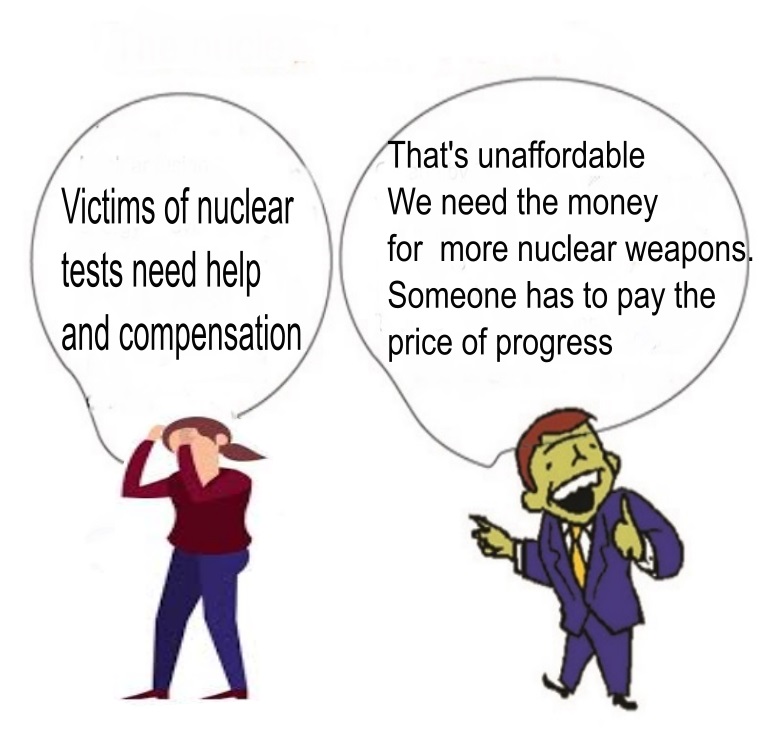
The defense spending bill for 2024 was signed into law on Dec. 22 by Biden, but the RECA expansion was cut from the final bill before it landed on his desk.
Without an extension, RECA is set to expire in June, and the deadline for claims to be postmarked is June 10, 2024, according to the DOJ.
‘Time is running out’
by beyondnuclearinternational by Shondiin Silversmith, Arizona Mirror
Navajo Nation urges Congress to act on RECA expansion bill
Kathleen Tsosie remembers seeing her dad come home every evening with his clothes covered in dirt. As a little girl, she never questioned why, and she was often more excited to see if he had any leftover food in his lunchbox.
“We used to go through his lunch and eat whatever he didn’t eat,” Tsosie said, recalling when she was around 4 years old. “And he always had cold water that came back from the mountain.”
Tsosie’s father, grandfather, and uncles all worked as uranium miners on the Navajo Nation near Cove, Arizona, from the 1940s to the 1960s. The dirt Tsosie’s father was caked in when he arrived home came from the mines, and the cold water he brought back was from the nearby springs.
Tsosie grew up in Cove, a remote community located at the foothills of the Chuska mountain range in northeastern Arizona. There are 56 abandoned mines located in the Cove area, according to the Environmental Protection Agency.
In the late 1960s, Tsosie said her grandfather started getting sick. She remembers herding sheep with him and how he would often rest under a tree, asking her to push on his chest because it hurt.
Tsosie said she was about 7 years old when her uncles took her grandfather to the hospital. At the time, she didn’t know why he was sick, but later on, she learned he had cancer. Her grandfather died in October 1967.
Over a decade later, Tsosie’s father also started getting sick. She remembers when he came to visit her in Wyoming; she was rubbing his shoulders when she felt a lump. She told him to get it checked out because he complained about how painful it was.
Her father was diagnosed with cancer in 1984 and went through treatments, but died in April 1985.
“When my dad passed away, everybody knew it was from the mine,” Tsosie said. He was just the latest on a long list of Navajo men from her community who worked in the uranium mines and ended up getting sick and passing away.
Because of that history, Tsosie became an advocate for issues related to downwinders and uranium mine workers from the Navajo Nation, including the continuation of the Radiation Exposure Compensation Act.
The Radiation Exposure Compensation Act, or RECA, provides a program that compensates individuals who become ill because of exposure to radiation from the United States’ development and testing of nuclear weapons.
RECA was initially set to expire in 2022, but President Joe Biden signed a measure extending the program for two more years. Now, it’s set to expire in less than a month…………………………………………………………………………………
In July 2023, the U.S. Senate voted to expand and extend the RECA program, and it was attached as an amendment to the National Defense Authorization Act, which funds the Department of Defense.
It could have extended health care coverage and compensation to more uranium industry workers and “downwinders” exposed to radiation in several new regions — Colorado, Missouri, New Mexico, Idaho, Montana, and Guam — and expanded coverage to new parts of Arizona, Nevada and Utah.
The defense spending bill for 2024 was signed into law on Dec. 22 by Biden, but the RECA expansion was cut from the final bill before it landed on his desk.
When she heard that the Radiation Exposure Compensation Act amendments failed to pass, Tsosie said it really impacted her, and she cried because so many people deserve that funding.
“I know what it feels like. I know what it feels like to suffer,” she said.
Without an extension, RECA is set to expire in June, and the deadline for claims to be postmarked is June 10, 2024, according to the DOJ.
The sunset of the Radiation Exposure Compensation Act is approaching fast, and leaders from the Navajo Nation are urging Congress to act on the expansion bill that has been waiting for the U.S. House of Representatives to take it up for more than two months.
“Time is running out,” Justin Ahasteen, the executive director of the Navajo Nation Washington Office, said in a press release.
“Every day without these amendments means another day without justice for our people,” he added. “We urge Congress to stand on the right side of history and pass these crucial amendments.”
Republican Sen. Josh Hawley from Missouri introduced S. 3853 – The Radiation Exposure Compensation Reauthorization Act, which funds RECA past its June sunset date for another six years.
The bill passed through the U.S. Senate with a bipartisan 69-30 vote on March 7. But since being sent to the House on March 11, the bill hasn’t moved.
The RECA expansion bill would include more communities downwind of nuclear test sites in the United States and Guam. It would extend eligibility for uranium workers to include those who worked after 1971. Communities harmed by radioactive waste from the tests could apply for the program, and expansion would also boost compensation payments to account for inflation.
“The Navajo Nation calls for immediate passage of S. 3853,” Ahasteen said in a press release. “This is to ensure that justice is no longer delayed for the Navajo people and other affected communities.”
Ahasteen told the Arizona Mirror in an interview that congressional leaders holding the bill back due to the program’s expense is not a good enough reason not to pass it.
“They keep referencing the cost and saying it’s too expensive,” he said. But, he explained, the RECA expansion is only a sliver of U.S. spending on foreign aid or nuclear development.
And it shouldn’t even be a matter of cost, Ahasteen said, because people have given their lives and their health in the interest of national security.
“The bill has been paid with the lives and the health of the American workers who were exposed unjustly to radiation because the federal government kept it from them and they lied about the dangers,” he said.
From 1945 to 1992, the U.S. conducted a total of 1,030 nuclear tests, according to the Arms Control Association.
Many were conducted at the Nevada Test Site, with 928 nuclear tests conducted at the site between 1951 and 1992, according to the Nevada National Security Site. About 100 of those were atmospheric tests, and the rest were underground detonations.
According to the United Nations Scientific Committee on the Effects of Atomic Radiation, atmospheric tests involved unrestrained releases of radioactive materials directly into the environment, causing the largest collective dose of radiation thus far from man-made radiation sources………………………………………………………………………
The legacy of uranium mining has impacted the Navajo Nation for decades, from abandoned mines to contaminated waste disposal.
From 1944 to 1986, nearly 30 million tons of uranium ore were extracted from Navajo lands, according to the EPA, and hundreds of Navajo people worked in the mines, often living and raising families in close proximity to the mines and mills.
Ahasteen said those numbers show exactly how large the uranium operations were on the Navajo Nation and the impact it would have on the Navajo people.
“There are photos on record to show Navajo people being exploited, not given any proper protective equipment, but (the federal government) knew about the dangers of radiation since the ’40s,” Ahasteen said. “They were given a shovel and a hard hat, and they were told: Go to work. You’ll earn lots of money. You’ll have a nice life, and we did that, but it didn’t work so well for us.”……………………………………………………………………………………………………………………
WHAT YOU CAN STILL DO BEFORE JUNE 7TH
Urge your U.S. Representative to push for a House floor vote on, and to vote in favor of, extending/expanding RECA, the Radiation Exposure Compensation Act. And urge House Speaker Mike Johnson to allow the vote on the House floor, on the Hawley version of RECA (the most expansive). There is likely enough support to pass the bill. Johnson’s phone is: 202-225-4000.
Shondiin Silversmith is an award-winning Native journalist based on the Navajo Nation. Silversmith has covered Indigenous communities for more than 10 years, and covers Arizona’s 22 federally recognized sovereign tribal nations, as well as national and international Indigenous issues. This article was first published by the Arizona Mirror, https://beyondnuclearinternational.org/2024/05/26/time-is-running-out-2/
16 June – WEBINAR -“NATO IN THE ARCTIC”
Sunday June 16, 2024 organized by the Global Women for Peace – United Against NATO (GWUAN)
Registration/program https://us06web.zoom.us/meeting/register/tZcrdO2tqTIuHNU2kgT-PS1xUzWZcR2tgxXQ
19.00 Helsinki/St. Petersburg time
18.00 Stockholm/Oslo/Copenhagen time
17.00 London time
12.00 Toronto/Washington time
09.00 Seattle time
08.00 Anchorage time
Description
Webinar organized by the Global Women for Peace – United Against NATO (GWUAN)
Moderator: Pippa Bartolotti – author and politician working with United National Anti-war Coalition and Global Women United for Peace against NATO
Opening words: Sean Conner – Executive Director of IPB
Event order: 1. US, Canada, Russia – 30 min
US: Bruce Gagnon, Coordinator Global Network Against Weapons & Nuclear Power in Space – Breaking Russia up to get at Arctic resources
Canada: Tamara Lorincz – Pugwash Group, Voice of Women for Peace, WILPF – The militarization of Canada’s Arctic
Russia: Oleg Bodrov – physicist, ecologist, board member of the International Peace Bureau, Chairman of the Public Council of the South Coast of the Gulf of Finland, St. Petersburg, Russia – Victory With Weapons is Impossible in the Atomic World
Discussion 20 min
2. Norway, Sweden, Denmark/Greenland, Finland – 40 min
Norway: Ingeborg Breines – Former Chair of IPB and UNESCO Director – The militarization especially in the Norwegian Arctic, new American bases and the Arctic Council
Sweden: Lars Drake – Environmental economist and former adjunct professor at the Swedish University of Agricultural Sciences – Natural resources in the Arctic – extraction, environment and international conflicts
Denmark/Greenland: Palle Bendsen – long time climate, environmental, anti-nuclear activist, involved in opposition to uranium mining plans in Southern Greenland. Engaged in the Danish Centre for Conflict Resolution and the Council for International Conflict Resolution, where he in 2019 authored an analysis of the “changing Arctic” – The Arctic is Changing – AGAIN
Finland: Teemu Matinpuro, executive director of the Finnish Peace Committee – Finland – NATO – DCA – the Arctic
Discussion 30 min
Supporters of the webinar: – GWUAN (Global Women for Peace United Against NATO) – IPB (International Peace Bureau) – Global Network Against Weapons & Nuclear Power in Space – World BEYOND War
Biden and the ballot box
We’ve learned too late that the love affair between Butcher Bibi and Genocide Joe is an unbreakable bond, writes LINDA PENTZ GUNTER

LET ME be clear. I have never had a love affair with Joe Biden. Not that kind of love affair. But politically, like many on the left, I’ve been willing to check his name at the ballot box while overlooking a few of his political shortcomings because, so we told ourselves, Biden is at heart a decent human being.
At first, as Israel’s genocidal retaliation for the October 7 Hamas attacks continued, I remained reluctantly in the camp willing to vote for Biden in November. However tightly one might have to hold one’s nose, it was imperative to preserve our democracy and keep Donald Trump out of the White House. In the meantime, surely Biden would step up and stop the bloodshed in Gaza.
That was then. This is now.
For months we rallied and lobbied, voted “uncommitted” in the primaries and called for a ceasefire. President Biden ignored all of it. He has now fully earned the nickname given to him by the thousands of students occupying their campuses across the country: “Genocide Joe.”
I cannot vote for Biden in November.
I had already written this column last week but democratic socialist, Senator Bernie Sanders, kept insisting a vote for Biden was essential to keep fascism from our door. So I hesitated. Then I read Biden’s response to the International Criminal Court’s announcement on Monday that it would seek arrest warrants for Israeli Prime Minister Benjamin Netanyahu and Minister of Defence Yoav Gallant.
I hit “Send.”
Biden called the ICC announcement “outrageous” and said unambiguously, “there is no equivalence — none — between Israel and Hamas. We will always stand with Israel against threats to its security.”
That’s the true love affair: Butcher Bibi and Genocide Joe. We’ve learned too late that it’s an unbreakable bond and that Joe Biden is not, in fact, a “decent human being.”
To be unmoved by a genocide is incomprehensible. To be unmoved when you could stop it, is unforgivable. To actively aid and abet it by supplying the arms that do the killing, is abhorrent. The Biden administration is guilty on all three counts.
And entirely unrepentant. The White House has played a craven game of deception for months, purely for political ends. There have been many low points but one of the worst was the recent announcement that the US would withhold transfer of certain larger, more destructive weapons to Israel. This seemed, on the surface, a step in the right direction, and was initially welcomed as such.
However, it was followed two days later by the release of a likely deliberately delayed White House report that said there was “insufficient information” to be sure that US-supplied weapons were being used by Israel in violation of human rights law. The green light was back on to keep US arms to Israel flowing.
Worse, the report actually stated that Israel “has had to confront an extraordinary military challenge.” Fewer than 300 Israeli soldiers have been killed so far since Israel’s assault on Gaza began. More than 35,000 Palestinians have died, almost all civilians and mostly women and children.
Who, exactly, is facing “an extraordinary military challenge” here? But Biden says there is “no equivalence.” Incredible.However, it was followed two days later by the release of a likely deliberately delayed White House report that said there was “insufficient information” to be sure that US-supplied weapons were being used by Israel in violation of human rights law. The green light was back on to keep US arms to Israel flowing.
Worse, the report actually stated that Israel “has had to confront an extraordinary military challenge.” Fewer than 300 Israeli soldiers have been killed so far since Israel’s assault on Gaza began. More than 35,000 Palestinians have died, almost all civilians and mostly women and children.
Who, exactly, is facing “an extraordinary military challenge” here? But Biden says there is “no equivalence.” Incredible.
Not voting for Biden in November will be a choice made under the threat of a massive campaign of blame shifting. Should Donald Trump win back the White House, those of us who could not vote for Biden will be told it was our fault.
But the responsibility for preventing what would be an unarguable catastrophe should Trump prevail lies with Biden, not us. To stave off fascism, Biden needs to give us an actual choice and win the White House on merit, not by default.
Linda Pentz Gunter is a writer based in Takoma Park, Maryland.
Texas A&M University System To Bring Nuclear Reactors To Texas A&M-RELLIS

Initiative aims to enhance Texas’ power grid and support technological growth with advanced nuclear energy solutions.
By Texas A&M University System, MAY 29, 2024
Leaders at The Texas A&M University System announced plans Wednesday to bring the latest nuclear reactors to Texas A&M-RELLIS.
John Sharp, chancellor of the Texas A&M System, said the System seeks to provide a platform for companies to test the latest reactors and technologies. It also will address the pressing need for increased power supply…………………………………….
To kickstart the latest nuclear initiative, the Texas A&M System will be seeking information — and later proposals — from manufacturers of nuclear reactors. Ultimately, the site could host multiple electrical power-generating facilities, and it could host first-of-a-kind reactors with a net increase of up to 1 GW of capacity that will have a direct connection to the grid operated by Electric Reliability Council of Texas, Inc., or as it is more commonly called, ERCOT..
Representatives from the System and from the companies hope to stand up operational reactors within the next five to seven years. https://today.tamu.edu/2024/05/29/texas-am-university-system-to-bring-nuclear-reactors-to-rellis/
Rare spat shows China and North Korea still at odds on nuclear weapons
Japan Times, BY JOSH SMITH, SEOUL, May 29, 2024
North Korea’s rare swipe at China this week underscored how Beijing and Pyongyang do not entirely see eye-to-eye on the latter’s illicit nuclear weapons arsenal, despite warming ties in other areas, analysts and officials in South Korea said.
The North condemned China, Japan and South Korea on Monday for discussing denuclearization of the peninsula, calling their joint declaration after a summit in Seoul a “grave political provocation” that violates its sovereignty.
Even though Beijing helped tone down the statement by advocating mention of the peninsula rather than the North specifically, that was enough to raise its neighbor’s hackles, one analyst said.
“It is notable that North Korea criticized a joint statement that China had signed onto, even after Beijing helped water down the statement,” added Patricia Kim, of the Brookings Institution in the United States.
In their remarks, the three nations “reiterated positions on regional peace and stability, denuclearization of the Korean Peninsula” but unlike the last such statements in 2019 and earlier, did not commit to pursue denuclearization.
Since international talks with the United States and other countries stalled in 2019, North Korea has moved to reject the concept of ever giving up its nuclear weapons.
“This is about North Korea emphasizing its stance that any diplomatic rhetoric suggesting Pyongyang should eventually denuclearize is unacceptable,” said Tong Zhao, a nuclear expert at the Carnegie Endowment for International Peace.
“After enshrining its nuclear status in the constitution and reprimanding anyone who questions it, North Korea is raising demands for formal international recognition as a nuclear-armed country.”……………………………………… more https://www.japantimes.co.jp/news/2024/05/29/asia-pacific/politics/china-north-korea-nuclear-weapons/—
Protest continues against Japan’s further discharge of nuke-contaminated water
By Jiang Xueqing in Tokyo https://www.chinadaily.com.cn/a/202405/26/WS66531eb9a31082fc043c9296.html
2024-05-26
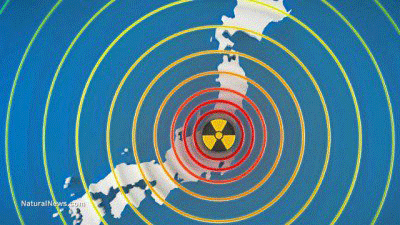
Japanese people continued to strongly oppose the discharge of nuclear-contaminated water from the wrecked Fukushima Daiichi nuclear power plant into the ocean during the latest round of radioactive water release.
Tokyo Electric Power Company, the operator of the Fukushima plant, started the sixth round of releasing nuclear-contaminated water into the sea on May 17. The company said it plans to discharge approximately 7,800 metric tons of radioactive water through June 4.
During a rally in front of the Prime Minister of Japan’s office in Tokyo on Friday, Kem Komdo, a 61-year-old Tokyo resident, said the discharge of nuclear-contaminated water into the ocean has no benefits at all, and the main risk is marine pollution.
Although Japanese media is promoting that the water treated through the Advanced Liquid Processing System, or ALPS, only contains tritium, Komdo said that is not true. He emphasized that the radioactive water contains various hidden contaminants that have come into contact with fuel debris, so the actual situation must be made clear.
“The (Japanese) government and TEPCO always tell the media to call it ‘ALPS-treated water’, not nuclear-contaminated water, saying that calling it nuclear-contaminated water causes harmful rumors. But that statement is clearly wrong because this is indeed contaminated water,” Komdo said. “By forcing us to call it ‘ALPS-treated water,’ TEPCO and the government are trying to evade responsibility for the Fukushima nuclear accident.”
The Fukushima Daiichi nuclear power plant suffered a triple meltdown following a major earthquake and subsequent tsunami on March 11, 2011.
Komdo said the Japanese government should change its policy to avoid discharging nuclear-contaminated water into the ocean and immediately switch to land storage as there is still space available.
“Otherwise, the government won’t gain the trust of China and other Pacific island countries, and it will also affect other diplomatic relations,” he said.
CNN Analysis Reveals US-Made Munitions Used in Rafah Massacre

Multiple weapons experts have confirmed that munitions manufactured by Boeing were used in the deadly strike that sees at least 45 dead.
By Diego Ramos / ScheerPost May 29, 2024
ACNN report revealed that Israel used American made munitions in Sunday’s deadly strike on the displacement camp in Rafah. Scenes of the assault, which killed at least 45 people and injured hundreds more, have spread across social media, showing burned bodies, beheaded children and civilians frantically attempting to escape.
According to the CNN analysis, the attack occurred at “Kuwait Peace Camp 1.” Videos shared on social media enabled reporters to identify the tail of a GBU-39 small diameter bomb, a U.S.-made weapon manufactured by Boeing. The analysis also revealed serial numbers on the bomb remnants, tracing the manufacturer of certain components to facilities in California.
CNN spoke to several weapons experts and veterans regarding the bomb’s identification as a Boeing GBU-39. According to Trevor Ball, a former U.S. Army senior explosive ordnance disposal team member:
“The warhead portion [of the munition] is distinct, and the guidance and wing section is extremely unique compared to other munitions. Guidance and wing sections of munitions are often the remnants left over even after a munition detonates. I saw the tail actuation section and instantly knew it was one of the SDB/GBU-39 variants.”
Chris Cobb-Smith, an explosive weapons expert and former British Army artillery officer, told CNN that the GBU-39 is a high-precision munition but “using any munition, even of this size, will always incur risks in a densely populated area.”
Richard Weir, senior crisis and conflict researcher at Human Rights Watch, and Chris Lincoln-Jones, a former British Army artillery officer and weapons and targeting expert also identified the fragments of the U.S.-made GBU-39 for CNN.
Despite pledging to stop supplying weapons “if they go into Rafah,” President Joe Biden is not expected to alter his support for Israel. https://scheerpost.com/2024/05/29/cnn-analysis-reveals-us-made-munitions-used-in-rafah-massacre/
Dounreay nuclear site workers strike in pay dispute
More than 500 workers at the Dounreay nuclear site have gone on strike in
a dispute over pay. Unite and GMB members have walked out after rejecting a
revised offer from Nuclear Restoration Services (NRS) made earlier this
month. Prospect union members accepted the deal after previously being
involved in the dispute at the complex near Thurso. Unite and GMB are
planning a further 24-hour strike on 19 June.
BBC 28th May 2024
Damning scientific report condemns the Australian Opposition’s push for nuclear power
Coalition’s brave nuke world a much harder sell after new CSIRO report
Graham Readfearn, https://www.theguardian.com/australia-news/article/2024/may/26/coalitions-brave-nuke-world-a-much-harder-sell-after-new-csiro-report?CMP=soc_568
The agency’s GenCost analysis says a first nuclear plant for Australia would deliver power ‘no sooner than 2040’ and could cost more than $17bn
The Coalition’s pitch on nuclear energy for Australia has had two recurring themes: the electricity will be cheap and it could be deployed within a decade.
CSIRO’s latest GenCost report – a document that analyses the costs of a range of electricity generation technologies – contradicts both of these points. It makes the Coalition’s job of selling nuclear power plants to Australians ever more challenging.
For the first time, the national science agency has calculated the potential costs of large-scale nuclear electricity in a country that banned the generation technology more than a quarter of a century ago.
Even using a set of generous assumptions, the CSIRO says a first nuclear plant would deliver power “no sooner than 2040” and could cost more than $17bn.
It is likely to spark an attack on the credibility of the report from nuclear advocates and those opposed to the rollout of renewable energy. Opposition leader, Peter Dutton, has already attacked the report.
In the meantime, Australia waits for the Coalition to say what kind of reactors it would deploy, where it would put them and how much it thinks they would cost.
Now that CSIRO has released its report, here’s what we know about the viability of a nuclear industry in Australia.
What’s new on nuclear costs?
CSIRO’s GenCost report says a 1,000 megawatt nuclear plant would cost about $8.6bn to build, but that comes with some large caveats. The main one is that this was the theoretical cost of a reactor in an Australia that already had an established and continuous program of building reactors.
The $8.6bn is based on costs in South Korea, which does have a continuous reactor building program and is one country the least beset by cost blowouts.
To make the cost more relevant, CSIRO compared the Australian and South Korean costs of building modern coal plants. Costs were more than double in Australia.
But CSIRO warns the first nuclear plants in Australia would be subject to a “first of a kind” premium that could easily double the $8.6bn build cost.
In the UK, a country that has been building reactors intermittently, costs for its under-construction Hinkley C reactor (more than three times the size of a theoretical 1,000MW reactor in Australia) started at $34bn and could now be as high as $89bn.
In the United States, the country’s largest nuclear plant has just turned on its final unit seven years behind schedule and at double the initial cost. There are no more nuclear plants under construction in the country.
What about the cost of the electricity?
CSIRO also offers cost estimates for the electricity produced by large-scale reactors, but those too assume a continuous nuclear building program in Australia.
Electricity from large-scale reactors would cost between $141 per megawatt hour and $233/MWh if they were running in 2030, according to GenCost.
Combining solar and wind would provide power at between $73 and $128/MWh – figures that include the costs of integrating renewables, such as building transmission lines and energy storage.
What about those small modular reactors?
The Coalition has also advocated for so-called “small modular reactors” which are not commercially available and, CSIRO says, are unlikely to be available to build in Australia until 2040.
One United States SMR project lauded by the Coalition collapsed in late 2023 because the cost of the power was too high.
That project, CSIRO says, was significant because its design had nuclear commission approval and was “the only recent estimate from a real project that was preparing to raise finance for the construction stage. As such, its costs are considered more reliable than theoretical projects.”
GenCost reports that power from a theoretical SMR in 2030 would cost between $230 and $382/MWh – much higher than solar and wind or large-scale nuclear.
How quickly could Australia build a nuclear plant?
Nuclear advocates tend to point to low nuclear power costs in countries that have long-established nuclear industries.
Australia has no expertise in building nuclear power, no infrastructure, no regulatory agency, no nuclear workforce and a public that is yet to have a serious proposition put in front of it.
Australia’s electricity grid is fast evolving from one dominated by large coal-fired power plants to one engineered for and dominated by solar, wind, batteries and pumped hydro with gas-fired power working as a rarely used backup.
This creates a major problem for the Coalition, because CSIRO estimates “if a decision to pursue nuclear in Australia were made in 2025, with political support for the required legislative changes, then the first full operation would be no sooner than 2040.”
Tony Wood, head of the Grattan Institute’s energy program, says: “By 2040, the coal-fired power stations will be in their graves. What do you do in the meantime?”
“You could keep the coal running, but that would become very expensive,” he says, pointing to the ageing coal fleet that is increasingly beset by outages.
Wood says the GenCost report is only a part of the story when it comes to understanding nuclear.
The Coalition, he says, would need to explain how much it would cost to build an electricity system to accommodate nuclear.
Could you just drop nuclear into the grid?
The biggest piece of generation kit on Australia’s electricity grid is a single 750 megawatt coal-fired unit at Kogan Creek in Queensland. Other power stations are larger but they are made up of a series of smaller units.
But the smallest of the “large-scale” nuclear reactors are about 1,000MW and most are 1,400MW.
Electricity system engineers have to build-in contingency plans if large units either trip or have to be pulled offline for maintenance. That contingency costs money.
In Australia’s current electricity system, the GenCost report says larger nuclear plants would probably “require the deployment of more generation units in reserve than the existing system consisting of units of 750MW or less.”
But by the time a theoretical nuclear plant could be deployed, most if not all the larger coal-fired units will be gone.
Who might build Australian nukes?
Some energy experts have questioned whether any company would be willing to take up a contract to build a reactor in Australia when there are existing nuclear nations looking to expand their fleets.
Right now, nuclear reactors are banned federally and in several states.
The GenCost report also points to another potential cost-raiser for nuclear – a lack of political bipartisanship.
The report says: “Without bipartisan support, given the historical context of nuclear power in Australia, investors may have to consider the risk that development expenses become stranded by future governments.”
Attacks on ICC Show ‘Condemning Hamas’ Is Really About Absolving Israel
FAIR ARI PAUL, 29 May 24
“Do you condemn Hamas?” This question is a familiar response from corporate journalists and pro-Israel advocates whenever anyone urges the Israeli military to stop its offensive in Gaza (Declassified UK, 11/4/23; Forward, 11/10/23; Jewish Journal, 11/29/23). If you denounce Israel’s response to the attacks without condemning Hamas, the insinuation goes, you are defending the militant group and the killing of Israeli civilians.
If you don’t start off by condemning Hamas’ attack, the British pundit Piers Morgan (Twitter, 11/23/23) said, “why should anyone listen to you when you condemn Israel for its response?”
The International Criminal Court surely condemned Hamas when an ICC prosecutor, Karim Khan, sought arrest warrants for Hamas’ three principal leaders along with Israeli Prime Minister Benjamin Netanyahu and his defense minister (Reuters, 5/21/24). That hasn’t helped the ICC in the press. By condemning both Hamas and Israel leaders for illegal acts of violence, the ICC is delegitimizing Israel, editorialists say.
‘A slander for the history books’
“Lumping them together is a slander for the history books. Imagine some international body prosecuting Tojo and Roosevelt, or Hitler and Churchill, amid World War II,” the Wall Street Journal editorial board (5/20/24) said. It added that “Israel has facilitated the entry of 542,570 tons of aid, and 28,255 aid trucks, in an unprecedented effort to supply an enemy’s civilians.”
For the record, the UN has estimated that Gaza needs 500 truckloads of humanitarian aid a day—so nearly four times as many as Israel has allowed in. Israeli soldiers have reportedly helped protesters block aid trucks (Guardian, 5/21/24), while the IDF has relentlessly targeted medical facilities (Al Jazeera, 12/18/23). And Israeli “forces have carried out at least eight strikes on aid workers’ convoys and premises in Gaza since October 2023,” according to Human Rights Watch (5/14/24).
The New York Post editorial board (5/20/24) engages in the same logic, saying Hamas leaders are “cold-blooded savages—who target innocent civilians for murder, rape and kidnapping,” while Israel is pure at heart: “law-abiding, democratic victims, who merely seek to eradicate the terror gang.”
Back on Planet Earth, Israel has targeted hospitals, journalists, schools and aid workers. The United Nations has declared a famine is underway (AP, 5/6/24), and its data show the death toll for Palestinians since October 7 is nearly 30 times larger than for Israelis, a testament to the conflict’s imbalance of might and ferocity. The UN estimates nearly 8,000 Gazan children have been killed (NPR, 5/15/24)…………………………………………………………………………………………………….
Some editorial boards have been calling for an end to the butchery in Gaza (LA Times, 11/16/23; Boston Globe, 2/23/24). But there is still a loud, booming editorial voice that is in line with official thinking in Washington: There is no red line for Israel. Anything goes. No matter what atrocity it commits, editorialists will ignore it and proclaim Israel the victim. https://fair.org/home/attacks-on-icc-show-condemning-hamas-is-really-about-absolving-israel/
1 This Month

of the week – Shut Down Drone Warfare!


Tell the Ukrainian Government to Drop Prosecution of Peace Activist Yurii Sheliazhenko

Petition to revoke the licensing of the Near Surface Nuclear Disposal Facility (NSDF) at Chalk River. https://www.ourcommons.ca/petitions/en/Petition/Details?Petition=e-7247
To see nuclear-related stories in greater depth and intensity – go to https://nuclearinformation.wordpress.com
-
Archives
- April 2026 (103)
- March 2026 (251)
- February 2026 (268)
- January 2026 (308)
- December 2025 (358)
- November 2025 (359)
- October 2025 (376)
- September 2025 (257)
- August 2025 (319)
- July 2025 (230)
- June 2025 (348)
- May 2025 (261)
-
Categories
- 1
- 1 NUCLEAR ISSUES
- business and costs
- climate change
- culture and arts
- ENERGY
- environment
- health
- history
- indigenous issues
- Legal
- marketing of nuclear
- media
- opposition to nuclear
- PERSONAL STORIES
- politics
- politics international
- Religion and ethics
- safety
- secrets,lies and civil liberties
- spinbuster
- technology
- Uranium
- wastes
- weapons and war
- Women
- 2 WORLD
- ACTION
- AFRICA
- Atrocities
- AUSTRALIA
- Christina's notes
- Christina's themes
- culture and arts
- Events
- Fuk 2022
- Fuk 2023
- Fukushima 2017
- Fukushima 2018
- fukushima 2019
- Fukushima 2020
- Fukushima 2021
- general
- global warming
- Humour (God we need it)
- Nuclear
- RARE EARTHS
- Reference
- resources – print
- Resources -audiovicual
- Weekly Newsletter
- World
- World Nuclear
- YouTube
-
RSS
Entries RSS
Comments RSS
 nuclear-news