Nuclear War Will Only Kill People Already Impacted By Nuclear Weapons. That’s Everyone.
By David Swanson, World BEYOND War, May 18, 2024,
World BEYOND War Board Member and Treasurer John Reuwer, a physician, supports downwinders impacted by nuclear weapons testing, demanding restitution from the U.S. government that has experimented on and lied to people for decades. John commented:
“I often think the two reasons most otherwise good people support war is they don’t count all the costs, and they don’t know the alternatives to protecting freedom and self determination. Here are indigenous peoples from numerous states across the country whose families and communities where seriously harmed by the Manhattan project and subsequent arms race, begging us to consider the cost imposed on them. These leaders have devoted their lives to educating America and Congress about the harm (an uncounted cost of the arms race) and asking for expansion of the Radiation Exposure Compensation Act. It was an honor to support them. I recommend this movie they made to understand some of their situation: First We Bombed New Mexico.”
Another movie that many will find enlightening is SILENT FALLOUT. Beginning in 1951, the U.S. government used numerous nuclear weapons on Nevada, and told everyone it was safe, including all the people in Nevada, Utah, Arizona, and the rest of the United States and world — the places reached by the fallout. Tourists went to Las Vegas for the fun of watching mushroom clouds. And cancer spread. People developed cancer at very high rates.
It’s not in this film, but a film crew shooting a Hollywood movie glorifying war, died off in high percentage from cancer after filming in the heavy fallout area. One of the dead was John Wayne.
Enormous craters remain in the desert — and in our knowledge. The U.S. government knew at least by 1952 that radioactive material was reaching every corner of the mainland United States, but who knows that in 2024?
Louise Reiss, a physician in Saint Louis, led a group of scientists who collected baby teeth — and accusations from Congress of being “communists” — and showed the extent of the fallout, influencing President John Kennedy to make an agreement with the Soviet Union to end atmospheric tests by both nations. Women went on strike from housework in 60 cities, which may have helped tip the balance.
More recent tests of honey show that radioactive material is still present across the United States, but most of it not from tests in Nevada, most of it from larger U.S. and UK tests in the Pacific and from Russian tests in Russia.
The U.S. and Russian and other governments have already nuked the United States and the world. Probably nobody is free of nuclear weapons radiation — or plastics or PFOA. Who knows, perhaps someday some scientists will figure out a link between what all these poisons do to the brains of Congress Members and the policies that have allowed the poisoning to contiinue.
But the damage done by nuclear weapons tests is nothing compared to the damage that would be done within minutes of someone starting a nuclear war. Annie Jcobsen’s new book, Nuclear War: A Scenario, has a few glaring doozies scattered through it, from a false and dangerous opening quote by Winston Churchill to falsely claiming that nuclear weapons ended World War II, to explaining that “deterrence” involves nations vowing “never to use nuclear weapons unless they are forced to use them” — which relevant nations, the United States and Russia, have actually never vowed. It also fantasizes North Korea starting a nuclear war, which may be the least likely scenario. But what it does usefully is lay out a timeline in seconds and minutes of how anyone using one nuclear weapon would within about half an hour or so doom most or all human life and most other life on Earth.
Reading through that timeline, one is struck by how seriously the lunatic nuclear machine takes itself (and how different it looks in that truest documentary Dr. Strangelove), how many billions of dollars are endlessly and immorally wasted on each gear in the machine, and how at no point in time does it every make the slightest sense to launch more nuclear weapons — not when you’re suspecting someone else has launched them and not when you’re sure. Launching them doesn’t stand a chance of deterring some future war by proving you meant your threats. There is no future war. There is no future anything. The choices with nuclear weapons are a never-use-them policy or lunacy.
We can also observe, as instiutional lunacy gasps its last and we with it, that the mountain bunkers to keep government officials alive are — at most — for fewer people than you can count on one hand, and how nuclear energy facilities serve as self-facing weapons.
There’s also a new series on Netflix called Turning Point: The Bomb and the Cold War, which may be so bad that it does more harm than good, even though it has many good moments, including those with Daniel Ellsberg speaking — whose book The Doomsday Machine is probably the single best one to read on the nuclear threat. I also think it important to read a book on the multitude of near misses — the many times we’ve already almost all died: Command and Control: Nuclear Weapons, the Damascus Accident, and the Illusion of Safety.
In general I think the proliferation of even deeply flawed books and movies is all to the good. Different people will read different books. Most people, who read nothing, will hear from a friend whose cousin saw an interview of an author on Youtube. Slowly, perhaps, people will grasp that the cold war never ended, that the danger is greater than ever before, and that there is no such thing as using one nuclear weapon and not using them all.
What can be done? Get rid of the underground bunkers and deal with the fact that we’re all in this together. Get rid of the policy of “launch on warning” as promised and reneged on by Bush, Obama, and Biden. Get rid of land-based ICBMs as redundant on lunacy’s own lunatic terms, and dangerous as hell over here in reality. Get the U.S. nukes out of Europe, as they serve — in both realty and in Jacobsen’s scenario — exclusively to make Europe a target. And — perhaps most importantly — stop believing absurd war lies, especially about Ukraine but also every other war, lies that blame only one side, depict it as subhuman, and pretend nonviolent solutions are not readily available for every crisis from Congress Members insulting each others’ faces to militaries invading and occupying nations.
Think before you click – and three other ways to reduce your digital carbon footprint

The invisible downside to our online lives is the data stored at giant energy-guzzling datacentre
Koren Helbig, https://www.theguardian.com/australia-news/article/2024/may/18/how-to-reduce-digital-carbon-footprint-energy-consumption
Think before you click – and three other ways to reduce your digital carbon footprint
The invisible downside to our online lives is the data stored at giant energy-guzzling datacentres
Supported by

Koren HelbigSat 18 May 2024 01.00 AESTShare226
It’s been called “the largest coal-powered machine on Earth” – and most of us use it countless times a day.
The internet and its associated digital industry are estimated to produce about the same emissions annually as aviation. But we barely think about pollution while snapping 16 duplicate photos of our pets, which are immediately uploaded to the cloud.
This is the invisible downside to our online lives: the data we produce is stored and processed in giant energy-guzzling datacentres dotted all over the world.
Over the past year I’ve delved into digital waste and learned key ways we can lower our digital carbon footprints.
1. Think before you click
Every document, photo and email – even every “like” or comment on social media – travels through multiple electricity-hungry layers of internet infrastructure, including computer servers housed in mindbogglingly large datacentres.
“The biggest datacentre on the planet … south of Beijing … has a surface area of 600,000 square metres, the equivalent of 110 football pitches,” writes the French journalist Guillaume Pitron in his 2021 book, The Dark Cloud: How the Digital World Is Costing the Earth.
Processing data within these “factories of the digital age” creates heat as a waste product, requiring air conditioning or chilled water systems – largely powered by coal – to maintain stable temperatures.
I started with small changes to reduce my data use – unsubscribing from unwanted newsletters and deleting unused phone apps.
I also avoid firing up generative AI for simple answers – it uses an estimated four to five times the energy of a conventional web search.
2. Clear the virtual clutter
Most of us hoard thousands of old or unread emails and countless photo duplicates. Regularly deleting them can help reduce your digital footprint.
Many inboxes allow you to search via file size; I’ve made a habit of periodically searching “1MB or larger” and deleting any emails with sizeable attachments I no longer need. Searching via sender name allows you to bulk-delete hundreds of marketing emails in one satisfying click.
In my professional and personal lives I take hundreds of photos shot in RAW, a file format two to six times larger than JPG – so I’m diligent about deleting duplicates almost immediately.
Android and iPhone offer basic “free up space” bulk-delete functionality for photos and files. Or try the GetSorted app, which breaks photo clean-up tasks into achievable chunks.
3. Minimise cloud storage
By next year the digital industry is set to become the fourth-highest electricity consumer in the world, behind China, India and the US.
To reduce my reliance on energy-intensive cloud storage, I’ve gone analogue. I store all my photos and files on password-protected hard drives, which only use energy when plugged in. I back these up quarterly to two copies, one of which is stored at a friend’s place in case of fire or theft at mine.
This helps save money as I pay for just one cloud subscription – where I only store the files I’m working on.
That system may be a bit too clunky for most – so regular clean-ups of the files you are choosing to store on the cloud becomes more important.
4. Keep devices for as long as possible
While it’s tempting to continually upgrade to the latest gadget, new devices come at a hefty environmental cost. The manufacture of a smartphone, for example, accounts for about 80% of its lifetime carbon emissions, according to the UN Environment Programme.
So the longer we keep using a device, the better. Refurbished phones and computers are becoming more common, and IT community websites such as ifixit.com can help you repair products yourself.
Even clearing cyber clutter can help prolong your device’s lifespan, according to a Macquarie University human geography associate professor, Dr Jessica McLean.
“My computer was running slowly and my browser kept crashing,” she says. “It turned out I had a bunch of videos and big documents stored that were eating a lot of memory. We deleted them and my computer started working again.”
But McLean, who wrote a book about the high environmental impact of digital activity, warns that the burden of digital pollution can’t fall to individuals alone.
“We need to be part of a systemic structural shift,” she says. “And that means taking individual opportunities to intervene but also demanding and expecting our governments to better regulate corporations and shift to carbon-neutral options.”
University of Sheffield gets into the nuclear debt web, partnering with Rolls Royce to make “small” nuclear reactors
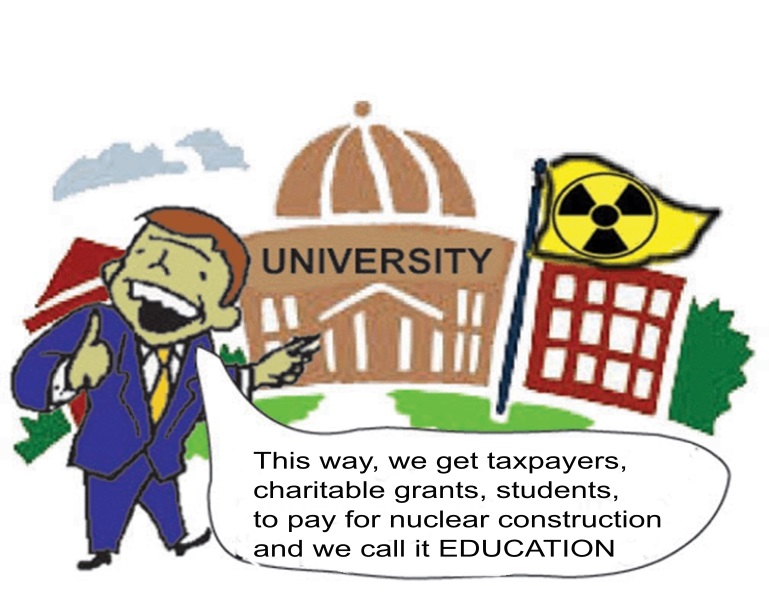
New facility will help de-risk and underpin the Rolls-Royce SMR programme
( De-Risking, is a strategy that companies apply when they cannot manage the money laundering risks that they have obligations to. )
Mirage News, 21 May 24
- The University of Sheffield and Rolls-Royce SMR are setting up a multi-million pound manufacturing and testing facility in South Yorkshire
- Based in the University of Sheffield AMRC’s Factory 2050, the new facility will produce prototype modules for small modular reactors (SMRs)
- New facility will help de-risk and underpin the Rolls-Royce SMR programme that aims to deploy a fleet of factory-built nuclear power plants in the UK and across the world
…………………… The first phase, announced today, is worth £2.7 million and will be part of a wider £15+ million package of work that will further de-risk and underpin the Rolls-Royce SMR programme.
The new facility at the University of Sheffield AMRC will produce working prototypes of individual modules that will be assembled into Rolls-Royce SMR power plants.
The Rolls-Royce SMR programme is UK’s first home-grown nuclear technology for over a generation and today’s announcement is another vital step towards deploying a fleet of factory-built nuclear power plants in the UK and around the globe.
Victoria Scott, Rolls-Royce SMR’s Chief Manufacturing Engineer, said: “Our investment in setting up this facility and building prototype modules is another significant milestone for our business.
“Our factories will produce hundreds of prefabricated and pre-tested modules ready for assembly on site. This facility will allow us to refine our production, testing and digital approach to manufacturing – helping de-risk our programme and ensure we increase our delivery certainty. https://www.miragenews.com/rolls-royce-smr-sheffield-uni-launch-new-1238675/
Solar and wind generation will soon pass nuclear, hydro

In a new monthly column for pv magazine, the International Solar Energy Society (ISES) explains how solar and wind are dominating power plant construction.
MAY 20, 2024 INTERNATIONAL SOLAR ENERGY SOCIETY (ISES) Authors: Prof. Ricardo Rüther (UFSC), Prof. Andrew Blakers /ANU https://www.pv-magazine.com/2024/05/20/solar-and-wind-generation-will-soon-pass-nuclear-and-hydro/
Our ISES pv magazine column in April showed that the fastest energy change in history is continuing. In 2023, solar and wind together constituted 80% of global net power capacity additions. Growth in power capacity is followed by growth in annual energy generation.
Over the past decade, global solar generation has grown ninefold to reach 1,500 TWh per year while wind generation has tripled to 2300 TWh per year (Figure 1 on original). This corresponds to compound growth rates of 22% and 11% per year respectively. In contrast, hydro, nuclear and coal generation had growth rates of about 1% per year, and gas 3%.
The solar growth rate of 22% per year is equivalent to doubling every 3 years. At this growth rate, solar generation will reach 100,000 TWh per year in 2042 which is enough to fully decarbonize the global economy.
Nuclear has a global average capacity factor of 74%, followed by coal (50% to 70%), combined cycle gas (40% to 60%), wind (30% to 60%), large hydro (30% to 50%), and solar photovoltaics (12% to 25%).
Despite its relatively low capacity factor, solar generation is tracking to surpass nuclear generation in 2026, wind in 2027, hydro in 2028, gas in 2030 and coal in 2032.
Solar and wind are strongly dominating powerplant construction, whereas construction of all other generation technologies is both small and stagnant. Coal, gas and nuclear could be mostly gone by mid-century once retirements outpace new construction.
The leading countries for per capita solar and wind generation are all in Europe, except Australia (Figure 2 on original). Also shown in Figure 2 is global per capita generation from hydro and nuclear. Combined generation from solar and wind in the leading countries is now fourfold larger than the global average generation from hydro and nuclear combined.
Australia is a global pathfinder because, unlike in Europe, it cannot share electricity across national boundaries to reduce the effects of variable weather and demand. Australia must go it alone. Australia is convincingly demonstrating that change can happen quickly with good policies. Over the period 2020 to 2030, fossil generation is falling from 75% to 18%, while solar and wind generation is rising from 19% to 75%.
Brazil and Chile are middle income pathfinder countries, with about 81% and 60% respectively of electricity generation coming from hydro, wind and solar. Pathfinder countries are driven by a desire to reduce both electricity prices and emissions. There are few serious concerns about future grid stability because there will be sufficient investment in storage, transmission, and demand management.
Iran appoints nuclear negotiator Ali Bagheri as interim foreign minister
First Post FP Staff • May 20, 2024
Following the horrific helicopter crash that killed Iran’s Foreign Minister and President, Ali Bagheri, the country’s seasoned nuclear negotiator, was named acting Foreign Minister on Monday.
Hossein Amir-Abdollahian, the late foreign minister, had Bagheri, 56, as his deputy. He is well-known for his strong connections to Iran’s ultraconservatives and his membership in the inner circle of Supreme Leader Ayatollah Ali Khamenei.
Bagheri was known for his composed manner throughout his tenure, even though he took strong positions, especially when it came to denouncing intervention from the West.
Bagheri is well-versed in Iran’s nuclear dossier, a divisive topic that has soured relations between Tehran and major international players, notably Israel. He became a prominent opponent of the 2015 nuclear agreement, charging that Iran’s interests were compromised by the previous government…………………………………………….
With nuclear talks at a stalemate due to major differences, especially with the United States, Baghari’s nomination as interim foreign minister comes at a difficult moment. https://www.firstpost.com/world/iran-appoints-nuclear-negotiator-ali-bagheri-as-interim-foreign-minister-13772964.html
In Nuclear Crosshairs, Guam Still Doesn’t Control Its Own Affairs
… because its inhabitants are not fully considered Americans when it matters.
WORDS: APRIL ARNOLD, PICTURES: JAZMIN SMITH, MAY 20, 2024, https://inkstickmedia.com/in-nuclear-crosshairs-guam-still-doesnt-control-its-own-affairs/
At the core of Guam’s indigenous CHamoru culture are the concepts of inafa’maolek – inafa meaning “to make together” and maolek meaning “good.” It is the idea that something was once bad or broken and is in need of repair, and that repair comes from doing good together and restoring harmony. If there is one thing the CHamoru have known for nearly 500 years, it is how to make the best of broken circumstances.
In recent years, Guam has found itself at the center of tensions between the United States and countries in the Pacific. As the tiny island sits on the frontlines of the competition for influence in the region, Guam has increasingly come under threat of being a prime target for nuclear attack by China or North Korea.
In 2022, North Korea confirmed a test launch of an intermediate-range ballistic missile that could reach Guam. In 2023, the country confirmed launching spy satellites that targeted military installations in Japan, on the US mainland and on Guam. Equally concerning was North Korea’s response that attempts to interfere with their satellites would be considered a declaration of war. In April 2024, North Korea conducted a test launch of another intermediate-range ballistic missile that could also reach Guam.
“Guam Killer”
As for China, during a military parade in September 2015, the Chinese government unveiled a new missile that quickly became known as the “Guam Killer.” Following the introduction of this new missile, the US-China Economic Security Commission published a 2016 report detailing China’s military expansion and its implications for Guam.
Yet, despite the threat to the island, it still does not have a full say over many aspects of its strategic role in international affairs. Its citizens are not allowed to vote in US presidential elections, with straw polls showing that voting trends of the territory do not guarantee one political party leverage over the other.
Nor does Guam have full representation in US Congress, limiting its ability to lobby for the island’s interests, despite being in harm’s way militarily and environmentally. As the US promotes democracy worldwide, it should start at home by affording Guam statehood. This, in turn, could help temper the aggression and rhetoric China and North Korea have directed at the island, giving the US an even stronger foothold in the region.
History of Foreign Rule
Guam has been under foreign rule since 1565 and foreign aggression since 1521 when Ferdinand Magellan landed on the island. As a strategic trade outpost for Spain for over 300 years, the CHamoru were forced to convert to Catholicism by the Jesuits and subservient to Spanish governance that ravaged the island’s natural resources and culture. In the book “Destiny’s Landfall,” author Robert F. Rogers detailed stories of the abuse the CHamoru people experienced at the hands of governors who had a recurring penchant for excessive greed and virile priests seeking to exact their purportedly divine authority.
Then, as a concession of the Spanish-American War, Spain transferred Guam to the US under the Treaty of Paris of 1898. This was a controversial transaction at the time as Congress was amid the throes of the debate over Manifest Destiny and expansion into the Pacific.
Much to the surprise of the citizens of Guam, the transfer did not result in its incorporation into the country as a state, despite establishing a local democratic government to aid this effort.
Military Oversight
Instead, the island was placed under the oversight of the Department of the Navy for 52 years, where military governance had absolute authority. As a result of the treaty, the US government faced a new hurdle of incorporating these newly-acquired territories.
Through a series of Supreme Court rulings known as the Insular Cases, the US decided that Guam among other islands such as Puerto Rico, Hawaii, and the Philippines, would be considered territories without full citizenship rights.
Language from one of the Insular Cases, Downes vs. Bidwell, states, in part, the following about foreign territories: “If those possessions are inhabited by alien races, differing from us in religion, customs, laws, methods of taxation, and modes of thought, the administration of government and justice, according to Anglo-Saxon principles, may for a time be impossible.”
Taking Advantage
In short, even though Guam had been under Catholic influence and rule for more than 300 years and had adopted many Catholic practices, it was not enough to be accepted into the US as more than an “alien race.”
Meanwhile, the US had begun taking full advantage of Guam’s position in the Pacific, constructing military bases starting in WWII. It wasn’t until 1950 that the Department of the Navy would transfer its oversight of Guam to the Department of the Interior, designating the island as an unincorporated territory through the Guam Organic Act.
With the steady military buildup of US forces on Guam over the decades, the US would gain more influence in the Pacific while pushing CHamoru off their lands and creating waste management nightmares that now include two Superfund sites used to dispose of hazardous chemicals.
Military Buildup
Even as tensions have grown, military officials have called for increased investment in a missile defense capability on the island to counter China’s capabilities development and aggression in the region. This includes relocating 5,000 US Marines to Camp Blaz on Guam later in 2024, with some concerned over impacts to the local ecosystem and historical sites.
Meanwhile, Guam continues to wrestle with the US government on waste management funding to clean up the Superfund site, Ordot Landfill. The landfill was formerly owned and used by the Department of the Navy during WWII, with some of its contents allegedly being toxic chemicals such as Agent Orange. Even upon returning the landfill to the island after Congress passed the Guam Organic Act in 1950, the Navy continued to use the dump until the 1970s.
After its closure in 2011, Guam’s local government began clean-up efforts and filed a lawsuit under the Superfund Act to seek financial help from the US government on the $160 million estimated cost. A lower court ruled that Guam’s lawsuit surpassed the statute of limitations under the Comprehensive Environmental Response, Compensation and Liability Act. As one article states, “Shouldering the cost alone would be unduly difficult for the small island, as the bill exceeds the combined annual budget of its health, social services, police, fire, public works, solid waste and environmental departments.”
In May 2021, the Supreme Court reversed the ruling, and in September 2023 the US government agreed to pay $48.9 million in cleanup costs that were incurred prior to Aug. 10, 2022. The remaining $110 million in costs will still have to be covered by Guam’s local government.
Self-Determination
The conversation of Guam’s self-determination starts at the local level. Guam’s Commission on Decolonization was formed in 1997 to promote domestic education and outreach on the island’s options for self-determination. These options include statehood, free association, or independence. The first step in this process is the self-determination vote, where voters decide which of the decolonization options to pursue. Yet, efforts for a referendum have already run into issues at the federal level.
Before conducting the vote, Guam’s government needs to decide who is included in the definition of self-determination, which it has already done. According to the commission’s website, the right of self-determination belongs to those who were colonized, with the definition of “native inhabitants of Guam,” referring to people who became US citizens through the 1950 Guam Organic Act, as well as their descendents.
In 2020, the Supreme Court declined to review Guam’s appeal of a previous lower court ruling on conducting a nonbinding plebiscite to determine whether native inhabitants preferred statehood, free association, or independence because the vote was discriminatory on the grounds of race.
In February 2024, Guam’s government began looking into better defining the term so that it meets expectations in local law and was not “considered again a ‘proxy for race’ and therefore unconstitutional.”
On May 13, 2024, Guam’s Attorney General published an opinion that there was “no room” for Guam’s definition of the phrase that would be deemed constitutional. Instead, the AG recommended Guam’s Governor take other legal routes, such as lobbying Congress to recognize Guam’s unique history and work with the island to develop a path towards self-determination as well as petition support from the United Nations.
Reluctance
Separately, politicians on Guam are also reluctant to pursue tribal classification for the CHamoru people, especially after the US federal government sued Guam over land trust issues.
In 2017, Madeleine Bordallo, then the Guam delegate to the US House of Representatives, expressed concerns over the implications of enrolling the CHamoru as a tribe when the island would have to transfer ownership of the tribal lands to the federal government.
Each of these issues has made it difficult for Guam to gain traction in pursuing any form of self-determination, let alone statehood.
While it is unlikely that the majority of US elected officials would support anything other than statehood for Guam, leaving the island in a position that forces them to either lobby Congress for any self-determination support or solicit help from the United Nations could strain the relationship at a delicate time internationally.
Path Forward
After a referendum favoring statehood, all that is required for Guam to become a state is a simple majority vote on a joint resolution in both houses of Congress and approval by the President. The biggest hurdle is often lobbying Congress for the votes. The CHamoru have had their land taken from them to support US military demands with little-to-no reconciliation efforts from the US government.
Yet, the tiny island finds itself in the crosshairs of growing tensions between multiple nuclear weapons states, with barely a voice to hold the US government accountable for its actions. Many arms control and nonproliferation experts lament the lack of US public interest in the threat of nuclear war. Perhaps, it is because those most at risk are not fully considered Americans when it matters. If the US truly cares about ensuring democracy around the world, it should start at home.
North Korea vows to boost nuclear posture after US subcritical nuke test
DPRK slams US for destabilizing global security through no-expolosion experiment, though expert downplays threat
NK News Jeongmin Kim , May 20, 2024
North Korea has condemned the U.S. for conducting a no-explosion nuclear experiment that it claims destabilizes global security, vowing to recalibrate its own nuclear deterrence measures in response.
The U.S. Energy Department’s National Nuclear Security Administration (NNSA) announced last week that it conducted a “subcritical experiment at an underground facility in Nevada on May 14 to collect information about the reliability and effectiveness of American nuclear warheads.
“This is a dangerous act that renders the extremely worsening global security environment more unstable, having seriously negative impact on the strategic balance among major nuclear powers,” an unnamed spokesperson of North Korea’s foreign ministry said in a statement on Monday.
Both the externally facing Korean Central News Agency and the domestic party daily Rodong Sinmun carried the statement.
The spokesperson called the U.S. the “world’s biggest nuclear weapons state” with a “strategic goal to militarily control other countries,” disqualifying it from discussing the threat of nuclear war.
It is “nothing but rhetoric,” the statement continues before referencing the strategic assets that visited South Korea in the past couple of years, the U.S.-ROK Nuclear Consultative Group on discussing joint nuclear planning and the joint tabletop exercise slated for August on North Korean nuclear use scenarios.
The latest test in Nevada has “added new tension to the military showdown among nuclear weapons states, fomenting the international nuclear arms race,” the statement reads, vowing to improve its nuclear defense posture against this threat.
However, Shin Seung-ki, a senior analyst at the Korea Institute for Defense Analyses (KIDA), told NK News that the U.S. test is not as threatening or new as North Korea described it. ………………………………………….
South Korean and U.S. authorities have said North Korea completed preparations for a seventh nuclear test around two years ago, but Pyongyang has not conducted one so far. https://www.nknews.org/2024/05/north-korea-vows-to-boost-nuclear-posture-after-us-subcritical-nuke-test/
North Korea says it forced to take measures to increase nuclear deterrence
20 May 2024, By Alimat Aliyeva, https://www.azernews.az/region/226324.html
The subcritical nuclear test conducted by the United States at the Nevada test site leads to an escalation of the global nuclear arms race, and Pyongyang is forced to take the necessary measures in this regard, Azernews reports.
It notes that the test “creates new tensions in the military confrontation between nuclear states and accelerates the global nuclear arms race.”
“In no case should the influence of this nuclear test on the military security situation in the region of the Korean Peninsula be allowed. In order to prepare for the strategic instability that is being created in the region and globally due to the unilateral action of the United States, we are forced to take the necessary measures to increase universal readiness for nuclear deterrence within the framework of our sovereign right and possible options,” the representative of the department added.
It is not said exactly what measures can be taken, but it is noted that the DPRK will “consistently protect the security, rights and interests of the state “by these actions, as well as “prevent the creation of a strategic imbalance and a security vacuum in the region of the Korean Peninsula.”
US-Saudi officials meet for security and nuclear deal

the Biden administration is offering a strategic deal on nuclear deal to the Saudis to assist a Saudi civilian nuclear program, as Iran has reached the weapons threshold under President Joe Biden’s watch.
May 20, 2024 , https://www.middleeastmonitor.com/20240520-us-saudi-officials-meet-for-security-and-nuclear-deal/
US National Security Adviser, Jake Sullivan, and Saudi Crown Prince, Mohammed Bin Salman, met in Dhahran to discuss a range of issues, including normalisation of ties with Israel, Reuters reports.
According to the report, a Saudi statement on Sunday also said, “the semi-final version of the draft strategic agreements between the two countries, which are almost being finalised”, were discussed.
The report added that the Biden administration is offering a strategic deal on nuclear deal to the Saudis to assist a Saudi civilian nuclear program, as Iran has reached the weapons threshold under President Joe Biden’s watch.
The meeting also covered “what is being worked on between the two sides on the Palestinian issue to find a credible path towards a two-state solution”, as well as attempts to stop the war in Gaza and facilitate the distribution of humanitarian aid there.
UN watchdog warns on nuclear trafficking
https://www.aljazeera.com/news/2024/5/20/un-watchdog-warns-on-nuclear-trafficking
The IAEA reports thousands of pieces of nuclear materiel have gone missing over last three decades.
The United Nations’ nuclear watchdog has called for “vigilance” as it warned of thousands of instances of radioactive materials going missing.
The International Atomic Energy Agency’s (IAEA) Incident and Trafficking database reported on Monday that 31 countries reported 168 incidents in which nuclear or other radioactive material was lost, stolen, improperly disposed of or otherwise neglected last year, “in line with historical averages”. The watchdog has recorded more than 4,200 thefts or other incidents over the past 30 years.
The IAEA noted that six of last year’s incidents were “likely related to trafficking or malicious use”, also known as Group I, representing a slight increase from 2022 but a drop from 2021.
The trafficking database covers three types of incidents where nuclear or radioactive material escaped regulatory control, with Group I being the most serious.
Incidents where trafficking or malicious use is unlikely or can be ruled out are known as Group II and those where any connection is unclear fall into Group III.
The trafficking database was set up to track the illicit trafficking of nuclear material, such as uranium and plutonium, which can be used in atom bombs, and radioactive material, such as isotopes used in hospital equipment.
The IAEA released its latest finding as it opened its fourth international conference on nuclear security, which will run until Friday in the Austrian capital, Vienna.
Since 1993, the nuclear watchdog has recorded 4,243 incidents, 350 of them connected or likely to be connected to trafficking or malicious use.
“The reoccurrence of incidents confirms the need for vigilance and continuous improvement of the regulatory oversight to control, secure and properly dispose radioactive material,” said Elena Buglova, director of the IAEA’s nuclear security division.
The IAEA noted a decline in incidents involving nuclear material, such as uranium, plutonium and thorium.
1 This Month
Chernobyl: The Lost Tapes – A good documentary on Chernobyl on SBS available On Demand for the next 3 weeks– https://www.sbs.com.au/ondemand/tv-program/chernobyl-the-lost-tapes/2352741955560

of the week–London Campaign for Nuclear Disarmament

Tell the Ukrainian Government to Drop Prosecution of Peace Activist Yurii Sheliazhenko
To see nuclear-related stories in greater depth and intensity – go to https://nuclearinformation.wordpress.com
-
Archives
- April 2026 (152)
- March 2026 (251)
- February 2026 (268)
- January 2026 (308)
- December 2025 (358)
- November 2025 (359)
- October 2025 (376)
- September 2025 (257)
- August 2025 (319)
- July 2025 (230)
- June 2025 (348)
- May 2025 (261)
-
Categories
- 1
- 1 NUCLEAR ISSUES
- business and costs
- climate change
- culture and arts
- ENERGY
- environment
- health
- history
- indigenous issues
- Legal
- marketing of nuclear
- media
- opposition to nuclear
- PERSONAL STORIES
- politics
- politics international
- Religion and ethics
- safety
- secrets,lies and civil liberties
- spinbuster
- technology
- Uranium
- wastes
- weapons and war
- Women
- 2 WORLD
- ACTION
- AFRICA
- Atrocities
- AUSTRALIA
- Christina's notes
- Christina's themes
- culture and arts
- Events
- Fuk 2022
- Fuk 2023
- Fukushima 2017
- Fukushima 2018
- fukushima 2019
- Fukushima 2020
- Fukushima 2021
- general
- global warming
- Humour (God we need it)
- Nuclear
- RARE EARTHS
- Reference
- resources – print
- Resources -audiovicual
- Weekly Newsletter
- World
- World Nuclear
- YouTube
-
RSS
Entries RSS
Comments RSS
 nuclear-news