Netflix’s “Turning point. The bomb and the cold war”. Episode 2 – Poisoning the Soil.

This episode mainly covers the period in Russia 1930s through, 1950s, and then the USA, with remarkable pictures and interviews, sometimes very moving ones, with people involved in the events. It shows how the Soviet Union developed into a cruel totalitarian regime, and how in the West, ideas of defence morphed into paranoia about the “red menace”, and the further development of nuclear weapons.
Soviet Union.
Stalin. Russia failed to come to terms with the past Stalin still revered “his glorious accomplishments” “His crimes not well known, not understood“ The most evil person in Russia’s history“
Deep and irreconcilable conflicts between the great powers – for 50 years – out to destroy each other’s way of life – existential struggle between the capitalist world and the communist world
1848 – capitalist industrial society – child labour. Marx and Engels came up with a utopian solution – communism. Lenin in Russia, inspired by Marx and Engels, took power and proclaimed Russia a state run by workers and peasants. Bolsheviks felt besieged, and this brought on the red terror, and a bloody civil war. Stalin, basically a gangster, rises. In 1922 the Soviet Union is established and Stalin takes over.
The promise of equality was not kept. The 1929 collectivisation of agriculture is told in apersonal and dramatic way. It resulted in famine across the Soviet Union. Stalin fixed on Ukraine – a special program of food collection. 1932, Ukrainians were controlled, with borders closed, some 4 million died of starvation – the holodomor
The Soviet Union becomes truly totalitarian – 1937-38 – the Great Terror – great purge trials. Stalin paranoid about secret enemies – many colleagues exterminated. Huge system of concentration camps all across the Soviet Union – the gulags – to punish. to frighten – and also to provide slave labour, 15-20 million people – several million died. .
Stalin was genocidal to his own people – poured toxic materials into the soil. Very personal and heart-breaking testimonials and visuals of this period
1945 – the Soviet army stole everything they could from the conquered lands. Soviet Union had lost 20 million soldiers, and was now occupying lands of Eastern Europe. George Kennan tells Truman that Stalin wants more power, defines Soviet as an adversary, that understands only force and the threat of force. He says that the two world powers would one day fight for dominion over the world. This was the beginning of the Cold War.
The USA and “the West”
In the USA this mood of necessity to defend against the Soviet Union – led to the creation in 1947 of the Pentagon. Air force, Army, Navy all together under the Secretary for Defense, The National Security Council, the CIA. USA transitions into a vast military and intelligence apparatus.
March 1946 Winston Churchill gives his “Iron Curtain” speech. Berlin becomes the centre for the growing divide between the Eastern and the Western blocs. the Soviets trying to take over the whole of Berlin, with a sort of siege, the Berlin blockade, countered successfully by western countries flying in supplies.
1949 NATO established. Moscow formed the Warsaw Pact. Meanwhile in China Mao Zedong takes over with a communist government – furthering the cold war and the feeling that communism was expanding around the globe – kicking off the red hysteria. Then the news that Moscow has the atomic bomb – huge project for Russia. Helped by spies – Klaus Fuchs, who saw Russia as an ally against Nazism, (he got 14 years gaol).
The son of Julius and Ethel Rosenberg tells their tragic story. The crimes of Stalin’s Russia were not at that time understood, while capitalism’s injustices and antisemitism were rife in USA and Europe. Ethel was almost certainly innocent. Julius and Ethel refused to give up the names of communists, and therefore were executed, (botched in Ethel’s case) – one of the prosecutors was the zealous young Roy Cohn.

The House Un-American Activities Committee – focussed on the Red Menace in the media, and Senator Joe McCarthy and Roy Cohn expanded this persecution to other areas, even the army. This fear of communist spies stoked the cold war – but McCarthy never found a single spy. McCarthy was finally discredited. Roy Cohn went on to later teach “hardball politics” to the young Donald Trump.
Meanwhile Edward Teller comes on the scene in the early 1950s – with his plans for the thermonuclear bomb, and the fear that Russia too is developing this even more monstrous weapon. Daniel Ellsberg copied the papers on the nuclear war plans – strange and horrible” – recognises this project as “institutional insanity”
U.S. rejects China’s proposal to ban first use of nuclear weapons.

People’s World May 16, 2024 BY JOHN WOJCIK, MARK GRUENBERG AND BEN CHACKO
The U.S. has dismissed Chinese calls for a no-first-use treaty between nuclear weapons states, saying it has questions about China’s “sincerity.”
The outright dismissal of China’s proposal followed a major speech in which Biden announced radical tariffs of up to 100 percent, on steel imports from China. That speech follows months of U.S. military buildup in the waters off the coast of China, including the placement of additional nuclear submarines around the Korean peninsula, all in the name of “protecting” Taiwan, which is, of course, a part of China itself.
Undersecretary of State Bonnie Jenkins, the country’s top arms control official, told the Senate Foreign Relations Committee last night that the U.S. worried China had increased its number of nuclear warheads to over 500, might have 1,000 by 2030, and that this was proof that the country was not “sincere” about its proposal to ban first use of the apocalypse-engendering weapons.
The Biden administration’s claim that China had increased the number of its warheads to 500 is just that – an unverified claim. In addition, the U.S. has 12 times that number with an admitted 3,700 of such warheads.
The U.S. says China refuses to engage in nuclear disarmament talks with it. China actually has engaged in talks, first by discussing with the U.S. the need for the U.S. to reduce its outrageously large number of missiles, as compared to China’s number, to show it is serious about fairness. And now it has added to those talks with its proposal to ban the first use of the weapons.
China’s position is that it has an arsenal that is tiny in comparison with that of the United States and that the size of the arsenals has to be part of serious talks. China has also gotten India to sign a no-first-use deal between those two countries. While all these initiatives by China were underway the U.S. was busy unilaterally canceling nuclear arms deals between the U.S. and Russia and continuing to push expansion of NATO not just up to the borders of Russia but into the Pacific regions near China.
China also stores its warheads and delivery systems separately, to avoid the risk of launches by accident or misunderstanding, as almost happened in 1983, when Soviet lieutenant Stanislav Petrov recognized reports of incoming U.S. missiles as a system malfunction and prevented a retaliatory strike which could have begun World War III.
The new, highest-ever U.S. tariffs on Chinese products were announced by President Biden shortly before the Chinese peace initiatives were rejected by his administration. The tariffs would apply to government-subsidized Chinese steel, aluminum, solar cells, electric vehicles—rising to 100% tariffs this year—and their batteries, semiconductors, and some raw materials.
The Biden tariffs are much higher than the Trump tariffs that Biden opposed when Trump was president……………………………… more https://peoplesworld.org/article/u-s-rejects-chinas-proposal-to-ban-first-use-of-nuclear-weapons/—
Mini-Nukes, Big Bucks: The Interests Behind the Small Modular Reactor Push

Scandal-ridden SNC-Lavalin is playing a major role in the push for SMRs.
Then there’s Terrestrial Energy
the Breakthrough Energy Coalition (BEC) no longer makes its membership public, the original coalition included such familiar names as Jeff Bezos (Amazon), Marc Benioff (Salesforce), Michael Bloomberg, Richard Branson, Jack Ma (Alibaba), David Rubenstein (Carlyle Group), Tom Steyer, George Soros, and Mark Zuckerberg. Many of those names (and others) can now be found on the “Board and Investors” page of Breakthrough Energy’s website.
Why Canada is now poised to pour billions of tax dollars into developing Small Modular Reactors as a “clean energy” climate solution
by Joyce Nelson, January 14, 2021
https://watershedsentinel.ca/articles/mini-nukes-big-bucks-the-money-behind-small-modular-reactors/—
Back in 2018, the Watershed Sentinel ran an article warning that “unless Canadians speak out,” a huge amount of taxpayer dollars would be spent on small modular nuclear reactors (SMRs), which author D. S. Geary called “risky, retro, uncompetitive, expensive, and completely unnecessary.” Now here we are in 2021 with the Trudeau government and four provinces (Saskatchewan, Ontario, New Brunswick, and Alberta) poised to pour billions of dollars into SMRs as a supposed “clean energy” solution to climate change.
It’s remarkable that only five years ago, the National Energy Board predicted: “No new nuclear units are anticipated to be built in any province” by 2040.
So what happened?
The answer involves looking at some of the key influencers at work behind the scenes, lobbying for government funding for SMRs.
The Carney factor
When the first three provinces jumped on the SMR bandwagon in 2019 at an estimated price tag of $27 billion, the Green Party called the plan “absurd” – especially noting that SMRs don’t even exist yet as viable technologies but only as designs on paper.
According to the BBC (March 9, 2020), some of the biggest names in the nuclear industry gave up on SMRs for various reasons: Babcock & Wilcox in 2017, Transatomic Power in 2018, and Westinghouse (after a decade of work on its project) in 2014.
But in 2018, the private equity arm of Canada’s Brookfield Asset Management Inc. announced that it was buying Westinghouse’s global nuclear business (Westinghouse Electric Co.) for $4.6 billion.
Two years later, in August 2020, Brookfield announced that Mark Carney, former Bank of England and Bank of Canada governor, would be joining the company as its vice-chair and head of ESG (environmental, social, and governance) and impact fund investing, while remaining as UN Special Envoy for Climate Action and Finance.
“We are not going to solve climate change without the private sector,” Carney told the press, calling the climate crisis “one of the greatest commercial opportunities of our time.” He considers Canada “an energy superpower,” with nuclear a key asset.
Carney is an informal advisor to PM Trudeau and to British PM Boris Johnson. In November, Johnson announced £525 million (CAD$909.6 million) for “large and small-scale nuclear plants.”
SNC-Lavalin
Scandal-ridden SNC-Lavalin is playing a major role in the push for SMRs. In her mid-December 2020 newsletter, Elizabeth May, the Parliamentary Leader of the Green Party, focused on SNC-Lavalin, reminding readers that in 2015, then-PM Stephen Harper sold the commercial reactor division of Atomic Energy of Canada Ltd. (AECL) “to SNC-Lavalin for the sweetheart deal price of $15 million
May explained, “SNC-Lavalin formed a consortium called the Canadian National Energy Alliance (CNEA) to run some of the broken-apart bits of AECL. CNEA has been the big booster of what sounds like some sort of warm and cuddly version of nuclear energy – Small Modular Reactors. Do not be fooled. Not only do we not need new nuclear, not only does it have the same risks as previous nuclear reactors and creates long-lived nuclear wastes, it is more tied to the U.S. military-industrial complex than ever before. That’s because SNC-Lavalin’s partners in the CNEA are US companies Fluor and Jacobs,” who both have contracts with US Department of Energy nuclear-weapons facilities.”
But, states May, “Natural Resources Minister Seamus O’Regan has been sucked into the latest nuclear propaganda – that ‘there is no pathway to Net Zero [carbon emissions] without nuclear’.”
Terrestrial Energy
Then there’s Terrestrial Energy, which in mid-October 2020 received a $20 million grant for SMR development from NRCan’s O’Regan and Navdeep Bains (Minister of Innovation, Science and Industry). The announcement prompted more than 30 Canadian NGOs to call SMRs “dirty, dangerous, and distracting” from real, available solutions to climate change.
The Connecticut-based company has a subsidiary in Oakville, Ontario. Its advisory board includes Stephen Harper; Michael Binder, the former president and CEO of the Canadian Nuclear Safety Commission; and (as of October) Dr. Ian Duncan, the former UK Minister of Climate Change in the Dept. of Business Energy and Industrial Strategy (BEIS).
Perhaps more important, Terrestrial Energy’s advisory board includes Dr. Ernest Moniz, the former US Secretary of the Dept. of Energy (2013-2017) who provided more than $12 billion in loan guarantees to the nuclear industry. Moniz has been a key advisor to the Biden-Harris transition team, which has come out in favour of SMRs, calling them “game-changing technologies” at “half the construction cost of today’s reactors.”

In 2015, while the COP 21 Paris Climate Agreement was being finalized, Moniz told reporters that SMRs could lead to “better financing terms” than traditional nuclear plants because they would change the scale of capital at risk. For years, banks and financial institutions have been reluctant to invest in money-losing nuclear projects, so now the goal is to get governments to invest, especially in SMRs.
That has been the agenda of a powerful lobby group that has been working closely with NRCan for several years.
The “billionaires’ nuclear club”
The 2015 Paris climate talks featured what cleantechnica.com called a “splashy press conference” by Bill Gates to announce the launch of the Breakthrough Energy Coalition (BEC) – a group of (originally) 28 high net-worth investors, aiming “to provide early-stage capital for technologies that offer promise in bringing affordable clean energy to billions.”
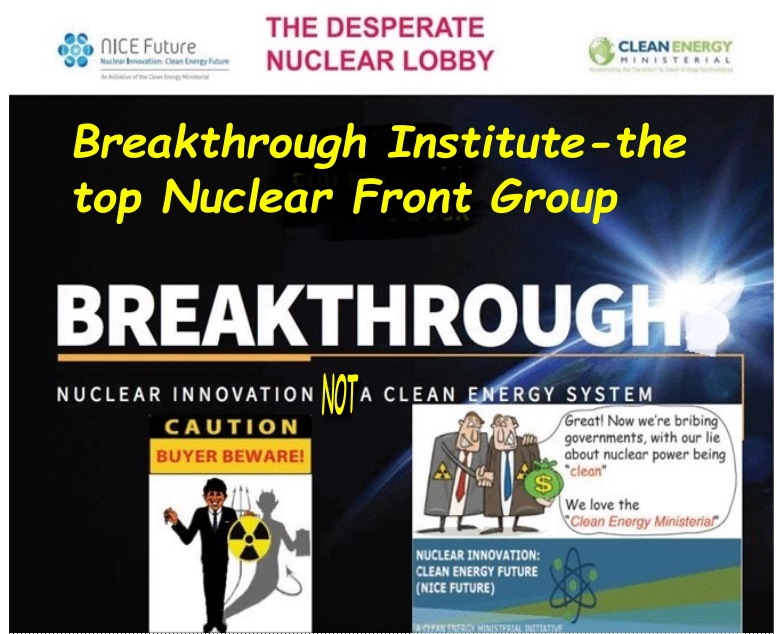
Though BEC no longer makes its membership public, the original coalition included such familiar names as Jeff Bezos (Amazon), Marc Benioff (Salesforce), Michael Bloomberg, Richard Branson, Jack Ma (Alibaba), David Rubenstein (Carlyle Group), Tom Steyer, George Soros, and Mark Zuckerberg. Many of those names (and others) can now be found on the “Board and Investors” page of Breakthrough Energy’s website.
Writing in Counterpunch (Dec. 4, 2015) shortly after BEC’s launch, Linda Pentz Gunter noted that many of those 28 BEC billionaires (collectively worth some $350 billion at the time) are pro-nuclear and Gates himself “is already squandering part of his wealth on Terra Power LLC, a nuclear design and engineering company seeking an elusive, expensive and futile so-called Generation IV traveling wave reactor” for SMRs. (In 2016, Terra Power, based in Bellevue, Washington, received a $40 million grant from Ernest Moniz’s Department of Energy.)
According to cleantechnica.com, the Breakthrough Energy Coalition “does have a particular focus on nuclear energy.” Think of BEC as the billionaires’ nuclear club.
By 2017, BEC was launching Breakthrough Energy Ventures (BEV), a $1 billion fund to provide start-up capital to clean-tech companies in several countries.
Going after the public purse
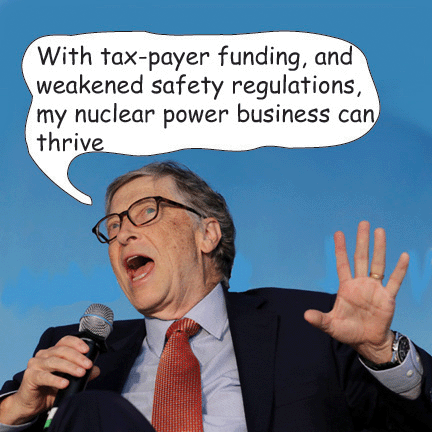
Bill Gates was apparently very busy during the 2015 Paris climate talks. He also went on stage during the talks to announce a collaboration among 24 countries and the EU on something called Mission Innovation – an attempt to “accelerate global clean energy innovation” and “increase government support” for the technologies. Mission Innovation’s key private sector partners include the Breakthrough Energy Coalition, the World Economic Forum, the International Energy Agency, and the World Bank.
An employee at Natural Resources Canada, Amanda Wilson, was appointed as one of the 12 international members of the Mission Innovation Steering Committee.
In December 2017, Bill Gates announced that the Breakthrough Energy Coalition was partnering with Mission Innovation members Canada, UK, France, Mexico, and the European Commission in a “public-private collaboration” to “double public investment in clean energy innovation.”
Canada’s Minister of Natural Resources at the time, Jim Carr, said the partnership with BEC “will greatly benefit the environment and the economy. Working side by side with innovators like Bill Gates can only serve to enhance our purpose and inspire others.”
Dr. M.V. Ramana, an expert on nuclear energy and a professor at the School of Public Policy and Global Affairs at UBC, told me by email: “As long as Bill Gates is wasting his own money or that of other billionaires, it is not so much of an issue. The problem is that he is lobbying hard for government investment.”
Dr. Ramana explained that because SMRs only exist on paper, “the scale of investment needed to move these paper designs to a level of detail that would satisfy any reasonable nuclear safety regulator that the design is safe” would be in the billions of dollars. “I don’t see Gates and others being willing to invest anything of that scale. Instead, they invest a relatively small amount of money (compared to what they are worth financially) and then ask for government handouts for the vast majority of the investment that is needed.”
Kevin Kamps, Radioactive Waste Specialist at Beyond Nuclear, told me by email that the companies involved in SMRs “don’t care” if the technology is actually workable, “so long as they get paid more subsidies from the unsuspecting public. It’s not a question of it working, necessarily,” he noted.
Gordon Edwards, President of the Canadian Coalition for Nuclear Responsibility, says governments “are being suckers. Because if Wall Street and the banks will not finance this, why should it be the role of the government to engage in venture capitalism of this kind?”
“Roadmap” to a NICE future
By 2018, NRCan was pouring money into a 10-month, pan-Canadian “conversation” about SMRs that brought together some 180 individuals from First Nations and northern communities, provincial and territorial governments, industry, utilities, and “stakeholders.” The resulting November 2018 report, A Call to Action: A Canadian Roadmap for Small Modular Reactors, enthusiastically noted that “Canada’s nuclear industry is poised to be a leader in an emerging global market estimated at $150 billion a year by 2040.”
At the same time, Bill Gates announced the launch of Breakthrough Energy Europe, a collaboration with the European Commission (one of BEC’s five Mission Innovation partners) in the amount of 100 million euros for clean-tech innovation.
Gates’ PR tactic is effective: provide a bit of capital to create an SMR “bandwagon,” with governments fearing their economies would be left behind unless they massively fund such innovations.
NRCan’s SMR Roadmap was just in time for Canada’s hosting of the Clean Energy Ministerial/Mission Innovation summit in Vancouver in May 2019 to “accelerate progress toward a clean energy future.” Canada invested $30 million in Breakthrough Energy Solutions Canada to fund start-up companies.
A particular focus of the CEM/MI summit was a CEM initiative called “Nuclear Innovation: Clean Energy (NICE) Future,” with all participants receiving a book highlighting SMRs. As Tanya Glafanheim and M.V. Ramana warned in thetyee.ca (May 27, 2019) in advance of the summit, “Note to Ministers from 25 countries: Prepare to be dangerously greenwashed.”
Greenwash vs public backlash
While releasing the federal SMR Action Plan on December 18, O’Regan called it “the next great opportunity for Canada.”
Bizarrely, the Action Plan states that by developing SMRs, our governments would be “supporting reconciliation with Indigenous peoples” – but a Special Chiefs Assembly of the Assembly of First Nations passed a unanimous 2018 resolution demanding that “the Government of Canada cease funding and support” of SMRs. And in June 2019, the Anishinabek Chiefs-in-Assembly (representing 40 First Nations across Ontario) unanimously opposed “any effort to situate SMRs within our territory.”
Some 70 NGOs across Canada are opposed to SMRs, which are being pushed as a replacement for diesel in remote communities, for use in off-grid mining, tar-sands development, and heavy industry, and as exportable expertise in a global market.
On December 7, the Hill Times published an open letter to the Treasury Board of Canada from more than 100 women leaders across Canada, stating: “We urge you to say ‘no’ to the nuclear industry that is asking for billions of dollars in taxpayer funds to subsidize a dangerous, highly-polluting and expensive technology that we don’t need. Instead, put more money into renewables, energy efficiency and energy conservation.”
No new money for SMRs was announced in the Action Plan, but in her Fall Economic Statement, Finance Minister Chrystia Freeland touted SMRs and noted that “targeted action by the government to mobilize private capital will better position Canadian firms to bring their technologies to market.” That suggests the Canada Infrastructure Bank will use its $35 billion for such projects.
It will take a Herculean effort from the public to defeat this NICE Future, but along with the Assembly of First Nations, three political parties – the NDP, the Bloc Quebecois, and the Green Party – have now come out against SMRs.
Award-winning author Joyce Nelson’s latest book, Bypassing Dystopia, is published by Watershed Sentinel Books. She can be reached via www.joycenelson.ca.
This is what nuclear war in 2024 would look like

ABC RN, Broadcast Thu 16 May 2024, https://www.abc.net.au/listen/programs/latenightlive/this-is-what-nuclear-war-in-2024-would-look-like/103840906
In 1985, President Ronald Reagan and Soviet General Secretary Mikhail Gorbachev cautioned the world “a nuclear war cannot be won and must never be fought”. Decades later, we’re closer to nuclear Armageddon than ever before, and investigative journalist Annie Jacobsen paints a devastating picture of exactly what that would look like.
Guest: Annie Jacobsen – investigative journalist and New York Times bestselling author. She also writes and produces TV, including Tom Clancy’s Jack Ryan. Her latest book is Nuclear War: A Scenario.
Credits
The Arsenal of Genocide: the U.S. Weapons That Are Destroying Gaza

the Biden administration has given itself a green light to keep sending weapons and Israel a flashing one to keep committing war crimes with them.
During the Second World War, the United States proudly called itself the “Arsenal of Democracy,” as its munitions factories and shipyards produced an endless supply of weapons to fight the genocidal government of Germany. Today, the United States is instead, shamefully, the Arsenal of Genocide, providing 70% of the imported weapons Israel is using to obliterate Gaza and massacre its people.
By Medea Benjamin, Nicolas J.S. Davies May 14, 2024, https://znetwork.org/znetarticle/the-arsenal-of-genocide-the-u-s-weapons-that-are-destroying-gaza/—
On May 8, 2024, as Israel escalated its brutal assault on Rafah, President Biden announced that he had “paused” a delivery of 1,700 500-pound and 1,800 2,000-pound bombs, and threatened to withhold more shipments if Israel went ahead with its full-scale invasion of Rafah.
The move elicited an outcry from Israeli officials (National Security Minister Itamar Ben-Gvir tweeted “Hamas loves Biden”), as well as Republicans, staunch anti-Palestinian Democrats and pro-Israel donors. Republicans immediately prepared a bill entitled the Israel Security Assistance Support Act to prohibit the administration from withholding military aid to Israel.
Many people have been asking the U.S. to halt weapons to Israel for seven months, and of course Biden’s move comes too late for 35,000 Palestinians who have been killed in Gaza, mainly by American weapons.
Lest one think the administration is truly changing its position, two days after announcing the pause, the State Department released a convoluted report saying that, although it is reasonable to “assess” that U.S. weapons have been used by Israeli forces in Gaza in ways that are “inconsistent” with international humanitarian law, and although Israel has indeed delayed or had a negative effect on the delivery of aid to Gaza (which is illegal under U.S. law), Israel’s assurances regarding humanitarian aid and compliance with international humanitarian law are “credible and reliable.”
By this absurd conclusion, the Biden administration has given itself a green light to keep sending weapons and Israel a flashing one to keep committing war crimes with them.
In any event, as Colonel Joe Bicino, a retired U.S. artillery officer, told the BBC, Israel can “level” Rafah with the weapons it already has. The paused shipment is “somewhat inconsequential,” Bicino said, “a little bit of a political play for people in the United States who are… concerned about this.” A U.S. official confirmed to the Washington Post that Israel has enough weapons already supplied by the U.S. and other allies to go ahead with the Rafah operation if it chooses to ignore U.S. qualms.
The paused shipment really has to be seen in the context of the arsenal with which the U.S. has equipped its Middle Eastern proxy over many decades.
A Deluge of American Bombs
During the Second World War, the United States proudly called itself the “Arsenal of Democracy,” as its munitions factories and shipyards produced an endless supply of weapons to fight the genocidal government of Germany. Today, the United States is instead, shamefully, the Arsenal of Genocide, providing 70% of the imported weapons Israel is using to obliterate Gaza and massacre its people.
As Israel assaults Rafah, home to 1.4 million displaced people, including at least 600,000 children, most of the warplanes dropping bombs on them are F-16s, originally designed and manufactured by General Dynamics, but now produced by Lockheed Martin in Greenville, South Carolina. Israel’s 224 F-16s have long been its weapon of choice for bombing militants and civilians in Gaza, Lebanon and Syria.
Israel also has 86 Boeing F-15s, which can drop heavier bombs, and 39 of the latest, most wastefully expensive fighter-bombers ever, Lockheed Martin’s nuclear-capable F-35s, with another 36 on order. The F-35 is built in Fort Worth, Texas, but components are manufactured all over the U.S. and in allied countries, including Israel. Israel was the first country to attack other countries with F-35s, in violation of U.S. arms export control laws, reportedly using them to bomb Syria, Egypt and Sudan.
As these fleets of U.S.-made warplanes began bombing Gaza in October 2023, their fifth major assault since 2008, the U.S. began rushing in new weapons. By December 1, 2023, it had delivered 15,000 bombs and 57,000 artillery shells.
The U.S. supplies Israel with all sizes and types of bombs, including 285-pound GBU-39 small diameter glide bombs, 500-pound Mk 82s, 2,000-pound Mk 84s and BLU-109 “bunker busters,” and even massive 5,000-pound GBU-28 bunker-busters, which Israel reportedly used in Gaza in 2009.
General Dynamics is the largest U.S. bomb manufacturer, making all these models of bombs. Most of them can be used as “precision” guided bombs by attaching Raytheon and Lockheed Martin’s Paveway laser guidance system or Boeing’s JDAM (Joint Direct Attack Munitions) GPS-based targeting system.
Little more than half of the bombs Israel has dropped on Gaza have been “precision” ones, because, as targeting officers explained to +972 magazine, their Lavender AI system generates thousands of targets who are just suspected rank-and-file militants, not senior commanders. Israel does not consider it worth “wasting” expensive precision munitions to kill these people, so it uses only “dumb” bombs to kill them in their homes—obliterating their families and neighbors in the process.
In order to threaten and bomb its more distant neighbors, such as Iran, Israel depends on its seven Lockheed Martin KC-130H and seven Boeing 707 in-air refueling tankers, with four new, state-of-the-art Boeing KC46A tankers to be delivered in late 2025 for over $220 million each.
Ground force weapons
Another weapon of choice for killing Palestinians are Israel’s 48 Boeing Apache AH64 attack helicopters, armed with Lockheed Martin’s infamous Hellfire missiles, General Dynamics’ Hydra 70 rockets and Northrop Grumman’s 30 mm machine guns. Israel also used its Apaches to kill and incinerate a still unknown number of Israelis on October 7, 2023—a tragic day that Israel and the U.S. continue to exploit as a false pretext for their own violations of international humanitarian law and of the Genocide Convention.
Israel’s main artillery weapons are its 600 Paladin M109A5 155 mm self-propelled howitzers, which are manufactured by BAE Systems in Chambersburg, Pennsylvania. To the layman, a self-propelled howitzer looks like a tank, but it has a bigger, 155 mm gun to fire at longer range.
Israel assembles its 155 mm artillery shells from U.S.-made components. One of the first two U.S. arms shipments that the administration notified Congress about after October 7 was to resupply Israel with artillery shell components valued at $147.5 million.
Israel also has 48 M270 multiple rocket launchers. They are a tracked version of the HIMARS rocket launchers the U.S. has sent to Ukraine, and they fire the same rockets, made by Lockheed Martin. U.S. Marines used the same rockets in coordination with U.S. airstrikes to devastate Mosul, the second largest city in Iraq, in 2017. M270 launchers are no longer in production, but BEA Systems still has the facilities to produce them.
Israel makes its own Merkava tanks, which fire U.S.-made tank shells, and the State Department announced on December 9, 2023, that it had notified Congress of an “emergency” shipment of 14,000 120 mm tank shells worth $106 million to Israel.
U.S. shipments of artillery and tank shells, and dozens of smaller shipments that it did not report to Congress (because each shipment was carefully calibrated to fall below the statutory reporting limit of $100 million), were paid for out of the $3.8 billion in military aid that the United States gives Israel each year.
In April, Congress passed a new war-funding bill that includes about $14 billion for additional weapons. Israel could afford to pay for these weapons itself, but then it could shop around for them, which might erode the U.S. monopoly on supplying so much of its war machine. That lucrative monopoly for U.S. merchants of death is clearly more important to Members of Congress than fully funding Head Start or other domestic anti-poverty programs, which they routinely underfund to pay for weapons and wars.
The move elicited an outcry from Israeli officials (National Security Minister Itamar Ben-Gvir tweeted “Hamas loves Biden”), as well as Republicans, staunch anti-Palestinian Democrats and pro-Israel donors. Republicans immediately prepared a bill entitled the Israel Security Assistance Support Act to prohibit the administration from withholding military aid to Israel.
Israel has 500 FMC-built M113 armored personnel carriers and over 2,000 Humvees, manufactured by AM General in Mishawaka, Indiana. Its ground forces are armed with several different types of U.S. grenade launchers, Browning machine-guns, AR-15 assault rifles, and SR-25 and M24 SWS sniper rifles, all made in the USA, as is the ammunition for them.
For many years, Israel’s three Sa’ar 5 corvettes were its largest warships, about the size of frigates. They were built in the 1990s by Ingalls Shipbuilding in Pascagoula, Mississippi, but Israel has recently taken delivery of four larger, more heavily-armed, German-built Sa’ar 6 corvettes, with 76 mm main guns and new surface-to-surface missiles.
Gaza Encampments Take On the Merchants of Death
The United States has a long and horrific record of providing weapons to repressive regimes that use them to kill their own people or attack their neighbors. Martin Luther King called the U.S. government “the greatest purveyor of violence in the world,” and that has not changed since he said it in 1967, a year to the day before his assassination.
Many of the huge U.S. factories that produce all these weapons are the largest employers in their regions or even their states. As President Eisenhower warned the public in his farewell address in 1960, “This conjunction of an immense military establishment and a large arms industry” has led to “the acquisition of unwarranted influence, whether sought or unsought, by the military-industrial complex.”
So, in addition to demanding a ceasefire, an end to U.S. military aid and weapons sales to Israel, and a restoration of humanitarian aid to Gaza, the students occupying college campuses across our country are right to call on their institutions to divest from these merchants of death, as well as from Israeli companies.
The corporate media has adopted the line that divestment would be too complicated and costly for the universities to do. But when students set up an encampment at Trinity College in Dublin, in Ireland, and called on it to divest from Israeli companies, the college quickly agreed to their demands. Problem solved, without police violence or trying to muzzle free speech. Students have also won commitments to consider divestment from U.S. institutions, including Brown, Northwestern, Evergreen State, Rutgers and the Universities of Minnesota and Wisconsin.
While decades of even deadlier U.S. war-making in the greater Middle East failed to provoke a sustained mass protest movement, the genocide in Gaza has opened the eyes of many thousands of young people to the need to rise up against the U.S. war machine.
The gradual expulsion and emigration of Palestinians from their homeland has created a huge diaspora of young Palestinians who have played a leading role in organizing solidarity campaigns on college campuses through groups like Students for Justice in Palestine (SJP). Their close links with extended families in Palestine have given them a visceral grasp of the U.S. role in this genocide and an authentic voice that is persuasive and inspiring to other young Americans.
Now it is up to Americans of all ages to follow our young leaders and demand not just an end to the genocide in Palestine, but also a path out of our country’s military madness and the clutches of its deeply entrenched MICIMATT (military-industrial-congressional-intelligence-media- academia-think-tank) complex, which has inflicted so much death, pain and desolation on so many of our neighbors for so long, from Palestine, Iraq and Afghanistan to Vietnam and Latin America.
Medea Benjamin and Nicolas J. S. Davies are the authors of War in Ukraine: Making Sense of a Senseless Conflict, published by OR Books in November 2022.
Medea Benjamin is the cofounder of CODEPINK for Peace, and the author of several books, including Inside Iran: The Real History and Politics of the Islamic Republic of Iran.
Nicolas J. S. Davies is an independent journalist, a researcher for CODEPINK and the author of Blood on Our Hands: The American Invasion and Destruction of Iraq.
The plutonium connection: Why I no longer conduct my research at the University of New Brunswick

I had already learned enough about the power and influence of the nuclear industry to know that I would be fighting a losing battle if I kept my research at UNB
Once during my 13 years at the NRC I was asked to work on a military technology project, and I refused. I had a visceral negative reaction to doing research that could potentially be implicated in mass killing.
by Susan O’Donnell, May 17, 2024, https://nbmediacoop.org/2024/05/17/the-plutonium-connection-why-i-no-longer-conduct-my-research-at-the-university-of-new-brunswick/
On Thursday this week, two very different emails landed in my inbox minutes apart. The juxtaposition jolted me, and I thought: it’s time to share my story about my departure from the University of New Brunswick.
The first email, from the NB Media Co-op, informed me that my commentary written with Gordon Edwards was just published. Our article marked the 50th anniversary of an event that had shocked the world: India’s test nuclear explosion made with plutonium extracted from a ‘peaceful’ nuclear reactor, a gift from Canada. We questioned if Canada was making the same mistake by backing the Moltex project to extract plutonium from used nuclear fuel at the Point Lepreau site on the Bay of Fundy in New Brunswick.
A UNB professor friend sent the second email. He wrote: ‘This will be aggravating to read, but I thought you’d want to see it. I’m attaching the announcement about Arthur Irving’s death coming from UNB’s President. Arthur Irving is celebrated for his commitment and dedication to the environment. Meanwhile, people who are actually committed to the environment (e.g., you) are blacklisted.’
The two emails had this connection: My research and writing about plutonium and Moltex is the main reason why in 2023 I moved my research program from the University of New Brunswick, the largest university in the province, over to St. Thomas University, a small liberal arts undergraduate institution that shares the campus with UNB in Fredericton.
My journey from UNB to STU began in 2020. At that point, I had been with the UNB Sociology department for almost 16 years as an adjunct professor, on faculty but not on staff and so not in the faculty union. During those years, I brought considerable federal research funding into UNB and hired and trained more than a dozen UNB graduate students. My research expertise includes technology adoption: analyzing the social, political, environmental and economic contexts in which people deploy technologies. I joined UNB in 2004 while employed at the National Research Council of Canada on the Fredericton UNB campus, as a senior researcher and vice-chair of the NRC’s research ethics board. Once during my 13 years at the NRC I was asked to work on a military technology project, and I refused. I had a visceral negative reaction to doing research that could potentially be implicated in mass killing.
At the start of 2020, I could not have imagined a connection between NB Power’s Point Lepreau nuclear reactor and weapons of mass destruction. That February, my UNB research project RAVEN was invited to partner with local groups to bring nuclear expert Gordon Edwards, president of the Canadian Coalition for Nuclear Responsibility, to New Brunswick to give public talks in Saint John and Fredericton. I readily agreed. Several months previously, I had read Gordon’s article in the NB Media Co-op about ‘small modular nuclear reactors (SMRs)’ and wanted to learn more. I put up posters around the UNB campus promoting Gordon’s upcoming talk. I asked the UNB communications office to help me promote Gordon’s visit, but they never came through, and I assumed they were too busy to help.
Gordon Edward’s talk, moved online when the pandemic hit in March 2020, sparked my research interest in the adoption of nuclear technology. I began looking into the two small nuclear reactor projects planned for New Brunswick, Moltex and ARC. In July that year, I co-wrote my first commentary with Gordon that mentioned our concerns about the Moltex project and plutonium extraction from used nuclear fuel. The same day that our piece was published in The Hill Times, the newspaper on Parliament Hill in Ottawa, the CEO of Moltex emailed, asking to meet with me. I agreed, and during a break in the pandemic that month, we met outside at Picaroons Roundhouse along with Janice Harvey, the coordinator of the Environment & Society program at St. Thomas University and a co-investigator on my RAVEN project. At the meeting, Janice and I disagreed with the Moltex CEO about the wisdom of his project to extract plutonium from the used nuclear fuel at Point Lepreau.
I continued my research into small nuclear reactors and plutonium extraction by reading research articles and consulting with Gordon and other experts across Canada and internationally. In May 2021, the federal government gave Moltex a $50.5 million grant to develop its technology that could be exported globally. Shortly after, nine U.S. non-proliferation experts wrote an open letter to Prime Minister Trudeau expressing concern about the Moltex project, writing that by ‘backing spent-fuel reprocessing and plutonium extraction, the Government of Canada will undermine the global nuclear weapons non-proliferation regime that Canada has done so much to strengthen.’ The Globe and Mail published an article about the nuclear weapons proliferation concerns with the Moltex project, and Gordon and I published commentaries in The Hill Times, the Bulletin of the Atomic Scientists and the NB Media Co-op.
During this time, I co-founded a public interest group with local activists, the Coalition for Responsible Energy Development in New Brunswick (CRED-NB), to advocate for a nuclear-free renewable energy future. Janice Harvey invited me to join her in the STU Environment & Society program as an adjunct research professor, and in June 2021 I was appointed to the STU faculty in addition to my UNB faculty appointment.
In August 2021, I received a phone call that augured the end of my research program at UNB. On the phone, a friend told me about overhearing the UNB president say: ‘Susan O’Donnell is spreading misinformation about nuclear energy.’ That shocked me for several reasons. First, I would never knowingly spread misinformation. Second, I’d never met the UNB president and didn’t know he knew I existed. Third, why the heck would he say such a thing? To find out, I filed a Right to Information request with UNB, asking for all communications received by the UNB President and the Vice-President Research that mentioned me or my research project RAVEN.
UNB released the information to me in November 2021. The release package, HERE, is dozens of pages, almost all of it redacted. Just enough information was left for me to know that the UNB senior administration’s concern about me began in February 2020, while I was putting up posters around UNB for Gordon Edwards’ talk about small nuclear reactors. Over the weeks leading up to Gordon’s event, a flurry of emails – involving the UNB president, his chief of staff, several vice-presidents, the UNB secretary, two UNB professors I’ve never met, numerous people in UNB communications, and the Atlantica Centre for Energy, a lobby group funded by the energy industry – fretted about the upcoming ‘anti-nuclear event,’ imagining that it was linked to the Green Party and would jeopardize funding for nuclear research at UNB. I finally realized why the UNB communications office had not responded to my request to help publicize Gordon’s talk.
Most interesting to me in the package was an email from the CEO of Moltex to the UNB vice-president research on July 6, 2020, the same day the CEO wrote to me requesting a meeting. To the VP research, the CEO wrote:
‘You may have seen the article recently written by Dr Susan O’Donnell and her group in NB media coop. It was today issued in the Hill Times which gives it significant exposure and credibility. I understand she is a lecturer at UNB. I have emailed her to request a meeting… I do have concerns that her group RAVEN is supported by SSHRC and yet it is being used as an advocacy group and she is using her Academic Freedom to express views without scientific credibility and in conjunction with political parties but I don’t plan on bringing that up with her. I greatly appreciate debate around nuclear and clean energy (I used to be anti nuclear) but it is hard to compete with misinformation backed by a university.’
There it was: the accusation that I was spreading ‘misinformation’ – the same accusation repeated later by the UNB president that my friend had overheard. Finally, I understood why the heck the president had said that: Moltex had stated it as a fact. I knew that Moltex was collaborating with UNB’s Centre for Nuclear Energy Research, and that in addition to the federal grant to Moltex of $50.5 million, UNB received more than $560,000. The Right to Information request showed me that half a million bucks buys a lot at UNB.
To learn more, I filed a complaint in December 2021 with the New Brunswick Ombuds office, asking UNB to release the redacted information. In April 2022, my complaint was dismissed, and I decided to drop it there.
I had already learned enough about the power and influence of the nuclear industry to know that I would be fighting a losing battle if I kept my research at UNB. I was due to write another application for federal research funding. My main concern was that the UNB VP research – who had written many emails about me (that had been redacted) and who would need to sign off on my future requests for federal research funding – was also on the advisory board of the UNB Centre for Nuclear Energy Research. An application for federal research funding takes months of work, and I was not willing to take the risk that after preparing the application, it could be vetoed at the final stage. I asked my UNB Sociology chair not to renew my faculty appointment when it expired in 2023, and I submitted my funding application via the research office at St. Thomas University.
When my UNB appointment ended, the Social Sciences and Humanities Research Council of Canada awarded me a five-year research grant at STU for the CEDAR project – Contesting Energy Discourses through Action Research. CEDAR has excellent co-investigators, collaborators and research assistants. We research the energy transition – focusing on nuclear energy – with the support of my new university administration.
As a bonus, my experience with the Right to Information system raised my awareness of how access to information requests could be useful for research. I’ve since filed more than two dozen requests with different federal and provincial government departments and agencies to learn what goes on behind the scenes between the nuclear industry and governments related to plutonium extraction from used nuclear fuel. As the release packages arrive, many heavily redacted, I’m making them available to other researchers, journalists, and anyone interested, via a page on the CEDAR project website, HERE. Using that information, The Globe and Mail published an article last September, and Gordon Edwards and I published another in March this year in The Bulletin of the Atomic Scientists about the collusion between the nuclear industry and the federal government to develop a policy on nuclear fuel reprocessing. My research continues.
Susan O’Donnell is the primary investigator of the CEDAR project at St. Thomas University.
Canada’s plutonium mishap in India was 50 years ago this week – is history repeating itself now?

the International Panel on Fissile Materials states: ‘the most important reason to be concerned about the practice of reprocessing is that plutonium can be used to make weapons.’
Canada’s support for the Moltex technology could be used by other countries to justify their own plutonium acquisition programs
by Susan O’Donnell and Gordon Edwards, May 16, 2024, https://nbmediacoop.org/2024/05/16/canadas-plutonium-mishap-in-india-was-50-years-ago-this-week-is-history-repeating-itself-now/
In the public imagination, nuclear power for electricity and nuclear weapons are entirely separate issues. Because Canada is not a nuclear weapons state, Canada’s nuclear power reactors are thought to be unrelated to weapons of mass destruction, and its nuclear technology exports are considered ‘peaceful.’
Yet this week marks the 50-year anniversary of one day in May when Canada’s ‘peaceful’ nuclear image was shattered. On May 18, 1974, India shocked the world by conducting a test A-Bomb explosion it called ‘Smiling Buddha.’ The nuclear explosive was plutonium, obtained from a ‘peaceful’ research reactor – a gift from the Canadian government in 1954.
Plutonium is not found in nature but nuclear reactors create it as a by-product. Plutonium was the explosive used in the A-Bomb that the U.S. military dropped on the Japanese city of Nagasaki in 1945, killing 70,000 civilians, half of them on the first day.
The story of India’s first A-Bomb shows that ‘intent’ is all that separates military from civilian use of nuclear technology. On that fateful day in 1974, it suddenly became clear that any country with a nuclear reactor can choose to extract plutonium from the fiercely radioactive used fuel and secretly make a nuclear bomb.
Plutonium extraction is a sensitive procedure called ‘reprocessing.’ Plutonium can also be used as a nuclear fuel. But this can only be done by first reprocessing used nuclear fuel, and this increases the risk of nuclear weapons proliferation. As the International Panel on Fissile Materials states: ‘the most important reason to be concerned about the practice of reprocessing is that plutonium can be used to make weapons.’
India’s nuclear explosion deeply traumatized Ottawa and shocked the world. U.S. Secretary of State Henry Kissinger publicly shamed Canada when he told the media that: ‘The Indian nuclear explosion occurred with material that was diverted not from an American reactor under American safeguards, but from a Canadian reactor that did not have appropriate safeguards.’ His statement conveniently ignored the fact that the U.S. encouraged India in its reprocessing technology.
India’s nuclear explosion led to a de-facto ban on commercial reprocessing in Canada by Prime Minister Pierre Elliot Trudeau following an explicit ban on reprocessing by U.S. President Jimmy Carter. The de-facto ban in Canada remains today, despite industry efforts to overturn it.
In 2022, Jonathan Wilkinson, Minister of Energy and Natural Resources, delivered ‘Canada’s National Statement on Nuclear Energy’ in Washington, emphasizing just one word, ‘peaceful’: ‘Canada began a legacy of nuclear excellence as the second country ever to produce nuclear power. Since that time, we have been actively involved in promoting the peaceful use of nuclear energy around the world.’
In 2023, Canada signed the G7 Leaders’ Hiroshima Vision on Nuclear Disarmament, committing the country to ‘prioritizing efforts to reduce the production and accumulation of weapons-usable nuclear material for civil purposes around the world.’
India’s nuclear explosion led to a de-facto ban on commercial reprocessing in Canada by Prime Minister Pierre Elliot Trudeau following an explicit ban on reprocessing by U.S. President Jimmy Carter. The de-facto ban in Canada remains today, despite industry efforts to overturn it.
In 2022, Jonathan Wilkinson, Minister of Energy and Natural Resources, delivered ‘Canada’s National Statement on Nuclear Energy’ in Washington, emphasizing just one word, ‘peaceful’: ‘Canada began a legacy of nuclear excellence as the second country ever to produce nuclear power. Since that time, we have been actively involved in promoting the peaceful use of nuclear energy around the world.’
In 2023, Canada signed the G7 Leaders’ Hiroshima Vision on Nuclear Disarmament, committing the country to ‘prioritizing efforts to reduce the production and accumulation of weapons-usable nuclear material for civil purposes around the world.’
The U.S. experts stated that Canada’s support for the Moltex technology could be used by other countries to justify their own plutonium acquisition programs and undo decades of efforts to keep nuclear weapons out of the hands of countries that might want to join the ranks of unofficial nuclear weapons states: India, Pakistan, North Korea and Israel.
In subsequent letters, the experts expressed concern that the Canadian government has forgotten the lessons learned 50 years ago with the launch of India’s nuclear-weapon program. They reminded the Prime Minister that the experience led Prime Minister P.E. Trudeau and U.S. President Jimmy Carter to oppose the separation of plutonium from spent fuel.
After India’s nuclear explosion in 1974, Canada and the United States became founding members of the Nuclear Suppliers Group that helped to ensure there has been no export of reprocessing technology to non-nuclear weapons states since. The U.S. experts stated: “It is imperative to uphold this decades-long norm of not reprocessing, lest we find ourselves in a world of many states with latent nuclear-weapon capabilities.”
Canada’s support for reprocessing now is sending the wrong signal to the world and threatening the already fragile global non-proliferation regime. Will history repeat itself?
An earlier version of this story was published by The Hill Times.
Susan O’Donnell, PhD, is the lead investigator of the CEDAR project in the Environment & Society program at St. Thomas University. Gordon Edwards, PhD, is president of the Canadian Coalition for Nuclear Responsibility in Montreal.
Top Labour donor joins campaign to stop Hinkley nuclear plant

Government wasting billions of taxpayers’ money on power station, warns Dale Vince
Jonathan Leake 16 May 2024
Millionaire Labour donor Dale Vince has joined a campaign to block
Britain’s biggest nuclear power station project. The entrepreneur, who
founded green energy company Ecotricity, has emerged as a patron to Stop
Hinkley after accusing the Government of wasting billions of pounds.
He said the decision to use taxpayer money to fund Hinkley Point C, which is
under construction in Somerset, was flawed because nuclear technology is
“hugely expensive and slow to develop”. His comments will be sure to
raise questions for Ed Miliband, Labour’s shadow energy secretary, who
has vowed to invest in nuclear energy.
The Opposition has accepted around
£1.5m in donations over the past decade from Mr Vince, who severed ties
with Just Stop Oil last year as part of his commitment to Labour. A
spokesman for Stop Hinkley said: “At a time when nuclear power is rapidly
losing ground to the astonishing growth in renewables, it’s great to have
someone onboard who founded a company which allows ordinary members of the
public to actually vote on the nuclear question with their electricity
bill.”
Telegraph 16th May 2024
https://www.telegraph.co.uk/business/2024/05/16/top-labour-donor-joins-campaign-stop-hinkley/
The Heroism of David McBride
By John Kiriakou https://consortiumnews.com/2024/05/16/john-kiriakou-the-heroism-of-david-mcbride/
By 2014 McBride had compiled a dossier into profound command failings that saw examples of potential war crimes in Afghanistan overlooked and other soldiers wrongly accused. On Tuesday he was sentenced to nearly six years in jail.
Sometimes a whistleblower does everything right. He or she makes a revelation that is clearly in the public interest. The revelation is clearly a violation of the law. And then he or she is even more clearly abused by the government. It would be great if these stories always had happy endings. Unfortunately, they don’t.
In this case, the whistleblower, the hero, Australian David McBride has been sentenced to five years and eight months in prison for telling the truth. He will not be eligible for parole for 27 months.
David McBride is former British Army officer and a lawyer with the Australian Special Forces who blew the whistle on war crimes committed by Australian soldiers in Afghanistan, specifically the killing of 39 unarmed Afghan prisoners, farmers, and civilians in 2012.
After failing to raise a response through official channels, McBride shared the information with the Australian Broadcasting Corporation (ABC), which published a series of major reports based on the material.
The ABC broadcasts in 2017 led to a major inquiry that upheld many of the allegations. Despite this, the ABC and its journalists themselves came under threat of prosecution for their work on the story.
The ABC offices in Sydney were raided by the national police, but in the end the government did not prosecute an ABC journalist because it was not in the public interest. McBride himself, however, was prosecuted for dissemination of official information.
Two Tours in Afghanistan
Let’s go back a few years. McBride at the time already was a seasoned attorney. After studying for a second law degree at Oxford University, he joined the British military and eventually moved back to Australia where he became a lawyer in the Australian Defence Forces (ADF). In that role he had two tours in Afghanistan in 2011 and 2013.
While on deployment, McBride became critical of the terms of engagement and other regulations that soldiers were working under, which he felt were endangering military personnel for the sake of political imperatives determined elsewhere.
By 2014 McBride had compiled a dossier into profound command failings that saw examples of potential war crimes in Afghanistan overlooked and other soldiers wrongly accused. His internal complaints were suppressed and ignored.
McBride’s reports also looked at other matters, including the military’s handling of sexual abuse allegations. After his use of internal channels had proven ineffective, McBride gave his report to the police. And eventually, he contacted journalists at ABC.
ABC’s Afghan Files documented several incidents of Australian soldiers killing unarmed civilians, including children, and questioned the prevalent “warrior culture” in the special forces. Subsequent to McBride’s disclosures, the behavior of other Coalition Special Forces in Afghanistan also came under sustained investigation.
In many ways, McBride’s reports went further than the issues identified by ABC. Amid prevalent rumors that Australian troops were responsible for war crimes, questionable deaths in Afghanistan had led to calls for investigations.
Report Vindicated McBride & ABC
In November 2020, the Brereton report (formally called the Inspector General of the Australian Defence Force Afghan Inquiry report) was published, utterly vindicating McBride and the ABC. Judge Paul Brereton found evidence of multiple incidents involving Australian personnel that had led to 39 deaths. Among his recommendations were the investigation of these incidents for possible future criminal charges.
There would be almost no criminal charges, however. At least, there would be only one eventual criminal charge against one single soldier in the murder of Afghan civilians. There have been no charges against the officers who covered up the war crimes.
Instead, though, there would be serious charges against McBride for “theft of government property” (the information) and for “sharing with members of the press documents classified as secret.” He faced life in prison.
McBride’s sentence illustrates the challenges that Australian whistleblowers face when reporting evidence of waste, fraud, abuse, illegality, or threats to the public health or public safety.
First, just like in the United States, there are no protections for national security whistleblowers. McBride took his career — indeed, his life — into his hands when he decided to go public with his revelations. But what else could he do?
Second, as in the United States, there is no affirmative defense. McBride, like Edward Snowden, Jeffrey Sterling, Daniel Hale and like me, was forbidden from standing up in court and saying, “Yes, I gave the information to the media because I witnessed a war crime or a crime against humanity. What I did was in the public interest.”
Those words are never permitted to be spoken in a court in the United States or Australia.
Recalling Nuremberg
Third, Australia is in dire need of some legal reforms. The judge in McBride’s case said at sentencing that McBride, “had no duty as an army officer beyond following orders.” That defense was attempted at Nuremberg and it failed. It’s time for the Australian judiciary to get into the 21st century.
There are a couple points of light in this whole fiasco. The Brereton Commission did indeed recommend that 19 members of the Australian Special Forces be prosecuted for war crimes. So far, one has been charged with a crime. He is accused of shooting and killing a civilian in a wheat field in Uruzgan Province in 2012.
Indeed, Andrew Wilkie, a former Australian government intelligence analyst-turned-whistleblower, and now member of Parliament, says that “the Australian government hates whistleblowers” and that it wanted to punish David McBride and to send a signal to other government insiders to remain silent, even in the face of witnessing horrible crimes. I would say exactly the same thing about the United States.
I’m proud to call David McBride a friend. I know exactly what he’s going through right now. But his sacrifice will not be in vain. History will smile on him. Yes, the next several years will be tough. He’ll be a prisoner. He’ll be separated from his family. And when he gets out of prison, well into his 60s, he’ll have to begin rebuilding his life. But he is right and his government is wrong. And future generations will understand and appreciate what he did for them.
John Kiriakou is a former C.I.A. counterterrorism officer and a former senior investigator with the Senate Foreign Relations Committee. John became the sixth whistleblower indicted by the Obama administration under the Espionage Act — a law designed to punish spies. He served 23 months in prison as a result of his attempts to oppose the Bush administration’s torture program.
And McBride will be allowed to appeal his conviction. Still any other light at the end of the tunnel is likely an oncoming train, rather than relief for the whistleblower.
But the bottom line is this. There is a war against whistleblowers in Australia just like there is in the United States.
Pension funds need ‘compelling’ returns from UK nuclear projects to invest
Ft. com 17 May 24
Potential investors tell Jeremy Hunt regulatory clarity also essential before backing new power plants.
Local authority pension funds managing hundreds of billions of pounds have told UK chancellor Jeremy Hunt that returns from new nuclear power plants need to be “compelling” to attract their cash. The chancellor is looking to pension funds to help finance the government’s ambition for nuclear power to meet a quarter of the UK’s electricity needs by 2050. Several town hall pension funds, managing more than £100bn in assets between them, were called to a meeting with Hunt this week, where the role of large retirement plans as potential investors in the Sizewell C nuclear project in Suffolk was discussed.
The head of the Sizewell C project spoke at the meeting, according to sources close to those who attended. London CIV, which manages £17bn of pension assets for local authorities in the capital and attended the meeting, outlined the criteria needed for it to invest. “Any infrastructure solution, including nuclear power, will need to provide regulatory clarity, a solid business model and a compelling inflation-linked return stream,” said London CIV. “This is ultimately about what our partner funds need. As they are our shareholders, we’ll collaborate with them to identify whether this area is worth exploring.”
Laura Chappell, chief executive of the Brunel Pension Partnership, which manages about £35bn in assets for eight local authority pension funds, attended the meeting and with other funds offered views to Hunt on the “problems, pitfalls and potential of investing in nuclear in the UK”. “Any infrastructure solution, including nuclear power, will need to provide regulatory clarity,” said Chappell in a statement to the FT. Chappell echoed that potential infrastructure projects would need to have a “solid business model, consistent policy, and a compelling investment proposition”. The pitch to pension funds comes against a backdrop of high-profile challenges for the nuclear sector in the UK.
France’s EDF said in January that the Hinkley Point C 3.2GW nuclear plant it is building in Somerset was on course to cost up to £46bn in today’s prices and would be delayed by two more years to 2029 — compared with an initial budget of £18bn and completion by 2025.
………………………………………………. Hunt’s meeting with pension leaders came more than a year after the government flagged its intention to consult on reforms that would make nuclear a more attractive investment for UK pension funds.
However, the government is yet to consult on these reforms, which would pave the way for nuclear power to be classified as “environmentally sustainable” under the UK’s upcoming “green taxonomy”
The Treasury declined to comment on the pension meeting, including who attended, but said: “We want to incentivise private investment in nuclear as a crucial source of reliable low-carbon energy and a driver of economic growth.
“We have already begun to engage with industry on the topic and will consult on a UK green taxonomy in due course.” The meeting was held in the same week ministers showed signs of losing patience with pension funds over low levels of investment in domestic listed and unlisted markets. In a speech this week, Bim Afolami, City minister, said “We have a challenge with pension funds.” He said if there was “no improvement” in levels of investment in the UK by pension funds then the government would “consider what further action can be taken”. https://www.ft.com/content/70cd278f-8ef5-4904-9535-305fe1095768
Nuclear Free Local Authorities welcome commitment to recruit new Theddlethorpe GDF Community Partnership Chair at less cost who is local

After a prolonged period of paid tenure, the Interim Chair of the Theddlethorpe GDF Community Partnership is finally making way for a successor – and the Nuclear Free Local Authorities have welcomed the commitments made to appoint a local person to the post at a significantly lower cost to the taxpayer.
Jon Collins has acted as Chair since being appointed by Nuclear Waste Services at the inception of the Theddlethorpe GDF Working Party. Mr Collins is the former leader of Nottingham City Council without strong roots within the Theddlethorpe Search Area. The NFLAs have been especially critical of the renumeration package attached to the post, which initially comprised a payment of £1,000 a day for two days per week, since reduced to £750. This day rate is many times higher than the average salary received in the local community.
Now the Community Partnership is recruiting a candidate for the ‘challenging but rewarding role’ to manage the meetings and business of the partnership. Although the NFLAs reject the hyperbole that the GDF represents the ‘biggest environmental protection project of our lifetime’, creditably the advertisement states that members of the partnership ‘have expressed a preference to recruit a Chair who lives or works in the Search Area’ and that renumeration has now been reduced to a more modest annual honorarium of £10,000.
By contrast, in West Cumbria, both Community Partnership Chairs have always been local Councillors and worked solely for expenses rather than salary.
With the Theddlethorpe Community Partnership now moving to public meetings, the appointment of a new independent and impartial Chair at this time will be a welcome move, but it remains to be seen whether a local person is in fact appointed to the role or if the appointee will ‘act independently and not represent either themselves or any organisation of which they are a member’.
The advert also states that the Independent Chair must ensure ‘the work of the Partnership is fair, unbiased and reflects the needs of the community’. This must pose the appointee with a dilemma for clearly the local community does not share the belief of Nuclear Waste Services that the GDF represents the ‘biggest environmental protection project of our lifetime’.
By contrast, in West Cumbria, both Community Partnership Chairs have always been local Councillors and worked solely for expenses rather than salary.
With the Theddlethorpe Community Partnership now moving to public meetings, the appointment of a new independent and impartial Chair at this time will be a welcome move, but it remains to be seen whether a local person is in fact appointed to the role or if the appointee will ‘act independently and not represent either themselves or any organisation of which they are a member’.
The advert also states that the Independent Chair must ensure ‘the work of the Partnership is fair, unbiased and reflects the needs of the community’. This must pose the appointee with a dilemma for clearly the local community does not share the belief of Nuclear Waste Services that the GDF represents the ‘biggest environmental protection project of our lifetime’.
The last thing that Scotland needs is new nuclear power, small or otherwise
Pete Roche, Edinburgh,
The last thing that Scotland needs is new nuclear power, small or otherwise. (Scotsman Editorial 16th May 2024). It is perfectly feasible to supply 100 per cent of Scotland’s energy (not just electricity) from renewable sources. In fact, a recent study [1] by renowned energy modelling academics at the LUT University in Finland, showed that not only is a 100 per cent renewable energy mix feasible for the whole UK but it would save well over £100 billion in achieving net zero by 2050, compared to the UK Government’s current strategy.
It’s true that renewable energy output is variable, and there are times when wind and solar are producing almost nothing. But there are also times when they produce too much power, and we have to pay wind to turn off. The UK could waste more than £3.5bn per year by 2030 this way.[2] The answer is flexibility, not “always on” nuclear power stations which will just end up wasting more power when renewables are plentiful.
Firstly, we need to: reduce overall demand (helping tackle fuel poverty in the process); introduce more flexibility with new smart technologies (for instance making use of demand-response aggregators like Edinburgh-based company Flexitricity), and vehicle to grid technology; build more energy storage – not just batteries, but pumped hydro storage (with several schemes in Scotland awaiting approval), gravity storage (developed in Edinburgh), compressed air storage; and thermal storage (developed in East Lothian).
These are just some of the ways we can make better use of the renewable resources we already have. Nuclear power is too slow and too inflexible and too expensive to play a role in cutting carbon emissions.
Germany admits to expelling Ukrainian soldiers over Nazi symbols
https://www.sott.net/article/491499-Germany-admits-to-expelling-Ukrainian-soldiers-over-Nazi-symbols 17 May 24v
The German government revealed on Wednesday that it has expelled seven Ukrainian troops undergoing military training in the country for sporting Nazi symbols. Berlin, however, attempted to downplay the potential threat posed by Ukrainian far-right nationalists to any future peace process between Kiev and Moscow.
According to the German military’s estimates, “around 10,000 Ukrainian soldiers were trained by German and multinational units on German soil in 2023.” Under the European Union Military Assistance Mission Ukraine (EUMAM UA) established in November 2022, German instructors and those from several other member states have trained Ukrainian military personnel.
In a reply to an inquiry made by the right-wing Alternative for Germany Party (AFD), the German government wrote that “within the framework of training for the Ukrainian armed forces conducted by the Bundeswehr, seven cases have been established where soldiers were wearing far-right extremist symbols.”
The document further revealed that these troops had been removed from the course and sent home.
Incoming Ukrainian military personnel are warned against the use of Nazi insignias on arrival, the German government said.
The reply noted that Berlin “sees no threat to a possible peace process in Ukraine [posed] by Ukrainian extremist nationalists.”
“It is Russia’s imperialism that underlies the illegal Russian war of aggression against Ukraine, and that threatens security in Europe,” the document said.
Upon the launch of Russia’s military operation against the neighboring state in February 2022, President Vladimir Putin listed the “denazification” of Ukraine as one of Moscow’s main goals. Russian officials have for years expressed concern over the growing role of far-right elements within the Ukrainian government and military.
Moscow has also claimed that some units within Kiev’s army are made up almost exclusively of neo-Nazis.
Ukraine’s glorification of WWII-era nationalist partisans who collaborated with Nazi Germany, as well as Ukrainian SS units, has also been condemned not only by Russia, but also neighboring Poland.
Despite these criticisms, monuments to honor these figures continue to be erected across Ukraine, with streets renamed after them in some cases as well.
Comment: What with Germany’s unwavering support for the war on Russia, as well as Israel’s genocide in Gaza, one can imagine that Berlin must have been rather reluctant to do the above:
1 This Month
Chernobyl: The Lost Tapes – A good documentary on Chernobyl on SBS available On Demand for the next 3 weeks– https://www.sbs.com.au/ondemand/tv-program/chernobyl-the-lost-tapes/2352741955560

of the week–London Campaign for Nuclear Disarmament

Tell the Ukrainian Government to Drop Prosecution of Peace Activist Yurii Sheliazhenko
To see nuclear-related stories in greater depth and intensity – go to https://nuclearinformation.wordpress.com
-
Archives
- April 2026 (139)
- March 2026 (251)
- February 2026 (268)
- January 2026 (308)
- December 2025 (358)
- November 2025 (359)
- October 2025 (376)
- September 2025 (257)
- August 2025 (319)
- July 2025 (230)
- June 2025 (348)
- May 2025 (261)
-
Categories
- 1
- 1 NUCLEAR ISSUES
- business and costs
- climate change
- culture and arts
- ENERGY
- environment
- health
- history
- indigenous issues
- Legal
- marketing of nuclear
- media
- opposition to nuclear
- PERSONAL STORIES
- politics
- politics international
- Religion and ethics
- safety
- secrets,lies and civil liberties
- spinbuster
- technology
- Uranium
- wastes
- weapons and war
- Women
- 2 WORLD
- ACTION
- AFRICA
- Atrocities
- AUSTRALIA
- Christina's notes
- Christina's themes
- culture and arts
- Events
- Fuk 2022
- Fuk 2023
- Fukushima 2017
- Fukushima 2018
- fukushima 2019
- Fukushima 2020
- Fukushima 2021
- general
- global warming
- Humour (God we need it)
- Nuclear
- RARE EARTHS
- Reference
- resources – print
- Resources -audiovicual
- Weekly Newsletter
- World
- World Nuclear
- YouTube
-
RSS
Entries RSS
Comments RSS
 nuclear-news