“Picking losers:” Choosing nuclear over renewables and efficiency will make climate crisis worse

Giles Parkinson, May 15, 2024, https://reneweconomy.com.au/picking-losers-choosing-nuclear-over-renewables-and-efficiency-will-make-climate-crisis-worse/
One of the world’s leading energy experts, and the man dubbed the “Einstein of energy efficiency” has debunked the claims that nuclear energy is essential to meet climate goals, saying that choosing nuclear over renewables and energy efficiency will make the climate crisis worse.
“Carbon-free power is necessary but not sufficient; we also need cheap and fast,” says Lovins, the co-founder of the Rocky Mountain Institute, now known as RMI, and who has been advising governments and companies on energy efficiency for half a century.
“We therefore need to count carbon and cost and speed. At actual market prices and deployment speeds, new nuclear plants would save manyfold less carbon per dollar and per year than cheaper, faster efficiency or modern renewables, thus making climate change worse
“The more urgent you think climate change is, the more vital it is to buy cheap, fast, proven solutions—not costly, slow, speculative ones.”
The comments by Lovins, made in a keynote presentation at the annual Energy Efficiency Summit in Sydney on Wednesday, are particularly relevant in Australia, where one side of politics is threatening to stop wind, solar and storage, and tear up Commonwealth contracts, and keep coal generators open until such time that nuclear can be built.
The federal Coalition, and its conservative boosters in the media and so called think tanks, argue that nuclear is the best way to get to net zero by 2050, ignoring the pleas and warnings from climate scientists who say that unless emissions cuts are accelerated, then the planet has little chance of keeping average global warming below 2.0° or even 2.5°c.
A common refrain from the Coalition, and conservative parties across the world for that matter, is that nuclear should be included as part of an “all of the above” strategy. To be fair, it is also used by Labor when justifying their infatuation with fossil gas and its proposed future beyond 2050.
“When someone says climate change is so urgent that we need “all of the above,” remember Peter Bradford’s reply: “We’re not picking and backing winners. They don’t need it. We’re picking and backing losers.”
“That makes climate change worse,” Lovins says,. No proposed changes in size, technology, or fuel cycle would change these conclusions: they’re intrinsic to all nuclear technologies.”
He noted that renewables add as much capacity every few days as global nuclear power adds in a whole year. “Nuclear is a climate non-solution (that) isn’t worth paying for, let alone extra.
“Nuclear power has no business case or operational need. It offers no benefits for grid reliability or resilience justifying special treatment. In fact, its inflexibility and ungraceful failures complicate modern grid operations, and it hogs grid and market space that cheaper renewables are barred from contesting.”
Lovins says that grids in Europe have shown that renewable dominated grids can be run with great reliability “like a conductor with a symphony orchestra” with comparatively little storage, and little is needed if politicians and grid operators embraced the full potential of energy efficient and demand site incentives.
Giles Parkinson Giles Parkinson is founder and editor of Renew Economy, and is also the founder of One Step Off The Grid and founder/editor of the EV-focused The Driven. He is the co-host of the weekly Energy Insiders Podcast. Giles has been a journalist for 40 years and is a former business and deputy editor of the Australian Financial Review.
NATO Spreads Nuclear Weapons, Energy, and Risk
By David Swanson, World BEYOND War, May 15, 2024, https://worldbeyondwar.org/nato-spreads-nuclear-weapons-energy-and-risk/
Article 5 of the North Atlantic Treaty declares that NATO members will assist another member if attacked by “taking action as it deems necessary, including the use of armed force.” But the UN Charter does not say anywhere that warmaking is authorized for whoever jumps in on the appropriate side.
The North Atlantic Treaty’s authors may have been aware that they were on dubious legal ground because they went on twice to claim otherwise, first adding the words “Any such armed attack and all measures taken as a result thereof shall immediately be reported to the Security Council. Such measures shall be terminated when the Security Council has taken the measures necessary to restore and maintain international peace and security.” But shouldn’t the United Nations be the one to decide when it has taken necessary measures and when it has not?
The North Atlantic Treaty adds a second bit of sham obsequiousness with the words “This Treaty does not affect, and shall not be interpreted as affecting in any way the rights and obligations under the Charter of the Parties which are members of the United Nations, or the primary responsibility of the Security Council for the maintenance of international peace and security.” So the treaty that created NATO seeks to obscure the fact that it is, indeed, authorizing warmaking outside of the United Nations — as has now played out in Yugoslavia, Afghanistan, and Libya.
While the UN Charter itself replaced the blanket ban on all warmaking that had existed in the Kellogg-Briand Pact with a porous ban plagued by loopholes imagined to apply far more than they actually do — in particular that of “defensive” war — it is NATO that creates, in violation of the UN Charter, the idea of numerous nations going to war together of their own initiative and by prior agreement to all join in any other member’s war. Because NATO has numerous members, as does also your typical street gang, there is a tendency to imagine NATO not as an illegal enterprise but rather as just the reverse, as a legitimizer and sanctioner of warmaking.
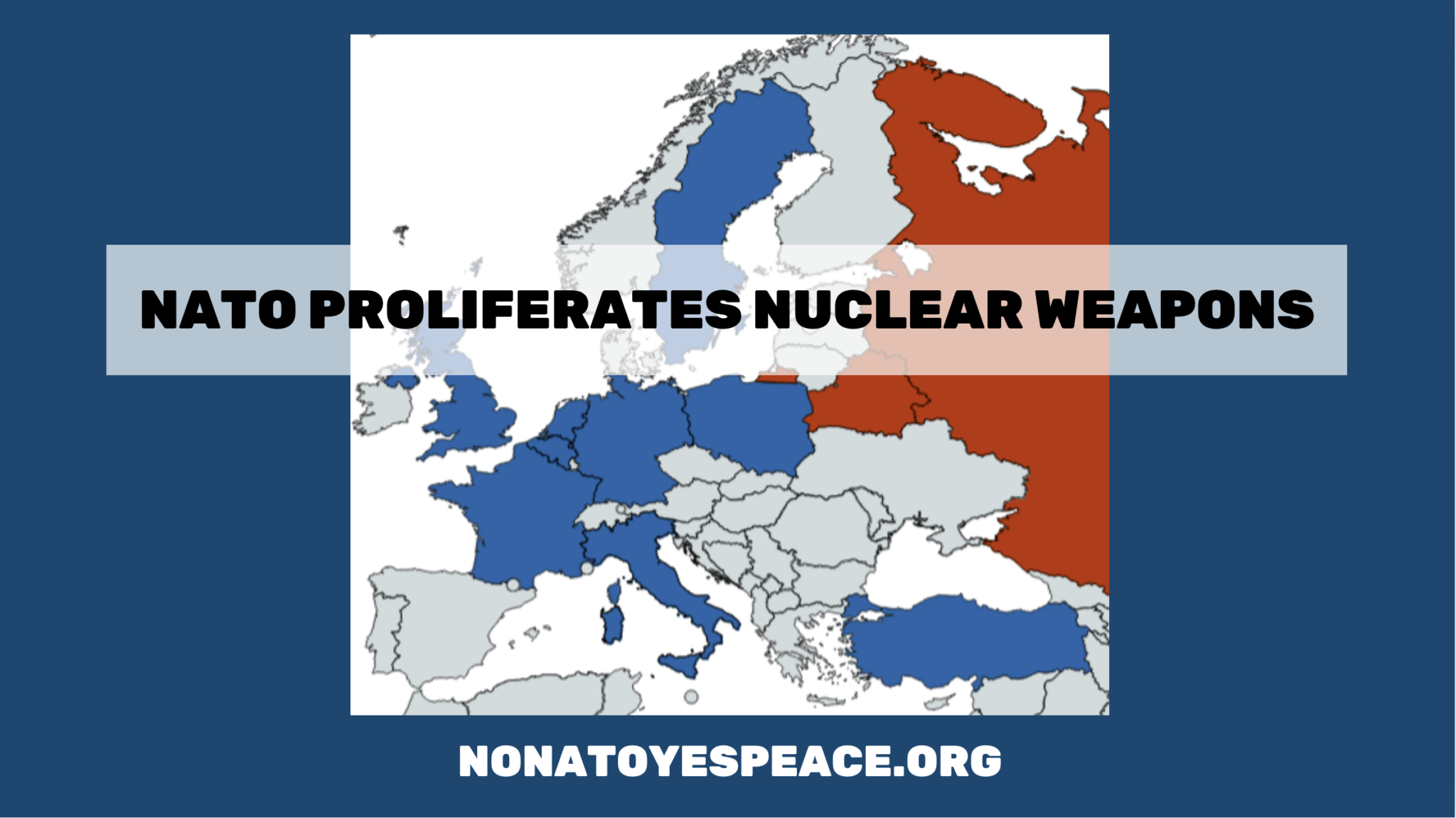
The Nuclear Nonproliferation Treaty forbids transferring nuclear weapons to other nations. It contains no NATO exception. Yet NATO proliferates nuclear weapons, and this is widely imagined as law enforcement or crime prevention. The prime minister of Sweden said this week that NATO ought to be able to put nuclear weapons in Sweden as long as somebody has determined it to be “war time.” The Nonproliferation Treaty says otherwise, and the people who plan the insanity of nuclear war say “What the heck for? We’ve got them on long-range missiles and stealth airplanes and submarines?” The people of Sweden seem, at least in large part, to also want to say No Nukes — but when were people ever asked to play a role in “defending democracy”? The purpose of bringing nukes into Sweden, for those in the Swedish government who favor it, may in fact be purely a show of subservience to U.S. empire, driven by fear of its obliging partner in the arms race, the militarists in Russia.
Poland’s president says his country would be happy to have “NATO” nuclear weapons there, “war time” or not, and this proposal is reported in U.S. corporate media with no mention of any legal concerns and with the claim that it comes as a response to the Russian placement of nuclear weapons in Belarus. Last year I asked the Russian ambassador to the United States why putting nuclear weapons into Belarus wasn’t a blatant violation of the Nonproliferation Treaty, and he said, oh no, it was perfectly fine, because the United States does it all the time.
In fact, NATO itself owns and controls no nuclear weapons. Three NATO members own and control nuclear weapons. We cannot be certain how many weapons they have, since nuclear weapons are both justified with the dubious alchemy of “deterrence” and, contradictorily, cloaked in secrecy. The United States has an estimated 5,344 nuclear weapons, France an estimated 290, and Great Britain an estimated 240.
NATO calls itself a “nuclear alliance” and maintains a “Nuclear Planning Group” for all of its members — those with and those without nuclear weapons — to discuss the launching of the sort of war that puts all life on Earth at risk, and to coordinate rehearsals or “war games” practicing for the use of nuclear weapons in Europe. NATO partners Israel and Pakistan are estimated to possess 170 nuclear weapons each.
Five NATO members have U.S. nuclear weapons stored and controlled by the U.S. military within their borders: Belgium, Germany, Italy, the Netherlands, and Turkey. These are estimated at 35 nuclear weapons at Aviano and Ghedi Air Bases in Italy, 20 at Incirlik in Turkey, and 15 each at Kleine Brogel in Belgium, Volkel Air Base in the Netherlands, and Büchel Air Base in Germany. The United States is reportedly also moving its own nuclear weapons into RAF Lakenheath in the UK, where it has stored them in the past. The people of each of these countries routinely protest the presence of nuclear weapons and have never been asked to vote on the matter. The notion that the nuclear weapons in a European country are still U.S. nuclear weapons and thus haven’t been proliferated is an odd fit with the general understanding of international treaties, which are conceived and written as if there were no such thing as empire.
With so-called U.S. or NATO nuclear weapons in potentially eight nations in Europe — and perhaps South Korea as well, at least on U.S. submarines docked there to please certain war-crazed South Koreans — there could soon be more nations in the world with “U.S.” nuclear weapons than nations with anybody else’s.
In recent years, the United States has been replacing its nuclear bombs stored in European nations with a newer model (the B61-12), while NATO members have been buying new U.S.-made airplanes with which to drop them. Turkey has had U.S. nukes stored in it even while U.S.-backed and Turkish-backed troops have fought each other in Syria, and even during a non-U.S.-backed coup attempt at the very base where the nuclear weapons are stored.
Seven other NATO members are said to support “nuclear missions” using their non-nuclear militaries: The Czech Republic, Denmark, Greece, Hungary, Norway, Poland, and Romania.
Poland and Romania also host new U.S./NATO missile bases that could launch missiles into Russia from very short distances, leaving the Russian government mere moments to decide whether the weapons are nuclear, or to decide whether to launch missiles of its own. The U.S. and NATO claim the bases are purely defensive, and various supporters of the bases have even claimed they had nothing to do with Russia—that they were either focused on Iran (then-U.S. President Barack Obama) or purely functioned as jobs programs for U.S. workers (former U.S. Ambassador Jack Matlock).
Meanwhile, the U.S. has been manufacturing what many of its officials describe as “more usable” or “tactical” nuclear weapons (merely several times the destructive power of what was used on Hiroshima). At the same time, the U.S. military is aware that, in its war game scenarios, the use of a single so-called “tactical” nuclear weapon tends to lead to all-out nuclear war. Or, as then-Secretary of Defense Jim Mattis told the House Armed Services Committee in 2018, “I don’t think there is any such thing as a ‘tactical nuclear weapon.’ Any nuclear weapon used any time is a strategic game-changer.”
The U.S.-made, disaster-prone F-35 is the first “stealth” airplane designed to carry nuclear bombs, meaning that it can in theory drop a nuclear bomb on a city with no warning from radar at all. The U.S./NATO have managed to sell F-35s to the U.S., UK, Italy, Netherlands, Norway, Denmark, Belgium, Poland, Israel, Australia, Japan, South Korea, and Singapore, with efforts under way to spread them to more nations, eventually perhaps creating a general need for them on the grounds of “interoperability.” The F-35 is currently being demonstrated on the people of Gaza.
The U.S. military has enough nuclear weapons in each of the following three forms to threaten all life on our planet: missiles on U.S. submarines in oceans around the world; bombs on U.S. airplanes circling the globe; and missiles in the ground in the United States. So why also keep nuclear bombs in European countries, where they would have to be loaded onto airplanes and flown (presumably to Russia) on missions either so “stealth” that they avoid all warning or so risky that they would have to be preceded by massive efforts to destroy air defenses?
If the decision to “go nuclear” were up to NATO, all members would have to reach a consensus on it. However, NATO has not always easily reached a consensus. For example, the U.S. attempted to bring NATO into its plans for a war on Iraq in 2003 but failed, in part because of huge public pressure against that war in NATO nations. Nuclear war is one of the least popular ideas ever, so the launch of a nuclear weapon might have to be “stealth” not only in relation to Russia but also in relation to the Western public. If the U.S. decides to use nuclear weapons, it almost certainly will not bother trying to use the ones it keeps stored in Europe. For that matter, were U.S. officials intent on reaching secret bunkers under hills some distance from Washington, D.C., they would need significant warning that a nuclear war had been secretly scheduled — a problematic concept for both the idea of deterrence and the idea of democracy.
The purpose of NATO in the North Atlantic Treaty is supposed to be defense against an attack on Europe, not deterrence. But in the event of responding to such an attack, whether the response were nuclear or not, the U.S. bombs stored in Europe would probably not be used. Threats in the name of deterrence have tended to fuel arms races and wars. But keeping U.S. nuclear weapons in Europe seems to fail even by the usual standards of deterrence theory, since their most likely use would be in an unlikely secret attack. Some U.S. officials believe those nuclear bombs serve no “military purpose” but only a “political” one, to reassure the host countries that the U.S. government cares about them.
The argument has also been made that, since Russia would like the nuclear bombs removed from Europe, the U.S. should either keep them there or demand something huge from Russia in exchange for removing them. Another argument is that this is part of making European nations share the burden, along the lines of making them spend more money on weapons. But if the burden serves no purpose, why should anyone share it? European government officials know the bombs are not useful as bombs. They know the bombs are provocative toward Russia. They know, in fact, that Russia is using the U.S. storage of nuclear bombs in European nations as an excuse to put Russian nuclear weapons into Belarus. So a more realistic understanding of the “political” purpose of U.S. nukes in Europe is probably a combination of the idea that the U.S. military will fight for any nation in which it has stored nukes, the perverse prestige that many imagine comes with possessing nukes (even if someone else actually possesses them on your land), and the general U.S. goals of keeping European governments intertwined with the U.S. military, supportive of U.S. military strategies, and willing to spend vast amounts on U.S.-made weapons.
Spreading along with nuclear weapons is nuclear energy — climate-disastrous, slow, expensive, super-dangerous nuclear energy, which creates permanent deadly waste, which poisons those around it, which no insurance company will insure, and the facilities for which constitute nuclear catastrophes waiting for accident or attack. Listen to Harvey Wasserman on what drugs you need to take in order to believe that nuclear energy is good for the climate. Not only are various nations pursuing nuclear energy in order to be closer to developing nuclear weapons, but nuclear NATO countries like the U.S. and UK are promoting this spread of nuclear technology at home and abroad because it is through nuclear energy that they maintain skills, training, and materials they want for nuclear weaponry.
There is a better way, and everyone who cares about avoiding nuclear apocalypse is invited to join in preparations for unwelcoming NATO to its 75th birthday party this July in Washington DC: https://nonatoyespeace.org.
David Swanson is an author, activist, journalist, and radio host. He is executive director of WorldBeyondWar.org and campaign coordinator for RootsAction.org. Swanson’s books include his latest: NATO What You Need to Know with Medea Benjamin. He blogs at DavidSwanson.org. He hosts Talk World Radio. He is a Nobel Peace Prize nominee, and U.S. Peace Prize recipient.
Mycle Schneider: Nuclear power is not an option
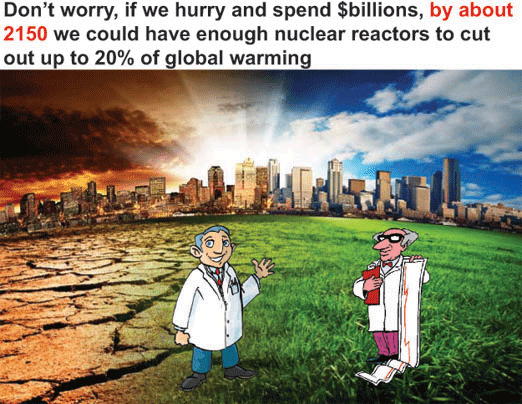
“The idea that we could go from zero to 10 reactors in 10 or even 20 years is a completely distorted idea of the feasibility of nuclear programmes,” said Schneider. “I think that’s probably the worst part of the nuclear myths currently.”
Instead, he said, it is well established that a single nuclear project, from conceptual idea to grid connection, can take up to 25 years to finalise. It’s precisely this timeline that makes nuclear energy an unfeasible solution to the climate emergency—a crisis on which we cannot afford to wait.
https://rightlivelihood.org/news/mycle-schneider-nuclear-power-is-not-an-option/— 14 May 24
Independent energy policy and nuclear analyst Mycle Schneider, recipient of the 1997 Right Livelihood Award for educating the public on the unparalleled risks of nuclear materials, has released the World Nuclear Industry Status Report annually since 2007.
Recently, he visited Stockholm to engage with the Swedish press, academics and politicians on the findings of the 2023 Report. In an interview with Right Livelihood, Schneider busts the Swedish right wing’s assertion that nuclear energy is an indispensable tool for overcoming the climate crisis.
Since Sweden’s right-wing parliamentary faction took power in October 2022, a national debate on the role of nuclear energy in balancing the energy mix and combating the climate crisis has taken centre stage.
This debate came to a head late last year when the Swedish parliament passed a bill removing the country’s 10 nuclear reactor cap and announced its plan to build and start up two new reactors by 2035.
In response to whether nuclear energy has a place in balancing Sweden’s energy mix and combating the climate crisis, Schneider’s answer is resoundingly clear: absolutely not.
But, it’s not for the reasons you may think. Arguing that any debate on nuclear’s environmental or economic costs or benefits is useless, Schneider insists that expanding nuclear energy under the given time constraints is simply not possible.
“The idea that we could go from zero to 10 reactors in 10 or even 20 years is a completely distorted idea of the feasibility of nuclear programmes,” said Schneider. “I think that’s probably the worst part of the nuclear myths currently.”
Instead, he said, it is well established that a single nuclear project, from conceptual idea to grid connection, can take up to 25 years to finalise. It’s precisely this timeline that makes nuclear energy an unfeasible solution to the climate emergency—a crisis on which we cannot afford to wait.
Nuclear energy’s costliness is another barrier that prevents it from being a means of tackling the climate crisis.
“It’s the combination of money and time,” said Schneider. “In order to respond to this challenge, nuclear power is not an option. It’s not a bad or a good option. It’s not an option. It’s too expensive and, above all, it’s too slow to be eligible as an effective instrument to deal with the climate emergency.”
Only ‘two countries’ would survive nuclear war after ‘5 billion die in 72 hours’, says expert

Journalist Annie Jacobsen says ‘most of the world would be covered in sheets of ice’.
Anish Vij 15 May 2024, https://www.ladbible.com/news/politics/nuclear-war-countries-survive-annie-jacobsen-diary-ceo-302018-20240515
There is a chance that around five billion people will die in just 72 hours in the event of nuclear war.
Happy Wednesday, everyone.
Though I’m sure you read the headline beforehand and are well prepared for some depressing insight into the future of humanity.
In this case, we have Annie Jacobsen to thank, an investigative journalist, New York Times bestselling author, and a 2016 Pulitzer Prize finalist.
The 56-year-old from Connecticut, US, has spent years researching the possible effects of nuclear war and she claims that there are only two countries where you might, I repeat, might survive.
The reason being that nuclear attacks would cause a thick smoke from burning fires to spread across the three continents, ultimately causing a mini ice-age.
This would most likely kill five billion of the eight billion people on earth within 72 hours.
She explained on Steven Bartlett’s Diary Of A CEO podcast: “Most of the world, certainly the mid-latitudes would be covered in sheets of ice …places like Iowa and Ukraine would be just snow for 10 years.
“Agriculture would fail, and when agriculture fails people just die.
“On top of that you have the radiation poisoning because the ozone layer will be so damaged and destroyed that you couldn’t be outside in the sunlight – people will be forced to live underground.”
Jacobsen said that Professor Brian Toon, a leading expert on climate and atmospheric science, told her that only two countries could potentially survive a nuclear winter – New Zealand and Australia, who can ‘sustain agriculture’.
The expert also opened up about the story of former US Secretary of Defence Bill Perry and the idea of a nuclear war happening by accident.
“He was on the night watch during the Carter Administration … he was told by the National Military Command Centre, which is the bunker beneath the Pentagon, that there were ballistic missiles on the way from Soviet Russia,” she said.
“This was confirmed by the nuclear bunker beneath Offutt Air Force Base in Nebraska the STRATCOM (Strategic Command) bunker.
“Not only were intercontinental ballistic missiles flying at the United States but there were sub-launched ballistic missiles coming at the United States. It was a massive motherlode of warheads.
“Within a matter of minutes he got word that it was a mistake – how does a mistake like that happen?
“What he told me was that there was a VHS tape of a simulated attack by the Soviet Union against the United States and the VHS tape had mistakenly been inserted into a machine in the nuclear bunker beneath the Pentagon and because it is linked to STRATCOM it was seen in both places.
Perry said to me it looked real because it was meant to look real.”
China and Russia Disagree on North Korea’s Nuclear Weapons
Beijing and Moscow have different perspectives on – and different appetites for – Pyongyang’s nuclear program.
The Diplomat, By Wooyeal Paik, May 15, 2024
China has been ambivalent about North Korea and its strategic behaviors for the last few decades, leading scholars in China to describe North Korea as both “strategic asset” and “strategic liability.” North Korea, China’s sole military ally with an official treaty, the Sino-North Korean Treaty of Friendship, Cooperation, and Mutual Assistance, signed in 1961, has proved tough to handle, if not outright volatile, for its security and economic patron.
Nonetheless, North Korea’s geopolitical importance to China as a buffer state against the United States and its East Asian allies (South Korea and Japan) has not lessened. Even in the era of high-tech weapons such as missiles, military satellites, nuclear submarines, and fifth-generation fighter jets, all of which serve to reduce the strategic value of physical buffer zones, it is still effective and valuable for China not to confront the mighty hostile power, the United States, on its immediate land border. Ground forces are still the ultimate military presence, and sharing a border with a U.S. allied, unified Korea would also come at a psychological cost for China.
Beyond its role as a buffer state, North Korea’s value as leverage or a bargaining chip for China in Beijing’s relations with South Korea and the United States has been well recognized. In 2024, however, China may consider adding another layer to this leverage by supporting North Korea’s nuclear program, as Russia has done.
North Korea is a de facto nuclear state with a set of viable delivery mechanisms including intercontinental ballistic missiles (ICBMs) and submarine-launched ballistic missiles (SLBMs).
This nuclear element of the Kim regime has been regarded as the quintessential reason for an ever-growing regional security instability in Northeast Asia and beyond.
For China, North Korea – and particularly its nuclear program – is a strategic liability. China prioritizes stability in its neighborhood, but North Korea purposefully pursues instability right next to China. This conflict of interests between the treaty allies exacerbates Chinese national security concerns, particularly regarding the United States and its hub-and-spoke system in the Indo-Pacific area.
In response to North Korea’s rapid nuclear and missile developments, the United States has significantly ramped up its military presence on and around the Korean Peninsula, in consultation with its ally, South Korea. That includes the regular deployment of strategic (i.e., nuclear-capable) U.S. assets to the region, something China is not comfortable with.
Russia, however, takes a different view. Over the past year, Moscow has shifted its strategic approach to the North Korea’s nuclear capability and provocations, from viewing them as a nuisance that disrupts the Non-Proliferation Treaty (NPT) regime to a tactical countermeasure against the United States. From Russia’s perspective, distracting the U.S. – the primary military and economic presence as the NATO leader – is a goal unto itself, as Washington is a major obstacle to Russia’s desire to conquer Ukraine and influence the post-Soviet Central and Eastern Europe.
Russia has been importing North Korean weapons – 152 mm artillery ammunition,122 mm multiple rocket launcher ammunition, and other conventional weapons – for use against Ukraine. In return, it’s widely believed that North Korea receives Russia’s technical assistance for the research and development of advanced space and weapons technologies: nuclear-powered submarines, cruise and ballistic missiles, military reconnaissance satellites. North Korea also receives food and energy in addition to rare international support for its pariah regime.
Russia actively endorses North Korea as a nuclear state and supports its “legitimate” use of nuclear weapons for its self-defense and beyond. As Kim Jong Un embraces a lower nuclear threshold, Russian President Vladimir Putin and his ruling elites have also expressed their willingness to employ low-yield tactical nuclear weapons against Ukraine and European NATO countries.
Thus, North Korea has evolved into a double-layered tool for Russia, acting as both a buffer state and a nuclear threat against the United States in Northeast Asia and Europe. This accelerates the convergence of security between Indo-Pacific and Euro-Atlantic regions.
Despite Russia’s high-profile advances with North Korea, China is still thought to be the only nation with significant influence over Pyongyang. ……………………………………………………….. more https://thediplomat.com/2024/05/china-and-russia-disagree-on-north-koreas-nuclear-weapons/
Military activities near Zaporizhzhya Nuclear Power Plant (ZNPP).
The International Atomic Energy Agency is continuing to monitor observance
of the five concrete principles aimed at protecting Ukraine’s
Zaporizhzhya Nuclear Power Plant (ZNPP) during the military conflict, where
nuclear safety and security remain precarious, Director General Rafael
Mariano Grossi said on 9 May in the IAEA’s Update 227.
During the week of 1-8 May, the IAEA team stationed at the ZNPP have heard military activities
on most days, including artillery and rocket fire some distance away from
the plant, as well as small arms fire both near to and further away from
the site. On 8 May IAEA experts on site reported that there was an air raid
alarm with restrictions on movement outside of buildings for about 90
minutes, which the ZNPP informed the team was allegedly due to drones being
present in the area of the cooling pond. The experts did not hear any
explosion during the period of the restriction on movement. Earlier on 8
May however another air raid alarm was heard, again restricting outside
movement and resulting in the team’s planned walkdown within the site.
Modern Power Systems 14th May 2024
https://www.modernpowersystems.com/news/newsrussian-military-steps-up-activity-at-znpp-11770581
Together Against Sizewell C vows to continue fight after legal challenge rejected by Supreme Court – as the nuclear plant welcomes the news

By Ash Jones , ash.jones@iliffepublishing.co.uk, 14 May 2024 https://www.suffolknews.co.uk/southwold/sizewell-c-campaigners-vow-to-continue-fight-after-supreme-c-9365930/
Campaigners protesting against the £20 billion Sizewell C plant are determined to continue their fight after a legal challenge was rejected by the Supreme Court.
The court yesterday refused an appeal by Together Against Sizewell C (TASC) after it called for a judicial review of the plant, near Leiston.
TASC first challenged the Government’s decision to give planning permission to the station in July 2022 after it was given the go-ahead by then-business secretary Kwasi Kwarteng.
Among its claims were that the Secretary of State was wrong to grant a Development Consent Order (DCO) without first assessing the environmental impact of proposals for Sizewell C’s water supply.
In its ruling, three Supreme Court judges said the group’s latest claims did not raise an arguable point of law.
Julia Pyke, the managing director of Sizewell C, welcomed the news and said the team were glad the challenge was rejected by the court.
However, Pete Wilkinson, from TASC, said the group would seek new avenues to challenge the plant.
Mr Wilkinson described yesterday’s ruling as a ‘bit of a blow’ but said the site still needed other permits and licences.
He said it was a challenge opposing Sizewell C through the courts and the Government seemed to have decided the plant will go through regardless.
“Local opposition to the plant appears to be growing as people in the area realise the imposition it will cause,” he said.
“There are about 36 site conditions that cover the site that we’ll be able to monitor, there are no details on water supply and a many-billion pound hole in finances as well as further licences to be awarded.
There are things that lend themselves to a possible challenge to give the public a chance to review.”
This followed TASC’s case being refused by the High Court last year – the decision to approve plant was also upheld by the Court of Appeal in December.
During the High Court case, the body argued against the impacts of water supply of up to two million litres per day, which it said were never assessed and that there was no way of knowing if the environmental benefits of the plant would outweigh the costs.
In addition, no opening date for the plant could be guaranteed, campaigners said.
Ms Pyke said the team knew the majority of East Suffolk residents supported the project and looked forward to the jobs and development opportunities it would bring.
She added: “We will continue to listen closely to local communities and we are as determined as ever to ensure that Sizewell C delivers for them.”
Small Modular Nuclear Five Times The Price (letter)
by News Of The Area – Modern Media –
DEAR News Of The Area,
IN response to Derek Musgrove opinion regarding small modular nuclear generation.
Derek, the reason nuclear sub reactors are not used for domestic generation is because they use a more enriched fuel unsuitable for domestic SMRs.
If you research your topic for five minutes you will find only five SMRs operating in the world.
There are quite a number in development but they are either abandoned or going to produce power at five times the cost of other types of generation.
Nuclear power also needs huge amounts of water for cooling so it limits their location options.
Feel free to check these facts.
Not scaremongering but why would we want to pay five times the cost for power.
The reactor in Canada is heavily subsidised by their government.
While you fact check, search how many SMRs would Australia need.
Did you know in 2023 in South Australia 80 percent of their power generation was from renewables.
Regards,
Ian HALL,
Hawks Nest.
Renewable Energy company Neoen to build its biggest battery to shift energy to evening peak in nuclear-dominated Ontario
Giles Parkinson & Joshua S Hill, https://reneweconomy.com.au/neoen-to-build-its-biggest-battery-to-shift-energy-to-evening-peak-in-nuclear-dominated-ontario/ 14 Mar 24
French renewable energy company Neoen has announced plans to build its biggest battery project to date – a 400 MW, four hour battery (1600 MWh) to shift excess energy to the evening peak in the nuclear dominated Canadian state of Ontario.
Neoen has created a new subsidiary company called Shift Solar to build the Grey Owl battery project, which was one of 10 storage projects that won capacity contracts offered by Ontario’s Independent Electricity Systems Operator (IESO) in the largest battery storage procurement in Canada’s history.
The Grey Owl Storage project will boast a total nameplate capacity of 400MW/1,600MWh, of which 380MW and four hours of storage (1520 MWH) has been contracted to the IESO over a period of 20 years, providing grid stability and reliability services.
“The battery will be able to charge during off-peak hours and redistribute the stored energy back into the grid at peak times, when it is needed most,” Neoen said in a statement.
Ontario’s grid is dominated by nuclear power, which provides 53 per cent of its electricity. Solar provides less than one per cent of grid production and wind less than 8.2 per cent, underlying the fact that even grids dominated by less flexible “baseload” power need, or want, battery storage to shift excess power to where it is needed most.
The IESO has been seeking up to 2,500MW of energy storage capacity (with multiple hours of storage) as well as some gas capacity to help meet projected shortfalls in electricity supply, made worse by the multi-year outages required to refurbish most of the state’s ageing nuclear plants.
In the tender results announced late last week, a total of 1.8 GW of battery storate capacity (it did not provide storage duration) was awarded, at an average price of $C672 per megawatt per day. A further 790 MW of storage capacity was awarded last year.
The Grey Owl battery will be one of the biggest in the world, and the second largest battery in Canada.
Neoen says it will be the largest in its own portfolio, bigger than the recently announced Collie 2 battery in Western Australia, which will be sized at 341 MW and 1363 MWh, and will have a similar role to the Grey Owl battery, except the W.A. battery will time shift excess solar rather than excess nuclear.
It should be noted, however,. that the Collie facility also included the 219 MW/877 MWh Collie Battery 1 facility that – combined with stage 2 – will create an overall battery project of 560 MW and 2240 MWh.
Neoen has also built the Hornsdale Power Reserve, the Victoria Big Battery (still the country’s largest operating battery), the Bulgana battery, and is building big batteries at Western Downs, Blyth and in the ACT.
“We are thrilled to have been awarded this major contract with the IESO,” said Emmanuel Pujol, CEO of Neoen Americas.
“The province’s energy and capacity needs are massive, and Neoen’s ambition is to be a key contributor, by developing a broad portfolio of renewable energy and storage projects for the years to come.”This is an important step for Neoen in Ontario and Canada, where we are accelerating our development.”
The Grey Owl project will be built in Arran-Elderslie, Bruce County, in Ontario, and is expected to begin operations in early 2028.
Giles Parkinson & Joshua S Hill
https://embed.global-roam.com/containers/68bbef3b-8764-457d-8310-f4f613b4cba0
1 This Month


Tell the Ukrainian Government to Drop Prosecution of Peace Activist Yurii Sheliazhenko

Petition to revoke the licensing of the Near Surface Nuclear Disposal Facility (NSDF) at Chalk River. https://www.ourcommons.ca/petitions/en/Petition/Details?Petition=e-7247


of the week – STOP SMALL MODULAR REACTORS IN CANADA
To see nuclear-related stories in greater depth and intensity – go to https://nuclearinformation.wordpress.com
-
Archives
- March 2026 (176)
- February 2026 (268)
- January 2026 (308)
- December 2025 (358)
- November 2025 (359)
- October 2025 (376)
- September 2025 (258)
- August 2025 (319)
- July 2025 (230)
- June 2025 (348)
- May 2025 (261)
- April 2025 (305)
-
Categories
- 1
- 1 NUCLEAR ISSUES
- business and costs
- climate change
- culture and arts
- ENERGY
- environment
- health
- history
- indigenous issues
- Legal
- marketing of nuclear
- media
- opposition to nuclear
- PERSONAL STORIES
- politics
- politics international
- Religion and ethics
- safety
- secrets,lies and civil liberties
- spinbuster
- technology
- Uranium
- wastes
- weapons and war
- Women
- 2 WORLD
- ACTION
- AFRICA
- Atrocities
- AUSTRALIA
- Christina's notes
- Christina's themes
- culture and arts
- Events
- Fuk 2022
- Fuk 2023
- Fukushima 2017
- Fukushima 2018
- fukushima 2019
- Fukushima 2020
- Fukushima 2021
- general
- global warming
- Humour (God we need it)
- Nuclear
- RARE EARTHS
- Reference
- resources – print
- Resources -audiovicual
- Weekly Newsletter
- World
- World Nuclear
- YouTube
-
RSS
Entries RSS
Comments RSS
 nuclear-news