TODAY. Dominic Cummings the “evil gnome” who makes us think.

I am NOT a fan of Dominic Cummings, (described as the evil gnome on the shoulder of former British prime minister Boris Johnson)
He’s the one who scandalised Britain with bizarre ideas on Covid vaccination. He has harsh anti-immigration views, has promoted small nuclear reactors, and was largely responsible for Britain’s decision to leave the European Union.
And now, Dominic Cummings is starting a new political party – with a mixture of what seem to me to be some good ideas and some terrible ideas.
AND YET, AND YET ……. Cummings has something to give us.
He is an independent thinker. At a time when we desperately need independent thinking. We are stuck with world leaders rigidly sticking to their doctrines, no matter what. With political party leaders who have no aim except to fight the other side, no matter what. The media love this conflict-obsessed culture, the military-industrial-nuclear-complex is orgiastic about it.
Cummings has a great interest and knowledge of ancient and modern history, has lived in Russia, and speaks Russian, -he does bring to politics a different view from that of the usual business-oriented politicians . He certainly has had a chequered career, (to put it kindly!) in British politics, and has made lots of enemies on both the Right and the Left.
Who knows whether Dominic Cummings’ new “start-up” political party will become a reality?
I’m certainly not advocating for that party. But many of Cumming’s ideas and policies are developed from a deep understanding of European history. And that is refreshing. In the current Ukraine mess, very few leaders and journalists show any grasp of history.
Even if you hate Dominic Cummings, you would have to concede that he has brought a highly individual and independent view on politics and world affairs.
And that is a valuable gift and example for us – as against slavishly following political parties, and dogmas like the “rules based international order”.
Nuclear power and nuclear weapons – two sides of the same coin

In March 2024, Prime Minister Rishi Sunak explicitly linked nuclear weapons production capability with civil nuclear power generation development. This is because nuclear reactors are used to create tritium – the radioactive isotope of hydrogen – necessary for nuclear weapons.
The government has admitted its push for nuclear energy expansion is linked to its strategic military interests
by Peter Wilkinson, 12 May 2024, o https://eastangliabylines.co.uk/nuclear-power-and-nuclear-weapons-two-sides-of-the-same-coin/
The government’s apparent answer to climate change and Russia’s invasion of Ukraine is to triple the amount of nuclear generated electricity in the belief that it generates ‘low carbon’ electricity. But a recent admission by Prime Minister Rishi Sunak suggests there is a strong military component to what looks on the surface to be a civil matter.
The UK review of the energy sector, prompted by the invasion of Ukraine, offered a golden opportunity to address the need to drive down demand for electricity and energy more generally. This could be achieved by retrofitting insulation to the housing stock and buildings, mandating solar panel use for all new homes, investing heavily in renewables, in emerging battery technology and in decentralisation. Instead, the government has focused on a massive expansion of nuclear-generated electricity.
The dual nuclear agenda
Now the reason has finally been openly admitted. Maintaining and improving the supply chain and the knowledge and skills base in the workforce for the UK’s £100bn Trident nuclear weapons renewal programme relies on the civil nuclear sector.
While this claim has been regularly made by anti-nuclear campaigners – and just as regularly denied by minister after minister – it is now openly acknowledged. The Roadmap states quite clearly that it is important to align civil and military nuclear ambitions across government, to strengthen the interconnections between civil and military industries’ research and development, and thereby reduce costs for both the weapons and power sectors.
In March 2024, Prime Minister Rishi Sunak explicitly linked nuclear weapons production capability with civil nuclear power generation development. This is because nuclear reactors are used to create tritium – the radioactive isotope of hydrogen – necessary for nuclear weapons.
The cat which was so carefully and fraudulently hidden for decades is finally out of the bag: ministers now have to acknowledge that the civil nuclear programme owes more to maintaining weapons of mass destruction – weapons that were outlawed by the Treaty on the Prohibition of Nuclear Weapons which entered into force in January 2021 – than it has to do with salvation from the existential crisis that is climate change.
Debunking myths: the truth behind nuclear ambitions
Its brave new world aims for a nuclear sector generating upto 24 Gigawatts of electricity by 2050. That’s comparable to seven new 3.2 Gw capacity Hinkley Point Cs or Sizewell Cs or forty-eight Sizewell A-size reactors at around half a Megawatt output.
The locations for a proposed ‘mix’ of ‘gigawatt-sized reactors’ such as the European Pressurised Reactor (EPR) planned for Sizewell C, and ‘small modular’ and ‘advanced modular’ reactors (SMRs and AMRs respectively) is the subject of the government’s ‘Nuclear Road Map’.
It is, necessarily, largely a work of fiction laced with eulogies to nuclear power and liberally interspersed with admissions of hope over expectations. The truth is that Hinkley Point C is now expected to cost an eye-watering £40+bn from its original £20bn, and Sizewell C has already cost the taxpayer £2.4bn in sweeteners to the private sector.
Commercial SMRs don’t yet exist, and they are not small, unless you consider that Sizewell A falls into that category. AMRs have remained a fantasy for decades and are likely to remain so. Mention them to a nuclear regulator, and you’ll probably get a raised eyebrow in response.
Nuclear revival: promises vs reality
The Sizewell project has yet to be granted multiple construction and operating permits and licences and no final investment decision has been made. Other issues which make Sizewell C a terrible idea include:
- A multi-billion hole existing in its finances
- There is no reliable and guaranteed supply of potable water – of which an average of 2.2 million litres a day are required in the country’s most water-scarce area
- It is situated in a flood zone
- It is in an Area of Outstanding Natural Beauty
- It sits on the fastest-eroding coastline in northern Europe
- An estimated 46 hectares of woodland have already been flattened
- The Environment Agency (EA) has authorised the dumping of 1,590 tonnes of dead and dying fish back into the North Sea each year as a consequence of the Sizewell C cooling water intake (not to mention the 100s of millions of fish, fish larvae and other marine biota)
- In addition, there will be an estimated 171 million sacrificial sand goby, none of which are acknowledged by the EA.
- Radiological discharges from Sizewell C to the sea and air have contested health impacts
EDF ploughs on
The Supreme Court is still considering the merits of a judicial review appeal against the original planning approval. None of these uncertainties and deficiencies have stopped EDF devastating the areas around the development with the sanction of the local planning authority.
The tragedy is that nuclear is now a redundant technology which takes too long to come to our climate-change rescue and is not fit to be in the front-line of defence against climate change. It does not represent a plan of great urgency to meet the accelerating existential threats of climate change.
It has a rapidly narrowing window in which to contribute its electricity to the job of reducing climate change risks. When compared to renewables and conservation measures, nuclear is slow, costly and unreliable in terms of the new technology embodied in the EPR design. The Flamanville project in France, using a Sizewell EPR-type reactor, is still offline, is twelve years late and will cost four times the original budget.
The government has been in thrall to nuclear power for a long time. Perhaps with the admission of its connection to its strategic miliary goals, we can now better understand why that is. But the knowledge only deepens and entrenches the divide between the hawks and the doves.
Ontario’s nuclear option is the wrong path to meet green energy targets

The province should focus on cost-efficient wind, solar and hydro expansion, as well as increased interprovincial transmission.
by Quinn Goranson May 13, 2024, https://policyoptions.irpp.org/magazines/may-2024/ontario-nuclear-option/
Ontario is failing in its strategy to reduce emissions to meet the province’s climate commitment of reducing emissions by 2030 to 30 per cent below 2005 levels (which is already 10 to 15 per cent below the current federal target).
The province’s auditor general released a report in 2021 stating the Ford government’s policies for reducing greenhouse gas (GHG) emissions were already falling short by 14.2 megatons.
Fast-forward three years and the situation is likely to get worse.
Plans to meet the province’s possible 1.7-per-cent annual increase in electricity demand include the addition of natural gas-powered turbines, refurbishing old nuclear reactors and developing small modular reactors (SMRs).
This presents a dual problem. First, burning natural gas produces CO2, so expanding capacity using new gas turbines will increase emissions. Second, nuclear power generation cannot successfully help meet 2030 targets

Ontario’s nuclear hopes out of step with reality
SMRs are a class of nuclear reactor, built in a factory and shipped to a site, designed to generate up to 300 megawatts (MW) of electrical power per unit. By comparison, larger conventional reactors in Ontario have a capacity of roughly 900 MW.
Ontario Power Generation (OPG) states it is “leading the way in the advancement of SMR technology in Canada” and that SMRs are “the future of nuclear power generation.”
This position collides head-on with technological realities.
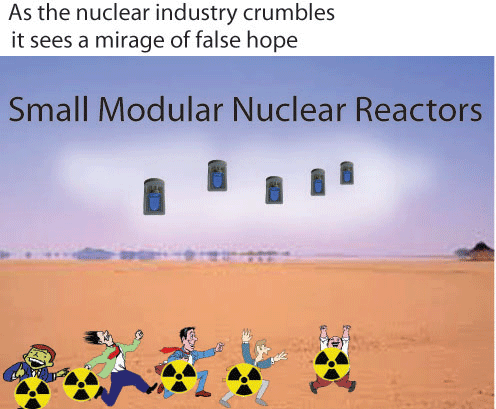
SMRs are a futuristic technology at best. The only operational SMRs anywhere in the world are in Northeast Russia and in Shidao Bay, China.
Both reactors faced construction delays, primarily due to cost overruns and poor economics., The Canadian Nuclear Safety Commission has yet to fully approve a single SMR licence.
SMRs cannot be built in time to help meet Ontario’s 2030 emission targets. Worse, by betting on them, OPG has committed to making Ontario’s electricity grid dirtier.
Nuclear power a costly option
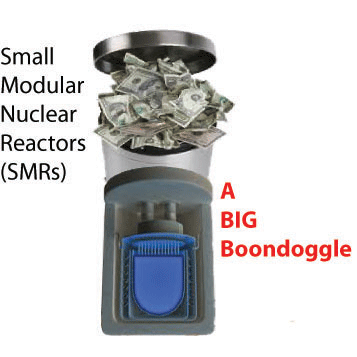
In addition to being largely unproven, SMRs will not be cheap. While their absolute cost may be lower than conventional nuclear reactors, their lower electricity output means they become significantly more expensive per megawatt to operate.
Beyond the fact that every single new nuclear project in Ontario’s history has gone over budget, gas and nuclear energy now contribute the most to increasing energy bills for Ontario residents.
A 2018 report from the Canadian SMR roadmap steering committee, a group of provincial and territorial governments and power utilities, estimated the baseline cost of electricity from SMRs would be 16.3 cents per kilowatt hour (kWh). Comparatively, according to the International Renewable Energy Agency renewable alternatives are less expensive:
- Onshore wind electricity costs consumers an average of 4.5 cents per kWh;
- Offshore wind costs an average of 10 cents/kWh;
- Solar PV farms cost an average of 6.6 cents/kWh;
- Hydropower costs an average of 5 cents/kWh.
In North America, the only SMR design certified by the United States Nuclear Regulatory Commission was cancelled due to “lack of interest” once rising costs deterred potential customers. Originally announced in 2015 at the equivalent of $4.1 billion Cdn, estimates rose to $5.6 billion (2018), then $8.4 billion (2020) and finally $12.7 billion (2023).
Time keeps on ticking
New nuclear projects are taking on average of 10 to 15 years to become operational. Ontario’s first SMR designated for the Darlington Nuclear Generating Station is planned for 2028.
Meanwhile, the Ontario government says additional SMRs could come online between 2034 and 2036. In reality, nuclear projects typically exceed time estimates by 64 per cent and given a strong trend of delays for such projects globally, new SMRs are unlikely to come online before 2042, if ever.
So, in addition to the speculative viability of SMRs, likely delays even under the best of circumstances mean this technology is unable to help meet Ontario’s emissions reduction targets.
Radioactive waste another key factor
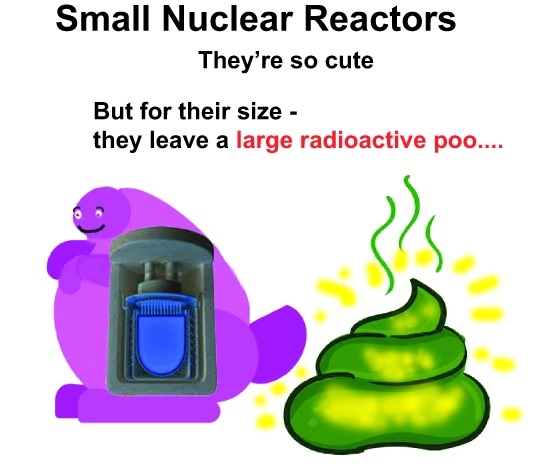
The “green” label often applied to nuclear energy should be viewed with scepticism. While no fossil fuel is burned to generate nuclear power, the industry produces radioactive waste and is not “renewable.”
In fact, there is evidence to suggest SMRs will produce a greater volume of radioactive waste per unit of electricity generated than existing large reactors.
Radioactive waste remains hazardous for tens of thousands of years and there are no demonstrated solutions to managing this risk. According to the Nuclear Waste Management Organization, which is owned by Canada’s nuclear power companies, radioactive nuclear waste must be fully isolated from people and the environment for one million years or more.
Committing to new nuclear projects in Ontario as a climate solution is essentially trading one intergenerational threat for another.
The green path toward Ontario’s emissions targets
A report from the David Suzuki Foundation in 2022 found that “reliable, affordable, 100 per cent emissions-free electricity in Canada by 2035 is entirely possible.”
In 2020, the International Energy Agency declared wind and solar the “cheapest sources of new electricity in history.”
In 2018, Ontario cancelled 758 signed contracts for smaller renewable energy projects, many of them in Indigenous communities Only recently, the province’s Independent Electricity System Operator (IESO) has announced it seeks to procure 5,000 MW of new non-emitting (wind, solar, hydropower or bioenergy) energy.
Utility-scale solar costs plummeted by 90 per cent between 2009-21. Wind energy costs declined 72 per cent. This presents an important opportunity given Ontario’s more than 1,500 kilometres of Great Lakes shoreline and abundant sunshine.
The already low cost of hydropower in Ontario through existing infrastructure, combined with the potential for integration with Hydro-Québec, can help Ontario convert its “intermittent wind and solar energy into a firm 24/7 source of baseload electricity,” according to the Ontario Clean Air Alliance.
Likewise, offshore wind-generating potential in Atlantic Canada far exceeds energy needs in the region and could be exported to Ontario via existing mainstream high-voltage direct-current transmission lines.
By cancelling SMR development and focusing on cost-efficient wind, solar and hydro expansion, as well as increased interprovincial transmission, Ontario can reclaim leadership when it comes to green energy development now and for future generations.
US Says It Won’t Let Iran Build Nuclear Bomb

Iran International Newsroom, 14 May 24 https://www.iranintl.com/en/202405131207
The US will not allow Iran to build a nuclear bomb, the State Department said on Monday, one day after a senior Iranian official said Tehran would have no option but to change its nuclear doctrine in the face of Israel’s threats.
“[President] Biden and [US Secretary of State Antony] Blinken will not allow Iran to have a nuclear weapon,” State Department deputy spokesperson Vedant Patel said in a press briefing.
He made the remarks in reaction to Sunday comments by Kamal Kharrazi, a senior advisor to Iran’s ruler Ali Khamenei, that the Islamic Republic would be left with no option but to alter its nuclear doctrine if Israel threatened its nuclear facilities or its existence.
“We continue to assess, though, that Iran is not taking any key activities that would be necessary to produce a testable nuclear device,” Patel told Iran International correspondent Samira Gharaei.
Kharazi said on Sunday that Iran does “not possess nuclear weapons, and there is a fatwa from the leader regarding this matter. But what should you do if the enemy threatens you? You will inevitably have to make changes to your doctrine.”
Asked if these comments were a concern for the United States, Patel said, “We don’t believe that the Supreme Leader has yet made a decision to resume the (nuclear) weaponization program that we judge Iran suspended or stopped at the end of 2003.”
“We continue to assess, though, that Iran is not taking any key activities that would be necessary to produce a testable nuclear device,” Patel told Iran International correspondent Samira Gharaei.
Kharazi said on Sunday that Iran does “not possess nuclear weapons, and there is a fatwa from the leader regarding this matter. But what should you do if the enemy threatens you? You will inevitably have to make changes to your doctrine.”
Asked if these comments were a concern for the United States, Patel said, “We don’t believe that the Supreme Leader has yet made a decision to resume the (nuclear) weaponization program that we judge Iran suspended or stopped at the end of 2003.”
When asked about the Biden administration’s strategy toward a “nuclear threshold state” like Iran in the absence of ongoing negotiations, Patel told Iran International, “We have ways of communicating with Iran when it’s in our interest, I’m not going to comment on that.”
In a Monday press conference in Tehran, Iran’s foreign ministry spokesman suggested that Kharrazi’s remarks were not the official position of the Islamic Republic, and that Tehran’s nuclear doctrine has not changed.
“Iran’s official position on Weapons of Mass Destruction has been repeatedly declared by high-ranking Iranian officials, and there has been no change in Iran’s nuclear doctrine,” Nasser Kanaani told reporters in a briefing held on the sidelines of Tehran International Book Fair, citing a fatwa by Ali Khamenei on the prohibition of the production and use of nuclear weapons as the basis for Iran’s position.
However, the fatwa Iranian officials refer to is not an irrevocable principle. Islamic fatwas can change or be reversed at a moment’s notice, experts have pointed out. Also, the alleged Khamenei fatwa is not actually a religious order, it is part of a statement he submitted to an international conference more than a decade ago.
Khamenei may invoke the principle of expediency to overrule his “anti-Nuclear” fatwa. The principle of expediency, as decreed by the founder of the Islamic Republic Ayatollah Khomeini in January 1988, stipulates that the Supreme Leader may even violate the fundamental tenets of the Islamic faith in order to preserve “the Islamic Regime” as the preservation of the Islamic Regime supersedes all else.
Kharrazi on Sunday also raised the issue of Israel’s alleged nuclear arsenal and called for the Jewish state’s nuclear disarmament. “If Israel threatens other counties, they cannot remain silent,” he retorted.
Last week, Kharrazi had stated, “If they dare to strike Iran’s nuclear facilities, our level of deterrence will change. We have experienced deterrence at the conventional level so far. If they intend to strike Iran’s nuclear capabilities, naturally, it could lead to a change in Iran’s nuclear doctrine.”
In recent weeks, Iran has evoked the option of using the nuclear option as a deterrent against the possibility of an Israeli strike against its atomic facilities, amid a new reality in the Middle East after the October 7 Hamas attack.
On Friday, Iranian lawmaker Ahmad Bakhshayesh Ardestani claimed Iran might already possess a nuclear weapon.
He conveyed to the Rouydad 24 website his belief that Iran’s decision to risk attacking Israel in April stemmed from its possession of nuclear weapons.
Ali-Akbar Salehi, who was foreign minister more than a decade ago and is still a key foreign policy voice in the Iranian government, also said last month that Iran has everything it needed to build a nuclear bomb, as tensions rose with Israel amid the Gaza war.
In a televised interview in April, Salehi, was asked if Iran has achieved the capability of developing a nuclear bomb. Avoiding a direct answer he stated, “We have [crossed] all the thresholds of nuclear science and technology.”
Salehi’s statement was preceded by a declaration from a Revolutionary Guard general. In the midst of tensions between the Islamic Republic and Israel, Ahmad Haghtalab, the IRGC commander of the Guard for the Protection and Security of Nuclear Facilities, announced on April 19 that if Israel intends to “use the threat of attacking our nuclear facilities as a tool to pressure Iran, a revision of the nuclear doctrine and policies of the Islamic Republic of Iran and a shift from previously stated considerations is conceivable and likely.”
Since early 2021, when the Biden administration opted for negotiations to restore the Obama-era JCPOA agreement, Iran has vastly expanded its uranium enrichment efforts and is now believed to have amassed enough fissile material for 3-5 nuclear warheads.
Nuclear Weapons at Any Price? Congress Should Say No

Costs are skyrocketing to modernize the U.S. nuclear arsenal. Instead of turning a blind eye, Congress should demand fiscal oversight and make hard decisions balancing costs with deterrence
BY SHARON K. WEINER, 13 May 24, https://www.scientificamerican.com/article/nuclear-weapons-at-any-price-congress-should-say-no/
Bipartisanship seems rare in Congress these days. But one place to consistently find agreement between Democrats and Republicans is support for modernizing the U.S. nuclear arsenal—currently numbering almost 5,000 nuclear warheads, plus the triad of missiles, submarines and bombers to deliver them. Unfortunately, that consensus also seems to extend to turning a blind eye to the exploding costs, which helps explain why the original $1 trillion modernization program proposed in 2010 today has a price tag approaching $2 trillion. That estimate is likely to escalate even further by 2050—the supposed end date for modernization.
Supporting nuclear modernization at any price is neither necessary nor affordable. Instead, Congress needs to improve, and be held accountable for, fiscal oversight of the nuclear arsenal.
Congress should first start by looking at the intercontinental ballistic missiles (ICBMs). In January of this year, the Air Force announced that the price tag for its new ICBM—the Sentinel—had increased by more than 37 percent. This triggered a review mandated by the Nunn-McCurdy Act—a 1982 law that sought to rein in the spiraling cost of military spending. Sentinel’s increased cost—from $96 billion to $130 billion over the next 10 years—is a “critical breach” of the act and should lead to termination of the program. To avoid this, the secretary of defense must explain the cause of the cost growth and restructure the program, which he is expected to do in coming months.
But the Sentinel “critical breach” underplays modernization’s inflation. In 2015 the U.S. Air Force put the price of a new ICBM program at $62 billion and argued that a new missile would be cheaper than maintaining the current Minuteman III ICBMs. A year later an independent Pentagon evaluation had argued that costs could go as high as $150 billion—yet the official estimate put the price at $85 billion. Congress failed to investigate why the budget request was based on the lower figure. So far, no hearings are planned to investigate the Sentinel cost overrun or to consider the options for restructuring or eliminating the program. For perspective, Congress has held two hearings on UFOs in the last two years.
Not to be outdone, the National Nuclear Security Administration (NNSA)—the part of the Department of Energy in charge of making warheads for the nuclear arsenal—announced on April 18 that building the facilities to make plutonium pits for those warheads would cost $28 to $37 billion—a significant jump over the 2018 estimate of $8.6 to 14.8 billion. But that increase doesn’t capture the full picture of the cost inflation that has plagued pit production.
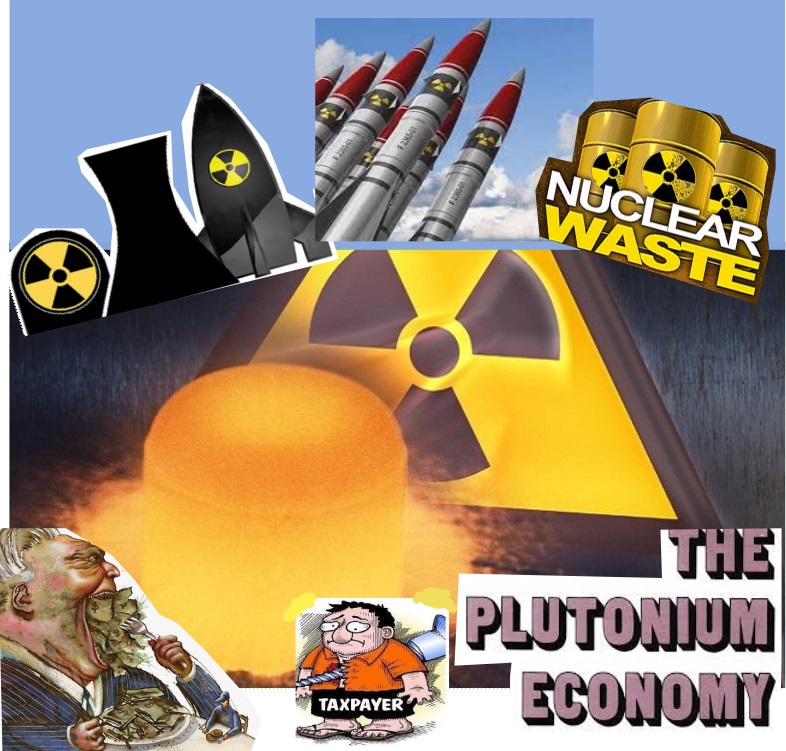
Until 1989, pits were made at Rocky Flats, a U.S. government facility operated by a contractor that was raided by the FBI and subsequently closed after numerous environmental and safety violations. Since that time, only a handful of pits have been made, all at Los Alamos National Laboratory, which itself has a history of safety problems.
In the late 1990s, NNSA began proposing expanded pit production at Los Alamos. In 2001 it proposed a facility to produce 80 pits per year at an estimated cost of $375 million. By 2011 the price tag for pit production had grown to between $3.7 and $5.8 billion—even at that time seen as unrealistically low because the facility’s design had yet to be completed and the estimate was for construction only, not operations and maintenance. By 2014, that plan was abandoned, and a new one was introduced with an estimated cost of $4.3 billion. Soon that too ran over budget and behind schedule. You might notice a pattern here.
At this point, Congress stepped in. But not to investigate the reasons for the cost overruns. Instead, in the 2015 National Defense Authorization Act, Congress simply ordered NNSA to succeed. It decreed that NNSA had to make 80 pits per year by 2027, later extended to 2030. Frustrated with the seeming inability of Los Alamos to make progress, in 2018 pit production was expanded to another NNSA facility: the Savannah River Site in South Carolina. The plan now is to repurpose for pit production a building originally intended to recycle plutonium from dismantled Cold War nuclear weapons to turn it into fuel for nuclear reactors. But that original disarmament project was terminated in 2018 after costs rose from a 2004 estimate of $1.8 billion to $17.2 billion. Congress never held hearings to assess the reasons for this cost escalation, lessons learned or how to prevent similar problems in the future.
If major projects at NASA, the Veterans Administration or almost any other government agency mimicked these problems, Congress would hold hearings and demand explanations. Nuclear modernization deserves the same hard scrutiny.
Congress should require independent cost estimates of the Sentinel program, pit production at both Los Alamos and Savannah River, and any other major nuclear modernization program where the estimated cost exceeds the original baseline by 50 percent or more—a threshold in the Nunn-McCurdy Act. These estimates should be undertaken by an entity that has no fiscal stake in the outcome, and is politically insulated from those who do.
Unlike the Defense Department’s Cost Assessment and Program Evaluation (CAPE) office, which has a track record of independent analysis, the NNSA has struggled to develop a similar oversight capability. The NNSA remains on GAO’s list of federal agencies that are “vulnerable to waste, fraud, abuse, and mismanagement,” or that need broad reform, since the list was first created in 1990. The NNSA has shown, repeatedly, that it cannot change itself.
It’s reasonable, of course, that cost estimates for projects involving uncertainties such as technologies still under development can result in a range of estimates. Routinely rubber-stamping endorsements of the lower figures, however, should stop. Instead the president’s budget submission should adopt the highest credible estimate, accompanied by an explanation of how the program will strive to come in under budget.
Independent cost estimates typically link budgets to services, such as plutonium processing, or material things such as facilities or weapons. In the case of nuclear modernization, though, that’s not sufficient; the link needs to extend to the impact on the strategy of deterrence. Nuclear weapons threaten the lives of billions of people. Does $14 billion worth of pit production provide better deterrence than $37 billion worth? Is a $118 million Sentinel missile more effective at preventing nuclear war than an existing ICBM that costs half as much? It’s only by linking dollars to deterrence that Congress can assess the tradeoffs and move beyond the notion that nuclear modernization is justified regardless of the final price tag.
MISTAKES THAT CAUSED THE CHERNOBYL DISASTER
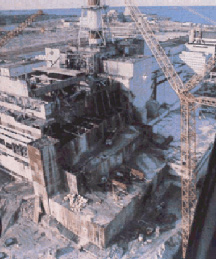
BY S. FLANNAGAN/MAY 12, 2024 https://www.grunge.com/1562994/mistakes-that-caused-chernobyl-disaster/
The Chernobyl disaster remains one of the most chilling incidents of the nuclear age. The Chernobyl Power Complex was the name of a nuclear power plant in northern Ukraine just a few miles from the Belarus border near the city of Pripyat. At the time Ukraine was part of the Union of Soviet Socialist Republics (USSR), and Chernobyl was constructed between 1970 and 1977 as part of the USSR’s nuclear expansion program. It had four reactors, each capable of generating colossal amounts of energy to enrich the Soviet bloc. On April 26, 1986, a series of errors caused reactor 4 to experience an unexpected surge of power that started a huge fire, which led to several explosions and the biggest release of radioactive material into the atmosphere in history.
Local areas such as Pripyat were evacuated, but a delayed emergency response saw the area transformed into an uninhabitable no-go zone. It has been reported that 31 people lost their lives in the immediate aftermath of the meltdown, including six firefighters who received double the fatal amount of radiation as they attempted to extinguish the blaze. But a delayed response saw the amount of material released into the environment and spread across Ukraine, Belarus, Russia, and parts of Central Europe. Hundreds of thousands of people were involved in the clean-up, many of whom went on to develop health problems such as cancer as a consequence of the exposure. Here are some of the mistakes that led to the meltdown, and to the local area being largely uninhabited even today.
A FLAWED DESIGN
The World Nuclear Association notes that one of the key issues that led to the meltdown of Reactor 4 which resulted in the Chernobyl disaster of 1986 was the flawed design of the reactor itself. Each of Chernobyl’s four reactors was of a new Soviet design known as “reaktor bolshoy moshchnosty kanalny,” or RBMK. RBMK reactors were one of two reactor designs to emerge from the USSR in the 1970s. They employ a water-cooling system and graphite control rods that regulate fission, which creates nuclear energy.
On the night of the meltdown, operators were attempting to test whether residual steam pressure would be able to keep the reactor going in the event of a power cut long enough for the backup diesel generators to take over. However, in the course of the experiment, a huge and unexpected power surge hit the reactor, which was later found to have been caused by the RBMK’s enormous “void coefficient,” ultimately meaning that excess steam in the water cooling system would not be able to absorb neutrons in the system, resulting in the surge. After an investigation into these flaws, crews were tasked with upgrading other reactors in the Chernobyl Power Complex to make them safer, though over the years these other reactors have also eventually been decommissioned.
SAFETY ISSUES COVERED UP
But the flaws in the design of the RBMK-1000 reactor at Chernobyl that rendered it unsafe weren’t exactly a surprise to experts in the wake of the meltdown. In fact, the site had suffered several notable accidents and emergencies years before the shocking events of April 1986. But as we know now, those in charge of the Soviet nuclear program sought to cover up evidence that their reactors were unsafe, meaning that they continued to be operated despite such safety issues leading to the worst nuclear accident in history.
According to a 2021 report published by Reuters, it was revealed that the side had a radiation leak as early as 1982 and that numerous accidents occurred at the plant in 1984. The Soviet government was reportedly aware of the truth that Chernobyl was fundamentally unsafe as a power plant as early as 1983 but kept the matter a secret from the public.
The same instinct among the Soviet powers that be to cover their tracks led to their delayed order to evacuate the city of Pripyat until about Chernobyl 36 hours after the meltdown began, ultimately exposing thousands of locals to dangerous levels of radiation.
The nuclear operators on-site at the Chernobyl Power Complex were later identified as lacking in adequate training required to keep such a complicated and cutting-edge power station running effectively and safely. In the years following the devastating nuclear meltdown, the operators themselves were afforded a great deal of blame for the disaster in which many of them lost their lives.
Indeed, the experiment that the Chernobyl nuclear operators were performing on the night of the meltdown was flawed as a result of human error, which largely came down to the team’s lack of understanding of the reactor’s internal systems. None of them expected the surge of power that the experiment unleashed. The experiment itself was later reported to have been unauthorized, though plant director Viktor Bryukhanov, chief engineer Nikolai Fomin, and his deputy, Anatoly Dyatlov later received 10-year prison sentences for the disaster. Official Soviet government reports claimed that the operators, three more of whom were given prison sentences, had been negligent.
The lack of training that the operators were afforded resulted from what is now known to have been an almost complete lack of safety culture at the Chernobyl Power Complex, a characteristic of Soviet industry more generally at the time. No interest in maximum design accidents, hypothetical disasters that could then be mitigated against in design features, were of little interest to commissioners or designers of the RBMK-1000 reactor, who were also looking to reduce costs.
The safety of Chernobyl was further impacted by opacity within the Soviet hierarchy, which prevented subordinates from reporting issues and misgivings to their superiors, leading to a culture of silence in which errors were not course-corrected. Similarly, mistakes, including those around safety, were covered up, rather than treated as lessons to be learned from. “The attitude came from the race for the atomic bomb, “Chernobyl: History of a Tragedy writer Sehii Plokhy writer told The Guardian in 2018. “The sacrifice of health and life was almost expected. That culture was transferred to the nuclear power establishment.”
Further safety features were overlooked as director Viktor Bryukhanov, who was also in charge of the setting up of the reactors as well as providing accommodation for the operators, raced to keep the project on track. The science journal Nature reports that under his direction electric cables were installed without the required fire-resistant cladding, just one instance of the corners that were cut in the creation of the plant despite the potential calamity that might occur were something to go wrong with any of its reactors.
A lax attitude to safety continued even after the meltdown and the delayed evacuation of local people from the area around the site as it grew more and more radiated and became a danger to human life. In the aftermath, an international effort saw a concrete “sarcophagus” erected around the reactor intended to stop the spread of further radiation. However, the structure was only intended to be temporary and still requires a permanent solution to this day, with experts claiming that it and other stores of radioactive material from the world’s worst nuclear disaster constitute an ongoing risk to public safety if not adequately maintained.
Afghanistan flash floods kill more than 300 as torrents of water and mud crash through villages

More than 300 people were killed in flash floods that ripped through
multiple provinces in Afghanistan, the UN’s World Food Programme said, as
authorities declared a state of emergency and rushed to rescue the injured.
Many people remained missing after heavy rains on Friday sent roaring
rivers of water and mud crashing through villages and across agricultural
land in several provinces, causing what one aid group described as a
“major humanitarian emergency”.
Guardian 12th May 2024
“Bouncing-back” and other resilience neologisms championed by the state are inherently at odds with the irreversibility of nuclear waste.

Rhetoric of resilience
Recovery of the state or recovery of the people?
Beyond Nuclear International By Mia Winther-Tamaki, 12 May 24
The Japanese people and landscapes still feel the unending impacts of a nuclear catastrophe that occurred a dozen years ago. Thousands of black bags litter the Fukushima exclusion zone enclosing radioactive earth and rubbish with nowhere to go. Japan has begun releasing millions of tons of radioactive wastewater into the sea. The death and destruction of the earthquake and tsunami — a tragedy in itself — was compounded by nuclear calamity…………………….
The Japanese government was responsible for not only creating the circumstance of neglect that caused the nuclear meltdown, but also for exacerbating the impacts of nuclear fallout through a delayed and opaque response that downplayed the severity of the catastrophe…………….
Following the nuclear disaster, Japan shifted to a necessary post-disaster survival and recovery strategy that can be characterized by the term “resilience,” defined by the United Nations Office for Disaster Risk Reduction as the ability to “resist, absorb, accommodate to and recover from the effects of a hazard in a timely and efficient manner, including through…preservation and restoration…”………………………………………………………………………..
“Bouncing-back” and other resilience neologisms championed by the state are inherently at odds with the irreversibility of nuclear waste. The Japanese translation of resilience, “fukkō” (復興), was employed as a catchphrase in building “apparatuses of [capital] capture” out of crisis, according to Sabu Kohso in his 2020 book Radiation and Revolution. In what Kohso calls the “nuclear capitalist nation-state,” the government endeavored to “build back better” and rejuvenate the national economy amidst an unprecedented crisis by implementing a series of fukkō reforms. These reforms included cuts in public spending, tax incentives targeted at international investors and the procurement of construction contracts, all of which ultimately proved advantageous for nuclear corporations and other private actors in the “business of reconstruction.”
The government used the disaster conveniently for profit-making, further transferring the nation’s wealth to the elites, while further immiserating the people. TEPCO exempted itself from responsibility for the nuclear meltdown when it referred to radiation as a “masterless object” (無主物), therefore absolving any self-accountability for cleaning up the radiation emitted from TEPCO’s own nuclear reactors.
Strategic documents such as the government’s 2012 white paper titled, “Toward a Robust and Resilient Society” were published with the intention of “nurturing the dreams and hopes of the people,” ………………………………………………………………….
While enlisting idealistic language and visions of a future, the Japanese state failed to provide basic amenities, housing, resources and support for the Japanese people who had essentially become nuclear refugees. The state divisively categorized evacuees as either “mandatory” or “voluntary,” based on the proximity of their homes to the site of the nuclear meltdown, though it has been shown that deadly levels of radioactivity persisted far outside mandatory zoned areas.
……………………………………………………………..The media ignored the resistance movement, dismissing the public’s widespread anticipation and anxiety about future nuclear accidents, and instead toed the government’s line about nuclear energy as safe.
Community-driven resilience led by activists focused on a diverse range of concerns, including anti-capitalism, feminism and environmentalism. Spearheading this resistance were mothers and those who work to provide everyday needs, tirelessly organizing networks of information-sharing and support. For the sake of their children and loved ones, those in caregiving roles questioned the government’s opaque reports of radiation levels, though they were often denigrated as “hysterical” and “paranoid” by authorities and other family members, according to Kohso. Within the confines of Japan’s patriarchal society, which frequently undermines the value of womens’ knowledge, female activists subverted norms that “freed them from a degree of social control, giving them greater freedom to mobilize.”
Author Nicole Frieiner documents how women mobilized resistance in informal digital spaces, such as a Facebook group named “Fukushima Network for Saving Children from Radiation,” and a blog titled “Connecting Mother’s Blog.” They created safe and accessible spaces that supported alternative points of connection for people across the world. Artists were also crucial to the Fukushima nuclear resistance.
………………………………………………………………… Survivors of Fukushima must live not only with the trauma caused by the earthquake, tsunami and nuclear meltdown, but also that which followed in the ambiguous aftermath — years of a violent lack of acknowledgement, dignity and respect from public authorities………………………………………………………. more https://beyondnuclearinternational.org/2024/05/12/rhetoric-of-resilience/
RAF Lakenheath protest to make airbase nuclear-free zone
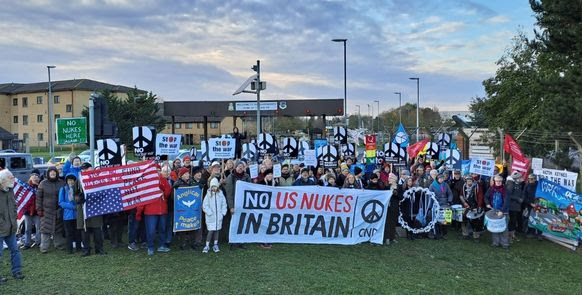
By Tom Cann, TomCann97, Community Report, 12 May, https://www.eadt.co.uk/news/24314379.raf-lakenheath-protest-make-airbase-nuclear-free-zone/
Residents and local councillors from across East Anglia came together to protest against the US plans to station nuclear weapons at an air base in Suffolk.
Protestors and activists went to RAF Lakenheath to declare the site a nuclear-free zone.
In January, it was revealed that the US was planning to put warheads three times as strong as the Hiroshima bomb at RAF Lakenheath.
They previously stationed nuclear missiles at the site but these were removed in 2008 when the Cold War threat from Moscow had receded.
The Campaign for Nuclear Disarmament (CND) lead a nationwide day of action on May 11.
A declaration was read out in front of the base, calling on the British government to work for global nuclear disarmament by refusing delivery of any US nuclear weapons and instead making Lakenheath a nuclear-free zone.
Sophie Bolt, from CND, said: “We know that US plans to deploy its nuclear bombs here at Lakenheath.
“This will not make us safer, but – on the contrary – make the world far more dangerous.
“With tensions still dangerously high between NATO and Russia, siting these weapons of mass destruction in Britain puts us all on the frontline of a nuclear war.”
Previously, an RAF Lakenheath spokesman said: “We recognise and support the right to peaceful protest as a fundamental aspect of a democratic society, however, it’s a long standing Ministry of Defence policy that we do not discuss the location or status of nuclear weapons.”
Activists plan more protests in July.
‘Insanity’— John Mearsheimer on the US role in Gaza and Ukraine
By Katie Halper and Aaron Maté / Useful Idiots May 13, 2024 https://scheerpost.com/2024/05/13/insanity-john-mearsheimer-on-the-us-role-in-gaza-and-ukraine/
Professor John Mearsheimer, whose political analysis predicted today’s horrors in Ukraine and Palestine, joins Useful Idiots to give his take on what’s next in the world’s biggest wars.
And since he’s been largely excluded from corporate media for his dissenting views, it’s more important than ever to get his word out.
“What you have here is a real disjuncture between what the elites think and what the publics think,” he says of the two conflicts, in what is already a clear affront to the narratives of elitist western media. “There are recent polls produced by the European Council on Foreign Relations and the Quincy Institute that show that only 10% of Europeans and 12% of Americans think that Ukraine can win the war.”
And when it comes to Israel, Mearsheimer explains that US policy is even further from what the people want. It’s not the voters who have a say, and even Congress (as pro-Israel as they are) isn’t in control: “I believe that 90% of it is accounted for by the [Israel] lobby.”
Professor Mearsheimer deep dives into each war: he explains why the US tanked Ukraine’s peace talks to further instigate Russia and what he would do now if he was in Biden’s or Putin’s position. He also delves into the influence of the Israel lobby and how Biden has given impunity to Israel’s killing Gaza killing spree.
Sen. Lindsey Graham suggests nuking Gaza, says nuking Hiroshima was ‘the right decision’
Amanda YenSun, The Daily Beast, Sun, 12 May 2024, https://www.sott.net/article/491372-Sen-Lindsey-Graham-suggests-nuking-Gaza-says-nuking-Hiroshima-was-the-right-decision
Sen. Lindsey Graham (R-SC) offered a baffling comparison of Israel’s war on Gaza to the U.S. decision to drop atomic bombs on Japan during World War II, telling Israel to “do whatever you have to do” to finish the military campaign.
Speaking to NBC’s Kristin Welker on Meet the Press Sunday morning, Graham made the argument that Israel would be justified in slaughtering civilians in Gaza by likening the situation to the U.S.’s war with Japan eight decades ago. He suggested Israel would be right to flatten the Gaza strip — home to 2.2 million Palestinians, half of whom are children — simply because the U.S. did it to Hiroshima and Nagasaki in the 1940s.
“So when we were faced with destruction as a nation after Pearl Harbor, fighting the Germans and the Japanese, we decided to end the war by bombing Hiroshima, Nagasaki, with nuclear weapons,” Graham began.
The senator continued to call the bombings of Hiroshima and Nagasaki “the right decision” by the U.S. That decision ended the war with Japan, but killed hundreds of thousands of Japanese civilians between the initial blasts and the deadly radiation that followed.
“Give Israel the bombs they need to end the war they can’t afford to lose, and work with them to minimize casualties,” Graham insisted.
It was unclear how he believed the U.S. and Israel could work to “minimize casualties,” since bombs tend not to discriminate between civilians and militants upon detonation.
Graham’s comments were so extreme that even Welker was taken aback, unsuccessfully attempting to interject as the senator talked over her.
“Can I say this?” Graham continued. “Why is it okay for America to drop two nuclear bombs on Hiroshima and Nagasaki to end their existential threat war? Why is it okay for us to do that? I thought it was okay.”
Of course, the presumption that the U.S. was justified in nuking Japan to end World War II has been contested by historians and other critics for decades. Those bombs also decimated nearly all of Hiroshima’s and Nagasaki’s medical infrastructures, making it nearly impossible to deliver aid to the injured and dying, according to the International Campaign to Abolish Nuclear Weapons.
Graham’s comments came as Israel appears poised to launch a full-scale invasion of Rafah, which the U.N. and the Biden administration have warned would be catastrophic for the 1.4 million people sheltering there. On Sunday, as Graham went on national television to suggest incinerating Gaza, the U.N. secretary general pleaded once more to prevent the area from spiraling into all-out devastation.
Comment: Is it any wonder that Russia is running nuclear drills when Western governments are riddled with liabilities like Graham?
Israel ‘Has Gone to War Against the Entire Palestinian People’: Sanders
“Any objective observer knows Israel has broken international law, it has broken American law, and, in my view, Israel should not be receiving another nickle in U.S. military aid,” Sanders said.
Common Dreams. OLIVIA ROSANE,13 May 24
Independent Vermont Sen. Bernie Sanders repeated his calls on Sunday for the U.S. to cut off military aid to the far-right government of Israeli Prime Minister Benjamin Netanyahu as it continues its devastating war on Gaza.
Sanders spoke on NBC’s “Meet the Press” in response to a U.S. State Department report released Friday, which found that it was “reasonable to assess” that Israel had used U.S. weapons to violate international humanitarian law in Gaza but that the U.S. was “not able to reach definitive conclusions” as to whether U.S. weapons had been used in any specific incidents.
“Any objective observer knows Israel has broken international law, it has broken American law, and, in my view, Israel should not be receiving another nickle in U.S. military aid,” Sanders said.

Friday’s report came in response to National Security Memorandum 20 (NSM-20), in which President Joe Biden tasked Secretary of State Antony Blinken with obtaining “certain credible and reliable written assurances from foreign governments” that they use U.S. arms in line with international humanitarian law and will not “arbitrarily deny, restrict, or otherwise impede, directly or indirectly, the transport or delivery of United States humanitarian assistance.”
The report, made to Congress, was criticized by human rights organizations who said it mischaracterized both the law and the facts in order to avoid imposing consequences on Israel for waging a war on Gaza that the International Court of Justice has determined could plausibly amount to genocide.
Speaking before Sanders on “Meet the Press,” Blinken denied that the report was an attempt to get out of holding Israel accountable………………………………………………………………………………….
Sanders told NBC that he thought many Republicans and also some Democrats wanted Israel to invade Rafah, but that this was not an opinion shared by the majority of people in the U.S.
“Poll after poll suggests that the American people want an immediate cease-fire. They want massive humanitarian aid to get in,” Sanders said. “The people of our country do not want to be complicit in the starvation of hundreds of thousands of children.” https://www.commondreams.org/news/sanders-israel-war-palestinian-people
1 This Month

of the week – Shut Down Drone Warfare!


Tell the Ukrainian Government to Drop Prosecution of Peace Activist Yurii Sheliazhenko

Petition to revoke the licensing of the Near Surface Nuclear Disposal Facility (NSDF) at Chalk River. https://www.ourcommons.ca/petitions/en/Petition/Details?Petition=e-7247
To see nuclear-related stories in greater depth and intensity – go to https://nuclearinformation.wordpress.com
-
Archives
- March 2026 (251)
- February 2026 (268)
- January 2026 (308)
- December 2025 (358)
- November 2025 (359)
- October 2025 (376)
- September 2025 (257)
- August 2025 (319)
- July 2025 (230)
- June 2025 (348)
- May 2025 (261)
- April 2025 (305)
-
Categories
- 1
- 1 NUCLEAR ISSUES
- business and costs
- climate change
- culture and arts
- ENERGY
- environment
- health
- history
- indigenous issues
- Legal
- marketing of nuclear
- media
- opposition to nuclear
- PERSONAL STORIES
- politics
- politics international
- Religion and ethics
- safety
- secrets,lies and civil liberties
- spinbuster
- technology
- Uranium
- wastes
- weapons and war
- Women
- 2 WORLD
- ACTION
- AFRICA
- Atrocities
- AUSTRALIA
- Christina's notes
- Christina's themes
- culture and arts
- Events
- Fuk 2022
- Fuk 2023
- Fukushima 2017
- Fukushima 2018
- fukushima 2019
- Fukushima 2020
- Fukushima 2021
- general
- global warming
- Humour (God we need it)
- Nuclear
- RARE EARTHS
- Reference
- resources – print
- Resources -audiovicual
- Weekly Newsletter
- World
- World Nuclear
- YouTube
-
RSS
Entries RSS
Comments RSS
 nuclear-news