TODAY. Time to rise above the tit-for-tat mentality – “Turning Point: the Bomb and the Cold War” (and this is not an ad)
This is a Netflix series. And I’m sorry to be looking as if I am advertising. But the thing is – life is too serious, too important – to worry about this.
To me, the important thing about this series is that it rises above political and national loyalties. Produced by Luminant Media and director Brian Knappenberger, this really is the definitive documentary on the Cold War and the Atomic Bomb.
I didn’t know that Americans were capable of creating an unbiased factual history of nuclear weapons – that didn’t justify all American actions, and demonise all Russian’s. But this is it.
I find this lengthy detailed comprehensive study quite gripping, and also believable – authentic. I’m actually now only halfway through it, but I feel so reassured – that there exists such a visual media – that sees all sides as made up of human beings, that respects our common humanity, – while it still sets out the stupidities and atrocities done , and makes no excuses for them.
In this era of short, snappy, unreliable media of all types, there is a desperate need for longer, thoughtful, thorough, properly researched studies on our troubled world situation. We need to be getting past those lofty myths of “honour” “patriotism” “loyalty” – to try to see clearly what is actually happening now, and how we got to the crises of today.
The End of the World as We Know It
and Democratic presidents, in particular, are often worried about appearing soft on defence—they are easily swayed by their military advisors.
Most of the US public thinks that America has renounced the optional first use of nuclear weapons. But while many presidential candidates have promised to do so, no one in office has ever made it an official policy.
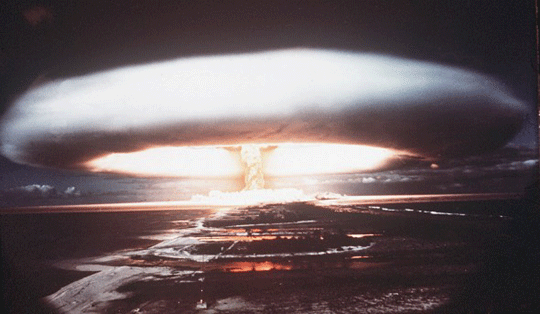
Far from enhancing American national security, or the security of the world, nuclear weapons will lead us to the edge of destruction.
Lawrence M. Krauss 6 May 24, https://quillette.com/2024/05/06/the-end-of-the-world-nuclear-war-weapons-apocalypse

A review of Nuclear War: A Scenario by Annie Jacobsen; 400 pages; New York: Dutton (March 2024)
As Chair of the Board of Sponsors of the Bulletin of the Atomic Scientists from 2008–2018, I helped unveil the Doomsday Clock every year for a decade. That meant that each year, I sat down with my colleagues for several days and seriously contemplated how close we might be to the end of civilisation. But even that sombre preparation could not prepare me for the grim realities unveiled in the recent book, Nuclear War: A Scenario, by veteran national security journalist Annie Jacobsen
Jacobsen details the events that would take place, minute by minute, in the 72 minutes from the launch of a rogue intercontinental ballistic missile (ICBM) by North Korea to the destruction of modern civilization and the death of up to five billion people.
Jacobsen imagines the following scenario:
0 min) A lone ICBM is launched from North Korea.
(19 min) The US launches 50 ballistic missiles at targets in North Korea and instructs submarines to launch 32 additional missiles.
(21 min) Most of Southern California becomes uninhabitable due to a North Korean submarine-launched ballistic missile (SLBM) attack on the Diablo Canyon nuclear reactor.
(33 min) Washington DC, together with almost all its 6 million inhabitants, is vaporized by the impact and explosion of the North Korean ICBM.
(49 min) Fearing they are under attack from the US missiles heading toward North Korea, Russia launches 1,000 missiles at US targets. On detection of these, the US launches an ICBM and SLBM attack on 975 Russian targets.
(51 min) NATO pilots launch an aerial nuclear attack on the Russian targets.
(52 min) North Korea is effectively wiped off the map, following the impact of 32 SLBM and 50 ICBM missiles.
(57 min) All land-based US military bases are destroyed by Russian SLBMs.
(58 min) Much of Europe is destroyed by a Russian SLBM attack on NATO bases. (59 min) The US launches the remainder of its stock of SLBMs at Russia.
(72 min) 1,000 locations in the United States are hit by Soviet ICBMs. A large fraction of the US population is killed immediately and most of the rest have little or no means of survival. A similar fate befalls Russia several minutes later.
Meanwhile, 52 minutes into this apocalyptic exchange, a nuclear device explodes in space high above the US, producing an electromagnetic pulse that renders almost all communication systems in the continental US inoperative, destroying much of the country’s infrastructure and causing widespread floods and fires, thus further complicating life for the few remaining survivors.
Whether or not one finds the specific scenario Jacobsen outlines plausible, it is clear that any major nuclear confrontation would have apocalyptic consequences. As Soviet Chairman Nikita Khrushchev said shortly after the Cuban Missile Crisis, in such a situation, “the survivors would envy the dead.”
Military planners have been preparing for scenarios like this since at least 1960, when the first comprehensive nuclear war planning exercise was carried out in the US.
As Jacobsen describes, in 1949, experts estimated that as few as 200 fission-type weapons of the kind that destroyed Hiroshima and Nagasaki would have been sufficient to essentially wipe out the Soviet Union. But despite this, both the US and the Soviets continued to amass weapons. By 1967, the US and USSR had around 30,000 nuclear and thermonuclear warheads each. While their arsenal has since been reduced, the US still has over 1,700 warheads on hair-trigger, launch-on-warning alert. Russia has only slightly fewer. Both countries have over 3,000 additional nuclear weapons stockpiled and available for use.
For the past 79 years, we have been living under the Damoclean sword of mutually assured destruction (MAD), the basis of modern nuclear deterrence. It is argued that since any act of nuclear aggression would lead to the annihilation of most of the world, no rational leader would launch a first strike. What is less frequently stressed, however, is that for this to work, deterrence must never, ever fail. Because once it does, the world as we know it will end.
The madness of having almost 2,000 nuclear weapons on hair-trigger alert, capable of being irretrievably launched on their missions of destruction at the mere warning of an incoming nuclear attack—before a single nuclear explosion has even occurred—has not been lost on US presidential candidates from both parties. Both George W. Bush, and Barack Obama vowed to take us back from the razor’s edge while running for president, but neither made good on this promise while in the White House. I was on Obama’s science policy team during his first run for the presidency. I was gratified when he won because I thought he would fix this lunacy. I was profoundly disappointed when he didn’t.
Most of the US public thinks that America has renounced the optional first use of nuclear weapons. But while many presidential candidates have promised to do so, no one in office has ever made it an official policy.
I have often wondered why successful presidential candidates change their tune once they get into the Oval Office. I suspect that the generals who advise the President and the Secretary of Defence have lived with the idea of launch-on-warning throughout their whole careers and cannot even imagine that a US president might allow a nuclear weapon to explode on American soil without having already launched a response. Since most presidents have no experience with war game planning—and Democratic presidents, in particular, are often worried about appearing soft on defence—they are easily swayed by their military advisors.
The maddening ramping-up of nuclear arsenals is a real-world example of the well-known game theory scenario called The Prisoner’s Dilemma, in which two prisoners, who cannot communicate with either other, are motivated by mistrust to make choices that are in neither party’s best interests. Likewise, each of the superpowers assumes that its adversary will stockpile ever more nuclear weapons, so it seems logical to stockpile more themselves.
There is a simple way out of this dilemma. Unlike in the game theory example, the prisoners here can talk to each other and, through diplomacy, can jointly arrive at a win-win strategy. The problem is that there are currently almost no front-door communications between either Russia and the US or China and the US on strategic nuclear issues. The resulting perils are clear—especially at this time, with the continuing war in Ukraine, tensions between China and Taiwan, and the brewing catastrophe in the Middle East.
The American public has been misinformed about the gravity of this threat because of a false narrative regarding anti-ballistic missile (ABM) defence. Having witnessed Israel’s recent success in defending itself against conventional missiles launched from Iran, many people assume that the US has a working ABM system (a false claim first touted by George W. Bush in around 2004). We don’t—despite having spent almost 176 billion dollars trying to create such a system. As Jacobsen emphasizes in her book, we have only 44 ABM interceptors in place. Moreover, in carefully controlled tests that did not realistically reproduce the many uncertainties inherent in an actual nuclear exchange—including the possible use of decoys—the prototypes of those interceptors have failed more than 50 percent of the time. We have essentially no defences against nuclear weapons. All we can do is try to ensure that they are never used.
For the arms industry, however, nuclear weapons—as horrifying as they are—are the gift that keeps on giving. The Biden administration’s $850 billion defence budget for 2025 allocates $69 billion to nuclear weapons operations and modernisation. Plans for 400 new ICBMs, new nuclear submarines and bombers, and upgrades to existing warheads are currently in the works, at a projected cost of three quarters of a trillion dollars over the next decade. MAD isn’t mad enough, it seems. Defence contractors, lobbyists, and right wing think tanks are concerned that 1,700 nuclear weapons are not enough and that “America’s enemies will become even more emboldened… while facing a hobbled and undersized American nuclear deterrent.”
Almost all the nuclear war games that military strategists have engaged in have invariably escalated to the point of Armageddon. Spending further billions to produce weapons whose sole purpose is to lead to nuclear annihilation will not make us safer. Far from enhancing American national security, or the security of the world, nuclear weapons will lead us to the edge of destruction.
I was proud to take the helm of the group established in 1947 by Albert Einstein and Robert Oppenheimer to warn the world of the dangers of nuclear weapons, in part through the annual setting of the Doomsday Clock. But, sadly, that effort has been an abject failure. Perhaps Jacobsen’s new book, reportedly soon to be adapted for the big screen, may bring people to their senses. For the past 79 years, we have been lucky, but our luck may not hold forever. Even a single ICBM launch could lead to a war that abruptly ends over 400,000 years of modern hominid evolution, leaving little or no trace of human existence and of our other technological achievements—all in less time than it took me to write these words.
Lawrence M. Krauss
Lawrence M. Krauss, a theoretical physicist, is President of the Origins Project Foundation. His most recent book is “The Edge of Knowledge: Unsolved Mysteries of the Cosmos.”
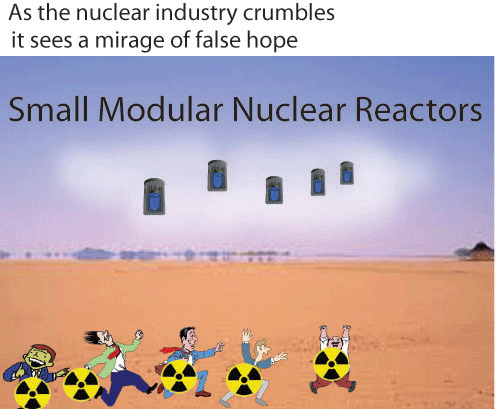
Small reactors don’t add up as a viable energy source
By M.V. Ramana and Sophie Groll. 6 May 24, https://cosmosmagazine.com/science/engineering/small-reactors-dont-add-up/
The nuclear industry has been offering so-called Small Modular Reactors (SMRs) as an alternative to large reactors as a possible solution to climate change.
SMRs are defined as nuclear reactors with a power output of less than 300 megawatts of electricity, compared to the typically 1000 to 1,500 megawatts power capacity of larger reactors.
Proponents assert that SMRs would cost less to build and thus be more affordable.
However, when evaluated on the basis of cost per unit of power capacity, SMRs will actually be more expensive than large reactors.
This ‘diseconomy of scale’ was demonstrated by the now-terminated proposal to build six NuScale Power SMRs (77 megawatts each) in Idaho in the United States.
The final cost estimate of the project per megawatt was around 250 percent more than the initial per megawatt cost for the 2,200 megawatts Vogtle nuclear power plant being built in Georgia, US.
Previous small reactors built in various parts of America also shut down because they were uneconomical.
The high cost of constructing SMRs on a per megawatt basis translates into high electricity production costs.
According to the 2023 GenCost report from the Australian Commonwealth Scientific and Industrial Research Organisation (CSIRO) and the Australian Energy Market Operator, the estimated cost of generating each megawatt-hour of electricity from an SMR is around AUD$400 to AUD$600.
In comparison, the cost of each megawatt-hour of electricity from wind and solar photovoltaic plants is around AUD$100, even after accounting for the cost involved in balancing the variability of output from solar and wind plants.
Building SMRs has also been subject to delays. Russia’s KLT-40 took 13 years from when construction started to when it started generating electricity, instead of the expected three years.
Small reactors also raise all of the usual concerns associated with nuclear power, including the risk of severe accidents, the linkage to nuclear weapons proliferation, and the production of radioactive waste that has no demonstrated solution because of technical and social challenges.
One 2022 study calculated that various radioactive waste streams from SMRs would be larger than the corresponding waste streams from existing light water reactors.
The bottom line is that new reactor designs, such as SMRs, will not rescue nuclear power from its multiple problems. Any energy technology that is beset with such environmental problems and risks cannot be termed sustainable.
Nuclear energy itself has been declining in importance as a source of power: the fraction of the world’s electricity supplied by nuclear reactors has declined from a maximum of 17.5 percent in 1996 down to 9.2 percent in 2022. All indications suggest that the trend will continue if not accelerate.
The decline in the global share of nuclear power is driven by poor economics: generating power with nuclear reactors is costly compared to other low-carbon, renewable sources of energy and the difference between these costs is widening.
Nuclear reactors built during the last decade have all demonstrated a pattern of cost and time overruns in their construction.
The Vogtle nuclear power plant being built in Georgia, involving two reactors designed to generate around 1,100 megawatts of electricity each, is currently estimated to cost nearly USD$35 billion.
In 2011, when the utility company building the reactor sought permission from the American Nuclear Regulatory Commission, it projected a total cost of USD$14 billion, and ‘in-service dates of 2016 and 2017’ for the two units.
In France, the 1,630-megawatt European Pressurised Reactor being built in Flamanville was originally estimated to cost 3 billion euros and projected to start in 2012, but the cost has soared to an estimated 13.2 billion euros and is yet to start operating as of March 2024.
These cost increases and delays confirm the historical pattern identified in a study published in 2014: of the 180 nuclear power projects around the world it studied, 175 had exceeded their initial budgets, by an average of 117 percent, and took 64 percent longer than initially projected.
However, the recent projects are even more extreme in the magnitude of the disconnect between expectations and reality.
These reactor projects, and the Hinkley Point C project under construction in the United Kingdom, also confirm another historical pattern: costs of nuclear power plants go up with time, not down. This is unlike other energy technologies, such as solar and wind energy, where costs have declined rapidly with experience.
The climate crisis is urgent. The world has neither the financial resources nor the luxury of time to expand nuclear power. As physicist and energy analyst Amory Lovins argued: “… to protect the climate, we must save the most carbon at the least cost and in the least time.”
Expanding nuclear energy only makes the climate problem worse.
The money invested in nuclear energy would save far more carbon dioxide if it were instead invested in renewables.
And the reduction in emissions from investing in renewables would be far quicker.
M.V. Ramana is the Simons Chair in Disarmament, Global and Human Security and Professor at the School of Public Policy and Global Affairs, at the University of British Columbia in Vancouver, Canada. He is the author of The Power of Promise: Examining Nuclear Energy in India (Penguin Books, 2012) and Nuclear is not the Solution: The Folly of Atomic Power in the Age of Climate Change (forthcoming from Verso Books).
Sophie Groll is a master’s student at the School of Public Policy and Global Affairs, at the University of British Columbia in Vancouver, Canada studying public policy and global affairs. Her focus is on environmental policy, low-carbon energy sources, and net-zero transition discourses.
Originally published under Creative Commons by 360info™.
UK’s Nuclear roadmap is a massive detour

UK plan reveals true ‘energy’ agenda is pathway to nuclear weapons sector
By Jonathon Porritt, Beyond Nuclear 6 May 24
After 14 years of Tory mismanagement, the UK finds itself bereft of an energy strategy.
This was finally confirmed in the release of the Government’s new Nuclear Roadmap. At one level, it’s just the same old, same old, the latest in a very long line of PR-driven, more or less fantastical wishlists for new nuclear in the UK. But at another, it’s a total revelation.
For years, a small group of dedicated academics and campaigners have suggested that the UK Government’s Nuclear Energy Strategy is being driven more by the UK’s continuing commitment to an “independent” nuclear weapons capability than by any authoritative energy analysis. For an equal number of years, this was aggressively rebutted by one Energy Minister after another, both Tory and Labour.
The new Nuclear Roadmap dramatically changes all that. It sets to one side any pretence that the links between our civil nuclear programme and our military defence needs were anything other than small-scale – and of no material strategic significance. With quite startling transparency and clarity, the Roadmap not only reveals the full extent of those links, but positively celebrates that co-dependency as a massive plus in our ambition to achieve a Net Zero economy by 2050.
“Startling” is actually an understatement. Such a comprehensive volte-face is rare in policy-making circles. Every effort is usually made by Ministers to obscure the scale (let along the significance) of any such screeching handbrake turns. That is so not the case with the new Roadmap.
Courtesy of the latest forensic work done by Professors Andy Stirling and Phil Johnstone at Sussex University (who have been absolutely at the forefront of seeking to bring these links into the public domain over many years – often with mighty little support from mainstream environmental organisations, let alone “independent” commentators), chapter and verse of this volte-face can be laid bare. Just a couple of examples from the Roadmap:
- “Not only does this Roadmap set a clear path for the growth of nuclear fission…it acknowledges the crucial importance of the nuclear industry to our national security, both in terms of energy supply and the defence nuclear enterprise.”
- “Government will proactively look for opportunities to align delivery of the civil and nuclear defence enterprises, whilst maintaining the highest standards of non-proliferation.”
- “To address the commonalities across the civil and defence supply chains, and the potential risk to our respective nuclear programmes due to competing demand for the supply chain, the Department of Energy Security and Net Zero (DESNZ) is working closely with the Ministry of Defence and the Defence Nuclear Sector.”
And there’s a whole lot more than that! As Andy Stirling has said: “Without any reflection on what this says about previous efforts to suppress discussion of this issue, the Government is now openly emphasising its significance.”
Indeed!
As usual, the UK’s ill-informed and unbelievably gullible mainstream media would appear to have missed the significance of this gobsmacking inflection point. So one can hardly expect them to have grasped its even more significant implications for UK energy strategy as a whole. In every single particular.
Let me briefly unpack some of those particulars:
- Nuclear
The new Roadmap reads like an outing to a massive nuclear sweet shop. On top of Hinkley Point C and Sizewell C, we’ll have one more big one. And then we’ll have lots of Small Modular Reactors, all over the country. And we’ll have a new fuel processing plant. And a new Geological Disposal Facility – at some much more distant point. And so on and on. 24 fantastical Gigawatts to be designed and delivered by 2050.
The reality couldn’t be more different:
- We will indeed end up with Hinkley Point C – at a staggering of cost of somewhere between £26 billion and £30 billion, with consumers paying twice as much for its electricity as they will for offshore wind. And it will almost certainly not come online until the end of the decade, 15 years on from the time it was meant to be up and running.
- We may possibly get Sizewell C, though the Government cannot currently guarantee the required level of investment. So a Final Investment Decision is unlikely before the next Election. At which point, Starmer may come to his senses and kill off this absurd white elephant.
- We will never get a third big reactor. The economics are literally impossible to justify.
- We are unlikely to get more than a couple of hugely expensive Small Modular Reactors, at some indeterminate point in the future, even with a new “flexible approach” to planning and financial inducements. Even that may prove to be an illusion. As Professor Steve Thomas has written: “Advocates of Small Nuclear Reactors claim they are cheaper and easier to build, safer, generate less waste, and will create many jobs compared to existing large reactor designs. These claims are unproven, misleading, or just plain wrong. Worldwide, no commercial design of SMR has even received a firm order yet.”
- And we may or may not get life extensions for the last five power stations in the “legacy fleet” – subject to regulatory approval, which may not be all that easy given extensive cracking in their reactor cores.
In short, the Roadmap is just a massive diversion from reality. Entailing incalculable opportunity costs. And putting at risk our entire Net Zero by 2050 strategy.
Ministers know all that. But they don’t really care. Our nuclear weapons programme (including upgrading Trident) will be protected as a consequence of this, via an unceasing flow of public money into the civil nuclear cul-de-sac, at a time when our defence budget is already massively overstretched. So who cares about the missing 24GW?
- Renewables
We’ll continue to see new investment into renewables here in the UK, despite (not because of) government policy, which has seriously messed up our offshore wind industry, maintained a de facto ban on onshore wind, couldn’t care less about solar, witters on vapidly about tidal without doing anything etc etc.
Meanwhile, on a global basis, renewables continue to boom………………………………………………………………………………………………………………………………..
The reasons for this almost complete silence can be traced back to successive governments’ grim intent to hang onto our so-called “independent nuclear deterrent”. At literally any costs……………………………… more https://beyondnuclearinternational.org/2024/05/06/nuclear-roadmap-is-massive-detour/
Military interests are pushing new nuclear power

in this supposedly “civil” strategy—are multiple statements about addressing “civil and military nuclear ambitions” together to “identify opportunities to align the two across government.”
A 2007 report by an executive from submarine-makers BAE Systems called for these military costs to be “masked” behind civil programs.
Rolls Royce even issued a dedicated report, marshaling the case for expensive “small modular reactors” to “relieve the Ministry of Defense of the burden of developing and retaining skills and capability.”
The UK government has finally admitted it
By Andy Stirling and Philip Johnstone, 6 May 24, https://beyondnuclearinternational.org/2024/05/06/military-interests-are-pushing-new-nuclear-power/
The UK government has announced the “biggest expansion of the [nuclear] sector in 70 years.” This follows years of extraordinarily expensive support.
Why is this? Official assessments acknowledge nuclear performs poorly compared to alternatives. With renewables and storage significantly cheaper, climate goals are achieved faster, more affordably and reliably by diverse other means. The only new power station under construction is still not finished, running ten years late and many times over budget.
So again: why does this ailing technology enjoy such intense and persistent generosity?
The UK government has for a long time failed even to try to justify support for nuclear power in the kinds of detailed substantive energy terms that were once routine. The last properly rigorous energy white paper was in 2003.
Even before wind and solar costs plummeted, this recognized nuclear as “unattractive.” The delayed 2020 white paper didn’t detail any comparative nuclear and renewable costs, let alone justify why this more expensive option receives such disproportionate funding.
A document published with the latest announcement, Civil Nuclear: Roadmap to 2050, is also more about affirming official support than substantively justifying it. More significant—in this supposedly “civil” strategy—are multiple statements about addressing “civil and military nuclear ambitions” together to “identify opportunities to align the two across government.”
These pressures are acknowledged by other states with nuclear weapons, but were until now treated like a secret in the UK: civil nuclear energy maintains the skills and supply chains needed for military nuclear programs.
The military has consistently called for civil nuclear
Official UK energy policy documents fail substantively to justify nuclear power, but on the military side the picture is clear.
For instance, in 2006 then prime minister Tony Blair performed a U-turn to ignore his own white paper and pledge nuclear power would be “back with a vengeance.” Widely criticized for resting on a “secret” process, this followed a major three volume study by the military-linked RAND Corporation for the Ministry of Defense (MoD) effectively warning that the UK “industrial base” for design, manufacture and maintenance of nuclear submarines would become unaffordable if the country phased out civil nuclear power.
A 2007 report by an executive from submarine-makers BAE Systems called for these military costs to be “masked” behind civil programs. A secret MoD report in 2014 (later released by freedom of information) showed starkly how declining nuclear power erodes military nuclear skills.
In repeated parliamentary hearings, academics, engineering organizations, research centers, industry bodies and trade unions urged continuing civil nuclear as a means to support military capabilities.
In 2017, submarine reactor manufacturer Rolls Royce even issued a dedicated report, marshaling the case for expensive “small modular reactors” to “relieve the Ministry of Defense of the burden of developing and retaining skills and capability.”
The government itself has remained coy about acknowledging this pressure to “mask” military costs behind civilian programs. Yet the logic is clear in repeated emphasis on the supposedly self-evident imperative to “keep the nuclear option open”—as if this were an end in itself, no matter what the cost. Energy ministers are occasionally more candid, with one calling civil-military distinctions “artifical” and quietly saying: “I want to include the MoD more in everything we do”.
In 2017, we submitted evidence to a parliamentary public accounts committee investigation of the deal to build Hinkley Point C power plant. On the basis of our evidence, the committee asked the then MoD head (who—notably—previously oversaw civil nuclear contract negotiations) about the military nuclear links. His response:
We are completing the build of the nuclear submarines which carry conventional weaponry. We have at some point to renew the warheads, so there is very definitely an opportunity here for the nation to grasp in terms of building up its nuclear skills. I do not think that that is going to happen by accident; it is going to require concerted government action to make it happen.
This is even more evident in actions than words. For instance hundreds of millions of pounds have been prioritized for a nuclear innovation program and a nuclear sector deal which is “committed to increasing the opportunities for transferability between civil and defense industries.”
An open secret
Despite all this, military pressures for nuclear power are not widely recognized in the UK. On the few occasions when it receives media attention, the link has been officially denied.
Other nuclear-armed states are also striving to maintain expensive military infrastructures (especially around submarine reactors) just when the civilian industry is obsolescing. This is true in the US, France, Russia and China.
Other countries tend to be more open about it, with the interdependence acknowledged at presidential level in the US for instance. French president Emmanuel Macron summarizes: “without civil nuclear power, no military nuclear power, without military nuclear, no civil nuclear.”
This is largely why nuclear-armed France is pressing the European Union to support nuclear power. This is why non-nuclear-armed Germany has phased out the nuclear technologies it once lead the world in. This is why other nuclear-armed states are so disproportionately fixated by nuclear power.
These military pressures help explain why the UK is in denial about poor nuclear performance, yet so supportive of general nuclear skills. Powerful military interests—with characteristic secrecy and active PR—are driving this persistence.
Neglect of this picture makes it all the more disturbing. Outside defense budgets, off the public books and away from due scrutiny, expensive support is being lavished on a joint civil-military nuclear industrial base largely to help fund military needs. These concealed subsidies make nuclear submarines look affordable, but electricity and climate action more costly.
The conclusions are not self-evident. Some might argue military rationales justify excessive nuclear costs. But history teaches that policies are more likely to go awry if reasons are concealed. In the UK—where nuclear realities have been strongly officially denied—the issues are not just about energy, or climate, but democracy.
Andy Stirling is Professor of Science & Technology Policy in the Science Policy Research Unit, University of Sussex. Philip Johnstone is Research Fellow, SPRU, University of Sussex.
Canada’s federal budget -calls nuclear energy “clean” – the height of absurdity!

Nuclear energy never will be ‘clean,’ write Jones and Edwards.
THE HILL TIMES | MONDAY, MAY 6, 2024
The 2024 federal budget contains many references to nuclear energy as
a “clean” source of electricity. In our view, referring to
nuclear electricity as “clean” is the height of absurdity.
The nuclear fuel chain begins with the mining of uranium from rock
underground where, without human intervention, it would remain safely
locked away from the biosphere. Uranium has many natural radioactive
byproducts, including radium, radon, and polonium-210 that are
discarded in voluminous sandlike “tailings” at uranium mine sites.
These materials are responsible for countless thousands of deaths in
North America alone. Canada has accumulated 220 million tonnes of
these indestructible radioactive mining wastes, easily dispersed by
wind and rain over the next 100,000 years.
Inside a nuclear reactor, uranium atoms are split to produce energy.
The atomic fragments are hundreds of newly created radioactive
poisons, most of them never found in nature before 1940. They make
used fuel millions of times more radioactive than the original
uranium. One used fuel bundle, freshly discharged, will deliver a
lethal dose of radiation in seconds to any unshielded human nearby.
There are hundreds of thousands of tonnes of waste irradiated fuel
bundles worldwide and the quantity grows larger each year. There is no
operating repository anywhere in the world for such wastes, but there
are several failed repositories.
Radioactive waste has the “reverse midas touch” turning everything
it touches into more radioactive waste. This includes the nuclear
vessel in which the waste is created, and everything that comes in
contact with the cooling water needed to prevent the waste from
melting down. Containers for radioactive waste become radioactive
waste themselves. All radioactive waste must be kept out of our food,
air and drinking water for countless millennia.
Radioactive atoms are unstable. They disintegrate, throwing off a kind
of subatomic shrapnel called “atomic radiation.” Emissions from
disintegrating atoms damage living cells. Chronic radiation exposure
can cause miscarriages, birth defects, and a host of degenerative
diseases including cancers of all kinds. Genetic damage to eggs or
sperm can transmit defective genes to successive generations.
Plutonium is one of the hundreds of radioactive byproducts created in
used nuclear fuel. It is of special concern because it is the primary
nuclear explosive in nuclear arsenals worldwide. “Reprocessing” of
nuclear fuel waste to extract plutonium is sometimes called
“recycling” but this is disinformation; the resulting waste is
more difficult to manage than the original fuel waste. Many serious
accidents have occurred around the world at reprocessing plants.
Places where extensive reprocessing has occurred are among the most
radioactively contaminated sites on Earth. Plutonium can be used as a
nuclear fuel, but extracting it is a nuclear weapons proliferation
risk.
Managing radioactive waste is difficult and very expensive. The
projected multi-billion-dollar cleanup cost for the legacy waste at
Chalk River, Ont., is the federal government’s biggest environmental
liability by far, exceeding the sum total of all other federal
environmental liabilities across Canada.
The multinational consortium running Canada’s federal nuclear
laboratories is receiving close to $1.5-billion annually, much of it
for managing legacy radioactive wastes. The consortium’s plans
include piling up one million tonnes of waste in a giant mound beside
the Ottawa River and entombing old reactors in concrete and grout
beside major drinking water sources. Many are of the view that the
plans fail to meet the fundamental requirement to isolate waste from
the biosphere and have been met with widespread concern, opposition
and legal challenges. Nuclear energy is not now, never has been, and
never will be “clean.”
The sooner our elected officials come to terms with this fact, the
better for Canada and Canadians. Honesty is the best policy.
Hamas will not be defeated for another two to three years: Israeli military sources
Hamas is reasserting civilian control of Khan Yunis following the withdrawal of the Israeli army and the return of some residents to the largely destroyed city
The Cradle, News Desk, MAY 5, 2024
Israeli military sources estimate that Hamas will not be decisively defeated in Gaza until 2026 or 2027, even as Hamas reasserts civilian control of the largely destroyed city of Khan Yunis following the army’s withdrawal, Israeli media reported on 4 May.
Sources speaking with Israeli newspaper Yedioth Ahronoth said, “We will not be in Gaza permanently. We’ll return for extensive raids deep into the territory to defeat a terror army built over 15 years.”
The sources add that “Meanwhile, the achievements of the forces that fought in Gaza are eroding, and there’s no conclusive political solution.”
The comments came amid reports that Hamas is reasserting security control over Khan Yunis following the withdrawal of the Israeli army and the slow return of Palestinians to their homes, or what is left of them, in the southern Gaza City since last month.
Yedioth Ahronoth reported that for Israel, it is becoming “increasingly difficult to achieve even the more modest goals of the war: reducing Hamas’ civilian, not just military, control, especially after the IDF’s main military operation ended this week, to continue with limited raids.”
The paper added that “The Air Force will not target every municipal worker currently clearing debris from the streets with a tractor, nor will it strike every Gazan head of sanitation or regional education department manager still receiving their salary from Hamas.”
Previous reporting from +972 Magazine indicated that the Air Force was using artificial intelligence to develop target lists to assassinate thousands of low-level Hamas members by bombing their homes at night while they slept with their wives and children.
Yedioth Ahronoth says the Israeli army now struggles to identify and target the intact internal security mechanisms of Hamas.
It noted a successful case last month in which the air force identified members of Hamas’ internal security services in Shujaiyah’s Kuwait Square last month and immediately launched airstrikes, killing most of them.
The paper also noted the Israeli military assassinated the mayor of the Maghazi refugee camp, Hatem al-Ghamri, for serving as the head of the local emergency committee for Hamas. The committee was responsible for distributing humanitarian aid to the camp’s residents.
“Since the first day of the war, the mayor has been working to provide relief services to tens of thousands of displaced people who sought refuge in the camp,” Mohammad al-Ayedi told the Palestine Chronicle.
“He directly supervised the central emergency committee of the camp and continued to work diligently until the day of his martyrdom. Indeed, he was killed while fulfilling his mission of providing relief to the displaced,” he added.
However, Yedioth Ahronoth notes, “the challenge of locating and targeting the dispersed workforce of thousands of Hamas operatives is akin to finding a needle in a haystack.”
Instead, video footage and eyewitness reports have emerged of many instances of Israeli drones opening fire and killing unarmed civilians, including children and healthcare workers, as well.
The paper added that in the markets of Jabaliya in northern Gaza, Hamas operatives are currently maintaining order and preventing price gouging on food amid shortages………………………………………more https://thecradle.co/articles-id/24727—
Israel Bans Al Jazeera Journalists, Network, Joining Syria and Iran as Repressive Regime
INFORMED COMMENT, JUAN COLE, 05/06/2024
Ann Arbor (Informed Comment) – The Committee to Protect Journalists on Sunday condemned the Israeli cabinet’s decision to ban the Al Jazeera news network in Israel. The network’s office was closed and its equipment was confiscated. Israeli cable channels were forced to delete Al Jazeera from their offerings, and even its website has been blocked for Israeli residents. Since Israeli news channels do not show the effects of the government’s total war on Gaza civilians, the Qatar-based channel had been one of the few sources of comprehensive coverage of the Gaza campaign for those Israelis who know English or Arabic.
On April 1, the Israeli parliament, dominated by the country’s far right parties, passed a law permitting the government to halt the broadcast of foreign channels in Israel “if the content is deemed to be a threat to the country’s security during the ongoing war.” Communications Minister Shlomo Karhi called Al Jazeera an “incitement channel” and a “mouthpiece of Hamas.” It was a ridiculous charge for anyone who actually watches the live stream of Al Jazeera English.
Carlos Martinez de la Serna, the New York-based director of the Committee to Protect Journalists, said, “CPJ condemns the closure of Al-Jazeera’s office in Israel and the blocking of the channel’s websites. This move sets an extremely alarming precedent for restricting international media outlets working in Israel. The Israeli cabinet must allow Al-Jazeera and all international media outlets to operate freely in Israel, especially during wartime.”
The Israeli military has killed some 140 journalists in Gaza. Since it has sophisticated drone surveillance and facial recognition programs and other forms of electronic surveillance, Al Jazeera reports that some of the surviving journalists are convinced that their vehicles and convoys were deliberately targeted despite being clearly identified as “press.”
One of the corruption cases being pursued in Israeli courts against Netanyahu has to do with his pressuring an Israeli newspaper to give him favorable coverage by threatening that otherwise the late casino mogul Sheldon Adelson would flood the market with free newspapers, hurting the profits of Yedioth Ahronoth.
Banning foreign news channels and reporters is not a new thing in the Middle East, or the wider world, but it has usually been done by governments that the US denounces as autocratic. Israel has now joined their ranks as a censorship regime………………………………………….
more https://www.juancole.com/2024/05/jazeera-journalists-repressive.html—
The Summer of Student Activist Protests

This power center for the U.S. Empire – Capitol Hill – presents serious students with an opportunity to educate their elders.
Make U.S. engagements in the Israeli-Palestinian conflict a major electoral campaign issue for November.
By Ralph Nader, May 3, 2024, https://nader.org/2024/05/03/the-summer-of-student-activist-protests/
At many college campuses, students are protesting in opposition to the Biden Administration’s unconditional backing, with weapons and diplomatic cover, of Netanyahu’s continuing serial war crimes slaughtering tens of thousands of Palestinian civilians in Gaza, most of them children and women. Hundreds of faculty members are defending these valiant youngsters and criticizing excessively harsh crackdowns by failed University presidents who are calling in outside police.
With graduations approaching, pro-Netanyahu lobbies and cowed University heads (like Columbia University President Minouche Shafik, who makes a salary of over $2,000 an hour) expect the students to disperse from campus for the summer and end their demonstrations.
The Israeli genocidal crimes against Gazans will continue and intensify if Israel invades Rafah. Millions of refugees will suffer. What will become of the organized student calls for a permanent ceasefire, greatly increased humanitarian aid and cessation of U.S. weapons shipments? The students who leave their campus protests can and should focus on members of Congress in their Districts and in Washington.
In two weeks, hundreds of Congressional summer student interns will begin arriving to work in Congressional offices. Congress is the decades-long reservoir for Israeli colonial aggression. Moreover, Congress, under AIPAC’s extraordinary pressure, has blocked testimony by prominent Israeli and Palestinian peace advocates since 1948. Not once have any of these peace advocates, many of whom are Israeli retired cabinet ministers, mayors, security and military leaders been invited to a Congressional Committee Hearing.
This power center for the U.S. Empire – Capitol Hill – presents serious students with an opportunity to educate their elders. Such an opportunity materialized during the Vietnam War when Congressional interns in the late 1960s organized a highly visible petition drive and engaged in peaceful protests.
Back in the Congressional Districts, the access is easier and available to many more students and faculty. Because Congress is in “recess” for much of the summer – Memorial Day, Fourth of July, and the entire month of August to Labor Day – students and citizens can demand public meetings preceded by formal summons to Senators and Representatives. (See my column “Sending Citizens Summons to Members of Congress”).
Five hundred to a thousand clearly legible signatures with the individuals’ occupations and emails should get these politicians to your well-prepared community meetings.
There would be no more notorious incommunicado behavior, laced with robo-letters to inquiring constituents. Instead, there would be person-to-person questioning, dialogue, and responses where evasions and sweet talk will be more difficult for the lawmakers to utilize.
The subject matter of these public meetings can extend beyond ghastly scenes of dead, dying, sick, and starving families in Gaza to Biden’s foreign and military policies. Our government is fueling an Empire producing disasters that are conducted in the name of the powerless American people, whose sovereign powers under our Constitution are delegated to Congress and the Executive Branch. The abuse of this power starts with Congress.
Nothing can compare to face-to-face meetings with the lawmakers. Letters, phone calls, and emails rarely can be relied on to reach them directly – that is if you are not a big campaign contributor. Besides, unlike in the past, today’s legislative staffers are much more likely to ignore these missives without even an acknowledgment. (See The Incommunicados report: https://incommunicadoswatch.org/).
A people’s town meeting has an agenda set by the people. Some suggestions follow:
1. There have been no Congressional hearings since before October 7th on the overall policies in the Middle East pursued by the White House and Congress. The House and Senate Armed Services and Foreign Affairs Committees have not been active. Instead, there have been show hearings berating University presidents to stifle free speech on their campuses and answer hypothetical questions about anti-semitism against Jews but not the other ongoing Congressionally weaponized anti-semitism against Gazan Arabs, who are Semites, being annihilated in that tiny enclave. Disgraceful! Demand public hearings for the citizenry.
2. Make U.S. engagements in the Israeli-Palestinian conflict a major electoral campaign issue for November. This is a major opportunity to get the direct attention of the 535 lawmakers and to push them to stop kicking the can down the road. The decades-long control of Congress by the “Israeli-government-can-do-no-wrong lobby” must end. There is too much massive, preventable suffering being ignored in the Middle East, too much danger of wider regional wars involving the super-powers, and too much damage to civil liberties and democratic processes in our own country to avoid these matters any longer.
3. The students and teachers will find allies in their Congressional Districts from long-time advocates like the American Friends Committee (Quakers), the Unitarians, united Jewish, Christian, and Muslim peace groups, the increasing numbers of outspoken labor union leaders, and just plain Americans fed up with the costly U.S. Empire and its military-industrial complex (remember President Eisenhower’s warnings).
People want their tax dollars returned to the crucial public necessities back home. They don’t like big business controlling Congress and getting away with looting Uncle Sam by their out-of-control greed and power. Over 70% of Americans believe these big companies have too much control over their lives including many liberal and conservative families.
Larger reforms, redirections, and horizons of society often start with one compelling abuse or outrageous travesty of justice. This has occurred in the labor, farmer, consumer, environmental, and civil rights movements throughout our history.
There will be high-visibility protests outside the National Democratic Party Convention in Chicago and probable demonstrations at the National Republican Party Convention in Milwaukee this summer. But the laser-focused citizen pressure should be on those 535 members of YOUR Congress, their local offices, and their staff.
Change Congress and you change America! That is leverage!
Enforcing Silence on Genocide

The U.S. public should by now be realizing that instead of stopping genocide, U.S. institutional and media authority is actively stamping out cries to stop the mass murder being committed with U.S. complicity, writes Elizabeth Vos.
By Elizabeth Vos, Consortium News, May 4, 2024, https://consortiumnews.com/2024/05/04/enforcing-silence-on-genocide/
Developments on university campuses and in Congress this week showed that the U.S. government’s top priority is not protecting students or civilian lives in Gaza, but to protect Israel’s ability to continue its unimpeded slaughter.
Anti-genocide student protestors at Columbia University, demanding Columbia divest from Israel, occupied the campus’s Hamilton Hall on Tuesday and renamed it Hind’s Hall after Hind Rajab, a 6-year-old Palestinian girl killed by Israeli soldiers in Gaza earlier this year. The Columbia protest has inspired more than 40 other anti-genocide university encampments across the country and in other nations.
On the morning the students occupied Hamilton Hall, MSNBC’s Morning Joe co-host Mika Brzezinski compared the student protests to Jan. 6, calling for authorities to “just start arresting people.” Jonathan Greenblatt, the CEO of the Anti Defamation League, echoed the comparison in the same MSNBC segment. Other supporters of Israel also made the same Jan. 6 anaolgy on social media early Tuesday morning.
Former CNN anchor Don Lemon wrote on X that the Columbia protest “feels January 6th ish to me” because the protesters had occupied a building. Not a federal government building, but a university hall. Has Lemon not heard of a sit-in?
Missing was the most apt and obvious comparison: the occupation of the same Columbia hall took place 56 years to the day since it was the site of a police crackdown on an historic student occupation against the Vietnam War.
Columbia University itself commemorates the anti-Vietnam War occupation of the same building by student protesters in 1968 on their own website. Nonetheless, the NYPD descended on the Hall on Tuesday night at the direct request of Columbia University President Minouche Shafik.
[See: The Israeli Connection to the Raid on Columbia University]
All the comparisons to Jan. 6 came less than 24 hours before the brutal crackdown at Columbia University and the City College of New York by the NYPD Tuesday night, in which almost 300 people were arrested.
Following the New York City arrests, CNN’s Chief Political Correspondent Dana Bash argued on air that the protests were “harkening back to the 1930’s in Europe,” claiming some Jewish people in the U.S. “feel unsafe,” words that completely echoed those of Israeli Prime Minister Benjamin Netanyahu.
How unsafe did students at the University of Pennsylvania feel when a Zionist counter protester sprayed their belongings with an unknown substance?
How unsafe did students feel at multiple universities when police violently arrested professors trying to shield them? In one case in St. Louis, police broke the ribs of a 65-year-old Southern Illinois professor.
How safe did UCLA students feel when they were attacked with fireworks and bats by counter protesters?
In addition to the repulsive comparison with Nazis, Bash’s claim omits the context of previous legitimate antiwar protests that acted virtually identically to the current-era largely peaceful student actions.
These portrayals also excuse the police brutality that followed hours later and has continued since. Police reportedly allowed Zionist counter protesters to violently attack the UCLA encampment for hours without intervention on Tuesday night, only to clear the encampment the next evening using extreme force that included shooting students at close range with rubber bullets.
Bash and the rest of the talking heads focused on the feelings of Zionists in the U.S., deflecting from the horror taking place in Gaza, further dehumanizing civilians there.
The horror on the ground in Gaza is beyond imagination. We can’t say how many Palestinians have been killed, as the Gaza health authorities were forced to stop counting months ago when the healthcare system there collapsed under Israel’s assault. We’ve been using the ‘15,000 children have died’ number for months, there’s no telling how many have been killed, maimed, or orphaned to date.
The experience of witnessing this ceaseless genocide in the same moment that protests against it are violently put down was summed up by one social media user:
“I am watching a toddler die on a table in a field hospital in Rafah with half her face blown apart while listening to college students fight tears reporting on a police assault on their campus for protesting that, and I feel like I am losing my fucking mind.”
Also unmentioned by Morning Joe and Dana Bash is the fact that Israel’s prime minister is being actively shielded by the U.S. from being charged by the International Criminal Court.
It doesn’t stop there: corporate media and police are not the only parts of the establishment trying to silence students and wider criticism of Israel.
The U.S. House of Representatives passed a bill on Wednesday that, if made law, will codify a definition of anti-Semitism created by the International Holocaust Remembrance Alliance (IHRA) into Title VI of the Civil Rights Act of 1964, a federal anti-discrimination law.
This would change the current definition of anti-Semitism to include criticism of Israel as hate speech. The IHRA sets out 11 examples of anti-Semitism.
Critics argue that the bill’s language is vague and would reportedly allow the federal Department of Education to restrict funding and other resources to campuses perceived as tolerating so-called “anti-Semitism,” not to mention the disbarring of discourse on social media platforms by citing “hate speech.” Multiple human rights groups have decried the bill.
The latest House bill is an addition to the anti-BDS laws already in place across 38 states, many of which impact speech on university campuses. One example can be found in Arkansas, where a 2017 anti-BDS law forces speakers at the University of Arkansas to sign an anti-BDS pledge, or they will not be paid.
This resulted in legal action, but the Supreme Court ultimately refused to hear the case, allowing the law to stand in deference to the interests of a foreign nation.
Republican Senator Marsha Blackburn went further, calling for: “Any student who has promoted terrorism or engaged in terrorists acts on behalf of Hamas should be immediately be added to the terrorist watch list and placed on the TSA No Fly List.”
Congresswoman Ilhan Omar denounced Blackburn’s sentiments as “insanely dangerous.” But Blackburn wasn’t alone. House Speaker Mike Johnson also called on the F.B.I. to investigate protesters and suggested the National Guard should be deployed.
We’ve collectively realized that no one, no protective force nor institution of power is going to stop Israel’s violence.
The U.S. public should by now be realizing that instead of stopping genocide, U.S. institutional and media authority is actively stamping out cries to stop the mass murder being committed with U.S. complicity.
Covering for Israel is evidently more important to U.S. leaders than international law, than the lives of civilians or students, than freedom of speech, and even, it seems, their own re-election as they resist polls showing a majority of Americans want an end to the killing in Gaza.
Elizabeth Vos is a freelance reporter, co-host of CN Live! and regular contributor to Consortium News.
Brutal 48C heatwave takes its toll on east Asia

East Asia is in the throes of an intense heatwave that is causing deadly
heatstroke, damaging crops, and has exposed an old town at the bottom of a
dried-up reservoir in the Philippines. The record temperatures are the
result of climate change, made worse by the El Niño weather phenomenon.
The town of Chauk in Myanmar recorded a temperature on Monday of 48.2C —
the highest ever measured there, and one of numerous records set across the
region. In the capital of the Philippines, Manila, a new high of 38.8C was
recorded. Some 48,000 state schools across the Philippines were closed all
week, as the authorities advised people to avoid going outside. The
increased use of air conditioning is putting pressure on the electricity
grid in the nation’s largest island, Luzon.
Times 3rd May 2024
https://www.thetimes.co.uk/article/brutal-48c-heatwave-takes-its-toll-on-east-asia-ct70rrg0p
California hits stunning new solar and battery records in postcard from energy future

Giles Parkinson , 3 May 24, https://reneweconomy.com.au/california-hits-stunning-new-solar-and-battery-records-in-postcard-of-energy-future/—
The records on renewable and battery storage continue to tumble in the northern spring as the technologies plays an increasingly important role in two of the biggest state grids in the world – California and Texas.
In California, as Renew Economy has reported over the last week, battery storage has emerged as often the biggest supplier of power for multiple hours in the state’s evening peak, meeting as much as 27 per cent of demand from its fleet of more than 10,000 MW of big batteries.
On Tuesday, California time, battery output jumped about 7,000 MW for the first time, reaching a peak of 7,046 MW at 7.55pm local time, nearly 300 MW above the peak set just a day earlier, and more than 1GW above the record that stood just two weeks earlier.
In Texas, battery capacity is also setting new benchmarks, reaching above 2,000 MW for just the second time ever and for the first time this summer. That share will grow dramatically with another 5 GW of battery capacity being added to the grid this year.
Solar records are also tumbling in quick fashion on both grids, underlying the need for battery storage as the solar output ramps down leading into the evening peaks in both states.
In California, a new peak of 18.54 GW of solar was reached at 1.10pm on Thursday, when battery storage was soaking up 4.4 GW of this output. It was the third time the solar output record had occurred in the last week.
Over the past two months, the share of wind, water and solar has imposed itself on the grid, reaching more than 100 per cent of demand on the last 19 consecutive days, sometimes for nine hours or more, and for 48 out of the last 56 days.
In Texas, a new record for solar also occurred last month when it reached 18.8 GW. This week, the PJM grid in the mid-west of the US set a new solar output record of 7.05 GW, the first time it reached above 7GW, and nearly double its record output from a year ago.
Giles Parkinson is founder and editor of Renew Economy, and is also the founder of One Step Off The Grid and founder/editor of the EV-focused The Driven. He is the co-host of the weekly Energy Insiders Podcast. Giles has been a journalist for 40 years and is a former business and deputy editor of the Australian Financial Review.
Nuclear-waste compensation (?bribery) numbers raise eyebrows

South Bruce would receive $418 million in total compensation if its site is selected; the comparison figure for Ignace is $170 million.
NWO Newswatch, Mike Stimpson, Local Journalism Initiative Reporter, 3 May 24
IGNACE – As a community vote on nuclear-waste concluded, residents of this Northwest municipality were talking about the deep geological repository’s other potential host municipality.
The Municipality of South Bruce, in southwestern Ontario near Lake Huron, on Monday published the hosting agreement it negotiated with the Nuclear Waste Management Organization.
The South Bruce agreement promises far more for that municipality than Ignace would receive if it is selected to host repository operations.
If the South Bruce site is selected for the proposed underground waste storage facility, the municipality would receive about $418 million over the project’s 138-year life, according to documents released by South Bruce.
The comparison figure for Ignace is approximately $170 million.
Reaction on social media included Ignace residents saying the divergent figures make Ignace look either foolish or an attractive bargain………………………………………………………..
Both municipalities must communicate their continued willingness to be host communities to the NWMO before a site is chosen.
If South Bruce voters decide in a referendum on Oct. 28 that they are not willing to continue as a potential host community, the industry-funded NWMO would remit a $4-million “exit payment” to the municipality.
If the Township of Ignace declares itself not willing, the exit payment would be $5 million.
If South Bruce is willing but not selected, it is to receive $8 million; Ignace would receive the same amount if willing but not selected.
In addition to the municipalities, nearby First Nations must be willing to participate in order for a site to be selected.
For the Revell Lake site, Wabigoon Lake Ojibway Nation must express willingness. The potential First Nations partner for the South Bruce site is Saugeen Ojibway Nation.
The NWMO has committed to selecting a site by December 31, 2024.
Construction is projected to begin around 2034 and take about 10 years to complete, Ponka said. https://www.nwonewswatch.com/local-news/nuclear-waste-compensation-numbers-raise-eyebrows-8683186
Land Defence Alliance stands united against the burial of nuclear waste
The group held a rally in Waverley Park on Tuesday afternoon.
NWO Newswatch, Clint Fleury, Apr 30, 2024
THUNDER BAY – With the decision on where Canada will store its nuclear waste looming, four of the six First Nations representatives from the Land Defence Alliance held a rally in Waverley Park to voice their concerns and dangers of this controversial project.
“We’re concerned about future leaks and accidents and we’re very concerned that if that should happen, it could contaminate the local environment like the animals and also the air and the grounds,” said Grassy Narrows Chief Rudy Turtle in an interview with Dougall Media.
Turtle was the first to take the microphone and send out a profound message of solidarity with his fellow First Nations who are opposed to the burial of used nuclear waste in the Revell Lake area.
Currently, Ignace Township and nearby Wabigoon Lake Ojibway Nation are each in a “willingness process” to decide whether they will be hosts for a deep geological repository between their communities.
Outside of Ignace and Wabigoon Lake Ojibway Nation, no other municipality or First Nation communities have a right to vote on their willingness to allow the storage of nuclear waste in Northwestern Ontario.
In southern Ontario, the municipalities of South Bruce and Saugeen Ojibway Nation are also considering being willing hosts to the repository where it is situated near them.
For many, there are too many variables and “what if” questions as the deep geological repository project slowly becomes less like a science fiction concept.
The trouble is that for many First Nation communities, the government’s track record of leaving contaminated industrial sites on treaty land has given way to skepticism. ……………………………………………………………………..
Turtle explained: “It’s coming from down south which is like 28 hours of driving, or whether it’s coming by train, it’s still like over 20 hours and there’s always the possibility of an accident. We’ve seen it happen with other chemicals. We’ve seen it happen with oil transportation.
“So, the potential, the possibility is there of an accident and people should be concerned about that. The towns that are in between during those 20-hour travel times. Those towns should be concerned. Those towns should be worried about the potential of having nuclear waste dumped or accidentally dumped along their communities.”
At the end of the rally, the Land Defence Alliance stood united to say no to the burial of nuclear waste in Northwestern Ontario. https://www.nwonewswatch.com/local-news/land-defence-alliance-stands-united-against-the-burial-of-nuclear-waste-8676906
Nuclear Waste Management Organization (NWMO) responds to Land Defence Alliance protest
In response to the recent Land Defence Alliance protest where a coalition of First Nations said “no” to burying nuclear waste in Northwestern Ontario, Vince Ponka, NWMO’s regional communications manager, attempts to dispel concerns surrounding the deep geological repository project.
Clint Fleury, May 2, 2024
THUNDER BAY – At a protest on Tuesday, Grassy Narrows Chief Rudy Turtle shared his strong opposition to the Nuclear Waste Management Organization’s (NWMO) proposed deep geological repository where Canada’s used nuclear fuel will potentially be stored.
In an interview with Dougall Media, Chief Turtle said the Land Defence Alliance has reached out to NWMO to speak with them about the project, but NWMO had a scheduling conflict which prevented them from attending a meeting.
“Well, the Land Defence Alliance just finished meeting these past couple of days and we had invited NWMO to come and sit with us but they didn’t show up, and they had a change of schedule or something and we were looking forward to talking to them,” said Chief Turtle.
Turtle stated they would like to set up a future meeting, but there was no date set at this time.
Vince Ponka, regional communications manager with the NWMO, said the organization was aware of the protest, however they were attending the final day of the “willingness process” in Ignace.
Ponka said the NWMO did reach out to Grassy Narrows to schedule a meeting. According to Ponka, the chief and council asked to meet with NWMO’s chief executive officer, Laurie Swami, the next day.
“Unfortunately, she just wasn’t able to make that quick of a turnaround,” said Ponka.
Ignace Township and nearby Wabigoon Lake Ojibway Nation are two of four potential hosting communities for the DGR. The other two are the municipalities of South Bruce and Saugeen Ojibway Nation.
Once the “willingness process” is complete in all four host communities, NWMO will start the site selection process.
Ponka said NWMO will have a site selected by the end of the year.
In the meantime, Ponka said he would like to meet with the Land Defence Alliance at any point in the future………………………….
The Land Defence Alliance is concerned about limiting the “willingness” vote to residents of Ignace and Wabigoon Lake Ojibway Nation. However, Ponka did say once the site selection process is finished, NWMO will branch out to the surrounding region to gather input on the next part of the process……………………………………………. https://www.nwonewswatch.com/local-news/nwmo-responds-to-land-defence-alliance-protest-8683263
1 This Month
Chernobyl: The Lost Tapes – A good documentary on Chernobyl on SBS available On Demand for the next 3 weeks– https://www.sbs.com.au/ondemand/tv-program/chernobyl-the-lost-tapes/2352741955560

of the week–London Campaign for Nuclear Disarmament

Tell the Ukrainian Government to Drop Prosecution of Peace Activist Yurii Sheliazhenko
To see nuclear-related stories in greater depth and intensity – go to https://nuclearinformation.wordpress.com
-
Archives
- April 2026 (139)
- March 2026 (251)
- February 2026 (268)
- January 2026 (308)
- December 2025 (358)
- November 2025 (359)
- October 2025 (376)
- September 2025 (257)
- August 2025 (319)
- July 2025 (230)
- June 2025 (348)
- May 2025 (261)
-
Categories
- 1
- 1 NUCLEAR ISSUES
- business and costs
- climate change
- culture and arts
- ENERGY
- environment
- health
- history
- indigenous issues
- Legal
- marketing of nuclear
- media
- opposition to nuclear
- PERSONAL STORIES
- politics
- politics international
- Religion and ethics
- safety
- secrets,lies and civil liberties
- spinbuster
- technology
- Uranium
- wastes
- weapons and war
- Women
- 2 WORLD
- ACTION
- AFRICA
- Atrocities
- AUSTRALIA
- Christina's notes
- Christina's themes
- culture and arts
- Events
- Fuk 2022
- Fuk 2023
- Fukushima 2017
- Fukushima 2018
- fukushima 2019
- Fukushima 2020
- Fukushima 2021
- general
- global warming
- Humour (God we need it)
- Nuclear
- RARE EARTHS
- Reference
- resources – print
- Resources -audiovicual
- Weekly Newsletter
- World
- World Nuclear
- YouTube
-
RSS
Entries RSS
Comments RSS
 nuclear-news