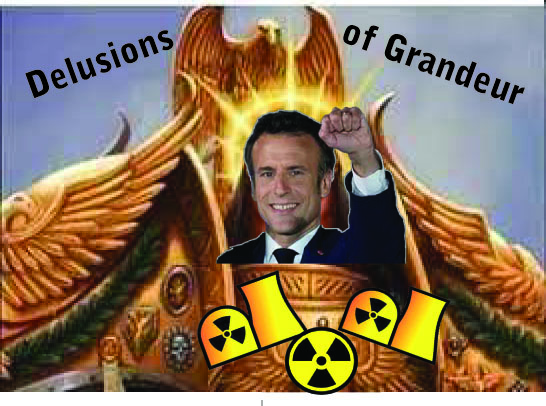
France’s Macron wants to build 14 new Nuclear reactors by 2050. 6 is more realistic
energy post eu, April 29, 2024 by Jonathan Bruegel
France’s President Macron is talking about a nuclear renaissance, after years of uncertainty over its future. The goal is to build 14 new reactors by 2050. But Jonathan Bruegel at IEEFA says this is unrealistc. France’s nuclear sector has much to recommend it. It produces up to 80% of the country’s total power generation, the highest share of nuclear in the generation mix anywhere in the world, and CO2-free. However, France hasn’t built a nuclear reactor since 1999, and construction delays and budget overruns plague the completion of its latest reactor, Flamanville 3, started in 2007. And with many of the 56 currently operational reactors reaching the end of their 40-year lifetime, decisions must be made whether to shut them down or extend their lifetimes by 10 or 20 years through major refits. Bruegel looks at the fundamentals and estimates that a more realistic goal is to build 6 new reactors by 2050, and to extend the lifetimes of 13 (or a maximum of 20) reactors. That would leave nuclear’s share in France’s 2050 mix at a maximum of 40% and more realistically 30%.
Key findings
- Given that new nuclear projects have faced significant construction delays and cost overruns, France’s plan to build 14 new reactors by 2050 is unrealistic.
- Nuclear should continue playing a key role in France’s power sector but not at the expense of renewables growth.
- French policy has recently shifted from a commitment to reduce nuclear generation to calls for a “renaissance” of the technology.
- France’s heavy reliance on nuclear has kept its power sector emissions relatively low but left it exposed to the many challenges associated with the technology.
Energy security
………………………… In the last two years, Europe’s imports of Russian piped gas have been largely replaced by liquified natural gas (LNG) from alternative sources. Curtailments and demand response mechanisms have contributed to absorbing the price shock…………………………..
In the case of France, this energy crisis was especially challenging since it coincided with many nuclear reactors being taken offline for maintenance work. In 2022, the country was a net power importer for the first time in more than 40 years. In 2023, as most nuclear reactors went back online, it resumed being a net power exporter. The episode illustrated the risks of France’s exposure to nuclear power.
Nuclear has dominated France’s power mix since the 1980s
……………………………..However, as Chart 1 [on original] shows, France hasn’t built a nuclear reactor since 1999, meaning its EPR expertise hasn’t benefitted its domestic nuclear fleet as much as it could have. Construction of the latest reactor, Flamanville 3, started in 2007. It has yet to be commissioned. So far, it is delayed by 12 years and is almost four times over budget.
With many reactors reaching the end of their 40-year lifetime, decision-makers must choose whether to shut them down or extend their operations by 10 or 20 years through major refitting programmes.
Policy shift sees France plan a “nuclear renaissance”
Nuclear’s role in France’s future power mix has become an increasingly crucial and controversial political debate.
After his election to the presidency in 2012, François Hollande committed to reducing the share of nuclear in France’s power production to 50% by 2035, with an ambitious decommissioning plan. However, not one nuclear unit was decommissioned under his presidency and no legally binding decommissioning dates for plants were set. The only binding commitment was to cap French nuclear capacity to 63GW.
During his first term between 2017 and 2022, President Emmanuel Macron did not engage in any nuclear policy shift, postponing the debate. The Flamanville 1 and 2 nuclear reactors were decommissioned in 2020 because they had exceeded their 40-year lifetime and no agreement had been made with operator EDF for a major refit programme.
Criticisms
During his second term, Macron has called for a “nuclear renaissance” and announced a goal to build 14 new reactors by 2050, implicitly targeting a maintenance of the 63GW of capacity and nuclear’s share in the power generation mix. The announcement was heavily criticised from across the political spectrum, with the main argument being that nuclear would slow the growth of renewables. Concerns have also been raised about the challenges associated with nuclear technology such as safety issues, long construction times, massive capital expenditures (see Chart 2 on original), a levelised cost of electricity higher than renewables and waste management.
Despite its role in reducing carbon emissions, Nuclear must not limit Renewables growth
Nuclear is not considered a renewable technology since uranium is needed, but the debate remains open on whether nuclear is green.
Although its challenges are well known (e.g., safety, costs, waste management), the French plan to build 14 new nuclear units by 2050 seems at best unrealistic.
Significant construction delays and cost overruns faced by the two latest EPRs, Flamanville 3 in France and Olkiluoto 3 in Finland, are evidence that building an average of one reactor every two years until 2050 is not a feasible goal…………………………………………………. more https://energypost.eu/frances-macron-wants-to-build-14-new-nuclear-reactors-by-2050-6-is-more-realistic/
No comments yet.
1 This Month
Chernobyl: The Lost Tapes – A good documentary on Chernobyl on SBS available On Demand for the next 3 weeks– https://www.sbs.com.au/ondemand/tv-program/chernobyl-the-lost-tapes/2352741955560

of the week–London Campaign for Nuclear Disarmament

Tell the Ukrainian Government to Drop Prosecution of Peace Activist Yurii Sheliazhenko
To see nuclear-related stories in greater depth and intensity – go to https://nuclearinformation.wordpress.com
-
Archives
- April 2026 (139)
- March 2026 (251)
- February 2026 (268)
- January 2026 (308)
- December 2025 (358)
- November 2025 (359)
- October 2025 (376)
- September 2025 (257)
- August 2025 (319)
- July 2025 (230)
- June 2025 (348)
- May 2025 (261)
-
Categories
- 1
- 1 NUCLEAR ISSUES
- business and costs
- climate change
- culture and arts
- ENERGY
- environment
- health
- history
- indigenous issues
- Legal
- marketing of nuclear
- media
- opposition to nuclear
- PERSONAL STORIES
- politics
- politics international
- Religion and ethics
- safety
- secrets,lies and civil liberties
- spinbuster
- technology
- Uranium
- wastes
- weapons and war
- Women
- 2 WORLD
- ACTION
- AFRICA
- Atrocities
- AUSTRALIA
- Christina's notes
- Christina's themes
- culture and arts
- Events
- Fuk 2022
- Fuk 2023
- Fukushima 2017
- Fukushima 2018
- fukushima 2019
- Fukushima 2020
- Fukushima 2021
- general
- global warming
- Humour (God we need it)
- Nuclear
- RARE EARTHS
- Reference
- resources – print
- Resources -audiovicual
- Weekly Newsletter
- World
- World Nuclear
- YouTube
-
RSS
Entries RSS
Comments RSS
 nuclear-news
Leave a comment