U.S. concerned about Ukraine strikes on Russian nuclear radar stations

Washington conveyed to Kyiv that attacks on Russian early-warning systems could be destabilizing.
By Ellen Nakashima and Isabelle Khurshudyan, May 29, 2024 https://www.washingtonpost.com/national-security/2024/05/29/us-ukraine-nuclear-warning-strikes/
The United States fears that recent Ukrainian drone strikes targeting Russian nuclear early–warning systems could dangerously unsettle Moscow at a time when the Biden administration is weighing whether to lift restrictions on Ukraine using U.S.-supplied weapons in cross-border attacks.
“The United States is concerned about Ukraine’s recent strikes against Russian ballistic missile early-warning sites,” said a U.S. official, who spoke on thecondition of anonymity because of the matter’s sensitivity.
Washington has conveyed its concerns to Kyiv about two attempted attacks over the last week against radar stations that provide conventional air defense as well as warning of nuclear launches by the West. At least one strike in Armavir, in Russia’s southeastern Krasnodar region, appeared to have caused some damage.
“These sites have not been involved in supporting Russia’s war against Ukraine,” the U.S. official said. “But they are sensitive locations because Russia could perceive that its strategic deterrent capabilities are being targeted, which could undermine Russia’s ability to maintain nuclear deterrence against the United States.”
A Ukrainian official familiar with the matter, however, said that Russia has used the radar sites to monitor the Ukrainian military’s activities, particularly Kyiv’s use of aerial weaponry, such as drones and missiles. The official, speaking on the condition of anonymity to discuss a sensitive security matter, confirmed that Ukraine’s Military Intelligence Directorate, known by its initials as GUR, was responsible for the strikes.
Ukraine is facing a continuing threat to its existence from a Russian enemy force — which boasts the world’s largest nuclear arsenal — that has gained ground of late, in part due to its sophisticated radar and weapons-jamming technology, which has rendered virtually useless some U.S.-provided guided missiles and artillery shells. This capability has also enhanced Moscow’s ability to track British and U.S.-provided longer-range weaponry and drones, which have caused serious damage to Russia’s Black Sea fleet and military installations in Crimea, the southern peninsula illegally seized from Ukraine in 2014.
The Ukrainian official said the goal of the strikes was to diminish Russia’s ability to track the Ukrainian military’s activities in southern Ukraine. The drone that targeted the radar station near Orsk, in Russia’s Orenburg region along Kazakhstan’s northern border, traveled more than 1,100 miles, making it one of the deepest attempted strikes into Russian territory. The Ukrainian official declined to say whether the strike, on May 26, caused any damage.
U.S. officials said they are sympathetic to Ukraine’s plight — administration officials are actively weighing whether to lift restraints on the use of U.S.-provided weapons to strike inside Russia. But were Russia’s early-warning capabilities to be blinded by Ukrainian attacks, even in part, that could hurt strategic stability between Washington and Moscow, the U.S. official said.
The perception issue is likely fueled by “an erroneous conviction that Ukraine’s targeting is directed by Washington,” said Dmitri Alperovitch, security analyst and chairman of Silverado think tank. “But that means attacks by Kyiv on Russian nuclear deterrence infrastructure has potential to trigger a perilous escalation with the West. At the end of the day, nuclear command and control and early-warning sites should be off-limits.”
Some analysts were puzzled at the targets: While Krasnodar is close enough to Ukraine to track missiles and drones, the radar station near Orsk is focused on the Middle East and China, they said.
Asked why they would target a site so far away, the Ukrainian official asserted that Russia “switched all of its capabilities for war against Ukraine.”
Following Ukraine’s disappointing counteroffensive last year, Russia has regained the initiative on the battlefield in recent months, advancing in the eastern Donetsk region and recently launching a new assault in the northeastern Kharkiv region along the border. Kyiv, meanwhile, has with increasing frequency targeted sites deep in Russia — a capability many doubted was possible without Western support and sign-off.

About three weeks ago, shortly after Russia began its assault on Kharkiv, Ukraine asked the United States to ease long-standing restrictions on using U.S.-provided weapons to attack targets inside Russia. Some senior officials favor such a move, including Secretary of State Antony Blinken, who has urged President Biden to agree to lift the restraints. The White House is considering such a proposal, but no action has been taken yet, officials say.
At a news conference Wednesday in Moldova, Blinken said the United States has “not encouraged or enabled strikes outside of Ukraine, but Ukraine, as I’ve said before, has to make its own decisions about the best way to effectively defend itself.”
Blinken added that the United States has “adapted and adjusted” to changing conditions on the battlefield and that as Russia pursues new tactics of “aggression” and “escalation,” was “confident that we’ll continue to do that.”
There is no restriction on Ukraine using U.S.-supplied air defenses to shoot down Russian missiles or fighter jets over Russian territory “if they pose a threat to Ukraine,” the U.S. official said.
But U.S. officials have previously expressed concern to Ukrainian officials over Kyiv’s attacks on Russian soil, sometimes even intervening during the planning stage. Ahead of the one-year mark of the war, theGUR was planning attacks on Moscow, according to a leaked classified report from the U.S. National Security Agency that was later confirmed by two senior Ukrainian military officials.
Days before the attack, U.S. officials asked Kyiv to scrub their plans, fearing it could provoke an aggressive response from the Kremlin; the Ukrainians complied, according to the leaked U.S. documents and the senior Ukrainian officials.
In a more recent example, Washington took exception to Ukrainian drones targeting oil refineries inside Russia — a request that came directly from Vice President Harris to Ukrainian President Volodymyr Zelensky at the Munich Security Conference in February, according to officials familiar with the matter. U.S. officials believed the strikes would raise global energy prices and invite more aggressive Russian retaliation inside Ukraine.
Amid growing concern over Russia’s battlefield advances, Washington is facing pressure from NATO and several key European allies to allow Ukraine to use the full force and range of U.S.-provided weapons.
If you cannot attack the Russian forces on the other side of the front line because they are on the other side of the border, then of course you really reduce the ability of the Ukrainian forces to defend themselves,” NATO Secretary General Jens Stoltenberg, the alliance’s top political official, said during a visit to Bulgaria on Monday.
Khurshudyan reported from Kyiv. Siobhán O’Grady in Kyiv and Alex Horton in Washington contributed to this report.
Nuclear sites, including Hanford, feeling the heat as climate change stokes wildfires drought

Dozens of active and idle laboratories and manufacturing and military facilities across the nation that use, store or are contaminated with radioactive material are increasingly vulnerable to extreme weather. Many also perform critical energy and defense research and manufacturing that could be disrupted or crippled by fires, floods and other disasters.
Dozens of active and idle laboratories and manufacturing and military facilities across the nation that use, store or are contaminated with radioactive material are increasingly vulnerable to extreme weather. Many also perform critical energy and defense research and manufacturing that could be disrupted or crippled by fires, floods and other disasters.
Officials scramble to up security at facilities with radioactive materials
The Columbian By TAMMY WEBBER, Associated Press, May 25, 2024,
As Texas wildfires burned toward the nation’s primary nuclear weapons facility, workers hurried to ensure nothing flammable was around buildings and storage areas.
When the fires showed no sign of slowing, Pantex Plant officials urgently called on local contractors, who arrived within minutes with bulldozers to dig trenches and enlarge fire breaks for the sprawling complex where nuclear weapons are assembled and disassembled and dangerous plutonium pits — hollow spheres that trigger nuclear warheads and bombs — are stored.
“The winds can pick up really (quickly) here and can move really fast,” said Jason Armstrong, the federal field office manager at Pantex, outside Amarillo, who was awake 40 hours straight monitoring the risks. Workers were sent home and the plant shut down when smoke began blanketing the site.
Those fires in February — including the largest in Texas history — didn’t reach Pantex, though flames came within 3 miles (5 kilometers). And Armstrong says it’s highly unlikely that plutonium pits, stored in fire-resistant drums and shelters, would have been affected by wildfire.
But the size and speed of the grassland fires, and Pantex’s urgent response, underscore how much is at stake as climate change stokes extreme heat and drought, longer fire seasons with larger, more intense blazes and supercharged rainstorms that can lead to catastrophic flooding. The Texas fire season often starts in February, but farther west it has yet to ramp up, and is usually worst in summer and fall.
Dozens of active and idle laboratories and manufacturing and military facilities across the nation that use, store or are contaminated with radioactive material are increasingly vulnerable to extreme weather. Many also perform critical energy and defense research and manufacturing that could be disrupted or crippled by fires, floods and other disasters.
There’s the 40-square-mile Los Alamos National Laboratory in New Mexico, where a 2000 wildfire burned to within a half mile (0.8 kilometers) of a radioactive waste site. The heavily polluted Santa Susana Field Laboratory in Southern California, where a 2018 wildfire burned 80% of the site, narrowly missing an area contaminated by a 1959 partial nuclear meltdown. And the plutonium-contaminated Hanford nuclear site in Washington, where the U.S. manufactured atomic bombs.
“I think we’re still early in recognizing climate change and … how to deal with these extreme weather events,” said Paul Walker, program director at the environmental organization Green Cross International and a former staff member of the House Armed Services Committee. “I think it’s too early to assume that we’ve got all the worst-case scenarios resolved … (because) what might have been safe 25 years ago probably is no longer safe.”
That realization has begun to change how the government addresses threats at some of the nation’s most sensitive sites.
The Department of Energy in 2022 required its existing sites to assess climate change risks to “mission-critical functions and operations,” including waste storage, and to develop plans to address them. It cited wildfires at Los Alamos and Lawrence Livermore national laboratories and a 2021 deep freeze that damaged “critical facilities” at Pantex.
Yet the agency does not specifically consider future climate risks when issuing permits or licenses for new sites or projects, or in environmental assessments that are reviewed every five years though rarely updated. Instead, it only considers how sites themselves might affect climate change — a paradox critics call short-sighted and potentially dangerous.
Likewise, the Nuclear Regulatory Commission considers only historical climate data rather than future projections in licensing decisions and oversight of nuclear power plants, according to a General Accounting Office study in April that recommended the NRC “fully consider potential climate change effects.” The GAO found that 60 of 75 U.S. plants were in areas with high flood hazard and 16 were in areas with high wildfire potential.
“We’re acting like … (what’s) happening now is what we can expect to happen in 50 years,” said Caroline Reiser, a climate and energy attorney at the Natural Resources Defense Council. “The reality of what our climate is doing has shifted dramatically, and we need to shift our planning … before we experience more and more of the extreme weather events.”……………………………………………………..
One of the most dangerous radioactive materials is plutonium, said Edwin Lyman, director of nuclear power safety at the Union of Concerned Scientists. It can cause cancer, is most dangerous when inhaled, and just a few hundred grams dispersed widely could pose a significant hazard, he said.
Experts say risks vary by site. Most plutonium and other radioactive material is contained in concrete and steel structures or underground storage designed to withstand fire. And many sites are on large tracts in remote areas where risk to the public from a radiation release would be minimal.
In 2000, a wildfire burned one-third of the 580-square-mile (1,502-square-kilometer) Hanford site, which produced plutonium for the U.S. atomic weapons program and is considered the nation’s most radioactive place.
Air monitoring detected plutonium in nearby populated areas at levels higher than background, but only for one day and at levels not considered hazardous, according to a Washington State Department of Health report.
The agency said the plutonium likely was from surface soil blown by the wind during and after the fire, though site officials said radioactive waste is buried several feet deep or stored in concrete structures………………..
The 2018 Woolsey Fire in California was another wakeup call.
About 150,000 people live within 5 miles (8 kilometers) of the Santa Susana Field Laboratory, a former nuclear power research and rocket-engine testing site.
The fire burned within several hundred feet of contaminated buildings and soil, and about 600 feet (183 meters) from where a nuclear reactor core partially melted down 65 years ago.
The state’s Department of Toxic Substances Control said sampling by multiple agencies found no off-site radiation or other hazardous material attributable to the fire. But another study, using hundreds of samples collected by volunteers, found radioactive microparticles in ash just outside of the lab boundary and at three sites farther away that researchers say were from the fire.
The state ordered demolition of 18 buildings, citing “imminent and substantial endangerment to people and the environment because unanticipated and increasingly likely fires could result in the release of radioactive and hazardous substances.”
It also ordered cleanup of old burn pits contaminated with radioactive materials. Though the area was covered with permeable tarps and did not burn in 2018, the state feared it could be damaged by “far more severe” wildfire, high winds or flooding.
“It’s like these places we think, it’ll never happen,” said Melissa Bumstead, founder and co-director of Parents Against Santa Susana Field Laboratory. “But … things are changing very quickly.”
Jay Coghlan, executive director of Nuclear Watch New Mexico, said he and others successfully urged federal nuclear security officials to include a wildfire plan in a 1999 final environmental impact statement for the Los Alamos National Laboratory.
The next year, the 48,000-acre (19,000-hectare) Cerro Grande Fire burned 7,500 acres (3,035 hectares) at the laboratory, including structures, and came within a half-mile (0.8 kilometers) of an area with more than 24,000 above-ground containers of mostly plutonium-contaminated waste………………………………………………………………………………..
In 2010, Pantex was inundated with 10 inches (25 centimeters) of rain that forced the plant to shut down, affecting operations for almost a month. The plutonium storage area flooded and corrosion later was found on some containers that’s since “been addressed,” said Armstrong, the field office manager.
In 2017, storms flooded facilities that processed nuclear material and led to power outages that affected a fire alarm control panel.
Then in 2021, Pantex was shut down for a week because of extreme cold that officials said led to “freeze-related failures” at 10 nuclear facilities and other plants. That included failure of a sprinkler head in a radiation safety storage area’s fire suppression system.
Pantex has since adopted freeze-protection measures and a cold weather response plan. And Armstrong says there have been upgrades, including to its fire protection and electrical systems and installation of backup generators.
Other DOE sites also are investing in infrastructure, the nuclear security agency’s Weckerle said, because what once was considered safe now may be vulnerable.
“We live in a time of increased risk,” he said. “That’s just the heart of it (and) … a lot of that does have to do with climate change.” https://www.columbian.com/news/2024/may/25/nuclear-sites-feeling-the-heat-as-climate-change-stokes-wildfires-drought/
Humanity’s survival is still within our grasp – just. But only if we take these radical steps

David King, 27 May 24 https://www.theguardian.com/commentisfree/article/2024/may/27/humanity-survival-emissions-resilience-ecosystems-greenhouse-gases
Reduce emissions, build resilience, repair ecosystems, remove greenhouse gases: these are the four Rs that can save us
n 2008, the late American climate scientist Wally Broecker warned of the global repercussions of polar ice loss. Today, his predictions echo louder than ever as Greenland ice haemorrhages at an alarming rate, threatening rapid sea-level rise. Over the past 15 years, the Arctic Circle region has been heating up at four times the global average; it’s now more than 3C above levels in the 1980s. In 2023, we witnessed a staggering loss of Antarctic Sea ice.
Over the past year, land and ocean temperatures have soared, far beyond what was anticipated for an El Niño year. Global average temperatures have breached the 1.5C mark, indicating that climate transition has been unleashed. From record-breaking wildfires across continents to catastrophic floods threatening to submerge major cities, extreme climate events have become the new norm, causing massive loss of life and economic damage worldwide.
Yet despite mounting evidence and urgent pleas, meaningful action falters. Global prosperity has historically emerged from fossil fuels. But the stranglehold of fossil fuel giants, generously subsidised by governments and financially backed by banks, places short-term profits over the planet’s survival. This entrenched dependency stymies efforts to transition to a sustainable future, despite the urgent need for change. GDP growth remains sacred, while climate, biodiversity, health, and social equity are sacrificed, condemning future generations to inherit a ravaged planet.
I say this acutely aware of how making such statements can appear as virtue signalling, particularly to those in the global south, where development is still taking hold. This is not primarily about denying them their pathway, but changing where those of us in the developed world stand – and perhaps our final destination.
On our current path, civilisation as we know it will disappear. If we meet current commitments only – net zero by 2050 – perhaps some form of humanity will survive, managing the challenges of continued extreme weather events, ice loss, and sea-level and temperature rises. But we have agency to change this, and a thriving future is still on the table. To grasp it, we must embark on a radical journey encompassing an essential “4R planet” pathway.
This means: reducing emissions; removing the excess greenhouse gases (GHGs) already in the atmosphere; repairing ecosystems; and strengthening local and global resilience against inevitable climate impacts.
It is absurd to think, as some influential fossil fuel leaders claim, that we can continue our economies based on burning fossil fuels because scientists are finding ways to capture the emissions from continued use. Recent analysis shows that annual global GDP costs due to extreme weather events could rise towards 100% of global GDP around the end of the century.
Meanwhile, the transition away from fossil fuels is already under way, with renewables, hydropower, geothermal energy, distributed energy storage, electric transport and nuclear energy already operating at competitive economic levels. For instance, Kenya has already achieved more than 90% electricity production from renewable sources, an enormous advantage to its economy. The rate of global transition, properly led by government regulations and the removal of subsidies for fossil fuel recovery, could and should be increased tenfold. Implementing the four Rs must be seen as a proper risk management cost, offsetting the very large financial loss figures projected.
Today, the world is emitting over 50bn tonnes of GHGs annually into the atmosphere, expressed as CO2 equivalent. Since we are unlikely to achieve a removal rate exceeding 10bn tonnes per annum, there can be no way forward without reducing emissions to a very small figure.
Today, the GHG level in the atmosphere exceeds 500parts per million (ppm), compared with the pre-industrial level of 275ppm. A safe level for humanity is about 350ppm, so we must remove excess GHGs already in the atmosphere. At about 10-20bn tonnes per annum I estimate it would take to the end of the century. We must start this process immediately.
Additionally, we will need to repair ecosystems to buy time, or else we will be overwhelmed by the consequences of melting polar ice and ice from mountain peaks before GHG levels are reduced sufficiently. Repairing the Arctic Circle will be a major enterprise. Promising processes are under development but are hampered by inadequate funding. Two immediate projects worth supporting are: covering the Arctic Sea with bright white cloud cover during the three months of the north pole summer; and pumping seawater on top of the thin layer of ice formed over the sea in the polar winter to thicken it. These will cost billions of dollars annually, a small fraction of the costs of lives and damage avoided. Deployment of such projects will require global governance and collaboration rarely seen, but if not now, then when? If not for this cause, then for what?
We are already seeing incredible changes around us, leading to the most vulnerable suffering most. Investing to the necessary scale in global resilience, particularly in the global south, will not only improve lives in real time but will also help repair the damaged trust between nations needed for a cohesive climate response.
Funding for the development of the four Rs will fall on advanced and emerging economies. Heads of G20 countries must lead the way. Vision and understanding from our leaders, coupled with a global public demanding more, are essential. Beyond policy changes and investment, a seismic cultural shift is imperative to steer humanity away from self-destruction towards a just and sustainable future. We must realign our political will, economic priorities and societal values to recognise that ecological wellbeing is matched to human wellbeing.
We often hear that in response to the climate crisis, we need to make sacrifices. But this framing is flawed. We must find joy in nurturing what is around us, from nature to the things we own. Fulfilment should come from quality, not quantity, and from nature, not new things.
We are a part of the natural world and depend on it. We can choose to transition our societies into a sustainable period of ecological civilisation. Over the coming decades, as we are faced with a self-inflicted set of global challenges, the need for such a cultural transformation will drive action. This process must begin now.
- David King is the founder and chair of the global Climate Crisis Advisory Group
Let Ukraine freely strike Russia with Western arms – NATO chief
https://www.rt.com/news/598218-nato-ukraine-stikes-russia/ 26 May 24
Moscow has dismissed claims that Kiev’s sponsors somehow restrict its use of weaponry.
NATO Secretary-General Jens Stoltenberg has argued that members of the US-led military bloc should let Ukraine freely use their weapons to launch strikes deeper into Russian territory.
“The time has come for allies to consider whether they should lift some of the restrictions they have put on the use of weapons they have donated to Ukraine,” Stoltenberg said on Friday in an interview with The Economist.
“Especially now when a lot of the fighting is going on in Kharkov, close to the border, to deny Ukraine the possibility of using these weapons against legitimate military targets on Russian territory makes it very hard for them to defend themselves.”
Stoltenberg noted that some NATO members have already lifted restrictions on using their weapons to attack targets in Russian territory. Asked whether he was referring to the US as the one major holdout, he said, “I think what we see now demonstrates the need to reconsider those restrictions, not least because we have fighting going on along the border between Russia and Ukraine.”
However, according to Moscow, the rhetoric about restrictions on the use of US munitions are false and designed to maintain the illusion that the West is not part of the conflict. Russian Foreign Minister Sergey Lavrov said that US weapons, such as ATACMS missiles armed with cluster warheads, have already been used on attacks inside Russia, including strikes against civilian targets.
“We proceed from the fact that American and other Western weaponry strikes targets on the territory of Russia, primarily civilian infrastructure and residential areas,” he told reporters on Friday.
The NATO chief’s comments come at a time when Western leaders are making increasingly bold statements about attacks on Russian territory. US President Joe Biden held back on sending long-range weapons to Ukraine in the early days of the conflict with Russia, citing concern over the possibility of triggering a wider conflict. When more advanced weaponry was later approved, it came with strings attached, including a prohibition on hitting Russian territory. However, as the New York Times reported on Thursday, views on those restrictions have shifted as Russian forces make battlefield gains.

After making a “sobering” visit to Ukraine earlier this month, US Secretary of State Antony Blinken reportedly began urging the administration to let Kiev’s forces use American weapons as it sees fit. A group of US lawmakers sent a letter to Secretary of Defense Lloyd Austin earlier this week, pressing him to give the Ukrainians the permissions they have requested.
Stoltenberg said he believes NATO members can thread the geopolitical needle by supporting Ukraine’s defense without becoming direct parties to the conflict. “We provide training, we provide weapons, ammunition to Ukraine, but we will not be directly involved from NATO territory in combat operations over or in Ukraine,” he said. “So, that’s a different thing.”
China and Russia Issue Nuclear Warnings
CEPA. By Michael Sheridan, May 28, 2024
The leaders of Russia and China have jointly shifted their stance on nuclear weapons, signaling a move away from decades of cautious Chinese thinking.
The Chinese-Russian accord is significant because it was accompanied by a joint challenge to the West’s buildup of its alliances and military presence in the Asia-Pacific region.
While the nuclear element of the joint communique following the May 16 summit of Xi Jinping and Vladimir Putin was not trumpeted and received little media attention, the two countries spelled out points of agreement on issues of significance.
The backdrop is China’s accelerated expansion of its nuclear forces and new fields of missile silos, leading the Pentagon to predict it may more than triple its capability to 1,500 weapons by 2035.
While Beijing is believed to adhere to a historical pledge that it would not be the first to use nuclear weapons, its actual doctrine remains obscure, there is a worrying absence of military dialogue with its rivals and recent purges at the top of its nuclear forces add to the uncertainties.
Nonetheless, it is clear that President Xi sees nuclear weapons as pieces on the global chessboard in a way that no previous leader of the People’s Republic thought necessary or desirable. Mao Zedong himself dismissed the atomic bomb as “a paper tiger.”…………………………………………………………………………….
Xi and Putin expressed “serious concern” that the US “under the pretext of conducting joint exercises with its allies that are clearly aimed at China and Russia” was acting to deploy land-based intermediate-range missile systems in the Asia-Pacific region (possibly a reference to plans to sell 400 Tomahawk cruise missiles to Japan and defend the so-called first island chain that rings China’s coasts.)
They did not specify the systems referred to but warned the US and NATO against providing “extended deterrence” to individual allies. They also singled out the AUKUS pact tightening defense cooperation between the US, Britain, and Australia.
In unusually specific language, the two leaders warned against “building infrastructure in Australia, a signatory to the South Pacific Nuclear Free Zone Treaty, that could be used for US and British nuclear forces to conduct operations and to carry out US-UK-Australian nuclear submarine co-operation.”………………………………….. https://cepa.org/article/china-and-russia-issue-nuclear-warnings/
White House to support new nuclear power plants in the U.S.

CNBC, MAY 29 2024
The White House on Wednesday plans to announce new measures to support the development of new U.S. nuclear power plants, a large potential source of carbon-free electricity the government says is needed to combat climate change.
The suite of actions, which weren’t previously reported, are aimed at helping the nuclear power industry combat rising security costs and competition from cheaper plants powered by natural gas, wind and solar……………………………………..
Critics worry about the buildup of radioactive waste stored at plants around the country and warn of the potential risks to human health and nature, especially with any accidents or malfunctions. Biden signed a law earlier this month banning the use of enriched uranium from Russia, the world’s top supplier.
At a White House event on Wednesday focused on nuclear energy deployment, the Biden administration will announce a new group that will seek to identify ways to mitigate cost and schedule overruns in plant construction.
It also said the Army will soon solicit feedback on deploying advanced reactors to provide energy for certain facilities in the United States. Small modular reactors and microreactors can provide energy that is more resilient to physical and cyber attacks, natural disasters and other challenges, the White House said.
The Department of Energy also released a paper outlining the expected increased safety of advanced reactors. And a new tool will help developers figure out how to cut capital costs for new nuclear reactors.
The youngest U.S. nuclear power reactors, at the Vogtle plant in Georgia, were years behind schedule and billions over budget when they entered commercial operation in 2023 and 2024. No new U.S. nuclear plants are currently being built……………………………….. https://www.cnbc.com/2024/05/29/white-house-to-support-new-nuclear-power-plants-in-the-us.html
2 aging central Japan nuclear reactors get 20-yr service extensions
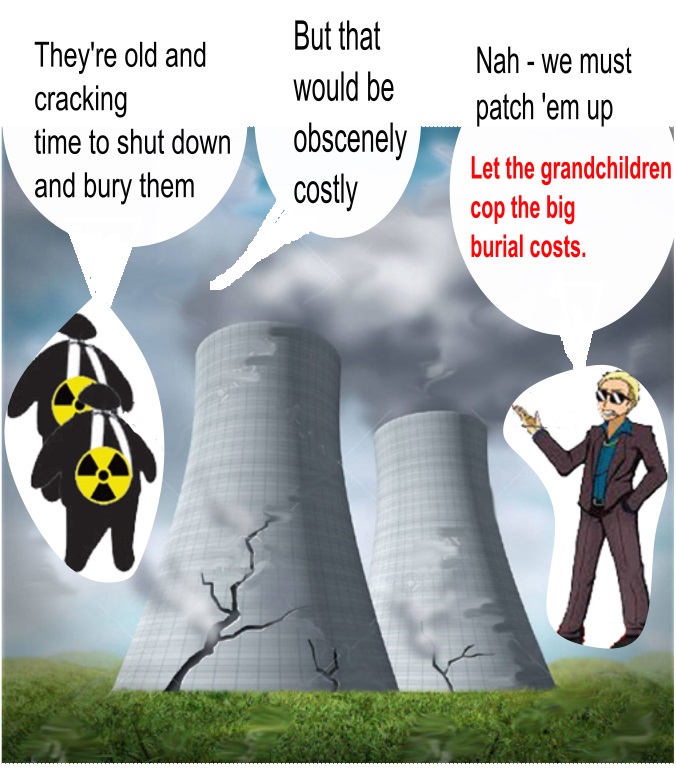
May 29, 2024 (Mainichi Japan) TOKYO (Kyodo) — The aging No. 3 and 4 reactors at the Takahama nuclear plant in central Japan were approved Wednesday by the nuclear regulator to continue operating for 20 more years, as the government maintains support of the technology’s use in the resource-poor country’s energy mix.
The decision makes them the seventh and eighth reactors nationwide that the Nuclear Regulation Authority has green-lit for extensions after 40 years of operations. All four reactors at the facility in Fukui Prefecture have now been approved to run for 60 years…………………..
The regulator’s Chairman, Shinsuke Yamanaka, said at a meeting that nuclear reactor pressure vessels tend to become brittle due to radiation, but an official at the organization’s secretariat said the reactors had been evaluated carefully and that there was “no problem.”
The facility’s No. 1 and 2 reactors were approved in June 2016 to operate beyond 40 years from their start date. In 2023, both reactors were rebooted for the first time since the 2011 Fukushima Daiichi nuclear disaster.
Following the nuclear accident, the government introduced rules mandating that nuclear units can operate for up to 40 years, with extensions to 60 years possible pending approval.
But in May 2023, the Japanese government enacted a bill to introduce a new system that will allow the country’s nuclear reactors to operate beyond the current 60-year limit……. https://mainichi.jp/english/articles/20240529/p2g/00m/0na/038000c
A robot will soon try to remove melted nuclear fuel from destroyed Fukushima reactor
THE ASSOCIATED PRESS, May 29, 2024, https://www.asahi.com/ajw/articles/15284702
The operator of Japan’s destroyed Fukushima No. 1 nuclear power plant demonstrated Tuesday how a remote-controlled robot would retrieve tiny bits of melted fuel debris from one of three damaged reactors later this year for the first time since the 2011 meltdown.
Tokyo Electric Power Company Holdings plans to deploy a “telesco-style” extendable pipe robot into Fukushima No. 2 reactor to test the removal of debris from its primary containment vessel by October.
That work is more than two years behind schedule. The removal of melted fuel was supposed to begin in late 2021 but has been plagued with delays, underscoring the difficulty of recovering from the magnitude 9.0 quake and tsunami in 2011.
During the demonstration at the Mitsubishi Heavy Industries’ shipyard in Kobe, western Japan, where the robot has been developed, a device equipped with tongs slowly descended from the telescopic pipe to a heap of gravel and picked up a granule.
TEPCO plans to remove less than 3 grams (0.1 ounce) of debris in the test at the Fukushima plant.
“We believe the upcoming test removal of fuel debris from Unit 2 is an extremely important step to steadily carry out future decommissioning work,” said Yusuke Nakagawa, a TEPCO group manager for the fuel debris retrieval program. “It is important to proceed with the test removal safely and steadily.”
About 880 tons of highly radioactive melted nuclear fuel remain inside the three damaged reactors. Critics say the 30- to 40-year cleanup target set by the government and TEPCO for Fukushima Daiichi is overly optimistic. The damage in each reactor is different, and plans must accommodate their conditions.
Better understanding the melted fuel debris from inside the reactors is key to their decommissioning. TEPCO deployed four mini drones into the No. 1 reactor’s primary containment vessel earlier this year to capture images from the areas where robots had not reached.
Medical Isotopes and Nuclear Power

| Radiation and medical isotopes are routinely and increasingly used to diagnose and treat many diseases. However, these medical uses do not depend on nuclear power reactors in any essential way. |
No doubt some medical isotopes can be produced in a nuclear reactor, but it doesn’t have to be a power reactor. Even if all the power reactors were shut down, the supply of medical isotopes would still be met by traditional alternative means.
From the beginning, all medical needs for artificial (human-made) isotopes have been met by particle accelerators and a handful of research reactors scattered around the world, including those in Canada.
Nevertheless, nuclear proponents argue nowadays that new nuclear power stations are “necessary” to ensure that the medical profession has all the diagnostic and therapeutic tools it needs. It’s a new sales pitch, and it’s not true.
For starters, X-rays and CT scans have nothing to do with nuclear reactors. Moreover, for the last 125 years – and for decades before the first power reactors were built in the late 1950s – medical isotopes have been (a) extracted from natural sources (e.g. radium needles, radon seeds), (b) produced in particle accelerators like cyclotrons (e.g. for PET scans), or (c) harvested from “target materials” irradiated in research reactors (e.g. technetium-99m).
None of these modes of production depend on nuclear power reactors, which are designed specifically to produce bulk electricity. Anything non-electrical is an afterthought.
It is true that one isotope, cobalt-60, has been produced in Canadian power reactors for both medical and industrial use, but the direct medical usage could be fully satisfied by research reactors.
None of these modes of production depend on nuclear power reactors, which are designed specifically to produce bulk electricity. Anything non-electrical is an afterthought.
It is true that one isotope, cobalt-60, has been produced in Canadian power reactors for both medical and industrial use, but the direct medical usage could be fully satisfied by research reactors.
To improve its public relations image, the nuclear industry has seen fit to diversify its operations by beginning to produce medical isotopes in power reactors, implying that it is providing an indispensable service to the medical community. Again, untrue.
For further information, consult this FACT SHEET
Putin warns West about consequences of long-range strikes on Russia
https://www.rt.com/russia/598350-putin-serious-consequences-west/ 29 May 24
Ukraine won’t be able to make such attacks without direct external assistance, the president has warned
Kiev’s Western backers need to understand that long-range strikes on Russian territory using weaponry they have supplied would represent a conflict escalation and lead to “serious consequences,” Russian President Vladimir Putin outlined on Tuesday.
Speaking to reporters at the end of a two-day visit to Uzbekistan, Putin addressed recent Ukrainian demands for NATO to permit the use of its weapons to attack deep inside Russia as well as comments by the US-led bloc’s head, Jens Stoltenberg, appearing to endorse the tactic.
“To be honest, I don’t know what the NATO secretary-general is saying,” Putin told reporters, adding that Stoltenberg “did not suffer from any dementia” when he worked constructively with Russia as the prime minister of Norway (2005-2013).
This constant escalation can lead to serious consequences. If these serious consequences occur in Europe, how will the US behave, bearing in mind our parity in the field of strategic weapons? Hard to say. Do they want global conflict?
Putin explained that long-range precision strikes require space reconnaissance assets – which Kiev does not have, but the US does – and that this targeting is already done by “highly qualified specialists” from the West, without Ukrainian participation.
“So, these representatives of NATO countries, especially in Europe, especially in small countries, must be aware of what they are playing with,” the Russian president said, noting that a lot of these countries have “a small territory and a very dense population.”
Putin told reporters that their colleagues in the West are ignoring Ukrainian attacks on Belgorod and other Russian regions along the border, and only focusing on the Russian advance on Kharkov.
“What caused this? They did, with their own hands. Well, then, they will reap what they have sown. The same thing can happen if long-range precision weapons are used,” the Russian president added.
Asked if Russia was refusing to negotiate with Ukraine, Putin told reporters that such claims by the West were baffling.
“We don’t refuse!” he said. “I’ve said it a thousand times, it’s like they don’t have ears!”
The Ukrainian side initialed an agreement with Russia in March 2022, then publicly reneged and refused to negotiate any further, Putin explained. He described Kiev’s current “peace conference” effort in Switzerland as an attempt to get some kind of international buy-in for its entirely unrealistic “peace platform,” which isn’t working out.
TODAY. Jobs jobs jobs in the nuclear industry – but is it true?

Go to Google news for nuclear information, and you’ll be swamped with glowing stories from the World Nuclear Association, the IAEA, and the big corporate media outlets – all about the wonderful future for the nuclear industry- –
all those jobs! including in the lovely nuclear weapons industry.
Jobs in renewable energy. This year’s report finds that renewable energy employment worldwide has continued to expand – to an estimated 13.7 million direct and indirect jobs in 2022. We can expect the creation of many millions of additional jobs in the coming years and decades. https://mc-cd8320d4-36a1-40ac-83cc-3389-cdn-endpoint.azureedge.net/-/media/Files/IRENA/Agency/Publication/2023/Sep/IRENA_Renewable_energy_and_jobs_2023.pdf?rev=4f65518fb5f64c9fb78f6f60fe821bf2

Jobs in nuclear power. I have not been able to find any kind of authoritative report on global jobs in nuclear power. I did find one source (on Quora) stating that each nuclear reactor in construction provides 1400-1800 jobs, and in operation 400 -700 jobs. The nuclear industry claims many more, but for construction, we must remember – this is all in the rather distant future.
The figure below is a prediction from many years ago. If we are to believe the nuclear lobby, this prediction should change rapidly.


What we do know is that at present, renewable energy jobs are increasing exponentially, and nuclear power building is almost at a standstill.
The figure on the left is also from many years ago. But I doubt that much has changed.
Of course – this is all about the actual reactors. There are many jobs in uranium mining, milling, transport etc, and of course, in nuclear weapons-making
The quality of jobs.
In energy efficiency there are many interesting and clean jobs. Also, workers know that they are contributing to a healthier planet – something to be proud of.
In renewable energy the jobs are relatively clean and healthy, and there’s again, the knowledge of being in an alternative to the polluting industries – coal and nuclear.
In nuclear energy and nuclear fuel, the workers are involved in the risky area of ionising radiation. There’s a huge amount of documentation on this. It is NOT a healthy job, though I suppose that it’s better to be a highly paid nuclear executive or lobbyist, safe in a nice office.
I doubt that nuclear workers can get much satisfaction about “helping the planet”, as the “peaceful” nuclear industry is so dirty, dangerous, and intimately connected with nuclear weapons.
No doubt some nuclear workers get paid a lot more than renewable energy workers do. But, there’s real value in knowing that your contribution to society is a clean and positive one.
US Endgame in Ukraine — War Without End, Amen

Even the mainstream press, loathe to report the setbacks the Armed Forces of Ukraine (AFU) have suffered, describes Russia’s northeast campaign, which began a few weeks ago, as a rout. The Kremlin says it has no interest in taking Kharkiv, and this so far appears to be the case.
the well-coordinated if not very artful American propaganda machine has begun preparing the public for a wider war that is to extend, as a matter of policy and military strategy, into Russian territory.
What happens when a powerful nation cannot afford to lose a war it has already lost?
By Patrick Lawrence, Special to Consortium News May 28, 2024
It is now two and a half years since Moscow sent two draft treaties, one to Washington, one to NATO in Brussels, as the proposed basis of talks toward a new security settlement — a renovation of relations between the trans–Atlantic alliance and the Russian Federation.
An urgently needed renovation, we must quickly add. And after that we must also quickly add the Biden regime’s rejection of Russia’s proposals as a “nonstarter” faster than you can say “deluded.”
Let us pause for a sec to bring to mind all those who have died in the war that erupted in Ukraine a year and a few months after Joe Biden refused, even mocked, Vladimir Putin’s honorable diplomatic demarche. All the maimed and displaced, all the towns and cities destroyed, all the farmland turned into moonscape.
And the all-but-complete peace accord, negotiated in Istanbul a few weeks into the war that the U.S. and Britain rushed to scuttle. And of course all the billions of dollars, somewhere north of $100 billion now, not spent on improving Americans’ lives but spent instead on arming a regime in Kiev that steals aid extravagantly while fielding an army with professed neo–Nazis.
It is useful to recall these things because they give context to a string of recent developments it’s important to understand, even if our corporate media discourage any such understanding.
If we keep recent history in mind, we will be able to see that the viscously irresponsible decisions of a couple of year ago, so wasteful of human life and common resources, are now repeated such that it is now certain the brutalities and waste will continue indefinitely even as their pointlessness is now way, way, way beyond denying.
The doorway opening on to this new sequence of events is the recent advance of the Russian military in Ukraine’s northeast. This new incursion now threatens Kharkiv, which is Ukraine’s second-largest city and lies a mere 25 miles from the Russian border.
Even the mainstream press, loathe to report the setbacks the Armed Forces of Ukraine (AFU) have suffered, describes Russia’s northeast campaign, which began a few weeks ago, as a rout. The Kremlin says it has no interest in taking Kharkiv, and this so far appears to be the case.
But the AFU’s rapid retreat bears a strong whiff of final defeat wafting in from not so far off in the distance. “Several Ukrainian combat brigades have not defected, or considered doing so,” Seymour Hersh, quoting his customary “I have been told” sources, reported in his newsletter last week, “but have made it known to their superiors that they will no longer participate in what would be a suicidal offensive against a better trained and better equipped Russian force.”
Brigades average 4,000 to 5,000 soldiers each and can run to 8,000 or even more. Hersh’s report suggests that a considerable number of Ukrainian troops, and maybe a very considerable number, are now effectively in mutiny against the AFU’s high command.
In evident response to Russia’s swift new incursion and the direction of the war altogether, the well-coordinated if not very artful American propaganda machine has begun preparing the public for a wider war that is to extend, as a matter of policy and military strategy, into Russian territory. This effort began with a New York Times interview with Volodymyr Zelensky, which was videoed and published in last Wednesday’s editions. A transcript of the interview is here.
This document is plainly intended to appeal to kale-consuming, Biden-supporting liberals who must be assured of the Ukrainian president’s just-like-us humanity and good judgment. He talked about his children and his dogs — there must be dogs in this sort of imagery — and how he reads fiction every night but is too tired to get very far.
But the core point, beyond the window dressing, was to insist that it is time to begin bombing Russian territory and that the Biden regime must reverse its prohibition of such operations.
A key passage:
“So my question is, what’s the problem? Why can’t we shoot them down? Is it defense? Yes. Is it an attack on Russia? No. Are you shooting down Russian planes and killing Russian pilots? No. So what’s the issue with involving NATO countries in the war? There is no such issue.
Shoot down what’s in the sky over Ukraine. And give us the weapons to use against Russian forces on the borders.”
Zelensky, a television actor we must not forget, has played this role on numerous occasions: Badger us for tanks, planes, long-range artillery, and missiles, the script written in Washington reads, and we will hesitate briefly before granting you your pressing needs as you defend democracy, the free world, and all those other “values” in the Cold War inventory.
Two days later, two, the Times reported exclusively that U.S. Secretary of State Antony Blinken, returning from “a sobering visit to Kyiv,” has of a sudden decided it is indeed time to broaden the war in the direction of a direct confrontation with Russia…………………………………………………………..
Let us all declare we feel unsafe as we realize what these people are talking about and what they are risking. Any allowance for expanded use of U.S.–made weapons against Russian targets, which will require American personnel on the ground in Ukraine, will unambiguously escalate the proxy war into a direct conflict between the U.S. and the Russian Federation.
Quagmire, anyone?
Reuters filed an impressive, equation-changing exclusive last week featuring unmistakably intentional leaks from the Kremlin signaling President Putin’s desire to stop the war in Ukraine and negotiate a ceasefire. Guy Faulconbridge and Andrw Osborn cited interviews with “five people who work with or have worked with Putin at a senior level in the political and business worlds.”
Time to sit up.
“Three of the sources, familiar with discussions in Putin’s entourage,” the two correspondents reported, “said the veteran Russian leader had expressed frustration to a small group of advisers about what he views as Western-backed attempts to stymie negotiations and Ukrainian President Volodymyr Zelenskiy’s decision to rule out talks.”
They then quoted one of their sources, “a senior Russian source who has worked with Putin and has knowledge of top-level conversations in the Kremlin,” as asserting, “‘Putin can fight for as long as it takes, but Putin is also ready for a ceasefire—to freeze the war.’”
While Putin has sent such signals on numerous occasions over the course of the past decade of war, this is big, in my view. For one thing, it strongly indicates what the new Kharkiv campaign is all about. Moscow does not want to take Kharkiv, the Faulconbridge and Osborn reporting suggests: It wants to enter talks from the position of strength all sides in all conflicts seek in the pre-negotiation phase.
Some other details confirm what distinguishes this set of signals from the Kremlin from others sent previously…………………………………………………………………………………………………..
Via his leaky confidants, who were almost certainly authorized, Putin proposes what amounts to an armistice. Both sides would stop shooting, and territorial dominion would remain as it is—not necessarily etched into the earth, but until both sides can negotiate on to another step toward a lasting settlement.
No, Kiev would not regain Crimea or the four republics that voted in September 2022 to rejoin Russia; and no, Russia would neither have demilitarized nor de–Nazified Ukraine, as it has many times stated as its aims……………………………………………………………………
The net response to the new Russian advances toward Kharkiv and the Kremlin’s artful leaks last week is to launch a new phase in a proxy war the West has already lost — a phase that also seems to have little chance of success, but holds more danger than any truly responsible statesman would ever risk.
Dmitry Peskov, the Kremlin’s dapper spokesman, told Faulconbridge and Osborn the other day that Russia didn’t want “an eternal war,” a forever war in the American idiom. This is a good thing not to want.
Neither Biden nor Zelensky, on the other hand, wants this war to end: They cannot afford it for a variety of reasons. This is the reality. They are the main impediment to peace. They have painted the conflict as some kind of cosmic confrontation between good and evil, and in so doing they have also painted themselves into a corner.
But what happens when a powerful nation cannot lose a war it has already lost? https://consortiumnews.com/2024/05/28/patrick-lawrence-us-endgame-in-ukraine-war-without-end-amen/?eType=EmailBlastContent&eId=aed8d1d4-5275-4b05-9f51-750290521dba
Small Modular Reactors: Still too expensive, too slow and too risky.

Institute for Energy Economics and Financial Analysis.
1 Report SMRs (Small Modular Reactors) Nuclear Transition United States
Institute for Energy Economics and Financial Analysis. May 29, 2024, David Schlissel and Dennis Wamsted more https://ieefa.org/resources/small-modular-reactors-still-too-expensive-too-slow-and-too-risky?fbclid=IwZXh0bgNhZW0CMTEAAR1jnn-FMHaMbUkjLSR0kbe-ku3uRRLcwq5jFcZfx62d4vHIZilLTK73YOg_aem_Abj940YmQyHY2fHN3alfZYFxXGCjmhy7qqSR1SLZ7HipqrGxyOaplVTSCuk7GjV3z8ZxriI0DSoGaIg4KFv_B5L1
Key Findings
Small modular reactors still look to be too expensive, too slow to build, and too risky to play a significant role in transitioning from fossil fuels in the coming 10-15 years.
Investment in SMRs will take resources away from carbon-free and lower-cost renewable technologies that are available today and can push the transition from fossil fuels forward significantly in the coming 10 years.
Experience with operating and proposed SMRs shows that the reactors will continue to cost far more and take much longer to build than promised by proponents.
Regulators, utilities, investors and government officials should embrace the reality that renewables, not SMRs, are the near-term solution to the energy transition.
The rhetoric from small modular reactor (SMR) advocates is loud and persistent: This time will be different because the cost overruns and schedule delays that have plagued large reactor construction projects will not be repeated with the new designs. But the few SMRs that have been built (or have been started) paint a different picture—one that looks startingly similar to the past. Significant construction delays are still the norm and costs have continued to climb.
IEEFA has taken a close look at the data available from the four SMRs currently in operation or under construction, as well as new information about projected costs from some of the leading SMR developers in the U.S. The results of the analysis show little has changed from our previous work. SMRs still are too expensive, too slow to build, and too risky to play a significant role in transitioning from fossil fuels in the coming 10 to 15 years.
We believe these findings should serve as a cautionary flag for all energy industry participants. In particular, we recommend that:
- Regulators who will be asked to approve utility or developer-backed SMR proposals should craft restrictions to prevent delays and cost increases from being pushed onto ratepayers.
- Utilities that are considering SMRs should be required to compare the technology’s uncertain costs and completion dates with the known costs and construction timetables of renewable alternatives. Utilities that still opt for the SMR option should be required to put shareholder funds at risk if costs and construction times exceed utility estimates.
Investors and bankers weighing any SMR proposal should carefully conduct their due diligence. Things will go wrong, imperiling the chances for full recovery of any invested funds.
State and federal governments should require that estimated SMR construction costs and schedules be publicly available so that utility ratepayers, taxpayers and investors are better able to assess the magnitude of the SMR-related financial risks that they may be forced to bear.
Finally, it is vital that this debate consider the opportunity costs associated with the SMR push. The dollars invested in SMRs will not be available for use in building out a wind, solar and battery storage resource base. These carbon-free and lower-cost technologies are available today and can push the transition from fossil fuels forward significantly in the coming 10 years—years when SMRs will still be looking for licensing approval and construction funding.
Russian think tank proposes ‘demonstrative’ nuclear blast to deter Western support for Ukraine
Livemint , Written By Shivangini 30 May 2024 https://www.livemint.com/news/world/russian-think-tank-proposes-demonstrative-nuclear-blast-to-deter-western-support-for-ukraine-11717034780694.html
A senior member of a Russian think tank, whose ideas often influence government policy, has proposed a ‘demonstrative’ nuclear explosion to deter the West from allowing Ukraine to use its arms against targets inside Russia, Reuters reported on Thursday, May 30.
Dmitry Suslov, a member of the Moscow-based Council for Foreign and Defence Policy, made the proposal shortly after President Vladimir Putin warned that NATO members in Europe were “playing with fire” by proposing to let Kyiv use Western weapons to strike deep inside Russia. As quoted by Reuters, Putin indicated that such actions could trigger a global conflict.
Ukraine’s leadership argues that it needs the capability to strike Russian forces and military targets inside Russia with long-range Western missiles to defend itself and prevent air, missile, and drone attacks. The report added that this view has garnered some support among Western countries, though not from Washington.
Russia, which has the world’s largest nuclear arsenal, has warned that allowing Ukraine to strike inside Russia would be a grave escalation, potentially drawing NATO and involved countries into direct conflict with Moscow and increasing the risk of nuclear war.
Suslov, whose think tank has been praised by Putin and whose ideas sometimes influence government policy, suggested that Russia must act decisively to deter the West from crossing a red line.
“To confirm the seriousness of Russia’s intentions and to convince our opponents of Moscow’s readiness to escalate, it is worth considering a demonstrative (i.e., non-combat) nuclear explosion,” Suslov wrote in the business magazine Profil. “The political and psychological effect of a nuclear mushroom cloud, which will be shown live on all TV channels around the world, will hopefully remind Western politicians of the one thing that has prevented wars between the great powers since 1945 and that they have now largely lost – fear of nuclear war,” Suslov wrote according to Reuters.
Suslov’s proposal is the latest in a series of similar suggestions by Russian security experts and lawmakers. It has raised concerns among Western security experts that Russia might be inching towards such a test, which could usher in a new era of major power nuclear testing.
There was no immediate comment on Suslov’s proposal from the Kremlin, which has stated that Russia’s nuclear policy remains unchanged. However, the Kremlin signalled its displeasure with increasingly aggressive Western rhetoric on arming Kyiv earlier this month by ordering tactical nuclear weapons drills.
Suslov also suggested that Russia initiate strategic nuclear exercises, warn any country whose weapons are used by Kyiv to attack Russia that Moscow reserves the right to strike that country’s targets anywhere in the world, and caution that it could use nuclear weapons if that country retaliates conventionally.
In November, Putin signed a law withdrawing Russia’s ratification of the global treaty banning nuclear weapons tests, a move intended to align Russia with the United States, which signed but never ratified the treaty. Russian diplomats have said that Russia, which has not conducted a nuclear test since the Soviet era, would not resume testing unless Washington does.
The Soviet Union last conducted a nuclear test in 1990, and the United States last did so in 1992. North Korea is the only country to have conducted a nuclear test this century.
Earlier this month, Russia warned Britain that it could strike British military installations and equipment both inside Ukraine and elsewhere if British weapons were used by Ukraine to strike Russian territory. This warning followed British Foreign Secretary David Cameron’s statement that Kyiv had the right to use UK-supplied weapons to strike targets inside Russia.
Israel Continues Gaza Attacks Despite UN Court Order To ‘Immediately Halt’ Rafah Offensive
https://www.rferl.org/a/gaza-israel-attacks-rafah-un-court/32963140.html
May 25, 2024 By RFE/RL (with reporting by AFP, AP, and Reuters)
Israel continued bombing in the Gaza Strip, including the city of Rafah, on May 25, one day after a top UN court ordered it to halt military operations against the southern city.
Israel gave no indication that the ruling by the International Court of Justice (ICJ) had affected its planning.
“Israel has not and will not carry out military operations in the Rafah area that ‘create living conditions that could cause the destruction of the Palestinian civilian population, in whole or in part,’” Israeli National Security Adviser Tzachi Hanegbi said in a statement, echoing wording found in the ICJ ruling.
Separately, following a meeting between U.S. and Israeli officials in Paris on May 25, an Israeli official said Tel Aviv was seeking to restart talks in the coming days in an effort to reach a hostage-release deal in Gaza.
“There is an intention to renew the talks this week and there is an agreement,” the official told the AFP news agency on condition of anonymity.
Early on May 25, hours after the court ruling, Israel carried out strikes on the Gaza Strip as fighting between Israeli troops and fighters for Hamas, which has been designated a terrorist organization by the United States and the European Union, continued.
Air strikes were reported in Rafah and the central city of Deir al-Balah.
European foreign policy chief Josep Borrell wrote on X, formerly Twitter, that “ICJ orders are binding on the Parties and they have to be fully and effectively implanted.
In its May 24 ruling, the ICJ said Israel must “immediately halt” its offensive against Rafah and take urgent measures to address the humanitarian crisis in the entire region. Measures should include reopening the Rafah border crossing with Egypt to allow aid to flow into Gaza.
The order is part of a case brought by South Africa accusing Israel of genocide and asking the court to rule that Israel must stop its offensive in the southern Gaza city.
In a ruling on January 26, the 15-judge panel ruled that Israel must do everything to prevent genocide during its offensive in response to an attack in October by Hamas — which has been designated a terrorist organization by the United States and the EU — but stopped short of ordering a cease-fire.
On March 28, it ordered Israel to take all necessary and effective action to ensure basic food supplies to Gaza’s Palestinian population.
Though the court’s rulings are legally binding, it has no way to enforce them.
Still, the 13-2 vote ordering Israel to halt its Rafah offensive, and to report on its progress in easing the humanitarian crisis within one month, increases pressure on Israel and further isolates it.
The ruling stepped up pressure against Israel just days after Norway, Ireland, and Spain announced they would recognize a Palestinian state and after the chief prosecutor of the International Criminal Court announced he would seek arrest warrants on war crimes charges for Israeli Prime Minister Benjamin Netanyahu, Israeli Defense Minister Yoav Gallant, and several top Hamas leaders.
Israel and Hamas have been fighting since October 7, 2023, when Hamas fighters launched a massive cross-border attack on Israel. Some 1,200 Israeli citizens were killed in the attack, while another 240 were taken hostage, some of whom are still being held by Hamas in Gaza.
-
Archives
- February 2026 (211)
- January 2026 (308)
- December 2025 (358)
- November 2025 (359)
- October 2025 (376)
- September 2025 (258)
- August 2025 (319)
- July 2025 (230)
- June 2025 (348)
- May 2025 (261)
- April 2025 (305)
- March 2025 (319)
-
Categories
- 1
- 1 NUCLEAR ISSUES
- business and costs
- climate change
- culture and arts
- ENERGY
- environment
- health
- history
- indigenous issues
- Legal
- marketing of nuclear
- media
- opposition to nuclear
- PERSONAL STORIES
- politics
- politics international
- Religion and ethics
- safety
- secrets,lies and civil liberties
- spinbuster
- technology
- Uranium
- wastes
- weapons and war
- Women
- 2 WORLD
- ACTION
- AFRICA
- Atrocities
- AUSTRALIA
- Christina's notes
- Christina's themes
- culture and arts
- Events
- Fuk 2022
- Fuk 2023
- Fukushima 2017
- Fukushima 2018
- fukushima 2019
- Fukushima 2020
- Fukushima 2021
- general
- global warming
- Humour (God we need it)
- Nuclear
- RARE EARTHS
- Reference
- resources – print
- Resources -audiovicual
- Weekly Newsletter
- World
- World Nuclear
- YouTube
-
RSS
Entries RSS
Comments RSS
 nuclear-news