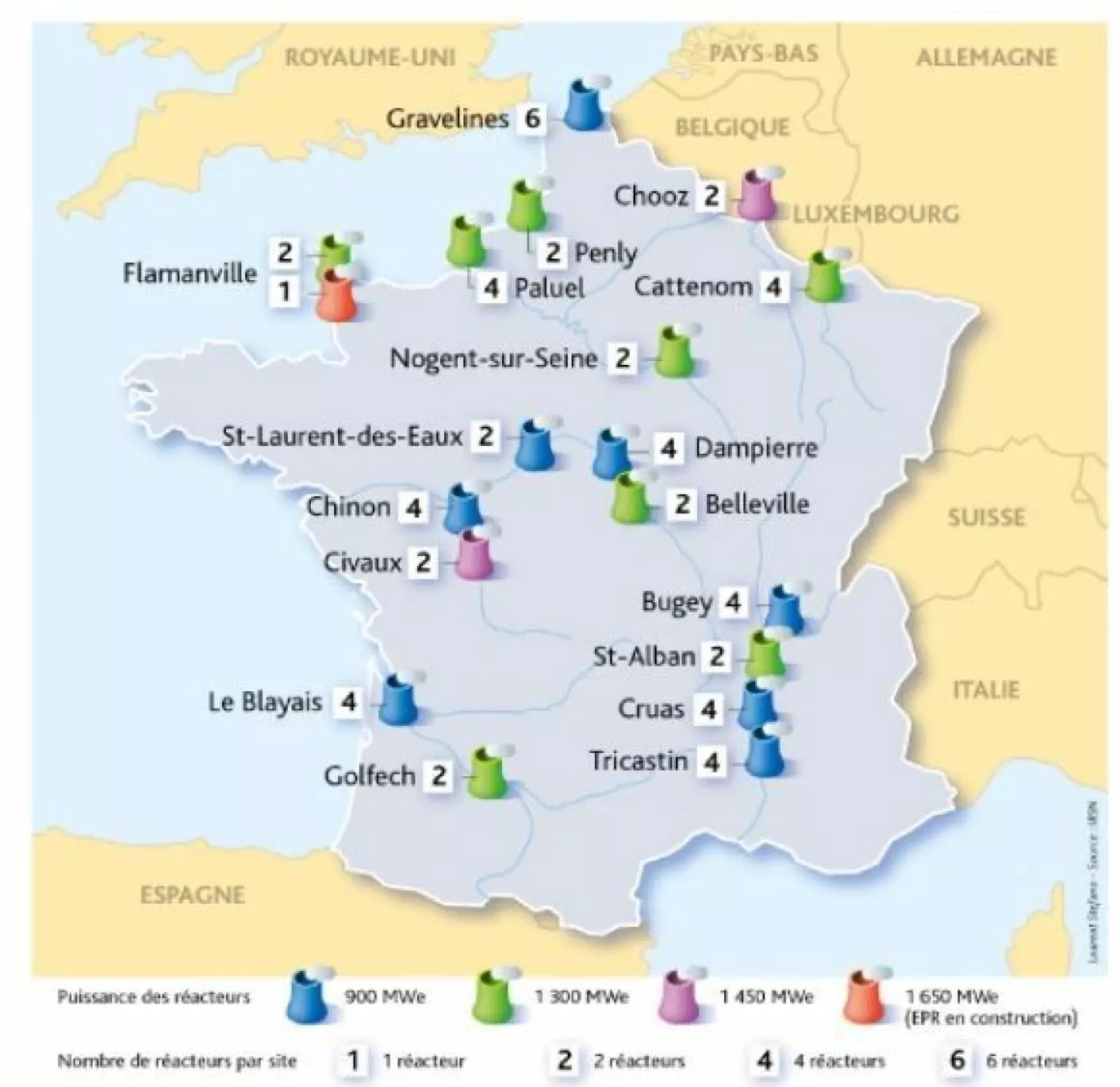
Where are France’s nuclear reactors and what is planned for more?
the six new sites will by no means triple French production, particularly since the older plants will increasingly be closed for repair and maintenance.
President Macron wants to triple atomic energy production by 2050
Richard Henshell, Saturday 20 April 2024
France is the third biggest producer of nuclear energy in the world and hopes to triple production by 2050. We look at where the country’s nuclear sites are and at President Macron’s plans for more.
Nuclear power represents up to 70% of the electricity produced in France at 282 Terawatt-hours (TWh), behind only China (395TWh) and the US (772TWh) and far ahead of the UK (42TWh).
However, many of its plants are approaching the end of their life-cycle. The majority of France’s 56 reactors date from the 1980s, and only two have been built since the year 2000.
In order to meet the requirements of the 2015 Paris Climate Accords, President Macron announced his plans to reinvest in France’s ageing nuclear plants during last year’s COP28 climate meeting in Dubai.
“Nuclear energy is back,” said Mr Macron (in English), adding that it was time to recognise the “essential role that nuclear energy can play in efforts to reach zero carbon dioxide emissions on a global level”.
“We will triple our capacity to produce nuclear energy between 2020 and 2050,” he said.
France’s 56 reactors are shared between 19 sites. Another reactor is scheduled to power up at Flamanville this summer, bringing the total to 57 reactors.
There are also plans to construct six new reactors at three existing plants:
- Two at Penly (Seine-Maritime) for 2035
- Two at Gravelines (Nord) for 2038
- Two at Le Bugey (Ain) for 2042
Construction is scheduled to start in summer 2024 on first of these new reactors in Penly, which like the others, will use the powerful new EPR-2 design. The estimated total cost for the six reactors is around €67.4 billion.
However, the six new sites will by no means triple French production, particularly since the older plants will increasingly be closed for repair and maintenance.
Indeed, in December 2021, the discovery of cracks in the emergency cooling systems of France’s four newest reactors led to them being shut down for over a year
Regardless, Mr Macron announced in February 2022 that France’s older plants could conceivably operate far into the future – beyond their 60th year or until they are no longer capable of producing electricity, or no longer safe.
No comments yet.
1 This Month


18 March Webinar @ 1 PM EST: An Assessment of SMR Projects: The Case of Canada
register for the zoom:
https://us02web.zoom.us/webinar/register/WN_o8BIIOUvQ2ONJR1nta65DQ#/registration


of the week – STOP SMALL MODULAR REACTORS IN CANADA
To see nuclear-related stories in greater depth and intensity – go to https://nuclearinformation.wordpress.com
-
Archives
- March 2026 (138)
- February 2026 (268)
- January 2026 (308)
- December 2025 (358)
- November 2025 (359)
- October 2025 (376)
- September 2025 (258)
- August 2025 (319)
- July 2025 (230)
- June 2025 (348)
- May 2025 (261)
- April 2025 (305)
-
Categories
- 1
- 1 NUCLEAR ISSUES
- business and costs
- climate change
- culture and arts
- ENERGY
- environment
- health
- history
- indigenous issues
- Legal
- marketing of nuclear
- media
- opposition to nuclear
- PERSONAL STORIES
- politics
- politics international
- Religion and ethics
- safety
- secrets,lies and civil liberties
- spinbuster
- technology
- Uranium
- wastes
- weapons and war
- Women
- 2 WORLD
- ACTION
- AFRICA
- Atrocities
- AUSTRALIA
- Christina's notes
- Christina's themes
- culture and arts
- Events
- Fuk 2022
- Fuk 2023
- Fukushima 2017
- Fukushima 2018
- fukushima 2019
- Fukushima 2020
- Fukushima 2021
- general
- global warming
- Humour (God we need it)
- Nuclear
- RARE EARTHS
- Reference
- resources – print
- Resources -audiovicual
- Weekly Newsletter
- World
- World Nuclear
- YouTube
-
RSS
Entries RSS
Comments RSS
 nuclear-news
Leave a comment