The fantasy of reviving nuclear energy.

Tripling the World’s Nuclear Energy Capacity Is a Fantasy: Stephanie Cooke.
World leaders are not unaware of the nuclear industry’s long history of
failing to deliver on its promises, or of its weakening vital signs. Yet
many continue to act as if a “nuclear renaissance” could be around the
corner even though nuclear energy’s share of global electricity generation
has fallen by almost half from its high of roughly 17 percent in 1996.
In search of that revival, representatives from more than 30 countries
gathered in Brussels in March at a nuclear summit hosted by the
International Atomic Energy Agency and the Belgian government.
Thirty-four nations, including the United States and China, agreed “to work to fully
unlock the potential of nuclear energy,” including extending the lifetime
of existing reactors, building new nuclear power plants and deploying
advanced reactors.
Yet even as they did so, there was an acknowledgment of
the difficulty of their undertaking. “Nuclear technology can play an
important role in the clean energy transition,” Ursula von der Leyen, the
president of the European Commission, told summit attendees.
But she added that “the reality today, in most markets, is a reality of a slow but
steady decline in market share” for nuclear power. The numbers underscore
that downturn. Solar and wind power together began outperforming nuclear
power globally in 2021, and that trend continues as nuclear staggers along.
Solar alone added more than 400 gigawatts of capacity worldwide last year,
two-thirds more than the previous year. That’s more than the roughly 375
gigawatts of combined capacity of the world’s 415 nuclear reactors, which
remained relatively unchanged last year.
At the same time, investment in
energy storage technology is rapidly accelerating. In 2023, BloombergNEF
reported that investors for the first time put more money into stationary
energy storage than they did into nuclear.
New York Times 18th April 2024
6 Comments »
Leave a comment
1 This Month
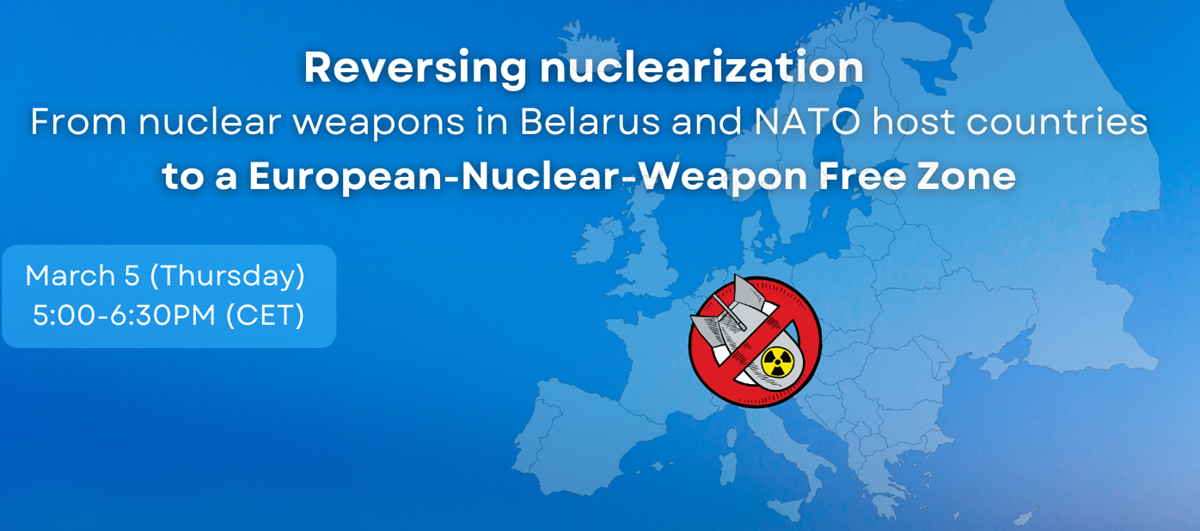
5 March -Online – Reversing nuclearization:
From nuclear weapons in Belarus and NATO host countries to a European-Nuclear-Weapon Free Zone
11am-12:30pm Eastern Time USA / 5pm-6:30pm CET

of the week – Advocating for a
nuclear free beach – https://www.samuellawrencefoundation.org/
The Samuel Lawrence Foundation advocates for a Nuclear Waste Free Beach at San Onofre, join us and take action!

10 March A LIVE WEBINAR THE REAL EFFECTS OF NUCLEAR POWER
What the Industry Isn’t Telling Us
1:00 PM Mountain, 2 pm Central, 3 pm Eastern. Live on the Keepers of the Water Facebook page

18 March Webinar @ 1 PM EST: An Assessment of SMR Projects: The Case of Canada
register for the zoom:
https://us02web.zoom.us/webinar/register/WN_o8BIIOUvQ2ONJR1nta65DQ#/registration

of the week – STOP SMALL MODULAR REACTORS IN CANADA
To see nuclear-related stories in greater depth and intensity – go to https://nuclearinformation.wordpress.com
-
Archives
- March 2026 (38)
- February 2026 (268)
- January 2026 (308)
- December 2025 (358)
- November 2025 (359)
- October 2025 (376)
- September 2025 (258)
- August 2025 (319)
- July 2025 (230)
- June 2025 (348)
- May 2025 (261)
- April 2025 (305)
-
Categories
- 1
- 1 NUCLEAR ISSUES
- business and costs
- climate change
- culture and arts
- ENERGY
- environment
- health
- history
- indigenous issues
- Legal
- marketing of nuclear
- media
- opposition to nuclear
- PERSONAL STORIES
- politics
- politics international
- Religion and ethics
- safety
- secrets,lies and civil liberties
- spinbuster
- technology
- Uranium
- wastes
- weapons and war
- Women
- 2 WORLD
- ACTION
- AFRICA
- Atrocities
- AUSTRALIA
- Christina's notes
- Christina's themes
- culture and arts
- Events
- Fuk 2022
- Fuk 2023
- Fukushima 2017
- Fukushima 2018
- fukushima 2019
- Fukushima 2020
- Fukushima 2021
- general
- global warming
- Humour (God we need it)
- Nuclear
- RARE EARTHS
- Reference
- resources – print
- Resources -audiovicual
- Weekly Newsletter
- World
- World Nuclear
- YouTube
-
RSS
Entries RSS
Comments RSS
 nuclear-news
When will the nuclear power industry give up? When will they give up? Nuclear power will never be cost effective, safe or ever necessary for our energy needs?
Nuclear power is inevitable for mankind’s future, consequent on its prodigious energy-density and its reliability.
It appears that Asia will lead the way (China, India, S. Korea) as the West dithers. We will notice only after Asia has demonstrated nuclear’s societal-wide superiority.
Timothy Maloney – “It appears that Asia will lead the way” – no – there’s a lot of hype as USA and Russia desperately market their unpopular reactors. Where’s your evidence? In some sort of crystal ball? Meanwhile – back in reality – China’s quiet energy revolution: the switch from nuclear to renewable energy – https://johnmenadue.com/chinas-quiet-energy-revolution-the-switch-from-nuclear-to-renewable-energy/
21 reactors now under construction
https://www.cnbc.com/2023/08/30/ho
37 reactors on line in past decade
https://www.economist.com/china/2023/11/30/china-is-building-nuclear-reactors-faster-than-any-other-country
5 reactors since 2022
https://thebreakthrough.org/issues/energy/chinas-impressive-rate-of-nuclear-construction
w-china-became-king-of-new-nuclear-power-how-us-could-catch-up.html
37 reactors on line in past decade
https://www.economist.com/china/2023/11/30/china-is-building-nuclear-reactors-faster-than-any-other-country
5 reactors since 2022
https://thebreakthrough.org/issues/energy/chinas-impressive-rate-of-nuclear-construction
21 reactors now under construction
https://www.cnbc.com/2023/08/30/how-china-became-king-of-new-nuclear-power-how-us-could-catch-up.html
Also
400 – 500 reactors by 2050
https://world-nuclear.org/information-library/country-profiles/countries-a-f/china-nuclear-power.aspx
By the end of 2023 it was clear that nuclear energy was no longer going to be the foundation of China’s future electricity generation system, and that this task had shifted to renewable energy. – between 2011 and 2022, the cost of solar PV modules declined by 85%, wind energy costs by 60-70%, and battery costs by 90%. – The central message here is that even in China – the world’s largest industrial economy and preeminent builder of advanced civil infrastructure in the 21st century – nuclear energy cannot compete with renewable energy to deliver low emission electricity generation at the deployment rates needed to meet mid-century emission targets. https://johnmenadue.com/chinas-quiet-energy-revolution-the-switch-from-nuclear-to-renewable-energy/