Annie Jacobsen: ‘What if we had a nuclear war?’

The author and Pulitzer prize finalist, who has written the latest pick for the New Scientist Book Club, Nuclear War: A scenario, on the “shocking truths” about a nuclear attack
By Annie Jacobsen, 12 April 2024, https://www.newscientist.com/article/2426579-annie-jacobsen-what-if-we-had-a-nuclear-war/
Not long after the last world war, the historian William L. Shirer had this to say about the next world war. It “will be launched by suicidal little madmen pressing an electronic button. Such a war will not last long and none will ever follow it. There will be no conquers and no conquests, but only the charred bones of the dead on an uninhabited planet.”
As an investigative journalist, I write about war, weapons, national security and government secrets. I’ve previously written six books about US military and intelligence programmes – at the CIA, The Pentagon, Defense Advanced Research Projects Agency– all designed to prevent, or deter, nuclear world war III. In the course of my work, countless people in the upper echelons of US government have told me, proudly, that they’ve dedicated their lives to making sure the US never has a nuclear war. But what if it did?
“Every capability in the [Department of Defense] is underpinned by the fact that strategic deterrence will hold,” US Strategic Command (STRATCOM), which is responsible for nuclear deterrence, insists publicly. Until the autumn of 2022, this promise was pinned on STRATCOM’s public Twitter feed. But to a private audience at Sandia National Laboratories later that same year, STRATCOM’s Thomas Bussiere admitted the existential danger inherent to deterrence. “Everything unravels itself if those things are not true.”
If deterrence fails – what exactly would that unravelling look like? To write Nuclear War: A scenario, I put this question to scores of former nuclear command and control authorities. To the military and civilian experts who’ve built the weapon systems, been privy to the response plans and been responsible for advising the US president on nuclear counterstrike decisions should they have to be made. What I learned terrified me. Here are just a few of the shocking truths about nuclear war.
The US maintains a nuclear launch policy called Launch on Warning. This means that if a military satellite indicates the nation is under nuclear attack and a second early-warning radar confirms that information, the president launches nuclear missiles in response. Former secretary of defense William Perry told me: “Once we are warned of a nuclear attack, we prepare to launch. This is policy. We do not wait.”
The US president has sole authority to launch nuclear weapons. He asks permission of no one. Not the secretary of defense, not the chairman of the joint chief of staff, not the US Congress. “The authority is inherent in his role as commander in chief,” the Congressional Research Service confirms. The president “does not need the concurrence of either his [or her] military advisors or the US Congress to order the launch of nuclear weapons”.
When the president learns he must respond to a nuclear attack, he has just 6 minutes to do so. Six minutes is an irrational amount of time to “decide whether to release Armageddon”, President Ronald Reagan lamented in his memoirs. “Six minutes to decide how to respond to a blip on a radar scope… How could anyone apply reason at a time like that?” And yet, the president must respond. This is because it takes roughly just 30 minutes for an intercontinental ballistic missile to get from a launch pad in Russia, North Korea or China to any city in the US, and vice versa. Nuclear-armed submarines can cut that launch-to-target time to 10 minutes, or less.
Today, there are nine nuclear powers, with a combined total of more than 12,500 nuclear weapons ready to be used. The US and Russia each have some 1700 nuclear weapons deployed – weapons that can be launched in seconds or minutes after their respective president gives the command. This is what Shirer meant when he said: “Such a war will not last long and none will ever follow it.”
Nuclear war is the only scenario other than an asteroid strike that could end civilisation in a matter of hours. The soot from burning cities and forests will blot out the sun and cause nuclear winter. Agriculture will fail. Some 5 billion people will die. In the words of former Soviet leader Nikita Khrushchev, “the survivors will envy the dead”.
I wrote Nuclear War: A scenario to demonstrate – in appalling, minute-by-minute detail – just how horrifying a nuclear war would be. “Humanity is one misunderstanding, one miscalculation away from nuclear annihilation,” UN secretary-general António Guterres warned the world in 2022. “This is madness. We must reverse course.”
How true.
Nuclear War: A Scenario by Annie Jacobsen, published by Torva (£20.00), is available now. It is the latest pick for the New Scientist Book Club: sign up here to read along with our members
Getting bigger but not safer or cheaper – the myth of Rolls Royce and its very big non-modular reactor
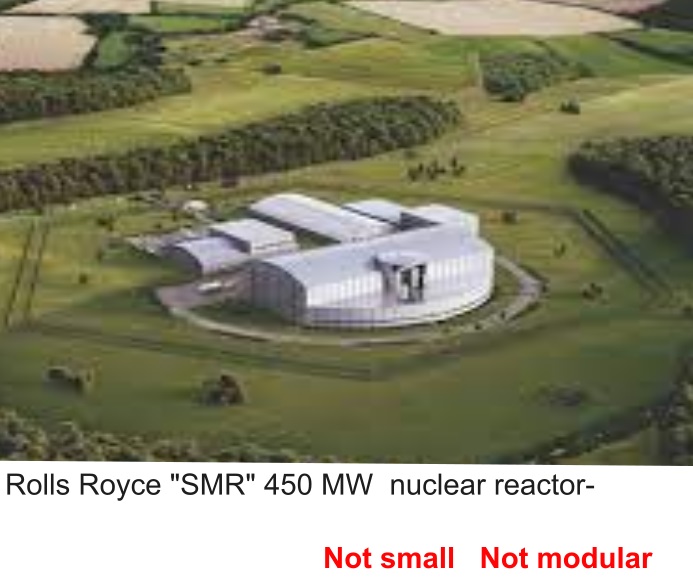
By David Toke, April 2024, https://100percentrenewableuk.org/getting-bigger-but-not-safer-or-cheaper-the-myth-of-rolls-royce-and-its-very-big-non-modular-reactor
Rolls Royce’s so-called small modular reactor (SMR) is getting bigger, but is likely to have fewer special safety features compared to EDF’s increasingly pricey design for Hinkley C.
In 2017 Rolls Royce said that its small modular reactor would be between 220 and 440 MW, but the latest design is bigger, at 470 MW. It is strange to call this small. Reactors in service at the moment (the so-called AGR reactors) were around the 600 MW size for each unit and, strange as it might seem, most of the first generation of so-called ‘Magnox’ nuclear reactors built in the UK were actually smaller than 470 MW. They were not called ‘small’. So why is Rolls Royce calling this a SMR? There’s no reason for this other than public relations.
Rolls Royce claim that the parts will be mainly built in factories. Well, of course they will, that’s always the case with nuclear power plant. The difference with building a relatively smaller plant of course is that you get less of the economies of scale in doing this. That is why nuclear power plant have got bigger.
So the fact that the Rolls Royce unit will be about a third the size of the EPR is likely to make them cost more. But there is one way that Rolls Royce will be able to economise compared to the European Pressurised Reactor (EPR) being built at Hinkley C, and that is because I have seen no sign that Rolls Royce will include some special safety features that have been included in the EPR.
The best known of these safety features are a) a ‘double containment’ feature that is designed to stop material from the inside getting out (as well as another external shell to shield from aircraft) and b) a ‘core catcher’ to stop a melting core eating its way into the ground and potentially contaminating water courses. I am assuming Rolls Royce will not be including either of these features, although it will have to satisfy the Office for Nuclear Regulation (ONR) that it has other ways of stopping radioactive releases from accidents.
Rolls Royce are now starting a ‘Generic Design Assessment’ (GDA) process with the ONR which will take around 5 years. After then they will be asking the UK Government for a blank cheque for a project.
Of course there is another factor and that is that EDF have some experience (admittedly not very successful of late) of building nuclear power plant. Rolls Royce do not have experience of building large nuclear power plant (which is what they are really hoping to do). Producing small (and, it must be said extremely expensive) genuinely small reactors for nuclear submarines is not the same thing at all! So Rolls Royce are likely not to have the skills to build large nuclear power plant. That is a bad sign!
The so-called SMRs proferred by Rolls Royce will just be the latest in a long line of very expensive, very lately delivered nuclear power stations in the UK. It is unlikely to be any cheaper than the reactor that EDF is building at Hinkley C (becoming more expensive as time goes on). But it will have fewer safety features.
Sign the petition for mandatory solar panels on buildings , and for fossil fuels to be banned in new buildings. See the petition page here.
Please share the petition page link as widely as you can on social media. Please write to you MP asking for solar pv to be mandatory on all new buildings and for fossil fuel boilers to be banned in them.
Amid Serious Iran-Israel Tension, The Nuclear Elephant Is In The Room

Tuesday, 04/09/2024, Shahram Kholdi, https://www.iranintl.com/en/202404097226
April 7 marked the sixth month of Hamas-Israel open conflict. Six days before this semi-anniversary, Israel’s April 1 strike on Iran’s embassy in Damascus punctuated an alarming turning point.
Israel’s action did not only corner Hezbollah, Iran’s primary quasi-state proxy on the bloody chessboard of their ongoing conflict but have also eliminated key military leaders. Amid various pundits attempting to predict Iran’s next move, many are acknowledging the significant factor of Iran’s nuclear program lurking in the background.
Supreme Leader Ali Khamenei’s “fatwa” and opinion on the prohibition of producing nuclear weapons “may change tomorrow,” Mahmoud-Reza Aghamiri, the president of Tehran’s Beheshti University and a pro-regime professor of nuclear physics, told Iran’s state TV this week. Aghamiri says Iran currently has the technology and capability to develop a nuclear bomb, and under such circumstances, developing it is easier than not making it.
The punditry and analyses on a possible “direct” clash between Iran and Israel is indeed all over the map. Some, whilst citing “warnings from unnamed Israeli officials behind the scenes” wonder whether or not Iran will strike Israel back from its own territory. Others probe whether it will have its proxies to escalate their asymmetrical strikes against Israel. And last but not least, a handful quibble over whether Israel’s strike would give President Joe Biden the occasion to proclaim support for Israel against Iran but further pressure Israel to heed the US’ demands on the conclusion of the war in Gaza and negotiations with Hamas for the release of the hostages.
On this very outlet, in an article published four days after Hamas attack on October 11, 2023, Benjamin Weinthal covered various sides of a debate on the (unlikely) possibility of a joint US-Israeli attack against Iran as a state sponsor of Hamas.
On the conventional front, The gravity of Israel’s situation cannot be exaggerated. The Hezbollah of Lebanon is armed with thousands of conventional rockets and cruise missiles that can potentially swarm and overwhelm the Israeli Air Defense Shield and Iron Dome and the analyses of Israel’s ability to take all Hezbollah’s arsenal preemptively has been the subject of much debate.
What most observers do not take into account is the possibility that the Israeli attack on the Iranian embassy in Damascus may trigger a rude awakening amongst the IRGC top brass and Khamenei. It might prompt them to hasten the development of their nuclear deterrence capabilities. Despite the regime’s longstanding vow to eliminate Israel, dating back to before 1979, the tensions between Iran and Israel are mutual and deep-rooted.
Israel is presently wary of the Iranian ability to deploy a handful of nuclear warheads and the IDF has been preparing itself for a decisive strike on the Iranian nuclear facilities for quite some time before the Hamas October 7 attack on Israel. Israel, as is discussed below, has been acutely aware of Iran’s ever growing weaponization capacity as early as 2018.
Yet Israel’s collective sense of insecurity is not simply rooted in its fear of its enemies or the deep-seated collective trauma of the Holocaust. Israel’s primary source of insecurity is rooted in its historical roller coaster experience of its alliances. The Soviet de jure recognition of Israel and support for its war of independence against the Arab nations was short-lived and inadequate. France was Israel’s major military supplier for much of the 1950s to the mid-1960s, and upon her aid Israel developed its conventional and unconventional nuclear programs.
But France proved unreliable when President De Gaulle sought a rapprochement with Israel’s Arab enemies and abandoned Israel in the mid-1960s. From the mid-1960s, the United States became Israel’s sole guarantor and ally in all aspects of economy and military from research and development, joint aeronautical and space projects to the development of the sophisticated air-defense systems, namely, “the Iron-Dome”, and the latest sophisticated UAVs.
The United States itself has wavered in its “unequivocal support” for Israel at least on three different occasions. First, President Dwight Eisenhower refused to support Israel in its collusion with the Anglo-French powers during the 1956 Suez Crisis. In fact, Eisenhower turned his back on Israel as he feared escalation with the Soviet Union. Incidentally, there are commentators who believe that President Biden should treat Prime Minister Benjamin Netanyahu to a similar set of measures that Eisenhower imposed on Israel in 1956.
There are indeed those in the US who believe Johnson failed to act to prevent Israel’s occupation of the West Bank in 1967 and this is a legacy from which Biden must take harsh lessons and act accordingly. Finally, President Barack Obama’s administration sidelined Israel’s Netanyahu to cajole Tehran’s ruling mullahs into the Joint Comprehensive Plan of Action (JCPOA) over their nuclear program causing Israel to distance itself ever farther from the Euro-American alliance. Israel has been less than forthcoming about sharing the details of its assassination and sabotage operations with its Euro-American allies ever since. According to some reports, “the CIA does not know” if Israel plans to bomb Iran.”
Today, Israel and Netanyahu are almost identical in their shared sense of insecurities. Even though a majority of Israelis may not vote him to office if elections were held today, they share the same sense of insecurity that has been the compass of his five mandates over the past thirty years. At the core of this sense of insecurity lies Iran’s nuclear program. Since 2018, Israel has taken possession of thousands of documents that lay bear all the militaristic directions of the Iranian nuclear program (Revealed: Emptying of the Iranian “Atomic Warehouse” at Turquz Abad). Over nearly 15 years, Israel is alleged to have succeeded in sabotaging many critical sites of the Iranian nuclear industrial complex. Moreover, Israel is accused of having masterminded the operations that eliminated Iranian nuclear scientists in the same period. Nonetheless, since Donald Trump left the JCPOA, the Iranian regime has progressively accelerated its uranium enrichment and proved Israel’s, read Netanyahu’s, worst fears. The International Atomic Energy Agency (IAEA) is effectively and totally is in the dark per the latest reports of IAEA and its dire warnings about the exact state of the Iranian nuclear program. In view of the above, it appears that Israel’s assassination and sabotage operations against the Iranian scientists and nuclear sites have effectively failed.
Israeli-American air forces joint drills for long range operations in the summer of 2023 revealed how alarmed both US and Israel were about the Iranian nuclear program. It was speculated at the time that such drills were to prepare both air forces for a joint operation on the Iranian nuclear facilities. Meanwhile, the Americans were in the midst of secret negotiation with the Iranians to reach an “informal nuclear agreement”.
However, joint exercises of such magnitude with any ally are always planned long in advance and are indicative of longstanding concerns. Accordingly, the joint US-Israeli hint at the fact that the Biden administration did neither have any confidence in the success of those secret negotiations with Iran, nor was it assured of the Iranian side’s honoring any such accord. Three weeks before Hamas attack on Israel, a most telling paragraph in the IDF statement on Israeli and Hellenic air forces’ joint drills for long range operations reads as follows: “The exercise is part of a series of exercises and models carried out by the IAF in the past year and their purpose is to improve operational and mental competence for long-range flights, refueling, attacks in the depth [of enemy territory] and achieving air superiority.”
Khamenei, per his religious edict, fatwa, has stated time and again that the manufacturing and usage of nuclear weapons is forbidden. However, Israel’s elimination of two high-ranking IRGC general inside the Iranian embassy’s compound in Damascus has established that there is no red line that it will not cross to maximize its security and minimize all risks. Such an escalating assault may cause the Iranian ruling clerics and the IRGC to wonder if their nuclear facilities will be next on Israel’s target list and they may consider attaining a deterrence greater than a conventional one. Khamenei may indeed invoke the principle of expediency to overrule his own “anti-Nuclear” fatwa. The principle of expediency, as decreed by the regime’s founder Ayatollah Khomeini in January 1988, stipulates that the Supreme Leader of the Islamic Republic may even violate the fundamental tenets of the Islamic faith in order to preserve “the Islamic Regime” as the preservation of the Islamic Regime supersedes all else.
Thus, if Israel continues to expand its unrelenting attacks on IRGC top brass and Iranian military and diplomatic facilities in the region, and the Iranian regime continues to plunge into the depths of a maelstrom of economic troubles, will Khamenei perceive such an assault as compromising the survival of the regime? And if so what will he do? Will he invoke the principle of expediency and order the rapid manufacturing of nuclear devices and their deployment in the form of a dozen or so warheads? Or will he be resigned to Israel’s overwhelming assault on its proxies and, like his predecessor, will drink from the poisonous chalice of surrender?
Keir Starmer slammed over staunch defence of nuclear weapons

“it’s increasingly clear that Starmer’s offer is just more of the same: billions of pounds wasted on nuclear weapons and nuclear power, and a belligerent foreign policy that includes support for the Aukus pact, Nato, and continuing arms sales to Israel, used to kill Palestinians.
“Putting billions of pounds into the pockets of arms companies and their investors will not reinvigorate the economy in any meaningful way.”
The National By Hamish Morrison @HMorrison97 Political Reporter, 10 Apr 24
KEIR Starmer has said Trident is the “bedrock” of Labour’s defence policy – despite growing concern over the state of the ageing nuclear fleet critics say is a “grotesque” waste of money.
The Labour leader launched a full-throated defence of Britain’s nuclear weapons in an attempt to stress the distance he has taken the party since its leadership under Jeremy Corbyn – who voted against the renewal of Trident while in charge.
During a visit to Barrow today, where nuclear submarines are being built, Starmer is expected to focus on increasing jobs and skills in defence.
Starmer said: “The changed Labour Party I lead knows that our nation’s defence must always come first. Labour’s commitment to our nuclear deterrent is total.
“In the face of rising global threats and growing Russian aggression, the UK’s nuclear deterrent is the bedrock of Labour’s plan to keep Britain safe.
“It will ensure vital protection for the UK and our Nato allies in the years ahead, as well as supporting thousands of high paying jobs across the UK………………………..
Labour will ensure that new UK leadership within Aukus helps make this national endeavour a success for Britain.”
The Aukus pact unites Australia, the UK and the USA in a military pact in the South Pacific, which critics say escalates tensions with the Chinese.
China’s government has described Aukus – which will see Australia provided with nuclear-powered submarines – as indicative of an “obsolete Cold War zero sum mentality”.
The SNP have said Labour’s commitment to Trident was “grotesque”.
Martin Docherty-Hughes (below), the party’s defence spokesperson, said: “Westminster has already wasted billions of pounds of taxpayer’s money on nuclear weapons and expensive nuclear energy.
“It is therefore grotesque that Sir Keir Starmer is prepared to throw billions more down the drain when his party claim there is no money to improve our NHS, help families with the cost of living or to properly invest in our green energy future.
“This money would be better spent on a raft of other things – not least investing in the green energy gold rush, which would ensure Scotland, with all its renewal energy potential, could be a green energy powerhouse of the 21st century.”
He blasted the “misfiring Trident missiles”, drawing attention to a high-profile blunder which saw a test missile dramatically fail to launch, landing just yards from the submarine carrying it.
Docherty-Hughes said the Government should provide more money for “underpaid and under-resourced” armed forces staff and conventional defence systems.
Alba general secretary Chris McEleny, who worked at HM Naval Base Clyde, where nukes are stored, said: “When one in four children in Scotland live in poverty it is obscene that resources are wasted to ensure that we have the best defended foodbanks in the world.”
He added that the “war-mongering Labour Party have now made it clear that independence is the only way to free Scotland of nuclear weapons”.
Healey, Labour’s shadow defence minister, said a “strong defence industrial strategy” would be “hardwired” in the party’s quest to promote economic growth if it gains power at the election.
He added: “We will make it fundamental to direct defence investment first to British jobs and British industry.”……………………………..
Kate Hudson, general secretary of the Campaign for Nuclear Disarmament, said voters were “desperately looking for hope from the Labour Party”.
She added: “However, it’s increasingly clear that Starmer’s offer is just more of the same: billions of pounds wasted on nuclear weapons and nuclear power, and a belligerent foreign policy that includes support for the Aukus pact, Nato, and continuing arms sales to Israel, used to kill Palestinians.
“Putting billions of pounds into the pockets of arms companies and their investors will not reinvigorate the economy in any meaningful way.” https://www.thenational.scot/news/24248069.keir-starmer-slammed-staunch-defence-nuclear-weapons/
Biden ‘very proud’ of expanding NATO to Russia’s borders
https://www.rt.com/news/595718-biden-proud-nato-expansion/ 12 Apr 24
The US leader believes it would be a “disaster” if the bloc were to break up
US President Joe Biden has hailed NATO’s further expansion toward Russia’s borders, while accusing Republican rival Donald Trump of undermining the unity of the American-led military bloc.
Russia has for years voiced concern about NATO’s creeping encroachment, viewing its policies as an existential threat. However, in an interview with Spanish-language broadcaster Univision that aired on Tuesday, Biden touted the recent addition of Finland and Sweden to the bloc’s ranks amid the Ukraine conflict as a great achievement.
“We’ve done something that I was very proud of. I’ve engaged with NATO for my whole career. We were able to expand NATO, and we have 2,000 miles of border because you have two Nordic nations having joined NATO. You have a whole range of NATO countries along the Russian border,” the US president said.
Biden went on to argue that a stalemate in Congress over his $61 billion military aid package for Kiev is “very dangerous” for the bloc’s unity, accusing his former US leader Trump of virtually holding the measure – and the entire Republican party – hostage.
“Trump runs that party. He maintains a sort of a death grip on it. Everybody’s afraid to take him on whether they agree with him or not, and it’s incredibly dangerous. The last thing we need is to see NATO start to break apart. It would be a disaster for the United States, a disaster for Europe, a disaster for the world,” Biden said.
The US has provided Ukraine with over $113 billion in various forms of assistance since the start of hostilities with Russia. Moscow has repeatedly condemned foreign arms shipments to Kiev, arguing they will only prolong the conflict, while making the West a direct participant in the hostilities.
Finland shares a 1,300km border with Russia, and Moscow has argued that NATO membership has threatened, not guaranteed, Finnish security. After Helsinki joined the alliance last year, Russian President Vladimir Putin announced the creation of a new military district bordering the Nordic nation. Sweden joined the bloc last month.
Putin has warned for nearly two decades that NATO’s policies undermine Russian national security, but a real “red line” for Moscow would be an attempt to move the bloc’s forces into Ukraine. The conflict in Ukraine is an “existential” one for Moscow and a “matter of life and death,” Putin said in February, while for the West it is simply a matter of “improving its tactical positions.”
UK Government decision to withhold nuclear power plant information unlawful
Government decision to withhold nuclear power plant information unlawful.
A ruling by the Information Commissioner (IC) requiring the Secretary of
State for Energy Security and Net Zero requesting the disclosure of
information in respect of a proposed nuclear power plant on Anglesey was
upheld by the General Regulatory Chamber (GRC) which concluded that the
public interest supported its disclosure.
Planning Resource 11th April 2024
Nuclear energy ‘now an obstacle to delivering net zero’ – Greenpeace.
Nuclear energy has been touted as key to the global transition,
but concerns around costs and timescales have generated scepticism.
According to Greenpeace director of policy Doug Parr: “Nuclear power
can’t bridge the gap between anything and anything. It is too slow. It is
too expensive. It is a massive distraction.”
Speaking about the role of
nuclear energy in the UK’s transition, Parr tells Energy Monitor: “It
doesn’t help with the kind of grid system that we need, which is going to
be renewables heavy. I think the UK focus on nuclear power is now an
obstacle to delivering net zero because it is sucking up time, energy and
political bandwidth, which can be spent on more useful things.”
Parr argues that governments should be investing in more immediate solutions. He
points to investment in Sizewell C – the 3.2GW power station set to be
built in the English county of Suffolk – where construction is set to
commence this year. It is likely to take between nine and 12 years to
complete, but delays at Hinkley C (of which Sizewell C will be a close
copy) have stirred doubt.
“We will be putting a lot of money into
something like Sizewell C, when actually we will find that it is a white
elephant by the time it has opened,” he contends. “We will have spent
all that time, energy and effort, which could have been put into improving
our housing stock, improving our grid or improving the ability of electric
vehicles to meet the needs of people through a proper charging network –
things that would actually would deliver this decade, not in 15 years time.
So, we would cut a lot more carbon, we would get something done that is
useful and we wouldn’t have piles of messy radioactive waste that we
still don’t know what to do with.”
Energy Monitor 10th April 2024, https://www.energymonitor.ai/features/nuclear-energy-now-an-obstacle-to-delivering-net-zero-greenpeace/
Why you probably shouldn’t become a Community Interest Company
by preorg, https://preorg.org/why-you-probably-shouldnt-become-a-community-interest-company/
Imagine you have sacrificed hundreds of hours of your volunteering time to a non-profit organisation doing good work. After years of effort, often exhaustion, you discover that the directors don’t care that much about whether you succeeded in helping those people you intended to help. They care mostly about how much time they can spend at the swimming pool at their second home in Spain. Your volunteer hours have helped fund that lifestyle.
How could such a situation arise? Aren’t charities supposed to have boards of governors that keep the organisation on track? But wait, it wasn’t a charity! It was a Community Interest Company. Now, I should say that I don’t currently know of any such dramatic betrayals of people’s goodwill. But what I will argue here is that this situation arising in some CICs is bordering on inevitable, given the operating parameters of CICs. Given the weakness of regulation of the companies, almost boasted about by the CIC Regulator, it’s only a matter of time.
Why would I think that? Most people seem happy with CICs; Community Interest Companies are a success story, we are told. There are now many thousands of CICs in the UK, all having appeared within the space of ten years. This rapid rise in fact means that many people have chosen a form the long-term resilience of which has yet to be tested. It would be exciting to write an article about all the horribly failed CICs littering the social economy landscape. But I don’t know of any; I can only do a much less exciting job: pointing out what’s wrong with CICs before they start to fail. My contention is that, with the help of an FOI request to the CIC Regulator, we can see that certain types of failure are predictable. As for why we haven’t seen the failures yet, it is largely because CICs are young and in most of them the founders are still in charge.
The CIC was designed for organisations with social goals. It must operate in the ‘community interest’, which is defined in the articles of the organisation. It is also chosen over charities as an organisation that can more easily buy and sell commercially. But among the people I have asked, the main reason for opting for a CIC has been that it is easy. It is a lightweight structure, it is unencumbered by bureaucracy. It can be set up in a couple of days and can adapt quickly to changing conditions since it doesn’t have long lists of rules in its constitution. More like a standard profit-making company then, but with social objectives built in. Supposedly. More on that later.
By comparison both charities and co-operatives or community benefit societies (BenComs) have a lot more rules. Rules! How annoying! How limiting! But hang on a moment, why, if rules are so tedious, do those other organisations bother with them? The answer is that most of the rules are about accountability. In the case of a charity, the board of trustees, who must be consulted on significant matters, exist to keep the charity in line with its social aims. In co-ops and BenComs it is the membership who must constantly be consulted, and who choose who leads the organisation. Democracy certainly can be quite annoying.
By comparison a standard CIC is at the mercy of its directors, who needn’t even be many in number. That’s fine, I hear some say, I am the director, and I trust myself to make good decisions. Perhaps, but do you intend to lead the organisation forever? Even if you plan to live forever, what happens if you get ill, or leave through some other reason beyond your control? The purpose behind many accountability mechanisms is that they transcend the ideals of one particular person. They embed the ethics and goals into the DNA of the organisation, whoever may be running it at a given time. So how long do you want your organisation to last?
There is one supposed accountability mechanism in CICs: the government regulator. In theory the Office of the Regulator of Community Interest Companies has a lot of power to force CICs to stick to their aims. In practice it appears to do very little, priding itself on being a ‘light touch’ regulator. When I contacted the Regulator, they explained that in the last year they received 57 complaints, only 3 of which resulted in an intervention by the regulator. None of these 3 were related to the community benefit requirements. The Regulator has so far never wound up a CIC or stripped one of its CIC status. The Regulator has no records of intervening in a CIC on the basis of the standard paperwork submitted each year, which in part reports on the organisation’s performance under its community benefit requirement. That is to say, there appears to be no pro-active monitoring of whether CICs are operating for community benefit.
Even Social Enterprise UK, a fan of the CIC form, has raised questions over the strength of the Regulator. This accountability mechanism begins to look weak, to say the least. I’m not sure it will ever improve either. I doubt the regulator will ever be well enough funded to investigate what is going on in tens of thousands of organisations. We should not look for accountability in the CIC regulator.
Let’s move on to another question, a special case of the accountability problem: what profits can be made from a CIC, often presented as a non-profit structure? There is a CIC limited by shares that is allowed to make a profit. Previously there was a dividend cap of 20% of share value in any given year. This was considered by the government to be ‘inhibiting investment’ so in 2014 they removed the cap. Say that again? Annual 20% profits inhibiting investment?
Let’s leave that aside. In fact the majority of CICs are limited by guarantee and are more genuinely non-profit in form. There are, however, a couple of massive catches. The directors of a CIC can pay themselves whatever they can argue could reasonably be seen as necessary, as long as they are still fulfilling their social objectives. As determined by the aforementioned ‘light touch’ regulator. A CIC with a turnover of some millions a year could in theory pay the directors a million a year, if they could argue that without the salary they couldn’t retain the talent they need. Is it still a non-profit? This raises the aforementioned scenario of people putting in hundreds of volunteer hours for a supposed non-profit while the directors are buying holiday homes in the Mediterranean.
The second problem is that nobody is paying any attention to who CICs contract out work to. If a CIC pays huge ‘management fees’ or overpays on a cleaning contract to a company that happens to be owned by, say, the partner of a director, any money in the organisation can very easily be siphoned out to profit-making enterprises. In a charity the board and regulator would keep a sharp eye on this type of activity; the CIC regulator barely seems to glance at the paperwork.
You, the current director, might not abuse your position so, but can you be so sure of your successors? We only need to look at Housing Associations for a case study in organisational mission drift, in part driven by the high salaries CEOs have been able to pay themselves.
A word too on putting an informal democratic structure on top of an undemocratic CIC: I’m told that the Centre for Alternative Technology in Wales acted for years like a co-operative, and those involved assumed that’s what it was. But it never took a co-operative legal form, so when it ran into trouble, new leadership bulldozed aside the democracy people had assumed was one of the core values of the organisation. CAT is at least a charity, but the lesson is that informal structures can be dispensed with any time the CIC directors get tired of them.
But surely there must be a right situation for a CIC? Perhaps. A CIC could be right for an organisation that is mostly a trading organisation and is for a short-term project which won’t exist for long. If the project is intended to run long-term, I don’t believe the CIC is a reliable form. It is at the mercy of the leadership that follows you, if not your own leadership. The CIC Regulator is not the safety net you need. For most people it would be worth choosing an organisational type that seems more ‘difficult’ in the short term, but will almost certainly be more sustainable and accountable in the long run.
For existing successful CICs, why would they bother to change if they are doing well as they are? Let’s remember they are still young organisations. Do we want to wait twenty years to see the emergence of accountability and mission-drift problems that are, I am suggesting, rather predictable? Mission-drift that the Regulator will never pick up on unless someone reports it?
There are a few ways to mitigate the risks here. The best option for many would be to convert into a co-operative CIC. Co-ops UK offers one set of model rules for this, and the Somerset Rules can also convert a CIC into a multi-stakeholder co-op. It will cost time and money, it is true, to change the rules, but it will surely not be as painful as the organisation going off track in a few years’ time after the founders have retired.
The second best option is to add democratic rules to the CIC. It is a benefit of CICs that they are very flexible. The CIC Regulator offers model rules of a participatory organisation of large membership, though it is still very much director-controlled. It is theoretically possible to set up a more democratic membership structure without being a co-operative. While this method may miss out on embedding some of the checks and balances that co-ops have developed over the years, it could make the organisation more accountable. But remember, rules that can be added can be taken away. Only co-ops and their cousins, community benefit societies, lock democracy in permamently.
Finally, if actual democracy seems too great a task, it is at least possible to simply install more directors onto the CIC board, preferably those affected by what the organisation does, and so establish a strong democratic culture among the CIC directors. It’s not a perfect fix, but increased collective decision-making will mitigate the problems of a top-down culture reliant on the goodwill of two or three people.
For those who haven’t started their organisation yet, this is a plea to consider that a sustainable organisation is an accountable one, and democracy is one of the best ways to ensure accountability. Thankfully others, in the form of the co-operative movement, have already paved the way for us.
1 This Month


Petition to revoke the licensing of the Near Surface Nuclear Disposal Facility (NSDF) at Chalk River. https://www.ourcommons.ca/petitions/en/Petition/Details?Petition=e-7247


of the week – STOP SMALL MODULAR REACTORS IN CANADA
To see nuclear-related stories in greater depth and intensity – go to https://nuclearinformation.wordpress.com
-
Archives
- March 2026 (163)
- February 2026 (268)
- January 2026 (308)
- December 2025 (358)
- November 2025 (359)
- October 2025 (376)
- September 2025 (258)
- August 2025 (319)
- July 2025 (230)
- June 2025 (348)
- May 2025 (261)
- April 2025 (305)
-
Categories
- 1
- 1 NUCLEAR ISSUES
- business and costs
- climate change
- culture and arts
- ENERGY
- environment
- health
- history
- indigenous issues
- Legal
- marketing of nuclear
- media
- opposition to nuclear
- PERSONAL STORIES
- politics
- politics international
- Religion and ethics
- safety
- secrets,lies and civil liberties
- spinbuster
- technology
- Uranium
- wastes
- weapons and war
- Women
- 2 WORLD
- ACTION
- AFRICA
- Atrocities
- AUSTRALIA
- Christina's notes
- Christina's themes
- culture and arts
- Events
- Fuk 2022
- Fuk 2023
- Fukushima 2017
- Fukushima 2018
- fukushima 2019
- Fukushima 2020
- Fukushima 2021
- general
- global warming
- Humour (God we need it)
- Nuclear
- RARE EARTHS
- Reference
- resources – print
- Resources -audiovicual
- Weekly Newsletter
- World
- World Nuclear
- YouTube
-
RSS
Entries RSS
Comments RSS
 nuclear-news