Spent nuclear fuel mismanagement poses a major threat to the United States. Here’s how.
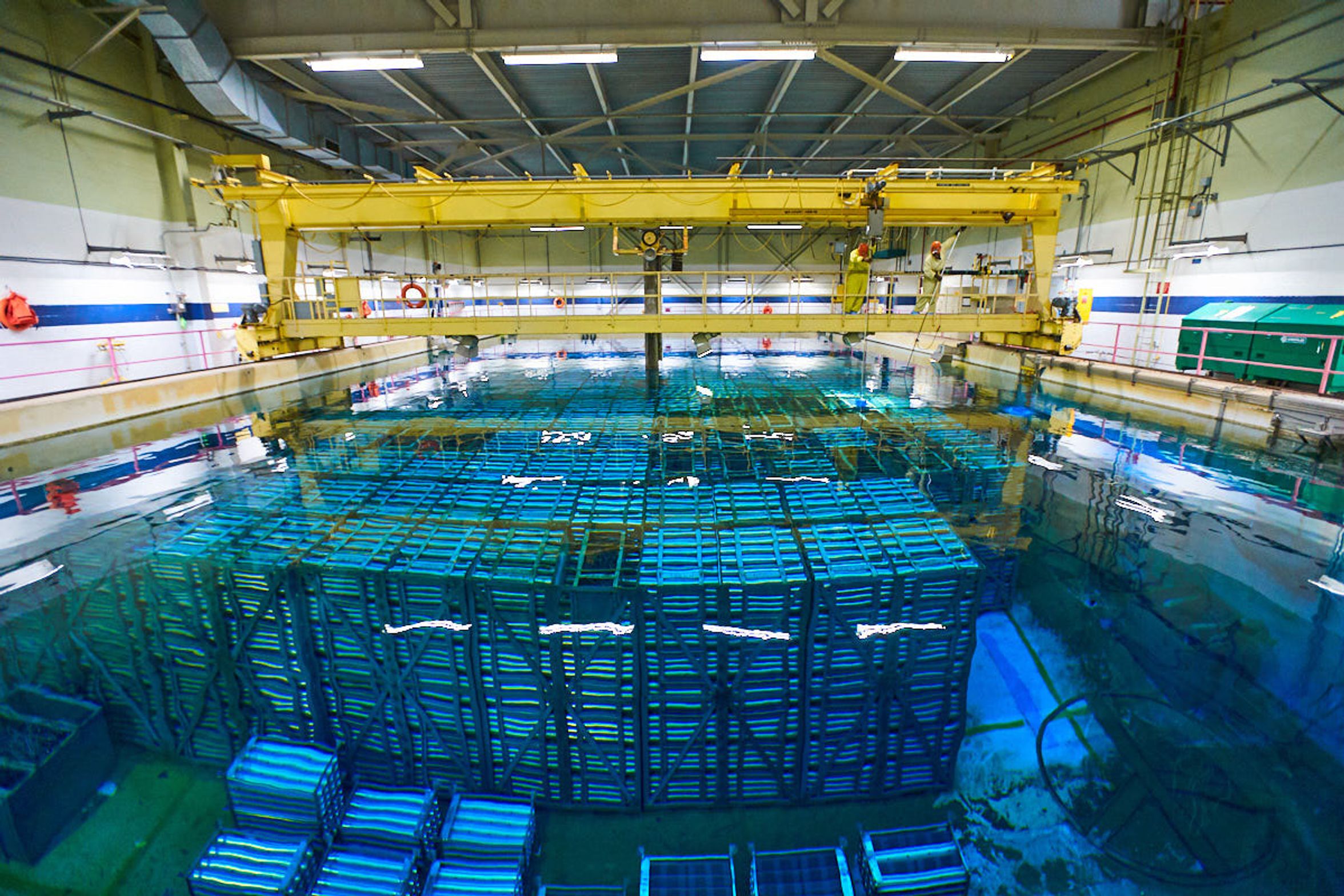
Restricting its analyses to a severe earthquake scenario allowed the NRC to help allay public fears over the dangers of spent fuel pool accidents. There is good reason to question whether severe earthquakes pose the greatest threat to spent fuel pools.
Solar storms, physical attacks, and cyberattacks have the potential to cause a nightmare scenario …….
Bulletin, By Mark Leyse | April 2, 2024
Irradiated fuel assemblies—essentially bundles of fuel rods with zirconium alloy cladding sheathing uranium dioxide fuel pellets—that have been removed from a nuclear reactor (spent fuel) generate a great deal of heat from the radioactive decay of the nuclear fuel’s unstable fission products. This heat source is termed decay heat. Spent fuel is so thermally hot and radioactive that it must be submerged in circulating water and cooled in a storage pool (spent fuel pool) for several years before it can be moved to dry storage.
The dangers of reactor meltdowns are well known. But spent fuel can also overheat and burn in a storage pool if its coolant water is lost, thereby potentially releasing large amounts of radioactive material into the air. This type of accident is known as a spent fuel pool fire or zirconium fire, named after the fuel cladding. All commercial nuclear power plants in the United States—and nearly all in the world—have at least one spent fuel pool on site. A fire at an overloaded pool (which exist at many US nuclear power plants) could release radiation that dwarfs what the Chernobyl nuclear accident emitted.
Many analysts see very rare, severe earthquakes as the greatest threat to spent fuel pools; however, another far more likely event could threaten US nuclear sites: a widespread collapse of the power grid system. Such a collapse could be triggered by a variety of events, including solar storms, physical attacks, and cyberattacks—all of which are known, documented possibilities. Safety experts have warned for decades about the dangers of overloading spent fuel pools, but the Nuclear Regulatory Commission and Congress have refused to act.
The threat of overloaded spent fuel pools. Spent fuel pools at US nuclear plants are almost as densely packed with nuclear fuel as operating reactors—a hazard that has existed for decades and vastly increases the odds of having a major accident.
Spent fuel assemblies could ignite—starting a zirconium fire—if an overloaded pool were to lose a sizable portion or all of its coolant water. In a scenario in which coolant water boils off, uncovered zirconium cladding of fuel assemblies may overheat and chemically react with steam, generating explosive hydrogen gas. A substantial amount of hydrogen would almost certainly detonate, destroying the building that houses the spent fuel pool. (Only a small quantity of energy is required to ignite hydrogen gas, including electric sparks from equipment. It is speculated a ringing telephone initiated a hydrogen explosion that occurred during the Three Mile Island accident in 1979.)
A zirconium fire in an exposed spent fuel pool would have the potential to emit far more radioactive cesium 137 than the Chernobyl accident released. (The US Nuclear Regulatory Commission (NRC) has conducted analyses that found a zirconium fire at a densely packed pool could release as much as 24 megacuries of cesium 137; the Chernobyl accident is estimated to have released 2.3 megacuries of cesium 137.) Such a disaster could contaminate thousands of square miles of land in urban and rural areas, potentially exposing millions of people to large doses of ionizing radiation, many of whom could die from early or latent cancer.
In contrast, if a thinly packed pool were deprived of coolant water, its spent fuel assemblies would likely release about 1 percent of the radioactive material predicted to be released by a zirconium fire at a densely packed pool. A thinly packed pool has a much smaller inventory of radioactive material than a densely packed pool; it also contains much less zirconium. If such a limited amount of zirconium were to react with steam, most likely too little hydrogen would be generated to threaten the integrity of the spent fuel pool building.
After being cooled under water for a minimum of three years, spent fuel assemblies can be transferred from pools to giant, hermetically sealed canisters of reinforced steel and concrete that shield plant workers and the public from ionizing radiation. This liquid-free method of storage, which cools the spent fuel assemblies by passive air convection, is called “dry cask storage.”

A typical US storage pool for a 1,000-megawatt-electric reactor contains from 400 to 500 metric tons of spent fuel assemblies. (Dry casks can store 10 to 15 tons of spent fuel assemblies, so each cask contains a far lower amount of radioactive material than a storage pool.) Reducing the total inventories of spent fuel assemblies stored in US spent fuel pools by roughly 70 to 80 percent reduces their amount of radioactive cesium by about 50 percent. And the heat load in each pool drops by about 25 to 30 percent. With low-density storage, a pool’s spent fuel assemblies are separated from each other to an extent that greatly improves their ability to be cooled by air convection in the event that the pool loses its coolant water. Moreover, a dry cask storage area, which has passive cooling, is less vulnerable to either accidents or sabotage than a spent fuel pool.
In the aftermath of the March 2011 Fukushima Daiichi accident in Japan, in which there was a risk of spent fuel assemblies igniting, the NRC considered forcing US utilities to expedite the transfer of all sufficiently-cooled spent fuel assemblies stored in overloaded pools to dry cask storage. The NRC decided against implementing such a safety measure.
To help justify its decision, the NRC chose to analyze only one scenario that might lead to a zirconium fire: a severe earthquake. In 2014, the NRC claimed that a severe earthquake with a magnitude “expected to occur once in 60,000 years” is the prototypical initiating event that would lead to a zirconium fire in a boiling water reactor’s spent fuel pool.
The NRC’s 2014 study concluded that the type of earthquake it selected for its analyses would cause a zirconium fire and a large radiological release to occur at a densely packed spent fuel pool once every nine million years (or even less frequently). Restricting its analyses to a severe earthquake scenario allowed the NRC to help allay public fears over the dangers of spent fuel pool accidents. (At the time of the Fukushima Daiichi accident, the New York Times and other news outlets warned that a zirconium fire could break out in the plant’s Unit 4 spent fuel pool, causing global public concern.)
There is good reason to question whether severe earthquakes pose the greatest threat to spent fuel pools. A widespread collapse of the US power grid system that would last for a period of months to years—estimated to occur once in a century—may be far more likely to lead to a zirconium fire than a severe earthquake. The prospect that a widespread, long-term blackout will occur within the next 100 years should prompt US utilities to expedite the transfer of spent fuel from pools to dry cask storage. Utilities in other nations, including in Japan, that have overloaded pools should follow suit.
Solar storms, physical attacks, and cyberattacks have the potential to cause a nightmare scenario in which the US power grid collapses, along with other vital infrastructures—leading to reactor meltdowns and spent fuel pool fires, whose radioactive emissions would aggravate the disaster.
Vulnerability to solar storms……………………………………………………………………………………………………………………..
Vulnerability to physical attacks.……………………………………………………………………………………………………….
Vulnerability to cyberattacks. …………………………………………………………………………………………………………….
Insufficient public safety.…………………………………………………………………………………….
Overloading spent fuel pools should be outlawed. Safety analysts have warned about the dangers of overloading spent fuel pools since the 1970s. For decades, experts and organizations have argued that in order to improve safety, sufficiently cooled spent fuel assemblies should be removed from high-density spent fuel pools and transferred to passively cooled dry cask storage. Sadly, the NRC has not heeded their advice.
In the face of the NRC’s inaction, Sen. Edward Markey of Massachusetts introduced The Dry Cask Storage Act in 2014, calling for the thinning out of spent fuel pools. The act, which Senator Markey has reintroduced in subsequent congressional sessions, has not passed into law.
The relatively high probability of a nationwide grid collapse, which would lead to multiple nuclear disasters, emphasizes the need to expedite the transfer of spent fuel to dry cask storage. According to Frank von Hippel, a professor of public and international affairs emeritus at Princeton University, the impact of a single accident at an overstocked spent fuel pool has the potential to be two orders of magnitude more devastating in terms of radiological releases than the three Fukushima Daiichi meltdowns combined. If the US grid collapses for a lengthy period of time, society would likely descend into chaos, as uncooled nuclear fuel burned at multiple sites and spewed radioactive plumes into the environment.
The value of preventing the destruction of US society and untold human suffering is incalculable. So, on the issue of protecting people and the environment from spent fuel pool fires, it is surprising when one learns that promptly transferring the nationwide inventories of spent fuel assemblies that have been cooled for at least five years from US pools to dry cask storage would be “relatively inexpensive”—less than (in 2012 dollars) a total of $4 billion ($5.4 billion in today’s dollars). That is far, far less than the monetary toll of losing vast tracts of urban and rural land for generations to come because of radioactive contamination.
One should also consider that plant owners are required, as part of the decommissioning process, to transfer spent fuel assemblies from storage pools to dry cask storage after nuclear plants are permanently shut down. So, in accordance with industry protocols, all spent fuel assemblies at plant sites are intended to eventually be placed in dry cask storage (before ultimately being transported to a long-term surface storage site or a permanent geologic repository). https://thebulletin.org/2024/04/spent-nuclear-fuel-mismanagement-poses-a-major-threat-to-the-united-states-heres-how/
Nuclear regulators should weigh climate change risk to power plants, report says

A GAO report found the Nuclear Regulatory Commission needs to factor more risk from the impact of more extreme natural events in how it licenses the safety of power plants.
CARTEN CORDELL, Managing Editor, Government Executive, APRIL 2, 2024, https://www.govexec.com/management/2024/04/nuclear-regulators-should-weigh-climate-change-risk-power-plants-report-says/395412/
With the possibility of climate change driving more extreme weather events in areas where nuclear power plants operate, the Nuclear Regulatory Commission needs to incorporate those events into the safety planning of the facilities, a new report has found.
The Government Accountability Office said in an audit Tuesday that 75 operational and shuttered nuclear power plants in the U.S. reside in areas expected to be further impacted by climate change-driven weather events like drought, extreme heat and floods.
The NRC is tasked with developing the safety regulations and for licensing those power plants, with the agency mandating that nuclear facilities are designed to withstand earthquakes, tornadoes, hurricanes and floods without harm to the public, largely by ensuring that their reactors remain cooled through a series of redundancies.
The report noted that while the NRC issued new safety requirements following the 2011 accident at Japan’s Fukushima Dai-ichi nuclear power plant — where an earthquake-triggered tsunami caused the meltdown of three reactor cores —the agency does not factor climate projections data in its safety risk assessments, instead leaning on historical data to predict potential future risk.
“In such a case, NRC expects the event to occur only once in 10,000 to 10 million years, depending on the hazard,” the report said. “NRC officials we interviewed told us that they review regional climate projections information for some hazards but do not incorporate site-specific climate projections data, which include hazard assessments, design bases or determining the adequate safety margin for plants.”
The agency also doesn’t reevaluate natural hazard or climate-related events in its license renewal process, beyond a power plant’s initial 40-year licensing period, instead focusing on its aging impacts and retaining its original natural disaster risk-informed design.
The report noted that as of January, the NRC “had issued license renewals to 49 of the 54 operating nuclear power plants, meaning most plants are operating on the basis of assessments of natural hazard risk that are over 40 years old.”
The NRC inspection process also doesn’t factor in the climate projections, but agency officials told the GAO that other criteria such as the historical record of severe natural phenomena at a power plant site — known as conservatism — safety margins and multiple independent and redundant layers of defense “provide an adequate margin of safety to address climate risks to the safety of nuclear power plants.” However, GAO officials said that the NRC has done no assessment to affirm that assertion.
“According to NRC officials, using site-specific climate projections data for extreme hazard levels in nuclear power plant design and safety reviews is challenging because of the uncertainty associated with applying these data to specific sites” the report said. “However, NRC regulations do not preclude NRC from using climate projections data, and new sources of reliable projected climate data are available to NRC.”
The report also notes that since 2017, the agency uses an information system dubbed Process for the Ongoing Assessment of Natural Hazard Information to log and document historical hazard data and assess potential risk, including events driven by climate change.
But GAO officials said that the NRC has not developed new regulations as a result of the system, hasn’t used it to assess potential changes to all natural hazards and hasn’t comprehensively reviewed natural hazards on a regular basis.
“NRC conducts POANHI assessments for one hazard at a time, and the agency does not have a schedule for reviewing natural hazards beyond the assessment of seismic hazards currently underway,” the report said. “As such, POANHI is used to react to new hazard information or events when NRC staff become aware of them.”
GAO officials offered three recommendations, including assessing whether licensing and oversight processes address increased risk from climate change, that the NRC develop a plan to address gaps in its assessment process and that the agency finalize guidance incorporating climate projections data into its processes.
NRC officials said the recommendations were “consistent with actions that are either underway or under development,” but asserted that its conservatism and defense-in-depth processes provided reasonable assurance to natural hazards and potential climate change.
GAO officials said the agency “cannot fully consider potential climate change effects on plants without using the best available information—including climate projections data—in its licensing and oversight processes.”
Companies serious about climate change should boycott CoP 29

Jonathon Porritt, 3 Apr 24, https://www.jonathonporritt.com/companies-serious-about-climate-change-should-boycott-cop-29/—
At some point over the next couple of months, Chief Sustainability Officers will be making decisions and recommendations about this year’s CoP in Azerbaijan at the end of the year.
My advice to them: spare yourselves the hassle. Just don’t send anyone. And then tell the world why your company has decided to call time on the corrupt, preposterous pantomime that the entire CoP process has become.
Some considerations you might like to take into account:
Learn from experience. CoP 28 in Dubai was a disaster. Nothing substantive was agreed (and, please, never confuse verbiage with substance), and the deeply malign influence of the oil and oil and gas industry was fully “out” for all to see.Baku will be worse than Dubai – as the capital of an even more corrupt, even more misogynistic, and more autocratic petrostate than the UEA.Think about it carefully: just by being there, your company will be conferring credibility on a process that has comprehensively squandered whatever credibility it might once have had. “By your presence/absence shall your company be judged” – as it were!The notional benefits of being there for your own company will be marginal at best, and zero at worst, with a lot of performative blather masking the hydrocarbon horror story that lies behind.The “networking opportunities” that you’re no doubt factoring into your thoughts about this are just so many ephemeral blips on the road to climate meltdown.
So, do yourself (and your CEO and other Execs lining up for a bit of superficial CoP cred) a favour. You know that the gap between what the science tells us and the policy response to that science is getting wider, not narrower. You know CoP 29 will see that gap widen even further.
Be true to your privileged knowledge. Not many people understand how things really are as well as you do. Give the lie, once and for all, to the absurd proposition that any individual company – even one as “progressive ” and “responsible” as yours surely is – can make a blind bit of difference at this level as the politicians drive us ever closer to the abyss.
Looking forward to a lively debate with all you CSOs out there!
Inside Sellafield behind the razor wire gun- toting guards and blast barriers at the toxic nuclear site

The 700-acre Sellafield complex means different things to different
people. To UK authorities it is a decommissioning hub being used to
spearhead the clean-up of Britain’s early nuclear industry mistakes, made
before the issue of long-term waste disposal was a priority.
In Ireland,
about 180km away, Sellafield is mostly seen as a potential hazard, a byword
for danger. A former reprocessing site for lethal spent nuclear fuel rods,
it was also known for a now-defunct power plant that was tacked on, Calder
Hall, but this was only ever a minor part of it. Reprocessing was the main
activity.
These days, Sellafield is seen as more of a nuclear dump for the
most radioactive material from all over the UK, with work ongoing in a
100-year, £134 billion (€156 billion) decommissioning project.
Yet another view of Sellafield: in the eyes of one nuclear industry source, the
site is a “gravy train” for well-paid staff and big contractors. Sellafield Ltd, the site’s UK state-owned operator whose mission is to make it safe, spends more than £2.5 billion each year on the clean-up strategy. It is also a bustling 24-hour workplace for 11,000 people paid an
average of €91,000 each annually.
The site’s critics, including the UK academic and radioactivity adviser to the Irish State, Dr Paul Dorfman, warn that the nuclear industry tries to dazzle outsiders with glossy public
relations. Sellafield, meanwhile, says it is only trying to be honest and
open about what it does.
The company, which answers to the UK government
through the Nuclear Decommissioning Authority (NDA), confirms that The
Irish Times is the first media outlet from the Republic to be granted
recent access to the site and its inner sanctum, where the most dangerous
nuclear material is handled. Thirty years after U2′s Bono landed on a
nearby beach in a Greenpeace protest, and almost 20 years after the
Republic last tried to sue the UK over its safety risks, its existential
relevance to Ireland remains.
Sellafield hasn’t gone away, you know. The battle to keep it safe goes on.
Irish Times 30th March 2024
Not content with nuclear wastes to the seas, the nuclear lobby now wants floating nuclear power – (for the environment! they say).
New association for maritime nuclear created
OFFSHORE ENERGY , April 3, 2024, by Naida Hakirevic Prevljak
A global group of companies with a common interest in developing nuclear energy solutions for the maritime sector have launched Nuclear Energy Maritime Organization (NEMO).
To be headquartered in London, NEMO will officially start activities in the second quarter of 2024.
By bringing together stakeholders with relevant expertise, NEMO aims to assist nuclear and maritime regulators in the development of appropriate standards and rules for the deployment, operation and decommissioning of floating nuclear power………………………………
Advanced nuclear technologies deployed at sea can reduce environmental impact, enhance social responsibility, and increase economic competitiveness. NEMO aims to provide a platform for its members to network and facilitate a functional connection between regulators to foster development and exchange best practices.
NEMO’s inaugural members are South Korean shipbuilder HD KSOE, the UK-based classification society Lloyd’s Register, American manufacturing and engineering company BWXT Advanced Technologies, American nuclear innovation company TerraPower, Japanese shipbuilder and ship repairer Onomichi Dockyard, American nuclear reactor designer and vendor Westinghouse Electric Company, Anglo-American maritime nuclear innovation company CORE POWER (UK), Fincantieri subsidiary VARD Group, French classification society Bureau Veritas, Italian classification society RINA, and Korean developer, consultant serving nuclear supply chain JEIL Partners.
……………………………………. The organization plans to hold regular events, workshops, webinars, and publications for its members and the wider public. The organization also intends to collaborate with other industry associations, government bodies, academic institutions, and civil society organizations to advance the cause of floating nuclear power.
In related news, Korean industry majors, led by shipping companies HMM and Sinokor, forged an alliance last year to develop nuclear-powered ships.
Under the agreement, the partners aim to develop and demonstrate how small modular nuclear reactors can be used to propel ships. The project will also investigate the development of relevant marine system interface and propulsion technology as well as the production of hydrogen using molten salt reactors (MSR). https://www.offshore-energy.biz/new-association-for-maritime-nuclear-created/
Nuclear energy cannot lead the global energy transition
With nuclear energy, when things go wrong, they go very, very wrong
Masayoshi Iyoda, Campaigner in Japan for 350.org, 3 Apr 24, ore https://www.aljazeera.com/opinions/2024/4/3/nuclear-energy-cannot-lead-the-global-energy-transition
On March 11, 2011, a magnitude 9 earthquake and a subsequent 15-metre tsunami struck Japan, which triggered a nuclear disaster at TEPCO’s Fukushima Daiichi nuclear plant. Three of the six plant’s reactors were affected, resulting in meltdowns and the release of a significant amount of radioactive material into the environment.
Today, 13 years later, Japan is still experiencing the impacts of this disaster. Immediately after the earthquake struck, more than 160,000 people were evacuated. Of them, nearly 29,000 still remain displaced.
Disastrous health effects due to exposure to radioactivity are still a serious concern for many, and environmental impacts on land, water, agriculture, and fisheries are still visible. The cost of the damage, including victim compensation, has been astronomical; $7bn has been spent annually since 2011, and work continues.
Last year, Japan’s plan to start releasing more than a million tonnes of treated wastewater into the Pacific Ocean sparked anxiety and anger, including among community members who rely on fishing for their livelihoods, from Fukushima to Fiji.
Yet, Japan and the rest of the world appear not to have learned much from this devastating experience. On March 21, Belgium hosted the first Nuclear Energy Summit attended by high-level officials from across the globe, including Japanese Vice-Minister for Foreign Affairs Masahiro Komura. The event was meant to promote the development, expansion and funding of nuclear energy research and projects.

The summit came after more than 20 countries, including Japan, announced plans to triple nuclear energy capacity by 2050 at last year’s UN Climate Change Conference (COP28).
All of these developments go against growing evidence that nuclear energy is not an efficient and safe option for the energy transition away from fossil fuels.
Despite advancements in waste-storage technology, no foolproof method for handling nuclear waste has been devised and implemented yet. As nuclear power plants continue to create radioactive waste, the potential for leakage, accidents, and diversion to nuclear weapons still presents significant environmental, public health, and security risks.
Nuclear power is also the slowest low-carbon energy to deploy, is very costly and has the least impact in the short, medium and long term on decarbonising the energy mix. The latest Intergovernmental Panel on Climate Change (IPCC) report pointed out that nuclear energy’s potential and cost-effectiveness of emission reduction by 2030 was much smaller than that of solar and wind energy.
Large-scale energy technologies like nuclear power plants also require billions of dollars upfront, and take a decade to build due to stricter safety regulations. Even the deployment of small modular reactors (SMR) has a high price tag. Late last year, a flagship project by NuScale funded by the US government to the tune of hundreds of millions of dollars had to be abandoned due to rising costs.
In addition to that, according to a report released by Greenpeace in 2023, even in the most favourable scenario and with an equal investment amount, by 2050, the installation of a wind and solar power infrastructure would produce three times more cumulative electricity and emit four times less cumulative CO2 compared to a water nuclear reactor in the same period.
And the climate crisis is not just about CO2 emissions. It is about a whole range of environmental justice and democracy issues that need to be considered. And nuclear energy does not have a stellar record in this regard.
For instance, uranium mining – the initial step in nuclear energy production – has been linked to habitat destruction, soil and water contamination, and adverse health effects for communities near mining sites. The extraction and processing of uranium require vast amounts of energy, often derived from nonrenewable sources, further compromising the environmental credentials of nuclear power.
Nuclear energy also uses centralised technology, governance, and decision-making processes, concentrating the distribution of power in the hands of the few.
For an equitable energy transition, energy solutions need not only to be safe, but justly sourced and fairly implemented. While nuclear power plants require kilometres of pipelines, long-distance planning, and centralised management, the manufacturing and installation of solar panels and wind turbines is becoming more and more energy efficient and easier to deploy.
If implemented correctly, regulation and recycling programnes can address critical materials and end-of-life disposal concerns. Community-based solar and wind projects can create new jobs, stimulate local economies, and empower communities to take control of their energy future as opposed to contributing more money to the trillion-dollar fossil fuel industry.
Although the 2011 disaster in Fukushima may seem like a distant past, its effects today on the health of its environment, people and community are reminders that we must not be dangerously distracted with the so-called promises of nuclear energy.
We must not transition from one broken system to another.
Wealthy countries have an ethical historical responsibility to support global finance reform and provide ample funding for renewable energy in lower-income countries. To keep our world safe and fair, not only do we need to tax and phase out fossil fuels immediately, but it is essential that we power up with renewable energy, such as wind and solar, fast, widely, and equitably.
Israel Keeps Getting More Murderous

In the span of just a few hours we learned that Israel committed a horrific massacre at al-Shifa hospital, struck an Iranian consulate in Syria killing multiple Iranian military officers, and killed a vehicle full of international aid workers in an airstrike. This murderous regime is out of control.
Israel is so dedicated to protecting civilian life that it’s deliberately gunning down unarmed Palestinians whenever they walk within firing range and then adding them to its “Hamas terrorists killed” tally. Haaretz reports that the IDF has set up “kill zones” in Gaza where they just shoot anything that moves, with an IDF reserve officer saying the number of Hamas members Israel claims to have killed is massively inflated because “In practice, a terrorist is anyone the IDF has killed in the areas in which its forces operate.” Haaretz notes that the three escaped Israeli hostages the IDF gunned down in December had wandered into one of these kill zones.
A Doctors Without Borders physician went on Sky News to talk about Israel’s deliberate destruction of Gaza’s healthcare system, and the Murdoch shill anchor who was interviewing her asked her if Hamas was active in al-Shifa hospital fighting Israelis. The doctor, Tanya Haj-Hassan, told him “I am just shocked that we’re still having this conversation” and went on to describe how Israel’s assault on Gazan healthcare workers is so methodical that Gazan hospital staff have been changing out of their scrubs before leaving work because Israeli troops are picking off anyone in scrubs.
At the beginning of the year I tweeted, “Gaza is a live laboratory for the military industrial complex. Data is with absolute certainty being collected on all the newer weapons being field-tested on human bodies in Gaza (just like has been happening in Ukraine) to be used to benefit the war machine and arms industry.” Since then we’ve learned that the IDF has been experimenting with new military robots in its Gaza assault, and that Israeli startups are now looking to start exporting new AI-powered war machinery marketed as having been “battle-tested” in Gaza………………………………………. https://www.caitlinjohnst.one/p/israel-keeps-getting-more-murderous?utm_source=post-email-title&publication_id=82124&post_id=143187375&utm_campaign=email-post-title&isFreemail=true&r=1ise1&triedRedirect=true&utm_medium=email
Fukushima City: 100 MW solar farm
4 Apr 24, https://www.pveurope.eu/solar-parks/japan-fukushima-city-100-mw-solar-farm—
Juwi Shizen Energy, the joint venture founded in 2013 between the German project developer Juwi and the Japanese developer of wind and solar parks Shizen Energy, has successfully connected the largest single project in its history to the grid in Fukushima City and has already handed it over to the operator.
Construction of the Azuma Kofuji solar park began in August 2020, and the first kilowatt hour of clean electricity was fed into the grid at the end of September 2022. Annually, the solar park, which is spread over several sub-areas, will produce around 107 million kilowatt hours of electricity. This corresponds to the average consumption of around 31,000 Japanese households.
Juwi Shizen implemented the project as EPC service provider. With the largest project in the joint venture’s history, the project volume implemented since its foundation in 2013 now increases to a total of 602 megawatts. Another 140 megawatts of solar capacity is currently under construction.
Renewable energy plants on abondoned former agricultural land encouraged by law
The completed facility covers an area of approximately 186 acres, most of which is unused farmland. The construction of renewable energy plants on such abandoned former agricultural land is encouraged by law in Japan.
The solar park is located in Fukushima Prefecture, about 80 kilometers from the Fukushima Daiichi nuclear reactor. There, core meltdowns occurred in several reactor units in March 2011 as a result of an earthquake and a tsunami triggered by it, making it one of the largest nuclear disasters in history. (hcn)
Portents of a nuclear war on a burning planet

By Andrew Glikson, Apr 3, 2024, https://johnmenadue.com/oppenheimers-legacy-portents-of-a-nuclear-war-on-a-burning-planet/
The 24 hours media news cycle clouds the minds of people, perpetrators and hapless victims alike, to the future dimension, whether that of future generations or of the natural world itself.
During the 20-21st centuries, as mean global temperature keeps rising toward 4oC, a failed brain neuron or a damaged computer chip can trigger a nuclear catastrophe, while the 24 hours media news cycle can blind humanity to the future. The conditions emerge where the world is largely taken over by the banality of evil, insane mass murders, fake news and artificial intelligence, lately camouflaged by glitzy Oscar-winning orgies attended by billionaires and celebrity actors, such as at the launch of the film Oppenheimer, where the 140 thousand incinerated victims and hibakusha survivors of the Hiroshima atomic bomb are completely ignored
The film, populated by nuclear scientists, decorated military officers and replete with romantic affairs, makes little reference to the looming road to a nuclear abyss herald by the clock of the atomic scientists. Thus “Oppenheimer” does little to challenge the long history of glorifying the work of white men, and risks perpetuating the persistent, often reductive, portrayals of Japanese victims in Hiroshima and Nagasaki.”
The world arsenal of 12,500 nuclear warheads, enough to terminate many advanced species on Earth, is hardly mentioned in the film, dominated by the world of good vs evil proclaimed by priests of god’s chosen nations, while the doomsday machine on which civilisation spends $trillions out of the mouth of starving children.
It is a statistical impossibility that this arsenal may not be triggered, at least in part, by accident or design, such as has nearly-happened. The bloodsheds in Ukraine and Gaza herald the onset of a rules-free world where anything is allowable, ultimately toward global death in the name of freedom.
Perched in front of fluorescent screens, oblivious to the unthinkable, the collective is mesmerised by the obscene untruths of the global media, portraying tribal massacres alternating with funeral insurance advertisements, national hubris and vacuous amusement.
How long would it take, if ever, for people to learn that the last thing politicians would tell them is the entire truth, even if they are aware of it.
Sane voices such as of Noam Chomsky and the late John Pilger are no longer heard.
It is not clear to what extent it worries too many people that the oncoming climate catastrophe and mass extinction of species have become statistically inevitable, as the idea that near -200,000 years of evolution may be eliminated belongs to the unthinkable. The idea may hardly enter into the minds of most decision makers, politicians and strategists.
The 24-hours media news cycle renders peoples’ minds oblivious to the future, whether of their offsprings or of the natural world itself.
The biggest lie, conscious or unconscious, used by authorities which are supposed to protect life, is when they use the term “Future” as they repeatedly do, the very future they are betraying by what they are doing and by what they currently are not.
Kiev has lost more than 80,000 troops since January
Russian MoD more https://www.rt.com/russia/595275-ukraine-losses-troops-shoigu/ 3 Apr 24
In excess of 1,200 Ukrainian tanks and other armored vehicles have also been destroyed, Sergey Shoigu has estimated.
Ukrainian forces have lost more than 80,000 troops since the beginning of the year, Russian Defense Minister Sergey Shoigu said on Tuesday, adding that the Russian military is continuing to reduce “the enemy’s combat potential.”
More than 14,000 pieces of military hardware have also been destroyed by Russian forces since January, including 1,200 tanks and other armored combat vehicles. During the same period, Moscow has liberated some 403 square kilometers of Russia’s new territories, Shoigu told a conference call with the country’s military leadership.
Despite Kiev’s lack of success on the battlefield, the Ukrainian leadership “is still trying to convince its Western sponsors of its ability to resist the Russian Army,” he said. To do so, Kiev has resorted to terrorism and long-range strikes on Russian territories, targeting the civilian population, the minister added.
“Our armed forces react asymmetrically to such crimes by Ukrainian militants,” the defense minister said. In March alone, the Russian military carried out 190 group strikes and two massive assaults on Ukraine using precision weapons and unmanned aerial vehicles, which targeted the country’s military and energy infrastructure facilities, he added.
Last month, the Russian Defense Ministry reported that the Ukrainian military had lost a total of 444,000 personnel since the outbreak of the conflict in February 2022, including 166,000 during last year’s failed summer counteroffensive.
However, Ukrainian President Vladimir Zelensky claimed in February that only 31,000 of its soldiers had been killed since the start of the conflict. He did not reveal how many had been injured or gone missing in action.
Meanwhile, Ukrainian military commanders have repeatedly complained about a significant shortage of manpower, prompting Kiev to seek new ways of replenishing its fighting force. This includes asking Ukraine’s Western supporters to send back draft dodgers who are hiding abroad, and lower the threshold for citizens to be recruited into military service.
Moscow has repeatedly described the Ukraine conflict as a proxy war being waged against Russia by the US and its allies, and has accused the West of using Ukrainians as “cannon fodder” in pursuit of their own interests.
1 This Month

of the week – Shut Down Drone Warfare!


Tell the Ukrainian Government to Drop Prosecution of Peace Activist Yurii Sheliazhenko

Petition to revoke the licensing of the Near Surface Nuclear Disposal Facility (NSDF) at Chalk River. https://www.ourcommons.ca/petitions/en/Petition/Details?Petition=e-7247
To see nuclear-related stories in greater depth and intensity – go to https://nuclearinformation.wordpress.com
-
Archives
- April 2026 (114)
- March 2026 (251)
- February 2026 (268)
- January 2026 (308)
- December 2025 (358)
- November 2025 (359)
- October 2025 (376)
- September 2025 (257)
- August 2025 (319)
- July 2025 (230)
- June 2025 (348)
- May 2025 (261)
-
Categories
- 1
- 1 NUCLEAR ISSUES
- business and costs
- climate change
- culture and arts
- ENERGY
- environment
- health
- history
- indigenous issues
- Legal
- marketing of nuclear
- media
- opposition to nuclear
- PERSONAL STORIES
- politics
- politics international
- Religion and ethics
- safety
- secrets,lies and civil liberties
- spinbuster
- technology
- Uranium
- wastes
- weapons and war
- Women
- 2 WORLD
- ACTION
- AFRICA
- Atrocities
- AUSTRALIA
- Christina's notes
- Christina's themes
- culture and arts
- Events
- Fuk 2022
- Fuk 2023
- Fukushima 2017
- Fukushima 2018
- fukushima 2019
- Fukushima 2020
- Fukushima 2021
- general
- global warming
- Humour (God we need it)
- Nuclear
- RARE EARTHS
- Reference
- resources – print
- Resources -audiovicual
- Weekly Newsletter
- World
- World Nuclear
- YouTube
-
RSS
Entries RSS
Comments RSS
 nuclear-news