UK Court Gives Biden Chance to Dodge Assange Appeal by “Assuring” His Rights
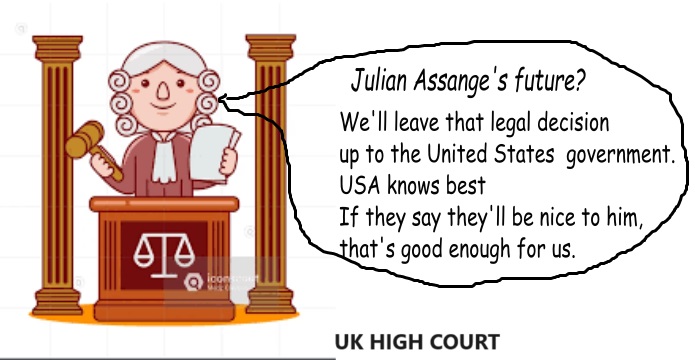
The WikiLeaks publisher could be extradited if the US gives “satisfactory assurances” of rights and no death penalty.
By Marjorie Cohn , TRUTHOUT 29 Mar 24, https://truthout.org/articles/uk-gives-biden-opportunity-to-dodge-assange-appeal-by-assuring-his-rights/
WikiLeaks publisher Julian Assange is closer than ever to being extradited to the United States for trial on 17 counts under the Espionage Act and one count of conspiracy to commit computer intrusion over WikiLeaks’s 2010-2011 revelation of evidence of U.S. war crimes in Iraq, Afghanistan and Guantánamo Bay. He faces 175 years in prison.
“This is a signal to all of you that if you expose the interests that are driving war they will come after you, they will put you in prison and they will try to kill you,” said Stella Assange, Julian’s wife, of his prosecution.
On March 26, the United Kingdom Divisional Court denied Assange the opportunity to make most of his appellate arguments. But the two-judge panel of Justice Jeremy Johnson and Dame Victoria Sharp left open the possibility that Assange could appeal on three grounds. They found that Assange “has a real prospect of success” on the following issues: If extradited to the U.S., he will be denied the right to freedom of expression, will suffer discrimination because he’s not a U.S. citizen and could be sentenced to death.
Rather than simply allowing Assange to argue the three issues on appeal, however, the panel gave the Biden administration an out. If the U.S. provides the court with “satisfactory assurances” that Assange won’t be denied any of these rights, his extradition to the U.S. can proceed without an appeals hearing.
Stella Assange called the decision “astounding,” adding, “The court’s recognized that Julian has been exposed to flagrant denial of his freedom of expression rights, that he is being discriminated against on the basis of his nationality and that he remains exposed to the death penalty.”
At an earlier stage in this case, the U.S. gave the U.K. High Court “assurances” that Assange would be treated humanely if extradited. That caused the court to reverse the magistrate judge’s denial of extradition (which was based on the likelihood of suicide if Assange is held in harsh conditions of confinement in the U.S.). The High Court accepted those assurances at face value in spite of the U.S.’s history of reneging on similar assurances.
The current ruling, however, requires U.S. assurances to be “satisfactory” and the defense will have an opportunity to challenge them at a hearing.
“Mr. Assange will not, therefore, be extradited immediately,” the panel wrote, implying that if they had denied his appeal outright, the U.K. authorities would put him on a plane to the U.S. forthwith. They gave the U.S. three weeks to come forward with satisfactory assurances.
If the U.S. fails to provide any assurances, Assange will be granted a hearing on the three grounds. If the U.S. does give assurances, a hearing to decide whether they are satisfactory will occur on May 20.
“The Biden administration should not offer assurances. They should drop this shameful case that should never have been brought,” Stella Assange said.
These are the grounds the High Court will review if the U.S. fails to provide “satisfactory assurances”:
1. Extradition Would Violate Freedom of Expression Guaranteed by Article 10 of European Convention on Human Rights
Assange would argue at trial that his actions were protected by the First Amendment to the U.S. Constitution. “He contends that if he is given First Amendment rights, the prosecution will be stopped. The First Amendment is therefore of central importance to his defence,” the panel concluded.
The First Amendment provides “strong protection” to freedom of expression, similar to that provided by Article 10 of the European Convention on Human Rights, the panel noted. Article 10 (1) of the convention says, “Everyone has the right to freedom of expression. This right shall include freedom to hold opinions and to receive and impart information and ideas without interference by public authority and regardless of frontiers.”
Gordon Kromberg, assistant U.S. attorney in the Eastern District of Virginia, where Assange’s trial would be held, said the prosecution might argue at trial that “foreign nationals are not entitled to protections under the First Amendment,” the panel noted. In 2017, then-CIA Director Mike Pompeo said that Assange “has no First Amendment freedoms” because “he is not a U.S. citizen.”
In addition, the U.S. Supreme Court ruled in the 2020 case of Agency for International Development v. Alliance for Open Society International that “it is long settled as a matter of American constitutional law that foreign citizens outside United States territory do not possess rights under the US Constitution.”
The panel wrote that if Assange “is not permitted to rely on the First Amendment, then it is arguable that his extradition would be incompatible with article 10 of the Convention.”
But even if the U.S. Department of Justice prosecutors give “satisfactory assurances” that Assange’s First Amendment rights would be protected, that is no guarantee. Prosecutors are part of the executive branch, which cannot bind the judicial branch due to the constitutional doctrine of separation of powers.
“The ruling reveals that the High Court does not understand the American system of government,” Stephen Rohde, who practiced First Amendment law for almost 50 years and writes extensively about the Assange case, told Truthout. “It only has before it the executive branch of the U.S. government. Whatever ‘satisfactory assurances’ the Department of Justice may give the High Court, they are not binding on the judicial branch.”
Moreover, Rohde said, “The High Court is obligated to uphold Assange’s rights to ‘freedom of expression’ under Article 10 of the European Convention on Human Rights, which protects Assange even if the U.S. courts refuse to do so. The only way to do that is to deny extradition.”
2. The U.K. Extradition Act Forbids Discrimination Based on Nationality
Julian Assange is an Australian citizen who would be tried in the U.S. if the Biden administration’s pursuit of extradition is successful.
Section 81(b) of the U.K. Extradition Act says that extradition is barred for an individual who “might be prejudiced at his trial or punished, detained or restricted in his personal liberty by reason of his … nationality.”
Due to the centrality of the First Amendment to Assange’s defense, the panel noted, “If he is not permitted to rely on the First Amendment because of his status as a foreign national, he will thereby be prejudiced (potentially very greatly prejudiced) by reason of his nationality.”
3. Extradition Is Barred by Inadequate Death Penalty Protection Required by the Extradition Act
Section 94 of the U.K. Extradition Act says, “The Secretary of State must not order a person’s extradition … if he could be, will be or has been sentenced to death for the offence” in the receiving state. That limitation does not apply if a written “assurance” that is “adequate” says “that a sentence of death- (a) will not be imposed, or (b) will not be carried out (if imposed).”
None of the charges that Assange is currently facing carry the death penalty. But if extradited to the U.S., he could be charged with aiding and abetting treason or espionage, both of which are capital offenses.
Ben Watson KC, secretary of state for the Home Department, admitted that:
a.) The facts alleged against [Assange] could sustain a charge of aiding or abetting treason, or espionage.
b.) If [Assange] is extradited, there is nothing to prevent a charge of aiding or abetting treason, or a charge of espionage, from being added to the indictment.
c.) The death penalty is available on conviction for aiding or abetting treason, or espionage.
d.) There are no arrangements in place to prevent the imposition of the death penalty.
e.) The existing assurance does not explicitly prevent the imposition of the death.
The panel noted that when former President Donald Trump was asked about WikiLeaks publishing the leaked documents, he said, “I think it was disgraceful…. I think there should be like a death penalty or something.” If Trump is reelected, he may seek to ensure that his Justice Department adds capital charges to the indictment.
In concluding that Assange could raise this issue on appeal subject to “satisfactory assurances,” the panel cited “the potential, on the facts, for capital charges to be laid; the calls for the imposition of the death penalty by leading politicians and other public figures; the fact that the Treaty does not preclude extradition for death penalty charges, and the fact that the existing assurance does not explicitly cover the death penalty.”
Appeal Grounds Denied by Panel
Remaining grounds for appeal that Assange requested were denied by the panel. They include prosecution for a political offense, prosecution based on political opinion; violation of right to a fair trial; violation of right to life; and violation of right to be free from torture and inhuman or degrading treatment or punishment. In addition, since no publisher has ever been prosecuted under the Espionage Act for publishing government secrets, Assange could not have known it was a crime.
The panel also ruled that Assange could not introduce new evidence adduced after the magistrate judge’s ruling. This includes a Yahoo News report detailing the CIA’s plan to kidnap and kill Assange when he was living under a grant of asylum in the Ecuadorian Embassy in London.
If the U.S. offers “satisfactory assurances” and extradition is ordered, Assange could appeal to the European Court of Human Rights and raise these additional issues as well.
Meanwhile, there is a possibility that instead of filing “assurances,” the Biden administration will opt to avoid the political pitfalls of Assange’s extradition to the U.S. and offer a plea bargain to end the case.
Marjorie Cohn is professor emerita at Thomas Jefferson School of Law, former president of the National Lawyers Guild, and a member of the national advisory boards of Assange Defense and Veterans For Peace, and the bureau of the International Association of Democratic Lawyers. She is founding dean of the People’s Academy of International Law and the U.S. representative to the continental advisory council of the Association of American Jurists. Her books include Drones and Targeted Killing: Legal, Moral and Geopolitical Issues.
Is Nuclear Fusion Really The Ultimate Solution to AI’s Crazy Power Use?

By Alex Kimani – Mar 29, 2024, https://oilprice.com/Energy/Energy-General/Is-Nuclear-Fusion-Really-The-Ultimate-Solution-to-AIs-Crazy-Power-Use.html
- A Boston Consulting Group analysis has predicted that data center electricity consumption will triple by 2030.
- Past trends in technology advances suggest that AI cons are very likely to outweigh the pros as far as power demand is concerned.
- OpenAI’s Altman: nuclear fusion is the ultimate solution to the AI energy puzzle
Two weeks ago, we reported how Artificial Intelligence (AI), cryptocurrency mining and clean energy manufacturing are powering the Fourth Industrial Revolution, or simply 4R, and driving disruptive trends including the rise of data and connectivity, analytics, human-machine interaction, and improvements in robotics. Unfortunately, these secular megatrends are pushing the U.S. power grid to its limits.

According to Sreedhar Sistu, vice president of artificial intelligence at Schneider Electric (OTCPK:SBGSF), excluding China, AI represents 4.3 GW of global power demand, and could grow almost five-fold by 2028. Another analysis has predicted that demand from AI will grow exponentially, increasing at least 10x between 2023 and 2026.

AI tasks typically demand more powerful hardware than traditional computing tasks. Meanwhile, bitcoin mining shows no signs of slowing down, with mining rates hitting 565 exahashes per second (EH/s) currently, a five-fold increase from three years ago.
Bitcoin mining consumes 148.63 TWh of electricity per year and emits 82.90 Mt CO2 per year, comparable to the power consumption of Malaysia. And, data center demand is not helping matters at all. Data center storage capacity is expected to grow from 10.1 zettabytes (ZB) in 2023 to 21.0 ZB in 2027, good for a 18.5% CAGR.

A Boston Consulting Group analysis has predicted that data center electricity consumption will triple by 2030, enough electricity to power 40 million U.S. homes.
The situation is already getting out of hand: U.S. power demand has started rising for the first time ever in 15 years. “We as a country are running out of energy,” Michael Khoo, climate disinformation program director at Friends of the Earth and co-author of a report on AI and climate, has told CNN.
To be fair, AI has been touted as one of the key technologies that will help tackle climate change. The revolutionary technology is already being used to track pollution, predict weather, monitor melting ice and map deforestation. A recent report commissioned by Google and published by the Boston Consulting Group claimed AI could help mitigate up to 10% of planet-heating pollution.
Unfortunately, past trends in technology advances suggest that AI cons are very likely to outweigh the pros as far as power demand is concerned.
“Efficiency gains have never reduced the energy consumption of cryptocurrency mining. When we make certain goods and services more efficient, we see increases in demand,” Alex de Vries, a data scientist and researcher at Vrije Universiteit Amsterdam, has pointed out.
At this point, nearly everybody agrees that we are incapable of developing renewable energy plants fast enough to meet this skyrocketing power demand. So, what other recourse do we have, short of saying let’s just build more natural gas and fossil fuel power plants?
Enter nuclear fusion, long regarded by scientists as the Holy Grail of clean and almost limitless energy. Sam Altman, head of ChatGPT creator OpenAI, says nuclear fusion is the ultimate solution to the AI energy puzzle, “There’s no way to get there without a breakthrough, we need fusion,” Altman said in a January interview. Altman reiterated this view a few weeks ago when podcaster and computer scientist Lex Fridman asked him about the AI energy conundrum.
Blue Sky Thinking

Unfortunately, Altman’s proposal is likely another case of overly optimistic blue-sky thinking, and we might not be any closer to building a commercial nuclear fusion reactor than we are to harvesting energy from blackholes.
For decades, nuclear fusion has been considered the “Holy Grail” of clean energy. If we were able to harness its power it would mean endless clean and sustainable energy. It’s what powers stars, and the theory is that it could be successfully applied to nuclear reactors–without the risk of a catastrophic meltdown disaster.
Scientists have been working on a viable nuclear fusion reactor since the 1950s–ever hopeful that a breakthrough is just around the corner. Unfortunately, the running joke has become that a practical nuclear fusion power plant could be decades or even centuries away, with milestone after milestone having fallen time and again
To be fair again, there’s been some promising glimpses into the possibilities here. Last year, a nuclear fusion reactor in California produced 3.15 megajoules of energy using only 2.05 megajoules of energy input, a rare instance where a fusion experiment produced more energy than it consumed. The vast majority of fusion experiments are energy negative, taking in more energy than they generate thus making them useless as a form of electricity generation. Despite growing hopes that fusion could soon play a part in climate change mitigation by providing vast amounts of clean power for energy-hungry technologies like AI, the world is “still a way off commercial fusion and it cannot help us with the climate crisis now”, Aneeqa Khan, research fellow in nuclear fusion at Manchester University, told the Guardian just after the initial December breakthrough.
You don’t have to look very far to get a healthy dose of reality check.
For decades, 35 countries have collaborated on the largest and most ambitious scientific experiments ever conceived: the International Thermonuclear Experimental Reactor (ITER), the biggest-ever fusion power machine. ITER plans to generate plasma at temperatures 10x higher than that of the sun’s core, and generate net energy for seconds at a time. As is usually the case with many nuclear power projects, ITER is already facing massive cost overruns that puts its future viability in question. W
When the ITER project formally commenced operations in 2006, its international partners agreed to fund an estimated €5 billion (then $6.3 billion) for a 10-year plan that would have seen the reactor come online in 2016. Charles Seife, director of the Arthur L. Carter Institute of Journalism at New York University, has sued ITER for lack of transparency on cost and incessant delays. According to him, the project’s latest official cost estimate now stands at more than €20 billion ($22 billion), with the project nowhere near achieving its key objectives. To make matters worse, none of ITER’s key players, including the U.S. Department of Energy, has been able to provide concrete answers of whether the team can overcome the technical challenges or estimates of the additional delays, much less the extra expenses.
Seife notes that whereas the Notre Dame took a century to complete, it eventually was used for its intended purpose less than a generation after construction began. However, he concludes by saying that the same can hardly be said about ITER, which looks less and less like a cathedral–and more like a mausoleum.
Einstein’s vision for peace

By Lawrence S. Wittner https://beyondnuclearinternational.org/2024/03/31/einsteins-vision-for-peace/
Aghast at the use of nuclear weapons, he threw himself into efforts to prevent worldwide nuclear annihilation
Although the popular new Netflix film, Einstein and the Bomb, purports to tell the story of the great physicist’s relationship to nuclear weapons, it ignores his vital role in rallying the world against nuclear catastrophe.
Aghast at the use of nuclear weapons in August 1945 to obliterate the cities of Hiroshima and Nagasaki, Einstein threw himself into efforts to prevent worldwide nuclear annihilation. In September, responding to a letter from Robert Hutchins, Chancellor of the University of Chicago, about nuclear weapons, Einstein contended that, “as long as nations demand unrestricted sovereignty, we shall undoubtedly be faced with still bigger wars, fought with bigger and technologically more advanced weapons.” Thus, “the most important task of intellectuals is to make this clear to the general public and to emphasize over and over again the need to establish a well-organized world government.”
Four days later, he made the same point to an interviewer, insisting that “the only salvation for civilization and the human race lies in the creation of a world government, with security of nations founded upon law.”
Determined to prevent nuclear war, Einstein repeatedly hammered away at the need to replace international anarchy with a federation of nations operating under international law. In October 1945, together with other prominent Americans (among them Senator J. William Fulbright, Supreme Court Justice Owen Roberts, and novelist Thomas Mann), Einstein called for a “Federal Constitution of the World.”
That November, he returned to this theme in an interview published in the Atlantic Monthly. “The release of atomic energy has not created a new problem,” he said. “It has merely made more urgent the necessity of solving an existing one. . . . As long as there are sovereign nations possessing great power, war is inevitable.” And war, sooner or later, would become nuclear war.
Given Einstein’s fame and his well-publicized efforts to avert a nuclear holocaust, in May 1946 he became chair of the newly-formed Emergency Committee of Atomic Scientists, a fundraising and policymaking arm for the atomic scientists’ movement. In the Committee’s first fund appeal, Einstein warned that “the unleashed power of the atom has changed everything save our modes of thinking, and thus we drift toward unparalleled catastrophe.”
Even so, despite the fact that Einstein, like most members of the early atomic scientists’ movement, saw world government as the best recipe for survival in the nuclear age, there seemed good reason to consider shorter-range objectives. After all, the Cold War was emerging and nations were beginning to formulate nuclear policies. An early Atomic Scientists of Chicago statement, prepared by Eugene Rabinowitch, editor of the Bulletin of the Atomic Scientists, underscored practical considerations.
“Since world government is unlikely to be achieved within the short time available before the atomic armaments race will lead to an acute danger of armed conflict,” it noted, “the establishment of international controls must be considered as a problem of immediate urgency.” Consequently, the movement increasingly worked in support of specific nuclear arms control and disarmament measures.
In the context of the heightening Cold War, however, taking even limited steps forward proved impossible. The Russian government sharply rejected the Baruch Plan for international control of atomic energy and, instead, developed its own atomic arsenal. In turn, U.S. President Harry Truman, in February 1950, announced his decision to develop a hydrogen bomb―a weapon a thousand times as powerful as its predecessor.
Naturally, the atomic scientists were deeply disturbed by this lurch toward disaster. Appearing on television, Einstein called once more for the creation of a “supra-national” government as the only “way out of the impasse.” Until then, he declared, “annihilation beckons.”
Despite the dashing of his hopes for postwar action to end the nuclear menace, Einstein lent his support over the following years to peace, nuclear disarmament, and world government projects.
The most important of these ventures occurred in 1955, when Bertrand Russell, like Einstein, a proponent of world federation, conceived the idea of issuing a public statement by a small group of the world’s most eminent scientists about the existential peril nuclear weapons brought to modern war. Asked by Russell for his support, Einstein was delighted to sign the statement and did so in one of his last actions before his death that April.
In July, Russell presented the statement to a large meeting in London, packed with representatives of the mass communications media. In the shadow of the Bomb, it read, “we have to learn to think in a new way. . . . Shall we . . . choose death because we cannot forget our quarrels? We appeal as human beings to human beings: Remember your humanity, and forget the rest.”
This Russell-Einstein Manifesto, as it became known, helped trigger a remarkable worldwide uprising against nuclear weapons in the late 1950s and early 1960s, culminating in the world’s first significant nuclear arms control measures. Furthermore, in later years, it inspired legions of activists and world leaders. Among them was the Soviet Union’s Mikhail Gorbachev, whose “new thinking,” modeled on the Manifesto, brought a dramatic end to the Cold War and fostered substantial nuclear disarmament.
The Manifesto thus provided an appropriate conclusion to Einstein’s unremitting campaign to save the world from nuclear destruction.
Lawrence S. Wittner is Professor of History Emeritus at SUNY/Albany and the author of Confronting the Bomb (Stanford University Press).
British nuclear site Sellafield to be prosecuted for cybersecurity failures

Alexander Martin, March 29th, 2024, https://therecord.media/sellafield-site-prosecution-nuclear-facility-cybersecurity
The United Kingdom’s independent nuclear safety regulator has announced that it will be prosecuting the company managing the Sellafield nuclear site over “alleged information technology security offenses during a four year period between 2019 and early 2023.”
It is not clear whether senior managers at the state-owned Sellafield Ltd. will face charges. Under the Nuclear Industries Security Regulations 2003, individuals convicted of an offense can face up to two years imprisonment.
“There is no suggestion that public safety has been compromised as a result of these issues,” the regulator announced on Thursday, adding that the decision to begin legal proceedings followed an investigation.
“Details of the first court hearing will be announced when available,” stated the ONR.
Sellafield had previously been the focus of enhanced regulatory attention over its cybersecurity failings, as the U.K. chief nuclear inspector’s annual report revealed last year. At the same time, EDF, the company operating several nuclear power plants in Britain, was placed under similar measures.
As set out in the U.K.’s civil nuclear cybersecurity strategy, the National Cyber Security Centre (NCSC) threat assessment warns that ransomware “almost certainly represents the most likely disruptive threat.”
A ransomware attack on the IT systems used by a nuclear power plant could disrupt its operations, although the industrial systems are designed with multiple failsafes to prevent a radiological accident.
Sellafield’s nuclear reactor was closed in 2003, but the sprawling complex remains the largest nuclear site in Europe, with the ONR describing it as “one of the most complex and hazardous nuclear sites in the world.”
It houses more plutonium — in particular the isotopes created as a byproduct of nuclear reactor operations — than any other location on the planet, alongside a range of facilities for nuclear decommissioning, and waste processing and storage.
It was the location of the country’s worst-ever nuclear accident in 1957, when a reactor caught fire leading to radioactive material spreading in the atmosphere across Britain and Europe.
Cyberattacks targeting the operational technology (OT) systems at power plants are rare, but not unheard of — with the Triton malware discovered in Saudi Arabia in 2017 among the best known and most concerning examples.
It is not known whether the suspected Russian actors behind that attack could have engineered a method to overcome the failsafe mechanisms preventing an explosion.
According to the British government’s National Risk Register, a cyberattack on the computer systems controlling a nuclear reactor could potentially require a controlled shutdown as a protective measure, although there is not a major concern about them causing any radiological discharge.
As Sellafield no longer has an operational nuclear reactor, it is not clear what damage a cyber incident at the facility could cause.
Michigan Republican congressman says Gaza should be destroyed with nuclear bomb ‘like Nagasaki and Hiroshima’, as he slams US for sending humanitarian aid
- Michigan Republican Congressman Tim Walberg has suggested using a nuclear bomb on Gaza in order to facilitate Israel’s elimination of Hamas
- He referenced bombs used in World War II on the Japanese cities of Nagasaki and Hiroshima
- Walberg’s remarks drew condemnation, with some calling for his resignation while his spokesperson said he was using a metaphor
By JAMES GORDON FOR DAILYMAIL.COM , 31 March 2024, https://www.dailymail.co.uk/news/article-13255849/Michigan-GOP-congressman-says-Gaza-destroyed-nuclear-bomb-like-Nagasaki-Hiroshima-slams-sending-humanitarian-aid.html
A Michigan Congressman has suggested a nuclear bomb should be dropped on Gaza to ‘support Israel‘s swift elimination of Hamas.’
Speaking during a town hall earlier this week, U.S. Rep. Tim Walberg, a Republican from Lenawee County, appeared entirely comfortable advocating for the use of nuclear weapons against the Palestinians.
‘It should be like Nagasaki and Hiroshima. Get it over quick,’ Walberg could be heard stating in a video posted to X in which he mentioned the Japanese cities in which America detonated atomic bombs at the end of World War II.
Walberg, an eight-term Republican congressman from Lenawee County, can also be heard speaking against providing humanitarian aid for those in the Palestinian territory.
‘We shouldn’t be spending a dime on humanitarian aid,’ Walberg stated in response to a question about American troops being deployed into Gaza to build a port that would help aid be delivered to the Palestinians.
Walberg had been responding to a question about an initiative put forward by President Joe Biden to use American tax dollars to construct a port off the Gaza coast that would allow humanitarian aid to be delivered more quickly.
Many recent reports have suggested the Gaza’s two million inhabitants are on the brink of famine as Israel’s war against Hamas approaches the six month mark.
The conflict began after Hamas terrorists launched an attack on Israeli citizens, killing 1,200 and taking 240 hostages.
Walberg’s office has now attempted to explain the GOP congressman’s seemingly straightforward answer as a metaphor.
‘During his community gathering, he clearly uses a metaphor to support Israel’s swift elimination of Hamas, which is the best chance to save lives long-term and the only hope at achieving a permanent peace in the region,’ Walberg spokesman Mike Rorke said on Saturday.
‘Congressman Walberg vehemently disagrees with putting our troops in harm’s way. He has great empathy for the innocent people in Gaza who have been thrust into this situation due to the attack carried out by Hamas leaving 1,163 innocent civilians dead,’ Rorke continued.
‘To this day, Hamas still is holding hostages, including Americans. Hamas should surrender and return the hostages.’
Walberg’s comments have been described as ‘clear call to genocide by a member of Congress’.
The Michigan chapter of the Council on American-Islamic Relations said his remarks should be ‘condemned by all Americans who value human life and international law.’
‘To so casually call for what would result in the killing of every human being in Gaza sends the chilling message that Palestinian lives have no value,’ CAIR Executive Director Dawud Walid said to Detroit News.
‘It is this dehumanization of the Palestinian people that has resulted in the ongoing slaughter and suffering we see every day in Gaza and the West Bank.’
The U.N. food agency has said famine is ‘imminent’ in northern Gaza, with two-thirds of population experiencing catastrophic hunger.
Later in the town hall, held on March 25 in Dundee, Michigan, Walberg went on to suggest that a nuclear bomb should also be used in Russia’s war with Ukraine in order to ‘defeat Putin quick.’
He said instead of American money being used to provide aid to Ukraine for humanitarian purposes, it should instead be used ‘to wipe out Russia, if that’s what we want to do.’
Walberg has been taken to task over his comments by his Democratic colleagues with some calling for his immediate resignation.
Michigan state Democratic Senator Darrin Camilleri tweeted how Walberg had been caught on video ‘endorsing and calling for a complete genocide in Gaza.’
‘He’s an absolute disgrace and needs to resign,’ Camilleri stated.
‘Threatening to use, suggesting the use of, or, God forbid actually using nuclear weapons, are unacceptable tactics of war in the 21st Century,’ wrote Democratic Michigan Rep. Haley Stevens.
US secretly sending more bombs to Israel – Washington Post.
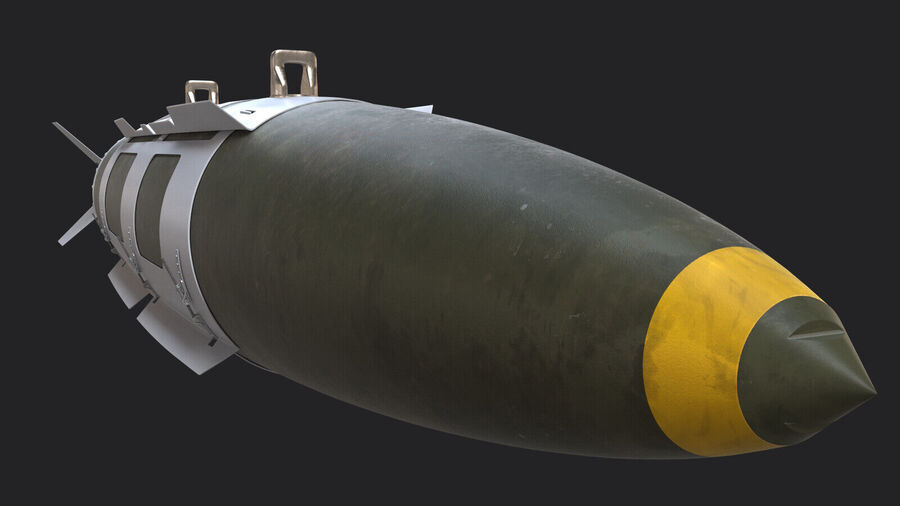
A US 2000 pound bomb (MK-84) of which the US has sent thousands to Israel to aid the genocide.
Sat, 30 Mar 2024 https://www.sott.net/article/490252-US-secretly-sending-more-bombs-to-Israel-WaPo
Washington is fueling the war in Gaza with new arms supplies despite a rift with West Jerusalem
The US has signed off on the transfer of billions of dollars worth of bombs and aircraft to Israel, despite publicly expressing concerns about a looming Israeli ground incursion into the overcrowded Gaza town of Rafah, the Washington Postreported on Friday.
Around 1,800 MK84 2,000-pound bombs and 500 MK82 500-pound bombs are among the armaments in the handover, anonymous Pentagon and White House officials told the newspaper. On top of that, the State Department reportedly authorized the transfer of 25 F-35A aircraft and engines valued at around $2.5 billion. The transfers had originally been approved by Congress years ago as part of the $3 billion+ annual military assistance to the longtime ally, so did not require a new notification.
The use of US-supplied bombs added to the soaring death toll in Gaza, which by the end of March topped 32,000, according to the latest figures provided by Palestinian health officials.
West Jerusalem is seeking to completely eliminate Palestinian militant group Hamas, which staged an incursion from the enclave into southern Israel last October, killing around 1,200 people and capturing scores of hostages.
The Israel Defense Forces (IDF) allegedly used the 2,000-pound bunker busters in strikes on Gaza’s Jabalia refugee camp and around the Al-Shati refugee camp last year. The Jabalia bombings alone are believed to have claimed more than 100 lives, in what the UN later called “disproportionate attacks that could amount to war crimes.”
Comment: Bombing a refugee camp with 2000 pound bunker buster bombs is a war crime.
Washington insists that Israel has provided the US with “credible and reliable written assurances” that any military aid provided has been used in accordance with international law. “We have not found them to be in violation,” State Department spokesman Matthew Miller told the press on Monday.
However, the rift between Washington and the Jewish state has become increasingly evident this week, when the US allowed a resolution urging for an immediate ceasefire to pass in the UN Security Council, instead of vetoing it. In response, Israel canceled the planned visit of a high-level delegation to the US.
The delegation was supposed to discuss the planned Israeli military operation against Rafah, a city in the south of Gaza where more than 1.4 million of the enclave’s total population is currently taking refuge. The UN has warned that the offensive will lead to massive loss of life, and even the White House has publicly urged Israel against the attack.
Israel has “no choice” but to send troops into the overcrowded Palestinian city, Prime Minister Benjamin Netanyahu told US lawmakers on Wednesday, reiterating that the remaining Hamas strongholds must be completely eliminated.
Comment: The US is without honor or shame and despite calls for peace and respect for civilians has supplied Israel with ‘carte blanche’ to continue its genocidal campaign. Had the US not supplied the weapons and the money, this war would have stopped long ago.
Ukrainian counteroffensive ‘biggest debacle in modern military history’ – David Sacks
https://www.rt.com/news/595214-sacks-ukraine-counteroffensive-fail/ 1 Apr 24
The former PayPal chief says US politicians such as Nancy Pelosi should be held accountable for encouraging the doomed operation.
The failure of Ukraine’s 2023 summer counteroffensive against Russia was “easily predictable,” according to US tech entrepreneur and venture capitalist David Sacks, who has suggested that the Washington elite should be held accountable for talking up the doomed operation.
Sacks’ comments came in response to a post on Saturday by Tesla and SpaceX CEO Elon Musk, who condemned the unnecessary loss of life suffered by Kiev’s forces as they attempted to “attack a larger army” that had superior defenses.
The failed Ukrainian counteroffensive was “one of the biggest debacles in the history of modern warfare,” Sacks said in agreement, adding that Kiev’s soldiers and tanks had effectively run “headlong into minefields while Russian artillery rained down on them from heavily fortified positions.”
“This should have been easily predictable,” the former PayPal COO and founder of the Yammer corporate social network stressed.
According to estimates released in March by the Russian Defense Ministry, the Ukrainian military saw over 166,000 casualties during last year’s failed counteroffensive. Kiev’s overall casualties since the outbreak of the conflict with Russia stand at 444,000, the ministry has claimed.
Sacks went on to suggest that US officials such as ex-CIA chief David Petraeus, former House Speaker Nancy Pelosi, and current US Secretary of State Antony Blinken should all be held responsible for encouraging the doomed operation.
“These people are fools who should have no credibility left. But of course the MSM never holds them accountable so we will get more of the same until Ukraine finally collapses,” Sacks surmised.
Musk, meanwhile, has called the counteroffensive “a tragic waste of life for Ukraine,” suggesting that Kiev should not have attacked Russian forces – which had deployed vast minefields and had stronger artillery – while Ukrainian forces lacked armor or air superiority.
“Any fool could have predicted that,” the billionaire said, recalling that one year ago he had recommended that Kiev’s forces entrench and apply all resources to defense.
Musk stated that Kiev would continue to have difficulty holding on to territory, but suggested that Russia was unlikely try to take over the entire country, arguing that it would face “extreme” local resistance in western regions of Ukraine.
He also warned that if the conflict “lasts long enough, Odessa will fall,” and advised Kiev to reach a negotiated settlement with Moscow as soon as possible, before Russia gains more territory and Ukraine loses all access to the Black Sea.
Moscow has stressed that it remains open to meaningful talks with Kiev, and has blamed the lack of a diplomatic breakthrough on the Ukrainian authorities, who refuse to accept the “reality on the ground.”
Ecocide a ‘Critical Dimension of Israel’s Genocidal Campaign’ in Gaza: Probe
Analysis by a research group found that roughly 40% of Gaza land that was previously used for food production has been destroyed by Israeli forces.
JAKE JOHNSON, Mar 29, 2024, https://www.commondreams.org/news/ecocide-israel-gaza
The widespread destruction Israel’s military has inflicted on Gaza’s farmland and agricultural infrastructure amounts to a “deliberate act of ecocide,” according to a new investigation that uses satellite imagery to survey the extent of the damage.
Released Friday ahead of Palestine’s Land Day, the analysis by the London-based research group Forensic Architecture (FA) shows that Israel’s ground forces—including tanks and other military vehicles—have advanced over half of Gaza’s farms and orchards, critical food sources that the besieged enclave’s population has worked tirelessly to cultivate in the face of decades of occupation.
“Since 2014, Palestinian farmers along Gaza’s perimeter have seen their crops sprayed by airborne herbicides and regularly bulldozed, and have themselves faced sniper fire by the Israeli occupation forces,” FA said. “Along that engineered ‘border,’ sophisticated systems of fences and surveillance reinforce a military buffer zone.”
Comparing satellite imagery from prior to Israel’s invasion and the present, FA found that roughly 40% of Gaza land that was previously used for food production has been destroyed by Israeli forces. Nearly a third of Gaza’s greenhouses have been demolished, according to the investigation.
“In total, Forensic Architecture has identified more than 2,000 agricultural sites, including farms and greenhouses, which have been destroyed since October 2023, often to be replaced with Israeli military earthworks,” the group said. “This destruction has been most intense in the northern part of Gaza, where 90% of greenhouses were destroyed in the early stages of the ground invasion.”
It is no surprise, then, that northern Gaza is currently experiencing famine conditions, with most of the population there at imminent risk of starvation as Israeli forces impede the flow of humanitarian assistance and continue their relentless bombing campaign.
Leading human rights organizations have accused the Israeli government of using starvation as a weapon of war in Gaza, pointing to the decimation of the territory’s agricultural sector and attacks on aid convoys. The United Nations warned less than two months into Israel’s assault that “in the north, livestock is facing starvation and the risk of death due to shortage of fodder and water.”
The new investigation was published amid growing global momentum to formally codify ecocide as an international crime alongside genocide, which Israel also stands accused of committing against Palestinians in Gaza.
An expert panel convened by Stop Ecocide International has defined ecocide as “unlawful or wanton acts committed with knowledge that there is a substantial likelihood of severe and either widespread or long-term damage to the environment being caused by those acts.”
Ecocide is officially recognized as a crime in at least 10 countries, including France, Ecuador, Russia, and Ukraine. Earlier this week, the European Council adopted new rules that include a provision criminalizing acts deemed “comparable to ecocide.”
FA’s analysis argues that Israel’s latest military assault on the Gaza Strip and the intentional targeting of the enclave’s agriculture is “a critical dimension of Israel’s genocidal campaign,” fueling both a humanitarian and environmental disaster.
“The targeted farms and greenhouses are fundamental to local food production for a population already under a decades-long siege,” the research group said. “The effects of this systematic agricultural destruction are exacerbated by other deliberate acts of deprivation of critical resources for Palestinian survival in Gaza.”
“These acts include the well-reported, catastrophic, and Israeli-made famine ongoing in Gaza, continued obstruction of humanitarian aid destined for Gaza, the destruction of medical infrastructure, the destruction beyond repair of other areas of civilian infrastructure, including bakeries, schools, mosques, churches, and cultural heritage sites,” the group added.
An interview with Annie Jacobsen, author of ‘Nuclear War: A Scenario’

By Michael Mechanic | April 1, 2024
Nuclear war is a topic few care to think about. We sometimes call it unthinkable. But we need to think carefully, and to talk—particularly with high-ranking foreign officials whose motives we may have reason to distrust, just as they distrust ours—about how we can collectively avoid launching a weapon that would end our civilization.
Pulitzer Prize finalist Annie Jacobsen’s timely new book, Nuclear War: A Scenario, is a lightning-fast read intended to put the nuclear threat squarely back on everyone’s radar. Her narrative thread, as the title suggests, is a fact-based (though thankfully fictional) scenario that shows how a nuclear launch can escalate into World War III at dizzying speed.
Jacobsen tees up her cinematic approach with chapters describing how we got here, including a discussion of America’s Single Integrated Operational Plan (SIOP) for General Nuclear War—which was devised in the 1960s and, as Jacobsen details in this book excerpt published today by Mother Jones, was more or less a recipe for the end of the world.
Because that’s nuclear war: One bad assumption, one shot, one retaliation, and it’s unstoppable.
Your book is frightful. What made you want to write in such detail how a nuclear war could unfold?
As a national security reporter, I have written six previous books on military and intelligence programs—CIA, Pentagon, DARPA—all designed to prevent nuclear World War III. During the Trump administration, amid the “fire and fury” rhetoric, I was watching STRATCOM commanders and deputy commanders speak freely on C-SPAN about the dangers therein. I began to wonder, My god, what would happen if deterrence failed? I began to interview people during COVID, when people had more time on their hands for someone like me—and that began the terrifying process of learning that nuclear war is, in essence, a sequence of events, and that once it starts it almost certainly will not stop.
………………………………………………………………………………………………………………… One thing that really struck me is the unbelievable speed at which nuclear war is waged.
Gen. Robert Kehler, the former commander of STRATCOM, said to me that the world could end in the next couple of hours. It took me a minute to ask my next question, because coming from someone in that position of authority—the most significant role in the entire nuclear apparatus—that really blew my mind.
Ditto goes for an interview I did with President Barack Obama’s FEMA chief, Craig Fugate. Of course, FEMA is the agency in charge of what’s called population protection planning for American citizens in the event of hurricanes, floods, earthquakes. Fugate told me that after a nuclear war, there wouldn’t be any population protection planning because everyone would be dead.
Help is not coming.………………….
I learned from your book that FEMA plays a unique role in the event of a nuclear attack, and it’s not what one might expect.
That’s right. In the ’50s and ’60s, the US position was that a nuclear war could be fought and won. That is no longer the official position. But plans were put in place for the continuity of government programs—the idea that the government must continue functioning no matter what. That is also a fantasy.
To hear from former Secretary of Defense Bill Perry about the madness and mayhem and anarchy that would follow, in his mind, in the event of a nuclear war, you really get the sense that civilization will fail. I believe one of the reasons so many of these sources went on the record for me is because they know that this is the truth. And they know it is up to the people to change the trajectory of where we’re headed. I mean, my god, look at the saber-rattling going on as we do this interview…………………………………………………………………………………………………………………………………………………………………………………………………………………………….
“Launch on warning” puts extraordinary pressure on a president. The one in your scenario is pretty clueless. He hasn’t ever rehearsed. Nobody told him he’d have just six minutes to choose from a Denny’s breakfast menu of existential options in response to what may or may not be an incoming nuke. It’s hard to believe the Pentagon doesn’t put every new president through a series of war games.
I was just as surprised as you are. But that’s coming from multiple secretaries of defense and national security advisers—people in a position to advise the president on a nuclear counterattack. The best summation came from Leon Panetta, who explained that as White House chief of staff he was witness to the fact that the president is primarily concerned with domestic issues—like his popularity. I asked Panetta how clued in he was when he was the CIA director, and he said almost not at all, because the CIA is about intelligence, not nuclear operations………………………………………………………………………………………………………………….
Your book busts some common myths, for instance the belief that the US could shoot down an incoming nuclear missile. We really can’t defend against nuclear weapons, can we?
We can’t. That is pure fantasy. During the final fact-checking incantations, I had the book read by a lieutenant general who ran these scenarios for NORAD. I was almost hoping someone would say, Annie, you should take this part out of the book, because we have a secret Iron Dome that you can’t report on. No. The truth is that the United States relies upon 44 interceptor missiles to stop any incoming missiles. Russia alone has 1,674 nuclear warheads in “ready to launch” position. Adding to that, according to congressional reports, the interceptors are only approximately 50 percent effective.
Under the best of circumstances.………………………………………………………………..
The Rising Nuclear Threat
Readers respond to the “At the Brink” series of Opinion articles.
March 30, 2024, https://www.nytimes.com/2024/03/30/opinion/nuclear-threat.html
To the Editor:
Re the “At the Brink” series (Opinion, March 10):
Thank you for highlighting the existential threat of nuclear weapons.
President Ronald Reagan and the last Soviet president, Mikhail Gorbachev, issued a joint statement in 1985 saying “a nuclear war cannot be won and must never be fought.” But we squandered the opportunity at the end of the Cold War to abolish these weapons.
Today we are entering an extremely dangerous new arms race and risking direct military confrontation with a revanchist Russia, while other nuclear conflicts loom around the world.
The United States, as you report, is expected to spend up to $2 trillion to “modernize” the entire U.S. nuclear arsenal. More modern weapons are more likely to be used and to take the world over the fateful nuclear threshold.
A group of citizens and experts has proposed an alternative: “Back From the Brink,” a program to reduce nuclear risk. It calls on the United States to 1) declare it will never be the first to use nuclear weapons in a conflict and invite other nations to make similar pledges; 2) take nuclear weapons off hair-trigger alert; 3) end the president’s sole, unchecked authority to launch a nuclear attack; 4) cancel plans to “modernize” its nuclear arsenal; and 5) enter negotiations with other nuclear powers toward the verifiable global elimination of nuclear weapons.
An awakened citizenry must demand that our leaders work to end the nuclear threat.
David Keppel
Bloomington, Ind.
Oppenheimer: Monaghan man, Daniel A. McGovern, who captured nuclear devastation
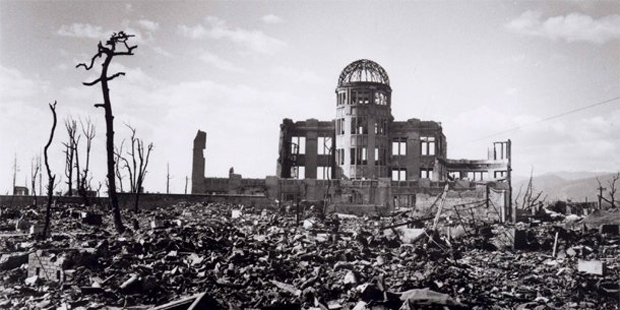
By Adam Mandeville, BBC News NI 31 Mar 24
The success of the film Oppenheimer has shone a spotlight once more on the bombings of Hiroshima and Nagasaki.
However, the story of one Monaghan man involved in the aftermath appears to have been forgotten.
Just one month after the bombings, Lt Col Daniel A. McGovern was the first person sent by the US to document the damage.
A member of the US Airforce, he was a specialist cameraman trained to document bombs and their aftermath.
In one scene in the Academy Award winning Oppenheimer film, the titular character played by Irish man Cillian Murphy looks in horror at footage of the aftermath of the bombing.
But these images may not have survived for others to see if it were not for one man from Carrickmacross.
McGovern’s biographer said the story is one of most amazing he has ever heard.
“McGovern’s story is better, in my opinion, than Oppenheimer’s,” he said.
In total, Col McGovern’s team collected over 125,000ft of colour and black and white footage – though much of this was classified.
When he returned from Japan, Col McGovern made secret copies of the footage to ensure it would be saved from US government censorship.
He took these from the Pentagon, storing one set at an air force motion picture depository in Dayton, Ohio, and kept the other himself.
In 1967, a US Congressional committee, that included Robert Kennedy, asked to see the atomic bomb footage.
The material had been declassified but no one could find the originals.
Col McGovern directed the authorities to his copies.
In 1970, the general public got its first glimpse of some of the footage as it was incorporated into a film called Hiroshima Nagasaki – August 1945.
McGovern’s huge risk to secretly keep copies of his footage ensured that the committee had access to crucial documents.
Joseph McCabe spent 20 years working on a biography of Col McGovern, called Rebels to Reels: A Biography of Combat Cameraman Daniel A. McGovern USAF.
He said Col McGovern could have been shot for treason after making copies of the classified footage, but did so to save it for future generations…………………………………………………..
Mr McCabe suggested the footage watched by J Robert Oppenheimer would have been captured by McGovern.
Historian Dr Tom Thorpe said without the footage captured by McGovern, films such as Oppenheimer may never have been made.
“McGovern’s actions to save the footage ensured that it remained available for future generations,” he said.
“[McGovern’s] contributions indirectly influenced the availability of such archival material for films like Oppenheimer.”
He added that the images are “immensely important to our understanding of history”.
…………………………………………………………………….. In the latter half of the 20th Century, Col McGovern would continue to work for the US military and government, photographing various bomb tests, including those of Wernher Von Braun, co-developer of the V2 rocket.
He was also asked to help gather footage in and around Roswell, New Mexico following the now famous Roswell incident.
Col Daniel A McGovern passed away in California in 2005.
In 2022, 100 years after the McGovern family left for the US, his family returned to Carrickmacross to witness the unveiling of a commemorative plaque, dedicated to the man who photographed one of the most infamous events of the 20th Century. https://www.bbc.com/news/uk-northern-ireland-68656372
‘My jaw dropped’: Annie Jacobsen on her scenario for nuclear war

in such circumstances the president is likely to be subject to “jamming”, a chorus of military voices urging he or she follows protocols which lead inexorably towards a retaliatory launch.
“My jaw dropped at so much of what I learned, which was not classified but had just been removed or rather sanitised from the public discourse,” she said. “I found myself constantly surprised by the insanity of what I learned, coupled with the fact that it’s all there for the public to know.”
in such circumstances the president is likely to be subject to “jamming”, a chorus of military voices urging he or she follows protocols which lead inexorably towards a retaliatory launch.
The author’s new book posits an all-too-possible catastrophe, destruction assured by human frailty as much as by technology
Julian Borger, Sun 31 Mar 2024 https://www.theguardian.com/books/2024/mar/31/annie-jacobsen-nuclear-war-scenario—
Annie Jacobsen was a high school student in 1983, when ABC television broadcast the film The Day After, about the horrors of nuclear war. She never forgot the experience. More than 100 million Americans watched and were terrified too. One of them lived in the White House. According to his biographer and his own memoirs, it helped turn Ronald Reagan into a nuclear disarmer in his second term.
Not long after, the world’s stockpile of nuclear warheads peaked and began to decline rapidly, from 70,000 to just over 12,000 currently, according to the Federation of American Scientists.
That is still enough however to reduce the Earth to a radioactive desert, with some warheads left over to make it glow. Meanwhile, the global situation is arguably the most dangerous since the Cuban missile crisis, the Russian invasion of Ukraine grinding on mercilessly and China contemplating following Moscow’s example by making a grab for Taiwan.
The danger of nuclear war is as immediate as ever but it has faded from public discourse, which is why Jacobsen, now a journalist and author, felt driven to write her new book, Nuclear War: A Scenario.
“For decades, people were under the assumption that the nuclear threat ended when the Berlin Wall went down,” Jacobsen said, before suggesting another reason the existential threat of nuclear weapons has been filtered out of mainstream discourse – it has been turned into a technical debate.
“Nuclear weapons and the whole nomenclature around them have been so rarefied it’s been reserved as a subject for those in the know,” she said.
In her book, Jacobsen seeks to break through jargon and details in order to tell a terrifying story in a devastatingly straightforward way. The spoiler alert is that it doesn’t end well.
As the book promises on the cover, it presents a single scenario for a nuclear war, set in the present day. North Korea, perhaps convinced it is about to be attacked, launches a surprise missile strike against the US, leading Washington to respond with a salvo of 50 Minuteman III intercontinental ballistic missiles (ICBMs). These are aimed at North Korea’s weapons sites and command centres, but in order to reach their intended targets the missiles have to fly over Russia, because they do not have the range to use any other route.
All too aware of the danger of miscalculation, the US president tries to get hold of his Russian counterpart. But the two men and the countries they run are not getting on, and he fails. Making things even worse, Russia’s dodgy satellite early warning system, Tundra, has exaggerated the scale of the US salvo, and from his Siberian bunker, the Russian president (Vladimir Putin in all but name) orders an all-out nuclear attack on the US.
The scenario is based on known facts concerning the world’s nuclear arsenals, systems and doctrine. Those facts are all in the public domain, but Jacobsen believes society has tuned them out, despite (or perhaps because of) how shocking they are.
Jacobsen was stunned to find out that an ICBM strike against North Korea would have to go over Russia, and that Russia’s early warning system is beset with glitches, an especially worrying fact when combined with the knowledge that both the US and Russia have part of their nuclear arsenals ready to launch at a few minutes’ notice. Both also have an option in their nuclear doctrine to “launch on warning”, without waiting for the first incoming warhead to land.
A US president would have a few minutes to make a decision if American early warning systems signaled an incoming attack. In those few minutes, he or she would have to process an urgent, complex and inevitably incomplete stream of information and advice from top defence officials. Jacobsen points out that in such circumstances the president is likely to be subject to “jamming”, a chorus of military voices urging he or she follows protocols which lead inexorably towards a retaliatory launch.
“My jaw dropped at so much of what I learned, which was not classified but had just been removed or rather sanitised from the public discourse,” she said. “I found myself constantly surprised by the insanity of what I learned, coupled with the fact that it’s all there for the public to know.”
Ultimately, only presidents can make the decision and once it is made, no one has the authority to block it. It is called sole authority, and it is almost certainly the most frightening fact in the world today. It means a handful of men each have the power to end the world in a few minutes, without having to consult anyone.
It is not a group anyone would choose to have that responsibility, including as it does the likes of Putin and Kim Jong-un. In Washington it is a choice this year between Joe Biden and Donald Trump. They all bring a lot of human frailty, anger, fear and paranoia to a potential decision that could end the planet.
You would want to have a commander-in-chief who is of sound mind, who is fully in control of his mental capacity, who is not volatile, who is not subject to anger,” Jacobsen said, referring to this year’s presidential election.
“These are significant character qualities that should be thought about when people vote for president, for the simple reason that the president has sole authority to launch nuclear weapons.”
- Nuclear War: A Scenario is published in the US by Dutton
United Arab Emirates signals interest in European nuclear energy investments, sources say

ENEC has ambitions of becoming an international nuclear energy company holding minority stakes in nuclear power infrastructure of other nations, without managing or operating them.
A lack of investment, cost overruns and delays have also plagued recent projects.
It could also face political opposition to an investment in such a sensitive area.
29/03/2024 , By Alexander Cornwell and Maha El Dahan, https://uk.investing.com/news/commodities-news/uae-signals-interest-in-european-nuclear-energy-investments-sources-say-3408307
DUBAI (Reuters) – The United Arab Emirates has approached European nations including Britain to gauge their interest in the Middle Eastern state investing in their nuclear power infrastructure, according to three sources familiar with the talks.
As part of its outreach, the UAE has discussed the idea of state-owned Emirates Nuclear Energy Company (ENEC) becoming a minority investor in European nuclear power assets, the sources said. They requested anonymity because the discussions are private.
ENEC has ambitions of becoming an international nuclear energy company holding minority stakes in nuclear power infrastructure of other nations, without managing or operating them, the sources told Reuters.
ENEC, owned by Abu Dhabi’s ADQ, has been holding talks to invest in the United Kingdom, the sources who have been briefed on the discussions added, without elaborating. Cash-rich oil producers United Arab Emirates and Saudi Arabia are seeking to diversify their economies away from fossil fuels. Meanwhile, Britain is looking for additional private investment in the Sizewell C large-scale nuclear project being built by French energy giant EDF (EPA:EDF) in southeast England after buying out a China backer.
The UAE and Britain in December signed a so-called memorandum of understanding on civil nuclear cooperation at the U.N. climate summit in Dubai, where more than 20 countries agreed a pledge to treble nuclear capacity by 2050.
“Sizewell C is a crucial part of the UK’s agenda for new nuclear power, which is central to our plans for achieving a low cost, clean and secure electricity system,” a spokesperson for Britain’s Department for Energy Security and Net Zero told Reuters.
“The commercial structure of the project is subject to ongoing development and commercially sensitive discussions,” the spokesperson said, adding they could not comment further.
As part of “international growth and investment plans, ENEC is working with a multitude of partners to explore collaboration opportunities in both new civil nuclear projects and civil nuclear technologies and related clean energy technologies such as clean hydrogen,” ENEC said in a statement to Reuters.
EDF declined to comment.
The UK and EDF are ‘on track’ to raise 20 billion pounds ($25.2 billion) for Sizewell C by end of year, a UK energy security minister told the Financial Times in January, without naming the investors. UK ministers have been lining up Abu Dhabi investors for Sizewell C, the Times of London reported last year.
The sources told Reuters that, among the proposals, ENEC could also be a partner in the development of new nuclear energy infrastructure in European countries given its relatively recent experience in building a facility.
ENEC oversaw the construction of the UAE’s sole nuclear power plant, which was constructed in Abu Dhabi by Korea Electric Power Corp (KEPCO), and started commercial operations in 2021.
Several European countries are pushing to expand nuclear – a low-carbon energy source – in an effort to meet ambitious climate goals and develop alternatives to Russian energy supplies.
But European Union states are divided over nuclear energy use, which fell out of favour over safety concerns following Japan’s Fukushima nuclear accident in 2011.
A lack of investment, cost overruns and delays have also plagued recent projects.
ENEC’s backing by a wealthy Gulf state could potentially help overcome investment challenges. However, it could also face political opposition to an investment in such a sensitive area.
Emirati state investments have recently raised concerns in Britain, which has blocked a state-linked acquisition of prominent conservative newspaper the Telegraph.
Britain’s government also determined that a recent investment by UAE state-linked telecommunications company E& posed national security concerns, although approved the deal.
($1 = 0.7925 pounds)
Japan confirms experts met in China to ease concerns over discharge of treated radioactive water
Japan said Sunday its experts have held talks with their Chinese
counterparts to try to assuage Beijing´s concerns over the discharge of
treated radioactive wastewater from the wrecked Fukushima Daiichi nuclear
power plant into the sea. The discharges have been opposed by fishing
groups and neighboring countries especially China, which banned all imports
of Japanese seafood. China´s move has largely affected Japanese scallop
growers and exporters to China. During the talks held Saturday in the
northeastern Chinese city of Dalian, Japanese officials provided
“science-based” explanation of how the discharges have been safely carried
out as planned, according to the Japanese Foreign Ministry.
Daily Mail 31st March 2024
Experts from Japan and China held talks on treated radioactive wastewater
Experts from Japan and China held talks on treated radioactive wastewater
being released from the Fukushima No. 1 nuclear power plant, the Foreign
Ministry in Tokyo said late Saturday, in the first public announcement of
such a meeting.
The two Asian powerhouses have faced off over the issue
since Japan began releasing the water into the Pacific Ocean last August,
with Beijing — a major importer of Japanese seafood — slapping a ban on
all such products immediately after.
Japan Times 31st March 2024
https://www.japantimes.co.jp/news/2024/03/31/japan/politics/fukushima-china-japan-experts
1 This Month
Chernobyl: The Lost Tapes – A good documentary on Chernobyl on SBS available On Demand for the next 3 weeks– https://www.sbs.com.au/ondemand/tv-program/chernobyl-the-lost-tapes/2352741955560

of the week–London Campaign for Nuclear Disarmament

Tell the Ukrainian Government to Drop Prosecution of Peace Activist Yurii Sheliazhenko
To see nuclear-related stories in greater depth and intensity – go to https://nuclearinformation.wordpress.com
-
Archives
- April 2026 (126)
- March 2026 (251)
- February 2026 (268)
- January 2026 (308)
- December 2025 (358)
- November 2025 (359)
- October 2025 (376)
- September 2025 (257)
- August 2025 (319)
- July 2025 (230)
- June 2025 (348)
- May 2025 (261)
-
Categories
- 1
- 1 NUCLEAR ISSUES
- business and costs
- climate change
- culture and arts
- ENERGY
- environment
- health
- history
- indigenous issues
- Legal
- marketing of nuclear
- media
- opposition to nuclear
- PERSONAL STORIES
- politics
- politics international
- Religion and ethics
- safety
- secrets,lies and civil liberties
- spinbuster
- technology
- Uranium
- wastes
- weapons and war
- Women
- 2 WORLD
- ACTION
- AFRICA
- Atrocities
- AUSTRALIA
- Christina's notes
- Christina's themes
- culture and arts
- Events
- Fuk 2022
- Fuk 2023
- Fukushima 2017
- Fukushima 2018
- fukushima 2019
- Fukushima 2020
- Fukushima 2021
- general
- global warming
- Humour (God we need it)
- Nuclear
- RARE EARTHS
- Reference
- resources – print
- Resources -audiovicual
- Weekly Newsletter
- World
- World Nuclear
- YouTube
-
RSS
Entries RSS
Comments RSS
 nuclear-news