Nuclear Restoration Services has been served with an “improvement notice” after the ONR found failures in its storage methods.
The Office
for Nuclear Regulation (ONR) said there were shortfalls in arrangements for
storing alkali metals at Nuclear Restoration Services’ (NRS) Dounreay
site on the coast of northern Scotland. “The storage arrangements for
these materials were inadequate and fell below legal compliance and the
high standards that we expect to see,” said Ian Phillips, ONR’s head of
safety regulation for decommissioning, fuel and waste sites.
Guardian 1st March 2024
US Refuses to Assure UK Judges That Assange Won’t Be Executed If He’s Extradited

UK law prohibits extradition to a country that may impose capital punishment.
By Marjorie Cohn , TRUTHOUT, February 27, 2024
n February 20 and 21, as nearly 1,000 supporters of Julian Assange gathered outside the London courthouse, a two-judge panel of the High Court of Justice presided over a “permission hearing.” Assange’s lawyers asked the judges to allow them to appeal the home secretary’s extradition order and raise issues that the district court judge had rejected without full consideration.
The High Court panel, Dame Victoria Sharp and Justice Jeremy Johnson, were concerned that the U.S. government could execute Assange if he is extradited to the United States, a penalty outlawed in the U.K. Although Assange faces 175 years in prison for the charges alleged in the indictment, there is nothing to prevent the U.S. from adding additional offenses which would carry the death penalty.
The Trump Administration Indicted Assange for Exposing U.S. War Crimes
Assange is charged with 17 counts of alleged violations of the Espionage Act, based on obtaining, receiving, possessing and publishing national defense information. He is accused of “recruit[ing] sources” and “soliciting” confidential documents just by maintaining the WikiLeaks website that stated it accepted such materials. Assange is also charged with one count of “conspiracy to commit computer intrusion” with intent to “facilitate [whistleblower Chelsea] Manning’s acquisition and transmission of classified information related to the national defence of the United States.”
The basis for the indictment, Assange’s lawyers told the panel, is WikiLeaks’s “exposure of criminality on the part of the U.S. government on an unprecedented scale.” Assange is charged for revealing war crimes committed by the United States in Iraq, Afghanistan and Guantánamo Bay. The indictment has nothing to do with Hillary Clinton and the 2016 election or Swedish allegations of sexual misconduct, which have been dropped.
WikiLeaks revealed the “Iraq War Logs” — 400,000 field reports including 15,000 unreported deaths of Iraqi civilians, as well the as systematic rape, torture and murder after U.S. forces handed over detainees to a notorious Iraqi torture squad. The revelations also included the “Afghan War Diary” — 90,000 reports of more civilian casualties by coalition forces than the U.S. military had reported.
In addition, WikiLeaks revealed the “Guantánamo Files,” 779 secret reports with evidence that 150 innocent people had been held at Guantánamo Bay for years, and 800 men and boys had been tortured and abused, in violation of the Geneva Conventions and the Convention Against Torture and Other Cruel, Inhuman or Degrading Treatment or Punishment.
WikiLeaks also revealed the notorious 2007 “Collateral Murder Video,” in which a U.S. Army Apache attack helicopter targeted and killed 11 unarmed civilians in Baghdad, including two Reuters journalists and a man who came to rescue the wounded. Two children were injured. The video contains evidence of war crimes prohibited by the Geneva Conventions.
And WikiLeaks exposed “Cablegate” — 251,000 confidential U.S. State Department cables that “disclosed corruption, diplomatic scandals and spy affairs on an international scale.” According to The New York Times, they told “the unvarnished story of how the government makes its biggest decisions, the decisions that cost the country most heavily in lives and money.”
“These were the most important revelations of criminal U.S. state behavior in history,” Assange attorney Mark Summers argued to the High Court panel.
Assange’s Appellate Issues
Assange is asking the U.K. High Court to review issues of treaty obligations, human rights violations and political persecution.
The U.S.-U.K. Extradition Treaty would allow the U.S. to amend or add charges which could expose Assange to the death penalty, a punishment prohibited in the U.K. In response to questioning by one of the judges, the prosecutor admitted that the U.S. had not provided assurances that Assange would not be subject to the death penalty if extradited.
Article 4(1) of the extradition treaty does not allow extradition for political offenses. Espionage is the “quintessential” political offense, Assange attorney Edward Fitzgerald told the panel. “The gravamen (and defining legal characteristic) of each of the charges is thus an alleged intention to obtain or disclose US state secrets in a manner that was damaging to the security of the US state,” which makes them political offenses, Assange’s lawyers wrote. The defense claimed it was an abuse of process for the United States to pursue extradition of Assange for a political offense……………………………………………………………………………….
“The Most Important Revelation Since Abu Ghraib”
The Collateral Murder video is “the most important revelation since Abu Ghraib,” Summers told the panel. “The cables Assange published disclosed extrajudicial assassinations, rendition, torture, dark prisons and drone killings.” Summers said the Guantánamo Files revealed a “colossal criminal act.” The defense pointed out that WikiLeaks’s revelations actually saved lives. After WikiLeaks published evidence of Iraqi torture centers established by the U.S., the Iraqi government refused President Barack Obama’s request to grant immunity to U.S. troops who committed criminal and civil offenses there. As a result, Obama had to withdraw U.S. forces from Iraq.
The Obama administration, which prosecuted more whistleblowers under the Espionage Act than all prior U.S. administrations combined, considered prosecuting Assange, but feared it would violate the First Amendment. The administration was unable to distinguish what WikiLeaks did from what The New York Times and The Guardian did since they also published documents that Chelsea Manning had leaked.
But the Trump administration did indict Julian Assange. The U.K. arrested Assange and has held him in Belmarsh Prison for nearly five years pending a decision on whether he should be extradited to the U.S. to stand trial.
In January 2021, following a three-week hearing, Baraitser denied extradition after finding that Assange’s mental health was so frail there was a “substantial risk” of suicide if he was extradited to the U.S. because of the harsh conditions of confinement in which he would be held. But she rejected all other legal objections to extradition that Assange had raised.
U.S. “Assurances” That Assange Will Be Treated Humanely
After Baraitser had already ruled, the U.S. came forward with diplomatic “assurances” that Assange would be treated humanely if extradited to the United States. The Biden administration assured the court that Assange: (1) would not be subject to onerous Special Administrative Measures (SAMs) that would keep him in extreme isolation and monitor his confidential communications with his attorneys; (2) would not be housed at the notorious ADX Florence maximum security prison in Colorado; (3) would receive psychological and clinical treatment in custody; and (4) could serve any custodial sentence in Australia.
But the U.S. said the assurances wouldn’t apply if Assange committed a “future act” that “met the test” for the SAMs. That unspecified contingency would be based on a subjective determination of prison authorities with no judicial review.
Although the United States has reneged on nearly identical assurances in the past, the High Court accepted them at face value, saying it was satisfied that the U.S. was acting in good faith, and in December 2021, the High Court reversed Baraitser’s denial of extradition.
However, in a 2023 decision, the U.K. Supreme Court unanimously held that the court has an independent duty to determine the validity of assurances,
writing, “The government’s assessment of whether there is such a risk is an important element of that evidence, but the court is bound to consider the question in the light of the evidence as a whole and to reach its own conclusion.”
In June 2023, a single High Court judge, Jonathan Swift, refused Assange permission to appeal in a cursory three-page ruling. The hearing on February 20 and 21 was an effort by Assange’s legal team to reverse that decision so that the High Court will entertain his appeal.
Assange Redacted Names of Informants to Protect Them
…………………… Several witnesses testified at the 2020 extradition hearing that Assange took great care to ensure that the names were redacted. Other outlets published the unredacted cables before WikiLeaks with no adverse consequences.
………………….Moreover, Brig. Gen. Robert Carr testified at Manning’s court martial that no one was harmed by the WikiLeaks releases. Summers told the panel that Baraitser never balanced the public interest in the disclosures against the fact that no harm came from them.
Conviction of Assange Would Chill Investigate Journalists From Exposing Government Secrets
In November 2022, The New York Times, The Guardian, Le Monde, DER SPIEGEL and El País signed a joint open letter calling on the Biden administration to drop the Espionage Act charges against Assange. They wrote, “Publishing is not a crime,” noting that Assange is the first publisher to be charged under the Espionage Act for revealing government secrets.
The indictment would punish conduct that national security journalists routinely engage in, including cultivating and communicating confidentially with sources and soliciting information from them, shielding their identities from disclosure, and publishing classified information. If Assange is prosecuted and convicted, it will discourage journalists both in the U.S. and abroad from publishing evidence of government wrongdoing.
No publisher has ever been prosecuted under the Espionage Act for disclosing government secrets. The U.S. government has never prosecuted a publisher for publishing classified information, which constitutes an essential tool of investigative journalism.
But rather than dropping Trump’s prosecution of Assange consistent with the position of the Obama-Biden administration, Joe Biden has zealously pursued extradition and prosecution.
Pending House Resolution Would Call for Dismissal of All Charges Against Assange.
On December 13, 2023, House Resolution 934 was introduced in the U.S. House of Representatives by Rep. Paul A. Gosar (R-Arizona), with cosponsors from both political parties. It would express “the sense of the House of Representatives that regular journalistic activities are protected under the First Amendment, and that the United States ought to drop all charges against and attempts to extradite Julian Assange.” The resolution states that the WikiLeaks disclosures “promoted public transparency through the exposure of the hiring of child prostitutes by Defence Department contractors, friendly fire incidents, human rights abuses, civilian killings, and United States use of psychological warfare.”
…………… The conviction of Assange under the Espionage Act, the resolution continues, “would set a precedent allowing the United States to prosecute and imprison journalists for First Amendment protected activities, including the obtainment and publication of information, something that occurs on a regular basis.”
…………..
At the conclusion of the two-day hearing, the High Court panel set a due date of March 4 for further written submissions from the parties. If the court agrees to review at least one of Assange’s appellate issues, there will be a full hearing. Meanwhile, Assange, who is in poor physical and emotional health, remains in prison.
If the High Court denies his right to appeal, Assange can ask the European Court of Human Rights to hear his case. If that court finds “exceptional circumstances” and an “imminent risk of irreparable harm,” it can order provisional measures, including a stay of execution while the case is pending in the European court. But there is a danger that the U.K. could immediately extradite Assange to the United States before the European Court of Human Rights has a chance to consider Assange’s petition.
Get These Rich People Off the Moon.

Other than allowing billionaires and private companies to benefit from taxpayer-funded pipe dreams and advertising, the value of going to the moon for all mankind is not at all clear.
The US military has also expressed an interest in renting Starships for their Space Force cargo and troops — delivering war to poor countries anywhere in the world within one hour.
Despite the mess it makes on Earth, NewSpace investments are growing in popularity among everyman-for-himself superrich techies
BY PETER HOWSON,on behalf of Koohan Paik-Mander
Texas start-up Intuitive Machines has achieved the first moon landing by a private firm. It’s dumping rich people’s detritus on the lunar surface — a grim sign of how the superrich plan to plant their flag beyond our own planet.
Amid tears of joy at their Houston control room, the Texas start-up Intuitive Machines successfully landed on the moon. Their uncrewed lander, known as Odysseus, hitched a ride on a SpaceX rocket last week, touching down near the moon’s south pole on Thursday. After many failed attempts by various private outfits, Intuitive Machines is the first private company to plant a free-market flag on the moon
In January, a different US private venture crashed back to Earth. Astrobotic’s Peregrine lander had been supposed to dispose of at least seventy dead rich people (and one rich dog) on the lunar surface.
Spending billions of dollars dumping odd things in space has become a tradition among the lunar classes. Elon Musk famously sent a Tesla Roadster as the dummy payload for the 2018 Falcon Heavy test flight. Driven by a mannequin in a spacesuit dubbed “Starman,” the car is now an enduring satellite of the sun. You can track him, if you like.
The Japanese isotonic drinks company Pocari Sweat has been trying to leave a can of pop on the moon since 2014. It finally crashed with Astrobotic’s failed $100 million lander. The Japanese still plan to send a hydrogen-powered Toyota “Lunar Cruiser” up there, despite a few explosive setbacks.
Toxic Effects
Other than allowing billionaires and private companies to benefit from taxpayer-funded pipe dreams and advertising, the value of going to the moon for all mankind is not at all clear. British astronaut Tim Peake suggests the microgravity up there might one day enable exotic treatments for all sorts of diseases, albeit expensive treatments for those who can afford them. Aside from body parts, fizzy pop, and “art,” the squillion-dollar landers are packed full of instruments designed for exploring the unknown, before anyone else gets their mitts on it.
So called “NewSpace” companies are on the prowl for profitable rare earth metals, helium-3, and water. Just like the spice of Arrakis, helium-3 is being pitched as “the most precious resource in the universe.” At least it might be if someone invents a use for it. Getting large quantities of water to space is pricey. A stable reservoir will keep plebs alive while they mine for spice. And both hydrogen and oxygen can make the rocket fuel needed to search for shiny things further afield.
It all sounds very exciting. But realizing these fantasies has costs for the rest of us. According to Atrium, a big insurer for rocket-makers, early space-faring outfits should typically expect 30 percent of their launches to end in catastrophic failure. When two separate SpaceX Starship launches in Texas went south last year, toxic particulates rained down on people’s homes. Debris broke windows and caused fires that burned across Boca Chica Park, home to endangered birds and ocelot cats.
“We never gave our consent,” said one indigenous Carrizo-Comecrudo representative at a SpaceX protest in South Texas. “Yet they [SpaceX] are moving forward. It’s colonial genocide of native people and native lands.” Bekah Hinojosa of the Texas environmental group Another Gulf Is Possible claims environmental deregulation, tax breaks, and subsidies have been used by the Texas state government to lure SpaceX in. Meanwhile local indigenous communities who rely on Boca Chica’s fish to feed their families feel their customary land is being sacrificed.
For the Navajo people, the costly blunders are no bad thing. The Navajo hold the moon to be sacred, and consider fly-tipping and mining there an act of profound desecration. According to the Navajo Nation’s president Dr Buu Nygren, “The sacredness of the Moon is deeply embedded in the spirituality and heritage of many Indigenous cultures, including our own.”
Wars on Our Home Planet
Yet, despite the mess they’re making, SpaceX plans on going bigger and bigger.
SpaceX will soon be moving its monster Starship boosters from Boca Chica to the much larger Kennedy Space Center in Florida. Like the Falcon 9, SpaceX’s Starship is designed as a workhorse for frequent, repeated flights. Instead of only a couple of launches per year, Kennedy will start to resemble an airport. The same powerful and destructive super heavy-lift rockets that devastated Boca Chica will be lifting off on a near daily basis from the Florida coast.
The US military has also expressed an interest in renting Starships for their Space Force cargo and troops — delivering war to poor countries anywhere in the world within one hour.
NewSpace is scaling up US geopolitical influence behind a facade of free-market competition. In Indonesia, SpaceX has edged out Beijing to become the country’s satellite launch partner of choice. The partnership was achieved through the personal relationship Musk nurtured with outgoing Indonesian president Joko Widodo. The deal marks a rare instance of a US company making inroads in Indonesia, whose telecommunications sector is dominated by Chinese outfits offering low costs and easy financing. Some see the SpaceX deal as just a sweetener for Musk to build a new Tesla factory somewhere in Indonesia. The electric vehicle-maker has so far signed contracts worth billions for Indonesia’s nickel and other essential materials for the company’s car batteries.
As well as ripping up Indonesia’s pristine forests for luxury car bits, plans to furnish Musk with a new spaceport on the island of Biak, Papua, is fermenting anger among indigenous Warbon peoples. Clearances for the spaceport are reigniting ethnic tensions and military violence. Somewhere between 40 and 150 Papuans protesting the spaceport have been killed by the Indonesian military since the plans were originally unveiled.
Real People Are Gross
Despite the mess it makes on Earth, NewSpace investments are growing in popularity among everyman-for-himself superrich techies.
For them, dealing with today’s real social and environmental problems tends to involve paying icky taxes and/or remunerating their workers fairly. Meanwhile, finding solutions for potential future problems is far more profitable. For billionaires, “longtermism” packages up this predicament beautifully.
Factoring future populations into decision-making models is just a nice, sustainable thing to do. Longtermism on the other hand, is too much of a good thing. It’s an extreme utilitarian, accelerationist ideology asking us to drastically increase rates of economic growth and technological advancement to ensure humanities’ long-term survivability as a multiplanetary species.
Meanwhile, taxes and government interventions are framed as an impediment to growth and innovation. For these longtermists, someone potentially not being born on Mars in the far distant future is in many ways far worse than someone actually dying of a preventable disease or poverty today. Mars guy is super smart and loaded. Unlike the stinky real person, Mars guy is likely to live a long happy life free of dysentery. He’s white because rich people tend to be that way.
If this all sounds a bit fascist, that’s because it is. According to Oxford philosopher Nick Bostrom, widely considered the founding father of longtermism, “blacks are more stupid than whites,” as he once said on an extropian community message board. “I like that sentence and think it is true.” Bostrom then used an offensive slur beginning with “N.” “It seems that there is a negative correlation in some places between intellectual achievement and fertility,” he argued. “If such selection were to operate over a long period of time, we might evolve into a less brainy but more fertile species.” He later apologized for coming across as “racist.”
Thanks in part to Musk, the cost of space travel has dropped considerably. A seat on a Falcon 9 rocket and an eight-day stay on the International Space Station (ISS) now only costs $82 million. Musk predicts his one-way tickets to Mars will cost somewhere between $500,000 to $1 million, a price at which he thinks “it’s highly likely that there will be a self-sustaining Martian colony.” For the poors, Musk has an indentured labor package where workers take out a loan to pay for their tickets, paying them off later by mining for spice or something.
Life on Earth will end one day (we have somewhere between one and five billion years). But the universe will also end. What then? We could just keep on running through the vacuum of a dying universe. Or, instead of living as slaves obsessing over spice and birth quotas for some odious space baron, we could take a leaf from the Navajo’s book, taking the moon for sacred, and mountains, lakes, and rivers, too. If we treat our planet right, we might just live longer and better.
I’ll admit: I wrote two versions of this article, depending on the fate of the Intuitive Machines lander. In 1969, President Richard Nixon did something similar, just in case everyone died onboard Apollo 11. But when it comes to NewSpace, there’s no need for tears or alternative endings.
Private space missions will only ever serve the billionaires, not us.If we make no effort to change direction, we will end up where we are heading.”
After Macron touted troops to Ukraine, Putin warns West of nuclear war risk
The Russian president, in a state of the nation address, upped the ante on Thursday. Should the world be worried about his threat?
Aljazeera, By Mansur Mirovalev, 1 Mar 2024
President Vladimir Putin has threatened to use nuclear weapons if Western powers send soldiers to within striking distance of Russia.
His comments on Thursday, in a state of the nation address, were the kind of remarks usually uttered by Dmitry Medvedev, a Putin ally who served as Russia’s president from 2008-2012 and prime minister until becoming a top security official in 2020………………….
Putin has now upped the ante, responding to French President Emmanuel Macron’s assumption on Monday that a deployment of European troops to Ukraine cannot be “ruled out”………………..
The West has “announced the possibility of sending Western military contingents to Ukraine,” Putin said on Thursday. “The consequences for possible interventionists will be way more tragic.
“They should eventually realise that we also have weapons that can hit targets on their territory. Everything that the West comes up with creates the real threat of a conflict with the use of nuclear weapons, and thus the destruction of civilisation,” he said.
Moscow has the world’s largest nuclear arsenal including a new generation of hypersonic missiles and several times more tactical nuclear weapons than the collective West.
“Now it is Putin who clearly draws a red line about using the nukes,” Kushch said, adding that Macron had probed Putin’s reaction on when Moscow would be ready to launch the nukes…………………………………………………………………………………………………………………………… more https://www.aljazeera.com/news/2024/3/1/how-real-is-putins-threat-to-nuke-the-west
Holderness: Government guarantees plans for nuclear waste dump will be dropped for good

A Government minister has guaranteed that proposals for a nuclear waste dump in south Holderness will be dropped for good, the area’s MP has said.
By Joe Gerrard, 28th Feb 2024, https://www.yorkshirepost.co.uk/news/environment/holderness-government-guarantees-plans-for-nuclear-waste-dump-will-be-dropped-for-good-4536953
Beverley and Holderness MP Graham Stuart said he had secured a commitment from Nuclear Minister Andrew Bowie that a Geological Disposal Facility (GDF) will not come to south Holderness.
The Conservative MP said he was delighted with the confirmation after people from Holderness and local councillors managed to put a stop to the plans..
It comes after Nuclear Waste Services, the Government agency behind the proposals, said it would wind down the South Holderness Working Group after East Riding councillors voted to withdraw.
It followed pressure from local campaigners and South West Holderness ward’s Coun Sean McMaster and Coun Lyn Healing, backed by Mr Stuart, after GDF proposals were announced in January.
They would have seen radioactive nuclear waste transported to south Holderness and stored in a network of vaults and tunnels hundreds of metres underground for up to 175 years.
The establishment of the Working Group began a process that would have lasted at least a decade while also bringing between £1m and £2.5m-a-year in funding to the area.
Nuclear Waste Services said the international consensus was that GDFs were the best long-term solution for disposing of nuclear waste and it would have brought economic benefits to south Holderness
It comes after Nuclear Waste Services, the Government agency behind the proposals, said it would wind down the South Holderness Working Group after East Riding councillors voted to withdraw.
They would have seen radioactive nuclear waste transported to south Holderness and stored in a network of vaults and tunnels hundreds of metres underground for up to 175 years.
The establishment of the Working Group began a process that would have lasted at least a decade while also bringing between £1m and £2.5m-a-year in funding to the area.
Nuclear Waste Services said the international consensus was that GDFs were the best long-term solution for disposing of nuclear waste and it would have brought economic benefits to south Holderness.
But residents and councillors who spoke at East Riding Council’s full meeting on Wednesday, February 21, said it threatened tourism and farming and had caused house sales to fall through.
Former UK Government nuclear waste disposal adviser Paul Dorfman told LDRS putting a GDF in an area at risk of flooding such as south Holderness was ludicrous.
Mr Stuart said Nuclear Minister Mr Bowie had told him Nuclear Waste Services would fully respect the council’s decision to end discussions about the GDF
The Beverley and Holderness MP added the council vote reflected deep opposition in the local community to the plans.
Mr Stuart said: “Many people in Holderness didn’t want nuclear waste to come to the place they call home.
“I always want to see our communities strengthened, and Coun McMaster and Coun Healing did just that through their motion to have the council withdraw from discussions with Nuclear Waste Services.
“I’m delighted that the government minister responsible has confirmed that Nuclear Waste Services will now withdraw from Holderness, and leave us alone for good.”
Setting the record straight on Canada’s arms exports to Israel
Canadian officials, including the Minister of Foreign Affairs, have recently claimed that Canada does not export weapons to Israel, and instead has only exported “non-lethal” equipment to that country. Moreover, the Prime Minister stated before Parliament on February 14, 2024, that no export permits have been issued for Canadian arms transfers to Israel since October 7, 2023.
The Foreign Minister’s statement is misleading. The Prime Minister’s is patently false.
Documents recently released by Global Affairs Canada show that Canadian officials authorized nearly $30-million in military goods to Israel since October 7, 2023. These recent arms export authorizations are in addition to the more than $140-million (constant CAD) in military goods Canada has transferred to Israel over the last decade.
Under Canada’s export control regime, there exists no category for “non-lethal” arms exports. The relevant question is whether Canada has authorized the export of controlled military goods to Israel – and it has.
Given that the Government of Canada recognizes all these proposed exports as military goods, the claim that Canada only exports “non-lethal” equipment to Israel is misleading. Technology does not need be lethal itself to otherwise enable lethal operations.
We urge the Government of Canada to clarify and rectify its messaging on this matter.
Project Ploughshares also reiterates its call for Canada to end the supply of military goods to Israel, as per its obligations under the Export and Import Permits Act and the United Nations Arms Trade Treaty.
“Tritium Removal”: A Report on the Proposed MCECE Facility at Chalk River.
Gordon Edwards, 2 Mar 24
As it happens, both heavy water (used in all Canadian CANDU reactors) and tritium (produced in great quantities as a radioactive pollutant from CANDU reactors) are sensitive materials from the point of view of nuclear weapons proliferation.
Heavy water can be used to produce nuclear-weapons usable plutonium without the need to buy enriched uranium, a carefully controlled material. And tritium, in a purified form, can be used to vastly increase the explosive yield of an atomic bomb by acting as a “booster”. As little as two grams of tritium can magnify the blast of an implosion-type nuclear bomb by a factor of ten.
These matters are briefly touched upon in this report, which is mainly focussed on the dangers of tritium as an environmental pollutant that can endanger the health and safety of humans and the environemnt, especially for pregnant women.
“Tritium Removal”: A Report on the Proposed MCECE Facility at Chalk River
Prepared for Keboawek First Nation by Gordon Edwards, Ph.D.
Executive Summary
In a letter to Keboawek First Nation dated February 2, 2024 (reference # 2), we read that “CNL is restoring and protecting Canada’s environment by reducing and effectively managing nuclear liabilities. Among these liabilities is Atomic Energy of Canada’s (AECL) large inventory of tritium- contaminated heavy water.” In an accompanying Fact Sheet (reference # 3) CNL states that “tritiated heavy water cannot be used, re-used or disposed of in its current form.”
The fact that tritium-contaminated heavy water cannot be used, re-used, or even disposed of in its present form is a testament to the considerable hazards posed by radioactive tritium. Nevertheless, tritiated heavy water can be safely stored, and kept out of the environment, as is being done at present. There is no reason given by CNL as to why such storage cannot be continued indefinitely, until the radioactive tritium has disintegrated to innocuous levels.
Instead, CNL plans to build a tritium removal facility called the Modernized Combined Electrolysis and Catalytic Exchange facility (MCECE) to extract the radioactive tritium in a gaseous form from the non-radioactive heavy water. In the above-mentioned letter from CNL, we learn that CNL expects tritium emissions into the environment from this facility. Some simple arithmetic reveals that up to 10.7 trillion becquerels of tritium will be dispersed into the environment per year from this facility. (In the letter, up to 2 curies per week of tritium gas (T2) and up to 5 curies per week of deuterium tritium (DT) will be released into the atmosphere, for a total of 259 billion becquerels of tritium per week. Assuming an 80 percent capacity factor, that’s 10.7 trillion becquerels of tritium released per year.)
It is concluded that there is no justification for the proposed facility in terms of “protecting the environment by reducing and effectively managing nuclear liabilities”. The proposed facility does nothing to reduce the amount of radioactive tritium, but it does provide a mechanism for dispersing trillions of becquerels of tritium into the environment every year. Tritium is not effectively managed to protect the environment. Evidently, indefinite safe storage of tritium- contaminated heavy water is the preferred option if protecting the environment is the goal.
South Korea (and U.S.) has a permanent war economy.
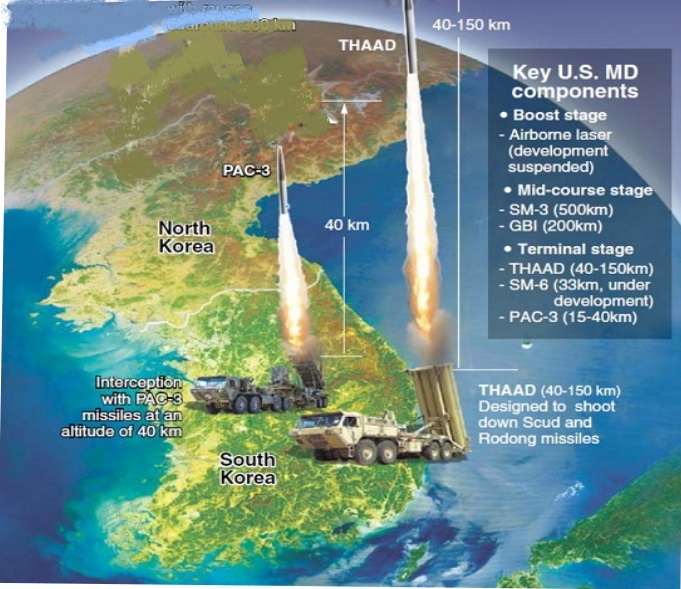
The only real jobs investment by Washington these days is going toward weapons of war.
South Korea is now being flooded with so-called ‘missile defense’ systems.
Bruce Gagnon – coordinator of the Global Network Against Weapons & Nuclear Power in Space
https://space4peace.blogspot.com/2024/03/south-korea-and-us-has-permanent-war.html
Yesterday was the last day of my space issues speaking tour across South Korea.
I had two meetings in the afternoon before my final talk in the evening in Seoul.
The first was a meeting with two representatives from SPARK (Solidarity for Peace and Reunification of Korea) which was formed to organize for national self-determination, peace and disarmament, and the reunification of the two East Asian Korean nations.
SPARK is now working on holding an ‘International People’s Tribunal to hold the U.S. accountable for dropping Atomic bombs’ in New York City in 2026 (date not yet set). The event aims to highlight the bombing of Hiroshima and Nagasaki in 1945 from the perspective of Korean A-bomb victims (an oppressed ethnic group) in Japan who are usually the forgotten victims. The goal of the tribunal will be to contribute to the realization of a nuclear-free Korean Peninsula and world, free from the threat and use of nuclear weapons.
I agreed that the Global Network would help in every way possible to make the event a success. (Let me know if your group would be interested in co-sponsoring this tribunal.)
Next on the schedule was a dinner meeting with Dr. Kang-Ho Song and other members of the organization called The Frontiers. Dr. Song was a major supporting activist in Gangjeong on Jeju Island during the long campaign to oppose the Navy base that was forced upon the 500 year old fishing/farming village by the United States. Dr. Song went to jail three times (the longest sentence was more than a year) for his non-violent protests against the base.
The Frontiers recently has become quite active supporting Japanese controlled islanders who are opposing the deployment of offensive missiles being aimed at China. They have made sailboat trips to the string of islands (including Okinawa and Taiwan) to build inter-island solidarity. In their literature The Frontiers states: ‘We sail with the hope of driving out war, military training, and bases from this sea and creating a sea of co-existence and peace where humanity and all sea creatures can live together.’
Last presentation
My last talk was attended by 55 people. I’m told that even for Seoul that is a good turnout as similar peace talks these days are lucky to draw 30 people.
It was fun to see several old friends show up who I know from my many visits to Jeju Island since 2009. The talk went well (my voice which these days occasionally gets shaky has held up throughout this trip) and there was a healthy question and answer period.
One woman approached me after the talk and said that ‘South Korea’s economy is not good for the people, we are becoming a permanent war economy’. I responded that it is the same in the United States these days as well.
In fact just this morning I received an email that in my home state of Maine Governor Mills, U.S. Senators Susan Collins and Angus King, and U.S. Representative Chellie Pingree will participate in the unveiling of the Maine Defense Industry Alliance (MDIA) at the York County Community College (YCCC) Instructional Site in Sanford. The MDIA is a newly established non-profit coalition of Maine defense companies, state agencies, community colleges and universities, and other vocational training organizations. The partnership was created to attract and train thousands of new employees for critical jobs in Maine’s defense industrial base.
This is a perfect example of what a permanent war economy looks like. The only real jobs investment by Washington these days is going toward weapons of war. In the case of Maine, the so-called leaders want expanded Pentagon funding for more Aegis destroyers at Bath Iron Works shipyard. They also want hypersonics testing at a former US air base in the northern part of the state (Loring). And they want a rocket launch center near Acadia national park that would hoist mini-satellites for the US Space Force to help fill up Lower Earth Orbit (LEO) before China and Russia can put significant numbers of satellites there.
South Korea is now being flooded with so-called ‘missile defense’ systems. They are on-board Navy Aegis destroyers which are consistently ported on Jeju Island. They are the THAAD and PAC-3 systems deployed at several bases throughout the ROK. And the US is deploying these same ‘shields’ in Guam, Japan/Okinawa, Taiwan, Philippines, and other locations in the region.
U.S. bases in the ROK are expanding and held more than 200 days last year of US-ROK war games right along the border of North Korea.
Alternative media
As a result of my talks during this tour there are already articles and interviews by people who came to hear me speak and quickly moved to share what they learned. Here are three examples and I am told there will be more to come.
- A woman named Oh Hyun-hwa in Daejeong gave a local radio interview. https://www.youtube.com/watch?v=iJfcAvmL8uo
- Anti-War Peace Activist Concerned Jeju seems to be turning into a big South Korea-U.S. military base. Article by Kim Soon-ae. https://www.ohmynews.com/NWS_Web/View/at_pg.aspx?CNTN_CD=A0003004637
- Space industry erodes the space, the commons, and destroys the future.Article by Kim Na-hee. https://www.ohmynews.com/NWS_Web/View/at_pg.aspx?CNTN_CD=A0003005816
Macron stands by remarks on NATO troops in Ukraine

https://www.sott.net/article/489392-Macron-stands-by-remarks-on-NATO-troops-in-Ukraine— 1 Mar 24
The French president brushed off criticism from fellow NATO members, insisting his words were “thought-through and measured”
French President Emmanuel Macron on Thursday stood by his controversial remarks on Monday about the prospects of deploying troops to Ukraine, which have caused uproar among some NATO members, and has insisted his words were well thought out.
Speaking to reporters on the sidelines of a visit to inspect the 2024 Olympics village near Paris, Macron refused to backtrack on his statements despite a flurry of criticism from some fellow members of the US-led bloc.
“These are sufficiently serious issues; every one of the words that I say on this issue is weighed, thought-through and measured,” Macron claimed.
The French president triggered the political furore on Monday while speaking to reporters after hosting a meeting of European leaders in Paris. Macron insisted that the West should stop at nothing to prevent Russia from getting the upper hand in the conflict, saying the deployment of troops by NATO and other Western countries to Ukraine could not be ruled out.
“There’s no consensus today to send, in an official manner, troops on the ground,” he said. “In terms of dynamics, we cannot exclude anything. We will do everything necessary to prevent Russia from winning this war.”
The statement prompted a wave of denial from NATO members, with multiple major members of the bloc, including the US, the UK and Germany insisting they harbor no such plans. Some lesser members of the bloc, however, namely Estonia and Lithuania, appeared to back Macron, suggesting that sending troops to Ukraine should not be ruled out.
“We shouldn’t be afraid of our own power. Russia is saying this or that step is escalation, but defense is not escalation,” the Prime Minister of Estonia Kaja Kallas told Sky on Wednesday. “I’m saying we should have all options on the table. What more can we do in order to really help Ukraine win?”
Moscow has strongly condemned Macron’s remarks, cautioning the US-led bloc against taking further hostile moves. Should NATO troops actually be deployed to Ukraine, a direct confrontation between the alliance and Russia will become not only “possible” but actually “inevitable,” Kremlin spokesman Dmitry Peskov warned.
From the same source there was:
1 Mar, 2024 06:34
Vast majority of French oppose Macron’s ‘troops in Ukraine’ comment – poll
Survey results published on Thursday by French newspaper Le Figaro showed that 68% of respondents disapproved of Macron’s comments on a possible future NATO deployment to the war-torn state, while just 31% said they agreed. The remainder, just 1%, were undecided.
Given the many cases of having stood up against the popular wind prevailing in France, 31 % is a pretty good score.
Add to this that although Macron has met with resistance to implications of the statements, he has support from a country like Estonia:
29 Feb, 2024 15:59
NATO member backs ‘boots on the ground’ in Ukraine
Estonia is “not afraid” of Russia and thinks sending NATO ground troops to Ukraine ought to be under consideration, Prime Minister Kaja Kallas has told Sky News in an interview aired on Wednesday.
So far, only Estonia and Lithuania have expressed any enthusiasm for the idea of escalating NATO support to Kiev beyond deliveries of weapons, ammunition, and money.
“We shouldn’t be afraid of our own power. Russia is saying this or that step is escalation, but defense is not escalation,” Kallas told Sky. “I’m saying we should have all options on the table. What more can we do in order to really help Ukraine win?”
Earlier this week, French President Emmanuel Macron argued that the US-led bloc should not rule out sending troops to Ukraine, or any other options. Most members of the bloc have sincedistanced themselvesfrom the idea – except two of the former Soviet Baltic republics.
On Tuesday, Lithuanian Foreign Minister Gabrielius Landsbergis urged NATO to “think outside the box.” Meanwhile, the country’sambassador to Sweden, Linas Linkevicius, said the bloc would “neutralize” the Russian enclave of Kaliningrad if Moscow “dares to challenge NATO.”
The Estonian and Lithuanian officials are supported by the US or were they given the cue cards, … like Macron?
29 Feb, 2024 23:57
Pentagon warns of direct Russia-NATO clash
Addressing the US House Armed Services Committee hearing on Thursday, Austin once again urged lawmakers to approve additional funding for Kiev’s war effort, painting a grim picture for NATO allies.
“If you are a Baltic state, you are really worried about whether you are next… And, frankly, if Ukraine falls, I really believe that NATO will be in a fight with Russia,” the Pentagon chief said.
Austin went on to claim that “other autocrats around the world will look at this and will be encouraged by the fact that this happened and we failed to support a democracy.
Macron is probably aware he is in the same situation as Rishi Sunak. That is there are already French “advisors” involved:
29 Feb, 2024 19:14
UK ‘directly involved’ in Ukraine conflict – KremlinThe outlet RTVI asked Peskov to comment a report from The Times which claimed that Admiral Tony Radakin, the head of the UK armed forces, has helped make “battle plans” for Ukraine.
“In general, it’s no secret that the British really provide different forms of support [to Ukraine]. People on the ground and intelligence and so on and so forth,” Peskov said. “That is, they are actually directly involved in this conflict.”
According to the British outlet, citing a Ukrainian military source, Radakin “is understood to have helped the Ukrainians with the strategy to destroy Russian ships and open up the Black Sea,” and seen as “invaluable in coordinating support from other senior chiefs in NATO.”
The admiral also reportedly visited Kiev and met with President Vladimir Zelensky, to discuss Ukraine’s strategy and the ways in which the West could help.
The Kremlin doesn’t have specific information related to Radakin, but “probably our military knows about this,” Peskov said.
Radakin, 58, was due to retire in November after three years as chief of the defense staff, but will stay on the job for another year at Prime Minister Rishi Sunak’s request, the Times reported. One source told the outlet that the British government considered it important to retain“continuity”ahead of the upcoming general election.
Inside Europe’s only nuclear unicorn — and its €1bn fundraising hopes

Sifted, Kai Nicol-Schwarz 1 Mar 24
UK-based Newcleo could make the first close as soon as April — but the startup wants to raise €billions more by the end of the decade
UK-based unicorn Newcleo is on a mission to raise €1bn in equity this year.
The nuclear energy startup is developing small modular reactors (SMRs) fuelled with radioactive waste, and the first close could come as soon as April, founder and CEO Stefano Buono tells Sifted.
If it lands the round, the raise will be the second largest in the nuclear sector globally — and the largest, by some way, in Europe.
It’s piqued the interest of European governments increasingly keen to shore up their energy sovereignty in the face of climate change and Russia’s war in Ukraine — and of investors (including the French government), who’ve written cheques to the tune of €400m since the startup launched in 2021.
But if Newcleo is to achieve its lofty ambitions, it’ll need billions more by the end of the decade.
The startup plans to complete a research facility in Italy by 2026, as well as a fuel processing plant and a demonstrator reactor in France by 2030. And that’s before it launches its first revenue-making commercial reactor — possibly in the UK, says Buono — sometime after 2033 and then — eventually — deploys a fleet of its reactors across Europe.
To get there, it will need to find big cheque investors with the patience of saints and convince governments to cough up their nuclear waste…………………………………………………………………………………….
Can Europe’s nuclear sector raise the billions it needs?
While funding in Europe has shot up over the past few years, bringing the region’s fourth-generation reactors to market will require tens of billions more.
Newcleo alone will need to invest €3bn in France by 2030 to build its fuel processing plant and a 30MW demonstrator reactor. And that’s all before it builds a commercial reactor — “possibly” in the UK, says Buono — which it hopes to have completed by 2033.
While several companies have raised megarounds in the US — since 2021, deals like Commonwealth Fusion Systems’ $1.8bn, TerraPower’s $750m and Helion Energy’s $500m have rolled in — the sector has hit funding troubles in the past year.
Startup reactor plans have fallen through and huge deals have collapsed as rising interest rates, inflation and the nuclear industry’s poor record of delivering projects on time have dented investor confidence, the FT reported in December…………………………..
Newcleo hopes to raise from family offices, high net-worth individuals and institutional investors. Existing backers include US VC Exor Ventures, the investment vehicle of the Agnelli family office — founder of Italy’s largest carmaker Fiat, Italian investor Azimut Group and Italian tech transfer fund LIFTT.
And for future fundraises, Newcleo could look to tap public funds in the form of tax credits too, says Buono…………………………
And then there’s the small matter of convincing investors to part with €1bn during a downturn. https://sifted.eu/articles/newcleo-1bn-fundraise
France accused of ‘unacceptable’ behaviour after demanding UK taxpayer cash for Hinkley nuclear.
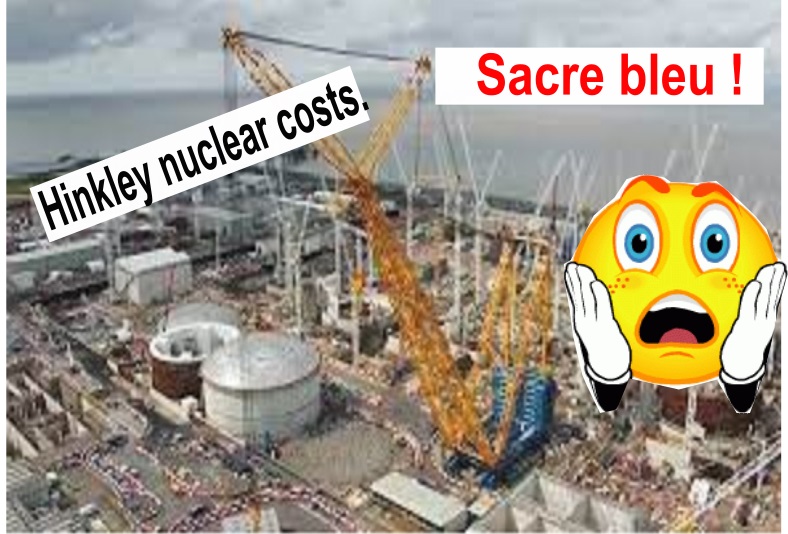
Former energy secretary Chris Huhne says Paris must cover cost overruns
Jonathan Leake, 29 February 2024 •
France’s demands for UK taxpayers to help fund Hinkley Point
C are “wholly unacceptable”, according to the former energy secretary
who helped develop the nuclear project. Chris Huhne, who was energy
secretary from 2010 to 2012, said he was “astonished and saddened” to
hear that both Bruno Le Maire, the French finance minister, and Luc
Rémont, chief executive of EDF, were pressing the UK to help with the cost
overruns.
Mr Huhne was a leading architect of the deal with EDF, France’s
state-owned electricity supplier, to build the nuclear power station. Under
the deal, finally signed off by Mr Huhne’s successor, Ed Davey, EDF was
responsible for all the estimated £18bn costs, with a start date of 2025.
Telegraph 29th Feb 2024
Conservationists say Hinkley C nuclear water intakes could wipe out Atlantic salmon stocks

West Somerset Free Press, By John Thorne , Friday 1st March 2024
ENDANGERED Atlantic salmon could be wiped out in the Bristol Channel once the new Hinkley Point C nuclear power station starts generating electricity, campaigners fear.
They believe the estuary’s migrating salmon population could be decimated by huge water cooling intakes serving the power station’s nuclear reactors.
The Missing Salmon Alliance (MSA), which is a collective of passionate conservation organisations with a common interest in improving the plight of Atlantic salmon, is demanding greater fish protection measures by Hinkley C’s owner EDF.
They accused EDF of ‘flagrant disregard’ for major fish kill potential if it was successful in a bid to drop a requirement to fit acoustic fish deterrents (AFDs) on the water intake heads on the bed of the estuary.
Consultation on Hinkley’s proposals to drop the AFDs ended on Thursday (February 29) and MSA said it understood the system was now unlikely to be used.
As mitigation for the removal of the AFDs, EDF had suggested compensatory creation of wetland habitat for birds and other species, and enhancements to fish passage on some existing weirs.
But MSA said Hinkley would draw a huge amount of water from the Bristol Channel to cool its reactors, about 120,000 litres per second.
A spokesperson said: “This is the equivalent of three Olympic swimming pools per minute and twice the average flow of the River Thames, in London.
“An independent panel warned in 2021 the power station could capture up to 182 million fish per year. It is likely that most of these will not survive.”
The area surrounding Hinkley is a Special Area of Conservation with a number of rivers which are home to endangered, protected, and commercially important fish, including Atlantic salmon, shad, elver eel, which is critically endangered, conger eel, brown shrimp, cod, bass, whiting, flounder, sole, and thornback ray.
The Severn has one of only four UK spawning populations of twait shad and data showed a significant risk of Hinkley wiping them out as nearly one-third of their population used the sea around the abstraction zones.
The International Union for Conservation of Nature (IUCN) classifies Atlantic salmon as ‘endangered’ in Great Britain and ‘near threatened’ on a global scale.
Game and Wildlife Conservation Trust head of fisheries Dylan Roberts said: “Wild Atlantic salmon migrate through the Bristol Channel each spring from a number of recognised rivers in the area.
“It is critical a real-time assessment of salmon smolts migrating through the area is funded by EDF.
“This is not solely about salmon, it is a much broader remit.
“It is about conserving our wider biodiversity against a massive State project steamrolling through and putting two fingers up to the environment.”
Angling Trust head of campaigns Stuart Singleton-White said: “What EDF propose in terms of compensation is inadequate.
“It will not compensate for the millions of fish sucked in by these intakes every year.
“It will decimate Atlantic salmon and shad.
“Without proper compensation and mitigation, they could become locally extinct.”………………..
Did the West Intentionally Incite Putin to War?
by GORDONHAHN, February 27, 2024
Over the last year the US and NATO countries have undertaken no effort to convince Ukrainian President Volodomyr Zelenskiy to begin talks with Putin, despite: the death of more than half a million Ukrainians; the destruction of much of Ukraine’s economy, finances, physical infrastructure, human capital, civil society; and the West’s inability to sustain financial and military support even as Ukraine loses the war when said support was at its height.
The West’s war strategy now seems to be to prolong a ‘long war’ in the hope either that the war begins to affect Russia and Putin’s standing there or that Putin’s health wanes and his system destabilizes. All this and much more written below raises suspicions the West intentionally, maybe even ‘subconsciously’ – the actions of small policy victories won in order to ‘confront Putin’ by competing elements within it, especially inside Washington – drew Russia into the NATO-Russia Ukrainian War. Aside from the background cause and main driver of this decision – NATO expansion – and more immediate precipitants of Putin’s decision in mid- to late February 2022, what efforts, of any, did the West undertake perhaps intentionally to drive this decision?
If we look at the course of events in reverse chronological order it seems to me even more glaringly so that the West sought this war and indeed drew Russia into it intentionally with the the strategy of using the war to weaken Russia’s economic and political stability. The strategic goal is the reinforcement of US hegemony and power maximalization by achieving two long-standing, interrelated sub-goals: (1) NATO expansion and (2) the removal from power of Russian President Vladimir Putin. Let’s reverse engineer the course of events.
……………………………………………………………………………………………………………. A final side note. All this has led to NATO and the US being combatants in a war against Russia, which threatens us with world war and nuclear conflagration https://gordonhahn.com/2024/02/27/did-the-west-intentionally-incite-putin-to-war/—
Today. My dilemma in writing about nuclear issues.

This might be a peculiarly Australian dilemma. I don’t know. The thing is – most people seem able to tolerate a bit of criticism of the nuclear industry. And indeed, when I post articles on my websites – nuclear-news.net and antinuclear.net, or on my newsletter, – that’s OK.
But if I bring in the subject of Ukraine, or especially of Gaza and Israel, – people get upset. What has that got to do with the nuclear industry? (Well, a lot really – as both situations bring us ever closer to the brink of nuclear war).
The big problem is this. As part of an Australian, and indeed worldwide, movement, for a safe clean nuclear-free world, my stuff is accepted as worthwhile. But, when I digress into examining what is going on in Ukraine, or worse, in Israel – then I am no longer to be trusted. Indeed, I am sometimes being called a Putin-lover, a communist. a terrorist – and especially anti-semitic.
As a consequence, then my anti-nuclear coverage is not to be trusted, either. It’s OK to be anti-nuclear – that’s a respectable opinion, as long as you’re pro Ukraine and pro Israel.
I really don’t know how to deal with this. It seems that, to be respected at all, it is necessary to conform to certain dogmas, such as “Russia is always evil” and “Israelis are holy victims”.
In my view – Putin is a murderous thug, but Russia is not always to blame, and Russian policies and aspirations should be viewed fairly.
Similarly, I think that the Jews, over history, have been terribly persecuted and murdered, but that doesn’t give Israel the licence to now do mass murder of the Gazan people.
There’s a dreadful conformity in Australia, and perhaps in all supposedly-white, English speaking countries. We must side with Ukraine, no matter what. And we must not be seen to be anti-semitic, no matter what.
So – I am left with the dilemma – should I ignore those two nuclear-war-trigger situations, in order to sound credible about nuclear matters?
Should I act “nice” about what Israel is doing, and pretend that I don’t notice? That is all too easy to do, in Australia, with its relentless media focus on sport.
Texas wildfires continue to pose threat to Pantex nuclear weapons plant, and climate change will bring further threats to nuclear facilities
By Jessica McKenzie, François Diaz-Maurin | February 28, 2024
A wildland fire in the Texas Panhandle forced the Pantex plant, a nuclear facility northeast of Amarillo, to temporarily cease operations on Tuesday and to evacuate nonessential workers. Plant workers also started construction on a fire barrier to protect the plant’s facilities.
The plant resumed normal operations on Wednesday, officials said.
“Thanks to the responsive actions of all Pantexans and the NNSA Production Office in cooperation with the women and men of the Pantex Fire Department and our mutual aid partners from neighboring communities, the fire did not reach or breach the plant’s boundary,” Pantex said in a social media post on Wednesday afternoon.
At a press conference Tuesday evening, Laef Pendergraft, a nuclear safety engineer with the National Nuclear Security Administration production office at Pantex, said the evacuations were out of an “abundance of caution.”
“Currently we are responding to the plant, but there is no fire on our site or on our boundary,” Pendergraft told reporters.
The 90,000-acre Windy Deuce fire burning four to five miles to the north of the Pantex plant was 25 percent contained as of late Wednesday afternoon.
Until the fire is fully contained, it will continue to pose a threat to the nearby Pantex plant, says Nickolas Roth, the senior director of nuclear materials security at the Nuclear Threat Initiative. “I think the sign that the coast is clear is that the fire is no longer burning,” he told the Bulletin. “One can imagine many reasons operations would resume.”……………………………………….
While the specific cause of the Smokehouse Creek fire has not yet been identified, climate change is making explosive wildfires more likely, with serious implications for the country’s nuclear weapons programs.
Since 1975, the Pantex plant has been the United States’ primary facility responsible for assembling and disassembling nuclear weapons. It is one of six production facilities in the National Nuclear Security Administration’s Nuclear Security Enterprise.
In addition to warhead surveillance and repair, the plant is currently working on the full scale production of the B61-12 guided nuclear gravity bomb and 455-kiloton W88 Alteration (Alt) 370 warhead as part of the broader US nuclear weapons life-extension and modernization programs. The plant handles significant quantities of uranium, plutonium, and tritium, in addition to other non-radioactive toxic and explosive chemicals.
If a wildfire were to impact the site directly, the health and safety implications could be enormous.
“I don’t like to speculate in terms of worst-case scenarios,” Roth told the Bulletin. “The potential for danger if a fire ever broke out at a site with weapons usable nuclear material is quite great.”
“The danger from plutonium really comes from inhaling particulates,” Dylan Spaulding, a senior scientist in the Global Security Program at the Union of Concerned Scientists, explained on a podcast in 2023. “So if powder is inhaled, or if somehow powder were to be dispersed through, say, a big fire or some kind of incident at the site, that would certainly pose a risk for surrounding communities.”
Up to 20,000 plutonium cores, or “pits,” from disassembled nuclear weapons can be stored on site. (The exact figure is classified, but experts contacted by the Bulletin said the current number of “surplus” plutonium pits already dismantled is likely to be around 19,000, plus an additional unknown number of backlog pits awaiting disassembly.)
But as Robert Alvarez wrote in the Bulletin in 2018, the plutonium is stored in facilities built over half a century ago that were never intended to indefinitely store nuclear explosives. After extreme rains flooded parts of the facility in 2010 and 2017, some of the containers began showing signs of corrosion.
A 2021 review by the Defense Nuclear Facilities Safety Board of the Pantex plant’s operations found that an increasing number of plutonium pits are stored in unsealed containers. These pits are either “recently removed from a weapon, planned to be used in an upcoming assembly or life extension program, or pending surveillance,” the board explained. The board previously recommended that these pits be repackaged into sealed insert containers for their safe long-term staging. But the plant personnel “stated it is only achieving approximately 10 percent of its annual pit repackaging goals, citing a lack of funding and priority.”…………………………………………………………………………..
A Department of Energy report published in April 2022 on fire protection at the Pantex, which identified several weaknesses within the plant, did not discuss risks from wildland fires.
“The event is obviously a stark reminder of the dangers of climate change on even high security nuclear weapons facilities,” said Kristensen.
But as other authors have previously argued in the Bulletin, climate change is a blind spot in US nuclear weapons policy. “All of these [nuclear] structures were built on the presumption of a stable planet. And our climate is changing very rapidly and presenting new extremes,” Alice Hill, a senior fellow for energy and the environment at the Council on Foreign Relations, told the Bulletin in 2021……….. https://thebulletin.org/2024/02/texas-wildfires-force-major-nuclear-weapons-facility-to-briefly-pause-operations/
1 This Month

petition to oppose the rapid increase of space-military industry threatening Jeju Island and the region.
[Petition by April 19th (KST)] Stop the joint military-Hanwha Systems-Jeju Provincial Government Sea Launch!
23 April – WEBINAR – Why new nuclear reactors are the wrong tools for decarbonization Thursday, April 23 • 1 AM – 2 AM AEST
World Nuclear Power. Reactors 1951-2026, 75 Years of Nuclear Power.
Interactive Map– https://dv.worldnuclearreport.org/

Chernobyl: The Lost Tapes – A good documentary on Chernobyl on SBS available On Demand for the next 3 weeks– https://www.sbs.com.au/ondemand/tv-program/chernobyl-the-lost-tapes/2352741955560

of the week–London Campaign for Nuclear Disarmament


Tell the Ukrainian Government to Drop Prosecution of Peace Activist Yurii Sheliazhenko
To see nuclear-related stories in greater depth and intensity – go to https://nuclearinformation.wordpress.com
-
Archives
- April 2026 (211)
- March 2026 (251)
- February 2026 (268)
- January 2026 (308)
- December 2025 (358)
- November 2025 (359)
- October 2025 (376)
- September 2025 (257)
- August 2025 (319)
- July 2025 (230)
- June 2025 (348)
- May 2025 (261)
-
Categories
- 1
- 1 NUCLEAR ISSUES
- business and costs
- climate change
- culture and arts
- ENERGY
- environment
- health
- history
- indigenous issues
- Legal
- marketing of nuclear
- media
- opposition to nuclear
- PERSONAL STORIES
- politics
- politics international
- Religion and ethics
- safety
- secrets,lies and civil liberties
- spinbuster
- technology
- Uranium
- wastes
- weapons and war
- Women
- 2 WORLD
- ACTION
- AFRICA
- Atrocities
- AUSTRALIA
- Christina's notes
- Christina's themes
- culture and arts
- Events
- Fuk 2022
- Fuk 2023
- Fukushima 2017
- Fukushima 2018
- fukushima 2019
- Fukushima 2020
- Fukushima 2021
- general
- global warming
- Humour (God we need it)
- Nuclear
- RARE EARTHS
- Reference
- resources – print
- Resources -audiovicual
- Weekly Newsletter
- World
- World Nuclear
- YouTube
-
RSS
Entries RSS
Comments RSS
 nuclear-news