TODAY. A world run by 11 year-old boys?

They can be delightful people, full of fun, curiosity, competitiveness and inventiveness. They come up with the bright ideas, sometimes daring and a bit risky, but always interesting.
Neuroscience tells us that the part of the brain, the frontal lobe, that deals with judgement and inhibition, develops fully only later in the male , – up to nearly age 30 – compared to, in females, a lot earlier. Also the male brain is, by and large, better at focussing on one thing, as compared with the female, where the electric impulses dart around the brain – considering various aspects.
These differences must have been useful in the past, when sabretooth tigers were a big danger – the larger, less inhibited young male person being more likely to rush out and fight this predator. Less useful now, when the danger is other aggressive male persons.

Which brings me to my thought. I was looking at this picture of Sam Altman – of ChatGPT fame. He’s actually 38, but he’s got that bright-eyed 11 year-old boyish look.
In fact, I reckon that they all do – Elon Musk, Bill Gates – and the rest of the billionaire tech entrepreneurs. Gee – they’re brilliantly clever, and daring, and wow! – they do great stuff, and a lot of it brings us a lot of benefits.
And they’re a lot more fun than boring old fogies, people like Ralph Nader, who warned about automobile safety, and nuclear danger.
AND YET … AND YET ……
Sam Altman is enthused about Artificial Intelligence – needing an orgy of electricity. But no worry – nuclear fusion will solve that! (only nuclear fusion is many decades away).
They all seem to love nuclear energy, and endless AI, and rockets to Mars – and all that wow stuff. Things like nuclear waste apparently are not that important, nor are ideas like energy conservation to address global heating, nor the growth of devastating weaponry – in space as well as on Earth, nor the consequences of all this for the environment, the fragile ecosystem that supports our species, as well as all those other species such as the insects, that don’t matter.
The world’s leaders seem to hang on every word from these guys. I think they are making a big mistake.
I postulate that the tech billionaires had such fun when they were 11, that they never left that persona behind. Inside, they are still 11. The super- confidence, the risk-taking, the narrow brain focus – it’s all still there.
Meanwhile, ordinary mortals, and that includes women with their more generalised thinking, are pondering about the climate, biodiversity, the environment, wars, the heritage for our grandchildren. I think that we need to listen more to ordinary mortals, more likely to be co-operative rather than competitive, and to men like boring old Ralph Nader, who is older than 11 inside.
Chris Hedges: The Crucifixion of Julian Assange

No new hearing will allow his lawyers to focus on the war crimes and corruption that WikiLeaks exposed. No new hearing will permit Julian to mount a public-interest defense. No new hearing will discuss the political persecution of a publisher who has not committed a crime.
The court……… offered the U.S. an easy out — give the guarantees and the appeal is rejected.
If the assurances are provided, lawyers for both sides have until April 30th to make new written submissions to the court. At that point, the court will convene again on May 20 to decide if the appeal can go forward.
British courts for five years have dragged out Julian Assange’s show trial. He continues to be denied due process as his physical and mental health deteriorates. This is the point.
By Chris Hedges ScheerPost, https://scheerpost.com/2024/03/27/chris-hedges-the-crucifixion-of-julian-assange-2/
Prosecutors representing the United States, whether by design or incompetence, refused — in the two-day hearing I attended in London in February — to provide guarantees that Julian Assange would be afforded First Amendment rights and would be spared the death penalty if extradited to the U.S.
The inability to give these assurances all but guaranteed that the High Court — as it did on Tuesday — would allow Julian’s lawyers to appeal. Was this done to stall for time so that Julian would not be extradited until after the U.S. presidential election? Was it a delaying tactic to work out a plea deal? Julian’s lawyers and U.S. prosecutors are discussing this possibility. Was it careless legal work? Or was it to keep Julian locked in a high security prison until he collapses mentally and physically?
If Julian is extradited, he will stand trial for allegedly violating 17 counts of the 1917 Espionage Act, with a potential sentence of 170 years, along with another charge for “conspiracy to commit computer intrusion” carrying an additional five years.
The court will permit Julian to appeal minor technical points — his basic free speech rights must be honored, he cannot be discriminated against on the basis of his nationality and he cannot be under threat of the death penalty.
No new hearing will allow his lawyers to focus on the war crimes and corruption that WikiLeaks exposed. No new hearing will permit Julian to mount a public-interest defense. No new hearing will discuss the political persecution of a publisher who has not committed a crime.
The court, by asking the U.S. for assurances that Julian would be granted First Amendment rights in the U.S. courts and not be subject to the death penalty, offered the U.S. an easy out — give the guarantees and the appeal is rejected.
It is hard to see how the U.S. can refuse the two-judge panel, composed of Dame Victoria Sharp and Justice Jeremy Johnson, which issued on Tuesday a 66-page judgment accompanied by a three-page court order and a four-page media briefing.
The hearing in February was Julian’s last chance to request an appeal of the extradition decision made in 2022 by the then British home secretary, Priti Patel, and many of the rulings of District Judge Vanessa Baraitser in 2021.
If Julian is denied an appeal, he can request an emergency stay of execution from the European Court of Human Rights (ECtHR) under Rule 39, which is given in “exceptional circumstances” and “only where there is an imminent risk of irreparable harm.” But it is possible the British court could order Julian’s immediate extradition prior to a Rule 39 instruction, or decide to ignore a request from the ECtHR to allow Julian to have his case heard there.
Julian has been engaged in a legal battle for 15 years. It began in 2010 when WikiLeaks published classified military files from the wars in Iraq and Afghanistan — including footage showing a U.S. helicopter gunning down civilians, including two Reuters journalists, in Baghdad.
Julian took refuge in the Embassy of Ecuador in London for seven years, fearing extradition to the U.S. He was arrested in April 2019 by the Metropolitan Police, who were permitted by the Embassy to enter and seize him. He has been held for nearly five years in HM Prison Belmarsh, a high-security prison in southeast London.
The case against Julian has made a mockery of the British justice system and international law. While in the embassy, the Spanish security firm UC Global provided video recordings of meetings between Julian and his lawyers to the CIA, eviscerating attorney-client privilege.
The Ecuadorian government — led by Lenin Moreno — violated international law by rescinding Julian’s asylum status and permitting police into their embassy to carry Julian into a waiting van. The courts have denied Julian’s status as a legitimate journalist and publisher. The U.S. and Britain have ignored Article 4 of their Extradition Treaty that prohibits extradition for political offenses. The key witness for the U.S., Sigurdur Thordarson — a convicted fraudster and pedophile — admitted to fabricating the accusations he made against Julian for money.
Julian, an Australian citizen, is being charged under the U.S. Espionage Act although he did not engage in espionage and was not based in the U.S when he was sent the leaked documents.
Continue readingSpending Unlimited – The Pentagon’s Budget Follies Come at a High Price.
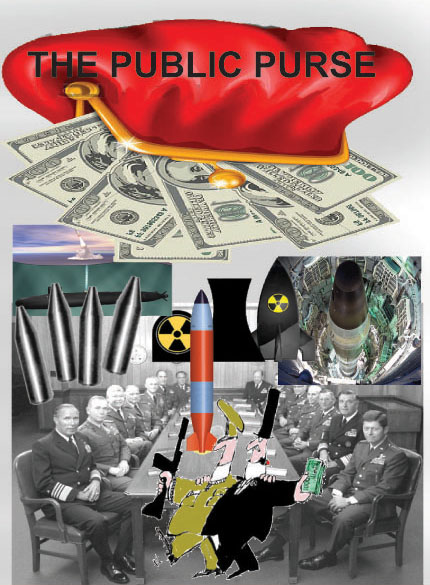
More waste, fraud, and financial abuse are inevitable as the Pentagon prepares to shovel money out the door as quickly as possible. This is no way to craft a budget or defend a country.
One way to begin reining in runaway Pentagon spending is to eliminate the ability of Congress and the president to arbitrarily increase that department’s budget. The best way to do so would be by doing away with the very concept of “emergency spending.
BY JULIA GLEDHILL AND WILLIAM D. HARTUNG, MARCH 26, 2024, https://tomdispatch.com/spending-unlimited-2/
The White House released its budget proposal for Fiscal Year 2025 on March 11th, and the news was depressingly familiar: $895 billion for the Pentagon and work on nuclear weapons at the Department of Energy. After adjusting for inflation, that’s only slightly less than last year’s proposal, but far higher than the levels reached during either the Korean or Vietnam wars or at the height of the Cold War. And that figure doesn’t even include related spending on veterans, the Department of Homeland Security, or the additional tens of billions of dollars in “emergency” military spending likely to come later this year. One thing is all too obvious: a trillion-dollar budget for the Pentagon alone is right around the corner, at the expense of urgently needed action to address climate change, epidemics of disease, economic inequality, and other issues that threaten our lives and safety at least as much as, if not more than, traditional military challenges.

Americans would be hard-pressed to find members of Congress carefully scrutinizing such vast sums of national security spending, asking tough questions, or reining in Pentagon excess — despite the fact that this country is no longer fighting any major ground wars. Just a handful of senators and members of the House do that work while many more search for ways to increase the department’s already bloated budget and steer further contracts into their own states and districts.
Congress isn’t just shirking its oversight duties: these days, it can’t even seem to pass a budget on time. Our elected representatives settled on a final national budget just last week, leaving Pentagon spending at the already generous 2023 level for nearly half of the 2024 fiscal year. Now, the department will be inundated with a flood of new money that it has to spend in about six months instead of a year. More waste, fraud, and financial abuse are inevitable as the Pentagon prepares to shovel money out the door as quickly as possible. This is no way to craft a budget or defend a country.
And while congressional dysfunction is par for the course, in this instance it offers an opportunity to reevaluate what we’re spending all this money for. The biggest driver of overspending is an unrealistic, self-indulgent, and — yes — militaristic national defense strategy. It’s designed to maintain a capacity to go almost everywhere and do almost anything, from winning wars with rival superpowers to intervening in key regions across the planet to continuing the disastrous Global War on Terror, which was launched in the wake of the 9/11 attacks and never truly ended. As long as such a “cover the globe” strategy persists, the pressure to continue spending ever more on the Pentagon will prove irresistible, no matter how delusional the rationale for doing so may be.
Defending “the Free World”?
President Biden began his recent State of the Union address by comparing the present moment to the time when the United States was preparing to enter World War II. Like President Franklin Delano Roosevelt in 1941, Joe Biden told the American people that the country now faces an “unprecedented moment in the history of the Union,” one in which freedom and democracy are “under attack” both at home and abroad. He disparaged Congress’s failure to approve his emergency supplemental bill, claiming that, without additional aid for Ukraine, Russian President Vladimir Putin will threaten not just that country but all of Europe and even the “free world.” Comparing (as he did) the challenge posed by Russia now to the threat that Hitler’s regime posed in World War II is a major exaggeration that’s of no value in developing an effective response to Moscow’s activities in Ukraine and beyond.
Engaging in such fearmongering to get the public on board with an increasingly militarized foreign policy ignores reality in service of the status quo. In truth, Russia poses no direct security threat to the United States. And while Putin may have ambitions beyond Ukraine, Russia simply doesn’t have the capability to threaten the “free world” with a military campaign. Neither does China, for that matter. But facing the facts about these powers would require a critical reassessment of the maximalist U.S. defense strategy that rules the roost. Currently, it reflects the profoundly misguided belief that, on matters of national security, U.S. military dominance takes precedence over the collective economic strength and prosperity of Americans.
As a result, the administration places more emphasis on deterring potential (if unlikely) aggression from competitors than on improving relations with them. Of course, this approach depends almost entirely on increasing the production, distribution, and stockpiling of arms. The war in Ukraine and Israel’s continuing assault on Gaza have unfortunately only solidified the administration’s dedication to the concept of military-centric deterrence.
Contractor Dysfunction: Earning More, Doing Less
Ironically, such a defense strategy depends on an industry that continually exploits the government for its own benefit and wastes staggering amounts of taxpayer dollars. The major corporations that act as military contractors pocket about half of all Pentagon outlays while ripping off the government in a multitude of ways. But what’s even more striking is how little they accomplish with the hundreds of billions of taxpayer dollars they receive year in, year out. According to the Government Accountability Office (GAO), from 2020 to 2022, the total number of major defense acquisition programs actually declined even as total costs and average delivery time for new weapons systems increase
Americans would be hard-pressed to find members of Congress carefully scrutinizing such vast sums of national security spending, asking tough questions, or reining in Pentagon excess — despite the fact that this country is no longer fighting any major ground wars. Just a handful of senators and members of the House do that work while many more search for ways to increase the department’s already bloated budget and steer further contracts into their own states and districts.
Congress isn’t just shirking its oversight duties: these days, it can’t even seem to pass a budget on time. Our elected representatives settled on a final national budget just last week, leaving Pentagon spending at the already generous 2023 level for nearly half of the 2024 fiscal year. Now, the department will be inundated with a flood of new money that it has to spend in about six months instead of a year. More waste, fraud, and financial abuse are inevitable as the Pentagon prepares to shovel money out the door as quickly as possible. This is no way to craft a budget or defend a country.
And while congressional dysfunction is par for the course, in this instance it offers an opportunity to reevaluate what we’re spending all this money for. The biggest driver of overspending is an unrealistic, self-indulgent, and — yes — militaristic national defense strategy. It’s designed to maintain a capacity to go almost everywhere and do almost anything, from winning wars with rival superpowers to intervening in key regions across the planet to continuing the disastrous Global War on Terror, which was launched in the wake of the 9/11 attacks and never truly ended. As long as such a “cover the globe” strategy persists, the pressure to continue spending ever more on the Pentagon will prove irresistible, no matter how delusional the rationale for doing so may be.
Defending “the Free World”?
President Biden began his recent State of the Union address by comparing the present moment to the time when the United States was preparing to enter World War II. Like President Franklin Delano Roosevelt in 1941, Joe Biden told the American people that the country now faces an “unprecedented moment in the history of the Union,” one in which freedom and democracy are “under attack” both at home and abroad. He disparaged Congress’s failure to approve his emergency supplemental bill, claiming that, without additional aid for Ukraine, Russian President Vladimir Putin will threaten not just that country but all of Europe and even the “free world.” Comparing (as he did) the challenge posed by Russia now to the threat that Hitler’s regime posed in World War II is a major exaggeration that’s of no value in developing an effective response to Moscow’s activities in Ukraine and beyond.
Engaging in such fearmongering to get the public on board with an increasingly militarized foreign policy ignores reality in service of the status quo. In truth, Russia poses no direct security threat to the United States. And while Putin may have ambitions beyond Ukraine, Russia simply doesn’t have the capability to threaten the “free world” with a military campaign. Neither does China, for that matter. But facing the facts about these powers would require a critical reassessment of the maximalist U.S. defense strategy that rules the roost. Currently, it reflects the profoundly misguided belief that, on matters of national security, U.S. military dominance takes precedence over the collective economic strength and prosperity of Americans.
As a result, the administration places more emphasis on deterring potential (if unlikely) aggression from competitors than on improving relations with them. Of course, this approach depends almost entirely on increasing the production, distribution, and stockpiling of arms. The war in Ukraine and Israel’s continuing assault on Gaza have unfortunately only solidified the administration’s dedication to the concept of military-centric deterrence.
Contractor Dysfunction: Earning More, Doing Less
Ironically, such a defense strategy depends on an industry that continually exploits the government for its own benefit and wastes staggering amounts of taxpayer dollars. The major corporations that act as military contractors pocket about half of all Pentagon outlays while ripping off the government in a multitude of ways. But what’s even more striking is how little they accomplish with the hundreds of billions of taxpayer dollars they receive year in, year out. According to the Government Accountability Office (GAO), from 2020 to 2022, the total number of major defense acquisition programs actually declined even as total costs and average delivery time for new weapons systems increased.
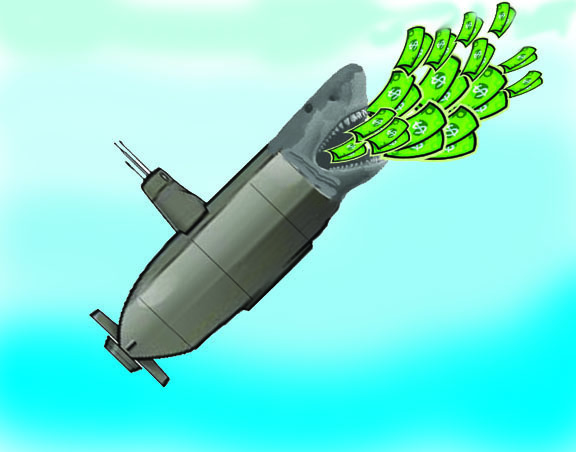
Take the Navy’s top acquisition program, for example. Earlier this month, the news broke that the Columbia-class ballistic missile submarine is already at least a year behind schedule. That sub is the sea-based part of the next-generation nuclear (air-sea-and-land) triad that the administration considers the “ultimate backstop” for global deterrence. As a key part of this country’s never-ending arms buildup, the Columbia is supposedly the Navy’s most important program, so you might wonder why the Pentagon hasn’t implemented a single one of the GAO’s six recommendations to help keep it on track.
As the GAO report made clear, the Navy proposed delivering the first Columbia-class vessel in record time — a wildly unrealistic goal — despite it being the “largest and most complex submarine” in its history.
Yet the war economy persists, even as the giant weapons corporations deliver less weaponry for more money in an ever more predictable fashion (and often way behind schedule as well). This happens in part because the Pentagon regularly advances weapons programs before design and testing are even completed, a phenomenon known as “concurrent development.” Building systems before they’re fully tested means, of course, rushing them into production at the taxpayer’s expense before the bugs are out. Not surprisingly, operations and maintenance costs account for about 70% of the money spent on any U.S. weapons program.

Lockheed Martin’s F-35 is the classic example of this enormously expensive tendency. The Pentagon just greenlit the fighter jet for full-scale production this month, 23 years (yes, that’s not a misprint!) after the program was launched. The fighter has suffered from persistent engine problems and deficient software. But the official go-ahead from the Pentagon means little, since Congress has long funded the F-35 as if it were already approved for full-scale production. At a projected cost of at least $1.7 trillion over its lifetime, America’s most expensive weapons program ever should offer a lesson in the necessity of trying before buying.

Unfortunately, this lesson is lost on those who need to learn it the most. Acquisition failures of the past never seem to financially impact the executives or shareholders of America’s biggest military contractors. On the contrary, those corporate leaders depend on Pentagon bloat and overpriced, often unnecessary weaponry. In 2023, America’s biggest military contractor, Lockheed Martin, paid its CEO John Taiclit $22.8 million. Annual compensation for the CEOs of RTX, Northrop Grumman, General Dynamics, and Boeing ranged from $14.5 and $22.5 million in the past two years. And shareholders of those weapons makers are similarly cashing in. The arms industry increased cash paid to its shareholders by 73% in the 2010s compared to the prior decade. And they did so at the expense of investing in their own businesses. Now they expect taxpayers to bail them out to ramp up weapons production for Ukraine and Israel.
Reining in the Military-Industrial Complex
One way to begin reining in runaway Pentagon spending is to eliminate the ability of Congress and the president to arbitrarily increase that department’s budget. The best way to do so would be by doing away with the very concept of “emergency spending.” Otherwise, thanks to such spending, that $895 billion Pentagon budget will undoubtedly prove to be anything but a ceiling on military spending next year. As an example, the $95 billion aid package for Ukraine, Israel, and Taiwan that passed the Senate in February is still hung up in the House, but some portion of it will eventually get through and add substantially to the Pentagon’s already enormous budget.
Meanwhile, the Pentagon has fallen back on the same kind of budgetary maneuvers it perfected at the peak of its disastrous Afghan and Iraq wars earlier in this century, adding billions to the war budget to fund items on the department’s wish list that have little to do with “defense” in our present world. That includes emergency outlays destined to expand this country’s “defense industrial base” and further supersize the military-industrial complex — an expensive loophole that Congress should simply shut down. That, however, will undoubtedly prove a tough political fight, given how many stakeholders — from Pentagon officials to those corporate executives to compromised members of Congress — benefit from such spending sprees.
Ultimately, of course, the debate about Pentagon spending should be focused on far more than the staggering sums being spent. It should be about the impact of such spending on this planet. That includes the Biden administration’s stubborn continuation of support for Israel’s campaign of mass slaughter in Gaza, which has already killed more than 31,000 people while putting many more at risk of starvation. A recent Washington Post investigation found that the U.S. has made 100 arms sales to Israel since the start of the war last October, most of them set at value thresholds just low enough to bypass any requirement to report them to Congress.
The relentless supply of military equipment to a government that the International Court of Justice has said is plausibly engaged in a genocidal campaign is a deep moral stain on the foreign-policy record of the Biden administration, as well as a blow to American credibility and influence globally. No amount of airdrops or humanitarian supplies through a makeshift port can remotely make up for the damage still being done by U.S.-supplied weapons in Gaza.
The case of Gaza may be extreme in its brutality and the sheer speed of the slaughter, but it underscores the need to thoroughly rethink both the purpose of and funding for America’s foreign and military policies. It’s hard to imagine a more devastating example than Gaza of why the use of force so often makes matters far, far worse — particularly in conflicts rooted in longstanding political and social despair. A similar point could have been made with respect to the calamitous U.S. interventions in Iraq and Afghanistan that cost untold numbers of lives, while pouring yet more money into the coffers of America’s major weapons makers. Both of those military campaigns, of course, failed disastrously in their stated objectives of promoting democracy, or at least stability, in troubled regions, even as they exacted huge costs in blood and treasure.
Before our government moves full speed ahead expanding the weapons industry and further militarizing geopolitical challenges posed by China and Russia, we should reflect on America’s disastrous performance in the costly, prolonged wars already waged in this century. After all, they did enormous damage, made the world a far more dangerous place, and only increased the significance of those weapons makers. Throwing another trillion dollars-plus at the Pentagon won’t change that.

Purgatorial Torments: Assange and the UK High Court
Australian Independent Media, March 27, 2024, by: Dr Binoy Kampmark
What is it about British justice that has a certain rankness to it, notably when it comes to dealing with political charges? The record is not good, and the ongoing sadistic carnival that is the prosecution (and persecution) of Julian Assange continues to provide meat for the table.
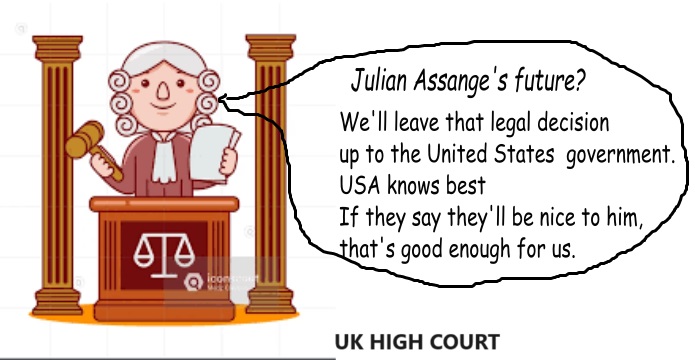
Those supporting the WikiLeaks publisher, who faces extradition to the United States even as he remains scandalously confined and refused bail in Belmarsh Prison, had hoped for a clear decision from the UK High Court on March 26. Either they would reject leave to appeal the totality of his case, thereby setting the wheels of extradition into motion, or permit a full review, which would provide some relief. Instead, they got a recipe for purgatorial prolongation, a tormenting midway that grants the US government a possibility to make amends in seeking their quarry.
A sinking sense of repetition was evident. In December 2021, the High Court overturned the decision of the District Court Justice Vanessa Baraitser to bar extradition on the weight of certain assurances provided by the US government. Her judgment had been brutal to Assange in all respects but one: that extradition would imperil his life in the US penal system, largely due to his demonstrated suicidal ideation and inadequate facilities to cope with that risk.
With a school child’s gullibility – or a lawyer’s biting cynicism – the High Court judges accepted assurances from the Department of Justice (DOJ) that Assange would not face the crushing conditions of detention in the notorious ADX Florence facility or suffer the gagging restrictions euphemised as Special Administrative Measures. He would also receive the appropriate medical care that would alleviate his suicide risk and face the prospect of serving the balance of any sentence back in Australia. The refusal to look behind the mutability and fickle nature of such undertakings merely passed the judges by. The March 26 judgment is much in keeping with that tradition.
The grounds for Assange’s team numbered nine in total entailing two parts. Some of these should be familiar to even the most generally acquainted reader. The first part, comprising seven grounds, argues that the decision to send the case to the Home Secretary was wrong for: ignoring the bar to extradition under the UK-US Extradition Treaty for political offences, for which Assange is being sought for; that his prosecution is for political opinions; that the extradition is incompatible with article 7 of the European Convention on Human Rights (ECHR) noting that there should be no punishment without law; that the process is incompatible with article 10 of the ECHR protecting freedom of expression; that prejudice at trial would follow by reason of his non-US nationality; that the right to a fair trial, protected by article 6 of the ECHR, was not guaranteed; and that the extradition is incompatible with articles 2 and 3 of the ECHR (right to life, and prohibiting inhuman and degrading treatment).
The second part of the application challenged the UK Home Secretary’s decision to approve the extradition, which should have been barred by the treaty between the UK and US, and on the grounds that there was “inadequate specialty/death penalty protection.”
In this gaggle of imposing, even damning arguments, the High Court was only moved by three arguments, leaving much of Baraitser’s reasons untouched. Assange’s legal team had established an arguable case that sending the case to the Home Secretary was wrong as he might be prejudiced at trial by reason of his nationality. Following from that “but only as a consequence of that”, extradition would be incompatible with free speech protections under article 10 of the ECHR. An arguable case against the Home Secretary’s decision could also be made as it was barred by inadequate specialty/death penalty protection.
What had taken place was a dramatic and savage pruning of a wholesome challenge to a political persecution garishly dressed in legal drag. On the issue of whether Assange was being prosecuted for his political opinions, the Court was happy to accept the woeful finding by Baraitser that he had not. The judge was “entitled to reach that conclusion on the evidence before her, and on the unchallenged sworn evidence of the prosecutor (which refutes the applicant’s case).” While accepting the view that Assange “acted out of political conviction”, the extradition was not being made “on account of his political views.” Again, we see the judiciary avoid the facts staring at it: that the exposure of war crimes, atrocities, torture and various misdeeds of state are supposedly not political at all.
………………………………………………………………………………………….. Of enormous, distorting significance was the refusal by the High Court to accept “fresh evidence” such as the Yahoo News article from September 2021 outlining the views of intelligence officials on the possible kidnapping and even assassination of Assange.
…………….Imaginatively, if inexplicably, the judges accepted her finding that the conduct by the CIA and UC Global regarding the Ecuadorian embassy had no link with the extradition proceedings. With jaw dropping incredulity, the judges reasoned that the murderous, brutal rationale for dealing with Assange contemplated by the US intelligence services “is removed if the applicant is extradited.” In a fit of true Orwellian reasoning, Assange’s safety would be guaranteed the moment he was placed in the custody of his would-be abductors and murderers.
The High Court was also generous enough to do the homework for the US government by reiterating the position taken by their brother judges in the 2021 decision. Concerns about Assange’s mistreatment would be alleviated by granting “assurances (that the applicant is permitted to rely on the First Amendment, that the applicant is not prejudiced at trial (including sentence) by reason of his nationality, that he is afforded the same First Amendment protection as a United States citizen, and that the death penalty not be imposed).” Such a request is absurd for presuming, not only that the prosecutors can be held to their word, but that a US court would feel inclined to accept the application of the First Amendment, let alone abide by requested sentencing requirements.
The US government has been given till April 16 to file assurances addressing the three grounds, with further written submissions in response to be filed by April 30 by Assange’s team, and May 14 by the Home Secretary. Another leave of appeal will be entertained on May 20. If the DOJ does not provide any assurances, then leave to appeal will be granted. The accretions of obscenity in the Assange saga are set to continue. more https://theaimn.com/purgatorial-torments-assange-and-the-uk-high-court/
UK to test new ‘Astraea’ nuclear warheads without detonation
The testing will be conducted in collaboration the French at a facility in Dijon, France.
IE, Christopher McFadden, 26 Mar 24
The United Kingdom’s Ministry of Defense (MoD) has just announced its intention to test its next-generation nuclear warhead without actually detonating it.
This test will be the first of its kind since international agreements limit new nuclear testing and countries will have to use some highly sophisticated scientific apparatus.
The new warhead, the A21 “Astraea,” will replace the existing British-made warheads on the nation’s stockpile of Trident-II submarine-launched missiles. These missiles are currently carried aboard the UK’s four Vanguard-class nuclear submarines.
Like the nuclear warheads, the UK has pledged to replace its aging Vanguard class with new Dreadnought-class submarines by the mid-2030s. “UK is committed to replacing our sovereign warhead in parliament in February 2021,” the UK’s MoD shared in a white paper…………………………………………………………….. https://interestingengineering.com/military/uk-to-test-new-astraea-nuclear-warheads-without-detonation
The Decision That Wasn’t A Decision
Extradition has been delayed as UK High Court of Justice urges US government to submit “assurances” or face an appeal
| STELLA ASSANGE, MAR 27. 2024 |
Yesterday, the UK High Court ruled on Julian’s request to appeal extradition to the United States. The result? The decision has effectively been put on hold until the U.S. submits assurances – previously deemed by Amnesty as “inherently unreliable” – including that he will not be prejudiced at trial by reason of his nationality and not receive the death penalty.
In a statement outside the Royal Courts of Justice, Stella said: “The UK High Court recognise that Julian is exposed to a flagrant denial of his freedom of expression rights, that he is being discriminated against on the basis of his nationality and that he remains exposed to the death penalty. And yet, what they have done is to invite a political intervention from the United States to send a letter saying ‘it’s all okay’…” https://stellaassangeofficial.substack.com/p/the-decision-that-wasnt-a-decision?utm_source=post-email-title&publication_id=800783&post_id=142999556&utm_campaign=email-post-title&isFreemail=true&r=ln98x&triedRedirect=true&utm_medium=email
Decades of Dissent: Anti-Nuclear movement explored in LSE Library exhibition
ianVisits, London, 27 Mar 24
A “tube map” in the shape of a fighter jet is on display at the moment, as part of an exhibition looking at the two conflicting sides in the protests about the arms trade.
n the late 1950s, hundreds of thousands of people took part in demonstrations against Britain’s role in the nuclear arms race, sparking a movement that would continue until the present day. Over the decades, individuals from all backgrounds would be united in their support or rejection of nuclear disarmament. At times of great political division, these alliances evolved to incorporate debates over industrial relations, social policy and British identity as a whole.
The exhibition approaches this network primarily from the point of view of peace and anti-nuclear groups such as the Campaign for Nuclear Disarmament (CND) and the Campaign Against Arms Trade (CAAT). However, it invites you to consider how the interests and goals of any group can interact and intersect with one or more others.
Most of the exhibition looks at the different groups campaigning on various aspects of the arms trade, and some of the key people involved, with a lot of archive documents and newspapers on display.
Even setting aside the political message, the display also reminds us of the often grassroots style of printing in use at the time, with basic printed flyers contrasting with today’s online content………………………………………………
The exhibition is open every day until 15th September 2024 and is free to visit.
The exhibition is located next to the entrance at the LSE Library, just off Portugal Street, near Holborn. https://www.ianvisits.co.uk/articles/decades-of-dissent-anti-nuclear-movement-explored-in-lse-library-exhibition-71146/
WATCH: Nabbed Australian Protestors Stopping Military Shipment to Israel
Video and article by Cathy Vogan, Consortium News https://consortiumnews.com/2024/03/25/watch-nabbed-stopping-military-shipment-to-israel/
Paul Keating, branch secretary of the Australian Maritime Union (AMU) spoke for fellow members in solidarity with the Palestinian community and faced off with police, when he and several hundred protestors blockaded Sydney’s Port Botany on Sunday to protest Australia’s export of military aid to Israel.
The protestors’ target is ZIM Shipping, a well known Israeli company that trade unionist Ian Rintoul says supports and is connected with Israel. “It offered its services to the Israeli state for the conduct of the genocide,” he told Consortium News. “Zim Shipping has actually been a target of protests at ports all around the world in the United States and Italy, Europe [and elsewhere in Australia]”.
Keating, who also spoke to CN, called on all of the other workers’ unions to stand with the AMU and for Prime Minister Anthony Albanese to place sanctions on Israel for what the International Court of Justice has called a plausible case of genocide.
He told the police chief at the scene: “This is an international working class issue”, and in his speech reiterated:
“On behalf of the MUA, we stand with our communities and throughout the generations we fought against the establishment who have supported apartheid, like we saw with South Africa, like we’ve seen with the wars that have forced ordinary working class men and women like ourselves and our communities into the most desperate of situations. We oppose war. Peace is union business, and this is our business”.
Deputy Leader of the Greens Mehreen Faruqi also spoke in favour of the blockade and condemned the government’s current policy. She said:
“It’s been 169 days of Israel’s genocide on Gaza. 169 horror-filled days for Palestinians. More than 30,000 Palestinians have been slaughtered by Israel. More than 1 million Palestinians are being starved by Israel. Famine and disease loom large in the ruins of Gaza. That’s the reality on the ground right at this moment. And how bereft, how bereft of humanity, of morality, of head and heart can the Labor government be to not do anything to stop these war crimes, this collective punishment, these atrocities and this genocide? How ruthless and cruel can you be to aid, abet and arm Israel?”
The blockade was short-lived and was broken up by police. Keating and 18 others were arrested and now face fines of up to AUS $22K and two years jail for obstructing traffic in the maritime zone.
Cathy Vogan is the executive producer of CN Live!
Antarctic sea ice ‘behaving strangely’ as Arctic reaches ‘below-average’ winter peak
Carbon Brief, AYESHA TANDON, 26 Mar 24,
Antarctic sea ice is “behaving strangely” and might have entered a “new regime”, the director of the US National Snow and Ice Data Centre (NSIDC) tells Carbon Brief.
Following an all-time low maximum in September 2023, Antarctic sea ice has been tracking at near-record-low extent for the past six months. Last month, it hit its 2024 minimum extent, tying with 2022 for the second-lowest Antarctic minimum in the 46-year satellite record.
Dr Mark Serreze, director of the NSIDC tells Carbon Brief that more warm ocean water is reaching the surface to melt ice and keep it from forming. He says that we “must wait and see” whether this is a “temporary effect” or whether the Antarctic has entered a “new regime”.
Meanwhile, Arctic sea ice has reached its maximum extent for the year, peaking at 15.01m square kilometres (km2) on 14 March. The provisional data from the NSIDC shows that this year’s Arctic winter peak, despite favourable winds that encouraged sea ice formation, was 640,000km2 smaller than the 1981-2010 average maximum.
This year’s maximum was the 14th lowest in the satellite record…………………………………………………………………………………………………………………………………………………..
Record-breaking Antarctic extent
Antarctic sea ice has been tracking at or near record-low levels for months.
The Antarctic set a record-low maximum on 10 September 2023, with an extent of 16.96m km2. This was “the lowest sea ice maximum in the 1979 to 2023 sea ice record by a wide margin”, and one of the earliest, the NSIDC says.
Antarctic conditions over 2023 were “truly exceptional” and “completely outside the bounds of normality”, one expert told Carbon Brief.
As 2023 progressed, Antarctic sea ice melt was “slower than average”, the NSIDC says. The total decline in Antarctic sea ice extent through October was 903,000km2, while the October average was 985,000km2.
Nevertheless, Antarctic sea ice extent continued to track at a record low. On 31 October 2023, Antarctic sea ice extent was still tracking at a record-low of 15.79m km2. This is 750,000km2 below the previous 31 October record low………….. more https://www.carbonbrief.org/antarctic-sea-ice-behaving-strangely-as-arctic-reaches-below-average-winter-peak/
Atomic blackmail – Russia-Ukraine war and Ramberg’s theory of vulnerability
Simon Bennett, School of Business, University of Leicester, 6 Mar 24
ABSTRACT
The Russia-Ukraine War is being fought between states committed to nuclear power. This paper references Ramberg’s nuclear powerplant (NPP) vulnerability treatise, the IAEA’s Seven Pillars of Safety metric and Pidgeon and O’Leary’s safety imagination approach to assess the safety of Ukrainian and Russian NPPs. It suggests governments should reflect on events in Ukraine, and, with reference to the above-mentioned approaches, decide whether the upside of nuclear power – the largely carbon-neutral production of electricity – outweighs the downside – giving a blackmail opportunity to hostile states. Although a cost-benefit analysis to inform decision-making is effortful, the paper suggests that failure to consider every advantage and disadvantage of nuclear power could prove costly in human and environmental terms. Drawing on Ukraine’s experience, the paper suggests the national interest is best served in time of war by generating electricity in multiple small plants rather than a few large plants.
Introduction
In 1985, at the height of the Cold War, foreign policy and nuclear expert Bennett Ramberg published his paperback Nuclear Power Plants: An Unrecognised Military Peril, whose subject is the targeting of NPPs by a protagonist to secure tactical or strategic advantage. The Russia-Ukraine War……..has made this subject relevant…………………………………………more https://www.tandfonline.com/doi/full/10.1080/00207233.2024.2317089
COMMENT.
a wonderful article. It contains so many insights that never seem to get mentioned —
– aggressor nation would risk poisoning its own soldiers, civilians and land.
– could target facilities with a larger footprint, such as waste storage ponds or fuel reprocessing plants.
– the ideological-doctrinal domain of propaganda and messaging.
– the blackmail potential of NPPs – it would seem wise to invest intellectual resources in imagining and active learning…….. a dearth of safety imagination in decision-making can be costly.
– – a large number of municipally-operated solar farms, wind farms, tidal barrages, waste-to-power and hydroelectric powerplants generating power for municipalities locally would have provided a more resilient system for Ukraine. In the matter of power generation, in time of crisis or conflict scaling-down secures.
Now there are three court challenges against Ontario nuclear waste disposal facility

National Observer, By Matteo Cimellaro | News, Urban Indigenous Communities in Ottawa | March 27th 2024
Legal challenges against a nuclear waste facility slated for construction near the Ottawa River continue to rise.
On Wednesday, a coalition made up of a First Nation and environmental groups launched a legal challenge against the federal government and Canadian Nuclear Laboratories (CNL) over the issuing of Species at Risk Act (SARA) permits to the company.
The court application argues that Ottawa’s granting of the SARA permits is unreasonable. It disputes CNL’s assertion that it chose the facility location to have the least impact on species at risk and has adopted the best mitigation measures.
The court documents also state the federal government did not adequately address Kebaowek First Nation’s submissions and evidence on the project and failed to include other species at risk, like the monarch butterfly, songbirds and the eastern wolf.
This most recent court challenge follows two others filed since the waste facility was approved by the Canadian nuclear regulator on Jan. 8.
The SARA permits allow for the deforestation and pre-construction work to begin on the facility with some mitigation measures for endangered Blanding’s turtles and two bat species named in the permits. The near-surface disposal facility is designed as a large earthen mound and will have a lifespan of at least 550 years. It will primarily house low-level nuclear waste, such as contaminated mops and protective equipment.
Approval for the preliminary work at the site was granted by the Canadian Wildlife Service, which said CNL successfully demonstrated feasible measures will be taken to minimize the impact of construction on the three species and that construction will not jeopardize their recovery.
Some measures will include identifying turtle and bat hot spots, “creation of turtle-crossing systems,” installation of temporary fencing around construction areas and permanent fencing along roadways, the decision stated.
After the SARA permits were awarded on March 18, Kebaowek Chief Lance Haymond told Canada’s National Observer in an interview the permits amounted to a “kill order.” Kebaowek launched the most recent legal challenge alongside Sierra Club, the Canadian Coalition for Nuclear Responsibility and a local citizens’ group.
Previously, Haymond sent a letter to Environment and Climate Change Minister Steven Guilbeault asking him to withhold the permits……………………………………………………………………
Kebaowek will likely seek an injunction against CNL, Haymond said.
Other legal battles include Kebaowek’s challenge over the United Nations Declaration Act (UNDA), which enshrined the United Nations Declaration on the Rights of Indigenous Peoples (UNDRIP) into Canadian law. In the judicial review, Kebaowek argues that the Canadian Nuclear Safety Commission (CNSC) did not secure the First Nation’s free, prior and informed consent during the licensing process, as mandated under UNDA.
Around the same time, a separate legal challenge launched by three citizens’ groups on Wednesday challenged the recent decision by the CNSC to approve the nuclear waste facility. The groups asked the Federal Court to review the commission’s failure to consider evidence around radiation dose limits, the types of waste entering the facility and other regulatory exemptions that were granted by the commission.
— With files from Natasha Bulowski https://www.nationalobserver.com/2024/03/27/news/three-court-challenges-against-ontario-nuclear-waste-disposal-site
US to Palestinians: ‘Tighten your belts, our food pier still 2 months away’
Walt Zlotow, West Suburban Peace Coalition, Glen Ellyn IL, 27 Mar 24
US ships heading toward Gaza to build American’s food delivering pier are sputtering along at 10 to 15 knots. The USVA Gen. Frank Besson Jr has been refueling in the Azores since Friday. Once underway it still has 5,000 miles to traverse before reaching destination. All other ships are behind the Besson, with 2 not having left the US yet.
With starvation rampant in Gaza, thanks to US enabling the Israeli genocide there, Uncle Sam sure is taking his sweet time creating infrastructure to deliver food aid. It won’t do much good even if completed since Israel blocks most aid in entering Gaza. Might be that our benevolent Uncle is giving Israel time to complete their genocidal ethnic cleansing so we can just pack up and go home.
If the US treated the Berliners being starved by the Russians in 1948 like they’re treating the Palestinians being starved in Gaza, Berlin would have fallen to the Russkies pretty damn quick.
1 This Month
Chernobyl: The Lost Tapes – A good documentary on Chernobyl on SBS available On Demand for the next 3 weeks– https://www.sbs.com.au/ondemand/tv-program/chernobyl-the-lost-tapes/2352741955560

of the week–London Campaign for Nuclear Disarmament

Tell the Ukrainian Government to Drop Prosecution of Peace Activist Yurii Sheliazhenko
To see nuclear-related stories in greater depth and intensity – go to https://nuclearinformation.wordpress.com
-
Archives
- April 2026 (127)
- March 2026 (251)
- February 2026 (268)
- January 2026 (308)
- December 2025 (358)
- November 2025 (359)
- October 2025 (376)
- September 2025 (257)
- August 2025 (319)
- July 2025 (230)
- June 2025 (348)
- May 2025 (261)
-
Categories
- 1
- 1 NUCLEAR ISSUES
- business and costs
- climate change
- culture and arts
- ENERGY
- environment
- health
- history
- indigenous issues
- Legal
- marketing of nuclear
- media
- opposition to nuclear
- PERSONAL STORIES
- politics
- politics international
- Religion and ethics
- safety
- secrets,lies and civil liberties
- spinbuster
- technology
- Uranium
- wastes
- weapons and war
- Women
- 2 WORLD
- ACTION
- AFRICA
- Atrocities
- AUSTRALIA
- Christina's notes
- Christina's themes
- culture and arts
- Events
- Fuk 2022
- Fuk 2023
- Fukushima 2017
- Fukushima 2018
- fukushima 2019
- Fukushima 2020
- Fukushima 2021
- general
- global warming
- Humour (God we need it)
- Nuclear
- RARE EARTHS
- Reference
- resources – print
- Resources -audiovicual
- Weekly Newsletter
- World
- World Nuclear
- YouTube
-
RSS
Entries RSS
Comments RSS
 nuclear-news