TODAY. Anthony Blinken would get into bed with the devil, if it meant lucrative sales of USA weapons and nukes to Hell

One cannot help but admire the frantic peregrinations of Antony Blinken all around the world, in pursuit of American weapons companies’ interest, as well as doing the smarmy cover-up for USA’s support of Israel’s genocide in Gaza. The guy has amazing energy and zeal. Not sure about integrity.
However, this is all symptomatic of American prevailing culture. The Biden administration does seem hell-bent on backing Israel – even though the horror of the atrocity in Gaza is visible to the world. Even though the world’s Jews now fear an awful backlash, and the rise of nasty anti-semitism.
But the USA blunders on. The war in Ukraine drags on, and the weapons flow no doubt will continue there. (The U.S. Republicans will surely eventually find a way to back the provision of more weapons to UKraine). The weapons flow continues to Israel, despite Biden’s pious proclamations about peace.
I’m forever reading in the U.S. press about other countries clamouring to buy USA nuclear technology – plans to sell small and large nuclear reactors to Poland, Romania, Slovakia, Estonia, the Czech Republic and Ukraine, Kenya, Ghana, and of course, the big nuclear submarine coup sale to Australia ………………
I also read – what I find rather nauseous – stuff about how the USA is “helping” the people of Gaza – compassionate aid, plans for when Israel is finally completely victorious, and so on.
But it was the BBC’s story today that really impressed me: Blinken visits Middle East to discuss Gaza post-war plan.
“The major Arab sponsor Saudi Arabia would normalise relations with Israel in return for access to advanced US weapons and an American-backed civilian nuclear power programme.“
I momentarily lack the energy to write about the USA’s new best friend – Saudi Arabia, (itself a buyer of USA arms), about the 2018 murder of Jamal Khashoggi, about the discrimination against women, and Saudi Arabia’s whole theocratic suppression of human rights.
But all is forgiven, if we can make money selling weapons, and if that means some delicate diplomatic acrobatics what better acrobat than Antony Blinken?
Glorious new financial jargon from the nuclear lobby – the “International Bank for Nuclear Infrastructure (IBNI)”

International Bank for Nuclear Infrastructure (IBNI) will become the ‘Gold Standard’ of nuclear finance.
the IBNI will have an estimated 30+ sovereign governmental member shareholders, each with aligned views on nuclear energy and other global policy objectives. …….. IBNI – as a specialised ‘global nuclear infrastructure bank’ – will have a global mandate to finance and support nuclear sector projects, programmes and industries in all its member countries .
where the bank aims to achieve the most significant global impacts will be in catalysing a highly significant ‘capital multiplier impact’, which represents the total quantum of global financial markets capital mobilised relative to each dollar of public investment (by sovereign shareholder member states) in the bank.
IBNI will become the ‘Gold Standard’ of nuclear finance.
Why nuclear energy needs exclusive global multilateral infrastructure bank By Daniel Dean, 18 Mar 2024 https://www.nsenergybusiness.com/features/why-nuclear-energy-needs-exclusive-global-multilateral-infrastructure-bank/—
The mobilisation of trillions of dollars of global capital necessary for the nuclear sector to scale in the near-term can be supported by a new kind of financial institution – an international multilateral infrastructure bank focused exclusively on nuclear energy, writes Daniel Dean, IBNI-IO SAG chairman.
Attaining current policy objectives, including 2050 Net Zero, will require global nuclear technologies to scale to an unprecedented magnitude and at breakneck speed.

COMMENT on Lie number 1. Attaining 2050 Net Zero may well be impossible anyway, but there is zero likelihood of nuclear power to have anything meaningful to do with it, other than to slow down real solutions – energy conservation and renewable energy .
This historically unmatched scaling will also require the very rapid mobilisation of multiple trillions of dollars of capital into the sector.quick online loans. Existing nuclear project delivery and financing mechanisms rely mainly on governmental support and attract very limited risk appetite from the global financial markets. Such existing models will be insufficient for catalyzing the very significant quanta of capital necessary required to enable nuclear to scale as quickly as possible to achieve multiple 100s of GW’s of additional global nuclear generation capacity. If the world is going to achieve its ambitious climate, clean energy, energy transition and energy security goals in this short period of time, there simply needs to be a fundamental change in the approach toward financing nuclear infrastructure.
Scaling of the nuclear sector faces numerous and multidimensional impediments. These interrelated impediments span a broad spectrum and include among others: public policy; regulatory, markets and ESG frameworks; social license; geopolitical; commercial and risk allocation models; and perhaps most importantly, affordability and accessibility. Each of the nuclear sector’s impediments is manifested in the form of financial risk. Clearly, the nuclear industry will need to do its part through increased on-time and on-budget performance and other progressive improvements, alongside the key roles of governments, owner-operators, end-users/ratepayers and all other stakeholder groups that will each need to do their part. However, the ‘sum of these parts’ (e.g. what each stakeholder can individually do) does not add up to a solution that will enable nuclear to scale.
The mobilisation of the necessary capital required for nuclear to scale, requires formulation of systemic and multidimensional risk mitigation solutions. The nuclear sector is currently caught in a ‘vicious circle’, whereby nuclear cannot and will not scale without access to a ‘runway’ of cost-efficient capital and such capital is not accessible unless nuclear becomes sufficiently de-risked due to scaling. Nuclear’s ‘vicious circle’ needs to be very rapidly transformed into a ‘virtuous circle’, which will require immediate risk mitigation solutions and unlocking capital flows well before scaling can begin.
From a financial risk management perspective, the nuclear sector poses excessive financial risk as it is measured in the form of the Value at Risk (“VaR”) metric. From a financier’s perspective, VaR can be described simply as: the amount of at-risk capital deployed and the probability of loss.
Because nuclear sector financings are both highly capital intensive and the real and perceived risks of the sector are viewed to be high, it is intuitive that the nuclear sector’s VaR profiles currently compare unfavourably against many other alternative asset classes.

Well that one sure is true!
A new nuclear investor
The proposed International Bank for Nuclear Infrastructure (IBNI) will be a new multilateral nuclear infrastructure bank that will be focused on enabling nuclear technology to rapidly scale and become both highly affordable and accessible within all its member countries, globally. Importantly, IBNI will finance and support both the production and supply chain (supply side) as well as the customer side (demand side) of the nuclear sector in member countries ranging from developing countries to highly developed ‘nuclear mature’ countries. The bank will act as the global early and long-term patient capital provider and it will finance and support all areas of the nuclear value spectrum on a technology-, vendor-, and country-neutral basis including new-build (Gen. III/ III+, Gen IV and future fusion, other); life-extensions and re-starts; refinancing and restructurings; fuel cycle (mining through repository); production and supply chains; nuclear infrastructure; and decommissioning and nuclear waste management projects, programs and industries.
IBNI will be capitalised, governed and operated using models similar to those that have been proven mission-successful by the world’s major global multilateral banks, which have been in existence for many decades. Those models include the World Bank Group (WBG); the European Bank for Reconstruction and Development (EBRD); and the Asian Development Bank (ADB). In other words, the IBNI will have an estimated 30+ sovereign governmental member shareholders, each with aligned views on nuclear energy and other global policy objectives. Whereas those existing ‘multilateral development banks’ like the WBG, EBRD and ADB are generally focused on missions such as economic development and poverty eradication (and generally, within defined geographies, developmental and/or income strata), IBNI – as a specialised ‘global nuclear infrastructure bank’ – will have a global mandate to finance and support nuclear sector projects, programmes and industries in all its member countries (not limited to geography, developmental status or income level). The existing multilateral banks are currently not providing any material support for the nuclear sector. While the change in longstanding policies of these institutions toward nuclear is highly encouraged and would be complimentary (not competitive), these institutions are ill-equipped to be seen as a substitute for IBNI’s proposed role as the global nuclear financing institution.
On the one hand, the bank will use its own capital to directly co-finance and support qualified nuclear projects based on the principle of ‘additionality’ (i.e. ‘bridging gaps’ throughout the nuclear value spectrum where existing public and private funding and financing are not adequately accessible on a cost-efficient basis). It is anticipated that the bank’s main commercial operating arm, the IBNI Ordinary Operations Fund will be a self-sustaining entity that will issue long-term debt in the global ‘sovereign and supranational bond markets’. Based on the strong shareholder liquidity and support offered by the bank’s shareholders, it is envisaged that the fund will achieve ‘triple-A’ credit ratings or the highest credit quality that will allow IBNI to borrow funds at the lowest cost and in turn, pass along lowest cost financing for the benefit of the bank’s programme participants. Certainly, accessing least-cost capital is one critical element that will drive down nuclear generation costs and enable nuclear technologies to achieve affordability targets, which are critical for enabling nuclear to scale.
On the other hand, and most importantly, where the bank aims to achieve the most significant global impacts will be in catalysing a highly significant ‘capital multiplier impact’, which represents the total quantum of global financial markets capital mobilised relative to each dollar of public investment (by sovereign shareholder member states) in the bank. IBNI’s advisory team projects that the bank should reasonably target a ‘capital multiplier impact’ of more than 100x, from the bank’s targeted establishment date in 2024/25 through 2050. Accordingly, the potential for the highly significant ‘capital multiplier impact’ effect targeted by IBNI will provide the highest value for money for each public dollar invested. Thus, a comparative investment in the bank would represent the most efficient means of achieving both national and global policy objectives, relative to strictly inward investments in a countries own nuclear sector’s domestic and bilateral initiatives (which the bank would not compete with).
COMMENT: utterly convincing? Not really.
Managing nuclear risk
In order to accomplish the bank’s core mission of scaling nuclear to attain a sustainable 2050 Net Zero World, IBNI will need to enable multidimensional risk mitigation solutions that will rapidly and sufficiently reduce nuclear sector VaR profiles to levels that become acceptable and in line with other similar infrastructure asset classes.
IBNI will implement programmes and offer customised financial product lines that will be engineered to systemically and progressively ‘flatten’ the VaR curves all across the nuclear sector. This ambition goes well beyond the necessary goal of developing market confidence through the necessary demonstration of global fleet deployments of serialised, repeatable, successful nuclear projects delivered within schedule and budget. IBNI will also serve as a global aggregator of an adopted set of universal nuclear-specific standards and criteria and the bank will aim to become a global institutional repository of nuclear financing expertise, which will become relied upon by investors, lenders and financing institutions for their own evaluation of nuclear sector financing transactions. Borrowing from the World Bank’s phraseology, IBNI will become the ‘Gold Standard’ of nuclear finance. While currently there are discrete elements of nuclear-specific financing standards and expertise available (from the International Atomic Energy Agency, Organisation of Economic Cooperation and Development, and Equator Principles IV, International Finance Corporation Standards, for example), there is, by no means, the necessary comprehensive set of nuclear-specific financing standards and criteria, such as those that pertain to every other asset class which are available from the existing major multilateral financing institutions like the World Bank. Nuclear is a very unique asset class that deserves its own global financial institution that would have deep expertise within the sector and an understanding of the unique multidimensional risk elements of nuclear finance. Such an institution would be able to adopt a set of standards and criteria specific to these unique elements.
Without an IBNI, and despite the valiant combined efforts of individual governments, sporadic international cooperation and the nuclear industry itself, the nuclear sector’s ability to scale will most likely continue to be constrained and the ‘vicious circle’ will persist unbroken.
COMMENT. Yes – agreed – the nuclear sector’s ability to scale will most likely continue to be constrained and the ‘vicious circle’ will persist
IBNI offers a unique ‘whole of the world’ proposition that will enable the global nuclear sector to rapidly and efficiently break the ‘vicious circle’ that persistently plagues the sector. Only through a global and systemic approach toward mitigating nuclear’s multidimensional risk elements and sufficiently ‘flattening’ the nuclear sector’s VaR curves can the sector’s ‘vicious circle’ be transformed into a ‘virtuous circle’. IBNI offers this unique global risk mitigation solution which will enable the mobilisation of trillions of dollars of global capital necessary for the nuclear sector to scale in the near term.

This article first appeared in Nuclear Engineering International magazine.
Armed by Washington, Israel Trashes the Genocide Convention
Stop treating Gaza like a natural disaster.
SCHEERPOST, By Stan Cox and Priti Gulati Cox / TomDispatch 20 Mar 24
It’s been almost two months since the International Court of Justice ordered Israel to stop killing Gazans and destroying their means of subsistence. So let’s look back and ask (1) how Israel has responded to its “orders,” and (2) how hard the Biden administration has pushed Israel to abide by those orders. Spoiler alert: the short answers are (1) not well and (2) not very.
The American government has provided most of the armaments and targeting technologies being used to kill Gazans by the thousands while turning many of the rest of them into refugees by destroying their homes, offices, schools, and hospitals. Nor did the Biden administration threaten to withdraw that support when Israel blocked shipments of crucial food and fuel to the 25-mile-long Gaza Strip. It also keeps vetoing U.N. Security Council resolutions that would hold Israel accountable. And President Biden, despite an increasing amount of rhetorical shuffling, continues to back Prime Minister Benjamin Netanyahu and the Israeli Defense Forces (IDF), even though they have ignored the International Court’s orders and continue committing atrocities.
Flouting the Order to Stop the Killing
On January 26th, the International Court of Justice handed down a ruling in a case brought by the Republic of South Africa accusing Israel of genocide. It ordered that Israel must “ensure with immediate effect that its military does not commit any acts described” in the United Nations Convention on the Prevention and Punishment of the Crime of Genocide.
The court’s first order prohibited “killing members” of the Palestinian population or “causing serious bodily or mental harm” to them. How did Israel respond? Consider that, between late December 2023 and January 21st of this year, the IDF had killed about 5,000 Palestinians, already pushing the death toll in the Gaza Strip past 25,000. The court’s order, issued days later, would have essentially zero effect. Another 5,000-plus Palestinians would be killed by late February, raising the death toll to more than 30,000.
During the month after the ruling, Israeli troops repeatedly killed or injured civilians fleeing to, or taking shelter in, areas the IDF had advertised as “safe zones.” Typically, when, on February 12th, Israeli aircraft attacked 14 homes and three mosques in the southern Gaza city of Rafah, killing 67 Palestinians, some of the survivors told reporters that they’d been inside tents in a refugee camp. Similarly, on February 22nd, Israeli warplanes struck a residential area in central Gaza, killing 40 civilians, mostly women and children, and wounding more than 100.
Worse yet, the Biden administration has enabled that ongoing killing spree by approving 100 separate military sales to Israel since the conflict began in October. As a former administration official told the Washington Post, “That’s an extraordinary number of sales over the course of a pretty short amount of time, which really strongly suggests that the Israeli campaign would not be sustainable without this level of U.S. support.”
In other words, the backbone of the war on Gaza comes with a label: “Made in USA.” In the decade leading up to October 7th, as the Stockholm International Peace Research Institute has reported, two-thirds of Israel’s arms imports came from the United States. (From 1950 to 2020, the U.S. share was a whopping 83%!)
In just the first couple of months of the war, the Biden administration sent 230 cargo planes and 20 ships full of military goods to Israel, a trove that included 100 BLU-109 bombs (2,000-pounders designed to penetrate hardened structures before exploding), 5,400 MK84 and 5,000 MK82 bunker-busters, 1,000 GBU-39 bombs, 3,000 JDAM bomb-guidance kits, and 200 “kamikaze drones.”
Such powerful bombs, reported Al Jazeera, “have been used in some of the deadliest Israeli attacks on the Gaza Strip, including a strike that leveled an apartment block in the Jabalia refugee camp, killing more than 100 people.” And yes, such bunker-busters were widely used in the U.S. wars in Iraq and Afghanistan, but not in places as densely populated as Gaza’s cities. Israeli sources tried to justify that particular death toll by insisting it was necessary to kill one of Hamas’s leaders. If so, we’re talking about a 100-to-1 ratio, or a kind of collective punishment being supported by our tax dollars………………………………………………………………………………………………………more https://scheerpost.com/2024/03/20/armed-by-washington-israel-trashes-the-genocide-convention/
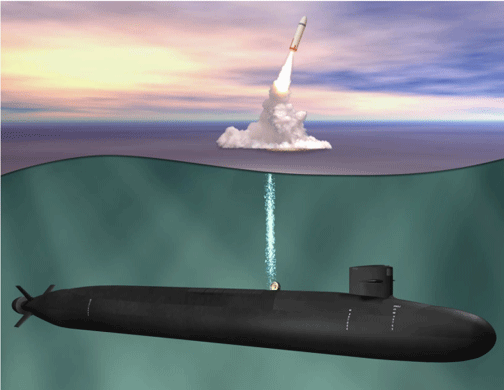
Nuclear Deterrence At Sea – France Begins Work On ‘Cutting Edge’ Nuke-Powered Ballistic Missile Submarine
By EurAsian Times Desk -March 21, 2024
The steel cutting of the first third-generation French SSBN took place at Naval Group’s shipyard in Cherbourg on March 20th. This symbolic gesture marks the start of hull production for these submarines, which will ensure France’s nuclear deterrence posture until the end of the 21st century.
Among the most complex systems, SSBNs are the cornerstones of France’s strategic oceanic force (FOST) and ensure that nuclear deterrence remains at sea.
Launched in February 2021, the SNLE 3G program for the French Navy brings together the armed forces, the French defense procurement agency (Direction Générale de l’Armement – DGA), which is responsible for overall project management, the French Atomic Energy Commission (CEA), for the nuclear boilers, and Naval Group, which is responsible for overall project management of the submarines, in association with TechnicAtome for the nuclear boilers………………………………………………………………………………………………………………………….. https://www.eurasiantimes.com/nuclear-deterrence-at-sea-france-starts-constructing/
Inside Fukushima: Eerie drone footage reveals first ever look at melted nuclear reactor with 880 tonnes of radioactive fuel still inside – 13 years after disaster
Daily Mail, By PERKIN AMALARAJ, 20 Mar 24
Eerie new drone footage has for the first time revealed the extent of the damage to the Fukushima nuclear power plant 13 years on from its meltdown.
The plant’s operators, Tokyo Electric Power Company Holdings, or TEPCO, released 12 photos from inside the site, which are the first ever images from inside the main structural support called the pedestal in the hardest-hit reactor’s primary containment vessel, an area directly under the reactor’s core.
Officials had long hoped to reach the area to examine the core and melted nuclear fuel which dripped there when the plant’s cooling systems were damaged by a massive earthquake and tsunami in 2011.
The high-definition color images captured by the drones show brown objects with various shapes and sizes dangling from various locations in the pedestal.
Parts of the control-rod drive mechanism, which controls the nuclear chain reaction, and other equipment attached to the core were dislodged by the drones.
TEPCO officials said they were unable to tell from the images whether the dangling lumps were melted fuel or melted equipment without obtaining other data such as radiation levels.
The drones did not carry dosimeters to measure radiation because they had to be lightweight and maneuverable.
About 880 tons of highly radioactive melted nuclear fuel remain inside the three damaged reactors.
TEPCO is attempting to learn more about its location and condition to facilitate its removal so the plant can be decommissioned.
The drone cameras could not see the bottom of the reactor core, in part because of the darkness of the containment vessel, officials said.
But the large amount that remains unknown about the interior of the reactors suggests how difficult it will be. Critics say the 30-40 year target for the plant’s cleanup set by the government and TEPCO is overly optimistic.
The daunting decommissioning process has already been delayed for years by technical hurdles and the lack of data……………………………….. https://www.dailymail.co.uk/news/article-13214131/Inside-Fukushima-Eerie-drone-footage-reveals-look-melted-nuclear-reactor-880-tonnes-radioactive-fuel-inside-13-years-disaster.html
—
Nuclear weapons: France to restart tritium production with EDF

By Paul Messad | Euractiv France, 20 Mar 24
France’s Minister for the Armed Forces, Sébastien Lecornu, announced on Monday (18 March) a new production cycle for tritium, which is essential for the manufacture of nuclear weapons, using state utility EDF’s two civilian reactors.
Lecornu visited the Civaux nuclear power plant in south-west France, which will produce the tritium for the military.
The tritium will be manufactured on the premises of the Commissariat à l’énergie atomique (CEA), the French nuclear scientific and industrial research establishment.
To manufacture tritium, it is necessary to treat lithium-containing material with radiation, by exposing it to the neutron fluxes present inside the core of a reactor.
Tritium, whose gaseous form is practically non-existent, naturally, can be extracted from the irradiated material.
This hydrogen isotope (1 proton, 2 neutrons, and hydrogen-3) is particularly vulnerable to disintegrating spontaneously. As a result, any stockpile is halved in 12 years and disappears almost entirely after a century.
But it is vital for the production of nuclear weapons, particularly hydrogen bombs and neutron bombs, for which it is the main explosive.
The French army and EDF have come up with this “collaboration” to ensure the availability of sufficient stocks of tritium “as part of the continuity and credibility of France’s nuclear deterrent”, according to the annex to the press release.
According to the Federation of American Scientists, France currently has 290 active warheads, the fourth largest, after China with 500, the US with 3,700, and Russia with 4,400…………………………………………………….
Discussions between the French armed forces ministry and EDF on this subject have been underway for more than 25 years, in anticipation of the closure in 2009 of the two reactors intended solely for the production of tritium located in Marcoule, in south-east France, after more than 50 years in operation.
The parties finally selected Civaux, one of France’s most powerful and newest nuclear power stations. It was selected because it was capable of operating for a very long time, Dutheil said……………………
despite the reassurances of the various parties involved, any signed agreement between the French government, CEA, and EDF, will not specify a date – to define the legal and contractual scope of the activities, a press release states.
Dutheil stated, that later this year EDF will submit a dossier to the Autorité de sûreté nucléaire, the French nuclear safety authority, which will examine the feasibility of the project.
As a result of this timetable, the first test irradiation of lithium will not take place until before 2025, when the plant’s reactors are scheduled to be shut down for maintenance.
[Edited by Rajnish Singh] https://www.euractiv.com/section/politics/news/nuclear-weapons-france-to-restart-tritium-production-with-edf/
Can the U.S. Develop A Nuclear Bomb Without Ever Testing It? We’re About to Find Out.

In the 1960s, studies showed that throughout the U.S. and the world, children’s baby teeth contained 50 times the normal level of radioactive strontium-90, a byproduct of the warheads, increasing their risk of bone cancer. For these reasons, the United States moved to underground testing in 1963, where the explosions could be contained in deep holes and monitored with scientific instruments. Even then, underground tests led to contamination of soil and groundwater and vented radiation into the atmosphere, where it was often carried away on winds.
The new weapon should work just fine—in theory. But without live testing, scientists won’t know for sure.
Popular Mechanics, BY ADAM MANN MAR 21, 2024
One-foot-thick concrete doors lead to the central target chamber of the National Ignition Facility (NIF), a $3.5 billion research center dedicated to studying nuclear weapons. The mazelike facility is loud with the sound of whirring fans, banging equipment, and, on occasion, beeping signals. Each of the gigantic doors has been covered with concrete injected with boron, an element known for its ability to absorb high-energy neutrons that come blasting out of the chamber as a result of the explosive experiments taking place there………………….
The NIF is far more than just the world’s most expensive movie prop. The central target chamber is situated between two football-field-size buildings on the grounds of the Lawrence Livermore National Lab in Northern California. The enormous blue sphere contains the world’s largest and most powerful laser. Scientists can focus 192 individual ultraviolet laser beams onto targets no bigger than peppercorns. The targets implode with the force of a miniature nuclear blast. When this happens, for a fraction of a second, the target becomes the hottest place in the solar system, with temperatures exceeding 100 million degrees Fahrenheit and pressures 100 times denser than lead.
The only facility capable of conducting such experiments, the NIF has allowed scientists to pioneer fusion energy, investigate conditions in the bellies of stars, and answer questions about the complex physical processes that occur when a nuclear warhead goes off. That data has become all the more critical now that the Navy, Department of Defense, and the Deparment of Energy’s National Nuclear Security Administration (NNSA) are planning to build a new warhead, called the W93. (Nuclear weapons are named for the order in which they are conceived, making this the 93rd design considered by the United States.) This will be the first new nuclear weapon in more than thirty years—and it will be the first that scientists have ever built without the capability of testing it. That’s because since 1996, the United States has participated in a near-worldwide Comprehensive Test Ban Treaty that prohibits the detonation of a nuclear warhead anywhere in the world for military or scientific purposes.
Development of the W93 is expected to cost roughly $15 billion, and the warhead should be ready to deploy sometime in the next decade. The program was first announced in 2020 during the Trump Administration, and its preliminary design studies are due to be completed this October. Which means the United States has now entered into its first new nuclear weapons project since the end of the Cold War.
Officials feel assured that decades of research and simulations will allow them to produce the warhead without too much trouble. “We have learned so much about how the actual weapons work through these computer models and experiments,” says Frank Rose, the principal deputy administrator of the NNSA. “We have a high degree of confidence that we can design, build, and maintain this new W93 warhead without resorting to new explosive nuclear testing.”
But not everyone is convinced, especially given that things almost invariably work differently in reality than in models. “I find it enormously concerning,” says Geoff Wilson, a policy analyst with the Center for Arms Control and Non-Proliferation. “I’m sure that folks from the national laboratories will say, ‘Oh, we test these things all the time.’ And I’m sure that they are incredible simulations.” Yet military programs for things such as new fighter jets are often delayed and run over budget because engineers discover that their components did not work as they had originally been designed. So, Wilson says, “the question of testing is a real one.”………………………………………………………………………………………………..
The early live tests of nuclear weapons served several purposes. The 1945 Trinity test, the first ever conducted, was necessary for scientists to know that their new device would actually work as planned, and it also gave them their first look at the effects of a nuclear blast. When it went off, the blast released a force equivalent to 18,600 tons of dynamite, fusing sand in the New Mexico desert into glass and, according to observers, lighting up the sky “like the sun.”
The United States has conducted 1,053 subsequent nuclear tests, with various degrees of destruction. These were mainly done to gain a better understanding of different weapons designs, how powerful each would be, and whether nuclear weapons could be used in conjunction with soldiers on a battlefield.
Though most warheads were detonated in remote areas such as islands and deserts, live testing was still incredibly damaging to people and the environment. The 1954 Bravo test on Bikini Atoll, in the Marshall Islands, ended up being nearly three times larger than physicists had predicted, and the consequences were far-reaching. Radiation poisoning affected not only the crew of a Japanese fishing vessel near the fallout zone but also residents of Rongelap and Utirik, a pair of atolls 100 and 300 miles to the east, respectively. Such powerful tests left many islands uninhabitable and produced radioactive fallout that lingered in the atmosphere for long periods of time.
In the 1960s, studies showed that throughout the U.S. and the world, children’s baby teeth contained 50 times the normal level of radioactive strontium-90, a byproduct of the warheads, increasing their risk of bone cancer. For these reasons, the United States moved to underground testing in 1963, where the explosions could be contained in deep holes and monitored with scientific instruments. Even then, underground tests led to contamination of soil and groundwater and vented radiation into the atmosphere, where it was often carried away on winds………………………………………………..
Predicting how a nuclear warhead will perform when detonated requires understanding the material properties of plutonium, one of the strangest and most enigmatic elements on the periodic table. Plutonium is what is known as a fissile material, an element that is capable of undergoing reactions where atoms split apart, and it is used in the core of nuclear warheads. It is also an element so rare in nature that the amounts needed for an atomic bomb must be manufactured. Plutonium’s scarcity is also the reason we don’t know much about how it changes or degrades over time—information that’s vital to ensuring that our current atomic arsenal isn’t full of duds.
There is some debate as to whether the hollow plutonium cores of warheads that power the explosion, known as pits, need to be regularly switched out for newer pits. An independent assessment in 2007 from the scientific advisory group JASON concluded that the W76’s and W88’s plutonium cores should be good for at least a century. A 2012 study from Livermore backed up these findings, identifying no unexpected aging issues for 150 years, though it advocated for further research to understand the pit aging process……………………………….
Clearly, the goal of the Comprehensive Test Ban Treaty was to avoid the proliferation of nuclear weapons, and not just the testing of new ones. Plans to build a new nuclear weapon represents a deviation from the spirit of the treaty, says Lisbeth Gronlund, a nuclear arms-control expert and theoretical physicist at the Massachusetts Institute of Technology.
But the U.S. military believes it can and should be done. Nuclear weapons are the backbone of our military strategy, which rests on the concept of mutually assured destruction when it comes to conflict with other nuclear-armed adversaries……………………………………………………………….
The exact mechanisms the W93 will utilize are both a state secret and, at this stage, unknown, because the design details have yet to be decided. But the project will include a new aeroshell—the conical tip of a projectile in which a warhead is placed—called the Mark 7 (Mk7) that is meant to be less likely to detonate accidentally than the Navy’s current submarine-launched missiles. The chemical explosive that starts the process of the warhead’s explosion is intended to be less likely to detonate accidentally as well. https://www.popularmechanics.com/military/weapons/a60255563/w93-nuclear-bomb/
Canada to expedite approval of new nuclear projects, energy minister says
Reuters, By Steve Scherer and Rod Nickel, March 1, 2024
OTTAWA, Feb 29 (Reuters) – Canada will expedite the approval process for new nuclear projects, but will not exclude them from the federal environmental review as requested by the province of Ontario, Energy and Natural Resources Minister Jonathan Wilkinson said.
All new major projects in Canada, including nuclear reactors, have to be reviewed under the Impact Assessment Act (IAA), which the government has promised to revise this spring after the Supreme Court last year ruled it overstepped into provincial jurisdiction.
Wilkinson said the legislative revisions to the IAA will be limited to addressing the concerns of the court because if the government does more than that, it would “have to open up large scale consultations that will take significant time.”
“That being said, we do have some ideas that as to how we can make the process more efficient and respond to the thoughts and aspirations of the provinces,” Wilkinson told Reuters in an interview on Wednesday, adding that accelerating the process will not come at the cost of addressing environmental concerns.
Canada is the world’s second-largest uranium producer, but the long regulatory process has resulted in miners like NexGen Energy having to wait seven years and counting to build the world’s largest uranium mine in Saskatchewan.
“It’s a very long process,” said NexGen CEO Leigh Curyer. “Government and industry working together to bring these projects online more expeditiously, that is absolutely key.”……………………..
Nuclear expansion faces opposition, however, over charges it already doesn’t adequately review risks.
The Sierra Club environmental group opposes development of nuclear fuels because of dangerous waste, high cost and links to weapons, said Sierra’s Canada programs director Gretchen Fitzgerald.
“Canada again and again has failed to create valid environmental assessment processes and arms-length regulation of the nuclear power industry – leaving communities at risk,” Fitzgerald said………………………………
OLD SITES VS NEW ONES
Last month, Ontario said would start work to refurbish aging nuclear reactors at Pickering, located about 45 km (28 miles) east of Toronto, to extend production by 30 years…………………………………………………………..
Ontario is developing what could be the first operating small modular reactor (SMR) in the Western world by the end of the decade, a technology that many countries are looking at as a way of replacing coal-fired plants, Wilkinson said.
Wilkinson said SMRs are “sort of carbon copies of each other” and so should not require repetitive engineering assessments.
The government is also reviewing its entire regulatory process to approve large industrial projects including nuclear by eliminating overlaps between the provincial and federal assessments, he said. The details of that review, which will have a particular impact on mining, will be released in the next few months, Wilkinson said……….https://www.reuters.com/business/energy/canada-expedite-approval-new-nuclear-projects-energy-minister-says-2024-02-29/
Israel Will Steal 16% of Gaza’s Land By Establishing ‘Buffer Zone’
Israel is destroying homes and agricultural land to create the zone
by Dave DeCamp March 18, 2024 https://news.antiwar.com/2024/03/18/israel-will-steal-16-of-gazas-land-by-establishing-buffer-zone/
Israel’s plan to create a “buffer zone” inside Gaza along its border with Israel will take 16% of the Strip’s territory, The Wall Street Journal reported, citing an analysis of the operation by Adi Ben Nun, a Hebrew University geography professor.
Israel has begun the process of constructing the zone, which involves demolishing Palestinian homes and agricultural land that are in the way. The buffer will be about 1 kilometer (.6 miles) in width.
Israeli media reported in January that Israel had destroyed 1,100 of the 2,800 buildings in the border areas. In that same month, 21 Israeli soldiers were killed while working to demolish a building after a Hamas rocket detonated explosives IDF soldiers had planted.
The Israeli military insists it needs to create the buffer zone to prevent future October 7-style attacks. But the plan also advances Israel’s seizure of Gaza’s territory, and many ministers in the Israeli government favor re-establishing Jewish settlements in the Strip.
On top of the buffer zone on the border, Israel is also constructing a road that will cut the Gaza Strip in two. Israel claims that it doesn’t seek to occupy Gaza but wants to maintain open-ended security control of the Strip, which is not possible without some form of occupation.
The Biden administration claims it’s opposed to any Israeli plans that will shrink Gaza’s territory. But the US continues to provide Israel with unconditional military aid as it’s enacting a plan to steal 16% of Gaza.
The last stammering of Jewish fascism

In Israel, the Jewish democratic opposition organized anti-Zionist demonstrations, which were not very well attended. Speakers emphasized the betrayal of the Prime Minister, who used the shock of October 7 not to save the hostages, but to realize his colonial dream.
Washington then decided to radically change its policy. Until then, it had considered that it could not afford to let Israel lose. It had therefore supported its crime. Now, it could no longer afford to let the Jewish fascists win. It’s important to understand that Washington didn’t change its mind when it saw the suffering of the Gazans, nor because of a sudden outburst of anti-fascism, but because of the threats of the “revisionist Zionists”. Its positions are dictated exclusively by its desire to maintain its domination of the world. It could not contemplate another defeat for its Israeli allies, this time after those in Syria and Ukraine. But it could even less envisage losing to the “revisionist Zionists”.
Victoria Nuland’s dismissal demonstrates the Biden Administration’s desire to clean up its own house, while doing the same for Israel.
https://www.voltairenet.org/article220564.html VOLTAIRE NETWORK | PARIS (FRANCE) | 12 MARCH 2024, by Thierry Meyssan
Anyone acting in good faith understands that murdering 30,000 innocent people has nothing to do with eliminating Hamas. Operation Iron Glaive appears for what it is: a cover to realize the old dream pursued by Jewish fascists from Jabotinsky to Netanyahu: to expel the Arab population from Palestine. From then on, this mass crime, committed for the first time live on television, turned the world’s political chessboard upside down. Feeling threatened, the Jewish supremacists themselves threatened the United States. Anxious to remain masters of the “free world”, the United States is preparing to topple the Jewish supremacists.
The Biden administration watched with bated breath as Israel reacted to the attack by the Palestinian Resistance, including Hamas, known as the “Flood of Al-Aqsa” (October 7). Operation Iron Glaive began with a massive pounding of Gaza City on a scale unprecedented anywhere in the world, including the World Wars. From October 27 onwards, this was followed by ground intervention, looting and the torture of thousands of Gazan civilians. In five months, 37,534 civilians were killed or disappeared, including 13,430 children and 8,900 women, 364 medical personnel and 132 journalists. [1].
At first, Washington reacted by unwaveringly supporting “Israel’s right to defend itself”, threatening to veto any ceasefire request and supplying as many bombs as necessary for the widespread destruction of the Palestinian enclave. It was unthinkable, in its eyes, to suffer yet another defeat, after those in Syria and Ukraine. However, Americans were watching the horrors live on their cell phones. Many high-ranking State Department officials wrote and spoke of their shame at supporting this butchery. Petitions were circulated. Prominent figures, both Jewish and Muslim, resigned.
In the midst of a presidential election campaign, Joe Biden’s team could no longer stain its hands with blood. It therefore began to put pressure on the Israeli war cabinet to negotiate the release of the hostages and conclude a ceasefire. However, Benjamin Netanyahu’s coalition refused, playing on the trauma of its citizens to ensure that peace would only return once Hamas had been eradicated. Washington eventually realized that the events of October 7 were merely a pretext for Jabotinsky’s followers to do what they had always wanted to do: expel the Arabs from Palestine. He became more insistent, stressing that the Palestinians had a right to live, that the colonization of their land was illegal under international law, and that the Israeli-Palestinian question would be resolved by a “two-state solution” (and not by the binational state envisaged by Resolution 181 of 1947).
Revisionist Zionists” (i.e., followers of Jabotinsky [2]) responded by organizing the “Conference for the Victory of Israel” [3] on January 28, 2024. Headlining the event was Rabbi Uzi Sharbaf, sentenced in Israel to life imprisonment for his racist crimes against Arabs, but pardoned by his friends. Sharbaf did not hesitate to proclaim himself heir to the Lehi and Stern groups who fought against the Allies alongside duce Benito Mussolini.
The message was perfectly received in Washington and London: this tiny group intended to impose its will on the Anglo-Saxons and would not hesitate to attack them if they tried to prevent ethnic cleansing.
The White House immediately issued a ban on fundraising and transfers to them [4]. This ban was extended to all Western banks under the Foreign Account Tax Compliance Act (FATCA).
In addition, on February 8, President Joe Biden signed a Memorandum on the conditions of US arms transfers [5]. Israel has until March 25 to guarantee in writing that it will not violate either International Humanitarian Law (but not International Law itself) or Human Rights (in the sense of the US Constitution).
For their part, the parliaments of the Netherlands and the United Kingdom have begun debating the possibility of ceasing arms trading with Israel.
In Israel, the Jewish democratic opposition organized anti-Zionist demonstrations, which were not very well attended. Speakers emphasized the betrayal of the Prime Minister, who used the shock of October 7 not to save the hostages, but to realize his colonial dream.
The “revisionist Zionists” then launched a media offensive against the United Nations Relief and Works Agency for Palestine Refugees in the Near East (UNRWA). Since 1949, this UN agency has been providing education, food, healthcare and social services to 5.8 million stateless Palestinians in Palestine itself, as well as in Jordan, Lebanon and Syria. It has an annual budget of over $1 billion and employs over 30,000 people. Already in 2018, President Donald Trump had questioned the agency’s assistance to Palestinians and suspended US funding for it. His intention was to force the Palestinian factions back to the negotiating table. Five years on, the aim of the “revisionist Zionists” is very different. By attacking UNRWA, they intend to force Jordan, Lebanon and Syria to expel Palestinian refugees too. To this end, they accused 0.04% of its staff of having taken part in Operation Flood of Al-Aqsa, and blocked their bank accounts in Israel. UNRWA Director Philippe Lazzarini of Switzerland immediately suspended the 12 accused employees and ordered an internal investigation.
Of course, he never received the proof the Israelis claimed to have, but one donor after another, led by the United States and the European Union, suspended funding. Within days in Gaza, and weeks in Jordan, Lebanon and Syria, the United Nations aid system collapsed.
Continue readingUkraine could need dictatorship to survive – Zelensky party MP
https://www.rt.com/russia/594489-ukraine-dictatorship-zelensky-party/ 20 Mar 24
The president is already “making most of the decisions” in the country, Sergey Demchenko has said
Ukraine may need to become a dictatorship in order to prevail in the conflict with Russia, an MP from President Vladimir Zelensky’s party has suggested.
Zelensky has already concentrated a great deal of power in his hands and “makes most of the decisions” on behalf of the government, Sergey Demchenko told Novyny.Live news on Monday. The situation is “reasonable” and does not mean that Ukraine is a dictatorship, though the country may need to become one, he argued.
”That is possible. During war, people sometimes say that the only way for a nation to emerge victorious is a state of dictatorship,” the lawmaker said. “For the country, for the people, dictatorship always plays negatively, but this tool may help beat the enemy.”
At present, Ukraine can be described as a “democratorship,” the host suggested, to which Demchenko replied that the term for the political system is not important.
The MP did not say whether he personally supports this path, but claimed that the Ukrainian people love freedom too much to accept life under a dictator.
Long before open hostilities with Russia erupted in February 2022, Zelensky cracked down on opposition politicians and critical media, claiming to do so in order to fight against Russian influence and domestic oligarchs.
His term in office is technically set to expire in late May, while a new presidential election must be held by the end of March. However, martial law suspends regular democratic procedures, and Zelensky has indicated that he has no intention of changing the constitution to allow a wartime election. The domination of his Servant of the People party in the parliament would likely have allowed the passage of such amendments, Ukrainian political experts have argued.
The parliament is currently debating a radical reform of the mobilization system, which would introduce hefty punishments for draft dodgers. Kiev intends to add up to 500,000 people to the armed forces with the proposed system in place.
Moscow has claimed that Zelensky is refusing to negotiate a peaceful settlement of the conflict, with the goal of protecting his personal power.
Ukraine’s losses ‘in the millions’ – retired Polish general
https://www.sott.net/article/489939-Ukraines-losses-in-the-millions-retired-Polish-general 20 Mar 24
Kiev does not have the resources or manpower to continue the fight against Russia, Rajmund Andrzejczak has said
Ukraine’s losses in the conflict with Russia should be counted “in the millions,” the former chief of the Polish General Staff, Rajmund Andrzejczak, has claimed. Kiev “is losing the war” and does not have the resources to sustain the fight against Moscow, he added.
In an interview with the Polsat broadcaster on Monday, the retired general described Ukraine’s battlefield situation as “very dramatic” and insisted that “there are no miracles in war.”
Ukrainian President Vladimir Zelensky’s decision to replace his top general, Valery Zaluzhny, with Aleksandr Syrsky has failed to make a significant difference as the same issues remain for Kiev’s new commander-in-chief, Andrzejczak added.
According to the retired general, Ukraine is suffering deficits in equipment and manpower, with losses taking their toll on its capabilities.
“They are missing over 10 million people. I estimate that the losses should be counted in the millions, not hundreds of thousands. There are no resources in this country, there is no one to fight.”
“The Ukrainians are losing this war,” Andrzejczak stated, pointing to media reports suggesting that Kiev is running out of anti-aircraft missiles to protect itself from Russian strikes.
Echoing warnings from several Western leaders in recent weeks, Andrzejczak called for arms production to be boosted and argued that the West should prepare for a full-scale conflict with Russia within two or three years. Russian President Vladimir Putin has insisted that Moscow has no plans or interest in attacking NATO.
Russian Defense Minister Sergey Shoigu stated last month that Ukraine had lost more than 444,000 troops since the start of the conflict in February 2022. The hostilities have also triggered an exodus of Ukrainian refugees, with almost 6.5 million recorded worldwide, according to UN data.
Officials in Kiev have repeatedly complained that Western arms shipments have been inadequate. Those calls have grown louder as US President Joe Biden’s request to provide an additional $60 billion in aid remains stalled in Congress, due to Republican demands to strengthen American border security.
Kiev is also mulling a new mobilization bill that would lower the minimum draft age for men from 27 to 25, with reported plans to send 500,000 new troops to the frontline.
Against this backdrop, the Russian military last month pushed Kiev out of the strategic Donbass city of Avdeevka, also liberating several nearby settlements. The former stronghold has been on the front line since 2014 and was frequently used by Kiev to shell residential blocks in the nearby city of Donetsk.
Without Extensive Narrative Manipulation, None Of This Would Be Consented To

CAITLIN JOHNSTONE, MAR 20, 2024,
Without extensive narrative manipulation, it would never occur to anyone that bombing Gaza into rubble is a reasonable response to a single Hamas attack.
Without extensive narrative manipulation, it would never occur to anyone that killing tens of thousands of Palestinians and starving hundreds of thousands more is a reasonable response to a thousand Israelis being killed.
Without extensive narrative manipulation, it would never occur to anyone that criticizing the actions of the state of Israel is antisemitic.
Without extensive narrative manipulation, it would never occur to anyone that saying “from the river to the sea” is a call for genocide.
Without extensive narrative manipulation, it would never occur to anyone to think about this onslaught and the discourse around it in terms of “Jews vs Jew haters”.
Without extensive narrative manipulation, it would never occur to anyone that it was fine and normal to keep an unwanted ethnic group in a walled-in area whose resources are tightly controlled by those in power.
Without extensive narrative manipulation, it would never occur to anyone that TikTok is a massive problem that needs to be eliminated.
Without extensive narrative manipulation, it would never occur to anyone that Israel should be able to inflict violence and abuse upon the Palestinian population for generations without ever receiving any violence in return.
Without extensive narrative manipulation, it would never occur to anyone that Israel using the Israeli army to murder civilians in an Israeli military campaign is something that can be blamed on Hamas.
Without extensive narrative manipulation, it would never occur to anyone that it is fine and acceptable for the IDF to be targeting healthcare workers, journalists and scholars and destroying hospitals, universities and mosques.
Without extensive narrative manipulation, it would never occur to anyone that dozens of Israeli hostages are more important than the hundreds of thousands of Palestinians who are being starved and murdered.
Without extensive narrative manipulation, it would never occur to anyone that the US war machine should be bombing people in Yemen, Iraq and Syria to stop their retaliations for the destruction of Gaza.
Without extensive narrative manipulation, it would never occur to anyone that the governments who are backing a genocide are not personally responsible for it.
Without extensive narrative manipulation, it would never occur to anyone that the unfathomable suffering that is taking place in Gaza right now should not be at the forefront of our attention.
Without extensive narrative manipulation, it would never occur to anyone that the genocide in Gaza should be allowed to continue instead of being brought to an immediate end.
And that’s why we’ve been seeing such extensive narrative manipulation — from our news media, from our government officials, and from Israel apologists on social media.
It’s because without extensive narrative manipulation, none of this would be consented to.
New Brunswick’s Point Lepreau nuclear plant ranked as poor performer among international peers
Consultant ranks Lepreau in ‘bottom quartile’ in multiple performance categories
Robert Jones · CBC News · Mar 20, 2024
Since 2014 the Point Lepreau nuclear generating station has been one of the poorest-performing reactors among dozens of similar facilities in five countries, a pair of unflinching reports commissioned by N.B. Power about the troubled plant suggest.
The U.S.-based energy consulting firm ScottMadden found N.B. Power spent less on upkeep at Lepreau since it completed a major refurbishment in 2012 than owners of more reliable reactors, and they provided evidence that Lepreau’s troubles may be connected to a failure to invest enough on maintenance.
The reports also suggest Lepreau’s performance may worsen in future years if amounts spent on keeping ahead of trouble are not increased significantly………………………………………………………..
Lepreau, originally commissioned in 1983, had a disappointing production record in its first 25 operational years that has continued over the last decade, despite a major overhaul of its reactor and nuclear components between 2008 and 2012.
In the 11 years from 2013 and 2023, Lepreau suffered 400 more days of downtime than originally projected, costing the utility up to $1 billion in lost production and repair costs that have been battering the utility’s finances…………………………………………………………………………. more https://www.cbc.ca/news/canada/new-brunswick/nb-power-point-lepreau-poor-1.7148879
1 This Month
Chernobyl: The Lost Tapes – A good documentary on Chernobyl on SBS available On Demand for the next 3 weeks– https://www.sbs.com.au/ondemand/tv-program/chernobyl-the-lost-tapes/2352741955560

of the week–London Campaign for Nuclear Disarmament

Tell the Ukrainian Government to Drop Prosecution of Peace Activist Yurii Sheliazhenko
To see nuclear-related stories in greater depth and intensity – go to https://nuclearinformation.wordpress.com
-
Archives
- April 2026 (126)
- March 2026 (251)
- February 2026 (268)
- January 2026 (308)
- December 2025 (358)
- November 2025 (359)
- October 2025 (376)
- September 2025 (257)
- August 2025 (319)
- July 2025 (230)
- June 2025 (348)
- May 2025 (261)
-
Categories
- 1
- 1 NUCLEAR ISSUES
- business and costs
- climate change
- culture and arts
- ENERGY
- environment
- health
- history
- indigenous issues
- Legal
- marketing of nuclear
- media
- opposition to nuclear
- PERSONAL STORIES
- politics
- politics international
- Religion and ethics
- safety
- secrets,lies and civil liberties
- spinbuster
- technology
- Uranium
- wastes
- weapons and war
- Women
- 2 WORLD
- ACTION
- AFRICA
- Atrocities
- AUSTRALIA
- Christina's notes
- Christina's themes
- culture and arts
- Events
- Fuk 2022
- Fuk 2023
- Fukushima 2017
- Fukushima 2018
- fukushima 2019
- Fukushima 2020
- Fukushima 2021
- general
- global warming
- Humour (God we need it)
- Nuclear
- RARE EARTHS
- Reference
- resources – print
- Resources -audiovicual
- Weekly Newsletter
- World
- World Nuclear
- YouTube
-
RSS
Entries RSS
Comments RSS
 nuclear-news