Space tourists and crew suffer high radiation risks – regulation is needed to protect them.
exposure to elevated levels of ionising radiation, such as those possible during space weather events, can potentially cause damage to DNA. The risk of space travel therefore ranges from a minor increase in health defects to serious health implications such as cancers.
The space tourism industry is currently not fully aware of the radiation risks, we discovered. It is instead relying on incomplete “informed consent” for non-crew participants.
The Conversation, March 19, 2024 , Chris Rees, Postgraduate Researcher of Space Risk Engineering, University of Surrey
In a decade or two, journeys into space could become as normal [really?]as transatlantic flights. In particular, the number of humans travelling into space with the help of commercial companies, such as Virgin Galactic and Blue Origin, will increase significantly.
But such travel comes with huge radiation risks. Sudden changes in space weather, such as solar flares, for example, could have significant health implications for crew and passengers. Now our recent paper, from the University of Surrey, Foot Anstey LLP Space and Satellite Team, has found that current legislation and regulation don’t do enough to protect space tourists and crew.
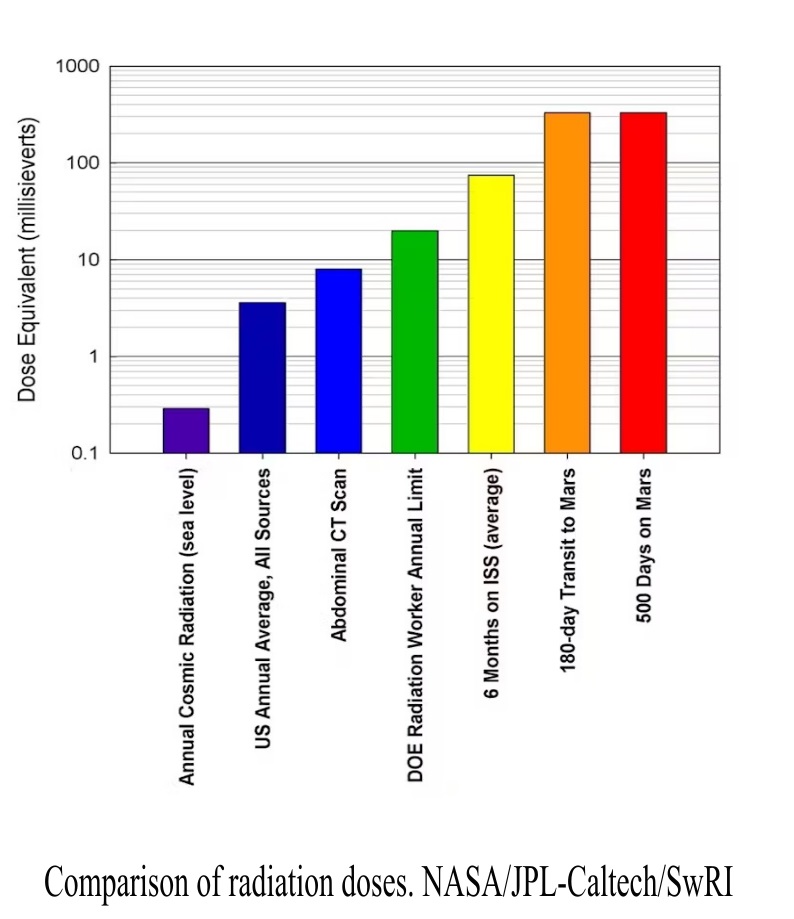
Changes in space weather could expose space tourists to radiation doses in excess of the recommended maximum 1 millisievert (mSv) yearly uptake for a member of the public and 20mSv yearly for those working with radiation. Research at the University of Surrey shows that during an extreme space weather event, flight participants could receive doses in excess of 100mSv.
Current legislation and regulation focusing on potential radiation exposure for space tourists is limited and largely untested. There is a heavy focus on conventional non-radiation risk and wider safety, with guidance stemming from regulation of normal commercial flights. However, these are significantly different to space tourism enterprises.
Similarly, the law around space flights and their associated risk liability is complex. Space law incorporates a mix of international law (such as international agreements, treaties and conventions), domestic legislation and guidance.
Cancer risk
Exposure to low levels of background natural radiation is part of everyday life. Most people are not aware of this exposure and the potential risks to our health. For example, an 0.08mSv effective dose from a commercial flight from the UK to the US.
However, exposure to elevated levels of ionising radiation, such as those possible during space weather events, can potentially cause damage to DNA. The risk of space travel therefore ranges from a minor increase in health defects to serious health implications such as cancers.
There has been significant risk assessment of radiation exposure on Earth; for example in the nuclear industry. This is unlike the space tourism industry, which is still in its infancy.
Previous research has focused on the potential risk assessment for astronauts from radiation exposure and long duration missions outside low-Earth orbit. But this does not consider risks for those on short trips to space as tourists. Thus, there is still significant work to be done to assess the unique risk for space tourist flights and the supporting guidance and regulation.
Any existing regulation, such as the UK Air Navigation Order and Federal Aviation Administration (FAA) space flight regulations, that is applicable to potential space flights focuses on crew, rather than paying passengers.
The space tourism industry is currently not fully aware of the radiation risks, we discovered. It is instead relying on incomplete “informed consent” for non-crew participants. The current regulation for the industry therefore places the risk burden firmly on the space tourist. We argue more legislation and regulation are needed.
Our recommendations
We made a series of recommendations in our report. But they are advisory. They are intended for the industry and regulators to consider as the space tourism sector continues to develop, particularly the FAA and the UK Civil Aviation Authority (CAA)………………………………… more https://theconversation.com/space-tourists-and-crew-suffer-high-radiation-risks-regulation-is-needed-to-protect-them-225693
No comments yet.
1 This Month
Chernobyl: The Lost Tapes – A good documentary on Chernobyl on SBS available On Demand for the next 3 weeks– https://www.sbs.com.au/ondemand/tv-program/chernobyl-the-lost-tapes/2352741955560

of the week–London Campaign for Nuclear Disarmament

Tell the Ukrainian Government to Drop Prosecution of Peace Activist Yurii Sheliazhenko
To see nuclear-related stories in greater depth and intensity – go to https://nuclearinformation.wordpress.com
-
Archives
- April 2026 (126)
- March 2026 (251)
- February 2026 (268)
- January 2026 (308)
- December 2025 (358)
- November 2025 (359)
- October 2025 (376)
- September 2025 (257)
- August 2025 (319)
- July 2025 (230)
- June 2025 (348)
- May 2025 (261)
-
Categories
- 1
- 1 NUCLEAR ISSUES
- business and costs
- climate change
- culture and arts
- ENERGY
- environment
- health
- history
- indigenous issues
- Legal
- marketing of nuclear
- media
- opposition to nuclear
- PERSONAL STORIES
- politics
- politics international
- Religion and ethics
- safety
- secrets,lies and civil liberties
- spinbuster
- technology
- Uranium
- wastes
- weapons and war
- Women
- 2 WORLD
- ACTION
- AFRICA
- Atrocities
- AUSTRALIA
- Christina's notes
- Christina's themes
- culture and arts
- Events
- Fuk 2022
- Fuk 2023
- Fukushima 2017
- Fukushima 2018
- fukushima 2019
- Fukushima 2020
- Fukushima 2021
- general
- global warming
- Humour (God we need it)
- Nuclear
- RARE EARTHS
- Reference
- resources – print
- Resources -audiovicual
- Weekly Newsletter
- World
- World Nuclear
- YouTube
-
RSS
Entries RSS
Comments RSS
 nuclear-news
Leave a comment