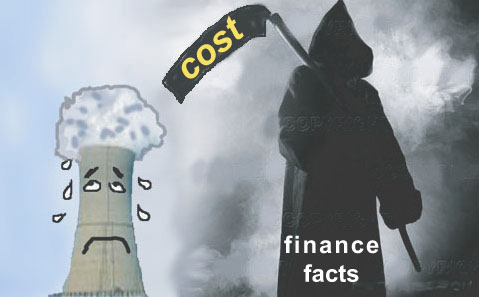
TODAY. In talking about nuclear matters, why is money the only game in town?
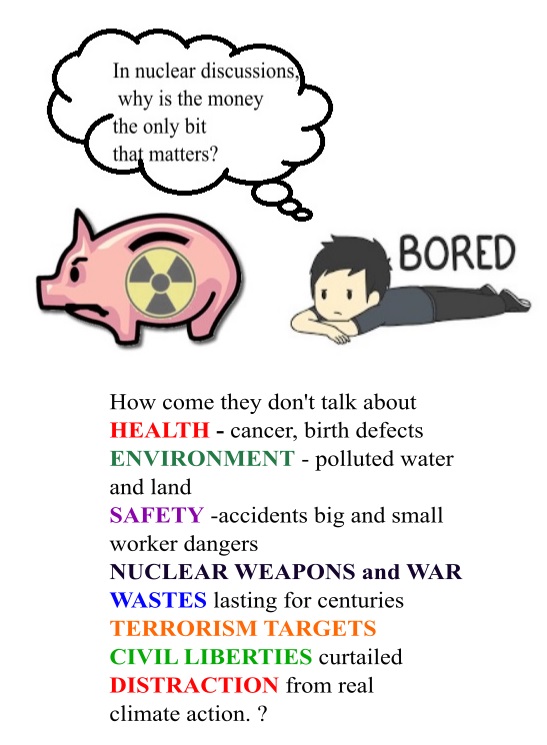
I’m constantly reading nuclear news items. And yes, I am getting bored with all the money stuff. I know it’s important. I know that money is very very important, especially these days with the cost of living on everyone’s mind.(Well, perhaps not the 1% – the very wealthy)
It must be so important. There’s America’s small nuclear reactor dream gone bung, because NuScale’s smrs cost too much. There are the bankruptcies Westinghouse- and those near to bankruptcy – Toshiba, EDF, and the companies with a chequered past e,g.- SNC-Lavalin, Areva (reborn as Orano),
There are the financial contortions going on in Britain, with its very dodgy “Great British Nuclear”. The USA agonising over the ginormous costs of the still uncompleted Vogtle NPP. And France with Macron’s delusional scheme for many big and small reactors to be built very fast, -while they can’t afford to fix up, or to close down, their existing fleet of aging reactors.
There are the “minor” countries also agonising over how to pay for their nuclear schemes – Indonesia, Bulgaria, Sweden, Kenya, Ghana………
But of course, Russia China, North Korea, are fine with nuclear economics – or so I’m told by some Australian nuclear zealots who are NRB (- not real bright). Yeah well, if you need a dictatorship to make nuclear power economic, I guess that’s the way to go. (But are we sure it’s all that good in those countries, anyway?)
But anyway, yes, I’m wondering why the media doesn’t seems to be fussing about the radioactive pollution of our planet, and the risks to health, especially of pregnant women, children, and everybody. Big accidents are rare – but they do happen , smaller accidents happen, too. And the connection with weapons, war, the nightmare possibility of omnicide – that’s a bit of a worry too. Of course indigenous people and those silly anti-nuclear activists make a fuss, but they don’t count, do they?
I guess it is all symptomatic of our era, our prevailing culture, the worship of not just profit, but ever-increasing profit.
Still, perhaps I should not complain. Worrying about money might be the only thing saving us from nuclear follies. And I note that when they do their earnest costing of nuclear power – they talk only about building costs and electricity prices – and it’s already too expensive! What if they also counted the cost of nuclear waste disposal, and a thousand years of securing it?
Mainstream climate scientists run the risk of becoming the new climate deniers.

“Executive Summary”
- The speed with which the climate is now changing is faster than (almost) all scientists thought possible.
- There is now zero prospect of holding the average temperature increase this century to below 1.5°C; even 2°C is beginning to slip out of reach. The vast majority of climate scientists know this, but rarely if ever give voice to this critically important reality.
- At the same time, the vast majority of people still haven’t a clue about what’s going on – and what this means for them and everything they hold dear.
- The current backlash against existing (already wholly inadequate) climate measures is also accelerating – and will cause considerable political damage in 2024. Those driving this backlash represent the same old climate denial that has been so damaging over so many years.
- The science-based institutions on which we depend to address this crisis have comprehensively failed us. The Intergovernmental Panel on Climate Change is incapable of telling the whole truth about accelerating climate change; the Conference of the Parties (under the UN Framework Convention on Climate Change) has been co-opted by the fossil fuel lobby to the point of total corruption.
- By not calling out these incontrovertible realities, mainstream scientists are at risk of becoming the new climate deniers.
more https://www.jonathonporritt.com/mainstream-climate-science-the-new-denialism/
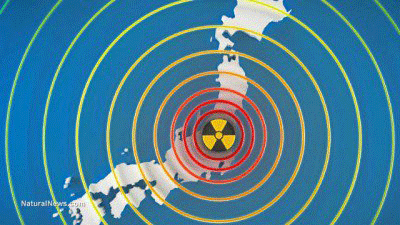
Japan finishes first-year ocean discharge of nuclear-tainted wastewater amid backlash
“All fishermen are against ocean dumping. The contaminated water has flowed into what we fishermen call ‘the sea of treasure’, and the process will last for at least 30 years,“
“There is no good reason to dump radioactive materials into the ocean. There is no reason to just dilute them and flush them away,“
https://thesun.my/world/japan-finishes-first-year-ocean-discharge-of-nuclear-tainted-wastewater-amid-backlash-PD12227910 18 Mar 24,
TOKYO: Despite opposition and concern from at home and abroad, Japan’s crippled Fukushima Daiichi Nuclear Power Plant has finished its initial year of discharging nuclear-contaminated wastewater into the ocean, according to the plant’s operator, said Xinhua.
As per the initial plan, approximately 31,200 tons of wastewater, containing radioactive tritium, was released into the ocean since the discharge started in August 2023, with each round of discharge carried out for about two weeks. Earlier this week, International Atomic Energy Agency Director-General Rafael Grossi emphasised continued efforts in monitoring Japan’s ocean discharge of nuclear-contaminated wastewater from the crippled plant, following his first visit to Fukushima prefecture since the discharge started.
Stressing that the discharge marks merely the initial phase of a long process, Grossi said that “much effort will be required in the lengthy process ahead,“ and reiterated the organisation’s stance on maintaining vigilance throughout the process.
While the Japanese government and TEPCO have asserted the safety and necessity of the discharge, concerns have been raised by neighbouring countries and local stakeholders regarding environmental impacts.
“All fishermen are against ocean dumping. The contaminated water has flowed into what we fishermen call ‘the sea of treasure’, and the process will last for at least 30 years,“ said Haruo Ono, a fisherman in the town of Shinchi in Fukushima.
“There is no good reason to dump radioactive materials into the ocean. There is no reason to just dilute them and flush them away,“ said the man in his 70s.
“Is it really necessary, in the first place, to dump what has been stored in tanks into the sea? How can we say it’s ‘safe’ when the discharged water clearly consists of harmful radioactive substances? I think the government and TEPCO must provide a solid answer,“ said Chiyo Oda, a resident of Fukushima’s Iwaki city.
Concerns were fuelled among the Japanese public over the recent leakage of contaminated water from pipes at the Fukushima plant. – Bernama, Xinhua
Space tourists and crew suffer high radiation risks – regulation is needed to protect them.
exposure to elevated levels of ionising radiation, such as those possible during space weather events, can potentially cause damage to DNA. The risk of space travel therefore ranges from a minor increase in health defects to serious health implications such as cancers.
The space tourism industry is currently not fully aware of the radiation risks, we discovered. It is instead relying on incomplete “informed consent” for non-crew participants.
The Conversation, March 19, 2024 , Chris Rees, Postgraduate Researcher of Space Risk Engineering, University of Surrey
In a decade or two, journeys into space could become as normal [really?]as transatlantic flights. In particular, the number of humans travelling into space with the help of commercial companies, such as Virgin Galactic and Blue Origin, will increase significantly.
But such travel comes with huge radiation risks. Sudden changes in space weather, such as solar flares, for example, could have significant health implications for crew and passengers. Now our recent paper, from the University of Surrey, Foot Anstey LLP Space and Satellite Team, has found that current legislation and regulation don’t do enough to protect space tourists and crew.
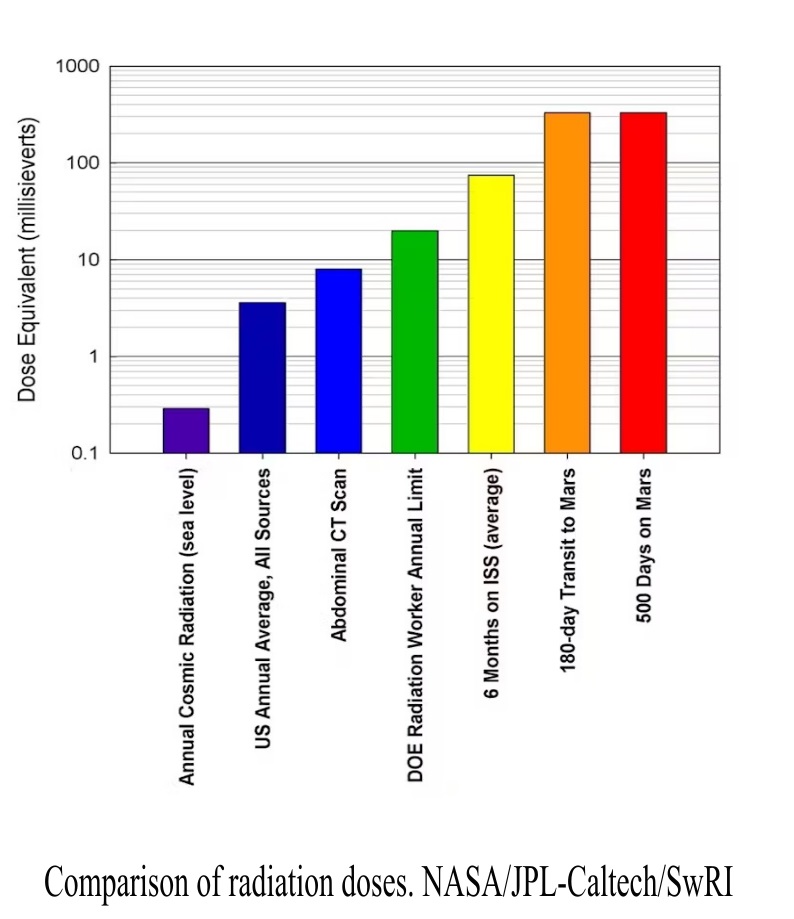
Changes in space weather could expose space tourists to radiation doses in excess of the recommended maximum 1 millisievert (mSv) yearly uptake for a member of the public and 20mSv yearly for those working with radiation. Research at the University of Surrey shows that during an extreme space weather event, flight participants could receive doses in excess of 100mSv.
Current legislation and regulation focusing on potential radiation exposure for space tourists is limited and largely untested. There is a heavy focus on conventional non-radiation risk and wider safety, with guidance stemming from regulation of normal commercial flights. However, these are significantly different to space tourism enterprises.
Similarly, the law around space flights and their associated risk liability is complex. Space law incorporates a mix of international law (such as international agreements, treaties and conventions), domestic legislation and guidance.
Cancer risk
Exposure to low levels of background natural radiation is part of everyday life. Most people are not aware of this exposure and the potential risks to our health. For example, an 0.08mSv effective dose from a commercial flight from the UK to the US.
However, exposure to elevated levels of ionising radiation, such as those possible during space weather events, can potentially cause damage to DNA. The risk of space travel therefore ranges from a minor increase in health defects to serious health implications such as cancers.
There has been significant risk assessment of radiation exposure on Earth; for example in the nuclear industry. This is unlike the space tourism industry, which is still in its infancy.
Previous research has focused on the potential risk assessment for astronauts from radiation exposure and long duration missions outside low-Earth orbit. But this does not consider risks for those on short trips to space as tourists. Thus, there is still significant work to be done to assess the unique risk for space tourist flights and the supporting guidance and regulation.
Any existing regulation, such as the UK Air Navigation Order and Federal Aviation Administration (FAA) space flight regulations, that is applicable to potential space flights focuses on crew, rather than paying passengers.
The space tourism industry is currently not fully aware of the radiation risks, we discovered. It is instead relying on incomplete “informed consent” for non-crew participants. The current regulation for the industry therefore places the risk burden firmly on the space tourist. We argue more legislation and regulation are needed.
Our recommendations
We made a series of recommendations in our report. But they are advisory. They are intended for the industry and regulators to consider as the space tourism sector continues to develop, particularly the FAA and the UK Civil Aviation Authority (CAA)………………………………… more https://theconversation.com/space-tourists-and-crew-suffer-high-radiation-risks-regulation-is-needed-to-protect-them-225693
UN Chief: Nuclear Risk Highest in Decades, Calls for Disarmament
The United Nations. https://www.miragenews.com/un-chief-nuclear-risk-highest-in-decades-calls-1197216/–– 18 Mar 24
Almost 80 years after the incineration of the Japanese cities of Hiroshima and Nagasaki, nuclear weapons still represent a clear and present danger to global peace and security, UN Secretary-General António Guterres told the Security Council on Monday.
Calling for disarmament now, he urged States with nuclear arsenals to lead the way across six areas for action that include dialogue and accountability.
“Nuclear weapons are the most destructive weapons ever invented, capable of eliminating all life on earth. Today, these weapons are growing in power, range and stealth. An accidental launch is one mistake, one miscalculation, one rash act away,” he warned.
Doomsday Clock ticking loudly
The meeting on nuclear disarmament and non-proliferation was convened by Japan, Security Council president for March and, as Mr. Guterres noted, the only country that knows better than any other “the brutal cost of nuclear carnage.”
It was being held at a time “when geopolitical tensions and mistrust have escalated the risk of nuclear warfare to its highest point in decades.”
He said the Doomsday Clock – the symbol for humanity’s proximity to self-destruction – “is ticking loudly enough for all to hear”.
Meanwhile, academics and civil society groups, to Pope Francis, youth, and the survivors of Hiroshima and Nagasaki, known as Hibakusha, have been clamouring for peace and an end to the existential threat.
No ‘Oppenheimer’ sequel
Even the Oscar-winning Hollywood film Oppenheimer “brought the harsh reality of nuclear doomsday to vivid life for millions around the world,” he said, adding that “humanity cannot survive a sequel”.
Despite these appeals for the world to step back from the brink, “States possessing nuclear weapons are absent from the table of dialogue,” he said, while “investments in the tools of war are outstripping investments in the tools of peace.”
Mr. Guterres stressed that disarmament is the only path to “vanquish this senseless and suicidal shadow, once and for all.”
Dialogue and confidence-building
He appealed to States armed with nuclear weapons to take the lead in six areas, starting with re-engaging in dialogue to develop transparency and confidence-building measures to prevent any use of a nuclear weapon.
“Second, nuclear saber-rattling must stop,” he said. “Threats to use nuclear weapons in any capacity are unacceptable.”
Nuclear weapon States must also re-affirm moratoria on nuclear testing, which includes pledging to avoid actions that would undermine the 1996 Comprehensive Nuclear-Test-Ban Treaty (CTBT), whose entry-into-force must be priority.
From commitment to action
Furthermore, disarmament commitments must become action, together with accountability, under the Treaty on the Non-Proliferation of Nuclear Weapons (NPT). The landmark accord, signed more than 50 years ago, is the only binding commitment to the goal of disarmament by States which officially stockpile nuclear weapons.
The Secretary-General also highlighted the need for a joint first-use agreement. “Nuclear weapon States must urgently agree that none of them will be the first to use nuclear weapons. As a matter of fact, none should use them in any circumstances,” he said.
Reducing stockpiles
Finally, he called for reductions in the number of nuclear weapons. In this regard, he urged the United States and Russia – the world’s largest nuclear weapons holders – to take the lead and also find a way back to negotiations towards the full implementation of the New START Treaty and agree on its successor.
Mr. Guterres also pointed to the responsibility of non-nuclear weapon States to fulfil their own non-proliferation obligations and to support disarmament efforts.
He said the Security Council also has a leadership role, including “to look beyond today’s divisions, and state clearly that living with the existential threat of nuclear weapons is unacceptable.”
Bulgarian nuclear experts question economic viability of new nuclear project
By Emiliya Milcheva and Krassen Nikolov | Euractiv.bg 18 Mar 24
Bulgarian nuclear experts are questioning the economic feasibility of the country’s plan to build two US nuclear reactors at the Kozloduy nuclear power plant, raising questions on funding and whether the country has the means to purchase energy from these plants.
“It will be very difficult to find banks to finance the project,” Valentin Kolev, energy expert and a member of the American Association of Energy Engineers told Euractiv. “If we assume that we will produce 15 terawatt-hours per year, in 20 years of operation, it makes 300 terawatt hours. At a price of €17.6 billion for the two reactors, a price of close to €60/MWh would result, but this is only the investment. Fuel costs and much more are not included. The price cannot be below €100-125.”
Energy Minister Rumen Radev said that the electricity from the new Kozloduy NPP reactors will cost €65/MWh.
Bulgaria will build the two nuclear reactors with loans, and only 30% of the construction costs will be financed with money from the state budget, according to an investigation by Euractiv.
At the end of last year, Bulgarian Prime Minister Nikolai Denkov told Euractiv that Greece, Serbia, and North Macedonia were interested in signing long-term contracts for the purchase of electricity from the future seventh and eighth units of the Kozloduy NPP. However, Bulgaria has not been able to attract the three neighbouring countries as investors.
European companies also showed no interest in building the new plant, with the Bulgarian parliament voting to open negotiations with the Korean company Hyundai. The nuclear reactors will be based on the AR-1000 technology of the American company Westinghouse.
Bulgarian Energy Minister Rumen Radev sets the final price for the new reactors at €13 billion, but most experts claim that the price will exceed €17.5 billion.
Kolev recalled the HSBC investment study for the abandoned Belene nuclear power plant project, set to comprise two Russian reactors. This study calculated the cost of electricity at €75/MWh, which led the government to abandon the project as the return on investment would not be high enough.
“For now, it is not clear how the new nuclear plants will be paid for,” Neykov commented.
Another Bulgarian energy expert – Georgi Stefanov – also expressed fears billions of euro might be spent from the state budget, but in the end, nothing would be built.
“The construction of a power plant should be looked at like this: How much money do we need, how much money will we earn, and then how much money will we pay for the disposal when the NPP is closed, and for the maintenance of the nuclear waste?” Stefanov said……………………………….https://www.euractiv.com/section/politics/news/bulgarian-nuclear-experts-question-economic-viability-of-new-nuclear-project/
—
In Japan, Opposition to restarting nuclear power plants has grown, especially among women

https://mainichi.jp/english/articles/20240318/p2a/00m/0op/004000c 18 Mar 24
More against restarting nuclear plants than for after Japan Noto quake: Mainichi poll
TOKYO — Forty-five percent of people opposed restarting nuclear power plants in Japan, exceeding the 36% who support the move, as they likely realized the risk again in the wake of the Jan. 1 Noto Peninsular earthquake, according to a Mainichi Shimbun opinion poll conducted on March 16 and 17.
The same question was asked in the Mainichi questionnaire carried out in May 2022 and March 2023 in which 47% and 49% of respondents supported the idea, respectively, outweighing the 30% and 37% of those who were at odds.
There was a stark contrast between men and women in the results of the recent survey, with 55% of men answering they were for restarting nuclear power plants in contrast with the 34% against it, while 56% of women who said they were opposed to the idea outweighed the 20% in favor of it.
Younger people tended to support the idea, while older respondents were more opposed, with nearly 70% of those aged 18 to 29 in favor, and approximately 60% of those aged 70 and older against. Opinions among those in their 50s were evenly split, with about 40% for and 40% against.
(Japanese original by Hiroshi Miyajima, Political News Department)
A chance to break the nuclear links – Kate Hudson, CND

,
https://labouroutlook.org/2024/03/17/a-chance-to-break-the-nuclear-links-kate-hudson-cnd/
“It’s just not possible for the UK to have an independent foreign policy, or defence and security policies, if it remains attached at the hip to the US nuclear programme.”
By Kate Hudson, Campaign for Nuclear Disarmament (CND)
Whoever is in the White House after the upcoming presidential election, one thing is clear: Britain has to break its ‘special nuclear relationship’ with the US. We’re all familiar with the so-called ‘special relationship’, basically tying Britain into really bad foreign policy decisions. But not so many people know about the US-UK Mutual Defence
Agreement (MDA) – the world’s most extensive nuclear sharing agreement.
Known in full as the ‘Agreement between the UK and the USA for cooperation in the Uses of Atomic Energy for Mutual Defence Purposes’, the treaty initially established an agreement between both countries to exchange classified information to develop their respective nuclear weapon systems.
At the start, the MDA prohibited the transfer of nuclear weapons, but an amendment in 1959 allowed for the transfer of nuclear materials and equipment between both countries up to a certain deadline.
This amendment is extended through a renewal of the treaty every ten years, most recently in2014 – without any parliamentary debate or vote. The British public and parliamentarians initially found out about that extension and ratification when President Obama informed the United States Congress.
Renewing such agreements on the nod, without transparency or accountability, is never a good thing. When it ties us so tightly to nuclear cooperation with the White House this is an even greater cause for concern. The time has come to really vigorously oppose this Agreement.
It also puts us at odds with our commitments under the NPT: the MDA confirms an indefinite commitment by the US and UK to collaborate on nuclear weapons technology and violates both countries’ obligations as signatories to the NPT. The NPT states that countries should undertake ‘to pursue negotiations in good faith on effective measures relating to… nuclear disarmament’.
Rather than working together to get rid of their nuclear weapons, the UK and US are collaborating on further advancing their nuclear arsenals. Indeed, a 2004 legal advice paper by Rabinder Singh QC and Professor Christine Chinkin concluded that it is ‘strongly arguable that the renewal of the Mutual Defence Agreement is in breach of the nuclear Non-Proliferation Treaty’, as it implies ‘continuation and indeed enhancement of thenuclear programme, not progress towards its discontinuation’.
On every level the MDA must be challenged. It’s just not possible for the UK to have an independent foreign policy, or defence and security policies, if it remains attached at the hip to the US nuclear programme. When the US seems hell-bent on taking us into war after war, unquestioning allegiance from the UK cannot continue.
The MDA is up for renewal again this year. Now is the time to start asking the questions, raising the protest,and making the case for independence. It’s time for the special nuclear relationship to end. Watch this space!
The spending horrors facing UK’s next PM from old nuclear subs to RAAC in schools
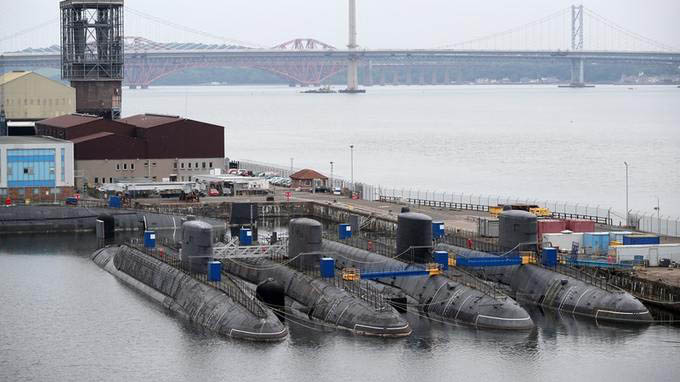
Meg Hillier warned that the next Government will face many spending ‘big nasties’ that will eat up already stretched budgets
The spending horrors facing the next PM from old nuclear subs to RAAC in
schools. Meg Hillier warned that the next Government will face many
spending ‘big nasties’ that will eat up already stretched budgets.
The influential chair of the Public Accounts Committee (PAC) has warned of the
“big nasties” of public spending that face the next Government. In an
interview with i, Labour MP Meg Hillier warned that there wasn’t
“nearly enough good project management” in Government to ensure that
the numerous issues she’s identified, from crumbling hospitals to an out
of service a nuclear submarine fleet, are dealt with.
The UK also needs to
consider how it will safely dispose of its fleet of retired nuclear
submarines, a job that is expected to be very costly for the Ministry of
Defence. The current Vanguard class of submarines are due to be phased out
by 2032 and replaced by the Dreadnought class, and it was estimated in 2016
that the renewal of the programme could cost between £167bn and £179bn
over its 30-year life span.
iNews 17th March 2024
https://inews.co.uk/news/politics/spending-horrors-facing-next-prime-minister-2960825
Deadlines, costs, production: France’s nuclear company EDF in a moment of truth
By Paul Messad | Euractiv France, Mar 18, 2024
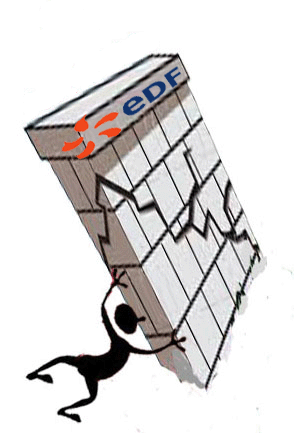
EDF, the French state-owned energy giant faces criticism for rising costs and delays in its nuclear projects, its existing reactors have also been encountering problems. Euractiv looks at the implications of these challenges for EDF and the wider nuclear energy industry.
January 23, 2023: EDF, Europe’s leading energy company, announces a further extension of the costs and construction times of its two 3rd generation pressurized water reactors (EPR) located at Hinkley Point in England. The budget could increase by 70 to 90% compared to initial estimates and the start-up could be four to six years late.
……….the delays are “not likely to undermine the confidence of the British government in its nuclear strategy” , defends SFEN. Proof of this would be its reinvestment of more than a billion pounds sterling in two other reactors built by EDF in England, at Sizewell.
For others, on the contrary, the Anglo-Saxon situation is symptomatic of the challenge faced by the largest nuclear operator in the world, in whose confidence is eroded as projects progress, while it aims, in particular, at the construction of six, then 14 EPRs in France, and one (or even four in total) in the Czech Republic for which the authorities are awaiting guarantees.
Especially since another project tarnishes the image of the French giant. On the continent, EDF is in fact building an EPR in France, in Flamanville (Normandy). But as in England, construction is experiencing significant delays (12 years) and additional costs (+470%). The start-up of the reactor planned for “mid-2024” could even be further delayed .
……………………..In France, the government intends to get started since it plans to build six EPRs — and possibly eight others. Estimated costs and deadlines for the first six: 52 billion euros and a first commissioning in 2035.
For once, according to Les Échos , costs have already been revised upwards… by 30%. When questioned, the CEO of EDF, Luc Rémont, “does not confirm any figures” .
“We will be there when we have made all the optimizations [engineering design, component manufacturing, etc., Editor’s note] ,” he explained on the sidelines of the Franco-Czech nuclear summit organized in Prague. on March 8 and 9.
The deadlines, already “very demanding” , he agreed at the end of November, have since been postponed to 2040.
This back and forth annoys the Minister of the Economy and Energy. “EDF must learn to keep its costs and its schedule ,” criticized Bruno Le Maire at the beginning of March in Le Monde .
Czech Republic, Poland, Slovakia…
It must be said that EDF is playing on its international reputation.
In Prague, Mr. Rémont accompanied the President of the Republic, Emmanuel Macron, who came to defend EDF’s candidacy for the construction of one, or even four reactors in total, in the Czech Republic.
However, the country’s authorities have emphasized their commitment to respecting deadlines and costs.
“We are interested in the lowest possible price, the highest possible guarantees that the plant will be built on time ,” Jozef Síkela, Czech Minister of Industry and Trade, told Euractiv .
Clearly, it is not because EDF is the only European company in the running that it will be chosen. Worse, the company is walking on eggshells, competing, as in 2009 on the reactor issue in the United Arab Emirates, by a subsidiary of the South Korean KEPCO.
“Fifteen years later, the Flamanville EPR […] is still not in service. Three of the South Korean reactors in Abu Dhabi are there and the last one very soon [with delay, Editor’s note]” , reminded the former representative of EDF to the European institutions (1987 to 2000) Lionel Taccoen, resumed on
The situation may seem all the more worrying as EDF is also interested in building reactors in the Netherlands, Bulgaria , Slovenia, Slovakia and Poland where the French firm was recently defeated .
In addition, the Czech authorities have left the door open for the American Westinghouse to propose a new offer. The latter has also won several contracts for reactors in Europe in recent years. …………………….
The other dark spot on EDF’s picture lies in the management of its existing fleet and in particular the annus horribilis 2022 where, in the midst of the energy crisis, production has fallen back to pre-1990 levels .
“The year in which France should have shone is exactly the year in which we had a 50% reduction in the fleet,” argued to Euractiv at the end of January Xavier Daval, vice-president of the Renewable Energies Union, the main actors’ union. of the sector in France.
We will now have to wait until 2027, according to EDF , to once again reach production levels slightly higher than those of 1995 (around 360 TWh over the year), far from the 400-420 TWh reached between 2002 and 2015.
As if more was needed, EDF discovered at the beginning of March new “indications” of corrosion , a nightmare of 2022, on one of the reactors in the park.
Nevertheless, the company and the nuclear industry benefit more than ever from government support. France, like the fifteen other European states, which are part of the “nuclear alliance”, supports the emergence of 30 to 45 large reactors by 2050 . Will EDF be the main architect? https://www.euractiv.com/section/energy-environment/news/frances-edf-faces-uphill-battle-as-europes-demand-for-nuclear-reactors-grows/
US and Japan seek UN resolution calling on all nations to ban nuclear weapons in outer space
The United States and Japan are sponsoring a U.N. Security Council resolution calling on nations not to deploy or develop nuclear weapons in space
ByEDITH M. LEDERER Associated Press, March 19, 2024,
UNITED NATIONS — The United States and Japan are sponsoring a U.N. Security Council resolution calling on all nations not to deploy or develop nuclear weapons in space, the U.S. ambassador announced Monday.
Linda Thomas-Greenfield told a U.N. Security Council meeting that “any placement of nuclear weapons into orbit around the Earth would be unprecedented, dangerous, and unacceptable.”
The announcement that the U.S. and Japan had circulated a resolution follows White House confirmation last month that Russia has obtained a “troubling” anti-satellite weapon capability, although such a weapon is not operational yet.
Russian President Vladimir Putin declared later that Moscow has no intention of deploying nuclear weapons in space, claiming that the country has only developed space capabilities similar to those of the U.S.
The Outer Space Treaty ratified by about 114 countries including the United States and Russia prohibits the deployment of “nuclear weapons or any other kinds of weapons of mass destruction” in orbit or the stationing of “weapons in outer space in any other manner.”
Japan’s Foreign Minister Yoko Kamikawa, who chaired the council meeting, said that even during “the confrontational environment” of the Cold War, the rivals agreed to ensure that outer space remained peaceful. That prohibition on putting any weapons of mass destruction into orbit must be upheld today, she said.
Thomas-Greenfield said all parties to the treaty must commit to the ban on nuclear and other destructive weapons, “and we must urge all member states who are not yet party to it to accede to it without delay.”
She said the United States looks forward to engaging with the other members of the 15-nation Security Council “to forge consensus around this text.”…………………………………………………………………………………………………….
more https://abcnews.go.com/US/wireStory/us-japan-seek-resolution-calling-nations-ban-nuclear-108261129
Fourth discharge of treated Fukushima water completed
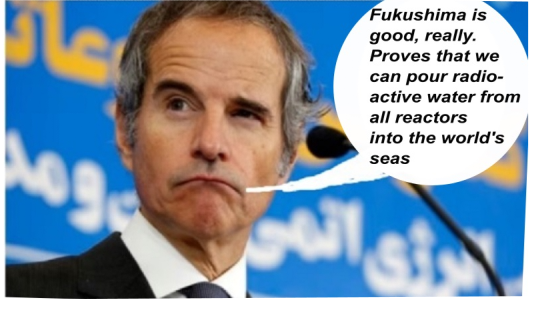
The release of the fourth batch of treated radioactive water from the
crippled Fukushima No. 1 nuclear power plant into the sea concluded Sunday,
with the next round possibly starting next month, the plant’s operator
said.
Japan Times 17th March 2024
https://www.japantimes.co.jp/news/2024/03/17/japan/fourth-fukushima-water-release-completed
1 This Month
Chernobyl: The Lost Tapes – A good documentary on Chernobyl on SBS available On Demand for the next 3 weeks– https://www.sbs.com.au/ondemand/tv-program/chernobyl-the-lost-tapes/2352741955560

of the week–London Campaign for Nuclear Disarmament

Tell the Ukrainian Government to Drop Prosecution of Peace Activist Yurii Sheliazhenko
To see nuclear-related stories in greater depth and intensity – go to https://nuclearinformation.wordpress.com
-
Archives
- April 2026 (126)
- March 2026 (251)
- February 2026 (268)
- January 2026 (308)
- December 2025 (358)
- November 2025 (359)
- October 2025 (376)
- September 2025 (257)
- August 2025 (319)
- July 2025 (230)
- June 2025 (348)
- May 2025 (261)
-
Categories
- 1
- 1 NUCLEAR ISSUES
- business and costs
- climate change
- culture and arts
- ENERGY
- environment
- health
- history
- indigenous issues
- Legal
- marketing of nuclear
- media
- opposition to nuclear
- PERSONAL STORIES
- politics
- politics international
- Religion and ethics
- safety
- secrets,lies and civil liberties
- spinbuster
- technology
- Uranium
- wastes
- weapons and war
- Women
- 2 WORLD
- ACTION
- AFRICA
- Atrocities
- AUSTRALIA
- Christina's notes
- Christina's themes
- culture and arts
- Events
- Fuk 2022
- Fuk 2023
- Fukushima 2017
- Fukushima 2018
- fukushima 2019
- Fukushima 2020
- Fukushima 2021
- general
- global warming
- Humour (God we need it)
- Nuclear
- RARE EARTHS
- Reference
- resources – print
- Resources -audiovicual
- Weekly Newsletter
- World
- World Nuclear
- YouTube
-
RSS
Entries RSS
Comments RSS
 nuclear-news