Satellites burning up in our atmosphere may not be as harmless as first thought
Business Insider, Marianne Guenot , Mar 2, 2024
- Spacecraft burning up in the atmosphere are leaving behind metal particles.
- Scientists are racing to understand if that affects the climate.
- One risk is that these particles may spark rainbow-colored clouds that damage the ozone layer.
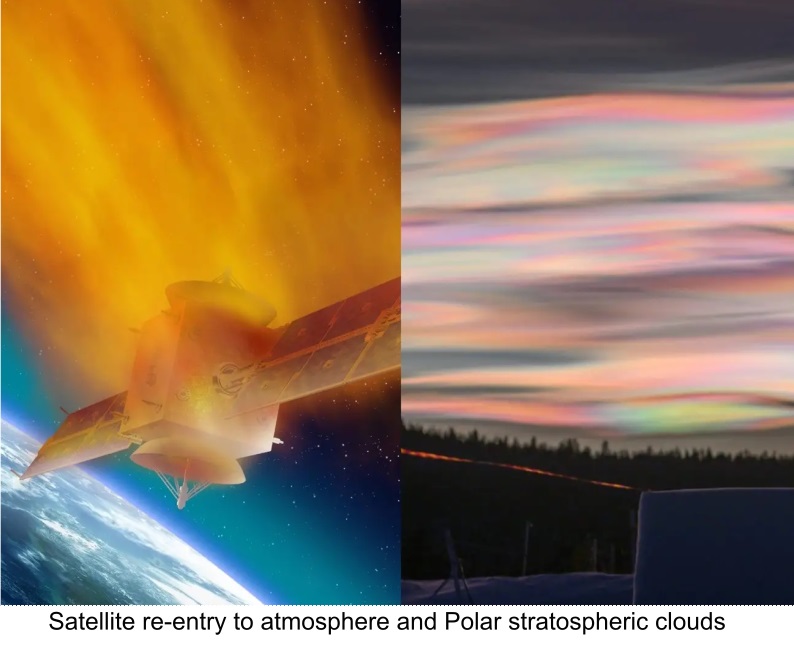
Satellites and spacecraft burning up in our atmosphere are leaving metal particles in the stratosphere — and scientists are worried it could harm our planet.
About 10% of the particles floating around the stratosphere now come from the aerospace industry, and we don’t know if this could impact the climate.
One risk is that these new particles could seed polar stratospheric clouds, which are spectacular rainbow-colored clouds that can damage the ozone layer, experts told Business Insider.
“This is a good demonstration of how important it is to have the basic research on the stratosphere,” Daniel Murphy, a research scientist at the National Oceanic and Atmospheric Administration Chemical Science Lab, who led a survey of the particles, told BI.
“There is a whole phenomenon here that we didn’t expect out and we don’t fully understand the implications,” he said.
Stratospheric particles can shape the ozone layer
…..This crucial layer of the atmosphere, mostly contained in the stratosphere, protects us from ultraviolet radiation from the sun. It was frequently splashed across the headlines about 40 years ago when scientists raised the alarm about gaping holes growing over the poles made by chlorofluorocarbons (CFCs) rising up uncontrolled to the atmosphere…………………………………………………
Metal from satellites and spacecraft is vaporizing into the atmosphere
Murphy and his colleagues recently conducted a survey of the state of stratospheric particles over Alaska using a sensitive detector aboard NASA’s WB-57 high-altitude research plane.
The findings, published in the peer-reviewed journal PNAS in October 2023, revealed that about 10% of the stratospheric sulfuric acid particles they picked up could not be explained by natural causes………………………………………………………………………………………………………………………….
We’re realizing how little we know

With launch costs going down, the number of satellites orbiting the planet is only expected to grow to over 50,000 by 2030, up from about 8,000 now. Many of these satellites are expected to have a short lifetime.
“If you multiply those numbers out, a satellite will be reentering the atmosphere on average about once an hour,” said Murphy.
Within the next few decades, Murphy and his co-authors estimate aerospace debris could make up 50% of the particles in the stratosphere, which makes the need to understand what they do even more pressing.
Spacecraft decommissioning is only part of the equation, said Chipperfield.
“There’s an increasing number of rocket launches for small satellites and tourism, which burn kerosene or other fuels that emissions in the atmosphere. Then some satellites and orbit have fuel like iodine that can come back to the atmosphere. And then the demise,” he said………………………………………………………………………………. more https://www.businessinsider.com/satellites-burn-atmosphere-particles-stratosphere-climate-ozone-2024-2
—
No comments yet.
1 This Month
Chernobyl: The Lost Tapes – A good documentary on Chernobyl on SBS available On Demand for the next 3 weeks– https://www.sbs.com.au/ondemand/tv-program/chernobyl-the-lost-tapes/2352741955560

of the week–London Campaign for Nuclear Disarmament

Tell the Ukrainian Government to Drop Prosecution of Peace Activist Yurii Sheliazhenko
To see nuclear-related stories in greater depth and intensity – go to https://nuclearinformation.wordpress.com
-
Archives
- April 2026 (114)
- March 2026 (251)
- February 2026 (268)
- January 2026 (308)
- December 2025 (358)
- November 2025 (359)
- October 2025 (376)
- September 2025 (257)
- August 2025 (319)
- July 2025 (230)
- June 2025 (348)
- May 2025 (261)
-
Categories
- 1
- 1 NUCLEAR ISSUES
- business and costs
- climate change
- culture and arts
- ENERGY
- environment
- health
- history
- indigenous issues
- Legal
- marketing of nuclear
- media
- opposition to nuclear
- PERSONAL STORIES
- politics
- politics international
- Religion and ethics
- safety
- secrets,lies and civil liberties
- spinbuster
- technology
- Uranium
- wastes
- weapons and war
- Women
- 2 WORLD
- ACTION
- AFRICA
- Atrocities
- AUSTRALIA
- Christina's notes
- Christina's themes
- culture and arts
- Events
- Fuk 2022
- Fuk 2023
- Fukushima 2017
- Fukushima 2018
- fukushima 2019
- Fukushima 2020
- Fukushima 2021
- general
- global warming
- Humour (God we need it)
- Nuclear
- RARE EARTHS
- Reference
- resources – print
- Resources -audiovicual
- Weekly Newsletter
- World
- World Nuclear
- YouTube
-
RSS
Entries RSS
Comments RSS
 nuclear-news
Leave a comment