TODAY. Normalising the unthinkable – the 16th Annual Nuclear (so-called) Deterrence Summit
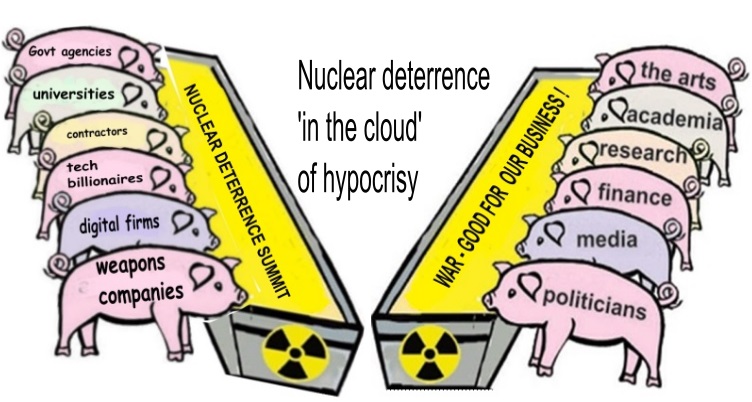
The 16th Annual Nuclear Deterrence Summit in Washington DC finished in early February
The propaganda guff should alert us to the deliberately misty thinking of the war-mongers, as they contort the facts, and kid themselves, and us, that they work for a peaceful world. The lovely phrases trip off their tongues so easily:
“Analytically driven data” “state of the art capabilities” “incredible efficiencies ” ” the cloud-based environments” “A digitalized enterprise”. Blah blah . My favourite is always “the cloud”, when what they really mean is acres and acres of dirty great machines guzzling electricity and water.
What this whole conference (now more gloriously termed “summit”) is really about, is profit, money for the American corporations – weapons ones, digital ones, space companies, contractors, and also the Pentagon, government agencies, corporate media and universities. Check out the sponsors –

There are words and phrases that you won’t hear at these conferences – “diplomacy” “negotiation” “understanding”. There’s no money in that stuff.
But you will hear “adversaries” “enemies” “evil” – there’s money in being “war ready” even better “global war ready”. Some participants actually believe that the USA could wage a nuclear war and win it – (whatever “winning a nuclear war” might mean)
I’m not religious, but I can’t help thinking what might have happened if Jesus somehow got into this crooked conference. He wouldn’t have been polite – tables overturned, lap-tops and projectors busted, corporate salesmen driven. Of course, he would be arrested as a terrorist, and given the Julian Assange treatment.
Microsoft’s Kate Crawford: ‘AI is neither artificial nor intelligent’

who benefits and who is harmed by this AI system? And does it put power in the hands of the already powerful? What we see time and again, from facial recognition to tracking and surveillance in workplaces, is these systems are empowering already powerful institutions – corporations, militaries and police
The AI researcher on how natural resources and human labour drive machine learning and the regressive stereotypes that are baked into its algorithmsSun 6 Jun 2021 18.00 AESTShare
Kate Crawford studies the social and political implications of artificial intelligence. She is a research professor of communication and science and technology studies at the University of Southern California and a senior principal researcher at Microsoft Research. Her new book, Atlas of AI, looks at what it takes to make AI and what’s at stake as it reshapes our world.
……………………………………… What’s the aim of the book?
We are commonly presented with this vision of AI that is abstract and immaterial. I wanted to show how AI is made in a wider sense – its natural resource costs, its labour processes, and its classificatory logics. To observe that in action I went to locations including mines to see the extraction necessary from the Earth’s crust and an Amazon fulfilment centre to see the physical and psychological toll on workers of being under an algorithmic management system. My hope is that, by showing how AI systems work – by laying bare the structures of production and the material realities – we will have a more accurate account of the impacts, and it will invite more people into the conversation. These systems are being rolled out across a multitude of sectors without strong regulation, consent or democratic debate.
………………………..systems might seem automated but when we pull away the curtain we see large amounts of low paid labour, everything from crowd work categorising data to the never-ending toil of shuffling Amazon boxes. AI is neither artificial nor intelligent. It is made from natural resources and it is people who are performing the tasks to make the systems appear autonomous.
Problems of bias have been well documented in AI technology. Can more data solve that?
Bias is too narrow a term for the sorts of problems we’re talking about. Time and again, we see these systems producing errors – women offered less credit by credit-worthiness algorithms, black faces mislabelled – and the response has been: “We just need more data.” But I’ve tried to look at these deeper logics of classification and you start to see forms of discrimination, not just when systems are applied, but in how they are built and trained to see the world. Training datasets used for machine learning software that casually categorise people into just one of two genders; that label people according to their skin colour into one of five racial categories, and which attempt, based on how people look, to assign moral or ethical character. The idea that you can make these determinations based on appearance has a dark past and unfortunately the politics of classification has become baked into the substrates of AI.
……………………………Beginning in 2017, I did a project with artist Trevor Paglen to look at how people were being labelled. We found horrifying classificatory terms that were misogynist, racist, ableist, and judgmental in the extreme. Pictures of people were being matched to words like kleptomaniac, alcoholic, bad person, closet queen, call girl, slut, drug addict and far more I cannot say here. ImageNet has now removed many of the obviously problematic people categories – certainly an improvement – however, the problem persists because these training sets still circulate on torrent sites [where files are shared between peers].
And we could only study ImageNet because it is public. There are huge training datasets held by tech companies that are completely secret. They have pillaged images we have uploaded to photo-sharing services and social media platforms and turned them into private systems.
……………………………………………. What do you mean when you say we need to focus less on the ethics of AI and more on power?
Ethics are necessary, but not sufficient. More helpful are questions such as, who benefits and who is harmed by this AI system? And does it put power in the hands of the already powerful? What we see time and again, from facial recognition to tracking and surveillance in workplaces, is these systems are empowering already powerful institutions – corporations, militaries and police……………………………………………………………………………………………………………
Atlas of AI by Kate Crawford is published by Yale University Press (£20). To support the Guardian order your copy at guardianbookshop.com. Delivery charges may apply https://www.theguardian.com/technology/2021/jun/06/microsofts-kate-crawford-ai-is-neither-artificial-nor-intelligent
AI’s craving for data is matched only by a runaway thirst for water and energy

John Naughton, https://www.theguardian.com/commentisfree/2024/mar/02/ais-craving-for-data-is-matched-only-by-a-runaway-thirst-for-water-and-energy
The computing power for AI models requires immense – and increasing – amounts of natural resources. Legislation is required to prevent environmental crisis.
One of the most pernicious myths about digital technology is that it is somehow weightless or immaterial. Remember all that early talk about the “paperless” office and “frictionless” transactions? And of course, while our personal electronic devices do use some electricity, compared with the washing machine or the dishwasher, it’s trivial.
Belief in this comforting story, however, might not survive an encounter with Kate Crawford’s seminal book, Atlas of AI, or the striking Anatomy of an AI System graphic she composed with Vladan Joler. And it certainly wouldn’t survive a visit to a datacentre – one of those enormous metallic sheds housing tens or even hundreds of thousands of servers humming away, consuming massive amounts of electricity and needing lots of water for their cooling systems.

On the energy front, consider Ireland, a small country with an awful lot of datacentres. Its Central Statistics Office reports that in 2022 those sheds consumed more electricity (18%) than all the rural dwellings in the country, and as much as all Ireland’s urban dwellings. And as far as water consumption is concerned, a study by Imperial College London in 2021 estimated that one medium-sized datacentre used as much water as three average-sized hospitals. Which is a useful reminder that while these industrial sheds are the material embodiment of the metaphor of “cloud computing”, there is nothing misty or fleecy about them. And if you were ever tempted to see for yourself, forget it: it’d be easier to get into Fort Knox.
There are now between 9,000 and 11,000 of these datacentres in the world. Many of them are beginning to look a bit dated, because they’re old style server-farms with thousands or millions of cheap PCs storing all the data – photographs, documents, videos, audio recordings, etc – that a smartphone-enabled world generates in such casual abundance.
But that’s about to change, because the industrial feeding frenzy around AI (AKA machine learning) means that the materiality of the computing “cloud” is going to become harder to ignore. How come? Well, machine learning requires a different kind of computer processor – graphics processing units (GPUs) – which are considerably more complex (and expensive) than conventional processors. More importantly, they also run hotter, and need significantly more energy.
On the cooling front, Kate Crawford notes in an article published in Nature last week that a giant datacentre cluster serving OpenAI’s most advanced model, GPT-4, is based in the state of Iowa. “A lawsuit by local residents,” writes Crawford, “revealed that in July 2022, the month before OpenAI finished training the model, the cluster used about 6% of the district’s water. As Google and Microsoft prepared their Bard and Bing large language models, both had major spikes in water use – increases of 20% and 34%, respectively, in one year, according to the companies’ environmental reports.”
Within the tech industry, it has been widely known that AI faces an energy crisis, but it was only at the World Economic Forum in Davos in January that one of its leaders finally came clean about it. OpenAI’s boss Sam Altman warned that the next wave of generative AI systems will consume vastly more power than expected, and that energy systems will struggle to cope. “There’s no way to get there without a breakthrough,” he said.
What kind of “breakthrough”? Why, nuclear fusion, of course. In which, coincidentally, Mr Altman has a stake, having invested in Helion Energy way back in 2021. Smart lad, that Altman; never misses a trick.
As far as cooling is concerned, it looks as though runaway AI also faces a challenge. At any rate, a paper recently published on the arXiv preprint server by scientists at the University of California, Riverside, estimates that “operational water withdrawal” – water taken from surface or groundwater sources – of global AI “may reach [between] 4.2 [and] 6.6bn cubic meters in 2027, which is more than the total annual water withdrawal of … half of the United Kingdom”.
Given all that, you can see why the AI industry is, er, reluctant about coming clean on its probable energy and cooling requirements. After all, there’s a bubble on, and awkward facts can cause punctures. So it’s nice to be able to report that soon they may be obliged to open up. Over in the US, a group of senators and representatives have introduced a bill to require the federal government to assess AI’s current environmental footprint and develop a standardised system for reporting future impacts. And over in Europe, the EU’s AI Act is about to become law. Among other things, it requires “high-risk AI systems” (which include the powerful “foundation models” that power ChatGPT and similar AIs) to report their energy consumption, use of resources and other impacts throughout their lifespan.
It’d be nice if this induces some investors to think about doing proper due diligence before jumping on the AI bandwagon.
The nuclear narrative.

What is a narrative? ……… In other words, it is about occupying public space to disseminate enchanting stories that give pride of place to industry, multinationals, investors, billionaires, each greener than the last.
Jean-François Nadeau, March 4, 2024, https://www.ledevoir.com/opinion/chroniques/808350/chronique-narratif
The future of the world, at least according to the head of the AtkinsRéalis firm, lies in nuclear power. This company, formerly known as SNC-Lavalin, has changed its name. The scandals that have affected her, she asserts, belong to the past.
For its campaign to promote atomic energy, AtkinsRéalis secured the services of two former prime ministers: Jean Chrétien and Mike Harris. In 2019, as revealed by Radio-Canada, Jean Chrétien had already gone so far as to propose, with astonishing lightness, storing foreign nuclear waste in Labrador. In a letter, the former prime minister wrote to a Japanese firm: “Canada has been the largest supplier of nuclear fuel for years, and I have always thought it would be appropriate for Canada to become, at the end of account, the steward and guarantor of the safe storage of nuclear waste after their first service cycle. »
No carbon neutrality without nuclear power , repeats the boss of AtkinsRéalis like an advertising slogan. We must replace fossil fuels, while doubling or tripling, thanks to nuclear power, the production of electricity, he pleads. There is no question, in this presentation, of rethinking a model of society based on an infinite expansion of consumption. Always more cars, as long as they are electric. Always more heating, regardless of the fact that our buildings are thermal sieves. In other words, what continues to matter is growth. And the increase in AtkinsRéalis’ turnover is largely due to nuclear power, as noted by Le Devoir .
Last week, Minister Pierre Fitzgibbon reiterated again that he was not closing the door to the return of nuclear power. Since the arrival of Michael Sabia at the head of Hydro-Québec , the signals pointing in the direction of this revival have multiplied. “I think that as a government, in the ministry, at home, we must stay on the lookout for what is happening in nuclear power,” the minister further affirmed in front of an audience of business people. To have such projects accepted, the minister specified that “you simply have to have a good narrative”. In Quebec, he laments, “we have not had any narrative on nuclear power” since the closure of Gentilly-2 .
What is a narrative? In 1928, Edward Bernays, the founding father of the public relations and advertising industry, called these language elements capable of manipulating public opinion propaganda . This word ended up, as we know, having unfavorable connotations. Others were therefore substituted. Here is the latest addition, used in all sauces: the narrative . In other words, it is about occupying public space to disseminate enchanting stories that give pride of place to industry, multinationals, investors, billionaires, each greener than the last.

Pierre Fitzgibbon shows interest in mini nuclear reactors. The boss AtkinsRéalis also praises this technology, which is far from wonderful. Nobody says too loudly that these types of plants produce more nuclear waste per megawatt. These mini power plants would produce up to thirty times more radioactive waste than conventional nuclear power plants.
In his “narrative”, the boss of AtkinsRéalis barely concedes that the management of radioactive materials constitutes a serious danger for humanity.
In Ontario, a large dump for radioactive waste was approved on January 9. Tons of heavy metals, dangerous radioactive elements, plutonium, uranium, etc. will pile up there for a century, not far from the Ottawa River. The whole thing promises to occupy, for eternity, an area equivalent to 70 National Hockey League ice rinks.
In France, 280 km of underground galleries are being built to store nuclear waste. To give an idea, the galleries of the Montreal metro total 71 km. This giant sarcophagus will be the largest construction site in Europe. In these galleries, the most dangerous waste will be able to spew radioactivity for 100,000 years.
So that the hydrogen and the fumes released from this collection of waste do not explode, it is necessary to continually ventilate. Which requires electricity. A power outage, if it lasts more than a week, could be catastrophic. Obviously, electrical problems, cataclysms, wars, terrorists, this will never happen in a hundred years. Not again in a thousand years, probably. Moreover, at the entrance to these sites, in what language should we warn future generations not to dig?
The speech of the boss of AtkinsRéalis is very similar to that which is also being given these days by the cereal manufacturer Kellogg’s. Gary Pilnick, its CEO, is sad to see the cost of food soaring. However, he does not recommend reviewing the profit margins on which the food giants are fattening, nor the exploitation system which governs this surge in prices. He simply suggests eating cereal at dinner, so that consumers can lower their bills and cereal manufacturers can make more money. At the bottom of the scale, this makes no difference to the misfortunes of the majority. Agricultural producers in Quebec, for example, find themselves this year with the lowest net incomes since 1938, they say.
Nuclear industries operate according to the same elastic logic which consists of making money at all costs. Our dependence on automobiles and energy-intensive lifestyles suits them. And it is enough, to hear them, to continue to rush forward, head down, to escape from a reality that is ruining the future. Their technologies promise to fix everything. As long as you are willing to swallow their narrative first, like soft cereal .
Wargame simulated a conflict between Israel and Iran: It quickly went nuclear
The Bulletin By Henry Sokolski | February 27, 2024
With the Gaza crisis, a nuclear Rubicon of sorts has been crossed: Elected Israeli officials—a deputy minister and a ruling party member of Parliament—not only publicly referenced Israeli possession of nuclear weapons, but suggested how such weapons might be used to target Gaza. This is unprecedented.[1]
More recently, Iran directly attacked an Israeli-manned intelligence outpost in Iraq. Iran also has inched within weeks of making several nuclear weapons and has made its military ever more immune to first strikes against its key missile and nuclear facilities. Iran and its proxies also now have long-range, high-precision missiles that could easily reach key Israeli targets.[2]
None of these developments is positive. For decades, most security analysts assumed Israel’s undeclared nuclear weapons were only deployed to deter attacks and that Iran would not dare to attack Israel directly. This after-action report describes a war game originally designed nearly two years ago. It directly challenges these assumptions and suggests that military strikes between Israel and Iran—including nuclear ones—are possible.
The Nonproliferation Policy Education Center held the game and its preparatory meetings—five separate sessions—in November and December of 2023. The 35 participants included Republican and Democratic Hill staff; US Executive Branch officials and analysts; leading academic scholars; national security and Middle Eastern think tank experts; and US military personnel.
The game consisted of three moves. After receiving a war brief and instructions from the Israeli prime minister, teams representing the Israeli Ministry of Defense, the Ministry of Foreign Affairs, and intelligence community formulated their preferred options for launching nuclear strikes against Iran. The prime minister selected one. Move two begins after the Israeli military carries out this strike. In move two, the teams were reconstituted to represent Israel, friendly Arab nations, and the United States and its European allies. Control played Iran, Russia, and China. Each team responded diplomatically and militarily to Israel’s initial nuclear strike against Iran. The game’s third and final move was a “hot wash” where participants discussed their insights……………………………………………………………………………………………………
Many critical questions remain unanswered. Would Israel or Iran conduct further nuclear strikes? Would Israel target Tehran with nuclear weapons? And vice versa, would Iran target Tel Aviv with nuclear arms? Would Russia or the United States be drawn into the war? These many basic unknowns helped inform each of the game’s four major takeaways:
The strategic uncertainties generated after an Israeli-Iranian nuclear exchange are likely to be at least as fraught as any that might arise before such a clash. An unspoken hope among security experts is that nuclear deterrence can work between Israel and Iran. Such optimism, however, discourages clear thinking about what might happen if deterrence fails and both countries use nuclear weapons……………………………………………………………………………………………
Although Israel and Iran might initially seek to avoid the nuclear targeting of population, such self-restraint is tenuous. …………………………………………………………………………………………
Multilateral support for Israeli security may be essential to deter Israeli nuclear use but will likely hinge on Israeli willingness to discuss regional denuclearization.An isolated and desperate Israel is far more likely to use nuclear weapons than an Israel surrounded by friendly, supportive neighbors………………………………………………………………………..
Little progress is likely in reducing Middle Eastern nuclear threats as long as the United States continues its public policy of denying knowledge of Israeli nuclear weapons. The current US policy is of not admitting that Israel possesses nuclear weapons……………………………………………….
…………………….Considering the strategic risks and uncertainties that a possible nuclear exchange between Israel and Iran revealed in this game, the formulation of proportionate military, political, and economic policies to deter nuclear use appears crucial. This requires gaming and careful planning—both efforts that the United States’ outdated policy toward Israel nuclear-related classification all but precludes.
Notes: …………………………………………….. https://thebulletin.org/2024/02/wargame-simulated-a-conflict-between-israel-and-iran-it-quickly-went-nuclear/
You know that the nuclear industry is in deep trouble when its top men at its top front group Breakthrough Institute get worried
NuScale Cancellation Should Be Wake-Up Call For Advocates
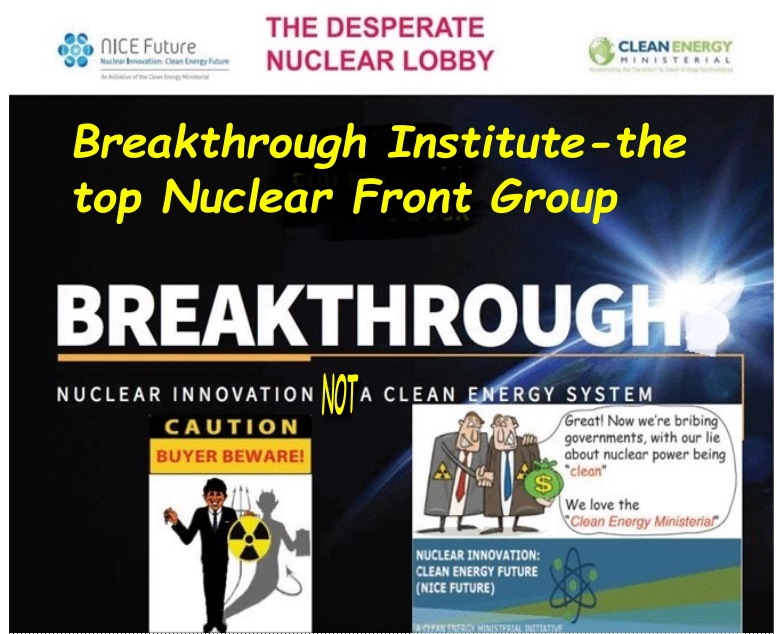
Advanced Nuclear Energy Is In Trouble, The Breakthrough Institute, Adam Stein, Adam is Director for Nuclear Energy Innovation at Breakthrough., Ted Nordhaus Ted Nordhaus is Founder and Executive Director of Breakthrough, 28 Nov 2023
Earlier this month, NuScale, the first company to receive a design certification from the Nuclear Regulatory Commission for a small modular reactor, announced that it was canceling its longstanding deal to deploy its first reactors to serve UAMPS, a consortium of small electricity cooperatives in the intermountain West, due to escalating project costs. The NuScale announcement follows several other setbacks for advanced reactors. Last month, X-Energy, another promising SMR company, announced that it was canceling plans to go public. This week, it was forced to lay off about 100 staff. In early 2022, Oklo’s first license application was summarily rejected by the Nuclear Regulatory Commission before the agency had even commenced a technical review of Oklo’s Aurora reactor. Meanwhile, forthcoming new cost estimates from TerraPower and XEnergy as part of the Department of Energy’s Advanced Reactor Deployment Program are likely to reveal substantially higher cost estimates for the deployment of those new reactor technologies as well.
In the wake of these developments, there has been an understandable desire among many nuclear advocates to whistle past this graveyard, with advocates rightly pointing out that there are many promising advanced nuclear technologies and companies working to bring new reactors to market. You can’t score if you don’t shoot and the nascent advanced nuclear industry is planning to take a lot of shots on goal. But taken together, recent developments suggest that efforts to commercialize a new generation of advanced nuclear reactors are simply not on track.
High Interest Rates and Commodity Prices
………………The increase in finance and materials costs for NuScale over the period between the launch of its deal with UAMPS in 2016 and its denouement in 2023 is instructive. Over that period, the U.S. Treasury prime interest rate more than doubled, to more than 8% from less than 4%. The price of steel almost tripled, to more than $650 a ton from less than $250 a ton.
…………Tax credits, clean energy standards, and loan guarantees, along with implicit reliance upon low-cost production in China, have been the primary tools that policymakers have used to drive tech expansion.
It is unclear in the current environment that these policy levers will be sufficient or that the latter reliance on Chinese supply chains is politically viable. Already, during the Trump years, Terrapower and a number of other nuclear developers concluded that developing their technologies in China was no longer a viable option as economic and political tensions between the U.S. and China rose.
For nuclear energy, the present challenges resulting from rising commodity prices and interest rates are further amplified by the regulatory environment. Simply licensing a new reactor has typically taken well over a decade, which exacerbates financing costs when interest rates rise. And regulatory restrictions deeply constrain supply chain flexibility……………………………………….
COMMENT. Of course this article goes on to argue that the solution is to weaken health, environmental and safety regulations !
‘It’ll be a shortlist of one!’ Villagers in England fear nuclear dump proposal

Plans for a new wave of atomic power have not factored in local concerns over the safety of the waste sites the schemes entail.
Alex Lawson, Sun 3 Mar 2024 , https://www.theguardian.com/business/2024/mar/03/itll-be-a-shortlist-of-one-villagers-in-england-fear-nuclear-dump-proposal
When Ian Harrison returned to the Lincolnshire coast to care for his parents a decade ago, he didn’t expect to spend his own retirement fighting plans to dig a £50bn nuclear waste dump near the beaches of his childhood.
Harrison, 67, lives a mile from the village of Theddlethorpe, one of three sites in England being examined for a possible geological disposal facility (GDF) to handle decades of nuclear waste from the power and defence industries. The cavernous dump will feature a series of tunnels and vaults dug 200-1,000 metres underground, capable of holding high-risk nuclear waste.
“It’s just a terrible idea to put a nuclear dump next to a seaside resort,” says Harrison, a retired warrant officer. “The safety concerns are real – look at Chernobyl – but people are more worried about the tourism that comes to Mablethorpe and the impact on local businesses.”Map showing proposed and withdrawn sites for GDFs
After several sites fell out of contention, the former gas terminal in Lincolnshire is one of just three which remain, with two on the Cumbrian coast – Mid Copeland and South Copeland. There is speculation about another site on the north-west coast.
The search for a home for Britain’s nuclear waste underlines a problem at the heart of its energy ambitions. Politicians have extolled the virtues of low-carbon nuclear power, but little attention has been given to the question of where to put the resulting waste.
Allerdale in Cumbria was ruled out last September after the government body behind the GDF project, Nuclear Waste Services (NWS), said there was “only a limited volume of suitable rock”, meaning it was not safe for storage. Last month, councillors in East Yorkshire withdrew from a process to consider hosting a GDF at South Holderness, east of Hull. In 2021, a council leader in Hartlepool resigned in a similar GDF row.
“At South Holderness, the local population complained and the council listened and stopped it,” says Harrison. “Here, people are worried, but they are sugarcoating it and not taking into account local concerns. Eventually, this will end up with a shortlist of one: us.”
The GDF is forecast to cost between £20bn and £53bn. Work on the project could take decades to begin, and high-risk waste will not enter it until at least 2075. The cost will be met by taxpayers, the existing nuclear plants’ operator EDF, and future power station operators.
Work on the GDF is expected to 4,000 jobs in its first 25 years. It is not an unprecedented move – Finland is nearing completion of a 450-metre-deep cavern to store its waste. France, Canada, Switzerland and Sweden are making progress on similar projects.
Britain’s nuclear waste is largely generated by its ageing power stations, as well as by industrial and defence sectors. It is housed in more than 20 ground-level sites which can hold the waste for up to 100 years, meaning a permanent store needs to be found. Even more waste is expected to be generated from a new era of reactors, despite lengthy delays,starting with Hinkley Point C in Somerset, currently the only new UK station under construction.
The handling of nuclear waste in Britain was put in the spotlight last year when the Guardian published Nuclear Leaks, a year-long investigation into problems with cybersecurity, safety and a “toxic” culture at Sellafield. Most of the waste now at the Cumbria site will be sent to a GDF, probably between 2050 and 2125.
While it can be argued that the Copeland sites have communities familiar with nuclear waste, it is an alien industry for Theddlethorpe, where geologists are studying the clay rock under the seabed.
Proponents of a GDF at Theddlethorpe, where a facility would be built onshore and the store tunnelled under the sea six miles off the coast, argue it will bring not only jobs but investment – in flood defences, road improvements and rail links. Detractors say its largely retired community will barely contribute to the workforce, and its holiday parks will play host only to construction workers while tourism slowly dies. A government gaffe in which Skegness was wrongly spelled as “Skegross” on a map did little to engender local support.
Ken Smith, a retired former lecturer and chair of the Guardians of the East Coast pressure group, says: “People call us nimbys and tell us that we’re only interested in the impact on house prices, but that’s a red herring. It’s about the people who live here and the way this could change their lives.”
A test of public support for the Theddlethorpe project is likely to be conducted in 2027. Jon Collins, the independent chair of the Theddlethorpe GDF Community Partnership, says only a small number of the 10,000 people who live in the search area have yet expressed an opinion. “There are a lot of people who have yet to engage. People deserve the opportunity to have a proper debate with all the facts before a decision is made.”
In Mid Copeland, David Moore, 70, a retired farmer, says local support for the project has increased in recent years. “Our community has been brought up handling radioactive waste,” says Moore, a representative on the Mid Copeland GDF community partnership. “We have a highly skilled workforce, and know it brings highly paid jobs.” Residents in nearby South Copeland are more circumspect, he claims.
A contentious element of the project has been the £1m a year in funds offered to prospective sites, handed out by NWS. Spending has included £382,067 for an adventure playground, garden and CCTV at the village halls; £49,981 on a project to reduce loneliness; and £26,102 to the Parrot Zoo Trust. Some locals see the taxpayer money as a “bribe”; others argue the money might as well be taken while the debate continues.
Collins says any final decision needs to take into account both local opinion and the best geological conditions for the site.
But Smith says: “A GDF is simply sweeping the problem under the carpet. My worry is that I want future generations to enjoy what I have I can take my grandchildren for a picnic on the beach: you can’t do that at Sellafield. I do not want the area to be torn apart. If they industrialise this coastline then all that enjoyment will be lost.”
NWS said: “A GDF will only be built where there is a suitable site and a willing community. This is a consent-based process and we are committed to giving local people all the information they need, listening to all voices and letting local people have their say on the topic.”
Out of the unfiltered mouths of US political leaders enabling the destruction of Ukraine.
Walt Zlotow, West Suburban Peace Coalition, Glen Ellyn IL, 4 Mar 24
“Four months into this thing, I like the structural path we’re on here. As long as we help Ukraine with the weapons they need and the economic support, they will fight to the last person. The best money we’ve ever spent.” Sen. Lindsay Graham (R-SC)
“It is a relatively modest amount that we are contributing without being asked to risk life and limb. The Ukrainians are willing to fight the fight for us if the West will give them the provisions. It’s a pretty good deal.” Sen. Roger Wicker (R-MS)
“I call that a bargain.” ND Republican Governor Doug Burgum referring to US war funding damaging Russian military without mentioning catastrophic Ukrainian military damage.
These people are not humane political leaders…they are moral monsters.
Walt Zlotow, West Suburban Peace Coalition, Glen Ellyn IL
The Ukrainian Intelligence Committee Is Preparing For The Worst-Case Scenario
ANDREW KORYBKO, FEB 28, 2024, https://korybko.substack.com/p/the-ukrainian-intelligence-committee—
What’s regarded as the worst-case scenario from the perspective of the ruling Ukrainian elite and their Western masters is the best-case scenario for the rest of the world. In the event that Zelensky is deposed and peace talks immediately resume right as Russia breaks through the Line of Contact, then NATO might not feel as pressured by its security dilemma with Russia to conventionally intervene in Ukraine, thus reducing the risk of World War III by miscalculation.
The Ukrainian Intelligence Committee warned in a Telegram post about the worst-case scenario that could happen by June whereby a Russian breakthrough across the Line of Contact (LOC) merges with protests over conscription and Zelensky’s illegitimacy to deal a deathblow to the state. They predictably claimed that those protests, along with claims of growing fatigue inside Western and Ukrainian societies plus civil-military tensions in Kiev, are just “Russian disinformation” even though they all veritably exist.
“Zelensky Is Desperate To Preemptively Discredit Potentially Forthcoming Protests Against Him” and that’s why he claimed in late November that Russia is conspiring to orchestrate a so-called “Maidan 3” against him, which is what the Intelligence Committee explicitly referred to in their post. Their warning also came as Ukrainian media reported that Zelensky plans to ask the Constitutional Court to rule on holding elections during martial law in order to retain legitimacy after his term expires on 20 May.
The preceding hyperlinked report from Turkish media also mentions how “opposition party leaders Petro Poroshenko and Yulia Tymoshenko proposed forming a coalition government to avoid a crisis of legitimacy” but were rebuked by National Security Council chief Danilov. What’s so interesting about this proposal is that it was first tabled by an expert from the powerful Atlantic Council think tank in an article that they published in Politico in mid-December in order to serve that exact same purpose.
This reminder and the subsequent proposal by those two opposition party leaders debunks the notion that questions about Zelensky’s legitimacy are solely the result of “Russian disinformation” just like a top European think tank’s latest poll from January debunks the same about fatigue over this conflict. The European Council on Foreign Relations, which can’t credibly be described as “pro-Russian”, found that only 10% of Europeans think that Ukraine will defeat Russia.
On the other side of the Atlantic, the Congressional deadlock over more Ukraine aid proves that such sentiments are shared in the halls of power, and those who hold these views understandably don’t want to continue throwing hard-earn taxpayer funds into a doomed-to-fail proxy war. Western leaders as a whole, however, are clearly panicking over the latest military-strategic dynamics that followed the failure of Kiev’s counteroffensive last summer and Russia’s recent victory in Avdeevka.
That’s why many of them debated whether to conventionally intervene in Ukraine during Monday’s meeting in Paris that was attended by over 20 European leaders. French President Macron said that this can’t be ruled out despite there being no consensus on the issue, which his Polish counterpart confirmed was the most heated part of their discussions that day. This prompted strong denials from all other Western leaders who claimed that they’ll never authorize this, but their words can’t be taken seriously.
After all, the worst-case scenario that the Ukrainian Intelligence Committee warned about and is actively trying to discredit as supposedly being driven solely by “Russian disinformation” could push them to conventionally intervene in order to avert the state’s collapse and an Afghan-like disaster in Europe. NATO is unlikely to sit idly on the sidelines if Russia steamrolls through the ruins after breaking through the LOC by sometime this summer, hence why a conventional intervention truly can’t be ruled out.
It would be very unpopular in the West as proven by the previously mentioned think tank’s latest poll and the ongoing Congressional deadlock over Ukraine aid, but that doesn’t mean that the elite won’t do it since they don’t take public opinion into consideration when formulating foreign and military policy. Even so, the large-scale protests that could follow in Europe are something that the elite want to avoid, but they might still risk them in order for their geopolitical project in Ukraine not to be totally for naught.
After all, the worst-case scenario that the Ukrainian Intelligence Committee warned about and is actively trying to discredit as supposedly being driven solely by “Russian disinformation” could push them to conventionally intervene in order to avert the state’s collapse and an Afghan-like disaster in Europe. NATO is unlikely to sit idly on the sidelines if Russia steamrolls through the ruins after breaking through the LOC by sometime this summer, hence why a conventional intervention truly can’t be ruled out.
It would be very unpopular in the West as proven by the previously mentioned think tank’s latest poll and the ongoing Congressional deadlock over Ukraine aid, but that doesn’t mean that the elite won’t do it since they don’t take public opinion into consideration when formulating foreign and military policy. Even so, the large-scale protests that could follow in Europe are something that the elite want to avoid, but they might still risk them in order for their geopolitical project in Ukraine not to be totally for naught.
Considering the global significance of this conflict, what’s regarded as the worst-case scenario from the perspective of the ruling Ukrainian elite and their Western masters is therefore the best-case scenario for the rest of the world. In the event that Zelensky is deposed and peace talks immediately resume right as Russia breaks through the LOC, then NATO might not feel as pressured by its security dilemma with Russia to conventionally intervene in Ukraine, thus reducing the risk of World War III by miscalculation.
Scottish National Party ministers to set out plans for removing nuclear weapons after independence
A new policy paper will focus on an independent Scotland’s ‘place in the world’
The Scotsman, By Alistair Grant, 4 Mar 24
SNP ministers are to set out proposals for the armed forces in an independent Scotland, including the removal of nuclear weapons from the country.
Angus Robertson, the external affairs secretary, will launch a new policy paper today focused on an independent Scotland’s “place in the world”.
And it will argue Scotland would gain “a seat at the table at the UN, the EU and other important global and regional forums”.
Mr Robertson said: “Independence would mean that Scotland gets to determine the type of nation it wants to be on the world stage. A nation that acts based on its values and principles, promotes human rights and development, and builds partnerships with other countries and international organisations to address global challenges.
“As an independent country we could renew and strengthen our existing relationships on these islands and around the world – promoting peace, prosperity and climate action, as a good global citizen committed to safeguarding human rights and upholding international law and the rules-based order.
“Scotland has a long history of being an outward-looking nation and I look forward to setting out our proposals in detail.”
It will be the latest in a series of Scottish Government papers, titled Building a New Scotland, which are described as forming a prospectus for an independent Scotland.
The SNP has long backed the removal of nuclear weapons from Faslane. However, there have been questions in the past over what this would mean for possible Nato membership.
The Scottish Greens, who have a power-sharing relationship with the SNP, do not support joining Nato…………………………………………………………. https://www.scotsman.com/news/politics/snp-ministers-to-set-out-plans-for-removing-nuclear-weapons-after-independence-4540930
Chilling Pictures of Hiroshima Weeks After Atomic Bomb Dropped Emerge
NewsWeek, By Jack Beresford, Mar 03, 2024
Haunting photos have emerged of Hiroshima just a few weeks after it was decimated by an atomic bomb on August 6, 1945.
Estimates vary on the number of people killed by the nuclear blast, with the Bulletin of the Atomic Scientists putting the number of casualties at between 110,000 and 210,000. What’s perhaps less well known, however, is what life was like for those left behind in the ruins of Hiroshima after the attack.
Now, a series of pictures has surfaced online offering a glimpse of the devastation left behind. They are images that have been familiar to Ben Green ever since his great uncle Dr. Bernie Greenwald showed them to him as a child.
“My great uncle Bernie was a doctor on the USS Pickett that pulled into Tokyo Bay on August 28th for the surrender ceremony,” Green told Newsweek. “They’d been ordered to stay put, but when he heard about the atom bomb, he and his friend ‘commandeered’ a jeep and drove to Hiroshima, knowing they’d just be hanging out in the Bay for a bit anyway.”
Greenwald was an avid amateur photographer who took pictures throughout the war and long after. His collection includes pictures of scuttled Japanese battleships, while Green still has the piece of a propeller from a kamikaze pilot that his great uncle found after it struck the USS Dorsey……………………………………………………………………………………..
Green said during his uncle’s time there, he ended up assisting a Japanese doctor and they became friends who remained in touch for several years after, even though they never met again.
Greenwald died, aged 97, in 2017, but his photographs and the stories he told Green have stayed with him. “His story about the people being kind to him when they could still taste the ashes of Hiroshima in the air really hit me and I think it stayed with him too,” he said. “Something about the juxtaposition of the most devastating weapon ever used on people with the people’s kindness to ‘the other’ encompasses such a range of humanity.”
Green said he’s always wanted to see his uncle’s pictures go to a museum or somewhere they can serve as part of the record of what happened in Hiroshima……………………….. more https://www.newsweek.com/chilling-pictures-hiroshima-weeks-after-atomic-bomb-dropped-1875169
Satellites burning up in our atmosphere may not be as harmless as first thought

Business Insider, Marianne Guenot , Mar 2, 2024
- Spacecraft burning up in the atmosphere are leaving behind metal particles.
- Scientists are racing to understand if that affects the climate.
- One risk is that these particles may spark rainbow-colored clouds that damage the ozone layer.
Satellites and spacecraft burning up in our atmosphere are leaving metal particles in the stratosphere — and scientists are worried it could harm our planet.
About 10% of the particles floating around the stratosphere now come from the aerospace industry, and we don’t know if this could impact the climate.
One risk is that these new particles could seed polar stratospheric clouds, which are spectacular rainbow-colored clouds that can damage the ozone layer, experts told Business Insider.
“This is a good demonstration of how important it is to have the basic research on the stratosphere,” Daniel Murphy, a research scientist at the National Oceanic and Atmospheric Administration Chemical Science Lab, who led a survey of the particles, told BI.
“There is a whole phenomenon here that we didn’t expect out and we don’t fully understand the implications,” he said.
Stratospheric particles can shape the ozone layer
…..This crucial layer of the atmosphere, mostly contained in the stratosphere, protects us from ultraviolet radiation from the sun. It was frequently splashed across the headlines about 40 years ago when scientists raised the alarm about gaping holes growing over the poles made by chlorofluorocarbons (CFCs) rising up uncontrolled to the atmosphere…………………………………………………
Metal from satellites and spacecraft is vaporizing into the atmosphere
Murphy and his colleagues recently conducted a survey of the state of stratospheric particles over Alaska using a sensitive detector aboard NASA’s WB-57 high-altitude research plane.
The findings, published in the peer-reviewed journal PNAS in October 2023, revealed that about 10% of the stratospheric sulfuric acid particles they picked up could not be explained by natural causes………………………………………………………………………………………………………………………….
We’re realizing how little we know

With launch costs going down, the number of satellites orbiting the planet is only expected to grow to over 50,000 by 2030, up from about 8,000 now. Many of these satellites are expected to have a short lifetime.
“If you multiply those numbers out, a satellite will be reentering the atmosphere on average about once an hour,” said Murphy.
Within the next few decades, Murphy and his co-authors estimate aerospace debris could make up 50% of the particles in the stratosphere, which makes the need to understand what they do even more pressing.
Spacecraft decommissioning is only part of the equation, said Chipperfield.
“There’s an increasing number of rocket launches for small satellites and tourism, which burn kerosene or other fuels that emissions in the atmosphere. Then some satellites and orbit have fuel like iodine that can come back to the atmosphere. And then the demise,” he said………………………………………………………………………………. more https://www.businessinsider.com/satellites-burn-atmosphere-particles-stratosphere-climate-ozone-2024-2
—
NewsReal: How Serious Are Western Leaders About Full-on War With Russia?
We heard last week that some EU leaders, notably French president Macron, want to send Western armed forces into Ukraine in order to ‘stop Russia from winning’. We know that their armed forces ARE already in Ukraine, but the implication of recent fighting-talk is that they’re considering escalating the current ‘proxy war’ to ‘the next level’.
How serious ARE Western leaders about doing this? They sound convinced that there is no other way, but are they just ‘posturing’?
We may soon find out because, in the meantime, unless SOMETHING changes, Trump and other populists’ victories are going to end Western hegemony and thus profitable war-making. What better way to stave off revolution at home than by sending would-be revolutionary males off to a bloody war…
Finland’s Olkiluoto nuclear power station to be disconnected for 37 days
The Olkiluoto-3 nuclear power plant in Finland – the first of its type
in Europe – will be disconnected from electricity production on 2 March
for its first annual outage, owner and operator Teollisuuden Voima Oyj
said. Regular electricity production began at the 1,600 MW EPR unit one
year ago with full commercial operation on 1 May.
TVO said the planned
outage is expected to last 37 days. The lengthy duration is due to the
technical characteristics of the plant type and the large number of
periodic tests and maintenance activities to be carried out during the
outage, TVO said. “As OL3 is the largest nuclear power plant unit in
Europe, there is a considerable number of components and equipment that
need to be serviced.” The plan for the Olkiluoto-3 outage includes some
1,900 different activities with almost 6,500 work phases.
Nucnet 1st March 2024
1 This Month

of the week – Shut Down Drone Warfare!


Tell the Ukrainian Government to Drop Prosecution of Peace Activist Yurii Sheliazhenko

Petition to revoke the licensing of the Near Surface Nuclear Disposal Facility (NSDF) at Chalk River. https://www.ourcommons.ca/petitions/en/Petition/Details?Petition=e-7247
To see nuclear-related stories in greater depth and intensity – go to https://nuclearinformation.wordpress.com
-
Archives
- April 2026 (103)
- March 2026 (251)
- February 2026 (268)
- January 2026 (308)
- December 2025 (358)
- November 2025 (359)
- October 2025 (376)
- September 2025 (257)
- August 2025 (319)
- July 2025 (230)
- June 2025 (348)
- May 2025 (261)
-
Categories
- 1
- 1 NUCLEAR ISSUES
- business and costs
- climate change
- culture and arts
- ENERGY
- environment
- health
- history
- indigenous issues
- Legal
- marketing of nuclear
- media
- opposition to nuclear
- PERSONAL STORIES
- politics
- politics international
- Religion and ethics
- safety
- secrets,lies and civil liberties
- spinbuster
- technology
- Uranium
- wastes
- weapons and war
- Women
- 2 WORLD
- ACTION
- AFRICA
- Atrocities
- AUSTRALIA
- Christina's notes
- Christina's themes
- culture and arts
- Events
- Fuk 2022
- Fuk 2023
- Fukushima 2017
- Fukushima 2018
- fukushima 2019
- Fukushima 2020
- Fukushima 2021
- general
- global warming
- Humour (God we need it)
- Nuclear
- RARE EARTHS
- Reference
- resources – print
- Resources -audiovicual
- Weekly Newsletter
- World
- World Nuclear
- YouTube
-
RSS
Entries RSS
Comments RSS
 nuclear-news
