Nuclear news – week to 4 March 2024

Some bits of good news – Passion for compassion: the group working to make the Commons kinder. Major research suggests humans can break free from tribalism **************************************
TOP STORIES. US Refuses to Assure UK Judges That Assange Won’t Be Executed If He’s Extradited. Atlantic Council report lays out options and possible first use of nuclear weapons against China over Taiwan.
Texas wildfires continue to pose threat to Pantex nuclear weapons plant, and climate change will bring further threats to nuclear facilities. USA is littered with nuclear sites that could face danger from natural disasters.
Nuclear space-based ASAT weapons – A brief international legal perspective.Get These Rich People Off the Moon.
AI’s craving for data is matched only by a runaway thirst for water and energy.
Climate. New Research from Antarctica Affirms the Threat of the ‘Doomsday Glacier,’ but Funding to Keep Studying It Is Running Out.
Noel’s notes. My dilemma in writing about nuclear issues. Nuclear power stopping climate change? IT’S THE OTHER WAY AROUND!
*************************************************************
NUCLEAR ISSUES
CLIMATE. Texas: Disaster declaration issued and nuclear weapons plant shut down as wildfires spread. Texas nuclear weapons facility pauses as fires spread. https://www.youtube.com/watch?v=Ba_oPoqeF2Y
Buried Nuclear Waste From the Cold War Could Resurface as Ice Sheets Melt. USA is littered with nuclear sites that could face danger from natural disasters. Could climate change release 35 swimming pools’ worth of nuclear waste? Or worse… unleash a world-ending pandemic? These are the terrifying unexpected consequences of melting ice.
| ECONOMICS. Tax-payer to take bigger financial risks under new payment plan for nuclear command satellites. The Cost of Nuclear War in Space. Inside Europe’s only nuclear unicorn — and its €1bn fundraising hopes. | ENERGY. Blackout risks due to Hinkley nuclear delays – a reminder of the value of energy efficienc | ENVIRONMENT. Oceans. Release of fourth batch of Fukushima treated radioactive water begins. China is ‘unlikely’ to lift import ban on Japanese seafood as dumping continues. Conservationists say Hinkley C nuclear water intakes could wipe out Atlantic salmon stocks |
| LEGAL. Fish v. electricity: Could Salem nuclear plant be shut down?More indictments for Ohio nuclear crimes. | MEDIA. When The Imperial Media Report On An Israeli Massacre.Einstein’s Postwar Campaign To Save The World From Nuclear Destruction.Chilling Pictures of Hiroshima Weeks After Atomic Bomb Dropped Emerge. | OPPOSITION to NUCLEAR . IT’S TIME TO CANCEL SIZEWELL C |
| POLITICS. Has the nuclear lobby hijacked Welsh democracy? “Big nuclear reactor” lobby fights back against “Small nuclear reactor” lobby. | POLITICS INTERNATIONAL and DIPLOMACY. Biden administration restores Trump-rescinded policy on illegitimacy of Israeli settlements. France accused of ‘unacceptable’ behaviour after demanding UK taxpayer cash for Hinkley nuclear. Chris Huhne Letter: UK Taxpayers shouldn’t be footing bill for EDF failings. Macron stands by remarks on NATO troops in Ukraine. | SAFETY. New nuclear reactors shielded from liability if federal law passes Congress: Price-Anderson Act renewal hidden from public. Mistakes, Misfiring and Trident: Britain’s Flawed Nuclear Deterrence |
| SPACE. EXPLORATION, WEAPONS. Satellites burning up in our atmosphere may not be as harmless as first thought. | TECHNOLOGY.So They’re Experimenting With Military Robots In Gaza Now.SMRs are useless says the UK’s leading SMR analyst! – 100 per cent renewable energy is much more feasible!UK spurns European invitation to join ITER nuclear fusion project.Microsoft’s Kate Crawford: ‘AI is neither artificial nor intelligent’.Finland’s Olkiluoto nuclear power station to be disconnected for 37 days. | WASTES.“Tritium Removal” A Report on the Proposed MCECE nuclear Facility at Chalk River also at https://nuclear-news.net/2024/03/03/2-b1-tritium-removal-a-report-on-the-proposed-mcece-facility-at-chalk-river/Burying nuclear waste the best of a bad bunch of options.Locals oppose nuclear waste plant – parish council. Holderness: Government guarantees plans for nuclear waste dump will be dropped for good.New plans to dismantle Rosyth dead nuclear submarines left for decades.Nuclear Restoration Services has been served with an “improvement notice” after the ONR found failures in its storage methods |
| WAR and CONFLICT.Wargame simulated a conflict between Israel and Iran: It quickly went nuclear. Israeli Calls to ‘Nuke Gaza’ Are Undermining the Nuclear Ambiguity Doctrine.After Macron touted troops to Ukraine, Putin warns West of nuclear war risk.Leaked Russian military files reveal its nuclear strike rules.Full Transcript of German Top Military Officials’ Leaked Plot to Attack Crimean Bridge.China urges largest nuclear states to negotiate a ‘no-first-use’ treaty.NewsReal: How Serious Are Western Leaders About Full-on War With Russia? | WEAPONS and WEAPONS SALES. France creates coalition to arm Ukraine with long-range weapons. Victoria Nuland accidentally reveals the true aim of the West in Ukraine. Setting the record straight on Canada’s arms exports to Israel. The reawakening of America’s nuclear dinosaurs. Iran Reduces Near-Weapons-Grade Stockpile, Defying Expectations. |
So They’re Experimenting With Military Robots In Gaza Now

CAITLIN JOHNSTONE, MAR 4, 2024, https://www.caitlinjohnst.one/p/so-theyre-experimenting-with-military?utm_source=post-email-title&publication_id=82124&post_id=142282788&utm_campaign=email-post-title&isFreemail=true&r=1ise1&triedRedirect=true&utm_medium=email
One of the most horrifying facts about this dystopia we live in is that large-scale military operations are routinely used as testing grounds for new war machinery, using human bodies as guinea pigs for experimentation in what amount to giant blood-soaked field laboratories — all to benefit the strategic objectives of empire managers and the profit margins of the military-industrial complex.
Haaretz has a new article out titled “Gaza Becomes Israel’s Testing Ground for Military Robots”, which reports that “In an effort to avoid harming soldiers and dogs, the IDF has been experimenting with the use of robots and remote-controlled dogs in the Gaza War.”
(Yeah because my gosh, can you imagine how terrible it would be if Israeli soldiers and dogs got harmed while carrying out a genocide?)
The article’s author Sagi Cohen reports that drone-mounted robot dogs and remotely controlled bulldozers are two of the new apocalyptic horrors currently being battle-tested in Gaza, saying “defense establishment officials confirm that there has been a leap in the use and sophistication of robots on the battlefield.” Which is a pretty disconcerting sentence to read.
This news comes out at the same time as a new Public Citizen report warning of the likely imminent arrival of autonomous weapons systems which will kill people with minimal instruction from human pilots, saying “The most serious worry involving autonomous weapons is that they inherently dehumanize the people targeted and make it easier to tolerate widespread killing, including in violation of international human rights law.”
The more normalized robots become within the world’s militaries the closer we come to this point, and steps are already being taken in that direction. As Common Dreams’ Thor Benson notes in an article about the Public Citizen report, “Israel has purchased and at times deployed self-piloting, lethal drones.”
Back in January I wrote that “Gaza is a live laboratory for the military industrial complex,” saying “Data is with absolute certainty being collected on all the newer weapons being field-tested on human bodies in Gaza (just like has been happening in Ukraine) to be used to benefit the war machine and arms industry.”
What sparked this comment at the time was reports and first-hand witness accounts we’d seen coming out about the prolific use of IDF “sniper drones” in Gaza since October, with Israeli forces frequently shooting Palestinians with quad drones armed with rifles. Copious records are most assuredly being compiled on the effectiveness of these newer weapons and tactics in ending human lives, which will then be used to help market those weapons to other states and to improve their efficiency in killing.
When I say this is most assuredly happening, I am not being hyperbolic for effect. Author and journalist Antony Loewenstein gave a lengthy interview on The Chris Hedges Report back in December about Israel’s long and extensively documented history of using Gaza as a testing ground for new weapons, spyware, surveillance and security systems, AI, drones, and tactics, which has profited scores of corporations and enabled Israel to become a player of outsized success in the global weapons industry.
“Israel’s drones, surveillance technology including spyware, facial recognition software, and biometric gathering infrastructure, along with smart fences, experimental bombs, and AI-controlled machine guns are all tried out on the captive population in Gaza, often with lethal results,” says Hedges in introduction. “These weapons and technologies are then certified as ‘battle-tested’ and sold around the world.”
This doesn’t only happen in Gaza. This past September The Wall Street Journal published an article titled “The War in Ukraine Is Also a Giant Arms Fair,” subtitled “Arms makers are getting orders for weapons being put to the test on the battlefield.” In January of last year CNN published a report titled “How Ukraine became a testbed for Western weapons and battlefield innovation,” with one source saying that Ukraine is “absolutely a weapons lab in every sense because none of this equipment has ever actually been used in a war between two industrially developed nations.”
And of course we are also seeing this same phenomenon in Africa. In 2021 Mintpress News published a report by Scott Timcke titled “West Africa is the Latest Testing Ground for US Military Artificial Intelligence” about this very same trend. In 2020 Libya saw what is believed to have been the first time a human being has ever been killed by a fully automated drone attack — that is, killed without the machine having been told to do so by a human.
The other day we discussed how the empire’s great weakness is that it depends on normal human beings to carry out its orders and turn the gears of the machine. If you look at the facts and think about them for a moment, it’s not hard to see how the empire managers are hoping to overcome this weakness in the future.
Could climate change release 35 swimming pools’ worth of nuclear waste? Or worse… unleash a world-ending pandemic? These are the terrifying unexpected consequences of melting ice
By ROB WAUGH FOR DAILYMAIL.COM, 2 March 2024 https://www.dailymail.co.uk/sciencetech/article-13135571/Could-climate-change-release-35-swimming-pools-worth-nuclear-waste-worse-unleash-world-ending-pandemic-terrifying-unexpected-consequences-melting-ice.html
- Buried ‘nuclear city’ and swimming pools’ worth of nuclear waste
- Frozen viruses have already begun to infect human beings
- READ MORE As melting ice exposes new oil reserves, oil giants move in
Around the world, glaciers and permafrost are melting, and in some places the retreating ice is releasing buried secrets people hoped would remain forgotten.
Rising waters have exposed a secret Greenland nuclear base that engineers thought would never resurface as well as a radioactive ‘Tomb’ at the site of American nuclear tests.
And while it sounds far-fetched, very credible experts have warned that the next pandemic may well come from ancient pathogens buried in the ice, or even from diseases harbored by frozen dead Neanderthals.
The ‘secret nuclear city’ under Greenland’s ice
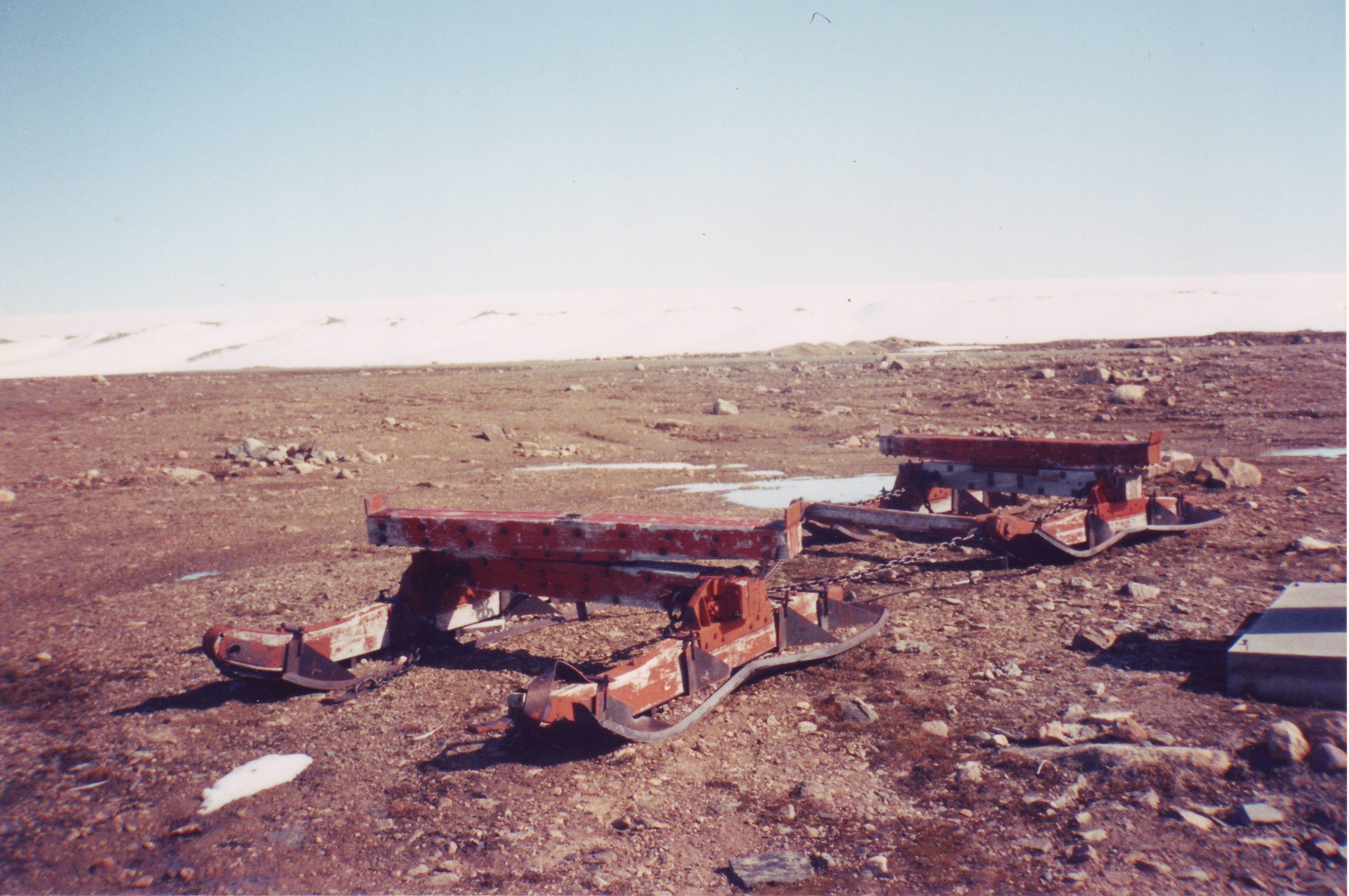
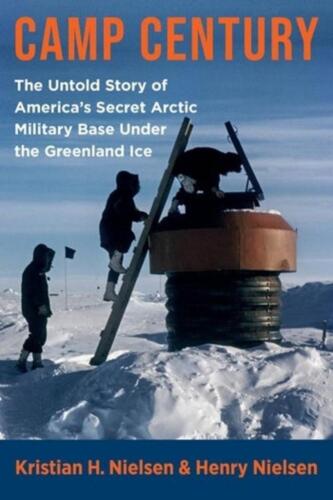
Camp Century in Greenland is a secret nuclear-powered ‘city under the ice’, where U.S. Army engineers carried out weapons research
The base has been abandoned for almost half a century, but now poses a serious concern over nuclear waste.
Powered by a portable nuclear generator, Camp Century was built in 1959, and was built to host 200 soldiers, with a plan to expand the base to hold 600 ballistic missiles.
‘Camp Century’ was abandoned in 1967, but the nuclear reactor at the base – which also had a hospital and a church in its tunnels – has long since been removed, but radioactive waste remains.
When the Army Corps of Engineers (ACE) left the base, they assumed that frigid temperatures and falling snow would keep the nuclear waste there forever.
In total, the waste is equivalent to the mass of 30 Airbus A320 airplanes – and researchers now fear that it could be released into the sea.
A 2016 study suggested that the nuclear waste could be released into the sea this century, but newer measurements at the base suggest that this will not happen until 2100.
‘Tomb’ of poison at nuclear test site
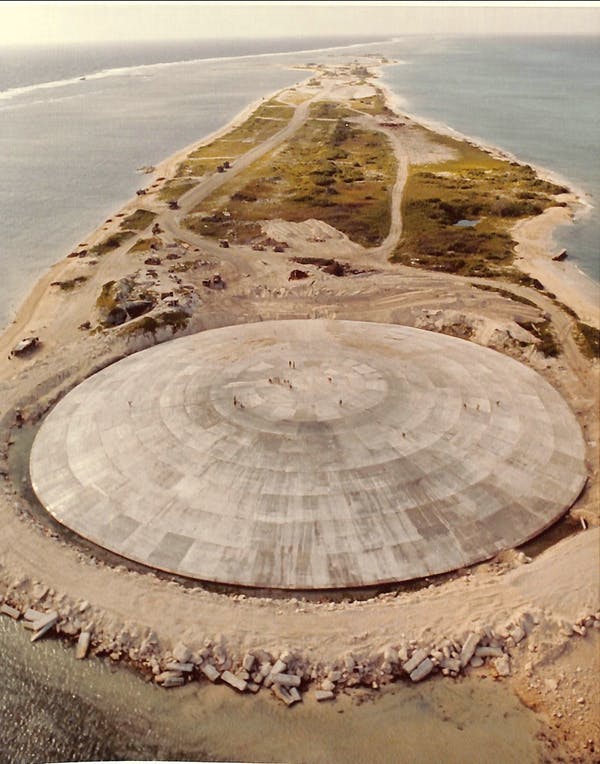
In the Marshall Islands, a huge ‘lid’ which locals know as ‘The Tomb’ covers 31 million cubic feet of nuclear waste – equivalent to the volume of 35 Olympic-sized swimming pools.
The islands were the site of American nuclear tests, but the U.S. military also shipped in waste from the mainland.
From 1946 to 1958, America conducted 67 nuclear tests in the South Pacific.
The concrete ‘lid’ officially known as the Runit Dome was built on Enewetak Atoll in the Marshall Islands to contain radioactive material from American nuclear tests in the 1950s.
Some studies have suggested that radiation levels near the site are similar to those near Chernobyl and the waters around the dome are rising every year.
Changing temperatures are causing the lid to crack, while rising waters are lapping at the atoll.
Plutonium – and a lost hydrogen bomb?
A 1968 plane crash scattered plutonium from American nuclear weapons over the ice in Greenland, which could be released by global warming.
The U.S. military assumed that the Thule air base in Greenland would be rapidly attacked in a nuclear war, so kept nuclear-armed bombers in the air to fly towards Russia in the event of an attack.
The Thule incident saw large amounts of radioactive plutonium dispersed onto the ice sheet, as a cabin fire in a B-52 bomber forced the crew to bail out.
Conventional explosives inside the four B28FI thermonuclear bombs detonated, spreading radioactive waste.
But the uranium-235 fissile core of one of the bombs was never found, despite a search with submarines.
Reports in the decades since have suggested that the lost bomb is lying under the seabed.
Frozen viruses and the next pandemic
Researchers have warned that the next pandemic could come from melting ice.
Genetic analysis of soil and lake sediment near the highest Arctic freshwater lake, Lake Hazen, suggests that the risk of ‘viral spillover’ may be high close to melting glaciers.
‘Spillover’ is where a virus infects a new host for the first time – and analysis of viruses and potential hosts in the lakebed suggests this risk may be higher near to melting glaciers.
Researchers at Ohio State University found genetic material from 33 viruses, 28 of which were unknown, in the Tibetan plateau in China, putting their age at 15,000 years old.
Viruses from Neanderthals
Other researchers have warned of viruses unleashed by melting permafrost: one-quarter of the northern hemisphere sits on top of permanently frozen ground – known as permafrost, but large areas are now melting as the world warms.
There are already examples of this – with a 2016 anthrax outbreak in Siberia attributed to melting permafrost exposing an infected reindeer carcass.
Previously researchers have warned that global warming and thawing ice might unearth diseases such as smallpox frozen into the corpses of victims, with a few infectious particles enough to revive the pathogen.
As permafrost thaws due to climate change, virologist Jean-Michel Claverie has warned that ancient viruses harbored in the long-frozen ground could be released.
Claverie explains that if an ancient pathogen eradicated Neanderthals, for instance, their frozen remains might still contain infectious viruses that could be unleashed as ice melts.
Claverie told Bloomberg News, “With climate change, we are used to thinking of dangers coming from the south.
“Now, we realize there might be some danger coming from the north as the permafrost thaws and frees microbes, bacteria and viruses.”
Claverie’s team previously revived giant viruses from up to 48,000 years ago – and the veteran scientist has warned that there could be even more ancient viruses in the ice, some of which could potentially infect humans.
Frozen poison in the ice
Polar regions have acted as a ‘chemical sink’ for the planet, locking away poisons in the ice – but melting ice could release this.
A study in Geophysical Research Letters found huge reserves of the toxic heavy metal mercury frozen in Arctic permafrost.
The amount may be 10 times higher than all the mercury pumped into the atmosphere from industry in three decades.
Paul Schuster, a U.S. Geological Survey hydrologist, “This is a complete game-changer for mercury. It’s a natural source, but some of it will be released through what we’re doing with climate change.”
Mercury is released by industry, volcanic eruptions and rock weathering – but what’s less clear is what will happen if the ‘pool’ in the Arctic is released.
The reawakening of America’s nuclear dinosaurs

“The issue of plutonium pit aging is a Trojan horse for the nuclear weaponeers enriching themselves through a dangerous new arms race,” said Jay Coghlan, executive director of Nuclear Watch New Mexico, an anti-nuclear group based in Santa Fe. “Future pit production is not about maintaining the existing, extensively tested stockpile. Instead, it’s for deploying multiple new warheads on new intercontinental ballistic missiles.”
The risk of a false alarm is enough reason to “do away with the ICBMs altogether,……. “An accidental launch is a major contributor to the overall probability of an all out nuclear war.”
Are America’s plutonium pits too old to perform in the new Cold War? Or are new ones necessary?
by Alicia Inez Guzmán February 28, 2024
Sprinkled across five western states, in silos buried deep underground and protected by reinforced concrete, sit 400 intercontinental ballistic missiles. Each of those missiles is equipped with a single nuclear warhead. And each of those warheads is itself equipped with one hollow, grapefruit-sized plutonium pit, designed to trigger a string of deadly reactions.
All of those missiles are on “hair-trigger alert,” poised for hundreds of targets in Russia — any one of which could raze all of downtown Moscow and cause hundreds of thousands of casualties.
Except — what if it doesn’t? What if, in a nuclear exchange, the pit fizzles because it’s just too old? In that case, would the weapon be a total dud or simply yield but a fraction of its latent power?
Outwardly, at least, that’s the question driving a whole new era of plutonium pit production at Los Alamos National Laboratory (LANL) and the Savannah River Plutonium Processing Facility in South Carolina.
Plutonium is widely known as one the most exotic elements in the periodic table. Trace amounts of it have been identified in the earth’s crust, though all of what’s now used for America’s nuclear weapons is manmade. For decades, these pits were cast with plutonium and other materials at a breakneck pace, installed in warheads and strapped into missiles that were regularly upgraded and modernized in an escalating arms race with the Soviet Union. Plutonium pits were never intended to grow old and senescent.
“We never worried about aging,” said Siegfried Hecker, former director of LANL and one of the world’s leading plutonium experts. “Because bombs were supposed to be out there for a dozen years or so.”
It’s been almost 40 years since America’s Cold War pit factory at Rocky Flats near Denver was raided by FBI agents and closed due to environmental crimes — among them, releases of radioactive effluent into nearby waterways. In that time, pit production went largely dormant, the USSR collapsed, arms reductions treaties were signed, stockpiles reduced and underground testing ceased.
Now, as the nuclear industrial complex awakens from its long slumber, the resumption of plutonium pit production has emerged as a deeply polarizing and political act. Anti-nuclear activists have accused the federal government of exploiting the uncertainty around aging to jumpstart a nearly $60 billion dollar manufacturing program. They assert that the real reason America has resumed the production of pits is for the purpose of introducing a new generation of warheads for a new generation of missiles — the first of which is the Sentinel, one of the most complex and expensive programs in the history of the U.S. Air Force.
The Sentinel ICBM has the capability to carry three separate warheads, each with its own target. Earlier versions of America’s missiles could and did have such capabilities and the option has remained available, but with post-Cold War weapons reductions, the number of warheads per missile was also reduced — one warhead, one intercontinental ballistic missile. As the U.S., Russia and China barrel toward a new Cold War, the U.S. will likely eschew such a convention in a matter of years.
“The issue of plutonium pit aging is a Trojan horse for the nuclear weaponeers enriching themselves through a dangerous new arms race,” said Jay Coghlan, executive director of Nuclear Watch New Mexico, an anti-nuclear group based in Santa Fe. “Future pit production is not about maintaining the existing, extensively tested stockpile. Instead, it’s for deploying multiple new warheads on new intercontinental ballistic missiles.”
But to hear Hecker and his colleagues tell it, the question of pit aging is as scientifically vexing as it is political. Plutonium, to its most studied acolytes, borders almost on the mystical, its properties as capricious as the human body. It can be brittle or soft under some circumstances or turn to powder when heated in air. It can disintegrate at room temperature. It can bombard itself with radiation and mar its own internal lattice structure. It can even heal that damage within fractions of a second, if not over the course of several decades.
According to Glenn Seaborg, former chair of the Atomic Energy Commission and the chemist credited with first synthesizing the element for use in weapons, plutonium is “so unusual as to approach the unbelievable.”
This quality means that even the most knowledgeable experts are reluctant to commit themselves to anything definitive when it comes to a plutonium pit’s long-term prospects. Does it last 50 years? One hundred? Is it comparable to a human body, whose bones weaken and whose mind is vulnerable to dementia? Or is it actually impervious to entropy?
“It is difficult to quantify how much the properties of a plutonium pit will change over time,”…………………………………………………………………………………………..
Too big to fail”
The political machinations actually go back even further — to the 2010 concession that President Barack Obama made to a largely Republican bloc of Senators: arms control in exchange for a revival of the nuclear weapons complex.
………………….
the beginning of a new era, a tectonic modernization of America’s nuclear triad — land, sea and air — now projected to cost close to $2 trillion over the next 30 years. That’s roughly the GDP of Canada.
Plutonium pits, of course, represent only a small fraction of the cost. That mind-boggling figure reflects a total reimagining of the nation’s entire nuclear program, complete with brand new ballistic missile submarines, 400 new Sentinel intercontinental ballistic missiles, tactical aircrafts, underground silos and 800 nuclear warheads.
The Sentinel program alone — cost, $131 billion — is a juggernaut. “I think this program has become too big to fail for an entrenched part of the military-industrial-congressional complex,” said Geoff Wilson, an expert on federal defense spending at the Independent watchdog, Project on Government Oversight.
…………………………………………………………. America’s warheads have also been regularly surveilled since the late 1990s, leading even the most cautious scientists to vouch for their reliability. In 2000, Raymond Jeanloz — a professor of earth and planetary science and astronomy at University of California, Berkeley— found little evidence that defects in those warheads increased significantly with age. His statistical models, based on data culled from LANL and LLNL, showed that such defects, if any, accumulate at the glacial rate of one percent per quarter century…………………….
A new Cold War
In the unthinkable scenario that a Sentinel is deployed, it would propel like a rocket beyond earth’s atmosphere and into space. As it reached its apogee, the missile would shed all its pieces and the warheads would descend toward their intended targets, half a world away.
For now, though, the Sentinel is barely a reality. The program is so complex and vastly over budget that some in the arms control community are calling for its complete cancellation. Experts question such a missile’s ability to deter China without provoking Russia. Other critics consider the plan to build new weapons as a dangerous return to the policies of the Cold War.
As for the plutonium pits, LANL is behind by at least four years; Savannah River by at least six. Indeed, to meet the projected quota demanded for future weapons could take decades.
But even if all the timetables are met, intercontinental ballistic missiles will always be a “danger to the world as long as they are on launch-on-warning alert,” according to Frank N. von Hippel, senior research physicist and professor of public and international affairs emeritus with Princeton University’s Program on Science and Global Security.
The risk of a false alarm is enough reason to “do away with the ICBMs altogether,” as he and others — presidents, retired commanders, and at least one secretary of defense, alike — have long campaigned to do. “An accidental launch is a major contributor to the overall probability of an all out nuclear war.”…………………………. And once an ICBM is launched, there would be no way to stop it
US Vetoes UN Resolution Condemning Israel for Flour Massacre
Nearly 1,000 Palestinians were killed and wounded after Israeli forces opened fire on people surrounding an aid convoyby Kyle Anzalone March 1, 2024
The US vetoed a UN Security Council resolution condemning Israel for a massacre of civilians surrounding an aid convoy in Gaza, a motion supported by all other member states. The Israel Defense Forces has acknowledged its soldiers fired on the crowd.
On Thursday, hundreds of Palestinians were killed and injured by Israeli soldiers as they gathered around an aid convoy near Gaza City. As some people took aid off the trucks, the IDF claimed the same Palestinians approached Israeli soldiers nearby, saying its troops felt “endangered” and opened fire. The killing has been dubbed the “flour massacre.”
More than 100 Palestinians were killed in the shooting and ensuing panic, while at least 750 others were injured. Tel Aviv has attempted to blame the Palestinians for the deaths, saying the violence was caused by the mob. Washington has claimed it needs more information to assess the incident.
While Israeli troops would bear responsibility for the carnage whether they fired upon civilians or merely incited a deadly stampede, doctors treating the victims said most of the injuries were gunshot wounds. Some outlets report that IDF forces also fired artillery or tank shells at the desperate crowd………………………………………………………………….
With a growing number of Palestinians on the brink of starvation amid dire food shortages, aid convoys have increasingly faced unrest from hungry crowds – most crucially in devastated northern Gaza, where aid shipments have all but ground to a halt. Jens Laerke, the spokesman for the UN humanitarian agency OCHA, explained that famine is now almost inevitable, and “once a famine is declared, it is too late for too many people.”
The UN estimates that one in four Palestinians are teetering on the edge of famine. The situation is worst in northern Gaza where one in six children are suffering from acute malnutrition and wasting.
In response to Hamas’ October 7 attack, top Israeli officials declared that Gazans would be cut off from food, water, fuel, and other aid. Tel Aviv has largely followed through with that threat, allowing only a trickle of aid into the besieged coastal enclave.
World Peace Foundation executive director Alex de Waal explained the starvation inflicted on the Palestinians is uniquely horrific in recent history. “Nothing is comparable in terms of the speed and the concentrated effort at destroying what is essential to sustain the life of people – nothing compares to Gaza over the last 75 years. The speed of deterioration of humanitarian conditions is absolutely terrifying,” he said.
Kyle Anzalone is the opinion editor of Antiwar.com, news editor of the Libertarian Institute, and co-host of Conflicts of Interest. https://news.antiwar.com/2024/03/01/us-vetoes-un-resolution-condemning-israel-for-flour-massacre/
New Research from Antarctica Affirms the Threat of the ‘DoomsdayGlacier,’ but Funding to Keep Studying It Is Running Out.
In a worst case scenario, rising global temperatures and marine heatwaves could melt enough of the Thwaites Glacier and other Antarctic ice to raise sea levels 10 feet by the early 2100s.

Inside Climate News, By Bob Berwyn, February 26, 2024
“………………………………………………………….. It took a whole day of sailing just to monitor and map the front of the Thwaites Glacier’s floating shelf, he said, with ice cliffs in some places towering several hundred feet above the water, marking the abrupt edge of an ice expanse about the size of Nebraska and averaging between 2,500 and 4,000 feet thick. If all the ice melts, it would raise average global sea level about 2 feet.
The sediment samples Kirkham and other scientists collected four years ago provided the data for a study published Monday in the Proceedings of the National Academies of Sciences that affirms one of the most serious concerns about Antarctica—that an irreversible meltdown of some of the frozen continent’s ice masses has already started.
“You just can’t ignore what’s happening on this glacier,” said lead author Rachel Clark, a University of Houston ice researcher who also works with the International Thwaites Glacier Collaboration, a team that has been trying to figure out just how fast the vulnerable ice will melt. But, she said the new study is important because it shows that the melting is not just random or limited to one glacier.
“It is part of a larger context of a changing climate,” she said.
Not Just Thwaites
After analyzing the chemistry and other characteristics of seafloor sediment grains from various depths and different locations near the floating edge of the glacier, the team’s members were able to show that the glacier had been relatively stable for nearly 10,000 years, since the end of the last ice age, but that it started to retreat in the mid-1940s.
Shifts in regional winds and associated changes in ocean currents are pushing more relatively warm water toward Antarctica’s frozen fringe, melting the ice and loosening it from rocky seafloor anchor points that have held the floating part of the glacier in place for thousands of years. As the ice melts away from the pinning points, it can float to sea and disintegrate faster, allowing the glacier behind it to accelerate toward the ocean. In the last 30 years, the amount of ice flowing out to sea from the Thwaites and Pine Island glacial areas and their associated floating ice shelves has doubled.
……………………………………the Thwaites Glacier, and the neighboring Pine Island Glacier, have kept retreating since the 1940s. …………………..
While the Thwaites Glacier has been identified as being among the most vulnerable to pinning point loss, a similar pattern of melting and retreat in many other Antarctic glaciers and ice shelves at least since the 1970s was documented in a separate study published Feb. 21 in Nature.
………………………………………………………… “We already seem to have pushed the climate and ice sheet system past certain irreversible thresholds, and need to observe and understand more about Thwaites, not less,” said Pam Pearson, founder and director of the International Cryosphere Climate Initiative. “Pleas of ignorance will be little comfort to future generations displaced by Antarctic sea-level rise that we could have stopped had we only acted in time.” https://insideclimatenews.org/news/26022024/new-research-from-antarctica-affirms-threat-of-doomsday-glacier-but-funding-is-running-out/
Mistakes, Misfiring and Trident: Britain’s Flawed Nuclear Deterrence
Australian Independent Media, March 4, 2024, Dr Binoy Kampmark
Nuclear weapons are considered the strategic silverware of nation states. Occasionally, they are given a cleaning and polishing. From time to time, they go missing, fail to work, and suffer misplacement. Of late, the UK Royal Navy has not been doing so well in that department, given its seminal role in upholding the doctrine of nuclear deterrence. In January, an unarmed Trident II D5 nuclear missile fell into the Atlantic Ocean after a bungled launch from a Royal Navy submarine.
The missile’s journey was a distinctly shorter than its originally plotted 6,000 km journey that would have ended in a location somewhere between Africa and Brazil. In language designed to say nothing yet conceal monumental embarrassment, UK Defence Secretary Grant Shapps called it “an anomaly” while the Labour opposition expressed concern through its shadow defence secretary, John Healey. An anonymous military source was the most descriptive of all: “It left the submarine but it just went plop, right next to them.
The anomaly in question, which Shapps witnessed on board the HMS Vanguard, took place off the coast of Florida during a January 30 exercise at the US’s Navy Port site. Its failure is the second for the missile, which was also tested in 2016 and resulted in its automatic self-destruction after veering off course and heading to the United States. It was therefore galling for the Defence Secretary to then claim in a written statement to Parliament that Trident was still “the most reliable weapons system in the world”, a claim also reiterated by the missile’s manufacturers, Lockheed Martin. With a gamey sense of delusion, Shapps continued to argue that the test merely “affirmed the effectiveness of the UK’s nuclear deterrent, in which the government has absolute confidence. The submarine and crew were successfully certified and will rejoin the operational cycle as planned.”…………………………………………………………………………………..
Even at the best of times, deterrence, as a claim, is the stuff of fluffy fiction, astrological flight and fancy. It is unverifiable, speculative, highly presumptuous. Who is to know if a nuclear weapon will be fired at any point, at any time, against any target, on whatever pretext presents itself?
The madman theory suggests that such a weapon will be deployed, though we are not sure when this might eventuate. Keeping company with such a theory is the rational, mass murderer type who takes comfort in the prospect that 100 humans might survive a holocaust killing billions. Shoot and take your chances. Human stupidity glows with the hope that errors will be healed, and mass crimes palliated.
In actual fact, the true proof of such deterrence would lie in hellish murder: weapons launched, catastrophe ensuing. Those recording such evidence are bound to be done by coarse skinned mutants with plumbing problems.
The Trident misfiring episode can be seen in one of two ways. First, it illustrates the point that we are here because of dumb luck, having survived error, misunderstanding and miscommunication. In the second sense, it yields an uncomfortable reality for the war planners in White Hall: Trident may not work when asked to.
Whether a system fails because of faulty machinery or accident, the problem of misfiring does not go away. At some point, a misfire with potency will result in deaths, though we can perhaps be assured that Trident may simply fail to live up to the heavy sense of expectation demanded of it. We can hope it just plops. https://theaimn.com/mistakes-misfiring-and-trident-britains-flawed-nuclear-deterrence/
Nuclear Restoration Services has been served with an “improvement notice” after the ONR found failures in its storage methods.
The Office
for Nuclear Regulation (ONR) said there were shortfalls in arrangements for
storing alkali metals at Nuclear Restoration Services’ (NRS) Dounreay
site on the coast of northern Scotland. “The storage arrangements for
these materials were inadequate and fell below legal compliance and the
high standards that we expect to see,” said Ian Phillips, ONR’s head of
safety regulation for decommissioning, fuel and waste sites.
Guardian 1st March 2024
1 This Month
Chernobyl: The Lost Tapes – A good documentary on Chernobyl on SBS available On Demand for the next 3 weeks– https://www.sbs.com.au/ondemand/tv-program/chernobyl-the-lost-tapes/2352741955560

of the week–London Campaign for Nuclear Disarmament

Tell the Ukrainian Government to Drop Prosecution of Peace Activist Yurii Sheliazhenko
To see nuclear-related stories in greater depth and intensity – go to https://nuclearinformation.wordpress.com
-
Archives
- April 2026 (139)
- March 2026 (251)
- February 2026 (268)
- January 2026 (308)
- December 2025 (358)
- November 2025 (359)
- October 2025 (376)
- September 2025 (257)
- August 2025 (319)
- July 2025 (230)
- June 2025 (348)
- May 2025 (261)
-
Categories
- 1
- 1 NUCLEAR ISSUES
- business and costs
- climate change
- culture and arts
- ENERGY
- environment
- health
- history
- indigenous issues
- Legal
- marketing of nuclear
- media
- opposition to nuclear
- PERSONAL STORIES
- politics
- politics international
- Religion and ethics
- safety
- secrets,lies and civil liberties
- spinbuster
- technology
- Uranium
- wastes
- weapons and war
- Women
- 2 WORLD
- ACTION
- AFRICA
- Atrocities
- AUSTRALIA
- Christina's notes
- Christina's themes
- culture and arts
- Events
- Fuk 2022
- Fuk 2023
- Fukushima 2017
- Fukushima 2018
- fukushima 2019
- Fukushima 2020
- Fukushima 2021
- general
- global warming
- Humour (God we need it)
- Nuclear
- RARE EARTHS
- Reference
- resources – print
- Resources -audiovicual
- Weekly Newsletter
- World
- World Nuclear
- YouTube
-
RSS
Entries RSS
Comments RSS
 nuclear-news