USA is littered with nuclear sites that could face danger from natural disasters

Elizabeth Weise, USA TODAY
Massive wildfires in Texas caused operations at the nation’s primary nuclear weapons facility to be paused earlier this week, another reminder that the United States is covered in highly sensitive locations that house nuclear weapons, waste and energy reactors.
The U.S. has more than 3,700 nuclear warheads stockpiled around the country and 54 nuclear power plants in 28 states. And while nuclear energy facilities and weapons sites have always been built with potential natural disasters in mind — whether it was earthquakes, hurricanes, tornadoes or floods — those disasters stress their support systems and create new worries for safety experts.
As of Wednesday evening, the Pantex nuclear weapons plant near Amarillo was not harmed and safely reopened.
Experts told USA TODAY that natural disasters like Texas’ wildfires typically don’t create an immediate nuclear threat, but they do make carefully caring for nuclear materials more expensive and difficult, increasing safety worries over the long term. Those worries are only compounded by disasters that keep getting worse as the planet warms………………………………………………………….
an analysis of the risks at nuclear power plants done in 2020 by business research and risk firm Moody’s found that costs are likely to increase due to the need to increase protections in a changing climate. That’s in part because nuclear power plants use external water sources for cooling, so most are built near rivers, lakes and oceans, putting them at greater risk of flooding, storm surges and sea level rise. https://www.usatoday.com/story/news/nation/2024/02/28/texas-wildfire-burned-near-nuclear-weapons-site-is-that-dangerous/72772407007/
Nuclear space-based ASAT weapons – A brief international legal perspective

Charlie JP Bennett, 27 Feb 24, https://www.ejiltalk.org/nuclear-space-based-asat-weapons-a-brief-international-legal-perspective/
On 14th February 2024, US and UK media reported the emergence of serious national security concerns by senior American officials and lawmakers that the Russian state was pursuing the deployment of a nuclear-based weapon designed to eliminate (enemy) satellites. It was added that such a weapon had not yet been deployed, but had reached some stage of development.
The exact severity of the development remains hotly contested (also here) and presently unknown, but was described as a ‘destabilising foreign military capability’ to the US and its allies. There is speculation that it may be a political ploy to further pressure the US house to authorise further aid to Ukraine in its conflict against Russia. There has also been speculation regarding a critically-important ambiguity in the information released – is it a nuclear weapon, or merely a nuclear-powered weapon? The latter is far less destructive.
Yet, the White House NSC strategic communications coordinator, John Kerby, stated on February 15th, without any hesitation whatsoever, that the weapon, if deployed, would be ‘space based, and a violation of the Outer Space Treaty’. Assuming this is true, and though not definitive evidence, the fact that no other weapons are prohibited by the Outer Space Treaty except for nuclear weapons/WMDs (see below) means that we have to consider the nuclear weapon scenario. The scenario for a weapon to be so definitively contrary to the treaty, and not nuclear, is small. Even if true in part, it would mark a frightening turning point in the decades-long consensus regarding nuclear-based weapons in space; and yet another compounding issue for an international legal order stretched to its limits.
How such weapons may work
It seems highly likely that the intent of such a space-based nuclear explosion would be to knock out satellites through the emission of a powerful Electromagnetic Pulse (EMP) as a consequence of the explosion: rendering all electronics caught in the (potentially enormous) area – and thus also any satellites – damaged or outright inoperable. These effects can linger for years, forming an artificial radiation belt around earth.
One of the last nuclear tests in outer space, the American ‘starfish prime’, produced an EMP so (unexpectedly) powerful that it damaged all electronics within a ~900 mile / ~1450 kilometre radius – including on the ground in Hawaii. That explosion had a large yield of approximately 1.4 megatons. Its resulting electromagnetic effects carried by the planet’s magnetic field, flattening them into a radioactive belt, almost immediately rendered three satellites in Low Earth Orbit (LEO) inoperable, and ultimately destroyed eight in the months that followed due to lingering radiation in orbit. Not many in absolute terms – but roughly a third of those deployed in 1962; at time of writing, there are approximately 8,300. This was not even a weapon designed to produce as large an EMP as possible, or to target specific orbits – both things a new weapon might do. There is little doubt that deployment of such an EMP through a nuclear medium would be a highly destructive weapon.
Some observers have pointed out that use of such a weapon would damage Russia’s (or any nuclear-ASAT deploying nation’s) own interests; its own space-based infrastructure – with the implication being that they would thus never actually use it. Given the events of the past several years, however, can we really rely on the assumption that a state will not – even severely – damage itself to prevent another state from achieving/acquiring/joining something? No. Absolutely not.
Tearing up the nuclear-space consensus
It is pertinent to distinguish between the use/deployment of a nuclear weapon in space, and the mere placing of such a weapon into outer space. Both are prohibited through different instruments.
Use of such a weapon in space is, flatly, prohibited. The most obvious legal violation would be against the “1963 Treaty Banning Nuclear Weapon Tests in the Atmosphere, in Outer Space and Under Water” (otherwise known as the ‘Partial test-ban treaty’), to which Russia is (and for now remains) a founding party. It is a short treaty with one operable article, created immediately after the Cuban Missile Crisis of 1962. It simply states the following:
Article 1
1. Each of the Parties to this Treaty undertakes to prohibit, to prevent, and not to carry out any nuclear weapon test explosion, or any other nuclear explosion, at any place under its jurisdiction or control:
a. in the atmosphere; beyond its limits, including outer space […]
The provision includes no further qualification. For now Russia remains a party to this treaty, though has pulled out of similar cold-war era treaties in recent years given the restrictions they place on military operations.
Further, the mere placement of such a weapon into space is clearly prohibited by international space law. The Outer Space Treaty is sometimes known as the ‘Space Constitution’, and is the most fundamental treaty governing outer space activities. All major space powers, including the US, Russia, China, Japan, and leading European states, are party to it. It plainly states:
Article IV
States Parties to the Treaty undertake not to place in orbit around the earth any objects carrying nuclear weapons or any other kinds of weapons of mass destruction, install such weapons on celestial bodies, or station such weapons in outer space in any other manner.
[…]
These provisions are rather simple as international legal provisions go. They reflect an agreement between the Soviet Union and the US established after repeated nuclear crises in the 1960s that the use of nuclear weapons must be limited as far as possible – including in outer space.
Desecration of the space environment
In addition to the above, there is also (as is so common when talking about space-based issues) the issue of the debris it will cause. Dead, inoperable satellites-turned-debris cannot manoeuvre to avoid orbital collisions with debris. They will remain in orbit, as debris, for potentially indefinitely depending on their altitude. While there is no binding international law or custom (yet) that prohibits the production of space debris, it could certainly be argued that the desecration of the space environment in this manner violates the Outer Space Treaty, Article IX of which prohibits the ‘contamination’ of the space environment and its celestial bodies.
We also know from the long-lasting consequences of Starfish Prime that, depending on the size and calibration of the weapon, entire regions of Low Earth Orbit could be rendered (near-)uninhabitable zones for satellites – or indeed any electronic systems – for potentially several years. This is strikingly similar, in terms of severity and also duration, with a Kessler Syndrome/Cascade; the worst case scenario following the continuous build-up of conventional space debris multiple decades from now. Entire regions of LEO could be rendered inoperable for satellites post-deployment of such a weapon, without considering the more immediate damage it would cause.
The Legality of the Threat or Use of Nuclear Weapons Advisory Opinion, though inconclusive in its final determination of the legality of a nuclear weapon’s use, does make clear that the long-term, and widespread nature of nuclear effects may well be in violation of international humanitarian law. The Court did not apply its reasoning to the realm of space specifically. However, it is worth noting that the effects of rendering regions of space uninhabitable is notably far more widespread than the effects of a typical nuclear weapon detonated on the ground (actually a little above) – whereas the latter may affect an area of hundreds of square kilometres, the former may affect an area of hundreds of thousands of cubic kilometres. Whether this changes the proportionality equation (preserved by the Court in relation to an extreme circumstance of self-defence) is perhaps worth further thought.
Further consequences
There has not been a known nuclear deployment in space since the 60s. Since then, the Partial Nuclear Test Ban and Outer Space Treaties have held firm, albeit with a couple of allegations of relatively minor primarily procedural breaches by various parties, from which no consequence followed. The mere deployment of such weapons may therefore tear up over 55 years of legal and geopolitical consensus, and throw astropolitics into a new era of threat – one where, as is increasingly common in many areas, international rules give way to military and strategic interests.
It is far from clear whether or not the US or its allies have capabilities to stop such a weapon from being deployed should it reach space. In theory, conventional ASAT weapons (also heavily restricted) might be able to take them out before deployment, but this would of course amount to direct military engagement at a time where military intervention could have explosive consequences. Thus, once there, such a weapon would hang in orbit like a Sword of Damocles ready to swing – potentially crippling parts of civil (or even military) infrastructure at least for a time if used – and causing significant military, economic and societal damage. Given that a nation could send a nuclear weapon into space atop a ballistic missile if it wanted to, the insecurity and fear of having a nuclear weapon orbiting above a country at any point might even be its primary destructive power. They could also be extremely difficult to detect/verify as there – unlike a ballistic launch.
Concluding remarks
If Russia, or any nation, were to do this, there is no doubt that the placement, or detonation, of nuclear-based weapons in outer space would amount to a flagrant violation of several enduring international treaties. A great deal remains unknown, and seemingly contradictory. It is nonetheless important (also for international lawyers) to prepare for all scenarios – including purportedly stupid, self-harming ones. Russia has already harmed its (and all of our) space environment via conventional ASAT testing.
This further raises the question about whether Russia may withdraw from further nuclear-restricting treaties to do this, as has been hypothesised. It already has with several. The departure of one of the most prominent space-faring nations from the Outer Space Treaty would be legally monumental at a critical juncture in the development of international space law. It would further reflect yet more dismantling of the most basic rules of the ‘rules-based international order’.
Finally, this threat – the ambiguity of its imminence and its true existence aside – highlights the importance of the defence of space-based infrastructure upon which so much of the modern world – and modern military – relies. The vulnerability of these systems is now plain for all to see, and may perhaps induce concrete action to mitigate their risks. The threat of an outer-space arms race remains firmly on the table as a result of these developments, to the detriment of global safety, and especially to outer-space activities.
China urges largest nuclear states to negotiate a ‘no-first-use’ treaty
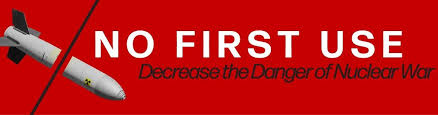
States with the largest nuclear arsenals should negotiate a treaty on no-first-use of nuclear weapons against each other or make a political statement in this regard, the Chinese foreign ministry’s arms control department said.
Director general of the department, Sun Xiaobo, called on nuclear states to fulfil their “special and priority responsibilities” on nuclear disarmament according to the U.N. Conference on Disarmament, which seeks to prevent nuclear war, official news agency Xinhua said on Wednesday.
During the forum’s weekly meeting in Geneva on Monday, Sun said the body should define a roadmap or timetable for an international legal instrument that would protect non-nuclear-weapon states from the threat of nuclear weapons.
“Nuclear-weapon states should negotiate and conclude a treaty on no-first-use of nuclear weapons against each other or make a political statement in this regard,” Sun said.
China and India are currently the only two nuclear powers to formally maintain a no first use policy. Russia and the United States have the world’s biggest nuclear arsenals.
Sun also called for a universal, non-discriminatory, non-proliferation, export control order to address global security challenges, and promote more compliance in the field of biochemistry to maintain the authority of the arms control treaty system.
The U.N. disarmament forum should also respond to emerging scientific and technological challenges such as artificial intelligence, outer space and cyber, he said.
Sun described the international strategic security situation as facing new challenges, and that countries with the strongest military power have repeatedly “broken treaties” in order to “seek their own absolute superiority”.
Atlantic Council report lays out options and possible first use of nuclear weapons against China over Taiwan.

The United States might also find itself in a situation in which it could not stop a Chinese invasion force from reaching Taiwan with conventional forces, but it could do so with nuclear weapons.
In this instance, the United States should be prepared to consider nuclear first use as well.
The Atlantic Council: Scowcroft Center for Strategy and Security has produced for us their report entitled: “DELIBERATE NUCLEAR USE IN A WAR OVER TAIWAN: Scenarios and Considerations for the United States” by Matthew Kroenig
Here below is the Conclusion of their 20 page report:
As US planners grow increasingly focused on the risk of a US-China war over Taiwan, they should be sure to pay attention to the nuclear dimension of such a possible conflict. Either side might rationally choose to gamble on nuclear escalation rather than risk defeat in such a high-stakes conflict.
To respond to possible Chinese nuclear use, the United States should identify a variety of targets on and off the Chinese mainland that would pose a setback to China’s war progress without making Chinese leadership fear for its own survival or for its nuclear force. These targets could include PLA Navy vessels; Chinese beachheads on Taiwan; or mainland ports, air bases, or headquarters supporting the invasion.
The United States might also find itself in a situation in which it could not stop a Chinese invasion force from reaching Taiwan with conventional forces, but it could do so with nuclear weapons. In this instance, the United States should be prepared to consider nuclear first use as well.
The United States should prepare for the possibility of nuclear use in a Taiwan Strait contingency by developing the strategies, alliance and partnership coordination mechanisms, and forces required to optimally deter Chinese nuclear use in these scenarios or to employ nuclear weapons if necessary. This report has set out some of those items for consideration.”
COMMENT from David Cooley: This Atlantic Council report lays out options and possible first use of nuclear weapons against China over Taiwan. This report, these folks think they can fight a nuclear war and “manage” it. This is slim possibility to outright fallacy to believe this possible. For survivability nuke control is dispersed, and there in lies human fallibility, and the best laid plans go out the window at first detonation. Escalation likely to follow based on simple use it or lose it for all sides. No where is it acknowledged that this is pure hubris, attempt to maintain world domination, they like to delude themselves with niceties like RBWO. This thinking outdoes Bibi and then some, crazy.
Texas nuclear weapons facility pauses as fires spread
The Standard, By John Crouch, February 28, 2024
A series of wildfires has swept across the Texas Panhandle, prompting evacuations, cutting off power to thousands, and forcing the shutdown of a nuclear weapons facility as strong winds, dry grass and unseasonably warm temperatures fed the blazes.
An unknown number of homes and other structures in Hutchinson County were damaged or destroyed, local emergency officials said.
The main facility that assembles and disassembles America’s nuclear arsenal shut down its operations Tuesday night.
“We have evacuated our personnel, non-essential personnel from the site, just in an abundance of caution,” Laef Pendergraft, a spokesman for National Nuclear Security Administration’s Production Office at Pantex, said during a news conference………………………………………………….
Republican Governor Greg Abbott issued a disaster declaration for 60 counties as the largest blaze, the Smokehouse Creek Fire, burned more than 1000 square kilometres, according to the Texas A&M Forest Service.
That is more than twice its size since the fire sparked on Monday……………………………………more https://www.standard.net.au/story/8539003/texas-nuclear-weapons-facility-pauses-as-fires-spread/
IT’S TIME TO CANCEL SIZEWELL C

https://action.stopsizewellc.org/its-time-cancel-sizewell-c 27 feb 24
In recent weeks, Hinkley Point C has been revealed to cost £46 billion, yet just hours before this was announced, the government DOUBLED the taxpayers’ money that had been paid into Sizewell C, to a staggering £2.5 billion. Stop Sizewell C described this as the epitome of insanity – to do the same thing over again and expect a different result.
Yet in fact Sizewell C is NOT an exact replica of Hinkley Point C. It is an 80% above ground copy, but the site and ground conditions are very different. And what’s worse is that while Hinkley C’s cost and schedule overruns are the responsibility of EDF, when Sizewell C overruns and overspends – as it inevitably will – it will fall on we consumers to pay.
Citizens Advice have told Ministers “the scope for material cost and time overruns [at Sizewell C] is very significant. Consumers need to be protected from those risks. They have no way to manage them and are reliant on [the government] to ensure they are not on the hook”.
It’s time to call a halt to this madness. Sizewell C is too slow, expensive and damaging to be the answer to our climate and energy security emergency. If you agree that Sizewell C is the wrong project in the wrong place, send a message to Rishi Sunak, Jeremy Hunt and Claire Coutinho, telling them why they should cancel Sizewell C.
France creates coalition to arm Ukraine with long-range weapons

28 Feb 24 https://www.rt.com/news/593253-france-macron-coalition-long-range-weapons-ukraine/
The aim is to enable Kiev to “carry out deep strikes” amid flagging US support, President Emmanuel Macron has said
France is leading a new coalition that aims to provide Ukraine with “medium and long-range missiles and bombs,” President Emmanuel Macron has announced. He has also not ruled out deploying ground forces to support Kiev in future.
Macron made the remarks following a summit of Ukraine’s backers on Monday, intended to demonstrate unwavering support for Kiev amid the suspension of American aid.
According to the French leader, the newly established coalition seeks to enable Ukraine to “carry out deep strikes.” There is a “broad consensus to do even more and faster together” to support Kiev, Macron added.
The move comes as continued US aid to Ukraine remains in doubt. President Joe Biden’s latest package, which envisages an additional $60 billion for Kiev, has been in limbo for months due to opposition from Republicans in the House of Representatives. Lawmakers have made clear they will only relent if the White House agrees to tighten US border controls and stems the flow of illegal migrants from Mexico.
Speaking on Monday, Macron also claimed that the deployment of Western troops to Ukraine cannot be ruled out, insisting that Paris will “do everything necessary to ensure that Russia cannot win this war.” His remarks were echoed by French Prime Minister Gabriel Attal in comments to the RTL broadcaster on Tuesday.
In response, Kremlin spokesperson Dmitry Peskov warned that “in this case, we have to talk not about the probability, but rather the inevitability” of a direct conflict between NATO and Russia, should Western military personnel be deployed to Ukraine.
Earlier this month, Paris and Kiev signed a bilateral security pact under which France pledged €3 billion ($3.26 billion) worth of defense aid by the end of the year.
In January, Macron revealed plans to provide Ukraine with 40 more SCALP-EG long-range cruise missiles and “hundreds of bombs.”
Paris agreed to ship the rockets, which have a range of over 250km (155 miles), last July, months after the UK agreed a similar move.
Russia has consistently condemned Western deliveries of long-range weaponry, saying it will only serve to prolong the hostilities unnecessarily without changing the final outcome.
Victoria Nuland accidentally reveals the true aim of the West in Ukraine


“And by the way, we have to remember that the bulk of this money is going right back into the US to make those weapons,” Nuland said, pleading in favor of the latest Ukraine aid package “
Ukrainians are a convenient pretext to keep the tax cash flowing in the direction of the US military industrial complex
SOTT, Rachel Marsden, Tue, 27 Feb 2024
US State Department fixture and Under Secretary of State for Political Affairs, Victoria Nuland, aka “Regime Change Karen,” apparently woke up one day recently, took the safety off her nuclear-grade mouth, and inadvertently blew up the West’s Ukraine narrative.
Until now, Americans have been told that all the US taxpayer cash being earmarked for Ukrainian aid is to help actual Ukrainians. Anyone notice that the $75 billion American contribution isn’t getting the job done on the battlefield? Victory in military conflict isn’t supposed to look like defeat. Winning also isn’t defined as, “Well, on a long enough time axis, like infinity, our chance of defeat will eventually approach zero.” And the $178 billion in total from all allies combined doesn’t seem to be doing the trick, either. Short of starting a global war with weapons capable of extending the conflict beyond a regional one, it’s not like they’ve been holding back. The West is breaking the bank. All for some vague, future Ukrainian “victory” that they don’t seem to want to clearly define. We keep hearing that the support will last “as long as it takes.” For what exactly? By not clearly defining it, they can keep moving the goal posts.
But now here comes Regime Change Karen, dropping some truth bombs on CNN about Ukrainian aid. She started off with the usual talking point of doing “what we have always done, which is defend democracy and freedom around the world.” Conveniently, in places where they have controlling interests and want to keep them – or knock them out of a global competitor’s roster and into their own. “And by the way, we have to remember that the bulk of this money is going right back into the US to make those weapons,” Nuland said, pleading in favor of the latest Ukraine aid package that’s been getting the side eye from Republicans in Congress.
So there you have it, folks. Ukrainians are a convenient pretext to keep the tax cash flowing in the direction of the US military industrial complex. This gives a whole new perspective on “as long as it takes.” It’s just the usual endless war and profits repackaged as benevolence. But we’ve seen this before. It explains why war in Afghanistan was little more than a gateway to Iraq. And why the Global War on Terrorism never seems to end, and only ever mutates. Arguably the best one they’ve come up with so far is the need for military-grade panopticon-style surveillance, so the state can shadow-box permanently with ghosts while bamboozling the general public with murky cyber concepts that it can’t understand or conceptualize. When one conflict or threat dials down, another ramps up, boosted by fearmongering rhetoric couched in white-knighting. There’s never any endgame or exit ramp to any of these conflicts. And there clearly isn’t one for Ukraine, either.
Still, there’s a sense that the realities on the ground in Ukraine, which favor Russia, now likely mean that the conflict is closer to its end than to its beginning. Acknowledgements abound in the Western press. And that means there isn’t much time left for Europe to get aboard the tax cash laundering bandwagon and stuff its own military industrial complexes’ coffers like Washington has been doing from the get-go.
Which would explain why a bunch of countries now seem to be rushing to give Ukraine years-long bilateral security “guarantees,” requiring more weapons for everyone. France, Germany, Canada, and Italy have all made the pledge. Plus Denmark, which also flat-out said that it would send all its artillery to Ukraine………………………………………………
Thanks to Nuland’s nuking of any plausible deniability on Ukrainian “aid” not going to Washington, it’s now clear that Ukrainians continue to die so poor weapons makers don’t end up shaking tin cans on street corners.………………………………………………………………………….. more https://www.sott.net/article/489314-Nuland-accidentally-reveals-the-true-aim-of-the-West-in-Ukraine
1 This Month

of the week – Shut Down Drone Warfare!


Tell the Ukrainian Government to Drop Prosecution of Peace Activist Yurii Sheliazhenko

Petition to revoke the licensing of the Near Surface Nuclear Disposal Facility (NSDF) at Chalk River. https://www.ourcommons.ca/petitions/en/Petition/Details?Petition=e-7247
To see nuclear-related stories in greater depth and intensity – go to https://nuclearinformation.wordpress.com
-
Archives
- April 2026 (114)
- March 2026 (251)
- February 2026 (268)
- January 2026 (308)
- December 2025 (358)
- November 2025 (359)
- October 2025 (376)
- September 2025 (257)
- August 2025 (319)
- July 2025 (230)
- June 2025 (348)
- May 2025 (261)
-
Categories
- 1
- 1 NUCLEAR ISSUES
- business and costs
- climate change
- culture and arts
- ENERGY
- environment
- health
- history
- indigenous issues
- Legal
- marketing of nuclear
- media
- opposition to nuclear
- PERSONAL STORIES
- politics
- politics international
- Religion and ethics
- safety
- secrets,lies and civil liberties
- spinbuster
- technology
- Uranium
- wastes
- weapons and war
- Women
- 2 WORLD
- ACTION
- AFRICA
- Atrocities
- AUSTRALIA
- Christina's notes
- Christina's themes
- culture and arts
- Events
- Fuk 2022
- Fuk 2023
- Fukushima 2017
- Fukushima 2018
- fukushima 2019
- Fukushima 2020
- Fukushima 2021
- general
- global warming
- Humour (God we need it)
- Nuclear
- RARE EARTHS
- Reference
- resources – print
- Resources -audiovicual
- Weekly Newsletter
- World
- World Nuclear
- YouTube
-
RSS
Entries RSS
Comments RSS
 nuclear-news