$14 Billion US Aid Package for Israel Crafted to Prepare for ‘Multi-Front War,’ Not Just Gaza

The $14 billion is included in the $95 billion foreign military aid that was recently passed by the Senateby Dave DeCamp February 22, 2024 at 1:26 pm ET CategoriesNewsTagsIsrael, Palestine
The $14 billion in additional military aid for Israel that President Biden is seeking was designed not just for operations in Gaza but also to prepare Israel for a “multi-front war,” The Times of Israel has reported.
A senior Biden administration official told The Jewish Telegraphic Agency that the $14 billion is “for Israel to defend itself in a multi-front war and to be sure it can deter a multi-front war.”
Israel has been escalating airstrikes in Lebanon against Hezbollah, though many strikes have killed civilians. The fire across the border risks a full-blown war, and there are no signs tensions will ease anytime soon. Israeli officials have been threatening to invade if Hezbollah doesn’t move back from the Israel-Lebanon border.
US officials have acknowledged to The Washington Post that Israeli Prime Minister Benjamin Netanyahu might view war in Lebanon as key to his political survival, as polling has shown Israelis want him to step down after the current conflict.
Israel also appears to be attempting to provoke Iran as several members of Iran’s Islamic Revolutionary Guard Corps (IRGC) have been killed by Israeli airstrikes in Syria since October 7. According to The New York Times, Israel was also behind a covert attack on two natural gas pipelines inside Iran.
The $14 billion is packed into the $95 billion foreign military aid bill that passed through the Senate but has yet to be brought to the House floor for a vote as Republicans are still looking for a border deal. The legislation also includes about $60 billion for Ukraine, and $4.8 billion for Taiwan and other spending in the Asia Pacific.
The $14 billion for Israel is on top of the $3.8 billion the country receives from the US each year. According to The Times of Israel, It includes $5.2 billion to go toward Israeli missile defense, which is seen as a critical necessity for a war with Hezbollah.
Another $3.5 billion will replenish munitions Israel has used in Gaza. The US will use $4 billion US to refill its own stockpiles, including a contingency stockpile located in Israel that the Israeli military has been allowed to use for its operations in Gaza.
Since October 7, the US has been shipping bombs and other types of weapons on a near-daily basis. According to the Israeli news site Ynet, the US has shipped over 25,000 tons of military equipment to support the Israeli slaughter in Gaza, which has killed over 29,000 Palestinians.
Energy Costs UK : The Price Of Power-Nuclear Fandango

British consumers of nuclear energy will be paying amongst the highest prices for electricity in the world.
masterinvestor, By Victor Hill 23 February 2024
Last month, UK energy secretary Claire Coutinho declared in the government’s Civil Nuclear Roadmap policy document that “Our nuclear industry is re-awakening”. That document pledges the UK to build 24 gigawatts of new nuclear power capacity over the next two decades. That is equivalent to six times the capacity of the one nuclear plant now under construction. Thus, at least one more massive nuclear plant is envisaged for an as yet unidentified location (although Wylfa in Anglesey, North Wales looks to be the most probable site).
There is currently one nuclear power plant under construction in the UK – Hinkley Point C – and one planned – Sizewell C. But the latest news on these is discouraging. Last month the French majority state-owned energy company EDF announced that the first reactor Hinkley Point C in Somerset would not come onstream until 2029 at the earliest, and probably more like 2031. There is no date set as yet for the second reactor. The final cost of the project, it said, could rise to £46 billion – as compared to an initial budget back in 2016 when contracts were signed of £18-24 billion.
EDF has encountered problems in the construction of other nuclear plants which use the European Pressurised Reactor (EPR) technology deployed at Hinkley Point at Olkiluoto, Finland and Flamanville, France. Some engineers have spoken about a design flaw in this technology. While they were designed for maximum safety – especially in the wake of the radiation leak at Fukushima,……….
To make matters worse, the French finance minister, Bruno Le Maire, began to press the case for the UK government to cough up more funds to finish the project. Worse still, EDF cast doubt over its commitment to build the new reactor at Sizewell C in Suffolk, in which it will have a 20 percent stake, unless the funding issue over Hinkley Point were satisfactorily resolved.
The funding structure devised for Sizewell C envisaged that consumers would pay a levy on their electricity bills to help pay for construction costs. This is the so-called Regulated Asset Base (RAB) model. Opponents of the project have dubbed this a “nuclear tax” which will endure for decades.
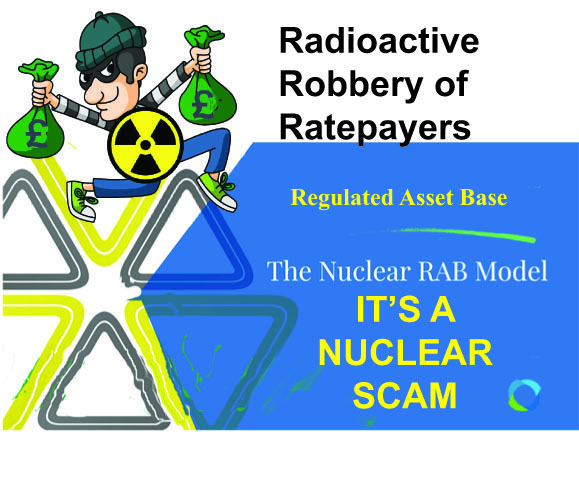
In contrast, Hinkley Point C will operate on the old contracts for difference model where the developers enjoy a guaranteed strike price once the reactors are operational. The original £89.50 per megawatt hour strike price has already been adjusted up to £125 in view of inflation. This means that British consumers of nuclear energy will be paying amongst the highest prices for electricity in the world.
The construction of Hinkley Point C was contracted by the UK government to EDF and China General Nuclear (CGN). Both Hinkley Point C and Sizewell C will have the capacity to power about six million households and will have an economic life of up to 60 years. The two plants could be producing 14 percent of Britain’s total electricity output in the late 2030s.
Ms Coutinho rushed out a press release on the evening of 23 January, saying: “Hinkley Point C is not a government project and so any additional costs or schedule overruns are the responsibility of EDF and its partners and will no way fall on [British] taxpayers”. This comment annoyed EDF and its main shareholder, the French government, to prompt a further statement. The substance of that was that unless the UK government offered something towards the shortfall at Hinkley Point, Sizewell C would simply not happen.
Eventually, the UK Department for Energy Security and Net Zero pledged an additional £1.8 billion of taxpayers’ money. The Minister for Nuclear and Renewables, Andrew Bowie MP, later admitted that he needed to raise an additional £20 billion of private finance to ensure that Hinkley Point C is completed…………………………………………………………………………………………………………………………………………
there has been no coherent political consensus around the need for nuclear power in the UK. The 2003 energy white paper published under Tony Blair’s government described nuclear power as an “unattractive option” – although Labour later changed its mind. There is still vocal opposition to nuclear power generation on safety grounds – and even more to the disposal of nuclear waste. The Low Level Waste Repository (LLWR) in Cumbria, operated by British Nuclear Fuels has been especially contentious. Many environmental and political activists associate nuclear energy production with nuclear weapons production. Moreover, there have been nine different energy secretaries sitting in cabinet since 2010. With such a level of turnover of people at the top, it has proven difficult to fashion policy.
At least the optimists foresee that Sizewell C will benefit from the lessons learnt at Hinkley Point C. Though, somehow, I doubt it……………………………. https://masterinvestor.co.uk/economics/energy-costs-the-price-of-power/—
Rethinking Ukraine: Putin and the Mystery of National Identity
It has always been the case that the sooner Ukraine and the West settle, the better deal they will get, and that is more true every day. But prolonging the war is an end in itself to those who make money from it.
Put simply, Russia will outlast its opponents.
the formation and dissolution of national identities……………………………………. I should be interested to know where Ukrainian nationalists claim their cultural heritage lies as proof of early national identity.
There is a historical and a current strain of Nazism in Ukrainian nationalism, and it is far too tolerated by the Ukrainian state; that is certainly true. But to claim all Ukrainian nationalists are Nazis is a nonsense.
Rethinking Ukraine: Putin and the Mystery of National Identity
Craig Murray February 19, 2024
The genocide in Gaza – or more precisely the major NATO powers’ active and practical support for the genocide in Gaza – has forced me to re-evaluate my views on Ukraine in a manner more sympathetic to the Russian narrative.
The formation of national identity is a very curious thing Ivory Coast has just won the African Cup of Nations at soccer, beating Nigeria in the final. The competition arouses huge patriotic fervour throughout the continent of Africa. But the boundaries of all the African nations, except arguably Ethiopia, are entirely artificial colonial constructs. They cut right across ethnic, cultural and linguistic boundaries…………………………………………………………………………………………………………………………..
I am aware I need to read more on the creation of national identity, because most of my thought is based on simple observation. It is however entirely plain that national identity can appear, and can be genuine, and can do so in a period of merely decades. There is now a Ukrainian national identity, and those who subscribe to it have the right to their state.
That they have a right to the former boundaries of Soviet Ukraine is a different proposition. Given the reality that it is plain a significant minority of the population do not subscribe to Ukrainian national identity, that civil war broke out, and that this relates to historic geographic fracture lines, it seems that division of territory is now not only inevitable but desirable.
All people of good will should therefore wish to see an end to fighting and a peace settlement, of which the territorial elements are somewhere close to the current lines between the forces, with Russia giving back some territory in return for recognition of its gains. The alternative is more death, human misery and economic malaise.
In particular, I was complacent in my dismissive attitude to the argument that the Western powers would back ethnic cleansing and massacre in the Donbass, by forces including some motivated by Nazi ideology. The same powers who are funding and arming Ukraine are funding and arming a genocide by racial supremacist Israeli forces in Gaza. It is beyond argument that my belief in some kind of inherent decency in the Western political Establishment was naive.
I apologise.
This does not mean that I was wrong to call the Russian invasion of the Ukrainian state illegal. I am afraid it was. You see, the law is the law. It has only a tenuous connection to either morality or justice. A thing can be justified and morally right, but still illegal.
The proof of this is that we have an entire legal structure governing transactions which is designed to achieve massive concentration of wealth. In consequence, the world is predicted to have its first trillionaires inside the next five years, while millions of children go hungry.
That is plainly immoral. It is plainly unjust. But it is not only legal, it is the purpose of the system of law.
I am, however, content that the “Right to Protect” doctrine has not become accepted in international law, because it is in general application neo-imperialist.
It was developed by the Blair government initially to justify NATO bombing of Serbia and the British re-occupation of Sierra Leone, and was used by Hillary Clinton to justify the destruction of Libya on the basis of lies about an imminent massacre in Benghazi. We should be wary of the doctrine.
(That is the major theme of my book The Catholic Orangemen of Togo).
The causes of the Russian invasion of Ukraine are plain. Alarm at NATO expansionism and forward positioning of aggressive military assets encircling Russia. The Ukrainian coup of 2014. Exasperation at Ukrainian bad faith and the ignoring of the Minsk accords. The continuing death toll from shelling of Russian speakers in the Donbass.
The suppression of the Russian language, of Russian Orthodox religion and of the main pro-Russian opposition political party in Ukraine are simple facts. These I have always acknowledged: until I saw the positive enthusiasm of leaders of the Western states for massacre in Gaza, I was not convinced they could not have been addressed by diplomacy and negotiation. I now have to reassess that view in the light of new information, and I now think Putin was justified in the invasion.
It is not that any of the arguments are new. It is simply that before I did not believe that the West would sponsor mass ethnic cleansing and genocidal attack on the Donbass by extreme Ukrainian nationalist-led, Western-armed forces. I thought the “West” was more civilised than that. I now have to face the fact that I was wrong about the character of the NATO powers.
The alternative to Putin’s action probably was indeed massacre and ethnic cleansing.
The urgent need now is for negotiation to put an end to the war. On that my position has not changed. The war is a disaster for the people of Europe. The American destruction of Nord Stream has devastated the German economy and resulted in huge energy price increases for consumers all across Europe, including the UK. There was a step jump in food inflation which has not been pulled back.
The continuation of the war will of course prime the pump of the military-industrial complex. Massive defence spending is the most efficient way to ensure kickbacks to the political class who control the flow of state funds, through both legal and illegal forms of corrupt reward to politicians.
As Julian Assange said, the object is not to win wars: the object is forever wars, to keep the funds flowing.
The truth is that the longer the war persists, the less generous Russia will be over returning occupied territory to Ukraine. The deal which was torpedoed by the West nearly two years ago (and in truth the US played more of a role than Boris Johnson – I was actually there in Turkey) ceded only the Crimea to Russia, with a Minsk plus deal for the Donbass which would have remained Ukrainian. That is unthinkable now. The major question is how large a coastal corridor Russia will insist on keeping westward from Crimea, and whether Putin can be persuaded to accept less than the historical dividing line of the Dnieper.
I do not share the Russian triumphalism at the dwindling manpower resources of the Ukraine. With the obscene billions the West is pumping into remote warfare in Ukraine, that is not the factor you might expect. But the political will of the West to continue to pump in these billions is plainly sapping, as it becomes obvious there will be no successful Ukrainian offensive. Put simply, Russia will outlast its opponents.
It has always been the case that the sooner Ukraine and the West settle, the better deal they will get, and that is more true every day. But prolonging the war is an end in itself to those who make money from it.
Putin’s historical disquisition to Tucker Carlson opened some Western eyes to another national perspective, and gave rise to widespread claims by Western media that Putin was factually wrong. In fact almost all of his facts were correct. The interpretation of them, and the position of other facts which were omitted or given less weight, is of course the art of history.
There is no question I find more fascinating in history than the formation and dissolution of national identities.
My own perspective on this – and there is no subject on which it is more important to understand the vantage point of the person writing – is governed by two factors in particular. Firstly, I am a Scot and come from one of Europe’s oldest nation states, which then lost its independence and struggles to regain it after being submerged in a new “British” national identity.
Secondly, as a former diplomat I lived and worked in the political field in a number of countries with differing histories of national identity.
These include Poland, a nation state which the historian Norman Davies brilliantly quipped “Has emerged from time to time through the mists of history – but never in the same place twice”.
It includes Ghana, a state with an extremely strong sense of national identity but which was an entirely artificial colonial creation.
It includes Nigeria, another entirely artificial colonial creation but which has struggled enormously to build national identity against deep and often violent ethnic and cultural differences.
It includes Uzbekistan, a country which also has entirely artificial colonial borders but which the western “left” fail to recognise as an ex-colony because they refuse to acknowledge the Soviet Union was a continuation of the Russian Empire.
These include Poland, a nation state which the historian Norman Davies brilliantly quipped “Has emerged from time to time through the mists of history – but never in the same place twice”.
It includes Ghana, a state with an extremely strong sense of national identity but which was an entirely artificial colonial creation.
It includes Nigeria, another entirely artificial colonial creation but which has struggled enormously to build national identity against deep and often violent ethnic and cultural differences.
It includes Uzbekistan, a country which also has entirely artificial colonial borders but which the western “left” fail to recognise as an ex-colony because they refuse to acknowledge the Soviet Union was a continuation of the Russian Empire.
So I have seen all this, as someone with a training and interest as a historian, who has read a great deal of Eastern European history. I have also lived in Russia and was for a time both a fluent Russian and Polish speaker. I do not write this to claim I am right, but so that you know what has formed my view.
Putin argued at great length that there never was such a country as “Ukraine”. The BBC has run a “fact check” and claimed this is “Nonsense”.
There are several points to make about this. The first is that the BBC did not, as it claimed, go to “independent historians”. It went to Polish, Ukrainian and Armenian historians with their own very distinct agenda.
The second is that these historians did not actually take issue with Putin’s facts. For a fact-check it does not really examine any of Putin’s historical facts at all. What the historians did was put forward other facts they felt deserve more weight, or different interpretations of the facts referenced by Putin. But none argued convincingly for the former existence of a Ukrainian national state or even the long term existence of Ukrainian national identity.
In fact their arguments were largely consistent with Putin. The BBC quote Prof Ronald Suny:
Mr Suny points out that the inhabitants of these lands when they were conquered by Russia were neither Russian nor Ukrainian, but Ottoman, Tatar or Cossacks – Slavic peasants who had fled to the frontiers.
Which is absolutely true: 18th century Russia did not conquer a territory called “Ukraine”. Much of the land of Ukraine was under Muslim rule when conquered by Catherine the Great, and nobody called themselves “Ukrainian”.
The BBC then gives this quote:
But Anita Prazmowska, a professor emerita at the LSE, says that although a national consciousness emerged later among Ukrainians than other central European nations, there were Ukrainians during that period.
“[Vladimir Putin] is using a 20th Century concept of the state based on the protection of a defined nation, as something that goes back. It doesn’t.”
Which is hardly accusing Putin of speaking “nonsense” either. Prazmowska admits the development of Ukrainian national consciousness came “later than other Central European states”, which is very definitely true. Prazmowska herself has a very Central European take – the idea of the nation state in England, Scotland and France, for example, developed well ahead of the period of which she was speaking.
I should address the weakness in Putin’s narrative, around the origins of World War 2. Russian nationalists have great difficulty in accommodating the Stalin/Hitler pact into the narrative of the Great Patriotic War, and while Putin did briefly reference it, his attempt to blame World War 2 essentially on Poland was a low point. But even here, there was a historical truth that the standard Western narrative ignores.
The Rydz-Smigly–led military dictatorship in Poland after the death of Pilsudski was not a pleasant regime. Putin was actually correct about Munich: both the UK and France had asked Poland to allow the Soviet army to march through to bolster Czechoslovakia against Germany, and Poland refused (Ridz-Smigly did not trust Stalin, and frankly I don’t blame him). But this is an example of part of Putin’s narrative that countered the received Western tradition, that most well-informed people in the West have no idea happened, and is perfectly true.
The fusing back then of Ukrainian nationalism with Nazism, and the atrocities of Ukrainian nationalists in WW2 against not just Jews but also Poles and other minorities, were also perfectly true.
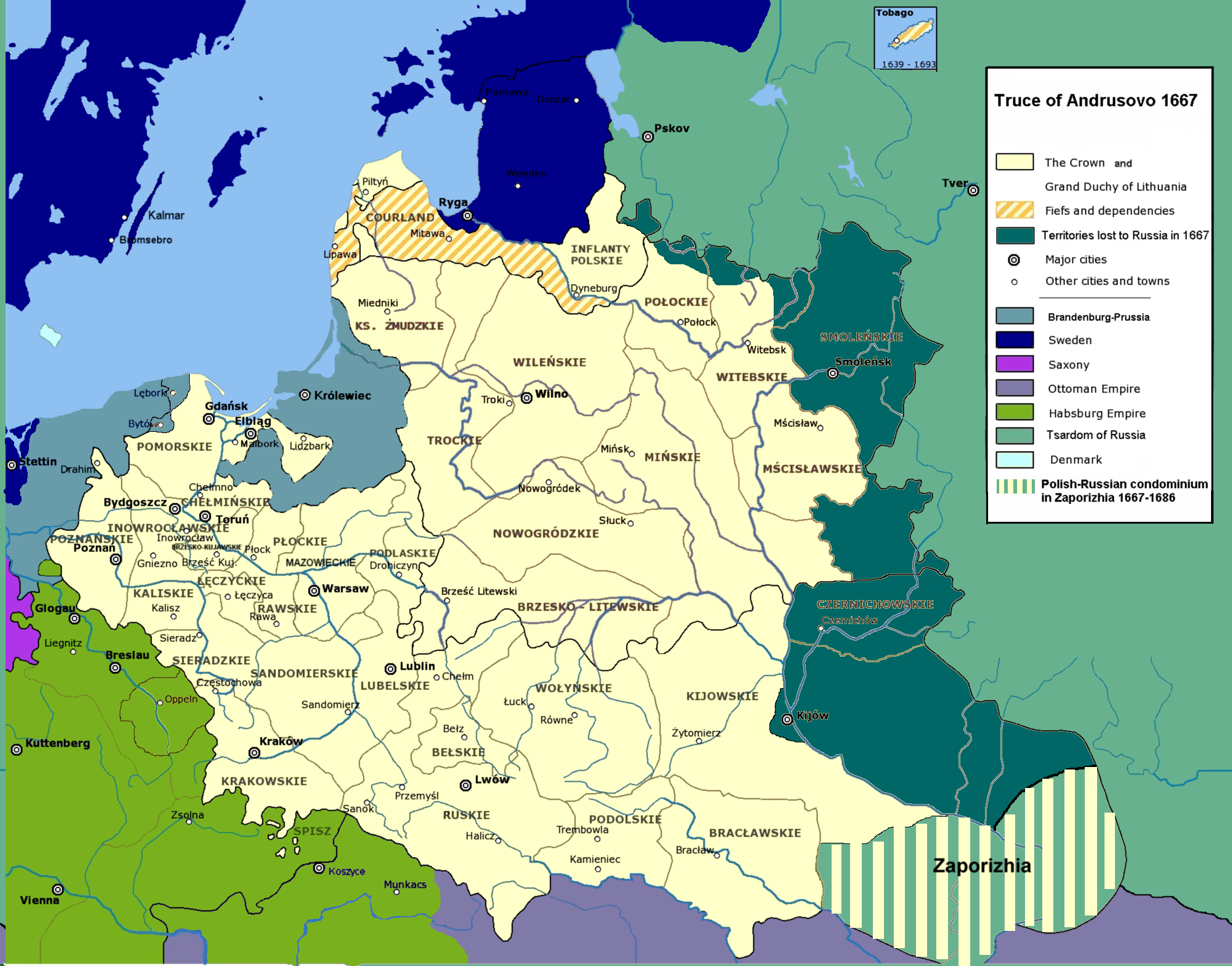
It is a simple and stark truth there never was a Ukrainian state before 1991. There just was not. Lands currently comprising Ukraine were at various times under the rule of Muslim Khans, of the Ottomans, of Cossack Hetmans (possibly the closest thing to proto-Ukrainians), the Polish-Lithuanian confederation and Russian Tsars.
As I have stated on this blog before, the boundary between Polish/Lithuanian and Russian influence became settled on the Dnieper. I have also published this map before, showing that history resonates through the current conflict. [map at top of page]
There is also the case of third-party recognition of the Ukrainian nationality. I have read, for example, the letters and memoirs, both published and unpublished, of scores of British soldiers and civil servants involved in the Imperial rivalry with Russia in Asia. Many had contact with Russian officers or diplomats. They did clearly recognise different ethnic identities within the Russian Empire. The Russian diplomat Jan Witkiewicz was described repeatedly by British officers as “Polish”, for example. “Cossack” and “Tartar” were frequently used. I cannot recall any of these British sources ever using the description “Ukrainian”.
Nor did British officers who actually passed through Ukraine, like Fred Burnaby and Arthur Connolly, describe it as such in their memoirs. Now I am not claiming that if British imperialists did not notice something, it did not exist. But if there were a centuries-old recognition by the rival Empire of the existence of a Ukrainian national identity, that would definitely mean something. There does not appear to be such.
I should be interested to know where Ukrainian nationalists claim their cultural heritage lies as proof of early national identity. What is the Ukrainian equivalent of Shakespeare’s John of Gaunt speech, of Scotland’s Blind Harry, or even of Poland’s Pan Tadeusz? (This is a genuine question. There may be areas of Ukrainian historic identity of which I am unaware).
Putin was not wrong about history (apart from the dodgy bit about origins of the second world war). But the correct question is whether any of this matters.
It is not whether Putin’s historical analysis is broadly correct, it is whether this matters. I am inclined to the view that Putin is correct that there is little evidence that the people living in Ukraine, hundreds of years ago, ever considered themselves a distinct national entity.
But they are all dead, so they don’t get a vote. The only thing that matters is the opinion of those living there now.
It seems to me beyond dispute that there is now a Ukrainian national identity. I know several Ukrainians who consider themselves joyously and patriotically Ukrainian, just as I know patriotic Ghanaians and even patriotic Uzbeks. The question of how this identity was forged and how recently is not the point.
I should add there are undoubtedly a great many Ukrainians whose sense of national identity is not linked to Nazism. There is a historical and a current strain of Nazism in Ukrainian nationalism, and it is far too tolerated by the Ukrainian state; that is certainly true. But to claim all Ukrainian nationalists are Nazis is a nonsense…………………………………………………………………………………………………
I am aware I need to read more on the creation of national identity, because most of my thought is based on simple observation. It is however entirely plain that national identity can appear, and can be genuine, and can do so in a period of merely decades. There is now a Ukrainian national identity, and those who subscribe to it have the right to their state.
That they have a right to the former boundaries of Soviet Ukraine is a different proposition. Given the reality that it is plain a significant minority of the population do not subscribe to Ukrainian national identity, that civil war broke out, and that this relates to historic geographic fracture lines, it seems that division of territory is now not only inevitable but desirable.
All people of good will should therefore wish to see an end to fighting and a peace settlement, of which the territorial elements are somewhere close to the current lines between the forces, with Russia giving back some territory in return for recognition of its gains. The alternative is more death, human misery and economic malaise.
https://www.craigmurray.org.uk/archives/2024/02/putin-history-and-the-mystery-of-national-identity/
Ten years after Maidan: Why won’t the West admit that the coup was based on a lie?
Felix Livshitz, RT, Sat, 24 Feb 2024, https://www.sott.net/article/489209-Ten-years-after-Maidan-Why-wont-the-West-admit-that-the-coup-was-based-on-a-lie
—
This feature was first published on February 6, 2023. On the occasion of the 10th anniversary of the events that took place in Kiev on February 22, 2014, we are again posting it on the front page.
Political scientist Ivan Katchanovski – of the University of Ottawa – revealed last year, in a paper, that the February 2014 massacre of Ukrainian protesters by sniper fire, a defining moment of the Western-backed Maidan coup, was not published by an academic journal for “political reasons.”
Evidence that external forces were involved has been suppressed for ‘political reasons’
‘The evidence is solid’
In a lengthy Twitter thread, Katchanovski first laid out the circumstances behind the rejection of his article, and the bombshell evidence included in it. The paper was initially accepted with minor revisions after peer review, and the journal’s editor offered a glowing appraisal of his work, writing:
“There is no doubt that this paper is exceptional in many ways. It offers evidence against the mainstream narrative of the regime change in Ukraine in 2014… It seems to me that the evidence the study produces in favour of its interpretation on who was behind the massacre of the protesters and the police during the ‘Euromaidan’ mass protests on February 18-20, 2014, in Ukraine, is solid. On this there is also consensus among the two reviewers.”
As the editor noted, the massacre was a “politically crucial development,” which led to the “transition of powers in the country” from the freely elected Viktor Yanukovich to the illegitimate and rabidly nationalistic administration of Aleksandr Turchinov, a former security services chief. It was endlessly cited in Western media as a symbol of the brutality of Ukraine’s government and an unprovoked attack on innocent pro-WesternMaidan protesters, who allegedly sought nothing more than democracy and freedom.
Rumors that the killings were a false flag intended to inflame tensions among the vast crowds filling Maidan, and provoke violence against the authorities, began circulating immediately.
No serious investigation into what happened was ever conducted by the Western media, with all claims that the sniper attacks were an inside job dismissed as Kremlin “disinformation.” However, even NATO’s Atlantic Council adjunct admitted in 2020 that the massacre was unsolved and that this “cast a shadow over Ukraine.”
Ask the witnesses
It may not remain unsolved for much longer though, due to an ongoing trial of policemen at the scene on the fateful day. The legal action has been unfolding for well over a year and has received no mainstream news attention at all outside Ukraine. Katchanovski drew heavily on witness testimony and video evidence that has emerged over the course of the trial in his suppressed paper.
For example, 51 protesters wounded during the incident testified at the trial that they were shot by snipers from Maidan-controlled buildings, and/or witnessed snipers there. Many spoke of snipers in buildings controlled by Maidan protesters shooting at police. This is consistent with other evidence collected by Katchanovski, such as 14 separate videos of snipers in protester-controlled buildings, 10 of which clearly feature far-right gunmen in the Hotel Ukraina aiming at crowds below.
In all, 300 witnesses have told much the same story. Synchronized videos show that the specific time and direction of shots fired by the police not only didn’t coincide with the killings of specific Maidan protesters, but that authorities aimed at walls, trees, lampposts, and even the ground, simply to disperse crowds.
Among those targeted by apparently Maidan-aligned snipers were journalists at Germany’s ARD. They weren’t the only Western news station in town at the time – so too were Belgian reporters, who not only filmed Maidan protesters screaming towards Hotel Ukraina for snipers not to shoot them, but also participants being actively lured to the killing zone. This incendiary footage was never broadcast.
CNN likewise filmed far-right elements firing at police from behind Maidan barricades, then hunting for positions to shoot from the 11th floor of the Hotel Ukraina, minutes before the BBC filmed snipers shooting protesters from a room where a far-right MP was staying. The network opted not to report this at the time.
We needn’t rely purely on video footage. Over the course of the trial, no fewer than 14 self-confessed members of Maidan sniper groups testified they had explicitly received massacre orders, Katchanovski claims. By contrast, no police officer at the scene has said they were directed to kill unarmed protesters, no minister has come forward to blow the whistle on such a scheme, and no evidence Yanukovich approved of the killings has ever emerged.
Separate from the trial, leaders of the far-right Svoboda party have openly stated that Western government representatives expressly told them before the massacre that they would start calling for Yanukovich’s ouster once casualties among protesters reached a certain number. This figure was even actively discussed by both sides – were five enough, or 20? Or even 100? The latter was the final total reported, and indeed led to calls for the Ukrainian government’s abdication.
***
Katchanovski previously published a landmark study on the Maidan massacre in 2021, which has been referenced over 100 times by scholars and experts, already making him one of most cited political scientists specializing in Ukraine, according to Google Scholar.
Whatever the nature and source of the political pressure applied to the journal that led to the censoring of the dynamite paper, the move may well backfire massively, in the spirit of the Streisand Effect. Indeed, it could help the truth of what happened on those deadly days come out, and assist in those responsible for the killings being brought to justice.
It should also prompt a wider reconsideration of the nature of Maidan too, and the government it produced. The banning of opposition parties, attacks on the Orthodox Church, the closure of dissident media outlets, and the war on Russian culture and language are all consequences.
Comment: It is interesting that the West keeps claiming that Ukraine is fighting for European values for as the last paragraph shows, those values contain nothing democratic, just or fair in them. The West might be right though as European values in reality are getting closer and closer to those demonstrated in Ukraine, namely fascism and totalitarianism.
See also:
Antarctica sea ice reaches alarming low for third year in a row

The extent of ice floating around the continent has contracted to below 2m sq km for three years in a row, indicating an ‘abrupt critical transition’
Graham Readfearn, 25 Feb 24 https://www.theguardian.com/world/2024/feb/24/antarctica-sea-ice-reaches-alarming-low-for-third-year-in-a-row
For the third year in a row, sea ice coverage around Antarctica has dropped below 2m sq km – a threshold which before 2022 had not been breached since satellite measurements started in 1979.
The latest data from the US National Snow and Ice Data Center confirms the past three years have been the three lowest on record for the amount of sea ice floating around the continent.
Scientists said another exceptionally low year was further evidence of a “regime shift”, with new research indicating the continent’s sea ice has undergone an “abrupt critical transition”.
Antarctica’s sea ice reaches its lowest extent at the height of the continent’s summer in February each year.
On 18 February the five-day average of sea ice cover fell to 1.99m sq km and on 21 February was at 1.98m sq km. The record low was 1.78m sq km, set in February 2023.
Whether the current level represents this year’s minimum won’t be known for another week or two.
Antarctica sea ice reaches alarming low for third year in a row
The extent of ice floating around the continent has contracted to below 2m sq km for three years in a row, indicating an ‘abrupt critical transition’
Graham Readfearn @readfearnSun 25 Feb 2024
For the third year in a row, sea ice coverage around Antarctica has dropped below 2m sq km – a threshold which before 2022 had not been breached since satellite measurements started in 1979.
The latest data from the US National Snow and Ice Data Center confirms the past three years have been the three lowest on record for the amount of sea ice floating around the continent.
Scientists said another exceptionally low year was further evidence of a “regime shift”, with new research indicating the continent’s sea ice has undergone an “abrupt critical transition”.
Antarctica’s sea ice reaches its lowest extent at the height of the continent’s summer in February each year.
On 18 February the five-day average of sea ice cover fell to 1.99m sq km and on 21 February was at 1.98m sq km. The record low was 1.78m sq km, set in February 2023.
Whether the current level represents this year’s minimum won’t be known for another week or two.
“But we’re confident the three lowest years on record will be the last three years,” said Will Hobbs, a sea ice scientist at the University of Tasmania.
Antarctica’s sea ice reaches its peak each September, but last year’s maximum extent was the lowest on record, easily beating the previous record by about 1m sq km. Scientists were shocked at how much less ice regrew last year, falling well outside anything seen before.
Coverage appeared to recover slightly in December as the refreeze progressed, but then fell away again to the current levels.
There are no reliable measurements of how thick Antarctic sea ice is, but Ariaan Purich, a climate scientist specialising in Antarctica and the Southern Ocean at Monash University, said it was possible the ice that did regrow was thinner than usual.
“It seems plausible, and thinner sea ice could melt back more quickly,” she said.
Scientists are still investigating what is causing the decline in sea ice,, but they are concerned global heating could be playing a role – in particular by warming the Southern Ocean that encircles the continent.
Sea ice reflects solar radiation, meaning less ice can lead to more ocean warming.
Walt Meier, senior research scientist at the National Snow and Ice Data Center, said that since most of the ice melts completely each summer “much of the ice is only 1-2 metres [thick]” – and even less near the ice edge.
“With the very low maximum last September, the ice was probably thinner on average in many areas, but it’s hard to say how much of an effect it has had on the rate of melt and the approaching minimum,” he said.
Antarctica’s ecosystems are tied to the sea ice, from the formation of phytoplankton that can remove carbon from the atmosphere to the breeding sites of penguins.
Purich led research last year that said the continent’s sea ice could have undergone a “regime shift” that was probably driven by warming of the subsurface ocean about 100 metres down.
Research led by Hobbs and colleagues at the Australian Antarctic Program Partnership and other institutions has added evidence to support this claim.
In a paper published this month in the Journal of Climate scientists examined changes in the extent of sea ice and where it was forming each year.
Looking at two periods – 1979 to 2006 and 2007 to 2022 – the researchers found the amount of sea ice had become much more variable, or erratic, in the later period.
This change could not be explained by changes in the atmosphere – mostly winds – which have previously dictated most of the year-to-year variability of the ice.
The study concludes an “abrupt critical transition” has occurred in Antarctica, but Hobbs said they could not say why.
“We don’t know what the driver of change is. It could be ocean warming or a change in ocean salinity,” he said. But it was also possible the change was a natural shift.
Scientists have warned the loss of sea ice is just one of several major changes being observed in Antarctica that is likely to have global consequences – in particular, its loss is exposing more of the continent to the ocean, accelerating the loss of ice on the land, which can push up global sea levels.
Scientists have been increasingly vocal in calling for governments to take the Antarctic changes more seriously and have lamented the comparative lack of data from on and around the continent.
Hobbs said: “What we need is sustained measurements of ocean temperature and salinity underneath the sea ice. We need improvements in our climate models. And we need time.”
Most Japan fishing groups hit by China import ban in Fukushima row
A Kyodo News survey has found that 80.6% of prefectural fisheries cooperative associations were affected by the discharge of treated radioactive water from the crippled Fukushima No. 1 nuclear plant into the sea, with many feeling the impact through China’s import ban on Japanese marine products. The survey, released Friday, found that 29 out of 36respondents among the members of the National Federation of FisheriesCooperative Associations said they “had felt” or “had somewhat felt”negative effects, including financial damage due to the water release,overwhelmingly due to the subsequent import ban by China
. Japan Times 24th Feb 2024 https://www.japantimes.co.jp/news/2024/02/24/japan/japan-fishing-groups-china-fukushima-ban/
Donald Trump and nuclear weapons are a scary mix.
A failing British nuclear arsenal reliant on the goodwill of Donald Trump? It’s a terrifying thought
Simon Tisdall. Guardian, 24 Feb 24
Believing US-supervised nuclear weapons make Britain safer is not only delusional and unsustainable, it’s dangerous.
Donald Trump and nuclear weapons are a scary mix. As president, he greatly expanded the US nuclear arsenal, scrapped arms control treaties and repeatedly threatened to start a nuclear war. On leaving office, he stole nuclear secrets from the White House and leaked their contents. A judge recently questioned his mental health.
For close ally Britain, the scariest thought is that Trump, if re-elected in November, could fatally undermine the UK’s “independent” nuclear deterrent, or worse, pressure London into actually using it. If Trump blundered into a nuclear showdown with, say, China, Russia or North Korea, Britain would be expected to back him – and could become a target.
None of these scenarios may be ruled out, despite UK insistence that it retains sole operational control of its four Vanguard-class nuclear missile submarines. In truth, such outcomes grow more plausible as the international security situation deteriorates, Trump threatens to abandon Nato and Europe, and nuclear arms proliferate globally. Successive UK governments are primarily to blame for Britain’s deepening nuclear nightmare. All have colluded in the pretence that the UK deterrent, known generically as Trident, is independent. In fact, the Vanguard submarines rely on American technology, logistics and maintenance, as will their Dreadnought-class successors. The new W93 replacement warhead borrows from US designs.
Even the US-made Trident II D5 ballistic missiles that carry the warheads are not owned but leased under the terms of the 1958 US-UK mutual defence agreement (MDA) and 1963 Polaris sales agreement. “UK nuclear weapons are only as independent as the US wants them to be,” a new study by the anti-nuclear Pugwash scientists’ network says. “The MDA [locks] the UK into dependence on the US for the procurement of nuclear weapons,” Pugwash states. “In practice, the UK’s technical dependence on the US would constrain any attack to which Washington objected. For example, the UK is reliant on American software for all aspects of nuclear targeting.”
This chronic dependency would give a re-elected Trump huge leverage, should he choose to use it, in the not improbable event of a security or foreign policy clash with a Labour government, for example, over Ukraine. Britain’s deterrent has always ultimately relied on US goodwill, an all-party commission on Trident noted in 2014……………………………………………………………………………
Britain’s habitual willingness to follow America to war, seen again recently in the Red Sea and notoriously in Iraq in 2003, could be its undoing – unless policy changes. “The UK is more likely to use nuclear weapons in a bilateral UK-US operation than either as part of a Nato strike or independently,” Pugwash says. The House of Commons defence select committee concluded in 2006 that “the only way that Britain is ever likely to use Trident is to give legitimacy to a US nuclear attack by participating in it…. In a crisis the very existence of the UK Trident system might make it difficult for a UK prime minister to refuse a request by the US president to participate.”
Trump aside, Britain’s deterrent faces multiple problems. One estimate puts the overall cost of renewing and maintaining Trident from 2019 to 2070 at £172bn. The system already faces delays and cost overruns. The first Dreadnought submarine is not expected to enter service until the early 2030s.
Meanwhile, the four Vanguard subs and their crews are undertaking record-length patrols, continuously at sea for five months or more. This reportedly compounds maintenance and morale problems. The entire fleet is now older than its originally planned service life of 25 years, according to the independent Nuclear Information Service. And the deterrent’s reliability is in question after a second, consecutive missile test failure last month. Official secrecy hinders public and parliamentary scrutiny of ministerial claims that all is working well…………………………………………………………………………………………
An incoming Labour government must not wait until disaster strikes. It should reallocate Trident’s billions to more socially useful projects. The belief that US-supervised and controlled nuclear weapons somehow make Britain safer and boost its global influence is delusional, unsustainable, unaffordable – and, in the age of Trump, downright dangerous. https://www.theguardian.com/commentisfree/2024/feb/24/failing-british-nuclear-arsenal-reliant-on-the-goodwill-of-donald-rump-is-terrifying-thought
New Israeli report alleging ‘systematic and intentional rape’ by Hamas relies on debunked Western media reports
The Grayzone, MAX BLUMENTHAL·FEBRUARY 22, 2024
The contents of the Israeli Association of Rape Crisis Center’s paper alleging “systematic” Hamas rape derive largely from discredited second-hand testimonies and debunked media reports. Among its most heavily cited sources is a dubious NY Times article that triggered a staff revolt at the paper.
Western media outlets are hyping a new report by the Israeli government-affiliated “Association of Rape Crisis Centers” (ARCC) which maintains that Hamas combatants carried out a campaign of “systematic and intentional” rape on October 7.
“Israeli report finds evidence of ‘systematic’ rape and abuse during 7 October attack,” a Guardian headline blared. “Report shows systematic rapes, murder of women in Israel on October 7,” Germany’s DPA screamed. Meanwhile, the Jerusalem Post shrieked, “Hamas terrorists forced families to watch loved ones get raped at gunpoint.”
Despite the AP’s acknowledgment that the report “did not specify the number of cases it had documented or identify any victims, even anonymously” and that its authors “declined to say whether they had spoken to victims,” dozens of mainstream outlets have presented its findings as incontrovertible fact.
Yet a close examination of the ARCC report reveals that the paper is short on new research, absent of hard evidence, and reliant instead on clips from factually-challenged articles by the same Western outlets promoting its publication. Among the paper’s most frequently cited sources is an infamously shoddy New York Times report by Jeffrey Gettleman purporting to detail “How Hamas Weaponized Sexual Violence on October 7.”
Following an internal staff uproar prompted by a series of Grayzone exposés which highlighted major inconsistencies and demonstrable falsehoods by the paper’s sources, the Times canceled an episode of its “Daily” podcast about the article.
Despite the controversy surrounding the Times’ report, the ARCC cites it twelve times in its own paper, while sourcing testimony second-hand from many of the same discredited Israelis as the Times.
The ARCC also relies substantially on testimony from ZAKA, the ultra-Orthodox “rescue” group which introduced false allegations that Hamas beheaded babies, cut fetuses from pregnant women, and had lunch in an Israeli family’s home after killing and mutilating them. ZAKA has been lambasted in Israeli media for serially mishandling evidence from the October 7 attacks and even staging atrocity scenes for fundraising purposes.
At least one quarter of citations in the ARCC’s paper are drawn from the widely panned New York Times article and credibility-strained ZAKA volunteers. The rest of the paper relies on dubious self-proclaimed witnesses like the Israeli army reservist Shari Mendes, who falsely claimed that Hamas not only cut a fetus from a pregnant Israeli woman, but beheaded its mother.
In citing the NY Times to demonstrate systematic rape by Hamas on October 7, the ARCC points to “a video posted on social media” which shows “a woman in a torn dress, without underwear, injured and with her face burned. Police investigators ruled that she had been raped.”
This section refers to Gal Abdush, a young woman killed on October 7 who features as a central character in the NY Times article. As The Grayzone reported, Abdush’s sister and brother-in-law both publicly denied that she was raped, with the former accusing the Times of manipulating her family into participating by misleading them about their editorial angle.
The ARCC later cites a NY Times account of “an IDF paramedic” who claimed to have entered a room in Kibbutz Beeri “where the bodies of two girls were found, one of whom was found with her pants rolled down and the remains of semen on her back.”
The Grayzone has exposed this source as well, revealing him as a reservist paramedic from Israeli Air Force Special Tactics rescue unit 669 who identifies himself to the media only as “G,” but whose real name is Guy Melamed. As we explained, no girls were found on Kibbutz Beeri in a condition remotely similar to Melamed’s description.
The closest match to the paramedic’s account were two teenage residents of Beeri, Yahel and Noiya Sharabi, who were killed on October 7. But according to the Times of Israel, the girls’ bodies were “found in an embrace” with their mother, and not “alone, separated from the rest of the family.”
Israeli media has also reported, “Lianne and Yahel [Sharabi] could only be identified through DNA samples. Noiya was identified through her teeth only two days ago.”
So how was Melamed able to find semen on one of the girls, and bruises on the other, and view their states of undress, if their bodies had been burned beyond recognition? The only answer is that he fabricated the entire scenario.
Before Melamed cooked up atrocities for the NY Times, which were later reheated by the ARCC, he appeared on a right-wing Indian news channel to invent an account of discovering a dead baby discarded into a trash can by Hamas. Given that only one baby was killed on October 7 – a one year old accidentally shot by a Hamas militant – the paramedic’s story could not have possibly been true.
Melamed was just one character among a motley collection of self-styled Israeli rescuers who fabricated October 7 atrocity tales to gain notoriety in the Western press. The most prolific fabulists emerged from an ultra-Orthodox Israeli state-affiliated group called ZAKA. This was the outfit responsible for “confirming” the bogus story of Hamas beheading babies on October 7 and spinning out the tale of a Palestinian militant slashing a fetus from a pregnant Jewish woman.
As The Grayzone reported, ZAKA is an infamously corrupt organization founded by a prolific sexual abuser. Before October 7, the group was nearly insolvent, but since it attracted international attention the lurid lies its volunteers spun out, it has raked in millions from wealthy Jewish diaspora donors including Russian billionaire Roman Abramovich and Meta’s Mark Zuckerberg.
Yossi Landau, the ZAKA “commander” who invented an array of debunked October 7 horror stories, has said that those who question his credibility “should be killed.”………………………………………………………………………………………………………………………………………………………………………………………………………………………..
ARCC paper paid for by Israel lobby bigwigs behind “10/7 Project” PR operation
Though released by an association seemingly dedicated to supporting sexual assault survivors in Israel, the ARCC’s paper alleging “systematic” rape by Hamas was paid for by Zionist pressure groups in the US. Its top sponsors include the Charles and Lynn Schusterman Family Foundation, which has donated millions to AIPAC-related initiatives, and the Jewish Federations of Greater Miami.
AIPAC and the Jewish Federations are also key pillars in the coalition of Israel lobby outfits behind a new propaganda initiative called the “10/7 Project.” According to Axios, the 10/7 Project comprises “a centralized communications operation that aims to provide newsrooms and policymakers with fact-based information on the [Gaza] war.”
In its bid to justify Israel’s blood-spattered assault on the Gaza Strip, which has left nearly 30,000 dead in over 130 days – most of them women and children – the 10/7 Project has contracted high-powered Democratic Party PR firms like SKDK to, in its words, “retell the story about the butchery of the Oct 7 attack and make outcasts of 10/7 deniers.”
Whether or not the 10/7 Project is responsible for the publicity blitz surrounding the ARCC’s new paper on “systematic” Hamas rape, it is clear Western media has become a laundromat for Israeli propaganda about October 7, recycling discredited allegations through a seemingly endless series of dodgy dossiers, and hyping each one as freshly obtained evidence of Palestinian savagery. https://thegrayzone.com/2024/02/22/israeli-hamas-debunked-western-media/
Pentagon investigating 50 cases of Ukraine military aid fraud
Rt.com 25 Feb 24
In one instance, shipping manifests were mysteriously changed before arms packages reached the country
The Pentagon’s inspector general has opened more than 50 cases into possible “theft, fraud or corruption, and diversion” of military aid to Ukraine. Allegations of graft surfaced almost immediately after the aid began flowing to Kiev and Inspector General Robert Storch has declared that more investigations are likely to follow.
Speaking at a briefing on Thursday, Storch said that though no allegations have been substantiated yet, “that may well change in the future,” according to Bloomberg. Additional investigations will be necessary “given the quantity and speed” of weapons being sent to Ukraine, he noted.
One case highlighted by Storch involved unidentified items arriving in Poland as part of a wider weapons shipment, before disappearing from a shipping manifest when they were sent across the border into Ukraine in June.
While the case of the disappearing equipment was highlighted in a report by Storch’s office last year, the inspector did not say at the time whether the items had been lost or stolen. Instead, his office stated that Pentagon personnel “did not have required visibility and accountability of all types of equipment during the transfer process.”
None of Storch’s reports to date have identified any outright criminality. However, Thursday’s announcement marks the first time he has acknowledged that his office is probing potential cases of “procurement fraud, product substitution, theft, fraud or corruption, and diversion.”
…………………………………………………………….. Ukrainian Defense Minister Aleksey Reznikov was dismissed from his post over graft allegations in September. His successor, Rustem Umerov, announced in January that an audit had revealed $262 million in theft-related costs in weapons procurement. https://www.rt.com/news/593080-pentagon-ukraine-aid-fraud/
First 2 years of US proxy war against Russia finds both US and Ukraine in downward spiral

Between 2007, and February 24, 2022, former presidents George W. Bush, Barack Obama, Donald Trump and Joe Biden floated NATO membership to Ukraine. This was in violation of George H.W. Bush’s 1991 promise not to expand NATO eastward toward Russia.
Sensible diplomats and historians scolded the US that such a move east was a red line of provocation that would inevitably result in military Russian pushback. They compared it with JFK’s willingness to start nuclear war with Russia to prevent installation of Russian missiles just 90 miles from the US in Cuba.
But the reckless presidents occupying the While House pushed on with their lust to expand NATO till Russia was completely surrounded to the west by US allies, possibly nuclear armed, to both isolate and degrade Russia as a political rival to US European hegemony.
But it was President Biden, after 15 long years of Russian pleading with America to cease NATO expansion, to trigger a violent Russian response. While touting NATO membership for Ukraine, he poured hundreds of millions in weaponry for Ukraine to finish off the Russian leaning Ukrainian dissidents in the Donbas seeking independence from Kyiv. He rebuffed every Russian entreaty to consider Russia’s security concerns. He even told Russia thru his spokesperson that ‘Russia’s security concerns were not up for discussion.’ A first year political science student wouldn’t have made that mistake.
So, after 15 years of pleading, Russia’s military response began 2 years ago today. What has it achieved for Ukraine who lobbied the US hard for NATO membership? Over 400,000 dead soldiers and 10,000 dead civilians. Over 14 million Ukrainians displaced from their homes, with 6 million fleeing as refugees in 11 European countries. Over a third of the prewar Ukraine economy is gone, putting Ukraine on US/NATO life support just to function. The Ukrainian military is near collapse. That is quite a needless decline for the US and Ukraine to provoke a senseless war.
Tho certainly not bloody nor broken economically as Ukraine, the US is also in decline from the war it provoked 2 years ago. Our sanctions against Russia have failed spectacularly. Our call for worldwide support to defeat Russia have been, outside of NATO and a few others, ignored. Dozens of countries, large and small, have abandoned US hegemony to join BRICS AND SCO, two political economic organizations dedicated to a multi polar world of nations not dominated by America. The US has boxed itself into a decline in world influence from which it will likely never recover. That is both good and long overdue.
But rather than face reality and direct Kyiv to negotiate the best resolution possible in a hopeless war, the US slogs on,pledging Ukraine $60 billion more in weapons for which there a few soldiers left to fire.
America’s decline which began 2 years ago today is political, diplomatic and moral, a trifecta of stupidity of which the Big Fools in the Biden administration are too blind or simply unwilling to see.
The Growing Environmental Footprint Of Generative AI

tech companies have been reporting whatever they choose, however they choose, about their AI impact

a great deal remains unrevealed about the millions of gallons of water used to cool computers running AI…… The same is true of carbon.
Undark, BY DAVID BERREBY, 02.20.2024
AI runs on power-hungry equipment that uses millions of gallons of fresh water. Policymakers are weighing the costs.
TWO MONTHS after its release in November 2022, OpenAI’s ChatGPT had 100 million active users, and suddenly tech corporations were racing to offer the public more “generative AI.” Pundits compared the new technology’s impact to the Internet, or electrification, or the Industrial Revolution — or the discovery of fire.
Time will sort hype from reality, but one consequence of the explosion of artificial intelligence is clear: this technology’s environmental footprint is large and growing.
AI use is directly responsible for carbon emissions from non-renewable electricity and for the consumption of millions of gallons of fresh water, and it indirectly boosts impacts from building and maintaining the power-hungry equipment on which AI runs. As tech companies seek to embed high-intensity AI into everything from resume-writing to kidney transplant medicine and from choosing dog food to climate modeling, they cite many ways AI could help reduce humanity’s environmental footprint. But legislators, regulators, activists, and international organizations now want to make sure the benefits aren’t outweighed by AI’s mounting hazards.
“The development of the next generation of AI tools cannot come at the expense of the health of our planet,” Massachusetts Senator Edward Markey said in a Feb. 1 statement in Washington, after he and other senators and representatives introduced a bill that would require the federal government to assess AI’s current environmental footprint and develop a standardized system for reporting future impacts. Similarly, the European Union’s “AI Act,” approved by member states last week, will require “high-risk AI systems” (which include the powerful “foundation models” that power ChatGPT and similar AIs) to report their energy consumption, resource use, and other impacts throughout their systems’ lifecycle. The EU law takes effect next year.
Meanwhile, the International Organization for Standardization, a global network that develops standards for manufacturers, regulators, and others, said it will issue criteria for “sustainable AI” later this year. Those will include standards for measuring energy efficiency, raw material use, transportation, and water consumption, as well as practices for reducing AI impacts throughout its life cycle, from the process of mining materials and making computer components to the electricity consumed by its calculations. The ISO wants to enable AI users to make informed decisions about their AI consumption.
Right now, it’s not possible to tell how your AI request for homework help or a picture of an astronaut riding a horse will affect carbon emissions or freshwater stocks. This is why 2024’s crop of “sustainable AI” proposals describe ways to get more information about AI impacts.
In the absence of standards and regulations, tech companies have been reporting whatever they choose, however they choose, about their AI impact, said Shaolei Ren, an associate professor of electrical and computer engineering at UC Riverside, who has been studying the water costs of computation for the past decade. Working from calculations of annual use of water for cooling systems by Microsoft, Ren estimates that a person who engages in a session of questions and answers with GPT-3 (roughly 10 t0 50 responses) drives the consumption of a half-liter of fresh water. “It will vary by region, and with a bigger AI, it could be more.” But a great deal remains unrevealed about the millions of gallons of water used to cool computers running AI, he said.
“Data scientists today do not have easy or reliable access to measurements of [greenhouse gas impacts from AI], which precludes development of actionable tactics,” a group of 10 prominent researchers on AI impacts wrote in a 2022 conference paper. Since they presented their article, AI applications and users have proliferated, but the public is still in the dark about those data, said Jesse Dodge, a research scientist at the Allen Institute for Artificial Intelligence in Seattle, who was one of the paper’s coauthors.
AI can run on many devices — the simple AI that autocorrects text messages will run on a smartphone. But the kind of AI people most want to use is too big for most personal devices, Dodge said. “The models that are able to write a poem for you, or draft an email, those are very large,” he said. “Size is vital for them to have those capabilities.”
Big AIs need to run immense numbers of calculations very quickly, usually on specialized Graphical Processing Units — processors originally designed for intense computation to render graphics on computer screens. Compared to other chips, GPUs are more energy-efficient for AI, and they’re most efficient when they’re run in large “cloud data centers” — specialized buildings full of computers equipped with those chips. The larger the data center, the more energy efficient it can be. Improvements in AI’s energy efficiency in recent years are partly due to the construction of more “hyperscale data centers,” which contain many more computers and can quickly scale up. Where a typical cloud data center occupies about 100,000 square feet, a hyperscale center can be 1 or even 2 million square feet.
Estimates of the number of cloud data centers worldwide range from around 9,000 to nearly 11,000. More are under construction. The International Energy Agency, or IEA, projects that data centers’ electricity consumption in 2026 will be double that of 2022 — 1,000 terawatts, roughly equivalent to Japan’s current total consumption.
However, as an illustration of one problem with the way AI impacts are measured, that IEA estimate includes all data center activity, which extends beyond AI to many aspects of modern life. Running Amazon’s store interface, serving up Apple TV’s videos, storing millions of people’s emails on Gmail, and “mining” Bitcoin are also performed by data centers. (Other IEA reports exclude crypto operations, but still lump all other data-center activity together.)
Most tech firms that run data centers don’t reveal what percentage of their energy use processes AI. The exception is Google, which says “machine learning” — the basis for humanlike AI — accounts for somewhat less than 15 percent of its data centers’ energy use…………………………………………………………………………………….
If global electricity use can feel a bit abstract, data centers’ water use is a more local and tangible issue — particularly in drought-afflicted areas. To cool delicate electronics in the clean interiors of the data centers, water has to be free of bacteria and impurities that could gunk up the works. In other words, data centers often compete “for the same water people drink, cook, and wash with,” said Ren.
In 2022, Ren said, Google’s data centers consumed about 5 billion gallons (nearly 20 billion liters) of fresh water for cooling. (“Consumptive use” does not include water that’s run through a building and then returned to its source.) According to a recent study by Ren, Google’s data centers used 20 percent more water in 2022 than they did in 2021, and Microsoft’s water use rose by 34 percent in the same period. (Google data centers host its Bard chatbot and other generative AIs; Microsoft servers host ChatGPT as well as its bigger siblings GPT-3 and GPT-4. All three are produced by OpenAI, in which Microsoft is a large investor.)
As more data centers are built or expanded, their neighbors have been troubled to find out how much water they take. For example, in The Dalles, Oregon, where Google runs three data centers and plans two more, the city government filed a lawsuit in 2022 to keep Google’s water use a secret from farmers, environmentalists, and Native American tribes who were concerned about its effects on agriculture and on the region’s animals and plants. The city withdrew its suit early last year. The records it then made public showed that Google’s three extant data centers use more than a quarter of the city’s water supply. And in Chile and Uruguay, protests have erupted over planned Google data centers that would tap into the same reservoirs that supply drinking water……………..more https://undark.org/2024/02/20/ai-environmental-footprint/?utm_source=Undark%3A+News+%26+Updates&utm_campaign=01eaa0c93b-RSS_EMAIL_CAMPAIGN&utm_medium=email&utm_term=0_5cee408d66-185e4e09de-%5BLIST_EMAIL_ID%5D
Wikileaks Reveals Alexei Navalny’s US Funding as Washington Exploits His Death
21 Feb 2024- Alexei Navalny’s political activities were funded by the US government through the National Endowment for Democracy (NED) as part of an effort to repeat US-backed 2014 Ukraine regime change inside Russia itself; – The Western media had previously (and reluctantly) revealed Navalny as far-right, racist, and xenophobic despite efforts to pass him off as a progressive pro-democracy activist; – US government-funded polling agencies consistently found Alexei Navalny extremely unpopular in Russia with single digit approval ratings; – After an alleged 2020 “Novichok” poisoning, Navalny’s popularity “surged” to 20% as the Western media accused Moscow of being behind the incident;
– The US is now exploiting the death of Navalny to advance its anti-Russia policy while the Western media collective omits all relevant context regarding Navalny’s background and US funding;
References:
NYT – Navalny’s Death Raises Tensions Between U.S. and Russia (February 16, 2024): https://www.nytimes.com/2024/02/16/wo…
CNN – Putin saw an existential threat in Navalny, the opposition leader whose name he dared not mention (February 16, 2024): https://edition.cnn.com/2024/02/17/eu…
Al Jazeera – Alexey Navalny: An archenemy Putin wouldn’t name and Kremlin couldn’t scare (February 16, 2024): https://www.aljazeera.com/news/2024/2…
Reuters – Putin critic Navalny’s approval rating surges in wake of poisoning (October 2020): https://www.reuters.com/article/us-ru…
The New Atlas – CNN + Bellingcat’s Latest Russian Novichok Lies | 12/16/2020 Review (December 2020):
Ralph Nader: What the Mass Media Needs to Cover Re: Israel/Gaza Conflict.

By Ralph Nader, February 23, 2024
Last October 27, I suggested subjects the mainstream media needed to cover relating to the saturation bombing of Gaza and its defenseless civilian families and infrastructure. Looking at these topics now, four months later, despite massive reporting, the attention to these subjects is still thin and more deserving of reporting than ever.1. How did Hamas, with tiny Gaza surrounded by a 17-year Israeli blockade, subjected to unparalleled electronic surveillance, with spies and informants, and augmented by an overwhelming air, sea and land military presence, manage to get the weapons and associated technology for their October 7th surprise raid? Readers still do not know how and from where these weapons entered Gaza year after year.
2. What is the connection between the stunning failure of the Israeli government to protect its people on the border and the policy of P.M. Netanyahu? Recall the New York Times (October 22, 2023) article by prominent journalist, Roger Cohen, to wit: “All means were good to undo the notion of Palestinian statehood. In 2019, Mr. Netanyahu told a meeting of his center-right Likud party: ‘Those who want to thwart the possibility of a Palestinian state should support the strengthening of Hamas and the transfer of money to Hamas. This is part of our strategy.’” (Note: Israel and the U.S. fostered the rise of Islamic Hamas in 1987 to counter the secular Palestine Liberation Organization (PLO)). Readers still need more information about the context of Netanyahu’s declared support for Hamas over the years and his connection to the buildup of Hamas funding and weaponry.
3. Why is Congress preparing to appropriate over $14 billion to Israel in military and other aid without any public hearings and without any demonstrated fiscal need by Israel, a prosperous economic, technological and military superpower with a social safety net superior to that of the U.S.? USDA just reported over 44 million Americans struggled with hunger in 2022. This, in the midst of a childcare crisis. Should U.S. taxpayers be expected to pay for Netanyahu’s colossal intelligence/military collapse? As an elderly Holocaust survivor told the New York Times “It should never have happened” in the first place.
4. Why hasn’t the media reported on President Biden’s statement that the Gaza Health Ministry’s body count (now over 7000 fatalities) is exaggerated? Indications, however, are that it is a large undercount by Hamas to minimize its inability to protect its people. Israel has fired over 8,000 powerful precision munitions and bombs into Gaza so far. These have struck many thousands of inhabited buildings – homes, apartments buildings, over 120 health facilities, ambulances, crowded markets, fleeing refugees, schools, water and sewage systems, and electric networks – implementing Israeli military orders to cut off all food, water, fuel, medicine and electricity to this already impoverished densely packed area the size of Philadelphia. For those not directly slain, the deadly harm caused by no food, water, medicine, medical facilities and fuel will lead to even more deaths and serious injuries.
Note that over three-quarters of Gaza’s population consists of children and women. Soon there will be thousands of babies born to die in the rubble. Other Palestinians will perish from untreated diseases, injuries, dehydration, and from drinking contaminated water. With crumbled sanitation facilities, physicians are fearing a deadly cholera epidemic.
Israel bombed the Rafah crossing on the Gaza-Egypt border. Only a tiny trickle of trucks are now allowed there by Israel to carry food and water. Fuel for hospital generators still remains blocked.
The undercount of fatalities/injuries is far greater now. The official figure is about 30,000 lives lost, with hundreds dying every day under the rubble. There is too little media interest in more realistic estimates. Undercounting lessens the pressure on Washington officials’ co-belligerents in the White House to call for a permanent ceasefire.
5. Why can’t Biden even persuade Israel to let 600 desperate Americans out of the Gaza firestorm?
6. Why isn’t the mass media making a bigger issue out of Israel’s long-time practice of blocking journalists from entering Gaza, including European, American and Israeli journalists? The only television crews left are Gazan-residing Al Jazeera reporters. Israeli bombs have already killed 26 journalists in the Gaza Strip since October 7th. Is Israel targeting journalists’ families? The Gaza bureau chief of Al Jazeera, Wael Al-Dahdouh’s family was killed in an Israeli airstrike on Wednesday. Israeli commanders now have killed over 100 journalists in addition in some cases to their entire families and continue to block foreign journalists except for a few brief “guided tours” in Israeli armored vehicles.
7. Why isn’t the mainstream U.S. media giving adequate space and voice to groups advocating a ceasefire and humanitarian aid? The message of Israeli peace groups’ peaceful solutions are drowned out by the media’s addiction to interviews with military tacticians. Much time and space are being given to hawks pushing for a war that could flash outside of Gaza big time. Shouldn’t groups such as Jewish Voice for Peace, the Arab-American Institute, Veterans for Peace and associations of clergy have their views and activities reported? Still being underreported are the activities all over the country of the Veterans for Peace and large labor unions demanding a permanent ceasefire and humanitarian aid.
8. Why is the coverage of the war overlooking the Geneva Conventions, the United Nations Charter and the many provisions of international law that all the parties, including the U.S., have been violating? (See the October 24, 2023 letter to President Biden). Under international law, Biden has made the U.S. an active “co-belligerent,” of the Israeli government’s vocal demolition of the 2.3 million inhabitants in Gaza, who are mostly descendants of Palestinian refugees driven from their homes in 1948. (See, Convention on the Prevention and Punishment of the Crime of Genocide). Coverage has expanded to include the U.S. vetoes on the Security Council and to global reporting on the International Court of Justice proceedings on South Africa’s calling for the Court to address Israel’s genocide of Palestinians in the Gaza Strip.
9. What about revealing human-interest stories? For example: How do Israeli F-16 pilots feel about their daily bombing of the completely defenseless Gazan civilian population and its life-sustaining infrastructures? The reporting on the military orders given to Israeli soldiers in Gaza who are slaying indiscriminately thousands of innocents of all ages and snipers attacking people and children in hospitals is inadequate. Why are no Hamas fighters taken as prisoners of war? Is there an order of “take no prisoners” even after capture? What are the courageous Israeli human rights and refuseniks thinking and doing in a climate of serious repression of their views as a result of Netanyahu’s defense collapse on October 7th? The open letter to President Biden on December 13, 2023, by 16 Israeli human rights groups appeared as a paid notice in the New York Times but received very little notice to its clarion call to stop the catastrophe in Gaza. (See the letter here).
10. Where is the media attention on the statements from Israeli military commentators, who, for years have declared high-tech US-backed, nuclear-armed Israel to be more secure than at any time in its history? Israel is reasserting its overwhelming military domination of the Middle East region, fully backed by U.S. militarism. The Israeli government is putting ads in U.S. newspapers wildly exaggerating long-subdued Hamas as an “existential” threat. Without Netanyahu strangely failing to keep the border guarded on October 7, 2023, what followed would not have happened!
Historians remind us that in a grid-locked conflict over time, it is the most powerful party’s responsibility to lead the way to peace.
Establishing a two-state solution has been supported by many Palestinians. All the Arab nations, starting with the Arab League peace proposal in 2002, support this solution as well. It is up to Israel and the U.S., assuming annexation of what is left of Palestine is not Israel’s objective. (See, the March 29, 2002 New York Times article: Mideast Turmoil; Text of the Peace Proposals Backed by the Arab League).More media attention on this subject matter is much needed.
The Rebellious CEO by Ralph Nader was published on November 14th. For more information go to: rebellious.ceo
U.S. Militarizes Space While Accusing Russia of Doing So
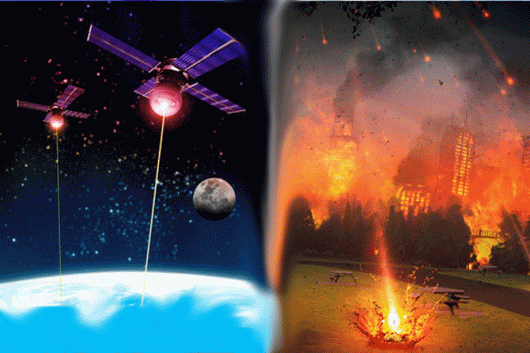
Since the creation of the U.S. Space Force in 2019, Washington has seen the militarization of space as a true strategic priority. At the time, then-American President Donald Trump had made it clear that the country’s objective was to achieve “American dominance in space.” Since then, several activities to increase American military space capabilities have been undertaken – many of them in partnership with other NATO countries and international allies.
In 2022, NATO began drafting a “space doctrine” based on “interoperability”. The following year, the alliance published a document exposing its main interests in space and pursuing American guidelines for the militarization of the orbit.
Lucas Leiroz, Strategic Culture Foundation, Tue, 20 Feb 2024, https://www.sott.net/article/489189-US-militarizes-space-while-accusing-Russia-of-doing-so
Recently, the U.S. began spreading rumors about alleged Russian space-based nuclear weapons. According to American intelligence, Moscow is developing a powerful anti-satellite weapon to be deployed in space, thus violating international norms that prohibit the militarization of Earth’s orbit.
In 2022, NATO began drafting a “space doctrine” based on “interoperability”. The following year, the alliance published a document exposing its main interests in space and pursuing American guidelines for the militarization of the orbit. According to analysts, the “interoperability” of NATO’s space activities simply means the creation of mechanisms for U.S. allies to help pay the high costs of military space development – while, on the other hand, only the Pentagon maintains real control of the activities and benefits from “space control”.
Mike Turner, head of the House Intelligence Committee, formally asked for the declassification of documents concerning the investigation on the “space-nukes”, stating that a deliberation on the case in the National Congress is necessary. According to Turner, American parliamentarians need to discuss this serious “threat” to U.S. national security, having therefore the requirement to fully release data obtained by intelligence on the subject.
Subsequently, the White House stated that there was no imminent threat to the country’s national security according to the information obtained so far. Spokespersons confirmed they are monitoring the possible existence of a Russian nuclear space program, but denied the existence of any evidence of a high-risk threat at the moment. As a result, once again American officials made contradictory statements, discrediting the image of U.S. authorities.
Moscow denied the accusations and stated that the rumors were intended to strengthen the anti-Russian establishment, pressuring parliamentarians to recognize the existence of a “threat” and thus approve the billion-dollar military aid package to Ukraine. Considering the domestic political stalemate in the U.S., with pro-war sectors failing to convince their opponents to continue aid to Kiev, it is very likely that the intention behind the spread of anti-Russian rumors is to actually increase fear among policymakers about a possible “danger”.
Obviously, as a major military power, the Russian Federation has its own anti-satellite systems and is able to employ them, if necessary, in a possible large-scale conflict scenario. However, the current tensions between Moscow and Washington, despite high, do not bring any need to use military force against American satellites, and there is therefore no “imminent threat” to the U.S. in the Russian arsenal.
In parallel, Moscow remains firmly committed to complying with international space law standards. The deployment of weapons of mass destruction in Earth’s orbit is banned by the treaties that regulate space activities. Therefore, even though it has weapons strong enough to inflict damage on enemy countries’ satellites, Russia is not willing to allocate nuclear weapons or weapons of mass destruction in outer space, as this would violate current regulations on the matter.
In fact, Russian actions regarding the outer space make it clear that Moscow intends to cooperate to prevent the militarization of Earth’s orbit. Russia, although it has the military capacity to do so, does not invest in “space-based” weapons, focusing its space activities on the peaceful and scientific sphere. This, however, is not the case with the U.S., which openly promotes the militarization of space, with constant efforts to turn Earth’s orbit into a true battlefield.
Since the creation of the U.S. Space Force in 2019, Washington has seen the militarization of space as a true strategic priority. At the time, then-American President Donald Trump had made it clear that the country’s objective was to achieve “American dominance in space.” Since then, several activities to increase American military space capabilities have been undertaken – many of them in partnership with other NATO countries and international allies.
“The U.S. Space Command planning document stated that the U.S. will ‘control and dominate space and deny other nations if necessary access to space (…) At the Space Command HQ in Colorado just above their doorway they have a sign that reads ‘Master of Space (…) Even with all its resources the U.S. can’t afford to pay for its ‘Master of Space’ plan by itself (…) [In order to maintain its dominance], the U.S. sets up a story line that it ‘must protect space’ from the dark forces in Russia, China, Iran, and North Korea (…) Interoperability’ ensures that all NATO members purchase new expensive space technologies mostly from U.S. aerospace corporations like Lockheed Martin, Raytheon, and others. In addition, ‘interoperability’ means that all space information, surveillance, and targeting is run through the U.S.-dominated system. In other words, NATO allies help pay for these costly space warfare systems but the Pentagon controls the ‘tip of the spear’,” Professor Bruce Gagnon, director of the Global Network Against Weapons and Nuclear Power in Space, once said commenting on the topic.
All these factors lead us to believe that there really was an attempt on the part of the U.S. to create a smokescreen for its own space militarization activities. By pointing out the existence of a “Russian danger”, Washington legitimizes its own “reactive” policies, thus encouraging increased investment in space weapons in NATO. In the same sense, this smokescreen helps to pressure parliamentarians to revise their stance on supporting Ukraine. With the popularity of the anti-Russian war gradually decreasing, the creation of a non-existent threat could serve as a legitimizing factor for the conflict.
In addition to all this, it is curious how contradictory U.S. narratives about Russia fluctuate. Previously, the American media accused the Russians of fighting using shovels due to the lack of weapons. Now, on the other hand, they accuse Russia of deploying nuclear weapons from space. These lies only worsen the mainstream media’s own image among Western public opinion, leading to absolute discredit.
Justice Department Announces Nuclear Materials Trafficking Charges Against Japanese Yakuza Leader
Takeshi Ebisawa, Leader within the Yakuza Transnational Organized Crime Syndicate, Allegedly Trafficked Nuclear Materials, Including Uranium and Weapons-Grade Plutonium
A superseding indictment was unsealed in Manhattan today charging a Japanese national with conspiring with a network of associates to traffic nuclear materials from Burma to other countries.
According to court documents, Takeshi Ebisawa, 60, and co-defendant Somphop Singhasiri, 61, were previously charged in April 2022 with international narcotics trafficking and firearms offenses, and both have been ordered detained.
“The defendant stands accused of conspiring to sell weapons grade nuclear material and lethal narcotics from Burma, and to purchase military weaponry on behalf of an armed insurgent group,” said Assistant Attorney General Matthew G. Olsen of the Justice Department’s National Security Division. “It is chilling to imagine the consequences had these efforts succeeded and the Justice Department will hold accountable those who traffic in these materials and threaten U.S. national security and international stability.”
“As alleged, the defendant brazenly trafficked material containing uranium and weapons-grade plutonium from Burma to other countries,” said U.S. Attorney Damian Williams for the Southern District of New York. “He did so while believing that the material was going to be used in the development of a nuclear weapons program, and while also negotiating for the purchase of deadly weapons. It is impossible to overstate the seriousness of this conduct. I want to thank the career prosecutors of my office and our law enforcement partners for ensuring that the defendant will now face justice in an American court.” …………………………………………………………………………………………………………………………………………………………………………………………………. more https://www.justice.gov/opa/pr/justice-department-announces-nuclear-materials-trafficking-charges-against-japanese-yakuza
1 This Month

petition to oppose the rapid increase of space-military industry threatening Jeju Island and the region.
[Petition by April 19th (KST)] Stop the joint military-Hanwha Systems-Jeju Provincial Government Sea Launch!

Chernobyl: The Lost Tapes – A good documentary on Chernobyl on SBS available On Demand for the next 3 weeks– https://www.sbs.com.au/ondemand/tv-program/chernobyl-the-lost-tapes/2352741955560

of the week–London Campaign for Nuclear Disarmament

Tell the Ukrainian Government to Drop Prosecution of Peace Activist Yurii Sheliazhenko
To see nuclear-related stories in greater depth and intensity – go to https://nuclearinformation.wordpress.com
-
Archives
- April 2026 (194)
- March 2026 (251)
- February 2026 (268)
- January 2026 (308)
- December 2025 (358)
- November 2025 (359)
- October 2025 (376)
- September 2025 (257)
- August 2025 (319)
- July 2025 (230)
- June 2025 (348)
- May 2025 (261)
-
Categories
- 1
- 1 NUCLEAR ISSUES
- business and costs
- climate change
- culture and arts
- ENERGY
- environment
- health
- history
- indigenous issues
- Legal
- marketing of nuclear
- media
- opposition to nuclear
- PERSONAL STORIES
- politics
- politics international
- Religion and ethics
- safety
- secrets,lies and civil liberties
- spinbuster
- technology
- Uranium
- wastes
- weapons and war
- Women
- 2 WORLD
- ACTION
- AFRICA
- Atrocities
- AUSTRALIA
- Christina's notes
- Christina's themes
- culture and arts
- Events
- Fuk 2022
- Fuk 2023
- Fukushima 2017
- Fukushima 2018
- fukushima 2019
- Fukushima 2020
- Fukushima 2021
- general
- global warming
- Humour (God we need it)
- Nuclear
- RARE EARTHS
- Reference
- resources – print
- Resources -audiovicual
- Weekly Newsletter
- World
- World Nuclear
- YouTube
-
RSS
Entries RSS
Comments RSS
 nuclear-news