The clock is ticking on the nuclear renaissance

Last week, Georgia Power revealed the latest delay to the expansion of
Plant Vogtle, a nuclear power station near Augusta which contains the first
new reactors built entirely from scratch in the US for more than three
decades. The company said unit 4 of the plant would not begin generating
power before the end of March due to the discovery of vibrations in a
cooling system in the reactor.
A similar problem affected the launch of
unit 3 before it finally began operating this past July, after seven years
of delays. Georgia Power said the problem with Vogtle’s unit 4 had been
fixed and it should begin operating in the second quarter.
But the disclosure marks the latest in a series of delays and cost overruns at the
flagship US project, which is forecast to cost more than double the
original price tag of $14bn.
Across the Atlantic, the UK’s plan to reboot
its nuclear sector has also run into trouble. Last month, French utility
EDF announced that Britain’s flagship Hinkley Point C power plant had
been delayed until 2029 at the earliest, with the cost spiralling to as
much as £46bn in today’s prices. The initial budget was £18bn, with a
scheduled completion date of 2025, but the project has faced repeated
setbacks. EDF cited the complexity of installing electromechanical systems
and intricate piping at the site in Somerset for the most recent delay.
The French government is pressing London to plug a multibillion-pound hole in
the budget of nuclear power projects being built in Britain by EDF. Both
projects are showcases for new, advanced, pressurised water reactors —
EDF’s EPR in the UK and Westinghouse’s AP1000 in the US —
underscoring the critical importance of getting them up and running as soon
as possible to encourage other customers to commit to the technologies.
US officials warn time is running out for the nuclear industry to prove it can
contribute to the country’s 2050 climate goals due to the long lead times
required to build reactors. Between five to 10 contracts to build new units
need to be signed within the next two to three years to enable the sector
to reach the commercial lift-off required to provide enough clean power by
the middle of the century.
FT 6th Feb 2024
https://www.ft.com/content/3777fb7f-4e7c-4ced-91b9-8de12a0cd428
Small Modular Reactors do not solve the many problems of nuclear, NGOs say

As the European Commission prepares to launch its industry alliance for Small Modular Reactors (SMRs) on 6 February, civil society organisations stress the high costs and slow progress, making this technology a risky distraction for the climate.
The European Union (EU) should concentrate its efforts on climate solutions that are already working to reduce emissions quickly, rather than costly experiments.
Davide Sabbadin, Deputy Manager for Climate and Energy at the EEB, said:
In its desperate fight for survival, the European nuclear industry is pleading for public support for SMRs, but smaller-scale nuclear won’t change the poor economics of investments in atomic energy. We don’t even know how long it would take to build SMRs, as all previous attempts have been scrapped. Why should the EU invest in costly alternatives over existing climate solutions? Every euro wasted on nuclear projects could help replace fossil fuels faster and cheaper if invested in renewables, grids, and energy storage instead.”
Like other industry alliances fostered by the Commission, the purpose of the new SMR alliance is to bring together governments, industry players, and stakeholders who seek to accelerate the development of the SMR industry. However, the launch of this alliance signals a dangerous shift of direction for the EU institutions prompted by the nuclear industry’s increasing calls for public funding and administrative support.
Despite the hype, SMRs do not currently answer any of the industry’s fundamental problems:
- Too expensive: In relative terms, the construction costs for SMRs are higher than for large nuclear power plants due to their low electricity output.
- Unproven technology: Even the simplest designs used today in submarines will not be available at scale until late next decade, if at all. Taking into account the learning curve of the nuclear industry, an average of 3,000 SMRs would have to be constructed in order to be financially viable.
- Ineffective climate solution: According to the latest IPCC report published in March 2023, nuclear power is one of the two least effective mitigation options (alongside Carbon Capture and Storage).
- Waste problem: Current SMR designs would create 2-30 times more radioactive waste in need of management and disposal than
- conventional nuclear plants.
- Geostrategic interests: Several EU countries rely on technology and nuclear fuel supplied by Russia’s state-owned Rosatom. Switching from importing Russian fossil fuels to Russian nuclear energy tech does not serve the EU’s energy security interests in the slightest.
New nuclear ventures take time and resources that we simply don’t have to tackle the climate crisis. Diverting attention from energy efficiency and faster-to-deploy renewables to costly and experimental technologies risks pushing Europe further away from meeting its climate commitments under the Paris Agreement.
The science is clear and must guide EU climate policy. In the 20 pages of the European Scientific Advisory Board on Climate Change’s report dedicated to the various “levers” the EU can use to curb carbon emissions in the energy sector, there is not a single reference to nuclear or SMRs.
The folly of Ontario’s nuclear power play
MARK WINFIELD, THE GLOBE AND MAIL, 5 Feb 24
Mark Winfield is a professor of environmental and urban change at York University and co-chair of the faculty’s Sustainable Energy Initiative. He is also co-editor of Sustainable Energy Transitions in Canada (UBC Press, 2023).
The Ontario government’s announcement last week of its intention to pursue the refurbishment of the Pickering B nuclear power plant on the shore of Lake Ontario between Toronto and Pickering represents a strategic triumph for the provincially owned Ontario Power Generation utility. The project would significantly reinforce the utility’s already dominant position in the province’s electricity system.
How well the decision serves the interests of Ontario residents, taxpayers and electricity ratepayers, and advances the sustainable decarbonization of the province’s electricity system, is another question altogether.
A Pickering B refurbishmenthad been assessed as uneconomic in 2010 and the plant scheduled to close in 2018. The facility is located in what is now a densely populated urban area where approval of a new plant would be unlikely.
New plans for that refurbishment are part of larger nuclear expansion strategy being pursued by OPG and the province. The plans include the refurbishment of six reactors at the Bruce Nuclear facility (also owned by OPG) and four reactors at the OPG Darlington facility. There are also proposals for four large new reactors totalling 4,800 MW in capacity at Bruce and four new 300 MW reactors at Darlington.
The total costs of these plans are unknown at this point, but an overall estimate in excess of $100-billion ($13-billion Darlington refurbishment; $25-billion Bruce refurbishment; $15-billion Pickering B refurbishment; $50-billion for Bruce new build; Darlington new build $10-billion or more) would not be unrealistic. Even that figure would assume that things go according to plan, which they rarely do with nuclear construction and refurbishment projects. This could constitute the largest nuclear construction program in the Americas or Europe.
Under the current legislative and policy regime for electricity in Ontario, none of these plans are subject to any external review or regulatory oversight in terms of costs, economic and environmental rationality, or availability of lower-cost and lower-risk pathways for meeting the province’s electricity needs and decarbonizing its electricity system. Rather, the system now runs entirely on the basis of ministerial directives that agencies in the sector – including the putative regulator, the Ontario Energy Board – are mandated to implement.
The government has justified its plans on the expectation of dramatic growth in electricity demand over the next few decades. This would be the result of population and economic growth, the widespread adoption of electric vehicles, the electrification of space heating – principally via heat pumps – and expectations of industrial development in areas like the hydrogen economy
There are serious grounds on which to question these projections. Growth in electricity demand in the province has been virtually flat these past two decades despite sustained population and economic growth. The province has no plans of its own for the electrification of transportation or space heating. In fact, it is currently proposing legislation to facilitate the expansion of natural gas service to new housing developments. Many of the anticipated industrial developments, particularly around things like hydrogen, are speculative at best……………………………………..
While nuclear energy may offer a low-carbon energy source, it fails in virtually every other dimension of sustainability: costs; the production of high-volume, toxic and radioactive waste streams that require management on timescales of hundreds, if not thousands, of millennia; and security, catastrophic accident and weapons proliferation risks that simply do not exist in relation to other energy technologies.
These considerations mean that nuclear projects need to be options of last resort in efforts to decarbonize energy systems. This is precisely the opposite of the approach now being taken by Ontario. These are choices that Ontarians and Canadians may come to regret for decades, if not centuries, if they are not subject to some form of serious external review before it is too late to reconsider https://www.theglobeandmail.com/business/commentary/article-ontario-pickering-nuclear-power-plant-refurbishment/
5.5 tons of radioactive water leaked from Fukushima nuclear plant: media
China Daily, Xinhua 2024-02-07
TOKYO — Approximately 5.5 tons of water containing radioactive materials have leaked from an equipment at Japan’s Fukushima Daiichi nuclear power plant, local media reported Wednesday.
At about 8:53 am local time on Wednesday, workers discovered water leaking from the outlet of a device used to purify nuclear-contaminated water during the inspection of the equipment, Fukushima Central Television reported, citing the plant’s operator Tokyo Electric Power Company (TEPCO).
TEPCO estimates that the amount of water that leaked was approximately 5.5 tons, which may contain 22 billion becquerels of radioactive materials such as cesium and strontium, the report said.
Most of the leaked water appeared to have seeped into the soil, but monitoring of a nearby drainage channel did not show any significant radiation level changes, it added.
TEPCO has made the area where the water was leaked a no-go area……………………………. more https://www.chinadaily.com.cn/a/202402/07/WS65c35af9a3104efcbdaea423.html
Over $1 Billion in Weapons Missing In Ukraine
Real Clear Wire, By Adam Andrzejewski, February 07, 2024
Topline: The Department of Defense has failed to properly track $1 billion worth of weapons provided to Ukraine, according to an internal audit released on Jan. 10 by the DOD Inspector General.
Key facts: The DOD is supposed to use special “enhanced end-use monitoring” techniques” to “safeguard” key weapons such as smaller, high-tech weaponry provided to Ukraine, which are likely targets for theft.
The audit says these monitoring procedures are not properly being followed in Ukraine, due to staffing shortages, poor internal logistics and more.
The audit found that $1 billion of the $1.7 billion — or 59% — in enhanced end-use monitoring designated weapons provided to Ukraine as of June 2023 are “delinquent,” meaning they can’t be accounted for in inventory reports.
Maybe the weapons are being used properly; maybe they have been stolen by Russian forces. No one can be completely sure…………………………….
The report also found that inventory databases were not regularly updated and that the Ukrainian Armed Forces failed to properly report missing weapons……………….
Background: The Biden administration has sent over $75 billion to Ukraine since February 2022, including $44 billion in military aid.
Some Republican leaders are already trying to block Biden’s request for additional funds for Ukraine. The missing weapons could strengthen their arguments.
This is not the first time weapons have gone missing during Biden’s administration……………………………………………………
Summary: While there is no direct evidence that weapons in Ukraine have actually been misused, the $1 billion inventory error calls into question the White House’s constant assurances that any aid would be carefully tracked.
Israel Aid Bill Fails in House as Progressives Slam ‘Blank Check for Netanyahu’

“The supplemental funding proposed, which includes no humanitarian aid for Gaza nor assistance for Ukraine, supports weapons of war and destruction that further jeopardize Israeli hostages and Palestinian civilians,
“Each U.S.-made or funded bomb dropped in Gaza further jeopardizes the chances of long-lasting peace for Israelis and Palestinians,” said Rep. Delia Ramirez.
JAKE JOHNSON, Feb 07, 2024, https://www.commondreams.org/news/israel-aid-house
A Republican effort to push through a standalone military aid package for Israel failed to clear the U.S. House on Tuesday, with members of the Congressional Progressive Caucus condemning the proposed $17.6 billion in unconditional assistance for a government that stands accused on the world stage of committing genocide in the Gaza Strip.
The legislation, which President Joe Biden threatened to veto if it reached his desk, needed two-thirds support to pass the House under a suspension of the rules. The final tally was 250 to 180, with 166 Democrats and 14 Republicans voting no.
Rep. Delia Ramirez (D-Ill.) said in a statement that “under no circumstances” could she have voted for the legislation, which House Republican leaders sought to advance ahead of the Senate’s planned procedural vote on a broader package that includes military aid to Israel and Ukraine and a border agreement that would dramatically weaken asylum protections.
“The death toll in Gaza continues to rise. Gazans are starving,” Ramirez said late Tuesday. “Over 1.5 million people have been displaced. Hostilities between the U.S. and Iran are escalating. And just this morning, The New York Times reported that one-fifth of the hostages still in captivity since the start of the conflict have likely died. We must change course.”
“The supplemental funding proposed, which includes no humanitarian aid for Gaza nor assistance for Ukraine, supports weapons of war and destruction that further jeopardize Israeli hostages and Palestinian civilians,” she continued. “Each U.S.-made or funded bomb dropped in Gaza further jeopardizes the chances of long-lasting peace for Israelis and Palestinians. I’ve said it before, and I’ll say it now: I will only support actions that bring us closer to peace.”
In a brief floor speech ahead of Tuesday’s vote, Rep. Ro Khanna (D-Calif.) described standalone Israel aid legislation as a “blank check for [Israeli Prime Minister Benjamin] Netanyahu” and other far-right officials seeking the permanent removal of Palestinians from Gaza.
If passed, the aid measure would have allowed the U.S. State Department to waive congressional notification requirements for billions of dollars in U.S. military financing for Israel, which has massacred Gaza civilians with American-made weaponry.
“I will vote no because it is painfully obvious to the entire world that what is needed today is a permanent cease-fire and a release of all hostages,” Khannas said. “There come moments in a nation’s history when our actions reveal our values. This is such a moment.”
The failure of the Israel aid bill came shortly after House Republicans also fell short in their effort to impeach Homeland Security Secretary Alejandro Mayorkas.
Rep. Ayanna Pressley (D-Mass.) wrote in response to the Mayorkas vote that “Republicans are deeply disconnected from the people.”
“They’re not serious about fixing our immigration system, they have no plan to improve folks’ lives, and they keep wasting our time with political stunts like these,” Pressley added. “This sham, failed impeachment is just the latest example.”
Senate Republicans on Wednesday are expected to block consideration of the broader supplemental security package over the border agreement, which they claim isn’t sufficiently harsh—a position right in line with that of former President Donald Trump, the frontrunner for the 2024 GOP presidential nomination.
Zelensky military purge to extend beyond top general – media
Rt.com 7 Feb 24
Together with General Valery Zaluzhny, the Ukrainian leader allegedly plans to let go of Chief of the General Staff Sergey Shaptala
Ukrainian President Vladimir Zelensky is reportedly considering letting go not only of Armed Forces Commander-in-Chief Valery Zaluzhny, but also of the Chief of the General Staff, according to the news outlet Ukrainskaya Pravda.
The report comes after Zelensky admitted last week that he intends to fire the top commander of the Ukrainian Armed Forces. The two have had a major falling out following Kiev’s failed summer counteroffensive. Zaluzhny has described the battlefield situation as a “stalemate,” while Zelensky has vehemently rejected this assessment, especially in light of waning support from Kiev’s Western backers.
In an interview with Italy’s RAI TG1 news channel on Sunday, Zelensky announced that he is planning a “serious” overhaul of the country’s leadership, noting that these changes will not be “about a single person.” He did not, however, list any specific names.
Citing sources within the Ukrainian government, Ukrainskaya Pravda reported on Monday that Zaluzhny may indeed not be the only one getting canned amid Zelensky’s purge and suggested that Sergey Shaptala, who currently serves as the Chief of the General Staff, will also be leaving his position as early as this week.
“[The fate of] everyone else has not yet been decided,” the source told the outlet.
Rumors of Shapatala’s resignation appear to be partially confirmed by a post from Zaluzhny, who posted a picture with his colleague on Monday, wishing him a happy birthday and writing: “It will still be difficult for us, but we will never be ashamed.”………………………………………………………………… more https://www.rt.com/russia/591911-ukraine-zelensky-shapatala-firing/
US Blocks Yemen-Saudi Peace Deal
New sanctions on the Houthis will make it impossible for the first phase of the Saudi-Houthi peace deal to be implemented
by Dave DeCamp February 6, 2024 , https://news.antiwar.com/2024/02/06/us-blocks-yemen-peace-deal/
The US is purposely blocking a Yemen peace deal that was negotiated between the Houthis and Saudi Arabia, The New York Times reported on Tuesday.
The US decision to re-designate the Houthis as “Specially Designated Global Terrorists” will block the payment of public sector workers living in Houthi-controlled Yemen, who have gone without pay for years.
The payment of civil workers has been a key demand of the Houthis and is part of the first phase of the peace deal. The Houthis had asked for the salaries to be paid for using oil revenue that goes to the Saudi-backed Yemeni government, whose leaders are mainly based in Saudi Arabia. It’s unclear if the Saudi side agreed to the Houthi demand or if they decided to pay the salaries using other means.
The first phase of the peace deal would also fully open Yemen’s airports and sea ports that have been under blockade since 2015, another aspect of the deal that will be complicated by the new US sanctions, which will go into effect later this month.
A US official told the Times that the US would only allow the payment of Yemeni civil salaries if the Houthis choose the path of “peace” and stop attacking shipping in the Red Sea. But the Houthis, who govern the most populated area of Yemen, have been clear the operations will only stop once the Israeli slaughter of Palestinians in Gaza ends.
Instead of pressuring Israel to stop its onslaught, President Biden launched a new war against the Houthis, which has dramatically escalated the situation. The Houthis are now targeting American and British commercial shipping, and there’s no sign they will back down.
Since January 12, the US has launched at least 18 rounds of missile strikes on Houthi-controlled Yemen. President Biden has acknowledged the strikes are not “working” since they haven’t stopped Houthi attacks. But he vowed to continue bombing Yemen anyway.
The US supported a Saudi/UAE-led coalition in Yemen in a brutal war that killed at least 377,000 people between 2015 and 2022. More than half of those killed died of starvation and disease caused by the bombing campaign and blockade.
A truce between the Saudis and Houthis has been held since April 2022, but a formal peace deal hasn’t been signed. Despite the new US bombing campaign, the Saudis and Houthis appear determined not to restart the war. When President Biden launched his bombing campaign in Yemen, Saudi Arabia urged the US to “avoid escalation.”
This week, a Houthi official said the Yemeni group was ready to formally make peace with the Saudis. “Sanaa is prepared for peace with Riyadh despite the challenges posed by the US and its associated Yemeni groups,” said Hussein al-Ezzi, the Houthi deputy foreign minister.
Some members of the US and Saudi-backed Yemeni presidential council are calling for a ground campaign against the Houthis. But the council does not have much influence and is known in Yemen as the “government of hotels” since many of its members are in exile.
‘All we can do is hope for the best’: Concerns persist about Canada’s planned radioactive waste disposal site


dilution is not a solution to pollution. It just means that millions of people are going to be exposed to much smaller doses. When it comes to cancer-causing materials, the number of people exposed “is very important” because when even a small dose of tritium or any other radioactive material is allowed to enter the drinking water for millions of people, the number of expected cancers and genetic mutations is magnified by the size of the population”
By Natasha Bulowski | News, Ottawa Insider | February 6th 2024
Everyone agrees a safe solution is needed for Canada’s current and future radioactive waste. But whether a recently approved disposal facility in Deep River, Ont., is the answer is the subject of hot debate.
The “near-surface disposal facility” (NSDF) will see up to one million cubic metres of radioactive waste buried in a shallow mound at Chalk River Laboratories (CRL), about 190 kilometres northwest of Ottawa. Project proponents argue Canada must find a way to store low-level nuclear waste, some of which is currently not well-managed…….
Opponents argue the project, a kilometre from the Ottawa River, poses risks to the drinking water supply for millions, will not safely contain the waste and the company failed to adequately consult many Algonquin Nations. Representatives from six concerned groups recently wrote an open letter to the federal government urging it to halt the project. The waste contains long-lived radionuclides, which many experts say require far more robust containment than this facility will offer.
Radionuclides are unstable, radioactive atoms. Some will remain radioactive for thousands or millions of years, while others are short-lived and decay quickly. The Environmental Protection Agency and other health organizations classify all radionuclides as cancer-causing.
Of the radionuclides present in the waste destined for the NSDF, 19 of 29 listed by Canadian Nuclear Laboratories (CNL) have half-lives of more than a thousand years. This means they’ll be present for more than 10,000 years, said Gordon Edwards, president of the Canadian Coalition for Nuclear Responsibility, in his 2022 submission to the Canadian Nuclear Safety Commission (CNSC). Another 12 on the list have half-lives of more than 100,000 years, so they will remain in the NSDF for well over a million years, wrote Edwards, a retired professor of mathematics and science with over 45 years serving as a consultant on nuclear issues.
Several groups and many Algonquin Nations are worried about the radionuclides, particularly one called tritium. This radioactive form of hydrogen is a carcinogen most dangerous when ingested because it enters the waterways with ease and can’t be filtered out with water treatment methods either at CRL or at the municipal level, notes Edwards.
These long-lived radionuclides are in “limited” quantities and “intrinsically part of the radiological fingerprints of waste streams at CRL and other CNL sites,” reads CNL’s submission. “It is not practical, technical, or economical to separate the long-lived radionuclides” because much of the waste is in the form of soil and building debris, it says.
CNL is run by a consortium of private companies (including AtkinsRéalis, formerly known as SNC-Lavalin) and contracted by the federal government to operate its laboratories and deal with waste.
When completed, CNL says the facility will resemble a huge grassy mound the size of 10 soccer fields. The bottom and top of the mound will be lined with synthetic membranes to keep water from getting in, according to CNL.
Construction is expected to take three years and cost $475 million, along with an estimated $275 million in operating costs over 50 years. During that time, CNL will verify all waste placed in the hollowed-out depression in the hillside meets the waste acceptance criteria.
The loose soil and smaller building debris will be compacted into layers and larger debris and waste packaged in drums and containers will be placed in the mound. Water that contacts areas where waste is stored or handled will be routed through a wastewater treatment plant and discharged in nearby Perch Lake. Once all the waste is inside, the final cover of earthen materials and a synthetic membrane go on top to keep precipitation away from the mound.
According to CNL’s draft monitoring plan, wastewater treatment will continue for 30 years and after that, it will be up to the liner and facility design to contain the mound’s contents. Some surveillance will take place to verify the facility is meeting environmental requirements. The top and bottom liners — which are supposed to “remain functional” for 500 years — will eventually erode.
However, it is “a critical flaw” that CNL didn’t plan for waste to be retrieved if something goes wrong later, the Canadian Environmental Law Association argued at the 2022 licensing hearings.
A retrieval plan is important because it gives future generations access to the waste for monitoring, repairs, to move it to a safer location or take advantage of safer technologies in the future, said Tanya Markvart, the law association’s environmental consultant.
“We really don’t know what’s going to happen over the next 100 to 500 or 2,000 years,” said Markvart.
CNL says there’s no plan to retrieve the waste because the facility design will safely manage it long term, but notes nothing is stopping future generations from retrieving its contents. But the law association says it is “unjust to shift the burden” to future generations, who neither created nor benefited from activities that made the radioactive waste………………………………………………………………………………………………………………….
Water worries
The NSDF’s proximity to the Ottawa River concerns environmentalists, many Algonquin leaders and more than 140 municipalities downstream. CNL materials indicate the facility’s base will be 50 metres above the current water levels of the Ottawa River and on bedrock sloping away from the river.
“Any site anywhere in the Ottawa Valley eventually drains to the river. That’s just basic hydrogeology,” said Mayor D’Eon, a member of CNL’s environmental stewardship council, when asked about opponents’ concern for the river.
“So whether you put it on that military base, which some people have said, or five kilometres away, hydrogeology takes everything to the Ottawa River,” she said.
The bedrock slopes towards Perch Lake, which has a creek that feeds directly into the Ottawa River and in the event of an overflow or other design failure, it wouldn’t take long for contaminated water to reach the lake, according to the Ottawa Riverkeeper, a charity focused on the health of the river and its tributaries. Hydrologist Wilf Ruland reviewed the NSDF proposal for Ottawa Riverkeeper and noted the location has “unfavourable geology” and will rely entirely on the NSDF’s engineered features to contain, collect and treat contaminated water leaching from the mound and prevent it from contaminating groundwater and surface water flow systems. The Ottawa Riverkeeper is also concerned about the presence of chemical contaminants and heavy metals, not just radioactivity.
………………………………. Edwards doesn’t think the waste would cause “a huge kill-off,” after all, “the Ottawa River is huge and the stuff does get diluted,” he told Canada’s National Observer in an interview.
“But we’ve learned over the years that dilution is not a solution to pollution. It just means that millions of people are going to be exposed to much smaller doses.” When it comes to cancer-causing materials, the number of people exposed “is very important” because when even a small dose of tritium or any other radioactive material is allowed to enter the drinking water for millions of people, the number of expected cancers and genetic mutations is magnified by the size of the population, added Edwards.
Pontiac County, Que., made up of 18 municipalities, is right across the river from the facility. Unlike Deep River, which calls itself the “proud home of Canadian Nuclear Laboratories,” Pontiac has opposed the project location from the get-go, said Jane Toller, head of the county council, in an interview with Canada’s National Observer………………………………………………………………………………………….
Toller supports Kitigan Zibi and Kebaowek First Nations, which are currently pressuring the federal government to deny CNL permits required under the Species at Risk Act. Toller says the CNSC’s decision is a “cut-and-dry” violation of the United Nations Declaration on the Rights of Indigenous Peoples, which says no hazardous material can be stored on Indigenous land without prior, free and informed consent. While Pikwakanagan First Nation — the Algonquin nation closest to the facility — signed an agreement with CNL, Kitigan Zibi and Kebaowek say they were not adequately consulted and do not consent to the facility.
“I just don’t know why our federal government has not paid attention to that,” said Toller.
The CNSC’s recent decision only granted CNL a licence to construct the facility. The company still must apply for an operating licence.
Natasha Bulowski / Local Journalism Initiative / Canada’s National Observer
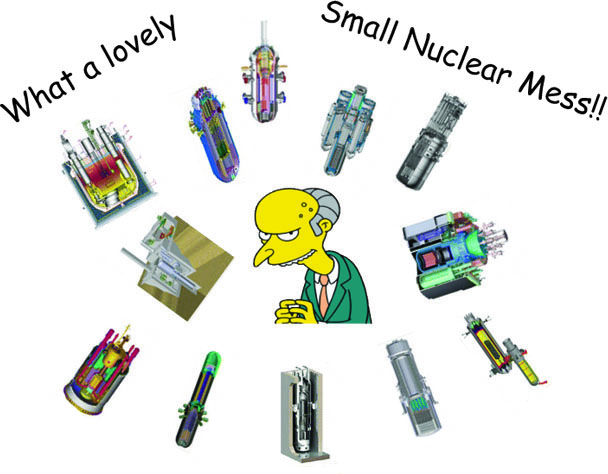
The dangerous craze for SMRs
This is going too far in trivializing risk. And this is not limited to “acceptability” which seems to be ASN’s major concern, but to the risks of such “mixed” installations.

a serious accident situation (AZF, Lubrizol) could damage the SMR unit and transform the accident into a disaster.
Bernard Laponche, Doctor of Science in Nuclear Reactor Physics, President of the Global Chance association, Le Club Mediapart, 5th Feb 2024 https://blogs.mediapart.fr/bernard-laponche/blog/050224/le-dangereux-engouement-pour-les-smr
The development of small modular nuclear reactors (SMR) is the subject of spectacular announcements.Based on the declarations of the Nuclear Safety Authority (ASN) on this
subject, we launch an appeal for reason on the realities and difficulties of such projects, on the technical, safety and security levels .
During his press conference on January 31, 2024, the president of the Nuclear Safety Authority (ASN) addressed the issue of small modular nuclear reactors, known as SMRs, and answered some questions on this subject.
In his presentation, the president highlights the technical and societal questions posed by these new reactors, as well as the safety, security and non-proliferation issues “to be integrated upstream of the projects”.
These are the usual concerns when we are interested in nuclear reactors, which produce heat and possibly electricity from fission and chain reactions of fissile elements (uranium, plutonium), but also products fission and transuranium elements found in irradiated fuels currently intended for reprocessing, leading to the accumulation of radioactive waste in addition to that from the dismantling of reactors. These are the problems that will have to be analyzed for candidate SMR reactors, as for any nuclear reactor and with the same rigor as for conventional reactors.
In the same way that a conventional industrial installation cannot claim to be free from all risk of accident, no nuclear installation can claim to be free of any risk of accident. The declaration “a nuclear accident is possible in France” by successive ASN officials is valid for SMRs, even if, as its current president says, certain innovative SMRs “present potentially promising intrinsic safety characteristics” .
The first “prototype” examples of candidate reactors under the title of SMR, that is to say intended to be mass-produced in a factory before installation on site, will therefore have to be built on nuclear sites, probably those housing research reactors.
As ASN points out, the use of SMR in France would not be of great interest for the production of electricity given the importance of the current fleet of EDF power plants and the announced projects. But, on the other hand, SMRs could be very useful for the production of heat or steam for the process industries (paper, food, chemical industries, etc.) of which there are very many.
It would then be necessary to install the SMR reactor very close to the industrial installation or even, according to ASN, inside this installation.
This is going too far in trivializing risk. And this is not limited to “acceptability” which seems to be ASN’s major concern, but to the risks of such “mixed” installations.
Indeed, we cannot admit the presence of a basic nuclear installation, containing highly radioactive materials within a classic industrial installation, of the ICPE type in which a serious accident situation (AZF, Lubrizol) could damage the SMR unit and transform the accident into a disaster.
Furthermore, it is clear that each promoter of an SMR candidate aims for a large order in the number of copies (of the order of a hundred say some) which will allow the “modular” manufacturing of reactors in a dedicated factory, this allowing the supposed reduction in unit cost.
In this case, by eliminating the solution of an SMR in the plant itself, we would have the creation of a large number of INB-ICPE couples. Even if we admit that the probability of an accident on the SMR is lower than for a conventional reactor (which remains to be demonstrated for each case), this probability is multiplied by the number of reactors, all identical.
In examining the safety files for EDF’s large power reactors and nuclear fuel plants, ASN and IRSN pay very close attention to “external attacks” of natural or malicious origin. What happens to these concerns for SMS located almost everywhere on the territory, on locations which are those of the industrial installation which they must supply with heat and whose location was chosen without any concern for nuclear safety and security? ? How would specific protection be organized which, to be effective, would certainly be expensive, especially since the SMRs concerned would be of low power?
The profusion of candidate projects for SMR, some of which are financially supported by the Government, leads to each being examined by the IRSN and the ASN, as announced by the latter. This examination can be postponed over time depending on the maturity of the projects, all of which currently only exist on file, more or less elaborate.
If this examination is done correctly, that is to say with as much care as for a power reactor, the examination of the technical and safety files of each SMR prototype is a considerable task. We can fear that the “craze” for SMRs that ASN speaks of will exert dangerous pressure on the quality of studies and safety and security injunctions.
Finally, but this is not the problem of the IRSN and the ASN, we would still need to have serious information on the costs. Not only that of the construction of a prototype (the example of NuScale in the United States is edifying) but also that of its exploitation and especially that of the fuel, from its manufacture to its treatment after use, dismantling and management garbage.
When we examine in the light of what we know of the climatic upheavals which are already affecting our territory and will intensify considerably, we can really ask ourselves the question of the fragility and the risk of installing a little small nuclear reactors everywhere which will obviously be subject, depending on the period and their site, to floods, droughts, storms, tornadoes, earthquakes, etc.
All those who today say they want to welcome an SMR on their territory should really think about it seriously.
Energy Security Minister Graham Stuart opposes Holderness nuclear waste site
By Stuart Harratt, BBC News
A MP said he is supporting efforts to oppose plans to bury nuclear waste in East Yorkshire.
Beverley and Holderness Conservative MP Graham Stuart called on East Riding Council to withdraw from discussions with Nuclear Waste Services (NWS).
The government agency has named South Holderness as a potential site for a Geological Disposal Facility (GDF).
Mr Graham, who is also the Minister for Energy Security, had previously called for a public vote on the proposals.
He now says he is supporting a motion by two local Conservative councillors, Lyn Healing and Sean McMaster, asking that the local authority stop talks with NWS.
‘Community says no’
“South Holderness is a special place, and the news that the area was being considered as the site for the UK’s GDF shocked many in our community,” Mr Stuart said.
“It is the people of Holderness who should determine what happens in their area and they have made clear their opposition to these plans.”
He added: “Our community says ‘No’ and Lyn and Sean have my backing to seek our withdrawal.”
Ms Healing and Mr McMaster said their motion to withdraw from discussions would be submitted to a full council meeting on 21 February.
“Yes, investment in Holderness is badly required but is this the right investment? We now believe it isn’t,” the councillors said……………………………………………………………………………… more https://www.bbc.com/news/uk-england-humber-68233882
Campaigners deeply concerned at Dr Thérèse Coffey’s support for Bradwell new nuclear power
A CAMPAIGNER group opposing new nuclear power in Bradwell-on-Sea said they
are “deeply concerned” following comments made by an MP. According to
the Blackwater Against New Nuclear Group (BANNG), former deputy prime
minister Dr Thérèse Coffey showed support for Bradwell as a “logical”
landfall site for a substation and converter linking East Anglian offshore
wind farms to the on-land national grid. BANNG have now refuted these
comments. A spokesman said: “National Grid has made it clear that
Bradwell is in the wrong place for the connection, would require upgraded
transmission infrastructure and faces environmental constraints from the
many designated areas on the Essex coastlands.
Maldon Standard 6th Feb 2024
On the brink of disaster: Israel threatens Lebanon with war – what could go wrong?
As mediation efforts fail to bear fruit, war between Israel and Lebanon seems to be matter of when, not if
Rt.com 7 Feb 24
srael’s Foreign Minister Yisrael Katz met his French counterpart on Monday, warning him that “time [is] running out to find a diplomatic solution in Lebanon,” and indicating that his country was prepared to go to war if diplomacy fails.
The reason is that, since October 7, Hezbollah, the Lebanon-based group linked to Iran, has carried out hundreds of attacks on Israeli targets. Fearing an influx of militants that could potentially invade and conquer parts of the country, some 60,000 northern Israelis have opted to leave, seeking refuge in the center, away from the hostilities.
Atalia Regev, from the community of Abirim about five kilometers from Israel’s border with Lebanon, left her home on October 7, when thousands of Hamas militants invaded southern Israel, massacring an estimated 1,200 people and injuring over 5,000.
“Back then, we were sure that a northern front would [soon] open, and we, too, would face the occupation of the Galilee, a scenario that had been talked about for a long, long time. There was so much fear. So, we packed our bags, took our kids and left,” Atalia recalls.
She was not the only one. As the fighting in the south intensified, some 60,000 Israelis left communities in the north, finding refuge in the center and in Jerusalem, with the hope that the rockets of the Iran-linked militia Hezbollah would not reach them there.
So far, Hezbollah’s attacks have been limited and measured. According to reports, the movement has staged more than a thousand anti-Israel assaults since the beginning of the hostilities. It has also targeted 48 border sites and at least 17 communities. But, for Regev, this was a good reason to stay where she was.
“Even when things calmed down [in the south], we realized we couldn’t go back. Our area was threatened all the time. Educational institutions for children have remained closed until recently. There were multiple power outages due to infrastructure damages [caused by attacks], and at times we had to spend long hours without electricity.”
Drums of War
Now, however, Regev fears, it may get even worse. On January 3 an explosion rocked the suburbs of Beirut, killing Salah Al Arouri, a senior Hamas leader. Although Israel didn’t claim responsibility for the attack, the finger of blame was directed at officials in West Jerusalem, with Nasrallah vowing that the assassination would not remain unanswered.
Since the killing of Al Arouri, Israel has beefed up its presence along the northern border, preparing itself for a potential full-fledged war.
Israel has a reason to worry. According to estimates, Hezbollah has an arsenal of up to 150,000 rockets and missiles. Many of them are long range, able to reach central and southern Israel. Apart from that, the Islamist group also boasts a well-trained army of fighters, and a commando unit – the Radwan force – waiting for an order to storm its enemy………………………………………………….. more https://www.rt.com/news/591907-israel-lebanon-hezbollah-war/
Ukraine’s top general sparing neo-Nazis from frontline slaughter – ex-CIA analyst
https://www.rt.com/russia/591948-zaluzhny-zelensky-nationalist-allies/ 7 Feb 24
Valery Zaluzhny may find allies in radical nationalists in his standoff with President Vladimir Zelensky, Larry Johnson says
Ukrainian President Vladimir Zelensky, who has reportedly been attempting to fire his top general, Valery Zaluzhny, could find himself out of a job before the nation’s top military commander, considering that the latter is backed by armed neo-Nazis, former CIA analyst Larry Johnson has argued.
Amid widespread reports that Zelensky had unsuccessfully tried to sack Zaluzhny, Ukrainian and foreign media described a tense meeting between the pair, with the general reportedly rejecting a call to resign voluntarily and the president hesitating to remove him under pressure from military top brass. Zelensky has since told the press that a major overhaul of the military command was imminent.
In conversation with Nima Alkhorshid, the Brazil-based host of the YouTube channel, Dialogue Works on Sunday, Johnson claimed the soap opera would be hilarious “if hundreds of thousands of Ukrainians weren’t dead and maimed.”
”The guy with the gun usually wins and last time I checked Zaluzhny’s got more guns than Zelensky,” Johnson said.
Comparing the two men, he said the general should not be seen as a “great guy.”
“I don’t want to present Zaluzhny as some sort of military genius or really a good-hearted man,” the commentator remarked. He is “a bit of a scumbag” who “embraces the neo-Nazi ideology,” Johnson claimed.
”He’s been very careful to not insert the most ideologically driven troops – the Azov and the Kraken units – into the front lines where they get killed, because he wants to preserve them. Instead, he is sending the cannon-fodder guys.”
Whether or not Zaluzhny shares the radical nationalist ideology of the Ukrainian far-right is hard to tell from his public statements, but he is believed to have considerable support in those circles.
A social meia post on Friday by Andrey Stempitsky, a Ukrainian military leader and prominent member of the nationalist Right Sector group, featured a photo of him giving Zaluzhny an honorary ID, certifying the general as the first member of Stempitsky’s brigade. A portrait of Stepan Bandera, a Ukrainian nationalist leader and Nazi collaborator, was in the background of the image.
Zelensky was elected president in 2019 on a platform of reconciliation with rebels in the east and with Russia, but threats of violence by the extreme right made his office pull back from early attempts to deliver on that promise
IAEA watchdog to visit nuclear plant in occupied Ukraine to assess safety of ageing fuel and low staffing.
UN nuclear watchdog chief Rafael Grossi said
he would visit the Zaporizhzhia nuclear power plant in Russian-occupied
Ukraine today to see if it can be run with a reduced number of staff and
whether its years-old uranium fuel is safe. Russia gained control of
Europe’s largest nuclear power plant after launching a full-scale
invasion of Ukraine in early 2022, and its six nuclear reactors are now
idled.
Irish Independent 7th Feb 2024
1 This Month

petition to oppose the rapid increase of space-military industry threatening Jeju Island and the region.
[Petition by April 19th (KST)] Stop the joint military-Hanwha Systems-Jeju Provincial Government Sea Launch!
World Nuclear Power. Reactors 1951-2026, 75 Years of Nuclear Power.
Interactive Map– https://dv.worldnuclearreport.org/

Chernobyl: The Lost Tapes – A good documentary on Chernobyl on SBS available On Demand for the next 3 weeks– https://www.sbs.com.au/ondemand/tv-program/chernobyl-the-lost-tapes/2352741955560

of the week–London Campaign for Nuclear Disarmament


Tell the Ukrainian Government to Drop Prosecution of Peace Activist Yurii Sheliazhenko
To see nuclear-related stories in greater depth and intensity – go to https://nuclearinformation.wordpress.com
-
Archives
- April 2026 (211)
- March 2026 (251)
- February 2026 (268)
- January 2026 (308)
- December 2025 (358)
- November 2025 (359)
- October 2025 (376)
- September 2025 (257)
- August 2025 (319)
- July 2025 (230)
- June 2025 (348)
- May 2025 (261)
-
Categories
- 1
- 1 NUCLEAR ISSUES
- business and costs
- climate change
- culture and arts
- ENERGY
- environment
- health
- history
- indigenous issues
- Legal
- marketing of nuclear
- media
- opposition to nuclear
- PERSONAL STORIES
- politics
- politics international
- Religion and ethics
- safety
- secrets,lies and civil liberties
- spinbuster
- technology
- Uranium
- wastes
- weapons and war
- Women
- 2 WORLD
- ACTION
- AFRICA
- Atrocities
- AUSTRALIA
- Christina's notes
- Christina's themes
- culture and arts
- Events
- Fuk 2022
- Fuk 2023
- Fukushima 2017
- Fukushima 2018
- fukushima 2019
- Fukushima 2020
- Fukushima 2021
- general
- global warming
- Humour (God we need it)
- Nuclear
- RARE EARTHS
- Reference
- resources – print
- Resources -audiovicual
- Weekly Newsletter
- World
- World Nuclear
- YouTube
-
RSS
Entries RSS
Comments RSS
 nuclear-news