Buried Nuclear Waste From the Cold War Could Resurface as Ice Sheets Melt
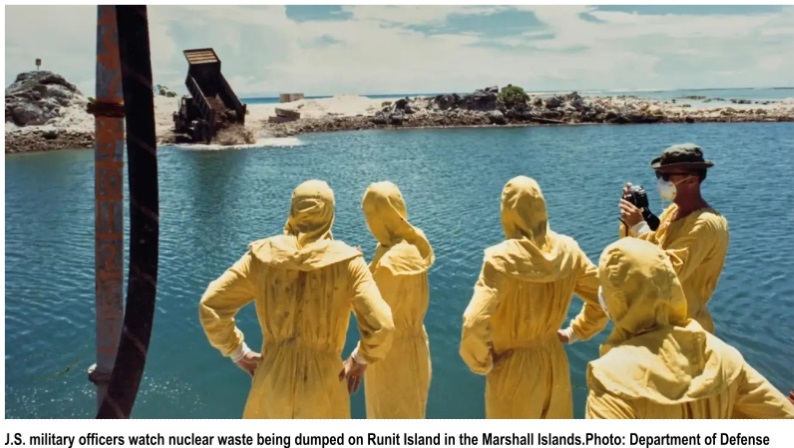
Decades after the U.S. buried nuclear waste abroad, climate change could unearth it.
By Anita Hofschneider, Grist, https://gizmodo.com/buried-nuclear-waste-from-the-cold-war-could-resurface-1851286777
Ariana Tibon was in college at the University of Hawaiʻi in 2017 when she saw the photo online: a black-and-white picture of a man holding a baby. The caption said: “Nelson Anjain getting his baby monitored on March 2, 1954, by an AEC RadSafe team member on Rongelap two days after ʻBravo.ʻ”
Tibon had never seen the man before. But she recognized the name as her great-grandfatherʻs. At the time, he was living on Rongelap in the Marshall Islands when the U.S. conducted Castle Bravo, the largest of 67 nuclear weapon tests there during the Cold War. The tests displaced and sickened Indigenous people, poisoned fish, upended traditional food practices, and wrought cancers and other negative health repercussions that continue to reverberate today.
A federal report by the Government Accountability Office published last month examines what’s left of that nuclear contamination, not only in the Pacific but also in Greenland and Spain. The authors conclude that climate change could disturb nuclear waste left in Greenland and the Marshall Islands. “Rising sea levels could spread contamination in RMI, and conflicting risk assessments cause residents to distrust radiological information from the U.S. Department of Energy,” the report says.
In Greenland, chemical pollution and radioactive liquid are frozen in ice sheets, left over from a nuclear power plant on a U.S. military research base where scientists studied the potential to install nuclear missiles. The report didn’t specify how or where nuclear contamination could migrate in the Pacific or Greenland, or what if any health risks that might pose to people living nearby. However, the authors did note that in Greenland, frozen waste could be exposed by 2100.
“The possibility to influence the environment is there, which could further affect the food chain and further affect the people living in the area as well,” said Hjalmar Dahl, president of Inuit Circumpolar Council Greenland. The country is about 90 percent Inuit. “I think it is important that the Greenland and U.S. governments have to communicate on this worrying issue and prepare what to do about it.”
The authors of the GAO study wrote that Greenland and Denmark haven’t proposed any cleanup plans, but also cited studies that say much of the nuclear waste has already decayed and will be diluted by melting ice. However, those studies do note that chemical waste such as polychlorinated biphenyls, man-made chemicals better known as PCBs that are carcinogenic, “may be the most consequential waste at Camp Century.”
The report summarizes disagreements between Marshall Islands officials and the U.S. Department of Energy regarding the risks posed by U.S. nuclear waste. The GAO recommends that the agency adopt a communications strategy for conveying information about the potential for pollution to the Marshallese people.
Nathan Anderson, a director at the Government Accountability Office, said that the United States’ responsibilities in the Marshall Islands “are defined by specific federal statutes and international agreements.” He noted that the government of the Marshall Islands previously agreed to settle claims related to damages from U.S. nuclear testing.
“It is the long-standing position of the U.S. government that, pursuant to that agreement, the Republic of the Marshall Islands bears full responsibility for its lands, including those used for the nuclear testing program.”
To Tibon, who is back home in the Marshall Islands and is currently chair of the National Nuclear Commission, the fact that the report’s only recommendation is a new communications strategy is mystifying. She’s not sure how that would help the Marshallese people.
“What we need now is action and implementation on environmental remediation. We don’t need a communication strategy,” she said. “If they know that it’s contaminated, why wasn’t the recommendation for next steps on environmental remediation, or what’s possible to return these lands to safe and habitable conditions for these communities?”
The Biden administration recently agreed to fund a new museum to commemorate those affected by nuclear testing as well as climate change initiatives in the Marshall Islands, but the initiatives have repeatedly failed to garner support from Congress, even though they’re part of an ongoing treaty with the Marshall Islands and a broader national security effort to shore up goodwill in the Pacific to counter China.
Fatal Flaws Undermine America’s Defense Industrial Base
Many elements of the traditional DIB have yet to adopt advanced manufacturing technologies, as they struggle to develop business cases for needed capital investment.
In other words, while adopting advanced manufacturing technologies would fulfill the purpose of the US Department of Defense, it is not profitable for private industry to do so.
Despite virtually all the problems the report identifies stemming from private industry’s disproportionate influence over the US DIB, the report never identifies private industry itself as a problem.
If private industry and its prioritization of profits is the central problem inhibiting the DIB from fulfilling its purpose, the obvious solution is nationalizing the DIB by replacing private industry with state-owned enterprises. This allows the government to prioritize purpose over profits. Yet in the United States and across Europe, the so-called “military industrial complex” has grown to such proportions that it is no longer subordinated to the government and national interests, but rather the government and national interests are subordinated to it.
US defense industrial strategy built on a flawed premise
Beyond private industry’s hold on the US DIB, the very premise the NDIS is built on is fundamentally flawed, deeply rooted in private industry’s profit-driven prioritization.
The report claims:
The purpose of this National Defense Industrial Strategy is to drive development of an industrial ecosystem that provides a sustained competitive advantage to the United States over its adversaries.
The notion of the United States perpetually expanding its wealth and power across the globe, unrivaled by its so-called “adversaries” is unrealistic.
China alone has a population 4-5 times greater than the US. China’s population is, in fact, larger than that of the G7 combined. China has a larger industrial base, economy, and education system than the US. China’s education system not only produces millions more graduates each year in essential fields like science, technology, and engineering than the US, the proportion of such graduates is higher in China than in the US.
China alone possesses the means to maintain a competitive advantage over the United States now and well into the foreseeable future. The US, attempting to draw up a strategy to maintain an advantage over China (not to mention over the rest of the world) regardless of these realities, borders on delusion.
Yet for 60 pages, US policymakers attempt to lay out a strategy to do just that.
Not just China, but also Russia
While China is repeatedly mentioned as America’s “pacing challenge,” the ongoing conflict in Ukraine is perhaps the most acute example of a shifting balance of global power.
Despite a combined population, GDP, and military budget many times greater than Russia’s, the collective West is incapable of matching Russian production of even relatively simple munitions like artillery shells, let alone more complex systems like tanks, aircraft, and precision-guided missiles.
While the US and its allies appear to have every conceivable advantage over Russia on paper, the collective West has organized itself as a profit-driven rather than purpose-driven society.
In Russia, the defense industry exists to serve national security. While one might believe this goes without saying, across the collective West, the defense industry, like all other industries in the West, exists solely to maximize profits.
To best serve national security, the defense industry is required to maintain substantial surge capacity – meaning additional, unused factory space, machines, and labor on standby if and when large surges in production are required in relatively short periods of time. Across the West, in order to maximize profits, surge capacity has been ruthlessly slashed, deemed economically inefficient. Only rare exceptions exist, such as US 155 mm artillery shell production.
While the West’s defense industry remains the most profitable on Earth, its ability to actually churn out arms and ammunition in the quantities and quality required for large-scale conflict is clearly compromised by its maximization of profits.
The result is evident today as the West struggles to expand production of arms and ammunition for its Ukrainian proxies.
The NDIS report would note:
Prior to the invasion, weapon procurements for some of the in-demand systems were driven by annual training requirements and ongoing combat operations. This modest demand, along with recent market dynamics, drove companies to divest excess capacity due to cost. This meant that any increased production requirements would require an increase in workforce hours in existing facilities—commonly referred to as “surge” capacity. These, in turn, were limited further by similar down-stream considerations of workforce, facility, and supply chain limitations.
Costs are most certainly a consideration across any defense industry, but costs cannot be the primary consideration.
A central element of Russia’s defense industry is Rostec, a massive state-owned enterprise under which hundreds of companies related to national industrial needs including defense are organized. Rostec is profitable. However, the industrial concerns organized under Rostec serve purposes related to Russia’s national interests first and foremost, be it national health, infrastructure or security.
Because Russia’s defense industry is purpose-driven, it produced military equipment because it was necessary, not because it was profitable. As a result, Russia possessed huge stockpiles of ammunition and equipment ahead of the Special Military Operation (SMO) in February 2022. In addition to this, Russia maintained large amounts of surge capacity enabling production rates of everything from artillery shells to armored vehicles to expand quickly over the past 2 years.
Only relatively recently have Western analysts acknowledged this.
Continue reading

“military industrial complex” has grown to such proportions that it is no longer subordinated to the government and national interests, but rather the government and national interests are subordinated to it.
the collective West has organized itself as a profit-driven rather than purpose-driven society………………………………across the collective West, the defense industry, like all other industries in the West, exists solely to maximize profits.
By Brian Berletic, Orinoco Tribune. February 24, 2024 https://popularresistance.org/fatal-flaws-undermine-americas-defense-industrial-base/
The first-ever US Department of Defense National Defense Industrial Strategy (NDIS) confirms what many analysts have concluded in regard to the unsustainable nature of Washington’s global-spanning foreign policy objectives and its defense industrial base’s (DIB) inability to achieve them.
The report lays out a multitude of problems plaguing the US DIB including a lack of surge capacity, inadequate workforce, off-shore downstream suppliers, as well as insufficient “demand signals” to motivate private industry partners to produce what’s needed, in the quantities needed, when it is needed.
In fact, the majority of the problems identified by the report involved private industry and its unwillingness to meet national security requirements because they were not profitable.
For example, the report attempts to explain why many companies across the US DIB lack advanced manufacturing capabilities, claiming:
Many elements of the traditional DIB have yet to adopt advanced manufacturing technologies, as they struggle to develop business cases for needed capital investment.
In other words, while adopting advanced manufacturing technologies would fulfill the purpose of the US Department of Defense, it is not profitable for private industry to do so.
Despite virtually all the problems the report identifies stemming from private industry’s disproportionate influence over the US DIB, the report never identifies private industry itself as a problem.
If private industry and its prioritization of profits is the central problem inhibiting the DIB from fulfilling its purpose, the obvious solution is nationalizing the DIB by replacing private industry with state-owned enterprises. This allows the government to prioritize purpose over profits. Yet in the United States and across Europe, the so-called “military industrial complex” has grown to such proportions that it is no longer subordinated to the government and national interests, but rather the government and national interests are subordinated to it.
US defense industrial strategy built on a flawed premise
Beyond private industry’s hold on the US DIB, the very premise the NDIS is built on is fundamentally flawed, deeply rooted in private industry’s profit-driven prioritization.
The report claims:
The purpose of this National Defense Industrial Strategy is to drive development of an industrial ecosystem that provides a sustained competitive advantage to the United States over its adversaries.
The notion of the United States perpetually expanding its wealth and power across the globe, unrivaled by its so-called “adversaries” is unrealistic.
China alone has a population 4-5 times greater than the US. China’s population is, in fact, larger than that of the G7 combined. China has a larger industrial base, economy, and education system than the US. China’s education system not only produces millions more graduates each year in essential fields like science, technology, and engineering than the US, the proportion of such graduates is higher in China than in the US.
China alone possesses the means to maintain a competitive advantage over the United States now and well into the foreseeable future. The US, attempting to draw up a strategy to maintain an advantage over China (not to mention over the rest of the world) regardless of these realities, borders on delusion.
Yet for 60 pages, US policymakers attempt to lay out a strategy to do just that.
Not just China, but also Russia
While China is repeatedly mentioned as America’s “pacing challenge,” the ongoing conflict in Ukraine is perhaps the most acute example of a shifting balance of global power.
Despite a combined population, GDP, and military budget many times greater than Russia’s, the collective West is incapable of matching Russian production of even relatively simple munitions like artillery shells, let alone more complex systems like tanks, aircraft, and precision-guided missiles.
While the US and its allies appear to have every conceivable advantage over Russia on paper, the collective West has organized itself as a profit-driven rather than purpose-driven society.
In Russia, the defense industry exists to serve national security. While one might believe this goes without saying, across the collective West, the defense industry, like all other industries in the West, exists solely to maximize profits.
To best serve national security, the defense industry is required to maintain substantial surge capacity – meaning additional, unused factory space, machines, and labor on standby if and when large surges in production are required in relatively short periods of time. Across the West, in order to maximize profits, surge capacity has been ruthlessly slashed, deemed economically inefficient. Only rare exceptions exist, such as US 155 mm artillery shell production.
While the West’s defense industry remains the most profitable on Earth, its ability to actually churn out arms and ammunition in the quantities and quality required for large-scale conflict is clearly compromised by its maximization of profits.
The result is evident today as the West struggles to expand production of arms and ammunition for its Ukrainian proxies.
The NDIS report would note:
Prior to the invasion, weapon procurements for some of the in-demand systems were driven by annual training requirements and ongoing combat operations. This modest demand, along with recent market dynamics, drove companies to divest excess capacity due to cost. This meant that any increased production requirements would require an increase in workforce hours in existing facilities—commonly referred to as “surge” capacity. These, in turn, were limited further by similar down-stream considerations of workforce, facility, and supply chain limitations.
Costs are most certainly a consideration across any defense industry, but costs cannot be the primary consideration.
A central element of Russia’s defense industry is Rostec, a massive state-owned enterprise under which hundreds of companies related to national industrial needs including defense are organized. Rostec is profitable. However, the industrial concerns organized under Rostec serve purposes related to Russia’s national interests first and foremost, be it national health, infrastructure or security.
Because Russia’s defense industry is purpose-driven, it produced military equipment because it was necessary, not because it was profitable. As a result, Russia possessed huge stockpiles of ammunition and equipment ahead of the Special Military Operation (SMO) in February 2022. In addition to this, Russia maintained large amounts of surge capacity enabling production rates of everything from artillery shells to armored vehicles to expand quickly over the past 2 years.
Only relatively recently have Western analysts acknowledged this.
Continue reading
SMRs are useless says the UK’s leading SMR analyst! – 100 per cent renewable energy is much more feasible!

by David Toke, https://100percentrenewableuk.org/smrs-are-useless-says-the-uks-leading-smr-analyst-100-per-cent-renewable-energy-is-much-more-feasible 25 Feb 24
Professor Stephen Thomas, the UK’s leading analyst of ‘small modular (nuclear) reactors’, has concluded that the idea faces a dead end, with no future. Yet the UK continues to give large grants to hopeful companies to develop these white elephants. The Government has proclaimed the need for ‘billions of pounds‘ of investment in SMRs. Meanwhile badly needed district heating networks to be supplied by large-scale heat pumps and a range of other realistic clean energy initiatives go unfunded!
The UK’s political institutions, including the House of Commons Environmental Audit Committee (EAC), continue to promote these fantasy SMRs through one-sided hearings and ignore possibilities for 100% renewable energy scenarios. Has the EAC set up an enquiry into the practicalities of 100 per cent or near 100 per cent renewable energy for the UK? No, it hasn’t, because it seems to prefer to spend time pursuing dead-ends such as SMRs.
Steve Thomas’s analysis lampooned the concept of SMRs when he said ‘The cheap way to produce SMRs is to scale down their failed designs’ (ie to scale down the larger versions of nuclear manufacturers previous failures). This highlights the central silliness of the idea of SMRs. On the one hand nuclear manufacturers built nuclear plant larger to improve economies of scale, but they have not produced economically viable results, so now there are pressures for them to reverse this process and make the resulting smaller nuclear power plant even worse!
He also commented that
‘All things equal, a large PWR/BWR will create less (nuclear) waste than the same capacity of small reactors’.
Thomas concluded that:
- the impression is that large numbers of SMRs are being ordered around the world
- These claims are unproven or misleading or simply wrong
- No modern design SMR is operating, 3 prototype SMRs are under construction (China, Russia, India)
- No current design has completed a full safety review by an experienced & credible regulator. Until this is done, it will not be known if the design is licensable or what the costs would be. So no design of SMR is commercially available to order
You can watch and hear Steve Thomas’s presentation on SMRs in the full youtube recording of our seminar on 100 per cent renewable energy rather than SMRs HERE Please go to 55 minutes into the recording to start watching from the beginning of Steve’s presentation.
The full power point presentation (on its own) can be downloaded from HERE
We shall soon be sending in the petition asking the EAC to launch an enquiry into 100 per cent renewable energy for the UK instead of the one it did on small modular reactors. It should be obvious that faced with new nuclear power failing and fossil fuel carbon capture and storage schemes that do not work we should be urgently looking at how we can run a 100 per cent renewable energy system for the UK! PLEASE SIGN IT NOW! Go to THIS PAGE HERE to sign the petition now!
Billionaire mining magnate Andrew Forrest lampoons Australian opposition’s nuclear push as ‘bulldust’

A push by the Coalition to develop nuclear energy generation in Australia has been slammed by mining magnate Andrew “Twiggy” Forrest.
Jack Quail, February 26, 2024 – https://www.news.com.au/technology/environment/climate-change/billionaire-mining-magnate-andrew-forrest-lampoons-coalitions-nuclear-push-as-bulldust/news-story/048f9a45dbb31091a4ed313479922288
Billionaire mining magnate Andrew “Twiggy” Forrest has rubbished a push to develop a local nuclear energy industry, even as fresh polling showed growing voter support for the proposal.
Dr Forrest took a veiled swipe at the opposition over its soon-to-be-unveiled nuclear energy policy, saying its push was “misinformed”, would act to sustain coal and gas powered generation for another two decades, and ultimately would lead to higher power prices.
“If we swallow this new lie that we should stop the rollout of green energy and that nuclear energy will be our fairy godmother, we will be worse off again,” the chair of mining and green energy firm Fortescue told the National Press Club on Monday.
“These misinformed, unscientific, uneconomic, plucked-out-of-thin-air, bulldust nuclear policies of politicians – masquerading as leaders – help no one.”
Dr Forrest, who in 2023 ranked as Australia’s third richest person, made his billions mining iron ore but in more recent years has aggressively pursued investments in renewable energy technologies and fuel, particularly green hydrogen.
Claiming he was “agnostic” on nuclear energy, Dr Forrest said the economics of such a proposal did not stack up when compared with renewable generation.
“Who is going to pay their nuclear electricity bill when it is 4-5 times more expensive than the renewables next door, even ignoring the decade plus it takes to develop nuclear?” Dr Forrest asked.
“With wind and solar, you’re up and running, lowering electricity costs and eliminating pollution within one to three years.”
The Coalition is yet to release a costed nuclear energy policy but has committed to do so ahead of the next federal election, due by May 2025 at the latest.
A Newspoll released by The Australian on Monday revealed 55 per cent of Australians support the replacement of coal-fired power plants with small modular nuclear reactors.
However, such technology is still in development, is yet to prove commercially viable, and would not be deliverable until the mid-2030s at the earliest.
The Albanese government has similarly disparaged the Coalition’s nuclear push, and has retained a ban on nuclear power and banking.
In his address, Dr Forrest also advocated for a “renewable energy-led economy”, recommending the government establish a “climate trigger” to assess the impact of carbon pollution in granting environmental approvals, rapidly expand firmed renewable energy, and introduce a levy on carbon emissions extracted from mining or imported into Australia.
“If we make the right decisions today, it will deliver the most profound and enduring economic growth opportunities ever seen, particularly in regional Australia,” he said.
Calling out the diesel fuel rebate, which costs the federal budget billions annually, Dr Forrest said the subsidy towards mining and fossil fuel companies should be scrapped.
“Massive taxpayer-funded financial support for huge mining companies, including Fortescue, to use imported diesel is indefensible,” Dr Forrest said.
Last week, Fortescue – of which Dr Forrest and his family own a 33 per cent stake – reported a 41 per cent increase in its first-half profit, beating analysts’ estimates and bucking a growing trend of sliding profitability among other major mining firms.
Netanyahu’s Post-War Plans for Gaza Call for Military Occupation ‘Without Time Limit’
The Israeli Prime Minister also wants to deploy troops along the border with Egypt
by Kyle Anzalone February 23, 2024, https://news.antiwar.com/2024/02/23/netanyahus-post-war-plans-for-gaza-call-for-military-occupation-without-time-limit/
Israel has released its first draft of its plans for post-war Gaza. Throughout the four months of a brutal onslaught, Israeli forces have decimated the Strip and killed 30,000 Palestinians. Israeli Prime Minister Benjamin Netanyahu’s post-war plans call for “operational freedom of action in the entire Gaza Strip without a time limit” and “demilitarization” of Palestinians.
The Israeli government first released the document to some media outlets on Thursday. According to the translation from NBC News, the document says, Israel will “maintain its operational freedom of action in the entire Gaza Strip, without a time limit,” and “The security perimeter being created in the Gaza Strip on the border with Israel will remain as long as there is a security need for it.”
Israel is also requesting control of the border between Egypt and Gaza. Netanyahu’s plan may face resistance in Washington and Cairo. Egypt has demanded that Israel not deploy its forces along the border. The US has asked Israel not to expand buffer zones in Gaza. However, Tel Aviv has ignored nearly all of Washington’s requests over the past four months with no impact on US aid shipments to Israel.
Netanyahu says he will not allow the rebuilding of the Strip to begin until the Palestinians have been “deradicalized.” Additionally, Tel Aviv plans to have complete control over the future political system in Gaza. Netanyahu says the Strip will be fully demilitarized.
President Joe Biden has requested that Netanyahu allow Arab states to finance the reconstruction of Gaza and allow the Palestinian Authority (PA) to govern Gaza in the process of creating a sovereign Palestine. Netanyahu’s proposal did not mention the PA.
The Israeli government has repeatedly stated that it will not allow the PA to control Gaza or the Palestinians to have a state. In the statement released by the Israeli government, Netanyahu says, “Israel utterly rejects international diktats over a final-status agreement with the Palestinians.”
Netanyahu additionally plans to shut down UNRWA, the main aid agency in Gaza, that hundreds of thousands of Palestinians rely on for survival. Tel Aviv recently accused the UN Relief and Works Agency of employing 12 people who took part in the Hamas attack in Israel. However, a US intelligence community assessment only endorsed the claim with “low confidence.”
Australia’s opposition leader ‘s ideas for nuclear power are not welcomed by the public

The Victorian towns where Peter Dutton is considering going nuclear
Josh Gordon and Benjamin Preiss, February 25, 2024, https://www.theage.com.au/politics/victoria/the-victorian-towns-where-peter-dutton-is-considering-going-nuclear-20240223-p5f7a3.html
The Coalition is leaving the door open to building nuclear reactors in the Latrobe Valley and Anglesea using land from retired coal-fired power stations as a solution to Victoria’s energy troubles.
But locals warn there would be significant opposition to nuclear reactors being built in their towns, even if the huge legal hurdles to constructing and running them could be overcome.
With Victoria’s energy security under scrutiny after a wild storm earlier this month left hundreds of thousands of homes without power and triggered the shutdown of the state’s largest coal-fired generator, the federal opposition has confirmed it is now in the “advanced stages” of developing an energy policy. Nuclear is set to be a key part of the mix.
Opposition energy spokesman Ted O’Brien told The Age potential locations remained a “work-in-progress”, but he had been advised that “communities with experience hosting coal plants could be ideal potential hosts for zero-emissions nuclear plants”.
That leaves Victoria’s three remaining coal-fired power plants, plus the now decommissioned site of the Hazelwood mine and power station, as strongly preferred locations – with existing connections to the energy grid, and a ready-made workforce preparing for the end of coal-fired generation over the next 15 years.
“We have been very transparent about the fact we are considering zero-emissions nuclear energy as part of Australia’s future energy mix, and we will remain open about the details of our policy when it is announced,” O’Brien said.
The state opposition remains more cautious about the prospect of nuclear in the Latrobe Valley, but it too is not ruling out the idea. Asked about using retired coal-fired power stations as sites for nuclear energy, Opposition Leader John Pesutto said a commonsense approach was needed.
“But for any new industry to succeed it would first need detailed inquiries and thorough examination,” Pesutto told The Age. “It would also require bipartisan support, as this is crucial for investment certainty and to eliminate sovereign risk.”
Other sites in Victoria have also been flagged. Federal Opposition Leader Peter Dutton recently hinted at the possibility of a small modular reactor on the Surf Coast at Anglesea, on the site of Alcoa’s former mine and power station.
“It’s zero emissions, you can put it into an existing brownfield site, so when the coal-fired generation comes to an end, you can put the nuclear modular reactors into that facility,” Dutton said in September.
The argument for nuclear is that plugging into existing infrastructure would be significantly cheaper and would reduce the need for thousands of kilometres of new transmission lines needed to connect wind and solar energy dotted across the grid.
O’Brien has previously pointed to a September 2022 study for the US Department of Energy that found using the infrastructure of an existing coal plant could reduce a nuclear plant’s capital costs by up to 35 per cent. He suggested Australia should look to the US state of Wyoming, which is planning to replace its coal-fired generators with nuclear by about 2030.
But any move towards nuclear power in Victoria would likely encounter strong resistance from communities worried about safety, waste disposal and the cost.
Voices of the Valley president Wendy Farmer said nuclear power would face major opposition from communities worried about the risks.Farmer said residents in the Latrobe Valley had already suffered the consequences of the Hazelwood mine fire in 2014, which burned for 45 days and caused health concerns for those living amid the smoke.
“I would be surprised if there would be any enthusiasm for a reactor,” she said.
Deputy Mayor Mike Bodsworth, who represents the Anglesea ward, said residents were excited by the potential for renewable power generation at the former Alcoa site.
“But nobody I know has ever mentioned nuclear,” he said. “Knowing the general preferences of the local population, I doubt it would be supported.”
The Coalition has been talking up the potential to use small-scale modular reactors to generate power, and argue this, along with gas, will be a key part of Australia’s future energy mix to provide so-called base-load generation along with variable renewables.
In May last year, US company Westinghouse released plans for a small modular reactor. Reuters reported Westinghouse planned to begin building the reactor by 2030.
But many experts say this approach would be prohibitively expensive in Australia, particularly if forced to compete against lower-cost renewable wind and solar generators now being installed at a rapid rate across the country.
The CSIRO’s best guess is that in 2030 the capital cost of a small modular reactor will be $15,844 per kilowatt of electricity generated, compared to $1078 for solar and $1989 for wind.
That suggests replacing Victoria’s three remaining coal-fired plants, which combined to produce up to 4730 megawatts of electricity, with nuclear would involve a capital cost of about $74.9 billion, before even considering the ongoing running, maintenance and waste disposal costs.
The Coalition would also need to get the numbers in state parliament to repeal existing state and federal laws, including Victoria’s Nuclear Activities (Prohibitions) Act of 1983, which bans the construction and operation of nuclear facilities in Victoria.
Victorian Energy Minister Lily D’Ambrosio said nuclear energy was “toxic, risky, will take years to develop and [is] the most expensive form of energy there is”.
“Not only are the sites of our former coal plants privately owned, but there is currently no regulatory framework for approving a nuclear power plant in Australia, there are no nuclear waste storage sites in Australia, and no modular nuclear reactors have made it past the trial phase,” she said.
Federal Energy Minister Chris Bowen said claims of a boom in small modular reactors was a myth, and suggested Dutton should explain to the people around Gippsland why they should accommodate multiple reactors “for no good reason”.
“Anyone who has done their homework knows nuclear is not viable,” Bowen said. “The alleged boom in small modular reactors is a furphy. It’s striking that a party that once prided itself on economic rationalism could embrace a frolic so spectacularly uneconomic.”
In the US, a project run by NuScale Power to build the first commercial small modular reactor was scrapped last year because of soaring costs, leaving taxpayers facing a significant bill. Other projects promising commercially competitive nuclear energy have similarly failed to materialise.
NATO says Kiev can use F-16 jets to strike targets ‘outside Ukraine’, despite Russia’s warning
More recently, some Russian officials have threatened that further western backing for Ukraine could lead to a global nuclear war.
Financial Times, Thu, 22 Feb 2024 https://www.sott.net/article/489220-NATO-says-Kiev-can-use-F-16-jets-to-strike-targets-outside-Ukraine-despite-Russias-warning
Ukraine has the right to strike “Russian military targets outside Ukraine” in line with international law, the Nato secretary-general has said for the first time since the start of the full-scale war nearly two years ago.
Jens Stoltenberg earlier this week acknowledged that the use of western-supplied arms to strike targets in Russia had long been a point of contention among Kyiv’s allies, due to fears of escalating the conflict.
“It’s for each and every ally to decide whether there are some caveats on what they deliver, and different allies have had a bit different policies on that,” Stoltenberg told Radio Free Europe in an interview published on Tuesday.
“But in general, we need to remember what this is. This is a war of aggression by Russia against Ukraine, in blatant violation of international law. And according to international law, Ukraine has the right to self-defence,” Stoltenberg added. “And that includes also striking legitimate military targets, Russian military targets, outside Ukraine. That is international law and, of course, Ukraine has the right to do so, to protect itself.”
A Nato official confirmed to the Financial Times on Thursday that Stoltenberg said Kyiv had the right to self-defence, including by striking legitimate Russian military targets outside Ukraine.
The comments represent a step up in rhetoric from Stoltenberg, who has previously referred to Kyiv’s rights under international law without explicitly mentioning attacks on Russian territory.
Comment: There have been a significant number of attacks on Russian territory, albeit mostly sabotage, but indeed this would represent an overt escalation, and to which Russia will be forced to respond: 14th Feb Massive explosion at Russia’s Voktinsk munitions factory
The debate over using western weapons to strike Russia is likely to intensify as some Nato allies begin to ship F-16 fighter jets to Ukraine. The US-made aircraft, if armed with long-range missiles, could significantly increase the potential range of Kyiv’s strikes into Russian territory.
In recent months Kyiv has stepped up strikes on military targets inside Russia with drones and long-range missiles, including an oil depot used by the Russian army near St Petersburg.
However, due to western sensitivities around attacks on Russian territory, Ukraine has only ever alluded to its responsibility. A spokesperson for Ukraine’s air defence forces, Yuriy Ignat, said that Ukraine “as a rule, does not comment”.
France and the UK, which have already supplied Kyiv with long-range missiles, have been cautious about endorsing such strikes for fear of escalation with Moscow.
In Germany, lawmakers are seeking to persuade Chancellor Olaf Scholz to send Taurus missiles to Ukraine, a long-standing demand from Kyiv as it could use the advanced German weapon to strike Russia’s supply lines.
The government’s parliamentary majority on Thursday was set to approve a motion asking Scholz to deliver “additional long-range weapons systems” to Kyiv, which many take to mean Taurus. The German missile has a slightly longer range than its French and British equivalents and is more sophisticated against reinforced structures, such as bunkers and bridges.
Russian President Vladimir Putin hinted last year that Moscow could strike western-supplied F-16s outside Ukraine’s borders, which he said risked bringing Nato into a direct conflict with Russia. “This seriously risks dragging Nato further into this armed conflict,” Putin said in June.” The tanks are burning and the F-16s will burn just as well.”
More recently, some Russian officials have threatened that further western backing for Ukraine could lead to a global nuclear war.
“We should do everything to stop [nuclear war] happening, but the clock is ticking faster and faster,” Dmitry Medvedev, a former president and prime minister, said in an interview published on Thursday.
“And in this I also see the impotence of western governments that are always saying the same thing: ‘The Russians are trying to scare us, they’ll never do it.’ They are mistaken. If the existence of our country is at stake, then what choice does our head of state have? None.”
Long-range strike capabilities for Kyiv have become more critical as the situation on the frontline becomes increasingly stalled in a gruelling artillery battle where Russian troops are able to outfire Ukraine’s by about three to one.
While Russia captured the town of Avdiivka last week, its first major battlefield victory since May 2023, the 1,000km frontline is largely static.
“It’s also important to actually recognise that even though the situation on the battlefield is difficult, we should not overestimate Russia and underestimate Ukraine,” Stoltenberg told reporters last week, noting that Ukrainian forces were able to carry out “deep strikes” into Russian-occupied Crimea and that they succeeded in sinking one of Russia’s ships in the Black Sea.
Comment: RT explains Russia’s position:
The way the US-made jet is designed means it might have difficulties operating from Ukrainian runways, sparking speculation that they could be flown from Poland, Romania or the Baltic states instead.
Russia has repeatedly warned such a deployment would be an escalation of the conflict and may even risk nuclear war, as the F-16 is capable of delivering B61 gravity bombs.
“So, if one of those planes takes off from a NATO nation – what would that be? An attack on Russia. I shall not describe what could happen next,” Dmitry Medvedev, former Russian president and deputy head of Russia’s National Security Council, said in an interview on Thursday.
It’s becoming clear that the US is intent on escalating the situation in one way or another, and alongside this Russia has been revealing just how involved with the proxy war the West is:
More indictments for Ohio nuclear crimes

Why does the nuclear industry find itself mired in these kinds of criminal conspiracies? Because it has no chance of standing on its own financial feet.
by beyondnuclearinternational, By Linda Pentz Gunter
Former executives face a judge — in their ankle monitors
It was called “likely the largest bribery money-laundering scheme ever perpetrated against the people of the state of Ohio.” And the shoes are still dropping. Or should that be ankle monitors? Because these latter belong to the three latest criminals indicted for their roles in a scheme that saw FirstEnergy hand over $61 million in bribes to Ohio politicians and their co-conspirators to secure favorable legislation.
That bill, known as HB6, guaranteed a $1.3 billion bailout to FirstEnergy in order to keep open its two failing Ohio nuclear power plants, Davis-Besse and Perry, as well as struggling coal plants. The nuclear portion of the bill has since been rescinded, but Ohio consumers are still paying to prop up two aging coal plants, to the tune of half a million dollars a day, amounting to an extra $1.50 a month on every ratepayer’s electric bill.
The $61 million bribery plot was the mastermind of then speaker of the Ohio House, Larry Householder, who is now a household name in Ohio for all the wrong reasons. He was sentenced last June to 20 years in prison for his part in the conspiracy. GOP Chairman Matt Borges, was also found guilty of racketeering conspiracy and sentenced to five years in federal prison. Both men say they will appeal.
Householder may have been the instigator, but in those earlier trials, FirstEnergy was described as a company that went “looking for someone to bribe them”. They found willing accomplices among politicians but also in the person of then Ohio Public Utilities Commission chairman, Samuel Randazzo.
So on February 12, yet more indictments were handed down, this time to Randazzo and the two FirstEnergy executives who corrupted him — former CEO Charles Jones, and former senior vice president of external affairs, Michael Dowling.
Their list of crimes, including a collective 27 felonies, was announced at a press conference by Ohio Attorney General Dave Yost. But although the presence of their company had been requested, the accused were not there. ………………………………………………………..
Householder, somewhat of a gangster lookalike himself, was described during his earlier trial as “the quintessential mob boss, directing the criminal enterprise from the shadows and using his casket carriers to execute the scheme.”
The mainstream national press has scarcely reported any of this. Maybe they view it as a local story. But this kind of nuclear corruption has also occurred in South Carolina and Illinois, culminating in multiple indictments and prison sentences. It’s possible we could yet see something similar go down in Georgia as electricity rates there soar to pay for the two late-arriving and over-budget Vogtle reactors, the second of which just started fissioning earlier this month.
Why does the nuclear industry find itself mired in these kinds of criminal conspiracies? Because it has no chance of standing on its own financial feet. Meanwhile, cheaper, faster, more job-friendly renewable energy industry options are leaving nuclear power behind in a cloud of radioactive dust.
This economic collapse has, in turn, put pressure on politicians to make things right for their corporate nuclear friends, something Senator Joe Manchin and others are currently working hard to do on Capitol Hill.
So there may yet be more shoes (and ankle monitors) to drop and it’s going to be very interesting to see who’s wearing them.
Linda Pentz Gunter is the international specialist at Beyond Nuclear and writes for and edits Beyond Nuclear International. https://beyondnuclearinternational.org/2024/02/25/more-indictments-for-ohio-nuclear-crimes/—
1 This Month

of the week – Shut Down Drone Warfare!


Tell the Ukrainian Government to Drop Prosecution of Peace Activist Yurii Sheliazhenko

Petition to revoke the licensing of the Near Surface Nuclear Disposal Facility (NSDF) at Chalk River. https://www.ourcommons.ca/petitions/en/Petition/Details?Petition=e-7247
To see nuclear-related stories in greater depth and intensity – go to https://nuclearinformation.wordpress.com
-
Archives
- April 2026 (114)
- March 2026 (251)
- February 2026 (268)
- January 2026 (308)
- December 2025 (358)
- November 2025 (359)
- October 2025 (376)
- September 2025 (257)
- August 2025 (319)
- July 2025 (230)
- June 2025 (348)
- May 2025 (261)
-
Categories
- 1
- 1 NUCLEAR ISSUES
- business and costs
- climate change
- culture and arts
- ENERGY
- environment
- health
- history
- indigenous issues
- Legal
- marketing of nuclear
- media
- opposition to nuclear
- PERSONAL STORIES
- politics
- politics international
- Religion and ethics
- safety
- secrets,lies and civil liberties
- spinbuster
- technology
- Uranium
- wastes
- weapons and war
- Women
- 2 WORLD
- ACTION
- AFRICA
- Atrocities
- AUSTRALIA
- Christina's notes
- Christina's themes
- culture and arts
- Events
- Fuk 2022
- Fuk 2023
- Fukushima 2017
- Fukushima 2018
- fukushima 2019
- Fukushima 2020
- Fukushima 2021
- general
- global warming
- Humour (God we need it)
- Nuclear
- RARE EARTHS
- Reference
- resources – print
- Resources -audiovicual
- Weekly Newsletter
- World
- World Nuclear
- YouTube
-
RSS
Entries RSS
Comments RSS
 nuclear-news