Energy Costs UK : The Price Of Power-Nuclear Fandango

British consumers of nuclear energy will be paying amongst the highest prices for electricity in the world.
masterinvestor, By Victor Hill 23 February 2024
Last month, UK energy secretary Claire Coutinho declared in the government’s Civil Nuclear Roadmap policy document that “Our nuclear industry is re-awakening”. That document pledges the UK to build 24 gigawatts of new nuclear power capacity over the next two decades. That is equivalent to six times the capacity of the one nuclear plant now under construction. Thus, at least one more massive nuclear plant is envisaged for an as yet unidentified location (although Wylfa in Anglesey, North Wales looks to be the most probable site).
There is currently one nuclear power plant under construction in the UK – Hinkley Point C – and one planned – Sizewell C. But the latest news on these is discouraging. Last month the French majority state-owned energy company EDF announced that the first reactor Hinkley Point C in Somerset would not come onstream until 2029 at the earliest, and probably more like 2031. There is no date set as yet for the second reactor. The final cost of the project, it said, could rise to £46 billion – as compared to an initial budget back in 2016 when contracts were signed of £18-24 billion.
EDF has encountered problems in the construction of other nuclear plants which use the European Pressurised Reactor (EPR) technology deployed at Hinkley Point at Olkiluoto, Finland and Flamanville, France. Some engineers have spoken about a design flaw in this technology. While they were designed for maximum safety – especially in the wake of the radiation leak at Fukushima,……….
To make matters worse, the French finance minister, Bruno Le Maire, began to press the case for the UK government to cough up more funds to finish the project. Worse still, EDF cast doubt over its commitment to build the new reactor at Sizewell C in Suffolk, in which it will have a 20 percent stake, unless the funding issue over Hinkley Point were satisfactorily resolved.
The funding structure devised for Sizewell C envisaged that consumers would pay a levy on their electricity bills to help pay for construction costs. This is the so-called Regulated Asset Base (RAB) model. Opponents of the project have dubbed this a “nuclear tax” which will endure for decades.
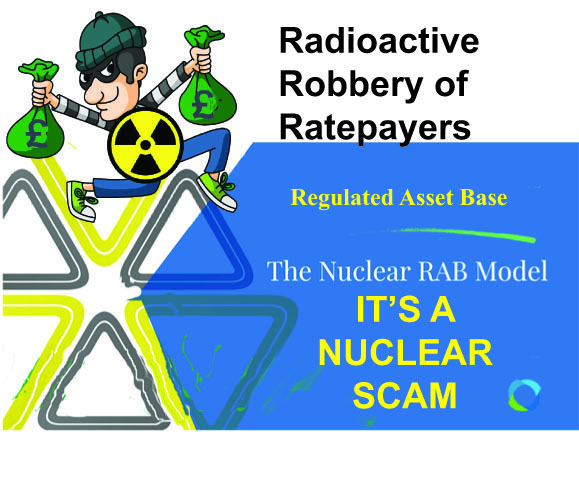
In contrast, Hinkley Point C will operate on the old contracts for difference model where the developers enjoy a guaranteed strike price once the reactors are operational. The original £89.50 per megawatt hour strike price has already been adjusted up to £125 in view of inflation. This means that British consumers of nuclear energy will be paying amongst the highest prices for electricity in the world.
The construction of Hinkley Point C was contracted by the UK government to EDF and China General Nuclear (CGN). Both Hinkley Point C and Sizewell C will have the capacity to power about six million households and will have an economic life of up to 60 years. The two plants could be producing 14 percent of Britain’s total electricity output in the late 2030s.
Ms Coutinho rushed out a press release on the evening of 23 January, saying: “Hinkley Point C is not a government project and so any additional costs or schedule overruns are the responsibility of EDF and its partners and will no way fall on [British] taxpayers”. This comment annoyed EDF and its main shareholder, the French government, to prompt a further statement. The substance of that was that unless the UK government offered something towards the shortfall at Hinkley Point, Sizewell C would simply not happen.
Eventually, the UK Department for Energy Security and Net Zero pledged an additional £1.8 billion of taxpayers’ money. The Minister for Nuclear and Renewables, Andrew Bowie MP, later admitted that he needed to raise an additional £20 billion of private finance to ensure that Hinkley Point C is completed…………………………………………………………………………………………………………………………………………
there has been no coherent political consensus around the need for nuclear power in the UK. The 2003 energy white paper published under Tony Blair’s government described nuclear power as an “unattractive option” – although Labour later changed its mind. There is still vocal opposition to nuclear power generation on safety grounds – and even more to the disposal of nuclear waste. The Low Level Waste Repository (LLWR) in Cumbria, operated by British Nuclear Fuels has been especially contentious. Many environmental and political activists associate nuclear energy production with nuclear weapons production. Moreover, there have been nine different energy secretaries sitting in cabinet since 2010. With such a level of turnover of people at the top, it has proven difficult to fashion policy.
At least the optimists foresee that Sizewell C will benefit from the lessons learnt at Hinkley Point C. Though, somehow, I doubt it……………………………. https://masterinvestor.co.uk/economics/energy-costs-the-price-of-power/—
No comments yet.
1 This Month


Petition to revoke the licensing of the Near Surface Nuclear Disposal Facility (NSDF) at Chalk River. https://www.ourcommons.ca/petitions/en/Petition/Details?Petition=e-7247


of the week – STOP SMALL MODULAR REACTORS IN CANADA
To see nuclear-related stories in greater depth and intensity – go to https://nuclearinformation.wordpress.com
-
Archives
- March 2026 (163)
- February 2026 (268)
- January 2026 (308)
- December 2025 (358)
- November 2025 (359)
- October 2025 (376)
- September 2025 (258)
- August 2025 (319)
- July 2025 (230)
- June 2025 (348)
- May 2025 (261)
- April 2025 (305)
-
Categories
- 1
- 1 NUCLEAR ISSUES
- business and costs
- climate change
- culture and arts
- ENERGY
- environment
- health
- history
- indigenous issues
- Legal
- marketing of nuclear
- media
- opposition to nuclear
- PERSONAL STORIES
- politics
- politics international
- Religion and ethics
- safety
- secrets,lies and civil liberties
- spinbuster
- technology
- Uranium
- wastes
- weapons and war
- Women
- 2 WORLD
- ACTION
- AFRICA
- Atrocities
- AUSTRALIA
- Christina's notes
- Christina's themes
- culture and arts
- Events
- Fuk 2022
- Fuk 2023
- Fukushima 2017
- Fukushima 2018
- fukushima 2019
- Fukushima 2020
- Fukushima 2021
- general
- global warming
- Humour (God we need it)
- Nuclear
- RARE EARTHS
- Reference
- resources – print
- Resources -audiovicual
- Weekly Newsletter
- World
- World Nuclear
- YouTube
-
RSS
Entries RSS
Comments RSS
 nuclear-news
Leave a comment