DAY ONE: Assange Timeline Exposes US Motives

February 20, 2024
Julian Assange’s lawyers on Tuesday argued before the High Court about why the imprisoned publisher must be allowed to appeal against his extradition order, reports Joe Lauria.
By Joe Lauria, in London, Consortium News
On Day One of Julian Assange’s attempt to appeal Britain’s order to extradite him to the United States, his lawyers laid out a timeline that exposed U.S. motives to destroy the journalist who revealed their high-level state crimes.
Before two High Court judges in the cramped, wood-paneled Courtroom 5 at the Royal Courts of Justice, Assange’s lawyers argued on Tuesday that two judges had seriously erred in the case on a number of grounds necessitating an appeal of the home secretary’s decision to extradite Assange to the United States.
High to the left of the court, next to oak shelves with neat rows of law books, was an empty iron cage. The court said it had invited Assange to either attend in person or via video link from Belmarsh Prison, where he has been locked up on remand for nearly five years. But Assange said he was too ill take part in any capacity, his lawyers confirmed.
Vanessa Baraitser, the district judge who presided over Assange’s 2020 extradition hearing, and Jonathan Swift, a High Court judge, came in for heavy criticism from Assange’s lawyers. Baraitser in January 2021 ordered Assange released on health grounds.
But she refused him bail while the U.S. appealed. On the basis of assurances that it would not mistreat Assange in the United States, the High Court reversed Baraitser’s decision. The U.K. Supreme Court then refused to take Assange’s challenge of the legality of these assurance and the home secretary signed the extradition order.
Assange’s last avenue of appeal is of the home secretary’s order as well as Baraitser’s 2021 decision, in which, on every point of law and many of fact, she sided with the United States. The application to pursue this appeal was rejected by a single High Court judge, Swift, last June.
He permitted his rejection of the application to itself be appealed. That two-day hearing began Tuesday before Justice Jeremy Johnson and Dame Victoria Sharp.
The Timeline
Assange lawyer Mark Summers made a forceful argument that the United States in essence is treating Assange no differently than any authoritarian regime would deal with a dissident journalist who revealed its secret crimes.
“There was evidence before the district judge that this prosecution was motivated to punish and inhibit the exposure of American state-level crimes,” Summers told the court. “There was unchallenged evidence” during Baraitser’s 2020 extradition hearing “of crimes that sit at the apex of criminality,” he said.
He said there was a direct nexus between Assange’s work to expose U.S. crimes and the U.S. pursuing him. “This is a prosecution for those disclosures,” he said. “There is a straight-line correlation between those disclosures and the prosecution, but the district judge (Baraitser) addressed none of this and neither did Swift.”
Summers then sketched out a timeline of events showing successive stages of motivation for the United States to go after Assange. “There was compelling circumstantial evidence why the U.S. brought this case,” he said.
First, he said, there was no prosecution of Assange (despite the Obama administration empaneling a grand jury) until 2016, when the International Criminal Court announced it would look into possible U.S. crimes in Afghanistan, following Assange’s disclosures. The U.S. then denounced him as a political actor.
Summers said “that morphed into plans to kill or rendition Assange” from the Ecuadorian embassy, where he had asylum, following the Vault 7 release of C.I.A. spying tools in 2017.
The then new C.I.A. Director Mike Pompeo, in his first public appearance in that position, denounced WikiLeaks as a hostile, non-state intelligence service, a carefully chosen legal term, Summers said, that permitted taking covert action against a target without Congressional knowledge.
Because these plans to kill or rendition Assange, asked for by President Donald Trump, raised alarms with White House lawyers, a legal prosecution was pursued as a way to determine where to put Assange if he were renditioned to the U.S., Summers said.
“This prosecution only emerged because of that rendition plan,” he said. “And the prosecution that emerged is selective and it is persecution.” It was selective because even though other outlets, such as Freitag and cryptome.org,, had published the unredacted diplomatic cables first, Assange was the only one charged.
“This is not a government acting on good faith pursuing a legal” path, he said……………………………………
Assange lawyer Edward Fitzgerald called espionage, with which Assange is charged, a “pure political offense.” The issue is crucial to Assange’s defense because the U.S.-U.K. Extradition Treaty bars extraditions for political offenses.
However, the Extradition Act, Parliament’s implementing legislation of the Treaty, does not mention political offenses. Baraitser ruled that the Act and not the Treaty should take precedence.
Assange’s team has been arguing that he is wanted for a political crime and therefore the extradition should not proceed. They argued that the Act bars extradition for “political opinion,” which they equate with “political offense.
A considerable amount of time in the five-hour hearing was thus spent by Assange’s lawyers making the point that Assange’s charges are political. Fitzgerald argued that Britain has extradition treaties with 158 nations and in all but two (Kuwait and the UAE), political offenses are barred.
Assange’s work was to influence and change U.S. policy, Fitzgerald said, therefore his work was political and he could not be extradited for his political views or opinions.
Informants!
Justices Johnson and Sharp appeared to be not extremely well-versed in the Assange case and seemed at times surprised by what they were hearing from Assange’s lawyers. But they had been prepared on the U.S. view of Assange allegedly harming U.S. informants.
What they didn’t know is that Assange had actually spent time redacting the names of U.S. informants from the Diplomatic Cables, while WikiLeaks‘ mainstream partners in 2010 did not.
Justice Johnson asked before lunch whether there were cases where someone had published the names of informants and were not prosecuted. After the break, Summers offered the example of Philip Agee, the ex-C.I.A. agent who revealed undercover agents’ names, some of whom were harmed, but he was never indicted for it.
Summers also mentioned The New York Times publishing names of informants in the Pentagon Papers. “The New York Times was never prosecuted,” Summers said. However, Richard Nixon indeed empaneled a grand jury in Boston to indict Times reporters but after it was revealed the government tapped whistleblower Daniel Ellsberg’s phone — and thus also the reporters’ — the case was dropped.
Despite their apparent unfamiliarity with the Assange case both judges seemed intrigued by its serious political, legal and press freedom issues. They are senior judges who might be less susceptible to political pressure.
The Death Penalty
The judges may also have been surprised to learn that under U.S. law and practice, (in this case with agreement from the British government), new charges could be added to Assange’s indictment after he would arrive in America. The Espionage Act, for instance, carries a provision for the death penalty if committed during wartime.
Britain does not have the death penalty and cannot extradite someone who could face capital punishment. Though the U.S. could offer Britain diplomatic assurances that it would not seek the death penalty against Assange, so far it has refused.
Fitzgerald also seemed to shock the courtroom by speaking of instances in U.S. courts where someone convicted for one crime could at sentencing receive time for another offense he or she was never tried for.
He expressed concern that though Assange was never charged with the Vault 7 C.I.A. leak, he might still be sentenced for it. He also said that at sentencing the rules of admissibility could be discarded, for example to consider evidence that was obtained through surveillance.
First Amendment
The judges may have been surprised to hear that the U.S. prosecutor in Virginia has said he may deny Assange his First Amendment rights during trial on U.S. soil because he is not a U.S. citizen. Pompeo stated more categorically that Assange would be without First Amendment protection.
Stripping the right of free speech is a violation of Article 10 of the European Court of Human Rights, Assange’s lawyers argued.
What Strasbourg Would Do
Summers brought the court through a scenario in which the European Court of Human Rights had tried Chelsea Manning, instead of a U.S. military court. He said whistleblower protection laws in Europe had advanced to the point where he believed the court would have weighed the harm done by breaking a confidentiality agreement and the harm prevented by blowing the whistle…….
The overall strategy of Assange’s lawyers appeared to be to make it obvious to these judges that there are vast grounds for appeal as well as arguments to toss the case (such as evidence of C.I.A. spying on Assange’s privileged conversations with his lawyers)
Forseeable
Assange’s lawyers also argued that Article 7 of the European Convention on Human Rights says someone must foresee that their behavior is a crime before he or she could be charged with it.
They said Assange could not have known that publishing his classified disclosures could have led to prosecution under the Espionage Act because no journalist or publisher had ever been charged under it for possession and publication of classified material. Therefore a violation of Article 7 should bar extradition, they say……………………
The hearing continues on Wednesday with lawyers representing the United States presenting their arguments about why Assange should not be allowed to appeal. https://consortiumnews.com/2024/02/20/day-one-assange-timeline-exposes-us-motives/
—
Swarming Our World. What Happens When Killer Robots Start Communicating with Each Other?
“Emergent” AI Behavior and Human Destiny
What Happens When Killer Robots Start Communicating with Each Other?
Tom Dispatch, Michael Klare, FEBRUARY 20, 2024
Make no mistake, artificial Intelligence (AI) has already gone into battle in a big-time way. The Israeli military is using it in Gaza on a scale previously unknown in wartime. They’ve reportedly been employing an AI target-selection platform called (all too unnervingly) “the Gospel” to choose many of their bombing sites. According to a December report in the Guardian, the Gospel “has significantly accelerated a lethal production line of targets that officials have compared to a ‘factory.’” The Israeli Defense Forces (IDF) claim that it “produces precise attacks on infrastructure associated with Hamas while inflicting great damage to the enemy and minimal harm to noncombatants.” Significantly enough, using that system, the IDF attacked 15,000 targets in Gaza in just the first 35 days of the war. And given the staggering damage done and the devastating death toll there, the Gospel could, according to the Guardian, be thought of as an AI-driven “mass assassination factory.”
Meanwhile, of course, in the Ukraine War, both the Russians and the Ukrainians have been hustling to develop, produce, and unleash AI-driven drones with deadly capabilities. Only recently, in fact, Ukrainian President Volodymyr Zelensky created a new branch of his country’s armed services specifically focused on drone warfare and is planning to produce more than one million drones this year. According to the Independent, “Ukrainian forces are expected to create special staff positions for drone operations, special units, and build effective training. There will also be a scaling-up of production for drone operations, and inclusion of the best ideas and top specialists in the unmanned aerial vehicles domain, [Ukrainian] officials have said.”
And all of this is just the beginning when it comes to war, AI-style, which is going to include the creation of “killer robots” of every imaginable sort. But as the U.S., Russia, China, and other countries rush to introduce AI-driven battlefields, let TomDispatch regular Michael Klare, who has long been focused on what it means for the globe’s major powers to militarize AI, take you into a future in which (god save us all!) robots could be running (yes, actually running!) the show. Tom
By combining AI with advanced robotics, the U.S. military and those of other advanced powers are already hard at work creating an array of self-guided “autonomous” weapons systems — combat drones that can employ lethal force independently of any human officers meant to command them. Called “killer robots” by critics, such devices include a variety of uncrewed or “unmanned” planes, tanks, ships, and submarines capable of autonomous operation. The U.S. Air Force, for example, is developing its “collaborative combat aircraft,” an unmanned aerial vehicle (UAV) intended to join piloted aircraft on high-risk missions. The Army is similarly testing a variety of autonomous unmanned ground vehicles (UGVs), while the Navy is experimenting with both unmanned surface vessels (USVs) and unmanned undersea vessels (UUVs, or drone submarines). China, Russia, Australia, and Israel are also working on such weaponry for the battlefields of the future.
Michael Klare, Swarming Our World
POSTED ON FEBRUARY 20, 2024
Make no mistake, artificial Intelligence (AI) has already gone into battle in a big-time way. The Israeli military is using it in Gaza on a scale previously unknown in wartime. They’ve reportedly been employing an AI target-selection platform called (all too unnervingly) “the Gospel” to choose many of their bombing sites. According to a December report in the Guardian, the Gospel “has significantly accelerated a lethal production line of targets that officials have compared to a ‘factory.’” The Israeli Defense Forces (IDF) claim that it “produces precise attacks on infrastructure associated with Hamas while inflicting great damage to the enemy and minimal harm to noncombatants.” Significantly enough, using that system, the IDF attacked 15,000 targets in Gaza in just the first 35 days of the war. And given the staggering damage done and the devastating death toll there, the Gospel could, according to the Guardian, be thought of as an AI-driven “mass assassination factory.”
Meanwhile, of course, in the Ukraine War, both the Russians and the Ukrainians have been hustling to develop, produce, and unleash AI-driven drones with deadly capabilities. Only recently, in fact, Ukrainian President Volodymyr Zelensky created a new branch of his country’s armed services specifically focused on drone warfare and is planning to produce more than one million drones this year. According to the Independent, “Ukrainian forces are expected to create special staff positions for drone operations, special units, and build effective training. There will also be a scaling-up of production for drone operations, and inclusion of the best ideas and top specialists in the unmanned aerial vehicles domain, [Ukrainian] officials have said.”
And all of this is just the beginning when it comes to war, AI-style, which is going to include the creation of “killer robots” of every imaginable sort. But as the U.S., Russia, China, and other countries rush to introduce AI-driven battlefields, let TomDispatch regular Michael Klare, who has long been focused on what it means for the globe’s major powers to militarize AI, take you into a future in which (god save us all!) robots could be running (yes, actually running!) the show. Tom
“Emergent” AI Behavior and Human Destiny
What Happens When Killer Robots Start Communicating with Each Other?
Yes, it’s already time to be worried — very worried. As the wars in Ukraine and Gaza have shown, the earliest drone equivalents of “killer robots” have made it onto the battlefield and proved to be devastating weapons. But at least they remain largely under human control. Imagine, for a moment, a world of war in which those aerial drones (or their ground and sea equivalents) controlled us, rather than vice-versa. Then we would be on a destructively different planet in a fashion that might seem almost unimaginable today. Sadly, though, it’s anything but unimaginable, given the work on artificial intelligence (AI) and robot weaponry that the major powers have already begun. Now, let me take you into that arcane world and try to envision what the future of warfare might mean for the rest of us.
By combining AI with advanced robotics, the U.S. military and those of other advanced powers are already hard at work creating an array of self-guided “autonomous” weapons systems — combat drones that can employ lethal force independently of any human officers meant to command them. Called “killer robots” by critics, such devices include a variety of uncrewed or “unmanned” planes, tanks, ships, and submarines capable of autonomous operation. The U.S. Air Force, for example, is developing its “collaborative combat aircraft,” an unmanned aerial vehicle (UAV) intended to join piloted aircraft on high-risk missions. The Army is similarly testing a variety of autonomous unmanned ground vehicles (UGVs), while the Navy is experimenting with both unmanned surface vessels (USVs) and unmanned undersea vessels (UUVs, or drone submarines). China, Russia, Australia, and Israel are also working on such weaponry for the battlefields of the future.
The imminent appearance of those killing machines has generated concern and controversy globally, with some countries already seeking a total ban on them and others, including the U.S., planning to authorize their use only under human-supervised conditions. In Geneva, a group of states has even sought to prohibit the deployment and use of fully autonomous weapons, citing a 1980 U.N. treaty, the Convention on Certain Conventional Weapons, that aims to curb or outlaw non-nuclear munitions believed to be especially harmful to civilians. Meanwhile, in New York, the U.N. General Assembly held its first discussion of autonomous weapons last October and is planning a full-scale review of the topic this coming fall.
For the most part, debate over the battlefield use of such devices hinges on whether they will be empowered to take human lives without human oversight. Many religious and civil society organizations argue that such systems will be unable to distinguish between combatants and civilians on the battlefield and so should be banned in order to protect noncombatants from death or injury, as is required by international humanitarian law. American officials, on the other hand, contend that such weaponry can be designed to operate perfectly well within legal constraints.
However, neither side in this debate has addressed the most potentially unnerving aspect of using them in battle: the likelihood that, sooner or later, they’ll be able to communicate with each other without human intervention and, being “intelligent,” will be able to come up with their own unscripted tactics for defeating an enemy — or something else entirely. Such computer-driven groupthink, labeled “emergent behavior” by computer scientists, opens up a host of dangers not yet being considered by officials in Geneva, Washington, or at the U.N.
For the time being, most of the autonomous weaponry being developed by the American military will be unmanned (or, as they sometimes say, “uninhabited”) versions of existing combat platforms and will be designed to operate in conjunction with their crewed counterparts. While they might also have some capacity to communicate with each other, they’ll be part of a “networked” combat team whose mission will be dictated and overseen by human commanders. The Collaborative Combat Aircraft, for instance, is expected to serve as a “loyal wingman” for the manned F-35 stealth fighter, while conducting high-risk missions in contested airspace. The Army and Navy have largely followed a similar trajectory in their approach to the development of autonomous weaponry.
The Appeal of Robot “Swarms”
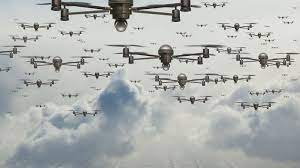
However, some American strategists have championed an alternative approach to the use of autonomous weapons on future battlefields in which they would serve not as junior colleagues in human-led teams but as coequal members of self-directed robot swarms. Such formations would consist of scores or even hundreds of AI-enabled UAVs, USVs, or UGVs — all able to communicate with one another, share data on changing battlefield conditions, and collectively alter their combat tactics as the group-mind deems necessary.
“Emerging robotic technologies will allow tomorrow’s forces to fight as a swarm, with greater mass, coordination, intelligence and speed than today’s networked forces,” predicted Paul Scharre, an early enthusiast of the concept, in a 2014 report for the Center for a New American Security (CNAS). “Networked, cooperative autonomous systems,” he wrote then, “will be capable of true swarming — cooperative behavior among distributed elements that gives rise to a coherent, intelligent whole.”
As Scharre made clear in his prophetic report, any full realization of the swarm concept would require the development of advanced algorithms that would enable autonomous combat systems to communicate with each other and “vote” on preferred modes of attack. This, he noted, would involve creating software capable of mimicking ants, bees, wolves, and other creatures that exhibit “swarm” behavior in nature. As Scharre put it, “Just like wolves in a pack present their enemy with an ever-shifting blur of threats from all directions, uninhabited vehicles that can coordinate maneuver and attack could be significantly more effective than uncoordinated systems operating en masse.”
In 2014, however, the technology needed to make such machine behavior possible was still in its infancy. To address that critical deficiency, the Department of Defense proceeded to fund research in the AI and robotics field, even as it also acquired such technology from private firms like Google and Microsoft. A key figure in that drive was Robert Work, a former colleague of Paul Scharre’s at CNAS and an early enthusiast of swarm warfare. Work served from 2014 to 2017 as deputy secretary of defense, a position that enabled him to steer ever-increasing sums of money to the development of high-tech weaponry, especially unmanned and autonomous systems.
From Mosaic to Replicator
Much of this effort was delegated to the Defense Advanced Research Projects Agency (DARPA), the Pentagon’s in-house high-tech research organization. As part of a drive to develop AI for such collaborative swarm operations, DARPA initiated its “Mosaic” program, a series of projects intended to perfect the algorithms and other technologies needed to coordinate the activities of manned and unmanned combat systems in future high-intensity combat with Russia and/or China…………………………………………………………………………………………………………..
To obtain both the hardware and software needed to implement such an ambitious program, the Department of Defense is now seeking proposals from traditional defense contractors like Boeing and Raytheon as well as AI startups like Anduril and Shield AI. While large-scale devices like the Air Force’s Collaborative Combat Aircraft and the Navy’s Orca Extra-Large UUV may be included in this drive, the emphasis is on the rapid production of smaller, less complex systems like AeroVironment’s Switchblade attack drone, now used by Ukrainian troops to take out Russian tanks and armored vehicles behind enemy lines.
At the same time, the Pentagon is already calling on tech startups to develop the necessary software to facilitate communication and coordination among such disparate robotic units and their associated manned platforms. To facilitate this, the Air Force asked Congress for $50 million in its fiscal year 2024 budget to underwrite what it ominously enough calls Project VENOM, or “Viper Experimentation and Next-generation Operations Model.” Under VENOM, the Air Force will convert existing fighter aircraft into AI-governed UAVs and use them to test advanced autonomous software in multi-drone operations. The Army and Navy are testing similar systems.
When Swarms Choose Their Own Path
In other words, it’s only a matter of time before the U.S. military (and presumably China’s, Russia’s, and perhaps those of a few other powers) will be able to deploy swarms of autonomous weapons systems equipped with algorithms that allow them to communicate with each other and jointly choose novel, unpredictable combat maneuvers while in motion. Any participating robotic member of such swarms would be given a mission objective (“seek out and destroy all enemy radars and anti-aircraft missile batteries located within these [specified] geographical coordinates”) but not be given precise instructions on how to do so. That would allow them to select their own battle tactics in consultation with one another. If the limited test data we have is anything to go by, this could mean employing highly unconventional tactics never conceived for (and impossible to replicate by) human pilots and commanders.
…………………………………… In military terms, this means that a swarm of autonomous weapons might jointly elect to adopt combat tactics none of the individual devices were programmed to perform — possibly achieving astounding results on the battlefield, but also conceivably engaging in escalatory acts unintended and unforeseen by their human commanders, including the destruction of critical civilian infrastructure or communications facilities used for nuclear as well as conventional operations………………………………………………..
What then? Might they choose to keep fighting beyond their preprogrammed limits, provoking unintended escalation — even, conceivably, of a nuclear kind? Or would they choose to stop their attacks on enemy forces and instead interfere with the operations of friendly ones, perhaps firing on and devastating them
……………………………….. Many prominent security and technology officials are, however, all too aware of the potential risks of this “emergent behavior” in future robotic weaponry and continue to issue warnings against the rapid utilization of AI in warfare.
Of particular note is the final report that the National Security Commission on Artificial Intelligence issued in February 2021. Co-chaired by Robert Work (back at CNAS after his stint at the Pentagon) and Eric Schmidt, former CEO of Google, the commission recommended the rapid utilization of AI by the U.S. military to ensure victory in any future conflict with China and/or Russia. However, it also voiced concern about the potential dangers of robot-saturated battlefields……………………………………………………………..
When the leading advocates of autonomous weaponry tell us to be concerned about the unintended dangers posed by their use in battle, the rest of us should be worried indeed. Even if we lack the mathematical skills to understand emergent behavior in AI, it should be obvious that humanity could face a significant risk to its existence, should killing machines acquire the ability to think on their own…………… more https://tomdispatch.com/emergent-ai-behavior-and-human-destiny/—
Utility EdF Writes Down $14B Loss on Delayed UK Nuclear Megaproject

By Peter Reina, February 20, 2024, https://www.enr.com/articles/58180-utility-edf-writes-down-14b-loss-on-delayed-uk-nuclear-megaproject
Following recent news of additional delays and cost hikes on the U.K.’s 3,260-MW Hinkley Point C nuclear power plant, the project company has reported an impairment of $14 billion on its assets.
French state controlled utiilty firm Electricité de France (EdF), which controls project financing and construction, last month updated Hinkley Point C’s forecast completion to between 2029 and 2031, with costs rising to a range of $39-43 billion. The previous completion target set in May 2022 was June 2027. EdF is currently financing all project construction costs.
Announcing its 2023 annual report, the utility also set this March as the expected target date for fuel loading at its 1,650-MW Flamanville 3 nuclear power plant on the north French coast. When work started in 2007, fuel loading was forecast for 2011.
Israel Demolishing Buildings to Construct Road in Gaza to Cut the Strip Into Two

The construction demonstrates Israel’s long-term plan to occupy Gaza.
By Dave DeCamp / Antiwar.com, https://scheerpost.com/2024/02/21/israel-demolishing-buildings-to-construct-road-in-gaza-to-cut-the-strip-into-two/
Israel is demolishing buildings to build a road through central Gaza that will cut the Strip in two, demonstrating Israel’s long-term plans to occupy the territory.
Israel’s Channel 14 reported on the road, which is being built in an area known as the Netzarim Corridor. The new road, known as Highway 749, will separate Gaza City from the rest of the Strip.
Israel is creating a 1-kilometer “buffer zone” to the north and south of the road, similar to the zone it’s creating along the entire Israel-Gaza border. According to The New Arab, among the structures likely to be demolished to build the road is the Turkish-Palestinian Friendship Hospital, which was shut down in November due to an Israeli siege that cut off fuel.
The construction will also require the demolition of Al-Aqsa University, several villages, amusement parks, and agricultural land. Israeli soldiers said the purpose of the road was to make it easier to launch incursions into Gaza, and it could also prevent the movement of Palestinians from the south to the north.
The Wall Street Journal also reported on the highway and said it would effectively create a militarized belt across Gaza that will help prevent the 1 million Palestinians who fled the north from returning to their homes. Israeli officials told the Journal that the road will be patrolled until Israel’s military operations are complete, which they say could be years away.
The Israeli officials also claimed that they don’t seek to occupy the Gaza Strip but plan to maintain “security control” within its borders for an indefinite period, which amounts to a military occupation. Israeli government ministers have also not been shy about their desire to re-establish Jewish settlements in Gaza.
Victory: Nuclear Free Local Authorities welcome Council vote on South Holderness nuke dump plan

NFLA 21 Feb 24,
The UK/Ireland Nuclear Free Local Authorities have welcomed today’s (21 February) overwhelming decision by the East Riding of Yorkshire Council to withdraw South Holderness from further consideration as a potential location for a high-level radioactive waste dump.
A motion was brought by South East Holderness Ward Councillor Sean McMaster to a meeting of the Full Council calling for the Council to ‘use its right of withdrawal with immediate effect due to the strong opposition from the communities of South Holderness’ . The Leader of the Council, Councillor Anne Handley, had already indicated her support for the motion, as had the Leaders of the Opposition Groups. Consequently, the motion was carried on a cross-party basis with 52 in favour and only 1 against.
News that the area was under consideration by Nuclear Waste Services was only announced in late January, with Invest East Yorkshire listed as the ‘Interested Party’ and a Working Group established with Dr David Richards as Chair.
The news prompted a massive public backlash with local people in the hundreds flocking to join a Facebook group, South Holderness against the GDF. Tens of thousands of leaflets have been distributed by local volunteers who have been pounding the streets in all weathers to inform residents of their reasons for opposing the plan, whilst 1,200 local people attended the first round of public events hosted by NWS staff, many to register their opposition and pose challenging questions to geologists from the nuclear industry. Chair Lynn Massey-Davis appeared in the first few days of the campaign to challenge the legitimacy of the dump in a spirited performance in a television interview with Peter Levy on BBC Look North.
The NFLAs have been proud to have offered some advice to the group and to local politicians at the Withernsea Town and East Riding Councils. Following an online conversation with the Labour Group Leader, Councillor Steve Gallant, the NFLA Secretary produced a bespoke briefing on the Right to Withdraw (see notes) for circulation to Councillors.
21st February 2024
Victory: NFLAs welcome Council vote on South Holderness nuke dump plan
The UK/Ireland Nuclear Free Local Authorities have welcomed today’s (21 February) overwhelming decision by the East Riding of Yorkshire Council to withdraw South Holderness from further consideration as a potential location for a high-level radioactive waste dump.
A motion was brought by South East Holderness Ward Councillor Sean McMaster to a meeting of the Full Council calling for the Council to ‘use its right of withdrawal with immediate effect due to the strong opposition from the communities of South Holderness’ . The Leader of the Council, Councillor Anne Handley, had already indicated her support for the motion, as had the Leaders of the Opposition Groups. Consequently, the motion was carried on a cross-party basis with 52 in favour and only 1 against.
News that the area was under consideration by Nuclear Waste Services was only announced in late January, with Invest East Yorkshire listed as the ‘Interested Party’ and a Working Group established with Dr David Richards as Chair.
The news prompted a massive public backlash with local people in the hundreds flocking to join a Facebook group, South Holderness against the GDF. Tens of thousands of leaflets have been distributed by local volunteers who have been pounding the streets in all weathers to inform residents of their reasons for opposing the plan, whilst 1,200 local people attended the first round of public events hosted by NWS staff, many to register their opposition and pose challenging questions to geologists from the nuclear industry. Chair Lynn Massey-Davis appeared in the first few days of the campaign to challenge the legitimacy of the dump in a spirited performance in a television interview with Peter Levy on BBC Look North.
The NFLAs have been proud to have offered some advice to the group and to local politicians at the Withernsea Town and East Riding Councils. Following an online conversation with the Labour Group Leader, Councillor Steve Gallant, the NFLA Secretary produced a bespoke briefing on the Right to Withdraw (see notes) for circulation to Councillors.
The impact of this decision will be profound. Under the published Community Guidance governing the GDF siting process, consideration of any Search Area must have the support of a Relevant Principal Local Authority (RPLA). The East Riding of Yorkshire Council is the RPLA for South Holderness and as such has the Right to Withdraw. Although the Community Guidance is vague and contradictory, appearing both to suggest that withdrawal can occur at any time or only once a Community Partnership is formed, it is clear that there will be little point NWS investing further money, time and staff resources on taking its plan forward at this early stage without political support; clearly then the process must soon come to an end.
Councillor David Blackburn, Chair of the NFLAs English Forum, was full of praise for local campaigners:
Commenting on the vote, Cllr Blackburn added:
“I am glad that Councillors of all parties saw sense and supported this motion on a cross-party basis. South Holderness is an agricultural and touristic area and as such was never appropriate for consideration for a nuclear waste dump. So what I do find inexplicable is why the Leader of the Council ever agreed for East Riding of Yorkshire Council to engage with the process and become a member of the Working Group in the first place, as a resolute NO would have killed the process off at the onset, as happened at Hartlepool.”
Nuclear Waste Services have now issued a press statement stating that it ‘fully respects the council’s decision to withdraw from the GDF siting process. Together with the Working Group Chair, NWS will now take the necessary steps to wind down the South Holderness Working Group and respond to outstanding requests for more information’. (See notes)…………………………………… more https://www.nuclearpolicy.info/news/victory-nflas-welcome-council-vote-on-south-holderness-nuke-dump-plan/
Minister urges TEPCO to ensure nuclear safety measures
By Jiang Xueqing in Tokyo 2024-02-22 , https://global.chinadaily.com.cn/a/202402/22/WS65d6a0fca31082fc043b86ea.html
Japan’s industry minister said on Wednesday a recent radioactive water leak at the wrecked Fukushima Daiichi Nuclear Power Plant earlier this month has caused anxiety in Japan and abroad and will hinder the completion of the decommissioning of the plant.
Ken Saito, minister of economy, trade and industry, summoned Tomoaki Kobayakawa, president of the Tokyo Electric Power Company, operator of the Fukushima plant, to his office on Wednesday, urging TEPCO to take the incident as a serious management issue and ensure thorough safety measures.
Furthermore, Saito requested an analysis to identify any common factors contributing to a series of troubles for the purpose of preventing recurrence. He also urged the utilization of digital technology to prevent human errors, Japanese public broadcaster NHK reported.
On Feb 7, TEPCO informed the International Atomic Energy Agency that water containing radioactive materials was found to have leaked from a caesium absorption tower at the plant.
TEPCO calculated that the leakage totaled around 5.5 cubic meters of water containing an estimated 0.022 terabecquerel of radioactive substances, according to the IAEA.
The water was assessed to have leaked from a valve left open during cleaning work at the absorption tower.
On Oct 26 last year, TEPCO announced that two male workers in their 20s and 40s, who were exposed to nuclear-contaminated water while cleaning pipes at the Advanced Liquid Processing System at the Fukushima nuclear power plant, have been hospitalized for decontamination and observation.
The two workers, employees of a partner firm of TEPCO, were engaged in the cleaning process along with three other male workers. During the operation, a hose used to transfer nuclear-contaminated water to a tank went loose, leading to the splashing of approximately 100 milliliters of radioactive water, as reported by The Asahi Shimbun, one of the major daily newspapers in Japan.
In the process of handling the Fukushima nuclear-contaminated water, accidents have occurred repeatedly, fully exposing the chaotic and disorderly internal management of TEPCO, a spokesperson of the Chinese Embassy in Japan said on Feb 8.
The accidents also demonstrate the inadequate and ineffective supervision measures by the Japanese government and once again prove the lack of long-term reliability of the nuclear-contaminated water treatment equipment, highlighting the necessity for international supervision, he said.
Japan has so far dumped approximately 23,400 cubic meters of nuclear-contaminated water from the Fukushima nuclear power plant into the sea since August 2023 in three rounds. The fourth round is scheduled to commence in late February.
The spokesperson of the Chinese Embassy in Japan said the discharge of nuclear-contaminated water from Fukushima into the sea concerns the health of all mankind, the global marine environment and international public interests.
“We once again earnestly urge Japan to take seriously the concerns of neighboring countries and the international community; engage in sincere consultations with relevant stakeholders; fully cooperate in establishing effective international monitoring arrangements with substantive participation from stakeholders; and handle nuclear-contaminated water in a scientific, safe and transparent manner,” he said.
Locals campaign to oppose Hinkley Point C’s plans to build a saltmarsh on the Pawlett Hams
LOCALS to a village near Bridgwater have set up a campaign group to oppose
Hinkley Point C’s plans to build a saltmarsh on the Pawlett Hams. The
group, named Protect Pawlett Hams, describes the area of land as ‘a
treasured expanse of 320 hectares of vibrant fresh water wetland and
grazing land’. The saltmarsh, planned by EDF to facilitate the Hinkley
Point C nuclear power station, is currently under public consultation, and
comes as an alternative to a previously proposed acoustic fish deterrent
system, which would reportedly make noise louder than a jumbo jet, 24-hours
per day for the next 60 years.
Bridgwater Mercury 20th Feb 2024
https://www.bridgwatermercury.co.uk/news/24130587.locals-campaign-hinkley-point-c-saltmarsh-plans
Somerset County Gazette 20th Feb 2024
Local environmental group says EDF’s plans for new salt marsh would be
an ‘ecological disaster’.
Burnham-on-sea.com 20th Feb 2024
House is heading toward “nuclear” war over Ukraine funding, one top House GOP leader says
By Major Garrett, February 21, 2024 CBS News
There’s a “50-50” chance of a government shutdown in early March, says House Financial Services Chairman Patrick McHenry, of North Carolina, and it’s House Speaker Mike Johnson’s fear of being ousted that will determine the outcome. And at the same time, McHenry says the House is heading to a procedural “nuclear” war over funding for Ukraine……………………………………………………………………………………………………………. more https://www.cbsnews.com/news/house-ukraine-funding-the-takeout/
1 This Month
Chernobyl: The Lost Tapes – A good documentary on Chernobyl on SBS available On Demand for the next 3 weeks– https://www.sbs.com.au/ondemand/tv-program/chernobyl-the-lost-tapes/2352741955560

of the week–London Campaign for Nuclear Disarmament

Tell the Ukrainian Government to Drop Prosecution of Peace Activist Yurii Sheliazhenko
To see nuclear-related stories in greater depth and intensity – go to https://nuclearinformation.wordpress.com
-
Archives
- April 2026 (114)
- March 2026 (251)
- February 2026 (268)
- January 2026 (308)
- December 2025 (358)
- November 2025 (359)
- October 2025 (376)
- September 2025 (257)
- August 2025 (319)
- July 2025 (230)
- June 2025 (348)
- May 2025 (261)
-
Categories
- 1
- 1 NUCLEAR ISSUES
- business and costs
- climate change
- culture and arts
- ENERGY
- environment
- health
- history
- indigenous issues
- Legal
- marketing of nuclear
- media
- opposition to nuclear
- PERSONAL STORIES
- politics
- politics international
- Religion and ethics
- safety
- secrets,lies and civil liberties
- spinbuster
- technology
- Uranium
- wastes
- weapons and war
- Women
- 2 WORLD
- ACTION
- AFRICA
- Atrocities
- AUSTRALIA
- Christina's notes
- Christina's themes
- culture and arts
- Events
- Fuk 2022
- Fuk 2023
- Fukushima 2017
- Fukushima 2018
- fukushima 2019
- Fukushima 2020
- Fukushima 2021
- general
- global warming
- Humour (God we need it)
- Nuclear
- RARE EARTHS
- Reference
- resources – print
- Resources -audiovicual
- Weekly Newsletter
- World
- World Nuclear
- YouTube
-
RSS
Entries RSS
Comments RSS
 nuclear-news