TODAY. How the USA betrays and disdains its allies – the case of Julian Assange.
Right now, USA leaders are bewailing and admiring Alexei Navalny – the courageous Russian who stood up to Putin, and paid the ultimate price for publicly exposing the government’s crimes .
The hypocrisy of Joe Biden and the rest of these phony U.S. “patriots” – too cowardly to face up to the truth, – to accept that their great “exceptional” nation could have done some wrong things! Like the Russian government, you get rid of, you kill, the person who exposed your wrongdoing.
Only the Russians do it quickly, without finesse.
The American government constructs an elaborate legal justification, and, with the sycophantic support of the British government, a long-drawn out procedure of torture – over many years – punishing the truth-speaker – the Australian citizen Julian Assange – in the name of “justice”.
Julian Assange is not an American citizen. He was not an official of the USA government. He did not hack into U.S. government computers to discover classified documents. Yet Assange is charged with this computer misuse, and espionage of classified documents! With violating 17 counts of the 1917 Espionage Act, with a potential sentence of 170 years!
What Assange did was to do what journalists do – publish information given to him by a source (- Chelsea Manning). The New York Times, The Guardian, and Der Spiegel also published this information. Why are their editors and journalists not also being charged with espionage?
Assange revealed crimes – massacres of civilians, torture, assassinations, the list of detainees held at Guantanamo Bay and the conditions they were subjected to, as well as the Rules of Engagement in Iraq, helicopter pilots who gunned down two Reuters journalists and 10 other civilians and severely injured two children. These perpetrators have never been charged. with anything.
Apart from the intrinsic injustice of the claims against Assange, there has been a whole series of illegal and very questionable actions against him. Some examples – the surveillance of Assange and his lawyers by a Spanish firm, while he was in the Ecuadorian Embassy, Ecuador’s rescinding Julian’s asylum status allowing police in, the UK court’s acceptance of the claim that Assange is “not a journalist”. A key witness admitted to fabricating the accusations against him. The CIA made plans for kidnapping and assassinating him.
Julian was convicted of breaching his bail conditions. The punishment? Almost 5 years in solitary confinement in maximum security Belmarsh prison. Belmarsh is for Category A prisoners, those who “pose the most threat to the public, the police or national security” and stand accused of terrorism, murder, or sexual violence.
Article 4 of the Extradition Treaty between USA and UK prohibits extradition for political offenses. Why has this been ignored in the drive to send Assange to trial in the USA?
It is likely that the British court will continue the British kow-towing to America.
As for Australia – the Australian Parliament, including Prime Minister Anthony Albanese, actually now have put their heads above the parapet, and called on the USA to release Assange. A bit of courage on their part – not seen since the days of Gough Whitlam (who was severely punished for attempting to stand up to the USA.)
But it matters little – what Australia wants for its citizen Assange. Australia has signed up for the nuclear submarine boondoggle, and for plastering U.S. military bases around the nation, and for being ready to join in attacking China whenever asked to.
Right now, Australia IS making some feeble attempts to separate itself from Joe Biden’s fealty to Israel, and even from castigating China. These will be disregarded by the mighty USA.
“Friendship’ with the USA is entirely one way, and Assange awaits his ultimate persecution.
An Open Letter from Editors and Publishers: Publishing is Not a Crime
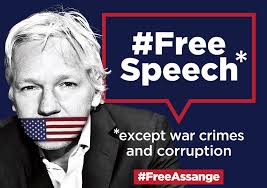
The following is a letter from The New York Times, the Guardian, Le Monde, El Pais and DER SPIEGEL urging the U.S. government to end its prosecution of Julian Assange for publishing secrets.
By The New York Times, the Guardian, Le Monde, El Pais and DER SPIEGEL, https://scheerpost.com/2024/02/18/an-open-letter-from-editors-and-publishers-publishing-is-not-a-crime/
Twelve years ago, on November 28th 2010, our five international media outlets – The New York Times, the Guardian, Le Monde, El Pais and DER SPIEGEL – published a series of revelations in cooperation with Wikileaks that made the headlines around the globe.
“Cable gate”, a set of 251,000 confidential cables from the US State Department disclosed corruption, diplomatic scandals and spy affairs on an international scale.
In the words of The New York Times, the documents told “the unvarnished story of how the government makes its biggest decisions, the decisions that cost the country most heavily in lives and money”. Even now in 2022, journalists and historians continue to publish new revelations, using the unique trove of documents.
For Julian Assange, publisher of Wikileaks, the publication of “Cable gate” and several other related leaks had the most severe consequences. On April 11th, 2019, Assange was arrested in London on a US arrest warrant, and has now been held for three and a half years in a high security British prison usually used for terrorists and members of organized crime groups. He faces extradition to the US and a sentence of up to 175 years in an American maximum security prison.
This group of editors and publishers, all of whom had worked with Assange, felt the need to publicly criticize his conduct in 2011 when unredacted copies of the cables were released, and some of us are concerned about the allegations in the indictment that he attempted to aid in computer intrusion of a classified database. But we come together now to express our grave concerns about the continued prosecution of Julian Assange for obtaining and publishing classified materials.
The Obama-Biden Administration, in office during the Wikileaks publication in 2010, refrained from indicting Assange, explaining that they would have had to indict journalists from major news outlets too. Their position placed a premium on press freedom, despite its uncomfortable consequences. Under Donald Trump however, the position changed. The DOJ relied on an old law, the Espionage Act of 1917 (designed to prosecute potential spies during World War 1), which has never been used to prosecute a publisher or broadcaster.
This indictment sets a dangerous precedent, and threatens to undermine America’s First Amendment and the freedom of the press.
Holding governments accountable is part of the core mission of a free press in a democracy.
Obtaining and disclosing sensitive information when necessary in the public interest is a core part of the daily work of journalists. If that work is criminalised, our public discourse and our democracies are made significantly weaker.
Twelve years after the publication of “Cable gate”, it is time for the U.S. government to end its prosecution of Julian Assange for publishing secrets.
Publishing is not a crime.
The editors and publishers of:
- The New York Times
- The Guardian
- Le Monde
- DER SPIEGEL
- El Pais
Germany and nuclear weapons: A difficult history

Volker Witting | Rina Goldenberg, 02/17/2024February 17, 2024
Donald Trump’s suggestion the US will no longer apply NATO’s principle of collective defense should he become president again has sent shockwaves through Europe.
German Defense Minister Boris Pistorius is annoyed by the current debate about European nuclear weapons.“There is no reason to discuss the nuclear umbrella now,” he told public broadcaster ARD.
Ever since Donald Trump suggested that, as US president, he would not provide military assistance to NATO countries if they invested less than 2% of their GDP in their defense, German politicians have been discussing whether French and British nuclear weapons would suffice as a protective shield or whether Europe needs new nuclear weapons.
“The debate about European nuclear weapons is a very German debate that we don’t see in any other country,” political scientist Karl-Heinz Kamp from the German Council on Foreign Relations (DGAP) told DW — especially not in Eastern Europe, where there is a constant perceived threat from Russian President Vladimir Putin’s Russia.
Germany has a special history: Germany was “seen as an intrinsically aggressive country, that had started two world wars and could not be trusted with nuclear weapons,” said Kamp.
Germany-based nukes during the Cold War
In 1954, not long after the end of World War II, the first chancellor of the Federal Republic of Germany, Konrad Adenauer, signed an agreement renouncing the production of its own nuclear, biological or chemical weapons on its territory. In return, the US included West Germany in its nuclear deterrence policy against the Soviet-led Warsaw Pact.
In 1958, the German parliament, the Bundestag, approved the deployment of US nuclear weapons, despite some pacifist protests among the population. In 1960, 1,500 US nuclear warheads were stored in West Germany and a further 1,500 in the rest of Western Europe.
The nuclear weapons were also available to the Bundeswehr for training and use in the “case of defense.” “There was never any discussion about Germany acquiring its own nuclear weapons,” said Kamp.
The West German and European peace movements grew. The protest against the “NATO Dual-Track Decision” in 1982 saw over a million people in West Germany take to the streets in protest against the planned stationing of new US medium-range missiles in the country.
Nevertheless, on November 22, 1983, a center-right majority in the Bundestag approved the stationing of the missiles in US bases shortly thereafter. At the time, the Greens were newly represented in the Bundestag and appealed to the Federal Constitutional Court against the storing and deployment of nuclear missiles on West German territory. This bid was rejected as unfounded in December 1984.
During the Cold War, East Germany, the communist German Democratic Republic (GDR), was part of the Warsaw Pact military alliance, and from 1958, nuclear missiles and warheads were stationed in Soviet military bases on GDR territory. Some were withdrawn in 1988 as part of the Intermediate-Range Nuclear Forces Treaty between the US and the Soviet Union.
After German reunification and the withdrawal of the Soviet military, the territory of the former GDR officially became free of nuclear weapons in 1991.
Post-Cold War Germany
After the fall of the Berlin Wall in 1989, the collapse of the Soviet Union and the end of the division between East and West Germany, the German position was once again cemented in the so-called “Two-Plus-Four Treaty”: No nuclear weapons! On September 12, 1990, the four victorious powers of World War II (the US, the Soviet Union, France and UK) stipulated that Germany East and West should be reunified and renounce nuclear weapons.
Kamp says this was hardly surprising, because “a German nuclear power would be something that would cause horror. For historical reasons alone.”
The US government withdrew many of these nuclear warheads after the collapse of the Soviet Union, though an estimated 180 US nuclear weapons are still stored in Europe, in Italy, Turkey, Belgium, the Netherlands and Germany.
Experts believe that 20 US nuclear warheads are currently stored in the town of Büchel in Rhineland-Palatinate, western Germany. “But the decision-making authority over these weapons lies solely with the American president,” explained Kamp.
Any debate about Germany acquiring its own nuclear weapons is completely unrealistic, says political scientist Peter Rudolf from the German Institute for International and Security Affairs. Nuclear bombs need to be stored so that they are not easy targets, he told the Frankfurter Allgemeine daily.
“Survivable nuclear weapons would have to be on nuclear-powered submarines that can remain underwater for a very long time, he said, pointing to equipment the Bundeswehr does not have. “So there are so many problems standing in the way of a German nuclear bomb that it has no relevance to current crises,” Rudolf concluded.
“Those who are now talking about a European defense dimension are not talking about German nuclear weapons, because Germany is a member of the Nuclear Non-Proliferation Treaty and has made several binding commitments under international law to renounce the possession of weapons of mass destruction — including nuclear weapons,” agreed Kamp.
Defense Minister Pistorius, meanwhile, who made headlines not so long ago saying Germany should get “war-ready”, is now keen to brush the whole debate aside: He told ARD that “the majority of those in charge in the United States of America know exactly what they have in their transatlantic partners in Europe, what they have in NATO.”
And Kamp agrees: “Trump may be able to damage NATO considerably, but he cannot destroy it. You can’t destroy decades of transatlantic relations in one term of office.”
Edited by Ben Knight and Peter Hille
UK could contribute to nuclear shield if Trump wins, suggests German minister
Comments draw Britain into debate about European security without US providing bulk of Nato’s nuclear deterrent
Patrick Wintour, Guardian, 19 Feb 24,
The UK could contribute to a new European nuclear shield if Donald Trump becomes US president again, a senior German minister has suggested, drawing British politicians into the debate about how Europe’s security could be bolstered in the event of the Republican frontrunner winning in November.
Questions over a European nuclear deterrence have intensified after Trump’s remarks on Saturday that he would not defend any Nato member that failed to spend 2% of its gross domestic product on defence – and would even encourage Russia to continue attacking.
European leaders have interpreted the comments as a warning that the alliance’s largely US nuclear shield can no longer be taken for granted if Trump returns to the White House. On Tuesday, Christian Lindner, the German finance minister and the leader of the Free Democratic party, called on politicians to consider an alternative model that could include British and French nuclear weapons……………………………………………………………..
The central issue in the nuclear debate is less whether Britain or France would put their nuclear weapons at the disposal of the EU, but whether the two countries could agree to put them at the service of a deterrence strategy for Nato’s European alliance area.
Although France keeps its nuclear deterrent outside the Nato command structure, Macron has offered to cooperate with Europe on nuclear defence. In 2020, he called for a “strategic dialogue” on “the role of France’s nuclear deterrent in [Europe’s] collective security”. Germany never took up that offer……………………………………………………………………………………..
The UK has said its nuclear weapons would be available for use at the request of Nato’s supreme allied commander Europe, the alliance’s most senior uniformed officer, and that they would only be used “in extreme circumstances of self-defence including the defence of our Nato allies”.
This offer, however, was made in the context of a US nuclear presence in Europe.
The Labour party has promised to intensify defence cooperation with Europe, including a commitment by the shadow defence secretary, John Healey, to reach an agreement with Germany within the first six months of taking office. But this modest pledge had nothing to do with the sharing of Britain’s nuclear deterrent. https://www.theguardian.com/world/2024/feb/15/uk-europe-nuclear-shield-donald-trump-germany-nato-deterrent
For Biden, ending Israel’s mass murder in Gaza is a ‘non-starter’
As Palestinians face mass starvation and new ethnic cleansing in Rafah, the White House rejects even token humanitarian gestures.
AARON MATÉ, FEB 20, 2024
At the White House last week, President Biden claimed to have concerns about Israeli plans for a ground invasion of Rafah, the southern Gaza area where more than one million Palestinians have fled. In the process, he committed a gaffe that revealed his actual stance.
“Our military operation in Rafah,” Biden began, before correcting himself. “Their — the major military operation in Rafah should not proceed without a credible plan… for ensuring the safety and support of more than one million people sheltering there. They need to be protected.”
Although unintentional, Biden was accurate to refer to an Israeli military operation in Gaza in the possessive form. Every Israeli atrocity in Gaza is committed with US support. Accordingly, within 24 hours, the White House made clear that despite Biden’s words of caution, only Israel’s mass murder campaign will remain protected.
According to three US officials, the Biden administration “is not planning to punish Israel if it launches a military campaign in Rafah without ensuring civilian safety,” Politico reports. Therefore, “no reprimand plans are in the works, meaning Israeli forces could enter the city and harm civilians without facing American consequences.” In another likely sign that Biden supports an Israeli assault, its allied regime in Egypt – a US client state — is now building an 8-square-mile walled enclosure that would cage fleeing refugees on its side of the Rafah border.
Biden’s spokespeople have also relayed that Israel has his green light to harm Rafah’s civilians.
“We’re going to continue to support Israel,” John Kirby said at the White House. “And we’re going to continue to make sure they have the tools and the capabilities to do that.” Asked directly if the US would punish Israel if it attacked Rafah without the Biden-demanded “credible plan” for civilian safety, Kirby responded: “I’m not going to get into a hypothetical game.”
To supply Israel with the proper “tools,” the US is rushing a new shipment of at least 1,000 bombs and related munitions. According to US intelligence officials, Israel has used about half the 21,000 bombs supplied by the US since the Oct. 7th attack. Israel’s remaining stockpile would be enough for 19 more weeks — but just days if war breaks out with Hezbollah on the northern border.
Israel’s dependence on US weaponry gives the White House instrumental leverage to impose conditions on its conduct – including demanding an end to the Gaza assault. But instead of using that influence, this latest transfer is part of “a broader effort by the Biden administration to speed the flow of weapons to Israel,” the Wall Street Journal observes…………………………………………………………………………………………….. more https://www.aaronmate.net/p/for-biden-ending-israels-mass-murder?utm_source=post-email-title&publication_id=100118&post_id=141822384&utm_campaign=email-post-title&isFreemail=true&r=ln98x&utm_medium=email
The odds of China using nuclear war to resolve the Taiwan issue
By John F. CopperFeb 20, 2024, https://johnmenadue.com/the-odds-of-china-using-nuclear-war-to-resolve-the-taiwan-issue-u-s-expert-versus-taiwan-experts/
Recently the Centre for Strategic and International Studies, a thinktank in Washington, DC, did a survey asking U.S. and Taiwan Experts if China might use nuclear weapons in a conflict with or over Taiwan. The results were astonishing to most who read the study. Almost half of U.S. experts reported they thought China would. Only one quarter that number of Taiwan experts, 11 percent, so opined.
Different histories and variances in views of the world order explain this.
The US view
The United States was born out of war in the late 1700s. Americans call it a revolutionary war or a war of independence. It was the latter. (Social classes did not change.)
Growing from a small country on the East Coast to a two-ocean nation in a century was built on wars with the indigenous people (American Indians) that were reduced from 100 percent of the population to 2 percent today. The wars were vicious, including the use of germ weapons and deliberately starving the enemy. Essentially wars of annihilation.
In the late 1800s the Indians were defeated marked by a victory (some called a massacre) in the Battle of Wounded Knee. Thenceforth the U.S. became an external expansionist power: incorporating Hawaii, defeating Spain to colonise the Philippines, and taking some other Pacific Islands.
World War I and II enhanced America’s world power status: from being an important nation to being a preeminent world power (superpower). In 1991, the U.S. defeated the Soviet Union, the only other superpower, with an arms race that America won—to become the world’s sole superpower.
Four years ago, former President Jimmy Carter noted America had been at peace only 16 of the last 242 years and concluded the U.S. was the most warlike nation in history. By contrast, China had not been at war in the last 40 years.
Meanwhile, after World War II the U.S. built a new world order employing its superior national power and its view of what the world should be –a world of global trade and economic growth and dragooned democracy. It worked well for a while.
But America became overstretched from its role as a military giant, and in some ways soft or at least tired of its global responsibilities. After the fall of the Soviet Union, it was not ready to lead a unipolar world.
More important, it faced a growing challenge. Mao, China’s great leader, died in 1976 and two years later Deng Xiaoping reconstructed China, getting rid of Mao’s radical communism and replacing it with free-market capitalism, trade and a system that built on China’s education tradition. China boomed economically.
It even grew during the world recession of 2008 and the subsequent almost slowest U.S. recovery in recent history. China became the number one nation in the world economically based on purchasing power. It led the word in steel production and other measures of big power status. In made the UN’s poverty eradication project work by helping developing countries grow with its formidable Belt and Road Initiative that was heading toward spending a trillion dollars compared to America’s biggest, the Marshall Plan (costing a bit over 100 billion in today’s dollars). Meanwhile, China passed the U.S. in registering patents and publishing academic articles while building modern airports and fast trains (more than the rest of the world combined while American had none).
President Trump met the China challenge with a make America great again policy. He sought to bring important industries back and restore U.S. capitalism. However, he faced virtually impossible hurdles to do this: an inflated and powerful government bureaucracy, too many lawyers that impeded business, horribly expensive penal and welfare systems, high taxes and a burdensome debt. Plus, the intelligence agencies and the federal police (FBI), the mainstream media, and American academe all opposed him while the Democratic Party that was bigger than his party had more money.
President Biden sought to destroy Trump’s America. As a globalist he advocated the idea of the US as an exceptional country and a superpower. America was to be a nation organising a bloc of democracies facing off against the China-led authoritarian nations. But this failed. America’s democracy appeared to many to have evolved into partisan rule by the deep state. Europeans did not want to be led by the U.S. Europe and Japan did not wish to end important economic ties with China. The Biden administration engaged in a financial and technology war with China, which hurt the U.S. more than China. The developing countries of the world continued to admire China for its aid and investments.
Good luck competing with China…
Meanwhile, pundits were taken by an idea expressed in the ancient book by Thucydides, The Peloponnesian Wars, that competition and eventually war between a status quo power (Sparta) and a rising power (Athens) was the model for most major wars after that. The relationship between America and China fit the model well. Thus, war was coming.
Provoking a war by demonising China as an expansionist power and an abuser of human rights meant that the U.S. should to go to war soon—before China, experiencing a renaissance and rising in national power, might defeat the U.S. that was experiencing decline.
The Taiwanese view
Taiwan has a very different history and view of the world from America. It early on grew up in isolation. Then it was exposed to the world outside via trade handled by its merchants, pirates, and outsiders. Chinese migrated to Taiwan and subdued the indigenous population reducing it to 2 percent of residents as happened in America; but this did not make Taiwan a world power.
Instead, Taiwan was ruled by Westerners (the Netherlands) for a brief time that improved its economy and more. For two centuries it was then ruled by China that did not have much interest in Taiwan and eventually abandoned it. Forthwith, Taiwan became a colony of Japan, during which time it saw economic modernisation without political choice or democracy.
Then the United States defeated Japan in war and returned Taiwan to China according to wartime agreements made at Potsdam and Tehran. Taiwan was not given any choice in the matter.
But China was at war with itself–a civil war between Chiang Kai-shek’s Nationalists and Mao Tse-tung’s Communists. Four years later Chiang lost and retreated to Taiwan to regroup. Again, Taiwan had no voice.
Owing to the Korean War the United States viewed Mao as a confederate of the Soviet Union and therefore an enemy. America gave aid and protection to Chiang’s Republic of China based on Taiwan. But the U.S. did not want a war with China allied with the Soviet Union and the result was a stalemate.
Chiang shifted his attention to Taiwan’s economic development and succeeded beyond almost anyone’s expectations. Its gross national product grew at a pace that far exceeded Western countries or Japan at their halcyon growth days.
Peace made this possible. Economic growth produced prosperity. Prosperity begat a middle class. A middle class serve to create political change and democracy.
Taiwan became a model for economic development and political change. Something similar happened in China under Deng: a booming economy and some political liberalisation. China and Taiwan linked up with trade and investments such that it made for mutual understanding and the avoidance of war, the same conditions that made the European Community work.
Strategically, Taiwan aligned with the United States against China in the Cold War. Like before it had no choice. But it avoided developing a nuclear weapon believing Chinese leaders when they said they would not use its nukes against Taiwan as they would not consider killing their own people.
Taiwan believed this because China did not engage in a nuclear arms race with America even though in the last two or three decades it could afford to do so. China sought to deal with Taiwan with its economic prowess, though it pulled its punches in using pressure and Taiwan knew it.
Taiwan’s residents’ national identity made it favour its sovereignty and separation from China or independence. Yet they knew this was contingent on America’s protection, regarding which they had some doubts.
Washington’s policy was that there was one China and Taiwan was part of China. President Biden restated this in the presence of world leaders at an APEC meeting in San Francisco. Feelings grew in Taiwan that America regarded it a pawn. The Biden administration forced Taiwan to invest in producing top-of-the line computer chips in Arizona, thus disabling what President Tsai called Taiwan’s “silicon shield.” She and Taiwan’s population could also see that China was on the rise; the U.S. was not.
Opinion polls in Taiwan reflected this. While residents’ identity favoured Taiwan and they picked independence over unification, they fancied the status quo more, and perceived Taiwan would reunify with China in the long run. Most of all they wanted peace. War, even if the U.S. kept its promises and fought for Taiwan, would still mean Taiwan would suffer grievously.
Finally, they preferred China’s world order that was founded on financial and technological power, not America’s system which relied on military might that Henry Kissinger, among others, opined was in quick decay.
Hence, it is understandable why U.S. pundits see China attacking Taiwan even with nuclear weapons much more likely than Taiwan scholars.
Hinkley Point C Nuclear could kill 22 BILLION fish in the Severn estuary
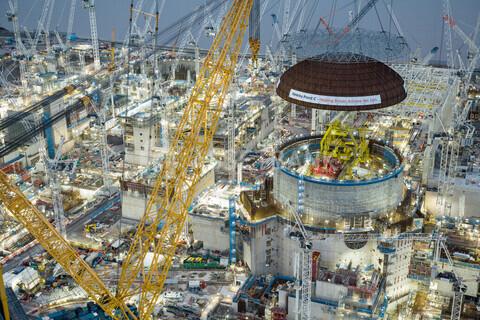
the huge cost to our precious natural world has been hidden behind the low-carbon story.
Somerset Apple, 17 Feb 24, Dave Phillips
A POWERFUL grouping of environmentalists, wildlife and fishing organisations have got together to condemn EDF’s plan to backtrack on promises made to install technology to prevent millions of fish and other marine life from being destroyed by the powerful cooling intakes for Hinkley Point C (HPC) nuclear power station that’s currently under construction.
When operational, HPC will suck in an Olympic-sized swimming pool of water every 12 seconds for the next 70 years from the Severn Estuary in an area inhabited by fish. Experts say it could wipe out 22 BILLION fish during its operational lifetime.
The Dillington Vision agreed between EDF, Somerset County Council and the UK Government, set out the vision for HPC which included the commitment to “recognise the value of the natural environment”. The original design of HPC included three measures to protect the marine environment, specifically fish populations, from the impacts of the power station.
This all relates to EDF’s consultation about removing the Acoustic Fish Deterrent (AFD), one of three ways to reduce fish killed at the new power station.
The proposed three methods were designed to work together:
- Low-velocity side entry at the tunnel heads designed to allow fish to swim away and not be sucked into the cooling tunnels.
- Fish recovery and return system.
- Acoustic Fish Deterrent (AFD) using sound that deter fish from swimming too close to the intake pipes in the first place.
In 2019, EDF proposed to remove the Acoustic Fish Deterrent as being difficult to install and maintain. This went to public inquiry with environmental groups (eNGOs) collectively giving evidence to support the Environment Agency (EA) in questioning EDF’s proposal.
In 2021, the UK Secretary of State for the Environment found in favour of the EA that the AFD should remain. EDF is now proposing not to implement the AFD and is instead proposing a package of measures claimed to compensate for the loss of fish in the estuary.
The eNGO group comprises:
- Angling Trust
- Avon Wildlife Trust
- Bristol Channel Federation of Sea Anglers
- Burnham Boat Owners
- Blue Marine Foundation
- Bristol Avon Rivers Trust
- Fish Legal
- Institute of Fisheries Management
- RSPB
- Severn Rivers Trust
- Somerset Wildlife Trust
- Wildlife Trusts Wales
- WWT, the charity for wetlands and wildlifeWhilst the eNGO group accepts that habitat restoration of saltmarsh, oysterbeds, kelp forest and river work could make an important and positive impact on the estuary, there is not enough evidence that it will address the huge losses of fish life that the cooling intakes will cause.
- They say: “Hinkley Point C nuclear power station (HPC) has been promoted as green and renewable because of the need to move away from fossil fuels. However, the huge cost to our precious natural world has been hidden behind the low-carbon story.
“Europe’s largest construction project on the edge of the Severn Estuary will have a significant impact on marine and migratory fish including already vulnerable Atlantic salmon, twaite shad and European eel over its lifetime.
“The impacts of this will be felt widely, affecting Welsh rivers, River Severn, the Bristol Avon, Somerset Levels and across the Celtic Sea. Life in the whole of the Severn Estuary and Bristol Channel could be dramatically affected over the next few decades according to a group of environmental organisations (eNGO’s)……………………………………………………………………………………………..
Objectors are calling for:
- More evidence of the potential impact of the AFD removal to determine the amount of compensation needed, including more consultation with independent groups of experts.
- Agreement on comprehensive long-term monitoring of the impact of the water intakes and the compensatory habitat as it develops throughout the lifetime of the power station.
- A commitment to respond to the results of the evidence gathering and monitoring with additional compensatory habitat, the fitting of fish deterrents on the intakes and/or reduction in intake water volumes as supplementary cooling techniques are more affordable or legislated.
Citizens Advice says Sizewell C costs should not be paid with energy bill hikes

Independent advice provider calls for clarity on funding and says project may offer ‘poor value for money’
Guardian, Alex Lawson 19 Feb 24
Ministers have been urged by Citizens Advice to protect consumers from a hike in household energy bills to pay for the proposed Sizewell C power station, amid international tensions over the rising costs of nuclear projects.
The UK’s largest independent advice provider has raised concerns that the project in Suffolk may offer “poor value for money” and called for greater clarity on its funding, in a letter to the Department for Energy Security and Net Zero.
Estimates of the cost of Sizewell C vary wildy – from £20bn to £44bn – and a process to find international investors to join the UK government and France’s EDF is ongoing.
Last month, the owner of Sizewell C’s sister project, EDF’s Hinkley Point C in Somerset, said it would be delayed to 2031 and cost up to £35bn, blaming inflation, Covid and Brexit. This could reach £47.9bn under its worst-case scenario. On Friday, EDF said it had taken a €12.9bn hit on the project.
EDF, which is wholly owned by the French government, is on the hook for cost overruns at Hinkley. French officials have lobbied the UK government to share the burden of the extra costs after its Chinese partner, CGN, was removed from the Sizewell C project over security fears.
However, Sizewell C has a different funding structure to Hinkley, exposing households to potential overruns.
Sizewell C Ltd, the entity behind the project, updated its electricity licence to allow a Regulated Asset Base (RAB) model to be implemented.
RAB financing models, which have been used in the construction of the Thames Tideway Tunnel and Heathrow Terminal 5, are designed to encourage investment by offering a guaranteed income for investors during the construction phase of a large project and bring down financing costs, with the cost added to bills.
In a response to the consultation on the licence update, Citizens Advice chief energy economist Richard Hall said: “By providing investors with a relatively guaranteed income stream, and one that commences during the construction phase, it can be convincingly argued that applying the RAB model to new nuclear projects could reduce the cost of capital that consumers have to pay.
“Our concern has been, and remains, that consumers are not simply exposed to the cost of capital, but also the volume of capital that needs to be employed. If the volume of capital required balloons, the project may offer consumers poor value for money even if it is cheaply financed.”
He added: “Looking at new nuclear projects in general, and the type envisaged at Sizewell C in particular, the scope for material cost and time overruns is very significant. Consumers need to be protected from those risks. They have no way to manage them, and are reliant on the [energy] department to take steps to ensure that they are not on the hook for cost or time overruns.”
Hall also raised concerns over proposals for advertising and publicity costs included in the licence consultation. “Billpayers should not be paying for the Sizewell C sales pitch,” he said.
The latest estimates of the cost of Sizewell C, conducted by University of Greenwich Business School and seen by the Guardian, forecast that it would cost £38.4bn and be complete in 2039. Its analysis suggests that the consumer surcharge to fund it would rise from £4.07 a year in the first year of the project, to £27.82 in year 15, costing households an extra £239.21 in total during its construction.
Alison Downes of the Stop Sizewell C campaign said: “The government emphasise that Hinkley Point C is EDF’s risk and responsibility, but when Sizewell C overspends and overruns – as it inevitably will – future ministers will have to explain why it was considered acceptable to put its construction risk on to consumers and taxpayers. Why has the Hinkley fiasco not taught the government that a RAB-funded Sizewell is a bad idea?”…………………………. https://www.theguardian.com/business/2024/feb/19/citizens-advice-says-sizewell-c-costs-should-not-be-paid-with-energy-bill-hikes
Touring South Korea to support opposition to US space warfare plans
Organizing notes, Bruce Gagnon, 19 Feb 24
https://space4peace.blogspot.com/2024/02/touring-south-korea-to-support.html
I’ve just landed in South Korea (ROK) where I will be on a speaking tour around the country for the next 10 days.
I was invited to come and talk about Washington’s push to entrap South Korea into the Pentagon’s space technology strategy aimed at North Korea, China and Russia.
Already at the US Osan AFB in South Korea the Space Force has set up operations with the ROK client state.
The US has pushed the right-wing Seoul government to massively expand their spending on military space tech. With the current US national debt now at $35 trillion, Washington can’t afford to pay for its expensive and ambitious plans to ‘control and dominate’ space. Thus the #1 job of the Pentagon and State Department is to get the allies to help pay for the space warfare infrastructure.
Currently the ROK government is building space R & D centers, satellite production facilities, new airfields likely to test hypersonic missiles and expanding ‘missile defense’ deployment sites.
One key goal the US has is to use ROK satellite production and launch facilities to hoist mini-satellites into Lower Earth Orbit (LEO) to help fill up the already crowded orbits before China and Russia can get there. Eyes and ears in LEO give a nation a decisive advantage in full scale war making.
Late last year the US hosted a big space industry conference in the capital city of Seoul in order to cement this expanding space warfare relationship. Dangling the promise of ‘lots of high-tech jobs’ the US has drawn the ROK into the trap.
The problem for the ROK (like all of Washington’s allies participating in this space warfare operation) is that they will have little to no input into how and when this Star Wars program will be used. Even though ROK will help pay for it (and host many of the bases) the Pentagon will remain in charge of the ‘tip of the spear’. Once becoming a colony of the US war machine, a nation loses their right to be full partners.
One sad thing about all of this is how Jeju Island (just off the southern tip of the Korean peninsula) is becoming further militarized via this new space tech operation.
Late last year the US hosted a big space industry conference in the capital city of Seoul in order to cement this expanding space warfare relationship. Dangling the promise of ‘lots of high-tech jobs’ the US has drawn the ROK into the trap.
The problem for the ROK (like all of Washington’s allies participating in this space warfare operation) is that they will have little to no input into how and when this Star Wars program will be used. Even though ROK will help pay for it (and host many of the bases) the Pentagon will remain in charge of the ‘tip of the spear’. Once becoming a colony of the US war machine, a nation loses their right to be full partners.
One sad thing about all of this is how Jeju Island (just off the southern tip of the Korean peninsula) is becoming further militarized via this new space tech operation.
Christopher Nolan Recognizes Those Who Have ‘Fought Long and Hard to Reduce the Number of Nuclear Weapons’ After Winning First-Ever BAFTA for ‘Oppenheimer’
Variety, By Alex Ritman, K.J. Yossman 19 Feb 24
Christopher Nolan has won the BAFTA Award for best director for “Oppenheimer.”
In his acceptance speech, he said that while his film ended on a “dramatically necessary note of despair,” he wanted to spotlight the “individuals and organizations who have fought long and hard to reduce the number of nuclear weapons in the world.”
“In accepting this I do just want to acknowledge their efforts and point out they show the necessity and potential of efforts for peace,” he added……………….. more https://variety.com/2024/film/awards/christopher-nolan-baftas-speech-oppenheimer-nuclear-weapons-1235914793/
1 This Month

of the week – Shut Down Drone Warfare!


Tell the Ukrainian Government to Drop Prosecution of Peace Activist Yurii Sheliazhenko

Petition to revoke the licensing of the Near Surface Nuclear Disposal Facility (NSDF) at Chalk River. https://www.ourcommons.ca/petitions/en/Petition/Details?Petition=e-7247
To see nuclear-related stories in greater depth and intensity – go to https://nuclearinformation.wordpress.com
-
Archives
- April 2026 (114)
- March 2026 (251)
- February 2026 (268)
- January 2026 (308)
- December 2025 (358)
- November 2025 (359)
- October 2025 (376)
- September 2025 (257)
- August 2025 (319)
- July 2025 (230)
- June 2025 (348)
- May 2025 (261)
-
Categories
- 1
- 1 NUCLEAR ISSUES
- business and costs
- climate change
- culture and arts
- ENERGY
- environment
- health
- history
- indigenous issues
- Legal
- marketing of nuclear
- media
- opposition to nuclear
- PERSONAL STORIES
- politics
- politics international
- Religion and ethics
- safety
- secrets,lies and civil liberties
- spinbuster
- technology
- Uranium
- wastes
- weapons and war
- Women
- 2 WORLD
- ACTION
- AFRICA
- Atrocities
- AUSTRALIA
- Christina's notes
- Christina's themes
- culture and arts
- Events
- Fuk 2022
- Fuk 2023
- Fukushima 2017
- Fukushima 2018
- fukushima 2019
- Fukushima 2020
- Fukushima 2021
- general
- global warming
- Humour (God we need it)
- Nuclear
- RARE EARTHS
- Reference
- resources – print
- Resources -audiovicual
- Weekly Newsletter
- World
- World Nuclear
- YouTube
-
RSS
Entries RSS
Comments RSS
 nuclear-news